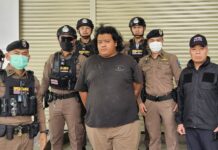
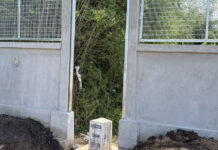
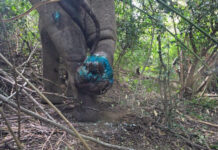
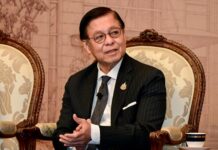
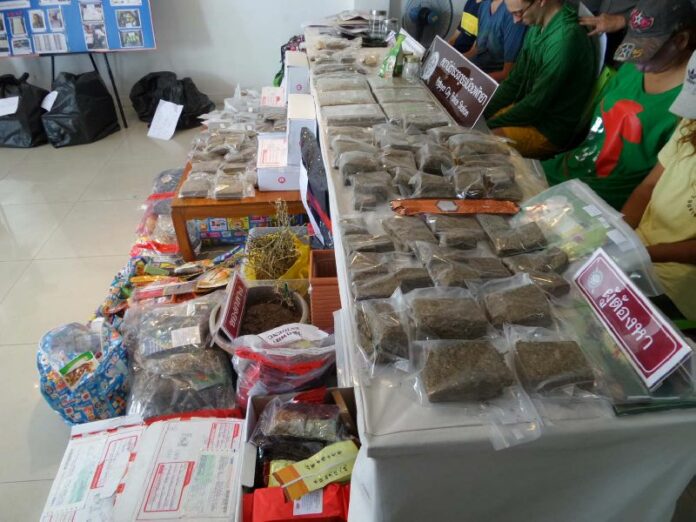
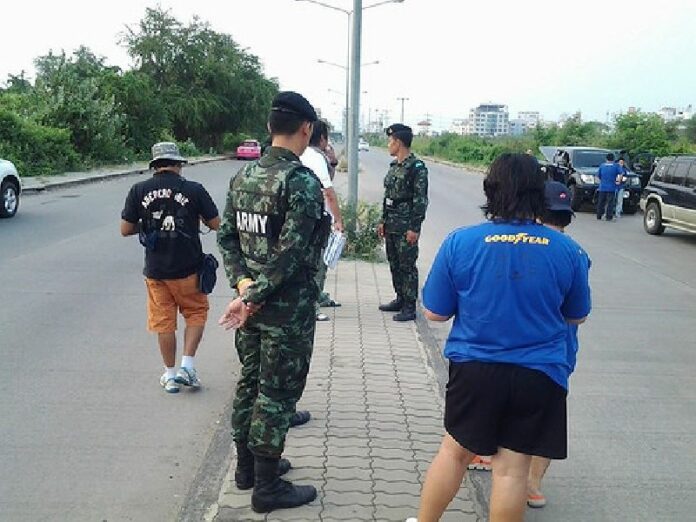
Marijuana allegedly found by police in a raid of the suspect's residence, 23 March 2015.
CHONBURI — Three Russians and two Thais have been arrested for allegedly growing marijuana plants in the resort town of Pattaya and mailing packages of cannabis to Russia.
Georgy Nyushkov, 28, Aleksei Druzhinin, 30, and Aleksei Samokhin, 26, were arrested at their home in Pattaya while the Thai suspects, Kaewchai Thumaporn, 43, and Kanokprom Wongsin, 28, were apprehended in Banglamung district, police say.
The Russian suspects reportedly told police they entered Thailand as tourists and bought marijuana from Kaewchai, paying 20,000 baht per kilogram. The suspects then hid the marijuana in packages of incense and mailed them to customers in Russia, said Pol.Maj.Gen. Nitipong Niamnoi, commander of Chonburi police.
"They saw that they were making good money, so they ordered marijuana seeds from a foreign country and planted them in their home," Pol.Maj.Gen. Nitipong said, adding that Kaewchai bought the marijuana from another Thai dealer, Kanokprom.
Chonburi police tracked down the suspects after customs officers at Bangkok’s Suvarnabhumi Airport reported intercepting a Russia-bound package from Pattaya that contained 10 kilograms of marijuana.
A raid of the Russian suspects' residence turned up 17 kilograms marijuana, one marijuana plant, 21 flower pots that had been prepared for marijuana planting, 20 postal packages, incense products, and a bong.
"We will prosecute all of the suspects in accordance with the law," said Pol.Maj.Gen. Nitipong. "We will also contact the Russian authorities to expand the arrest of marijuana buyers in that country."
For comments, or corrections to this article please contact: [email protected]
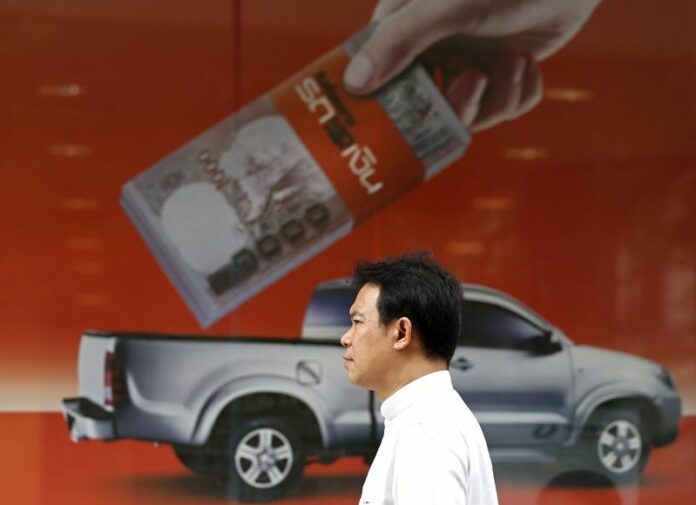
A Thai office worker walks past an ad for bank loans in Bangkok, Thailand, 08 July 2013. Developing Asia will show strong economic growth this year and in 2016, but an impending rise in US interest rates may require monetary responses to maintain stability, an Asian Development Bank report said Tuesday. EPA/RUNGROJ YONGRIT
MANILA (DPA) — Developing Asia will show strong economic growth this year and 2016, but an impending rise in US interest rates may require monetary responses to maintain stability, an Asian Development Bank report said Tuesday.
The region's gross domestic product is expected to grow 6.3 per cent in both 2015 and 2016, the same as last year, the Manila-based bank said in its annual Asian Development Outlook report.
"Developing Asia is making a strong contribution to global economic growth," the bank's chief economist Shang Jin Wei said.
"Falling commodity prices are creating space for policymakers across the region to cut costly fuel subsidies or initiate other structural reforms," he said. "This is a key opportunity to build frameworks that will support more inclusive and sustainable growth in the longer term."
But the report warned that reversals in "otherwise supportive environment" could dampen growth in the region.
"If China falters as it adjusts to its new normal, or if India reforms less decisively than anticipated, their slower growth could spill over to others in developing Asia," it said.
Outside the region, the Greek debt crisis and the deepening recession in Russia may also have consequences to the region, the report said.
"The impending rise in US interest rates may reverse capital flows to the region, requiring monetary responses to maintain stability," it added. "Finally, the benefits flowing from the low price of crude oil could evaporate if geopolitical tensions push it sharply higher."
Growth in China was expected to moderate to 7.2 per cent in 2015 and 7 per cent in 2016 as the government continues to implement structural reforms, which would further slow investment down, the report said.
The growth rates are lower than the average 8.5 per cent expansion for the Chinese economy in the period since the global financial crisis, it added.
Amid the cooling of China's economy, India is expected to overtake it in terms of growth "as the initial phase of government efforts to remove structural bottlenecks is lifting investor confidence," the report said.
India's economy is projected to expand 7.8 per cent in the fiscal year 2015, up from 7.4 per cent in 2014. The growth rate is expected to further pick up in the fiscal year 2016 when it is forecast to rise to 8.2 per cent.
Across the sub-regions, economic growth in East Asia will slow to 6.5 per cent in 2015 and 6.3 per cent in 2016, down from 6.6 per cent in 2014, amid the moderation in China.
South Asia's economy is predicted to grow faster at 7.2 per cent in 2015 and 7.6 per cent in 2016, reflecting the strong performance anticipated in India, the report added.
South-East Asia is poised for a growth rebound after the sub-region's growth fell to 4.4 per cent in 2014. The area's economy is expected to expand 4.9 per cent in 2015 and 5.3 per cent in 2016.
The report stressed the need for developing Asia to deepen reforms in banking and capital markets as well as to ensure greater access to financing for growth and equity in the region.
"Improving the efficiency of the banking sector and capital market can boost investment productivity and innovation," Wei said.
"Reducing the dominance of state-owned financial institutions and developing local currency bond markets are some of the important steps needed in promoting financial development," he said.
For comments, or corrections to this article please contact: [email protected]
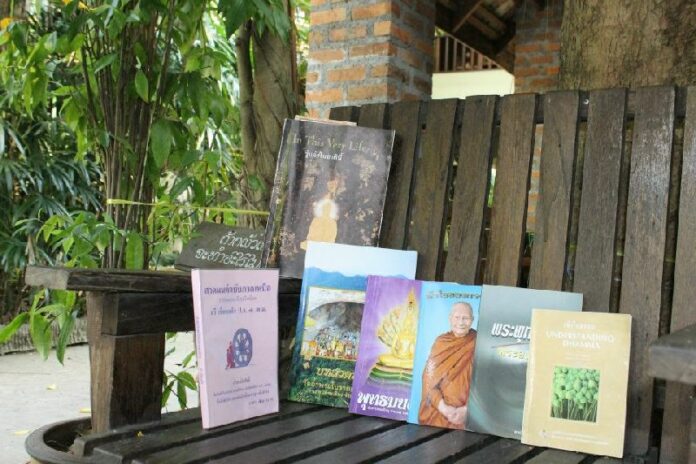
Books from the "Dharma book corner" inside the cafe.
CHIANG MAI — Visitors to Sankangpla Temple in Chiang Mai province looking for a boost of energy — physically or spiritually — are encouraged to order a special cup of "merit coffee" made by monks in a cafe on the temple grounds.
According to the temple's abbot, the cafe, named Kafae Boon (Merit Coffee), started as a small booth in 2012, after one of the monks suggested providing beverage to temple-goers.
A monk making coffee at Kafae Boon in Chiang Mai province.
"But we couldn't get the formula for our beverage right. We had to improvise," Phra Kru Sitthipanyaporn explained. He said a monk at the temple later came up with a unique formula for the coffee, took over the booth, and expanded it into a permanent shop in 2014.
Nowadays, the cafe offers modern and traditional Thai coffee, tea, and water. Sitthipanyaporn said the shop does not directly charge clients. Instead, the shop has a sign suggesting donation prices and advises visitors to donate the money to the temple. The cafe also features a "Dharma book corner" for temple-goers who are interested in learning more about Buddhist teachings.
Sitthipanyaporn said the cafe is intended to be a place where young people can chat about Buddhist philosophy.
"It's like a reception room for the temple that welcomes everyone," said the abbot, "If you don't have the money, you can still come to drink the coffee and talk about Dharma. We applied modern culture, such as coffee shop, that people like in our temple. All of the materials were donated by temple-goers."
Phra Tawatchai Kattirat said he works as a barista whenever he is free from his daily religious routines at the temple.
"We are well-trained for the job," Phra Tawatchai said, "We developed our beverage formula to rival leading coffee shops."
For comments, or corrections to this article please contact: [email protected]
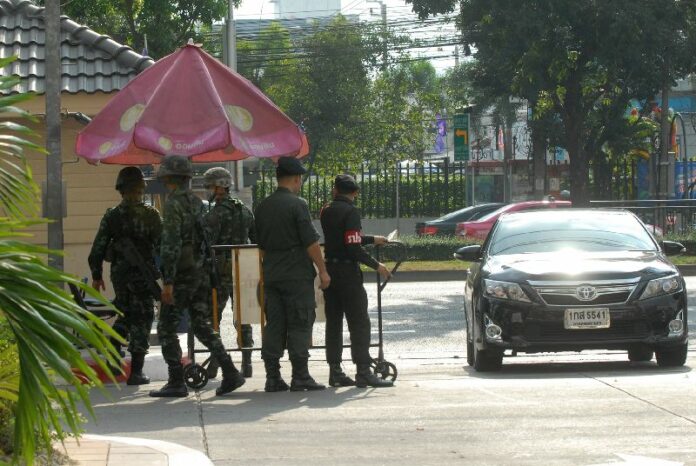
Soldiers at the Criminal Court in Bangkok on 16 March 2015.
BANGKOK — A Thai military court has denied bail to a terror suspect who said he was tortured in military custody earlier this month.
Sansern Sri-unruen, a 54-year-old taxi driver by profession, has been held in prison since 16 March to await a trial in military court for his alleged connection to a "terrorist network" that planned to stage bomb attacks in Bangkok.
Today, a judge denied the 800,000 baht bail posted by a member of the Thai Lawyers for Human Rights group, citing the possibility that Sansern might try to flee the country.
The lawyers group says that Sansern and three other men were beaten by soldiers while they were held incommunicado at an army camp for six days of interrogation. Under martial law, which was imposed by the military junta that seized power in the May 2014 coup, security officers can detain individuals without charges for up to seven days.
Sansern also said soldiers electrocuted him "30-40" times on his legs in an effort to extract a confession.
The four men have been accused of participating in a plot to "create chaos" and draw an intervention from the United Nations by planting bomb attacks around the capital city. Police say the network was responsible for the grenade attack at the Criminal Court on the night 7 March.
At least 12 arrests have been made in connection with the case so far.
"Everyone, including the chief of police and even the Prime Minister, answered in the same way that there was never any torture or beating of suspects," Maj.Gen. Sansern Kaewkamnerd said on 21 March, "The officers have clear evidence. There is no need to do such a thing. Soldiers and police don’t think it would help anything to do that. However, we are willing to investigate the issue."
Speaking to Khaosod yesterday, Pawinee Chumsri, the lawyer who represented Sansern, said her group has received 13 complaints about torture under military custody since the junta seized power on 22 May 2014. The complaints, she said, include three suspects who were arrested and accused of launching an attack on a Yellowshirt rally in Trat province on 22 February 2014.
"We try to collect evidence after we receive complaints, but I have to admit that it's very difficult, because security officers claim it's a matter of national security," Pawinee saide. "Martial law doesn't make it easy for independent agencies or human rights workers to prove the evidence after they receive complaints.”
She also warned security officers are more likely to resort to torture under martial law, which allows them to detain suspects in army camps without access to lawyers or the outside world.
Pawinee cited the case of Yapa Kaseng, an imaam from the restive province of Narathiwat who was detained by military officers under martial law and fatally tortured in their custody in 2008. Yapa was accused of aiding a local insurgent group that sought to secede Narathiwat and neighboring provinces from Thailand.
A court later confirmed in 2011 that Yapa was beaten to death by a group of soldiers when he was held at an army camp for interrogation. The Ministry of Defense also stated that there was no evidence that linked Yapa to the insurgents, and agreed to pay compensation to the cleric's family.
Last May, the junta held a Redshirt activist incommunicado for three weeks – violating the seven-day limit under martial law – before admitting to the public that she was in military custody. The activist, Kritsuda Khunasen, fled Thailand shortly after she was released and accused soldiers of torturing her while she was in their custody.
For comments, or corrections to this article please contact: [email protected]
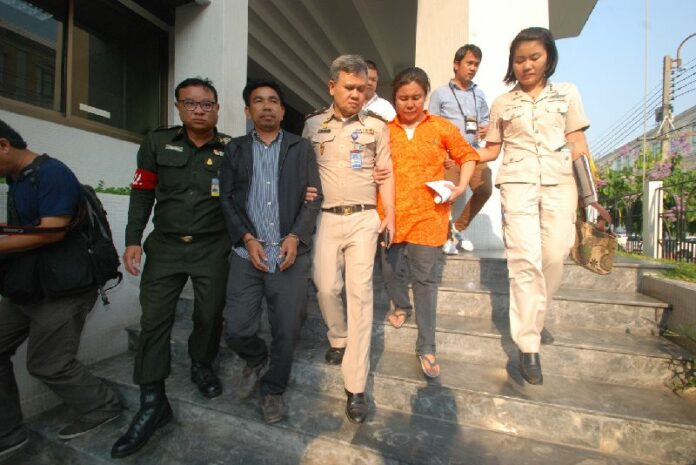
Supaporn "Dear" Mit-arak (orange), alleged mastermind of the terror plot, being taken to the court in Bangkok, 19 March 2015.
BANGKOK — A Thai military court has denied bail to a terror suspect who said he was tortured in military custody earlier this month.
Sansern Sri-unruen, a 54-year-old taxi driver by profession, has been held in prison since 16 March to await a trial in military court for his alleged connection to a "terrorist network" that planned to stage bomb attacks in Bangkok.
Today, a judge denied the 800,000 baht bail posted by a member of the Thai Lawyers for Human Rights group, citing the possibility that Sansern might try to flee the country.
The lawyers group says that Sansern and three other men were beaten by soldiers while they were held incommunicado at an army camp for six days of interrogation. Under martial law, which was imposed by the military junta that seized power in the May 2014 coup, security officers can detain individuals without charges for up to seven days.
Sansern also said soldiers electrocuted him "30-40" times on his legs in an effort to extract a confession.
The four men have been accused of participating in a plot to "create chaos" and draw an intervention from the United Nations by planting bomb attacks around the capital city. Police say the network was responsible for the grenade attack at the Criminal Court on the night 7 March.
At least 12 arrests have been made in connection with the case so far.
"Everyone, including the chief of police and even the Prime Minister, answered in the same way that there was never any torture or beating of suspects," Maj.Gen. Sansern Kaewkamnerd said on 21 March, "The officers have clear evidence. There is no need to do such a thing. Soldiers and police don’t think it would help anything to do that. However, we are willing to investigate the issue."
Speaking to Khaosod yesterday, Pawinee Chumsri, the lawyer who represented Sansern, said her group has received 13 complaints about torture under military custody since the junta seized power on 22 May 2014. The complaints, she said, include three suspects who were arrested and accused of launching an attack on a Yellowshirt rally in Trat province on 22 February 2014.
"We try to collect evidence after we receive complaints, but I have to admit that it's very difficult, because security officers claim it's a matter of national security," Pawinee saide. "Martial law doesn't make it easy for independent agencies or human rights workers to prove the evidence after they receive complaints.”
She also warned security officers are more likely to resort to torture under martial law, which allows them to detain suspects in army camps without access to lawyers or the outside world.
Pawinee cited the case of Yapa Kaseng, an imaam from the restive province of Narathiwat who was detained by military officers under martial law and fatally tortured in their custody in 2008. Yapa was accused of aiding a local insurgent group that sought to secede Narathiwat and neighboring provinces from Thailand.
A court later confirmed in 2011 that Yapa was beaten to death by a group of soldiers when he was held at an army camp for interrogation. The Ministry of Defense also stated that there was no evidence that linked Yapa to the insurgents, and agreed to pay compensation to the cleric's family.
Last May, the junta held a Redshirt activist incommunicado for three weeks – violating the seven-day limit under martial law – before admitting to the public that she was in military custody. The activist, Kritsuda Khunasen, fled Thailand shortly after she was released and accused soldiers of torturing her while she was in their custody.
For comments, or corrections to this article please contact: [email protected]
A screenshot of Asiandate.com, which allegedly used the photographs and names of dozens of Chiang Mai women without their permission.
CHIANG MAI — More than 50 women in Chiang Mai province say their photographs were used without their permission to make fake profiles on a dating website.
The women, most of whom are in their 20s and 30s, told police they were approached by a man named Suwannawit Wongyai who offered to take their photos and send them to advertising and modelling companies.
Suwannawit reportedly assigned a photographer named Sumek Intaraha to conduct the photoshoots at landmarks around Chiang Mai province. The women say they were paid 1,000 baht each for the sessions.
One of the victims told Khaosod that several months after the photoshoot, a foreign man contacted her through Facebook and said he had chatted with her on a dating site. The man reportedly paid 3,000 baht to join the site, AsianDate.com, which promised clients the opportunity chat with women featured in the advertisement.
"He asked whether I was looking for a partner, and whether I sell any sexual services," the victim said, "I was shocked."
Other women soon realized that the photos they took with Suwannawit were published on the same dating website, along with their names in English.
"I checked with my classmates, and we discovered that we were victims of the same action," the victim told Khaosod today. "In fact, I was a bit suspicious when I posed for the photos because [Suwannawit] told us to spell our names in English."
She said she believes that nearly 200 women posed for photos for Suwannawit because he advertised the project in many chat application groups used by university students and female models.
While the women were filing charges with the police today, Suwannawit arrived at the station and insisted on his innocence. Suwannawit said he was hired by a Ukrainian man to organize the photo sessions with beautiful women in Thailand for an unspecified project.
"Everytime the photoshoot was done, the Ukrainian would use his USB to copy all of the photos from me," Suwannawit told police, "He also asked the photographer to film the models during the photoshoot, and collect photocopies of their national ID cards. I followed the instructions. I didn't fool anyone. I was merely a middle man."
Police have charged Suwannawit with violating the Computer Crime Act, which criminalizes spreading false information on the internet. Police added that Sumek, the photographer, filed a complaint against Suwannawit with the police on 22 March on charges of false employment.
Police say they are investigating the incident, and expect that more people will file charges in the next several days.
For comments, or corrections to this article please contact: [email protected]
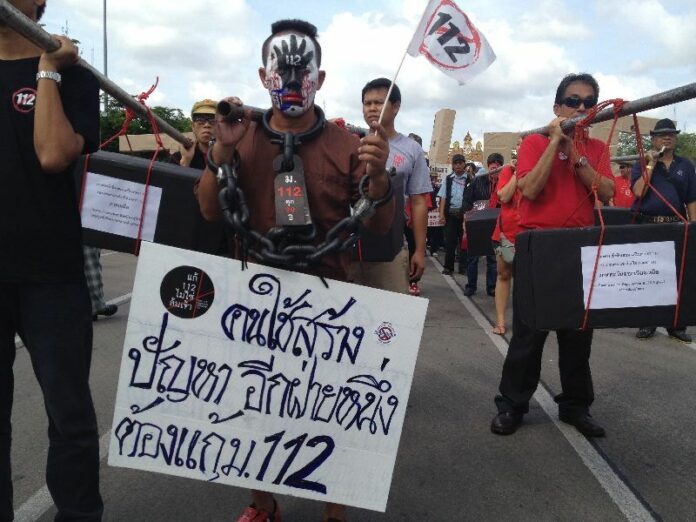
Activists demonstrate to demand a repeal of lese majeste law in Bangkok, 29 May 2012
BANGKOK – Thailand’s military government is seeking the extradition of 30 Thais living abroad who have been charged with defaming the monarchy, a crime punishable by up to 15 years in prison in Thailand.
Gen. Paiboon Koomchaya, Minister of Justice, said on 21 March that the government has compiled a list of 30 suspects that will be sent to the Ministry of Foreign Affairs to process for extradition.
According to Gen. Paiboon, all 30 have been charged with violating Section 112 of Thailand's Criminal Codes, a law known as lese majeste that criminalizes insulting the Thai Royal Family. Gen. Paiboon described the suspects as a "threat to national security."
"These people fled Thailand to live in neighboring countries and European countries," Gen. Paiboon said, adding that the 30 suspects are believed to be residing in seven different countries.
The general did not release the names or the countries of the fugitives, but added that the list includes Manoon Chaichana, the alleged mastermind of a terror network that attempted to stage several bomb attacks in Bangkok. Police say the network was also behind the grenade attack at the Criminal Court in Bangkok on 7 March, which did not cause any injuries.
The conservative Thai newspaper Naew Na published the following names of 22 individuals it said were included on the list:
1. Ekaphop Luera, aka Tang Acheewa
2. Chatwadee Amornpat, aka Rose London
3. Wuttipong Kodchathammakhun, aka Ko Tee
4. Saran Chuichai, aka Aum Neko
5. Charupong Ruangsuwan
6. Jakrapob Penkair
7. Sunai Chulpongsatorn
8. Chuphong Teetuan
9. Giles Ungpakorn
10. Mananchaya Kenkaew
11. Junya Yimprasert
12. Lerpong Wichaicommart, aka Joe Gordon
13. A Facebook user named "Secret Red Underground Working Group"
14. Pitsanu Promsorn, aka Anti
15. Neti Wichiansaen
16. Ong-art Thanakamolnand
17. Amnuay Kaewchomphoo, aka Woodside New York
18. Manoon Chaichana, aka Anek San Francisco
19. Saneh Thinsaen, aka Piengdin
20. Pisek Sanitthangkul, aka Mafia Family
21. Santi Wongpaiboon
22. Pol.Col. Nahatai Tanya
An official at the Ministry of Justice told Khaosod that the full list mentioned by Gen. Paiboon has not been released to the public as it is considered a state secret at this time. The official said there was concern that releasing the list could prompt the suspects to hide their tracks even further.
"Most of them are in the neighboring countries. Maybe 10 of them are in Western countries," said the official, who asked not to be named.
Although discussion about the monarchy has been a taboo in Thailand for years, the lese majeste law has been enforced with a renewed vigor by the military generals who seized power from an elected government on 22 May 2014. Junta chairman and Prime Minister Gen. Prayuth Chan-ocha, a hardline royalist, has declared rooting out "anti-monarchy elements" one of the top priorities of his administration.
For comments, or corrections to this article please contact: [email protected]
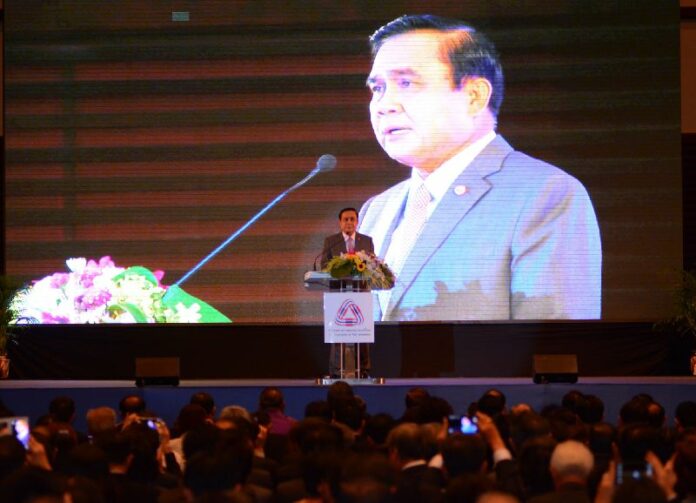
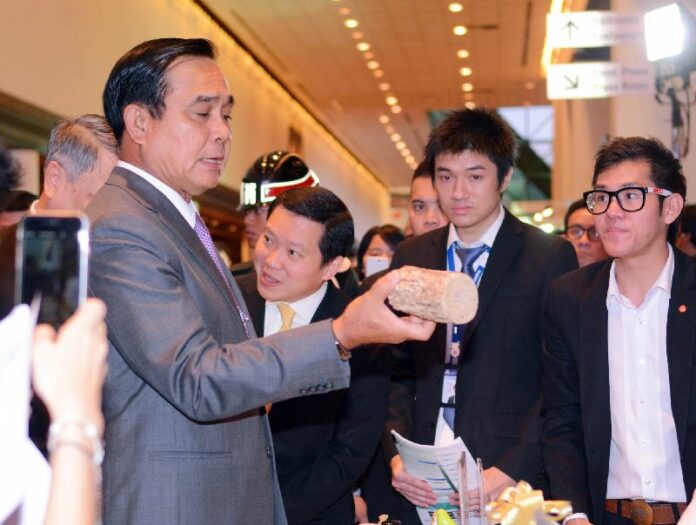
Gen. Prayuth Chan-ocha at a convention for the Federation of Thai Industries in Bangkok, 23 March 2015.
BANGKOK — The protracted political crisis that has rocked Thailand for the past decade is the result of "too much democracy," says Gen. Prayuth Chan-ocha, the retired army chief who seized power from an elected government in a military coup last May.
"Our country has seen so much trouble because we have had too much democracy, unlike other countries where the government has more power to restrict freedoms," Gen. Prayuth, who is now chairman of the ruling junta and Prime Minister, told investors and businessmen at a conference in Bangkok today. "Even the media can’t criticize [those leaders], like they do here. I insist that today, we are 99 percent democratic, because I didn't overthrow democracy at all."
Gen. Prayuth Chan-ocha at a convention for the Federation of Thai Industries in Bangkok, 23 March 2015.
Gen. Prayuth continued, "I can’t even stop people from opposing me at this moment. If I genuinely had complete power, I would have imprisoned [critics] or handed them to a firing squad. It would be over, I wouldn't have to wake up at night like this. Today there are some people who love me, but there are also many people who hate me. But please know that I am not doing for this myself. I am here to work for the country."
Gen. Prayuth has often cast himself as a selfless leader who, in his own words, "took over the administration of the country" in order to reconcile Thailand after nearly a decade of turbulent politics.
Ten months after the coup, democracy remains suspended under Gen. Prayuth’s watch as military-appointed councils hammer out reform proposals and a new constitution. The current draft of the new charter is considered the least democratic constitution in Thailand's recent history, with clauses that call for an unelected Senate and wide-ranging bureaucratic oversight of elected officials.
Gen. Prayuth was chosen to be Prime Minister by a rubber-stamp parliament of military officers and allies last year, but has alsoretained his post as the chairman of the ruling junta, making himthe first leader to amass such concentrated and far-reaching power over Thailand’s national administration since 1971, when Field Marshal Thanom Kittikachorn installed himself as Prime Minister, chairman of Revolutionary Council, and commander of the armed forces.
Gen. Prayuth has also shown no intention of repealing martial law, which was imposed two days before the coup and grants the military sweeping powers to infringe on civil rights.
"Today I am here to move the country forward. I have to erase disputes, and I don't know when the disputes will end," Gen. Prayuth said today. "I don't see anyone troubled by martial law. Without martial law, it would be much worse. So what are we going to do? If we cannot agree on things, well, let's just do nothing."
Since last May, soliders have invoked martial law to detain individuals without charges, conduct searches without warrants, ban political demonstrations, intimidate the media, and try civilians in martial courts, where military officers serve as judges and no appeal is permitted.
In January, the US-based Freedom House downgraded Thailand from "Partly Free" to "Not Free," joining the ranks of Myanmar, Cambodia, and Vietnam. The organization attributed Thailand's plunge in civil liberties to "the May military coup, whose leaders abolished the 2007 constitution and imposed severe restrictions on speech and assembly."
"Please, don't compare the situation at this moment with previous times, because I came here amid the conflict,” Gen. Prayuth said today. “Thailand has never been this divided. Please, let us unite once again."
Gen. Prayuth's assessment of Thailand's democratic situation also improved somewhat from last week. On 17 March, he told reporters at the Government that he believes Thailand is currently "90 percent democratic."
For comments, or corrections to this article please contact: [email protected]
Gen. Prayuth Chan-ocha at a convention for the Federation of Thai Industries in Bangkok, 23 March 2015.
BANGKOK — The protracted political crisis that has rocked Thailand for the past decade is the result of “too much democracy,” says Gen. Prayuth Chan-ocha, the retired army chief who seized power from an elected government in a military coup last May.
“Our country has seen so much trouble because we have had too much democracy, unlike other countries where the government has more power to restrict freedoms,” Gen. Prayuth, who is now chairman of the ruling junta and Prime Minister, told investors and businessmen at a conference in Bangkok today.
“Even the media can’t criticize [those leaders], like they do here. I insist that today, we are 99 percent democratic, because I didn’t overthrow democracy at all.”
Gen. Prayuth Chan-ocha at a convention for the Federation of Thai Industries in Bangkok, 23 March 2015.
Gen. Prayuth continued, “I can’t even stop people from opposing me at this moment. If I genuinely had complete power, I would have imprisoned [critics] or handed them to a firing squad. It would be over, I wouldn’t have to wake up at night like this. Today there are some people who love me, but there are also many people who hate me. But please know that I am not doing this for myself. I am here to work for the country.”
Gen. Prayuth has often cast himself as a selfless leader who, in his own words, “took over the administration of the country” in order to reconcile Thailand after nearly a decade of turbulent politics.
Ten months after the coup, democracy remains suspended under Gen. Prayuth’s watch as military-appointed councils hammer out reform proposals and a new constitution. The current draft of the new charter is considered the least democratic constitution in Thailand’s recent history, with clauses that call for an unelected Senate and wide-ranging bureaucratic oversight of elected officials.
Gen. Prayuth was chosen to be Prime Minister by a rubber-stamp parliament of military officers and allies last year.
He also retained his post as the chairman of the ruling junta, making him the first leader to amass such concentrated and far-reaching power over Thailand’s national administration since 1971, when Field Marshal Thanom Kittikachorn installed himself as Prime Minister, chairman of Revolutionary Council, and commander of the armed forces.
Gen. Prayuth has also shown no intention of repealing martial law, which was imposed two days before the coup and grants the military sweeping powers to infringe on civil rights.
“Today I am here to move the country forward. I have to erase disputes, and I don’t know when the disputes will end,” Gen. Prayuth said today. “I don’t see anyone troubled by martial law. Without martial law, it would be much worse. So what are we going to do? If we cannot agree on things, well, let’s just do nothing.”
Since last May, soliders have invoked martial law to detain individuals without charges, conduct searches without warrants, ban political demonstrations, intimidate the media, and try civilians in martial courts, where military officers serve as judges and no appeal is permitted.
In January, the US-based Freedom House downgraded Thailand from “Partly Free” to “Not Free,” joining the ranks of Myanmar, Cambodia, and Vietnam. The organization attributed Thailand’s plunge in civil liberties to “the May military coup, whose leaders abolished the 2007 constitution and imposed severe restrictions on speech and assembly.”
“Please, don’t compare the situation at this moment with previous times, because I came here amid the conflict,” Gen. Prayuth said today. “Thailand has never been this divided. Please, let us unite once again.”
According to Gen. Prayuth’s “roadmap to democracy,” a national election will be held in 2016, given that the new constitution has been finalized and the political climate is deemeed stable.
Gen. Prayuth’s assessment of Thailand’s democratic situation also improved somewhat from last week. On 17 March, he told reporters at the Government that he believes Thailand is currently “90 percent democratic.”
Photo by Sriprai Nonsee, a leading member of the Rangsit and Area Labour Union Group [Prachatai English]
(Prachatai English)
BANGKOK – The Thai military forced labor unionists to remove pro-election stickers and placards at a monthly rally.
Around six military officers on Saturday morning inspected cars which belong to Rangsit and Area Labor Union members at the rally in Pathumthani province, north of Bangkok, and ordered the union members to removed the A4 stickers simply read ‘election’.
The stickers were attached on both side of 15 cars of the union members, who were on their way to participate in the monthly union rally and seminar. However, they had to remove the stickers before the rally started because pressured from the military.