27.2 C
Bangkok
Monday, June 29, 2026
Home Blog Page 3049

Tourist Knocked Out By Pattaya Motorcycle Taxi Driver

Screen shots from the video.

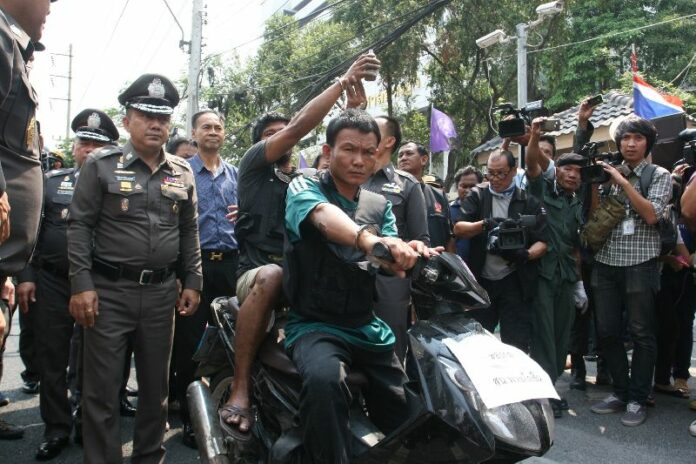
CHONBURI – A South Korean tourist was knocked out by a motorcycle taxi driver in Pattaya after he refused to pay his fare and provoked a fight with the driver, witnesses say.

A video that went viral on social media this week shows an Asian tourist arguing with a Thai motorcycle taxi driver in front of a bar in Pattaya. The tourist tries to kick the motorcyclist several times before the man punches the tourist once in the chin, sending him to the ground. The motorcyclist then walks away.

Dararat Kaewkongkerd, a 33-year-old waitress at "And Bar" on Soi 5, told Khaosod the incident took place in front of her bar on the night of 11 March. 

According to Dararat, the tourist was from South Korea, and drank heavily that night. When he was unable to pay for his 1,150 baht bill, the tourist hailed a motorcycle taxi to get the money from his hotel room, the waitress said. 

When the man returned, however, he only picked up his hat and refused to pay the bar tab and motorcycle fare, Dararat said. He then reportedly argued with the motorcyclist, attempted to fight him, and was eventually knocked out by the man. 

"After what happened the staff gave first aid to him until he regained his consciousness," Dararat said, "We also took him to his hotel room.”

She added that the motorcycle taxi driver left the scene quickly after the incident. 

Pol.Col. Sukthat Pumpanmuang, superintendent of Mueang Pattaya Police Station, said he has been informed about the fight, but that no one has filed charge with police. 

"If the victim files a charge with the police, we will proceed to identify and locate the motorcycle taxi driver in order to prosecute him under the laws," Pol.Col. Sukthat said. 


For comments, or corrections to this article please contact: [email protected]

You can also find Khaosod English on Twitter and Facebook
http://twitter.com/KhaosodEnglish
http://www.facebook.com/KhaosodEnglish

Advertisement

Thai Junta Leads Taxis in "Go Anywhere, No Rejection" Pledge

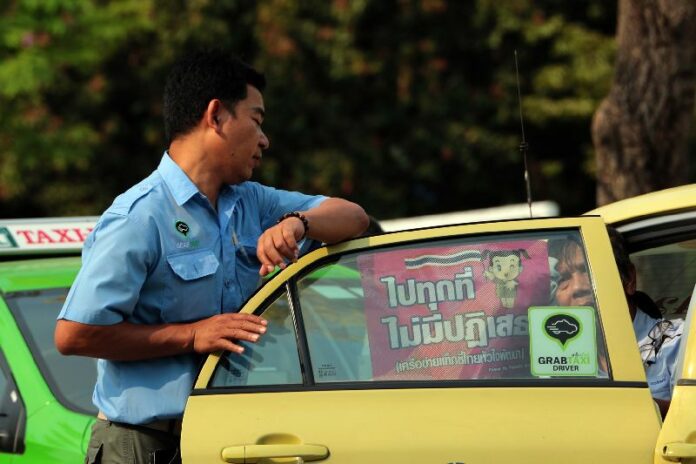
Taxi drivers placed stickers that said "Go Anywhere, No Rejection" on the windows of their cars after taking a pledge in a ceremony organized by the Armed Forces for Maintaining Peace and Order, 13 March 2015.

BANGKOK – The Thai military junta’s security unit organized a ceremony today in which more than 100 taxi drivers pledged to accept passengers regardless of their nationalities or intended destinations.

Lt.Gen. Kampanart Ruddith, commander of the Armed Forces for Maintaining Peace and Order (AFMPO), presided over the event at an army headquarters in Bangkok. 

As an evidence of their oath, taxi drivers placed stickers that said "Go Anywhere, No Rejection," on the windows of their cars. 

\
Taxi drivers holding their "
"Go Anywhere, No Rejection" signs, 13 March 2015.

Bangkok taxi drivers are notorious for refusing passengers, either because their destinations are "too far" or because the passengers demand using a fare meter. Many Thais say it is difficult to hail taxis in downtown Bangkok because drivers prefer to pick up foreign tourists who may be duped into paying a higher fare. 

Lt.Gen. Kampanart said that today's campaign will expand to include other taxi drivers in Bangkok. He said the AFMPO, which is the security wing of the military junta that seized power on 22 May 2014, has been working closely with agencies such as the Department of Land Transport and Ministry of Transport to solve issues related to taxi service over the past year.

The campaign does not only urge taxi drivers to accept all passengers, but also to dress neatly, regularly check their vehicles, and be polite, Lt.Gen. Kampanart told reporters. 

"Overall, the majority of taxis cooperate with us. There's only a minority that don’t understand, so it has led to problems and complaints. Therefore, we organized lectures and courses about taxi services, which are jointly overseen by the AFMPO, the Department of Land Transport, and the taxi federation,” said Lt.Gen. Kampanart.

"For Thais and foreigners, taxis are the face of this country," the lieutenant general continued. "The quality of taxis are one of the indicators of civilized countries." 

Last month, the Department of Land Transport released a mobile phone app that allows passengers  to rate the service of taxi drivers and file complaints. 

According to Lt.Gen. Kampanart, the AFMPO is also working to improve the safety and quality of public vans, motorcycle taxis, and buses. 

Since staging seizing power on 22 May 2014, the junta has regularly dispatched soldiers to assist police in law enforcement duties such as regulating public transportation systems, carrying out raids and arrests, and detaining suspects for interrogation. 

Related Coverage:
Thai Govt Releases Taxi Rating App 
Taxi Association Condemns 'No Japanese Passengers' Sign
New BKK Taxi Service to Stress Passenger Safety 

 
Advertisement

Alleged Mastermind of Court Grenade Attack Arrested

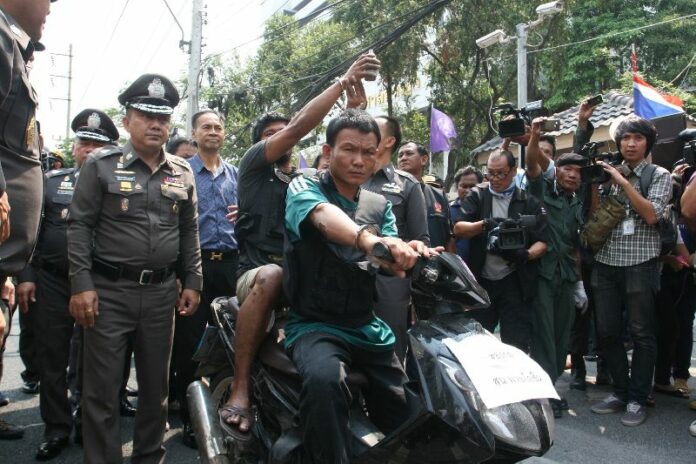
Police bring suspects to "reenact" grenade attack on Criminal Court house, 13 March 2015.

BANGKOK — Military officers have arrested a 49-year-old woman they say engineered the grenade attack on the Criminal Court in Bangkok last Saturday.

Supaporn Mit-arak, aka “Dear,” was arrested by a military unit in the northeastern province of Mukdahan on the night of 12 March, according to police. She is reportedly being held at an army barrack for interrogation under martial law, which allows the military to detain individuals without charges for up to seven days.

According to military officers, one of the suspects arrested last week said Supaporn paid him 20,000 baht to lob a grenade at the court house's parking lot on 7 March. The attack, which did not cause any injuries, was an attempt to create chaos and "draw an intervention" from the United Nations, the suspect reportedly told the military. 

\Military officers said a chat log in the suspect's phone further implicated Supaporn in the incident.

"I will pay you, but you have to bomb first," Supaporn allegedly wrote to Mahahin Khunthong in a chat message, according to the screenshot (right) provided by the military. "I will also give you 300 baht extra for the gas. You decide, my dear brother. I will say no more."

At least 5 suspects, including Supaporn, have been arrested in connection with the bombing. The four suspects arrested last week were transferred to police custody today.

Pol.Lt.Gen. Sriwarah Rangsiphramanakul, commander of Metropolitan Police Bureau, said Supaporn has a pending civil lawsuit filed against her, but no previous criminal record. 

He also said Supaporn is "connected" to a network of Thais living abroad who regularly defame the Thai monarchy on the internet, including "Anek San Francisco," a YouTube user who has posted a series of videos that criticize the Thai Royal Family. 

Pol.Lt.Gen. Sriwarah said further investigation is needed to determine whether Supaporn is connected to the bombing at Siam Paragon shopping mall on 2 February.

"We have to remain vigilant, because there are still people who want to challenge state power," Pol.Lt.Gen. Sriwarah said. "But we do not know if they are related to the aforementioned incident. In that case, the perpetrator was paid only 20,000 baht, but it caused much damage to the state." 

The officer added, "This is about state power and dark power. I insist that we will maintain security for the people, so that they can live in peace." 

 
Advertisement

Alleged Mastermind of Court Grenade Attack Arrested

Police bring suspects to "reenact" grenade attack on Criminal Court house, 13 March 2015.

BANGKOK — Military officers have arrested a 49-year-old woman they say engineered the grenade attack on the Criminal Court in Bangkok last Saturday.

Supaporn Mit-arak, aka “Dear,” was arrested by a military unit in the northeastern province of Mukdahan on the night of 12 March, according to police. She is reportedly being held at an army barrack for interrogation under martial law, which allows the military to detain individuals without charges for up to seven days.

According to military officers, one of the suspects arrested last week said Supaporn paid him 20,000 baht to lob a grenade at the court house's parking lot on 7 March. The attack, which did not cause any injuries, was an attempt to create chaos and "draw an intervention" from the United Nations, the suspect reportedly told the military. 

\Military officers said a chat log in the suspect's phone further implicated Supaporn in the incident.

"I will pay you, but you have to bomb first," Supaporn allegedly wrote to Mahahin Khunthong in a chat message, according to the screenshot (right) provided by the military. "I will also give you 300 baht extra for the gas. You decide, my dear brother. I will say no more."

At least 5 suspects, including Supaporn, have been arrested in connection with the bombing. The four suspects arrested last week were transferred to police custody today.

Pol.Lt.Gen. Sriwarah Rangsiphramanakul, commander of Metropolitan Police Bureau, said Supaporn has a pending civil lawsuit filed against her, but no previous criminal record. 

He also said Supaporn is "connected" to a network of Thais living abroad who regularly defame the Thai monarchy on the internet, including "Anek San Francisco," a YouTube user who has posted a series of videos that criticize the Thai Royal Family. 

Pol.Lt.Gen. Sriwarah said further investigation is needed to determine whether Supaporn is connected to the bombing at Siam Paragon shopping mall on 2 February.

"We have to remain vigilant, because there are still people who want to challenge state power," Pol.Lt.Gen. Sriwarah said. "But we do not know if they are related to the aforementioned incident. In that case, the perpetrator was paid only 20,000 baht, but it caused much damage to the state." 

The officer added, "This is about state power and dark power. I insist that we will maintain security for the people, so that they can live in peace." 

 
Advertisement

Thailand to Expand Etiquette Brief as Chinese Tourists Put Foot in it

A file photo from 14 August 2012 shows Chinese tourists posing at the Art in Paradise museum in Pattaya, Chonburi province, Thailand, 08 August 2012. Thai authorities were mulling further etiquette training for tourists as the latest images surfaced on social media of Chinese visitors breaching Thai taboos. EPA/RUNGROJ YONGRIT

BANGKOK (DPA) — Thai authorities were mulling further etiquette training for tourists as the latest images surfaced on social media of Chinese visitors breaching Thai taboos, officials said Thursday.

Internet users slammed the photos of Chinese tourists washing their feet and shoes in hand basins in a Thai national park, sharing the news item more than 100,000 times on Twitter and Facebook.

"They already let their children defecate in the middle of the airport, this is nothing to them," one commentator wrote.

The latest firestorm prompted authorities to mull new options to prevent future outrage.

Officials at the Koh Phi Phi National Park where the incident occurred said they would create signs in Chinese as soon as possible to alert tourists about proper etiquette.

Tourist Authority of Thailand (TAT) is considering producing videos to provide Chinese-language guidance on Thai culture and proper conduct in the kindgom, a representative told dpa Thursday.

The TAT, with local authorities, has already printed up pamphlets in Chinese on how to behave at sites such as museums and temples, as well as driving and queueing etiquette.

Several recent incidents have drawn the attention of media and authorites to conduct by Chinese tourists considered offensive.

A temple in northern Thailand in February pledged to build new toilets for other nationalities after complaints that Chinese tour groups had misused facilities and left them unusable.

Another incident saw a Chinese tourist kicking sacred bells at a separate temple.

Last year over 4.5 million Chinese tourists visited Thailand, the most from any single country.

 
Advertisement

Thailand to Expand Etiquette Brief as Chinese Tourists Put Foot in it

A file photo from 14 August 2012 shows Chinese tourists posing at the Art in Paradise museum in Pattaya, Chonburi province, Thailand, 08 August 2012. Thai authorities were mulling further etiquette training for tourists as the latest images surfaced on social media of Chinese visitors breaching Thai taboos. EPA/RUNGROJ YONGRIT

BANGKOK (DPA) — Thai authorities were mulling further etiquette training for tourists as the latest images surfaced on social media of Chinese visitors breaching Thai taboos, officials said Thursday.

Internet users slammed the photos of Chinese tourists washing their feet and shoes in hand basins in a Thai national park, sharing the news item more than 100,000 times on Twitter and Facebook.

"They already let their children defecate in the middle of the airport, this is nothing to them," one commentator wrote.

The latest firestorm prompted authorities to mull new options to prevent future outrage.

Officials at the Koh Phi Phi National Park where the incident occurred said they would create signs in Chinese as soon as possible to alert tourists about proper etiquette.

Tourist Authority of Thailand (TAT) is considering producing videos to provide Chinese-language guidance on Thai culture and proper conduct in the kindgom, a representative told dpa Thursday.

The TAT, with local authorities, has already printed up pamphlets in Chinese on how to behave at sites such as museums and temples, as well as driving and queueing etiquette.

Several recent incidents have drawn the attention of media and authorites to conduct by Chinese tourists considered offensive.

A temple in northern Thailand in February pledged to build new toilets for other nationalities after complaints that Chinese tour groups had misused facilities and left them unusable.

Another incident saw a Chinese tourist kicking sacred bells at a separate temple.

Last year over 4.5 million Chinese tourists visited Thailand, the most from any single country.

 
Advertisement

Top Garment Brands Slammed Over Cambodian Factory Conditions

A file photo shows a Gap store in New York, USA on 20 August 2009. Top apparel makers have not done enough to improve the conditions of the workers in their suppliers' Cambodian factories. EPA/JUSTIN LANE

PHNOM PENH (DPA) — Top apparel makers are not doing enough to improve the conditions of the workers in their suppliers' Cambodian factories, a rights group said Thursday.

Garment makers supplying H&M, Armani and Gap and others are evading norms laid out by the UN's International Labour Organization (ILO), thanks to loopholes and poor oversight, Human Rights Watch said.

Factories allegedly discriminate against pregnant workers, mandate overtime, pursue anti-union measures, hire minors, and use short-term contacts to avoid addressing workers' needs, according to the report titled Work Faster or Get Out: Labor Rights Abuses in Cambodia's Garment Industry, released Thursday.

Work spaces can be poorly ventilated and workers often receive insufficient bathroom breaks, it added.

"We are like slaves – not workers," one garment factory worker was quoted as saying in the report.

"These global apparel brands are household names," said Aruna Kashyap, senior women's rights researcher at the New York-based organization.

"They have a lot of leverage, and can and should do more to ensure their contracts with garment factories are not contributing to labour rights abuses."

Poor conditions persist despite oversight by the Ministry of Labour and the ILO programme Better Factories Cambodia set up in 2001.

The government was also criticized, for fining a number of factories that remains "abysmally low when compared to the number of factories overall and the persistent patterns of labour rights violations," the report said.

Cambodia's garment industry employs more than 700,000 people, 90 per cent women, and is a leading source of exports, the report said.

Human Rights Watch surveyed 270 workers in 73 factories across Cambodia. Other international brands called out in the report are Adidas, Joe Fresh and Marks & Spencer.

Adidas said it was working with the ILO to ensure better conditions, fair wages and union representation. It also highlighted improvements to the food supplied to the workers at its suppliers' factories.

"During 2014, 1,299 factory visits (including 1,172 factory audits) were undertaken," Silvia Raccagni, senior manager of sustainability communication, wrote dpa by email.

"We focus our efforts in higher risk countries."

Media representatives from the other brands did not reply to requests for comment.

Monitoring primary suppliers may fail to detect labour violations by subcontractors, the report said.

"Small factories that subcontract to larger export-oriented factories are more likely to hire workers on a casual basis, making it harder for workers to assert their rights because they risk being easily fired," the report said.

 
Advertisement

Activists Mark 11th Anniversary of Human Rights Lawyer’s Abduction

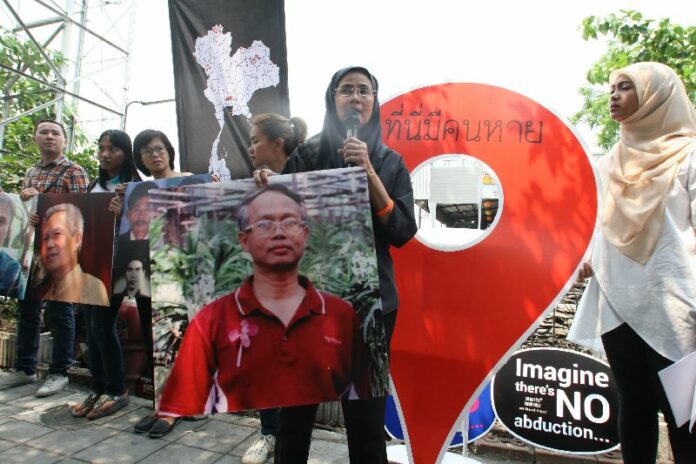
Activists, center Angkhana Neelapaijit, mark the 11th anniversary of the abduction of human rights lawyer Somchai Neelapaijit in Bangkok, 12 March 2015.

BANGKOK — Activists held a brief rally in Bangkok to mark the 11th anniversary of the abduction of a lawyer who represented suspects in human rights cases during the administration of Prime Minister Thaksin Shinawatra.

Somchai Neelapaijit was last seen at around Soi Ramkhamhaeng 69 in eastern Bangkok on 12 March 2004. Witnesses said they saw four to five men park a car next to Somchai, carry him into the vehicle, and drive away. Prior to his abduction, Somchai was representing several defendants charged with terrorism and insurgent activities in Thailand’s southern border provinces.

Although Somchai’s fate remains unknown, then-Prime Minister Thaksin told the press in January 2006 that Somchai was dead, citing “inside information” provided by intelligence agencies.

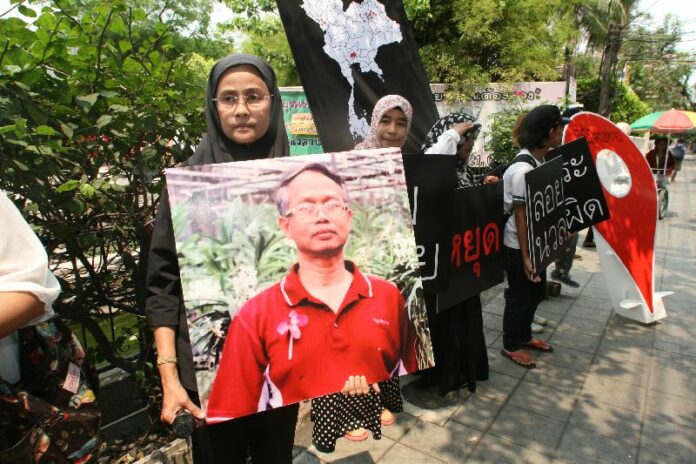
Activists mark the 11th anniversary of the abduction of human rights lawyer Somchai Neelapaijit on March 12, 2015, in Bangkok.

Today Somchai’s wife, Angkhana Neelapaijit, led a small group of activists to stage a symbolic demonstration in the alley where Somchai was abducted more than a decade ago. One of the activists held a large cutout of a location symbol in map applications with text that said: “At this spot, someone was abducted.”

Speaking to reporters, Angkhana said it has been proven that Somchai’s abduction was engineered by state officials, yet no government has had the “courage” to reveal the facts behind his enforced disappearance.

“There’s still obscurity even to this day. The perpetrators go unpunished.” Angkhana said, “My family never received justice that we have been calling for 11 years, because every government is only concerned with its own image. It doesn’t care about human dignity.”

Five police officers were arrested in connection with Somchai’s abduction, but the court later acquitted all defendants, citing insufficient evidence. Angkhana’s request for a re-opening the case was dismissed by the Criminal Court in 2014.

“Apart from Lawyer Somchai, there have been many ordinary people who were disappeared. These people insisted on their own rights, yet state officials see them as enemies,” said Angkhana.

She urged Thai authorities to pass a law that specifically criminalizes forced disappearance, as advised by international human rights NGOs. Under current Thai laws, individuals suspected of abduction face the relatively milder charge of “illegal detention.”

Somchai rose to fame among circles of rights activists in Thailand by representing defendants who were accused of taking up arms against authorities in the southern border provinces of Pattani, Yala, and Narathiwat – a region known as the Deep South. Shadowy insurgent groups started staging waves of attacks on the military and police in January 2004 with the aim of restoring the Islamic kingdom of Pattani, which was incorporated into modern day Thailand in the early 20th century.

At the time of his disappearance, Somchai was representing five Muslim men accused of participating in a raid on a military barrack. Somchai told the media that his clients were tortured by police while in custody, a claim Thai police vehemently denied. The five men were later acquitted in court.

The latest high-profile case of suspected abduction in Thailand involved Porlachee Rakchongcharoen, an activist known as “Billy” who challenged Thai authorities’ attempts to evict Karen communities in Kaeng Krachan National Park. Porlachee was last seen when he was detained by park rangers on 17 April 2014.

Chaiwat Limlikitaksorn, chief of the Kaeng Krachan National Park, insisted that Porlachee was released hours after his detention, but the his family believes Porlachee wasabducted by park authorities because of his activism.

Advertisement

Activists Mark 11th Anniversary of Human Rights Lawyer's Abduction

A small group of activists held a brief rally in Bangkok to mark the 11th anniversary of the abduction of a lawyer who represented suspects in human rights cases during the administration of Prime Minister Thaksin Shinawatra, 12 March 2015.

BANGKOK — Activists held a brief rally in Bangkok to mark the 11th anniversary of the abduction of a lawyer who represented suspects in human rights cases during the administration of Prime Minister Thaksin Shinawatra.

Somchai Neelapaijit was last seen at around Soi Ramkhamhaeng 69 in eastern Bangkok on 12 March 2004. Witnesses said they saw four to five men park a car next to Somchai, carry him into the vehicle, and drive away. Prior to his abduction, Somchai was representing several defendants charged with terrorism and insurgent activities in Thailand's southern border provinces. 

Although Somchai’s fate remains unknown, then-Prime Minister Thaksin told the press in January 2006 that Somchai was dead, citing "inside information" provided by intelligence agencies. 

\
Activists mark the 11th anniversary of the abduction of human rights lawyerSomchai Neelapaijit in Bangkok, 12 March 2015.

Today Somchai's wife, Angkhana Neelapaijit, led a small group of activists to stage a symbolic demonstration in the alley where Somchai was abducted more than a decade ago. One of the activists held a large cutout of a location symbol in map applications with text that said: "At this spot, someone was abducted." 

Speaking to reporters, Angkhana said it has been proven that Somchai's abduction was engineered by state officials, yet no government has had the "courage" to reveal the facts behind his enforced disappearance.

"There's still obscurity even to this day. The perpetrators go unpunished." Angkhana said, "My family never received justice that we have been calling for 11 years, because every government is only concerned with its own image. It doesn't care about human dignity." 

Five police officers were arrested in connection with Somchai's abduction, but the court later acquitted all defendants, citing insufficient evidence. Angkhana's request for a re-opening the case was dismissed by the Criminal Court in 2014.

"Apart from Lawyer Somchai, there have been many ordinary people who were disappeared. These people insisted on their own rights, yet state officials see them as enemies," said Angkhana.

She urged Thai authorities to pass a law that specifically criminalizes forced disappearance, as advised by international human rights NGOs. Under current Thai laws, individuals suspected of abduction face the relatively milder charge of "illegal detention." 

Somchai rose to fame among circles of rights activists in Thailand by representing defendants who were accused of taking up arms against authorities in the southern border provinces of Pattani, Yala, and Narathiwat – a region known as the Deep South. Shadowy insurgent groups started staging waves of attacks on the military and police in January 2004 with the aim of restoring the Islamic kingdom of Pattani, which was incorporated into modern day Thailand in the early 20th century. 

At the time of his disappearance, Somchai was representing five Muslim men accused of participating in a raid on a military barrack. Somchai told the media that his clients were tortured by police while in custody, a claim Thai police vehemently denied. The five men were later acquitted in court. 

The latest high-profile case of suspected abduction in Thailand involved Porlachee Rakchongcharoen, an activist known as "Billy" who challenged Thai authorities' attempts to evict Karen communities in Kaeng Krachan National Park. Porlachee was last seen when he was detained by park rangers on 17 April 2014. 

Chaiwat Limlikitaksorn, chief of the Kaeng Krachan National Park, insisted that Porlachee was released hours after his detention, but the his family believes Porlachee wasabducted by park authorities because of his activism.

 
Advertisement

Bipartisan Alarm Over Junta's 'Anti-Politician' Charter

Alongkorn at a press conference about the progress of the government's road map, 10 March 2015.

BANGKOK — In a rare public forum on the future of Thai politics, prominent politicians from the country’s rival parties banded together to criticize the junta’s new charter and its restraints on the power of elected officials.

Top members of the Pheu Thai and Democrat Parties—who a year ago would have been aptly described as sworn enemies—agreed last night that if enacted, the new charter will be a major setback for democracy in Thailand and sow the seeds for renewed conflict. 

The panel discussion, held at the Foreign Correspondent's Club in Thailand (FCCT), was the first public debate between politicians since the coup last May, after which the junta banned political activities of any kind in the name of achieving "national reconciliation." Although authorities instructed last night's panelists not to criticize the junta, the politicians did not mince words when discussing the draft of the new charter, which was written by a junta-appointed council to replace the constitution shredded after the coup.

Disapproval of the draft was expected from the Pheu Thai politicians, whose party controlled the government toppled in the military takeover, but for many, Democrat Party leader Kasit Piromya's criticism came as a surprise.

"I thought that this reformation process under the military’s direction would be moving Thailand in the direction of more democracy and not less," said Kasit, who invited the coup when he joined protests against the Pheu Thai government last year. "But what I’m seeing at the moment…is that we are going backwards. This is a regression of the democratic aspirations of Thai society."

The current charter draft has been criticized by pro-democracy activists for curtailing the power of elected politicians and bolstering bureaucratic oversight. The draft’s most controversial departures from recent constitutions include the transformation of the Senate into a fully-appointed body, and a clause that will allow an unelected "outsider" Prime Minister to take control in the event of a political crisis.

Officials say a finalized version of the constitution will take effect in September 2014, after which a national election will be held. 

Alongkorn Polabutr, the sole representative from the military government on the panel last night, echoed the charter's anti-politician bent when he opened his statement by pointing the finger at the three politicians to his right.

"I am not very comfortable here because all three of my colleagues are out of jobs," said Alongkorn, a former Democrat Party leader who joined the junta’s National Reform Council (NRC) last year. "The reason they are out of jobs is because they could not undertake a peaceful way of solving their own problems."

The 22 May coup was the culmination of six months of Democrat-backed street protests against a Pheu Thai government, whose legislators sparked public outrage by trying to pass an amnesty bill that would have allowed for the return of former Prime Minister Thaksin Shinawatra. Thaskin, the de facto leader of the Pheu Thai party, was ousted in a coup in 2006 and is reviled by Democrat Party supporters.

On 20 May 2014, then-army chief Gen. Prayuth Chan-ocha summoned representatives from both parties for "peace talks," and declared a coup two days later after they were unable to broker a compromise.

The three politicians on the panel last night, who in addition to Kasit included Veteran Pheu Thai leaders Chaturon Chaiseng and Phongthep Thepkanjana, admitted that their parties had played a role in the crisis that led to the coup. However, they agreed that punishing politicians by excluding them from the reform process and weakening their roles in government would only further exacerbate the country’s political rifts.

Chaturon, one of few voices to regularly criticize the reform process despite the junta’s clampdown on dissent, expressed concern that MPs will be restrained by a proposed council that will stay on to ensure the government continues the junta’s reform plans. 

Under the proposal, the 120-member council will be composed of members from the junta’s five interim bodies. 

"There will be a steering committee to monitor and make sure that the reform plans are continuously implemented," Chaturon explained. "People will have no way to demand what they need, because everything will be already decided."

In his defense of the new charter, NRC member Alongkorn listed the ways in which past politicians had failed the country, citing rampant corruption and damaging "populist polices." He said the new unelected Senate, which he called the 'House of Citizens,' would serve to keep politicians in check.

"We are going to have a House of Citizens to balance with the House of Politicians, because they don’t believe you are honest enough,” he said. "The usual means of checks and balances were not functioning."

However, Phongthep, a former judge, Pheu Thai MP and Cabinet Minister, argued that strengthening appointed bodies at the expense of elected politicians would only grease the wheels for more graft.

"When this House of Citizens takes office, they will become politicians," said Phongthep. "They will have the power, and people who have power can become corrupt."

Phongthep stressed that in order to reduce corruption, officials must be held more accountable to the voters, not less. He urged the junta to put the new charter up for a referendum and give voters the option to return to the 1997 constitution, in which both houses of parliament were fully and directly elected. 

Government officials said yesterday that the junta has not yet discussed whether there will be a referendum for the charter, which will be Thailand's 20th since the country became a democracy 82 years ago.

Speaking at the forum last night, NRC member Alongkorn said he understood the other panelists' criticism, but stressed the need to "look forward."

"I understand that we may not be under  normal circumstances after the coup d'etat and with martial law," he said. "If I was still thinking the old way, maybe I would speak the same way as these three gentlemen. But now, if you move a little bit to see the new future of Thailand and look back on where we made mistakes, maybe your way of thinking will change [too]." 

(Reporting by Sally Mairs)


For comments, or corrections to this article please contact: [email protected]

You can also find Khaosod English on Twitter and Facebook
http://twitter.com/KhaosodEnglish
http://www.facebook.com/KhaosodEnglish


Advertisement

Hot News

LATEST NEWS

Bangkok
overcast clouds
27.2 ° C
27.2 °
27.2 °
82 %
3.9kmh
100 %
Mon
34 °
Tue
34 °
Wed
33 °
Thu
35 °
Fri
27 °