




















32.3 C
Bangkok
Friday, July 3, 2026
Home Blog Page 3071

Prayuth Willing to Testify on 2010 Crackdown

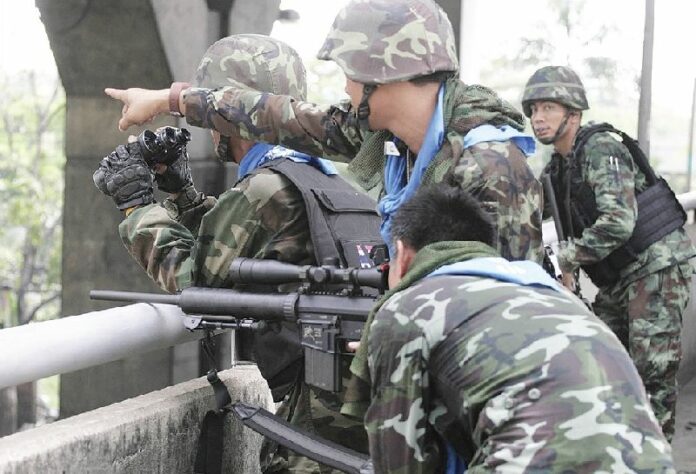
A military sniper aims at Redshirt protesters during a clash on Viphavadee Road in Bangkok, 28 April 2010.

BANGKOK — Junta chairman and Prime Minister Prayuth Chan-ocha said he is willing to provide testimony to Thailand’s anti-graft agency about his role as a top army commander in the 2010 military crackdown on Redshirt protesters.

On 24 February, the the National Anti-Corruption Commission (NACC) moved forward with “abuse of power” charges against former Prime Minister Abhisit Vejjajiva and his deputy Suthep Thaugsuban for authorizing the crackdown, which left over 90 people dead.

\
 Redshirt demonstrators face off with riot police near Ratchaprasong Intersection in Bangkok, 6 April 2010​.

If found guilty, the pair could be retroactively impeached and banned from political office for five years.

Yesterday, Abhisit suggested that the NACC question military commanders such as Gen. Prayuth, who will be able to provide more details about the operation.

Speaking to reporters today, Gen. Prayuth said he has not received any requests to appear before the commission, but is ready to testify if he is summoned.

"I am ready to give information, but I may not need to be there personally. I can submit the information through documents," said Gen. Prayuth, who served as commander of the First Region Army during the crackdown. 

Asked whether the investigation will affect the reputation of the military, Gen. Prayuth shot back, "How will that affect the military? The officers were performing their work."

He then raised his voice and told the reporters, "I want to ask you about this fact: were there armed people among the civilians? Were there? Answer me loudly. Were there Blackshirts among the Redshirts? Did they shoot at the soldiers? If so, then it's over."

Gen. Prayuth was referring to militants, known as the Blackshirts, who were allegedly allied to the Redshirts and exchanged fire with soldiers during the crackdown.

Abhisit, Suthep, Prayuth, and other military commanders insist that the Blackshirts, and not security officers, were responsible for much of the bloodshed. Suthep famously suggested in May 2010 that soldiers who were filmed firing into a temple on the last day of the crackdown were in fact "bandits" disguised as military officers. 

However, the NACC noted in its briefing this week that court inquests have determined security officers to be responsible for many of the civilian deaths.

The effort to hold Abhisit and Suthep accountable for the 2010 crackdown was initially taken up by the Division of Special Investigation, which filed murder charges against the two politicians in 2011. The Criminal Court eventually dropped the case last August, and granted the NACC authority to try Abhisit and Suthep in the Supreme Court's Division for Holders of Political Office. 

Military commanders who oversaw the operation, such as Gen. Prayuth, Gen. Anupong Paochinda, and Gen. Prawit Wongsuwan, have never been formally included in the investigation. 

Human rights groups have repeatedly faulted Thai authorities for failing to hold state officials accountable for the 2010 crackdown. 


For comments, or corrections to this article please contact: [email protected]

You can also find Khaosod English on Twitter and Facebook
http://twitter.com/KhaosodEnglish
http://www.facebook.com/KhaosodEnglish
Advertisement

Thai Exports Fall 3.5 Percent in January

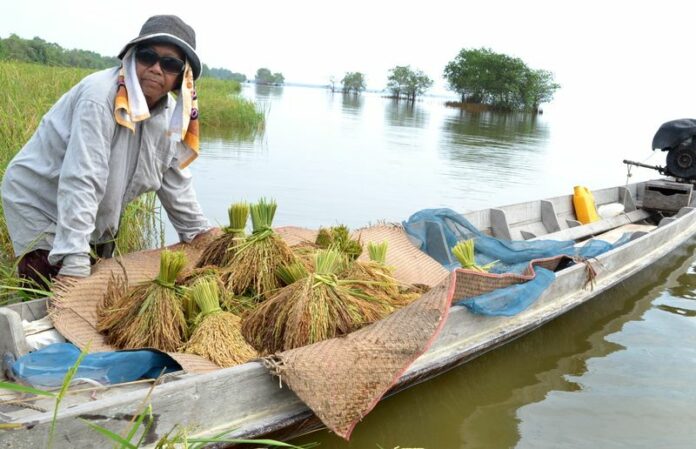
A file photo from 09 October 2014 shows Thai rice farmer Boonrung Wongponkhin loading fresh picked rice onto a boat in Pattalung district in southern Thailand, 25 September 2014. Thai exports fell 3.5 per cent in January due to declines in agricultural, agro-industrial and mining and fuel products. EPA/ROONARIT BOONTHONG

BANGKOK (DPA) — Thai exports fell 3.5 per cent in January due to declines in agricultural, agro-industrial and mining and fuel products, officials said.

The value of exports shrank due to the drop in export values of farm petroleum-related products, refined crude, chemicals and plastic pellets, according to the Department of International Trade Promotion.

Exports to major trading partners like China, Japan, Malaysia and Indonesia also decreased.

The value of total exports dropped to 17.2 billion dollars compared with 17.8 billion in January 2014.

Total import value decreased 13.3 per cent to 17.7 billion dollars from 20.4 billion over the same time period.


For comments, or corrections to this article please contact: [email protected]

You can also find Khaosod English on Twitter and Facebook
http://twitter.com/KhaosodEnglish
http://www.facebook.com/KhaosodEnglish
Advertisement

Junta's Charter Drafter Clarifies 'Unelected' Senate

File photo of Constitution Drafting Committee chairman Bowornsak Uwanno.

BANGKOK — The chairman of the junta-appointed Constitution Drafting Committee has urged the media to stop describing the next Senate as "unelected" and use the term "indirectly elected" instead.

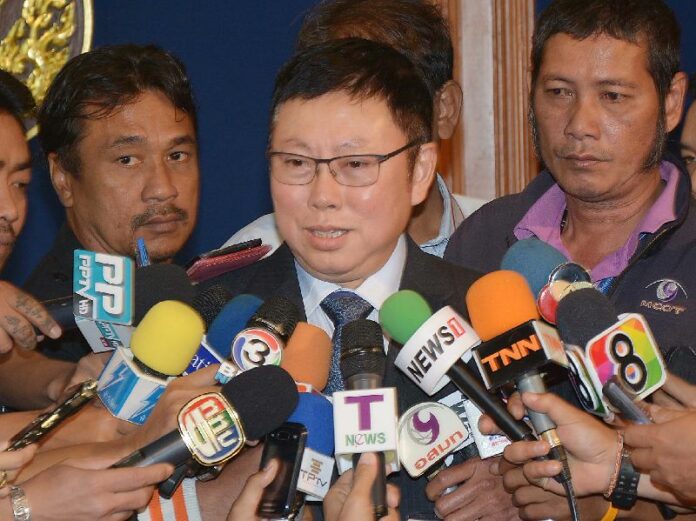
"Certain newspapers and TV channels have identified the new Senate as unelected," CDC chairman Bowornsak Uwanno said at a press conference today. "It's not lovely. It's an inaccurate presentation of news.”

The CDC announced yesterday that the next Senate will be a fully-appointed body under the new charter. 

The Senate will consist of 200 members, half of whom will be chosen by the council of "experts," which Bowornsak described as "a diverse group of individuals with expertise and morality about politics, national administration, the judicial system, society, ethnology, and folk wisdom." 

It remains unclear how the council of experts will be chosen. 

The other Senators – also appointed – will be chosen from a pool of former high-level politicians and bureaucrats such as prime ministers, military commanders, parliament speakers, judicial leaders, and representatives from other civic organizations.

Each senator can serve only one six-year term.

Under the previous constitution, which was dissolved after the May 2014 coup, the Senate was a half-appointed, half-elected body. The CDC's announcement of a fully-appointed Senate appears to confirm speculation among political analysts that the military junta is seeking to further curb the influence of elected politicians.

However, the CDC chairman stresed today that elected members of local administrative organizations will be included in the process of selecting senators, because they will be responsible from choosing 100 senators from a list of 200 candidates approved by the panel of "experts."

"Therefore, accusations that the new Senate is unelected are false," Bowornsak said.

He also told reporters that some foreign countries have similar parliamentary models, citing France,  though he failed to point out that French senators are indirectly elected by a "super-electorate" of elected local and regional officials, whose options are not screened by any unelected panel of professionals.  

"Columnists have the freedom to express their opinions," Bowornsak said. "But as for the news presentation, headlines, and news reporting by anchormen, it is absolutely necessary that they have to present accurate and unbiased news reports. Otherwise, the public will be exposed to one-sided information." 

The CDC is expected to finish drafting the new charter by September of this year, after which it will be sent to the junta for approval.

The junta has promised to hold an election after the constitution is finalized, given that “national reconciliation” has been completed and the political climate is deemed stable. 

 
CORRECTION: Senators will only be able to serve one six-year term under the new charter, not two terms as the original version of this article stated. 
 
For comments, or corrections to this article please contact: [email protected]

You can also find Khaosod English on Twitter and Facebook
http://twitter.com/KhaosodEnglish
http://www.facebook.com/KhaosodEnglish
Advertisement

Junta's Charter Drafter Clarifies 'Unelected' Senate

File photo of Constitution Drafting Committee chairman Bowornsak Uwanno.

BANGKOK — The chairman of the junta-appointed Constitution Drafting Committee has urged the media to stop describing the next Senate as "unelected" and use the term "indirectly elected" instead.

"Certain newspapers and TV channels have identified the new Senate as unelected," CDC chairman Bowornsak Uwanno said at a press conference today. "It's not lovely. It's an inaccurate presentation of news.”

The CDC announced yesterday that the next Senate will be a fully-appointed body under the new charter. 

The Senate will consist of 200 members, half of whom will be chosen by the council of "experts," which Bowornsak described as "a diverse group of individuals with expertise and morality about politics, national administration, the judicial system, society, ethnology, and folk wisdom." 

It remains unclear how the council of experts will be chosen. 

The other Senators – also appointed – will be chosen from a pool of former high-level politicians and bureaucrats such as prime ministers, military commanders, parliament speakers, judicial leaders, and representatives from other civic organizations.

Each senator can only serve one six-year term.

Under the previous constitution, which was dissolved after the May 2014 coup, the Senate was a half-appointed, half-elected body. The CDC's announcement of a fully-appointed Senate appears to confirm speculation among political analysts that the military junta is seeking to further curb the influence of elected politicians.

However, the CDC chairman stresed today that elected members of local administrative organizations will be included in the process of selecting senators, because they will be responsible from choosing 100 senators from a list of 200 candidates approved by the panel of "experts."

"Therefore, accusations that the new Senate is unelected are false," Bowornsak said.

He also told reporters that some foreign countries have similar parliamentary models, citing France,  though he failed to point out that French senators are indirectly elected by a "super-electorate" of elected local and regional officials, whose options are not screened by any unelected panel of professionals.  

"Columnists have the freedom to express their opinions," Bowornsak said. "But as for the news presentation, headlines, and news reporting by anchormen, it is absolutely necessary that they have to present accurate and unbiased news reports. Otherwise, the public will be exposed to one-sided information." 

The CDC is expected to finish drafting the new charter by September of this year, after which it will be sent to the junta for approval.

The junta has promised to hold an election after the constitution is finalized, given that “national reconciliation” has been completed and the political climate is deemed stable. 

 
CORRECTION: Senators will only be able to serve one six-year term under the new charter, not two terms as the original version of this article stated. 
 
For comments, or corrections to this article please contact: [email protected]

You can also find Khaosod English on Twitter and Facebook
http://twitter.com/KhaosodEnglish
http://www.facebook.com/KhaosodEnglish
Advertisement

Junta Accuses Exiled Historian of 'Distorting Facts' About Lese Majeste

File photo of NCPO spokesperson Col. Winthai Suvaree (center). [Matichon].

BANGKOK — Thailand's ruling military junta has accused a prominent critic of the monarchy of falsely framing his lese majeste charges as an act of harassment.

In a letter written to Thammasat University, Somsak Jeamteerasakul explained that he had fled Thailand and could not return to his job as a history professor because of repeated harassment from the Thai military.

The letter, which was posted on Somsak’s Facebook account today, described how armed soldiers in two military vehicles arrived at his home several weeks after the May 2014 coup, presumably to detain him for failing to report for a summons order.

"When they could not find me, the military and police harassed my wife, my mother, and my brother at their homes and offices, even though those family members of mine did not have anything to do with my actions," Somsak wrote. "They continued this harassment for months. At the same time, the military junta revoked my passport and issued an arrest warrant on me for failing to report to the military."

Somsak also described a drive-by shooting of his house that occurred in February 2014, several days after Col. Winthai Suvaree, the spokesperson of the Royal Thai Army at the time, threatened to use "social measures" to punish Somsak for his criticism of the monarchy.

Col. Winthai, who is now serving as a spokesperson for the junta, insisted today that the military never harassed Somsak, but merely visited his home because he failed to report to the junta, officially known as the National Council for Peace and Order (NCPO). The NCPO summoned and detained hundreds of politicians, activists, and academics for “attitude adjustment” in the wake of the coup.

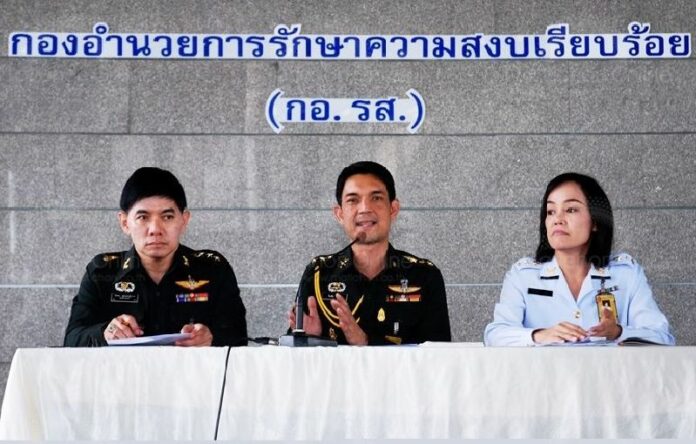
"Since he failed to report to the security officers, it was normal that the security officers had to track him down and make him enter the legal process," Col. Winthai said at press conference today.

The junta spokesperson also alleged that Somsak "presented insufficient information and distorted the facts" about the lese majeste (insult of monarchy) charges that the military filed against him in 2011 and 2014.

"Prior to the NCPO's [takeover] and efforts to move the country forward, Mr. Somsak was already facing criminal offences, and Mr. Somsak had the opportunity to contest those charges all along, yet he refused to use those legal channels," Col. Winthai said.

He added that Somsak's portrayal of the lese majeste charges as an act of intimidation "is only a claim from the perspective of Mr. Somsak."

Somsak is a rare outspoken critic of the monarchy in Thailand, where violating the country's harsh lese majeste law is punishable by up to 15 years in prison. He is believed to have fled Thailand shortly after the military staged a coup against an elected government on 22 May 2014.

In the letter to Thammasat University, Somsak argued that he would not be given a fair trial if he returned to Thailand to contest his lese majeste charges in court.

"It is clear that I would never have the opportunity to be treated fairly in accordance with the laws,” Somsak wrote. “Therefore, I have the legitimate right to preserve my life, body, and liberty by refusing to allow the military junta, who committed the treasonous act of seizing power, to arrest and harm me under the excuse of lese majeste."

The historian said he sent the letter to Thammasat University in December 2014 after he heard that the university administrators were contemplating firing him.

However, Thammasat announced yesterday that it had declined his attempt to resign and would formally expel Somsak instead, effectively disqualifying him from a pension and other benefits.

Related coverage:
Thammasat University Expels Monarchy Critic Living in Exile 


For comments, or corrections to this article please contact: [email protected]

You can also find Khaosod English on Twitter and Facebook
http://twitter.com/KhaosodEnglish
http://www.facebook.com/KhaosodEnglish
 

Advertisement

Junta Accuses Exiled Historian of 'Distorting Facts' About Lese Majeste

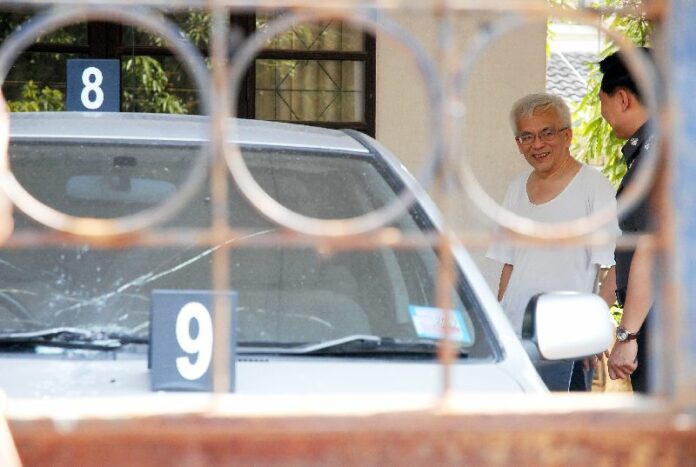
Somsak Jeamteerasakul, prominent critic of the Thai monarchy, at his home on 12 Feb 2014.

BANGKOK — Thailand's ruling military junta has accused a prominent critic of the monarchy of falsely framing his lese majeste charges as an act of harassment.

In a letter written to Thammasat University, Somsak Jeamteerasakul explained that he had fled Thailand and could not return to his job as a history professor because of repeated harassment from the Thai military.

The letter, which was posted on Somsak’s Facebook account today, described how armed soldiers in two military vehicles arrived at his home several weeks after the May 2014 coup, presumably to detain him for failing to report for a summons order.

"When they could not find me, the military and police harassed my wife, my mother, and my brother at their homes and offices, even though those family members of mine did not have anything to do with my actions," Somsak wrote. "They continued this harassment for months. At the same time, the military junta revoked my passport and issued an arrest warrant on me for failing to report to the military."

Somsak also described a drive-by shooting of his house that occurred in February 2014, several days after Col. Winthai Suvaree, the spokesperson of the Royal Thai Army at the time, threatened to use "social measures" to punish Somsak for his criticism of the monarchy.

Col. Winthai, who is now serving as a spokesperson for the junta, insisted today that the military never harassed Somsak, but merely visited his home because he failed to report to the junta, officially known as the National Council for Peace and Order (NCPO). The NCPO summoned and detained hundreds of politicians, activists, and academics for “attitude adjustment” in the wake of the coup.

"Since he failed to report to the security officers, it was normal that the security officers had to track him down and make him enter the legal process," Col. Winthai said at press conference today.

The junta spokesperson also alleged that Somsak "presented insufficient information and distorted the facts" about the lese majeste (insult of monarchy) charges that the military filed against him in 2011 and 2014.

"Prior to the NCPO's [takeover] and efforts to move the country forward, Mr. Somsak was already facing criminal offences, and Mr. Somsak had the opportunity to contest those charges all along, yet he refused to use those legal channels," Col. Winthai said.

He added that Somsak's portrayal of the lese majeste charges as an act of intimidation "is only a claim from the perspective of Mr. Somsak."

Somsak is a rare outspoken critic of the monarchy in Thailand, where violating the country's harsh lese majeste law is punishable by up to 15 years in prison. He is believed to have fled Thailand shortly after the military staged a coup against an elected government on 22 May 2014.

In the letter to Thammasat University, Somsak argued that he would not be given a fair trial if he returned to Thailand to contest his lese majeste charges in court.

"It is clear that I would never have the opportunity to be treated fairly in accordance with the laws,” Somsak wrote. “Therefore, I have the legitimate right to preserve my life, body, and liberty by refusing to allow the military junta, who committed the treasonous act of seizing power, to arrest and harm me under the excuse of lese majeste."

The historian said he sent the letter to Thammasat University in December 2014 after he heard that the university administrators were contemplating firing him. However, Thammasat announced yesterday that it had declined his attempt to resign and would formally expel Somsak instead, effectively disqualifying him from a pension and other benefits.

Related coverage:
Thammasat University Expels Monarchy Critic Living in Exile 


For comments, or corrections to this article please contact: [email protected]

You can also find Khaosod English on Twitter and Facebook
http://twitter.com/KhaosodEnglish
http://www.facebook.com/KhaosodEnglish
 

Advertisement

Cleared Rape Suspect Describes Police Intimidation

Tawan Thongyim, 35, working at an ice factory in Nakhon Ratchasima, 25 Feb 2015.  

NAKHON PATHOM — The 35-year-old man who was arrested and accused of raping more than ten women yesterday says he was bullied into making a false confession by police.

Police arrested Tawan Thongyim on 24 February and told reporters he confessed to being the serial rapist who sexually assaulted at least ten women in western Thailand over the past four years, killing two of them.

However, police announced today that Tawan's DNA did not match forensic samples collected from the crime scenes. 

Tawan told Khaosod that four plain-clothed police officers approached him yesterday while he was working at an ice factory in Nakhon Ratchasima province and said he resembled a sketch of the serial rapist drawn based on victims’ accounts.

Tawan said he was then driven to a police station in the town center.

"On the way, officers kept telling me all the time, 'confess, so that your penalty won't be harsh,'" Tawan told Khaosod. "When I was in the car, I was very afraid. I couldn't contact anyone, because the police took away my phone."

According to Tawan, police officers continued to pressure him into confessing at the station, which he eventually agreed to.

Police released Tawan at 1am the next day after forensic testing cleared him of a connection to the crime. 

"I want to ask for fairness," Tawan told Khaosod. "Now I am guilty in the eyes of society, they think I am the person that has been raping other people. It saddens me very much." 

As is common in Thai media, a number of news outlet reported yesterday’s arrest relying solely on the account given by police. Thai Rath, Thailand’s best-selling newspaper, published Tawan's photo on the front page with a headline identifying him as a "rapist psychopath."

Thai police have a long history of coercing suspects to "confess" to crimes they did not commit, often through beatings and threats of a lengthy jail sentence. As a result, suspects in Thailand frequently confess during police interrogations, which often take place without the presence of a lawyer, only to later recant their testimonies in court.

Pol.Gen. Worapong Chiwapreecha, deputy commander of Royal Thai Police, said police officers were initially convinced that Tawan was the perpetrator because of his physical resemblence to the facial composite sketch of the suspect.

He also said that Tawan was not coerced into making the false confession, but that the incident was the result of a "misunderstanding." 

"There was some misunderstanding. We were talking with him, and Mr. Tawan confessed that he committed the crime of stealing electric wires from the roads," Pol.Gen. Worapong said. "He wasn't confessing to raping the victims." 

Pol.Gen. Worapong added that Tawan "did not mind the incident, which he saw cooperating with the police." 

 
For comments, or corrections to this article please contact: [email protected]

You can also find Khaosod English on Twitter and Facebook
http://twitter.com/KhaosodEnglish
http://www.facebook.com/KhaosodEnglish
Advertisement

Arrest Warrant for Former Bangladesh Prime Minister

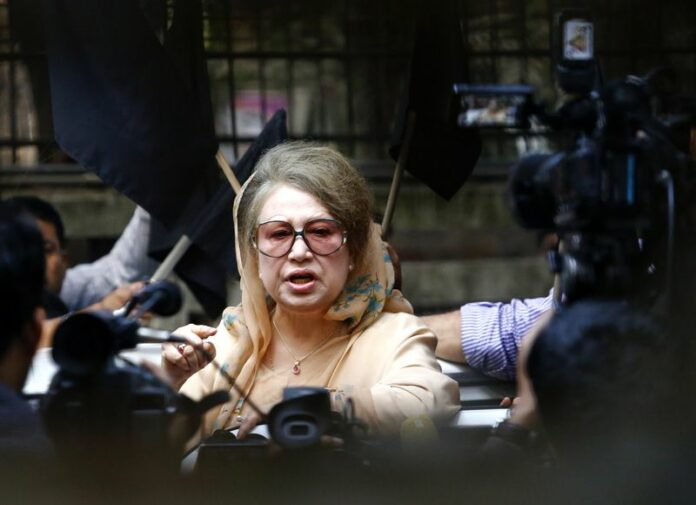
A file photo shows Bangladesh Nationalist Party (BNP) leader and former Prime Minister Khaleda Zia speaking to journalists from inside her office after police put barricades around her private offices in Dhaka, Bangladesh, 05 January 2015. EPA/ABIR ABDULLAH

DHAKA (DPA) — A Dhaka court Wednesday issued an arrest warrant for former prime minister Khaleda Zia after she repeatedly failed to appear in court to face graft charges, court officials said.

Judge Abu Ahmed Zamadar issued the warrant for Zia, the chief of the opposition Bangladesh Nationalist Party, whose supporters have been staging a transport blockade.

Zia had skipped court proceedings 56 times since the trial process began in 2011, prosecution lawyer Mosharraf Hossain Kajal said.

She is accused of embezzling about 664,000 dollars from two charities during her tenure in office between 2001 and 2006.

Zia, her son Tarique Rahman and some political deputies deny taking the money from two charities, the Zia Orphanage Trust and Zia Charitable Trust.

Defence lawyer Sanaullah Mia said Zia could not appear before the court on security grounds amid a nationwide transport blockade and general strike.

Zia called an indefinite transport blockade in early January after she was prevented from joining a rally in Dhaka on the first anniversary of an election she boycotted last year.

 
For comments, or corrections to this article please contact: [email protected]

You can also find Khaosod English on Twitter and Facebook
http://twitter.com/KhaosodEnglish
http://www.facebook.com/KhaosodEnglish
Advertisement

New Multilingual Signs, Flyers and Tourist Info Centres to Clarify Phuket Beach Rules

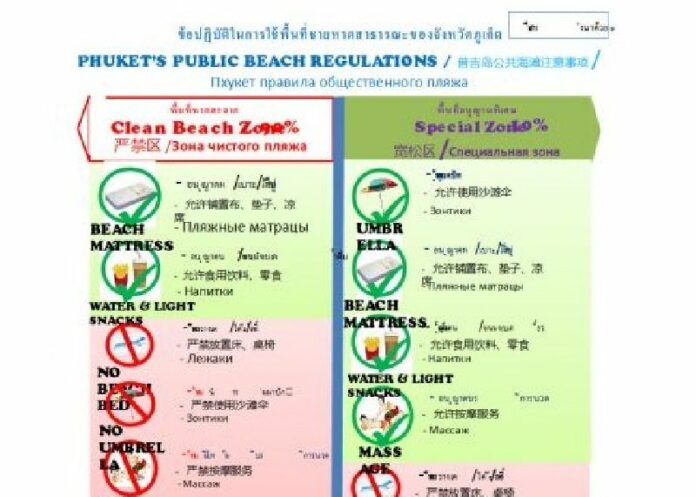
An example of what a section of the signs might look like. Approval of the final version of the signs is still pending. [Phuket News]

(The Phuket News)

PHUKET – The Muang Phuket District Beach Protection Unit – whose role is to track progress on the new beach management system in Muang district – is preparing to launch new tourist information centres and place multilingual graphic signs at the district’s 10 beaches.

The beaches in Muang District to get the signs and info centres include Kata Noi, Nui, Mai-Ngao, Karon Noi, Karon, Kata Yai, Nai Harn, Yanui, Laemka, Ao Saen Bay and on Racha Yai island (Patok beach).

The Beach Protection Unit confirmed details of the new tourist information campaign at a meeting at Karon municipality on Monday (February 23), held to create understanding about the new regulation signs and other details about the beach zones and new tourist information centers, which will be formally announced in an official opening ceremony expected to be held by the governor within the first week of March.

Read more here

Note: Khaosod English is not responsible for content on other websites.

Advertisement

Thammasat University Expels Monarchy Critic Living in Exile

Somsak Jeamteerasakul speaking to reporters after reporting to the police to hear the lese majeste complaint filed against him by the Thai army, 11 May 2011.

BANGKOK — A well-known history professor and outspoken critic of the Thai monarchy living in exile has been formally fired by Thammasat University for his absence.

The order, released by Thammasat University yesterday, states thatSomsak Jeamteerasakul, 56, violated university regulations by failing to report for work for more than 15 days despite a notice that ordered him to do so in late December 2014.

The order was signed by Thammasat University rector Somkid Lertpaitoon, who is also a member of the interim legislature appointed by the ruling military junta. 

"The aforementioned behavior and action of Dr. Somsak Jeamteerasakul constitutes a deliberate dereliction of duty,” the order reads. "It has caused grave damage to the University's reputation and funds.”

The document noted that Somsak submitted a letter of resignation in December 2014, but said the university administration declined to approve it. The university’s decision to fire Somsak instead of accept his letter of resignation means that the professor will be denied a pension and other benefits despite having taught at the university for more than 20 years.

A historian by trade, Somsak is a rare outspoken critic of the monarchy in Thailand, where offending the Royal Family is a crime punishable by up to 15 years in prison. He is believed to have fled Thailand shortly after the military staged a coup against an elected government on 22 May 2014.

The junta summoned Somsak and hundreds of other academics, activists, and politicians for "attitude adjustment” after the coup, but Somsak did not comply, prompting the military court to issue an arrest warrant and eventually revoke his passport.

After six months of silence, Somsak posted on his Facebook that he was living in exile in Europe. Although he has never specified which country he is living in, many others have confirmed that he is residing in France. Over the past few months, Somsak has published dozens of historical documents and criticism of the monarchy on social media. 

Somsak posted on Facebook yesterday that he was disappointed by university's decision to fire him instead of accept his letter of resignation.

"My savings are not much," he wrote. "What's more important is that I worked there for more than 20 years, so they should at least not punish me for not going to work … the punishment should not affect the pension that is supposed to reward all the work I have done."

Somsak also defended his reason for not returning to Thailand, namely the junta’s intensified crackdown on perceived anti-monarchists. At least 20 people have been prosecuted for violating Thailand's lese majeste monarchy law since Gen. Prayuth Chan-ocha, a staunch royalist, staged a military coup last May. Gen. Prayuth has also granted martial courts jurisdiction over lese majeste cases, removing the option for appeals.

"Throughout the 20 years of my career as a professor at Thammasat University, I have performed my duty to my utmost ability (for example, I almost never missed any class)," Somsak wrote. "I have also conducted myself as a good citizen of the country, and a good member of Thammasat University."

He added, "However, in the situation that individuals who severely violated the laws have installed themselves as rulers of the country by illegal means, and aimed to cause harm to my life, body, and liberty in such a direct manner, I regard it as the rights and duty of a bureaucrat, citizen, and member of the Thammasat community to disobey, oppose, and reject their effort to jail and harm me."

Somsak was referring to the drive-by shooting that targeted his home in February 2014 after he urged Thais to think critically about the monarchy in a Facebook post. Police have never identified the perpetrators, though the attack came only several days after a spokesperson of the Royal Thai Army threatened to use "social measures" to punish Somsak for his comments.

Today a member of the ruling junta denied speculation that the military pressured Thammasat University into firing Somsak. 

"It was in accordance with the regulations of the university,"  said Gen. Prawit Wongsuwan, deputy Prime Minister and Minister of Defense. "The military is merely administering peace and order. But we ended up facing these accusations. The procedure of the university was in accordance with its rules, regulations, and laws."


For comments, or corrections to this article please contact: [email protected]

You can also find Khaosod English on Twitter and Facebook
http://twitter.com/KhaosodEnglish
http://www.facebook.com/KhaosodEnglish
Advertisement

Hot News

LATEST NEWS

Bangkok
overcast clouds
32.3 ° C
34.4 °
30.5 °
74 %
4.5kmh
100 %
Fri
32 °
Sat
31 °
Sun
30 °
Mon
28 °
Tue
32 °