

























30.5 C
Bangkok
Sunday, July 5, 2026
Home Blog Page 3095

"A Ladyboy Paradise:" Gender Reassignment Surgery in Thailand

Pornnaphat Choochart, 38, in Bangkok, Thailand, 4 December 2014. Photo: Bill Bredesen/dpa

BANGKOK (DPA) – As a plastic surgeon at Bangkok's Yanhee Hospital, Greechart Pornsinsirirak performs around 180 sex change operations a year. Over his career, the doctor has transformed thousands of men into women.

A former patient recently told him she has had five boyfriends since her operation and "none of them knew she was a man," says Greechart, with barely concealed pride.

Thailand has long been considered one of the world's leading destinations for gender reassignment surgery, largely due to its low-cost, high-quality medical care and its general open-mindedness about gender roles.

In addition to Yanhee, five other major hospitals and clinics in Thailand, along with dozens of smaller specialty clinics, offer male-to-female sex change surgery.

\
Pornnaphat Choochart, 38, in Bangkok, Thailand, 4 December 2014. Photo: Bill Bredesen/dpa

"This is a ladyboy paradise," says Pornnaphat Choochart, 38, a Thai transgender female who underwent the procedure 10 years ago.

Thai society widely acknowledges the idea of a third gender, known as "kathoey." Although the group has struggled for legal recognition – transgender females are still identified as "mister" in their passports, for instance – the government is considering granting them formal distinction under the country's next constitution.

"I always believed I was a girl born into the wrong body," Pornnaphat says. "My relatives all treated me as a girl."

Thipnara Petrapitchanon, 29, a former contestant of Miss Tiffany Universe, the international transgender pageant held each year in the local resort of Pattaya, feels similar. She had the surgery in 2010.

"I am much more confident now," she says. "I can wear a bikini with confidence, and when I look in the mirror I see a woman. Socially, people also treat me like a woman now."

Before being eligible for gender reassignment surgery in Thailand, patients must prove that they have been "living as a woman" for at least one year, Greechart says, including dressing like a woman and taking female replacement hormones.

Foreign patients also need to have a psychological evaluation in their home country, followed by two more evaluations by psychologists in Thailand, the surgeon says.

More than 80 per cent of Yanhee's sex change patients come from overseas, mostly from Korea, Japan and Taiwan, but also from Western countries, with demand among foreign patients rising sharply in recent years, Greechart says.

A male-to-female sex change operation at Yanhee – one of Thailand's best-known cosmetic surgery hospitals, where document runners glide through the hallways on roller skates – costs between 240,000 and 320,000 baht (around 7,300 to 10,000 dollars), depending on the surgical method used.

Smaller, less reputable clinics might charge as little as 45,000 baht (1,400 dollars). By comparison, sex change surgery in the United States usually costs more than 20,000 dollars.

Patients are typically bedridden for one week following surgery, and then remain in the hospital for a second week for monitoring.

Advanced skin grafting techniques used in Thailand and elsewhere allow patients to retain a high degree of physical sensation, and aesthetically, the "final product" appears natural.

"There's an art to it," Greechart says. "It looks like a real woman."

And perhaps of equal importance to many patients, the ability to achieve orgasm is not lost through the operation.

The actual procedure takes between three and eight hours, depending on whether the doctor performs a simple skin graft, or whether a more complicated colon graft is required, using part of the large intestine. The prostate is not removed.

Greechart says he regularly receives inquiries from patients who experienced "bad surgery" at other clinics, and who hope a more skilled doctor can correct it.

"Sex changes are not all the same," he says. "A lot are very bad."

Sitting in his hospital office, Greechart clicks through images of botched operations on his computer screen and describes them: "A urethra but nothing else … infections … scarring … any of these people are very sad. We can fix it, but it won't be like normal. I always prefer to do it the first time."

Hospitals that perform gender reassignment surgery also offer a host of related procedures, such as breast implants, voice-change surgery and laser hair removal, among others.

Female-to-male gender reassignment is possible, although much less common, and requires multiple procedures over many months.

Thanyasa Tajinda, 32, the managing director of a transgender performing artist and modeling agency, says she has dreamed of having gender reassignment surgery for years but that her family was not initially supportive. They have now given their consent, she says.

"I plan to do it, 100 per cent," she says. "I just need to find the time. I'm not afraid at all."

She is confident that her reaction will be similar to others who have undergone the transition.

"After I opened my eyes in the recovery room, I felt a bit cold, but I thought, 'I'm a new person now,'" recalls Pornnaphat. "And I was very happy."

 

Advertisement

"A Ladyboy Paradise:" Gender Reassignment Surgery in Thailand

Thanyasa Tajinda is seen in Bangkok, Thailand, 4 December 2014. The 32-year-old plans to have male-to-female gender reassignment surgery next year. Photo: Bill Bredesen/dpa

BANGKOK (DPA) – As a plastic surgeon at Bangkok's Yanhee Hospital, Greechart Pornsinsirirak performs around 180 sex change operations a year. Over his career, the doctor has transformed thousands of men into women.

A former patient recently told him she has had five boyfriends since her operation and "none of them knew she was a man," says Greechart, with barely concealed pride.

Thailand has long been considered one of the world's leading destinations for gender reassignment surgery, largely due to its low-cost, high-quality medical care and its general open-mindedness about gender roles.

In addition to Yanhee, five other major hospitals and clinics in Thailand, along with dozens of smaller specialty clinics, offer male-to-female sex change surgery.

\
Pornnaphat Choochart, 38, in Bangkok, Thailand, 4 December 2014. Photo: Bill Bredesen/dpa

"This is a ladyboy paradise," says Pornnaphat Choochart, 38, a Thai transgender female who underwent the procedure 10 years ago.

Thai society widely acknowledges the idea of a third gender, known as "kathoey." Although the group has struggled for legal recognition – transgender females are still identified as "mister" in their passports, for instance – the government is considering granting them formal distinction under the country's next constitution.

"I always believed I was a girl born into the wrong body," Pornnaphat says. "My relatives all treated me as a girl."

Thipnara Petrapitchanon, 29, a former contestant of Miss Tiffany Universe, the international transgender pageant held each year in the local resort of Pattaya, feels similar. She had the surgery in 2010.

"I am much more confident now," she says. "I can wear a bikini with confidence, and when I look in the mirror I see a woman. Socially, people also treat me like a woman now."

Before being eligible for gender reassignment surgery in Thailand, patients must prove that they have been "living as a woman" for at least one year, Greechart says, including dressing like a woman and taking female replacement hormones.

Foreign patients also need to have a psychological evaluation in their home country, followed by two more evaluations by psychologists in Thailand, the surgeon says.

More than 80 per cent of Yanhee's sex change patients come from overseas, mostly from Korea, Japan and Taiwan, but also from Western countries, with demand among foreign patients rising sharply in recent years, Greechart says.

A male-to-female sex change operation at Yanhee – one of Thailand's best-known cosmetic surgery hospitals, where document runners glide through the hallways on roller skates – costs between 240,000 and 320,000 baht (around 7,300 to 10,000 dollars), depending on the surgical method used.

Smaller, less reputable clinics might charge as little as 45,000 baht (1,400 dollars). By comparison, sex change surgery in the United States usually costs more than 20,000 dollars.

Patients are typically bedridden for one week following surgery, and then remain in the hospital for a second week for monitoring.

Advanced skin grafting techniques used in Thailand and elsewhere allow patients to retain a high degree of physical sensation, and aesthetically, the "final product" appears natural.

"There's an art to it," Greechart says. "It looks like a real woman."

And perhaps of equal importance to many patients, the ability to achieve orgasm is not lost through the operation.

The actual procedure takes between three and eight hours, depending on whether the doctor performs a simple skin graft, or whether a more complicated colon graft is required, using part of the large intestine. The prostate is not removed.

Greechart says he regularly receives inquiries from patients who experienced "bad surgery" at other clinics, and who hope a more skilled doctor can correct it.

"Sex changes are not all the same," he says. "A lot are very bad."

Sitting in his hospital office, Greechart clicks through images of botched operations on his computer screen and describes them: "A urethra but nothing else … infections … scarring … any of these people are very sad. We can fix it, but it won't be like normal. I always prefer to do it the first time."

Hospitals that perform gender reassignment surgery also offer a host of related procedures, such as breast implants, voice-change surgery and laser hair removal, among others.

Female-to-male gender reassignment is possible, although much less common, and requires multiple procedures over many months.

Thanyasa Tajinda, 32, the managing director of a transgender performing artist and modeling agency, says she has dreamed of having gender reassignment surgery for years but that her family was not initially supportive. They have now given their consent, she says.

"I plan to do it, 100 per cent," she says. "I just need to find the time. I'm not afraid at all."

She is confident that her reaction will be similar to others who have undergone the transition.

"After I opened my eyes in the recovery room, I felt a bit cold, but I thought, 'I'm a new person now,'" recalls Pornnaphat. "And I was very happy."
 

Advertisement

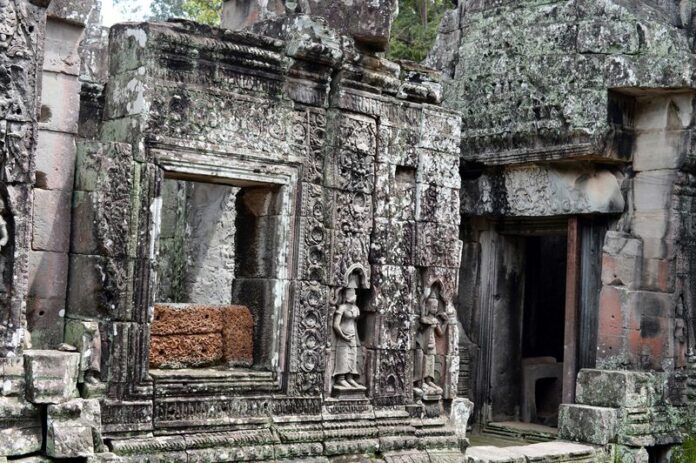
Three French Tourists Deported Over Naked Photos at Angkorian Temple

Banteay Kdei in Siem Reap, Cambodia, 13 October 2013. Three Frenchmen caught snapping naked photos of each other at the ancient temple were deported after being convicted of pornography and indecency charges, local media reported Monday. Photo: Jens Kalaene

BANGKOK (DPA) — Three Frenchmen caught snapping naked photos of each other at an ancient Cambodian temple were deported after being convicted of pornography and indecency charges, local media reported Monday.

The male tourists, all aged 19 or 20, were at Banteay Kdei, near the temple complex that includes Angkor Wat in the western province of Siem Reap, when they were apprehended on Thursday, the Cambodia Daily reported.

They were tried over the weekend and fined 1 million riel (250 dollars) each, given six-month suspended sentences and deported, the report said.

"We won't allow them to enter Cambodia for four years and confiscated their [camera] equipment," said Chau Sun Kerya, spokeswoman for the cultural authorities, according to the newspaper.


For comments, or corrections to this article please contact: [email protected]

You can also find Khaosod English on Twitter and Facebook
http://twitter.com/KhaosodEnglish
http://www.facebook.com/KhaosodEnglish

Advertisement

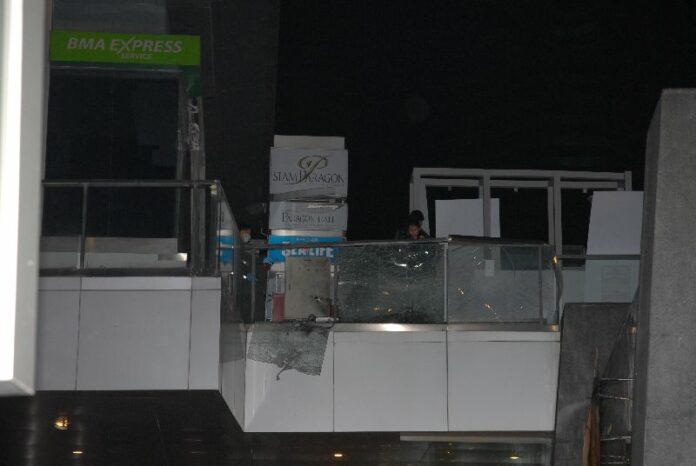
Double Bombs Target High-End BKK Shopping Mall

EOD officers collect evidence of the explosion at Siam Paragon shopping mall in Bangkok, 1 February 2015

BANGKOK – Two homemade explosives were set off near one of Thailand's largest shopping malls in downtown Bangkok Sunday night, police say.

The explosions took place at 8:10 pm. Two loud blasts were heard and cloud of smoke gathered on the walkway that connects Siam Paragon shopping mall to the Siam skytrain station. No injuries have been reported.

"The EOD team confirms that the explosions near entrance to Paragon were caused by two improvised explosives that were placed behind a power transformer," Pol Lt Gen Prawut Thawornsiri, assistant to the chief of Royal Thai Police, tweeted late Sunday night.

Police officers initially told the press that the explosion was caused by a malfunctioning electric transformer.

Pol.Maj.Gen. Sombat Milintachinda, head of the EOD team at Pathumwan Police Station, confirmed to Khaosod that the explosives were homemade "pipe bombs.”

Pieces of watches and metal were found at the scene and collected for further investigation by the police.

As a safety precaution, the skytrain suspended its service at Siam station for 30 minutes after the explosions. 

Advertisement

Islamic State Video Shows Beheading of Second Japanese Hostage

By Weedah Hamza

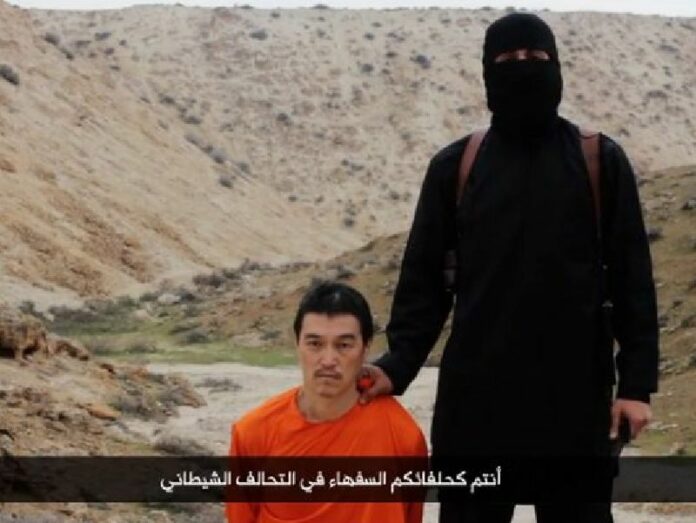
BEIRUT (DPA) – The Islamic State jihadist group announced late Saturday in an internet video that it has killed a second Japanese hostage, journalist Kenji Goto.

In a video titled "A message to Japan," a black-clad man holding a knife stands next to Goto, who is kneeling in an orange prison suit.

The knife is put to Goto's neck, and then video shows his bloodied head placed over the body.

Goto was a freelance journalist who covered wars in Africa, Afghanistan and the Middle East. He was abducted by Islamic State militants in October.

Before the killing, the militant in the video addresses Japanese Premier Shinzo Abe: "Because of your reckless decision to take part in this unwinnable war, this knife will not only slaughter Kenji but will also carry on and cause carnage wherever your people are found. … So let the nightmare for Japan begin."

Speaking in a southern English accent, the executioner, who has appeared in previous Islamic State video, said: "You, like your foolish allies in the satanic coalition, have yet to understand that we, by Allah's grace, are an Islamic caliphate with authority and power, an entire army thirsty for your blood."

In Tokyo, Abe told reporters he was outraged by the beheading of Goto.

"I feel strong resentment at the very despicable act," Abe said. "I will not tolerate terrorists."

He vowed to "cooperate with the international community and make the terrorists pay the price."

Goto's mother, Junko Ishido, told broadcaster NHK: "I'm so upset I'm left speechless."

In Washington, the White House National Security Council said US authorities were working to confirm the authenticity of the video.

US President Barack Obama condemned the slaying: "Through his reporting, Mr Goto courageously sought to convey the plight of the Syrian people to the outside world. Our thoughts are with Mr. Goto's family and loved ones, and we stand today in solidarity with Prime Minister Abe and the Japanese people in denouncing this barbaric act."

He applauded Japan's "steadfast commitment to advancing peace and prosperity in the Middle East," including through "generous assistance for innocent people affected by the conflicts in the region."

The United States would continue taking "decisive action to degrade and ultimately destroy" the Islamic State group, Obama said.

The group had said in an audio recording that Jordan had until sunset Thursday to release a jailed female militant, Sajida al-Rishawi, or Jordanian pilot Mu'ath al-Kasasbeh, whose fighter jet went down over Syria in territory held by Islamic State, and Goto, will be killed.

There was no mention of the Jordanian pilot's fate in the new video.

Jordan said Thursday it wants proof that the fighter pilot is alive before moving ahead with a prisoner swap with the militants.

Al-Rishawi, an Iraqi national, in 2005 took part in bombings that killed dozens of people in Jordan.

Some Jordanian media reports said that if al-Kasasbeh is dead, Rishawi will be hanged.

On January 24, the Islamic State group claimed responsibility for the beheading of Japanese hostage Haruna Yukawa. The militant group had first demanded a 200-million-dollar ransom for the release of Yukawa and Goto, in a video posted online on January 20.

Advertisement

Buddhist Tradition: World Peace through Inner Peace

DISCLAIMER: This is a paid advertisement. Its contents were not produced by Khaosod English's editorial team.

News & Press Release

Buddhist Tradition: World Peace through Inner Peace


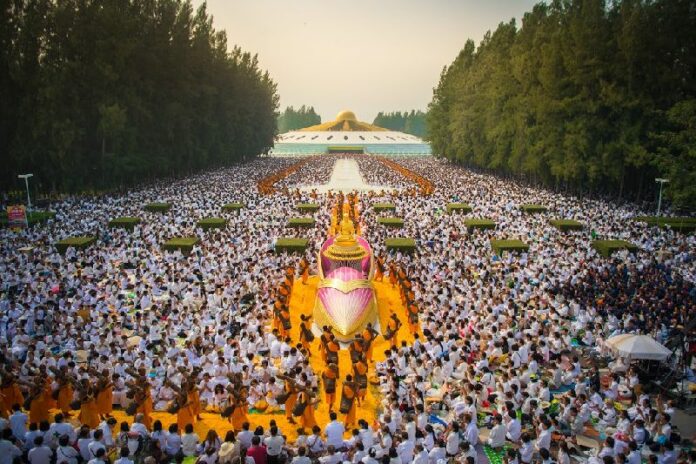
          Throughout its 45-year history, the Dhammakaya Temple has never wavered from its mission to create world peace through inner peace by promoting the Buddha’s method of meditation and teachings that have changed the world since 2558 years ago.  The ultimate aim of all activities organized by the temple is to bring peace to the minds of individuals, to the Thai society, and to the world that we all share.

Ven. Sanitwongse Wuttiwangso

Spokesperson of Wat Phra Dhammakaya


It all started with ‘why’

         Ven. Dattajivo, the vice abbot of the Dhammakaya Temple, has said: “Before beginning any work, we must first ask ourselves these questions: ‘what,’ ‘how,’ and especially ‘why’”.  Therefore, the founding of the temple 45 years ago began with such questions. The goal was to make the temple a meditation-learning center for monks, novices, and peace-loving people of all ages, nationalities and races.  Back then, the questions were: ‘why is it that the majority of people who come to the temple – any temple – are old people when the Buddha’s teachings are applicable for people of every age and are best learned when they are young?,’ ‘Have people lost interest in temples or have temples ceased to be interesting?,’ and ‘How can we encourage and inspire people to learn Dhamma?’


\


Ordination, Dhutaṅga and Moral Education for Youths

          During its first 30 years, Wat Phra Dhammakaya concentrated on building a strong foundation of activities and different projects within the temple.  Later, it expanded the scope of these activities in cooperation with many other Buddhist organizations, nongovernmental organizations, and educational institutions. Among such activities are the mass ordination of 100,000 monks throughout the country, the V-star moral education for youths, the nationwide alms-offering events, and the Dhammachai Dhutaṅga pilgrimage.


Mass Ordination of 100,000 monks throughout Thailand

         In order to maintain Buddhism, Buddhist monks have to collaborate to spread Lord Buddha’s teachings. However, in this present time, there are 5,937 deserted temples in Thailand (according to an official record of the National Office of Buddhism, dated 1 June 2009) mainly because fewer people are entering monkhood.  When people spend less than a month in monkhood, they do not have sufficient time to train themselves and to study Dhamma profoundly. As a result, very few people are aware of the true value of ordination.   Morever, these days very few employers allow their employees to take a three-month leave of absence to be ordained as monks during the Rains Retreat period.  Hence, there are very few ordainees to propagate Buddhist teachings, resulting in the critical situation of Buddhism in Thailand.

\

       Therefore, in order to produce the new generation of Buddhist monks to become the troop of Buddhism, Wat Phra Dhammakaya held a mass ordination of 7,000 monks from 7,000 villages throughout Thailand in year 2552 B.E. (2009 A.D.) and over 10,000 people were interested in participation. In consequence, Wat Phra Dhammakaya continued to arrange appropriate trainings for the rest of people interested.

       And in year 2553 B.E. (2010 A.D.), the mass ordination of 100,000 monks from 70,000 villages started twice a year—one in summer and the other one during the rains-retreat. Every year, there are a lot of people interested to participate in the program and even extend their stay in monkhood and are assigned to different temples in their hometowns, resulting in the decreasing numbers of deserted temples.

        In the most recent record of the National Office of Buddhism, in November 2557 B.E. (2014 A.D.), the numbers of deserted temples had been decreased down to only 4,000 temples. (http://www.thairath.co.th/content/464816)


Buddhist Tradition

P.Sanitwongse


V-Star & the 5UG Solution for A Brighter Future of the Nation

         “V-star” stands for “virtuous stars”. It is a moral education program for youths, conducted in cooperation with the International Buddhist Society and thousands of schools throughout Thailand with the common goal of cultivating the universal values of cleanliness, tidiness, politeness, punctuality, and mind-purifying meditation in the minds of the youth.


        These five values (5 Universal Values of Goodness or 5UG) may appear simple but they have proved to be highly beneficial to the young students themselves as well as their parents, schools and local communities when put into daily practice.  The value of ‘cleanliness,’ for example, goes beyond cleaning things and places to include the use of clean words and having a clean intention. The results of implementing this program have been tremendous. By helping their parents clean and tidy the house, school or temple, dressing politely, thinking through before speaking, being punctual at all times, studying hard, cleansing their minds with daily meditation, and following their heads rather than their impulses, these youths will become the country’s valuable human resources.  In short, they learn to take responsibility for themselves, their families, schools, temples and communities through daily practice of the 5UG.  Instead of looking for someone or something outside themselves to blame, they look for solutions and always start with themselves.  


Buddhist Tradition

P.Sanitwongse

\

Dhammachai Dhutaṅga

         Dhutaṅga is how monks take their disciplinary training to another level for the purpose of ridding themselves of defilements.  Dhutaṅga is about living light so that monks have more time to focus on meditation and observing their minds only. Monks on Dhutaṅga eat only one meal a day, take up residence outdoors, and consume only food that they receive from alms rounds. They keep personal possessions to a bare minimum and typically journey barefoot. 

        This year’s Dhammachai Dhutaṅga is from2 to 30 January 2015, covering seven provinces: Pathum Thani, Nonthaburi, Supanburi, Ayudhya, Nakon Pathom, Samutsakorn, and Bangkok.  During a Dhutaṅga training, monks get to practice endurance, fortitude, compassion, giving, team spirit, concentration, awareness, and moment-to-moment meditation. As they journey barefoot, they meditate, share inner peace, and spread loving-kindness to all living beings.

        The 1,130 monks on the Dhammachai Dhutaṅga pilgrimage come from different parts of Thailand. Yet, they are united by the mission to train themselves and to spread the message that “inner peace is prerequisite to external peace in any society and the world at large”.  Their peace journey also serves a tribute to honor the Buddha and the late Meditation Master Phramongkolthepmuni who rediscovered the Buddha’s key knowledge about the innate Body of Enlightenment (the Dhammakaya) which had been lost to the world about 500 years after His passing. 

\

        Although the annual Dhammachai Dhutaṅga pilgrimage is primarily for monks, many who had the opportunity to witness the group pilgrimage were inspired to learn and to practice the Buddha’s teachings.  It is one thing to know Dhamma from written or spoken words; it’s another to live it.  As the monks walk, they are putting their Dhamma practice to test.  It is obviously easier to meditate or to keep one’s mind still in a cool and quiet environment, and we all should find time to do that. But the fact is most of us live in an ever-expanding urban society and face many challenges – some of which are outside our control.  The only thing we ever have complete control over is our mind.  Therefore, it is important for us to train our mind to be calm and cool no matter where we are.  The Dhammachai Dhutaṅga monks are living proofs that inner peace is possible anywhere, under any condition – cold rain or scorching sun – and it begins from within.  They can do it, and so can you.


—————————————-


DISCLAIMER: This is a paid advertisement. Its contents were not produced by Khaosod English's editorial team. 

Advertisement

Matichon Apologizes For 'Blasphemous' Cartoon

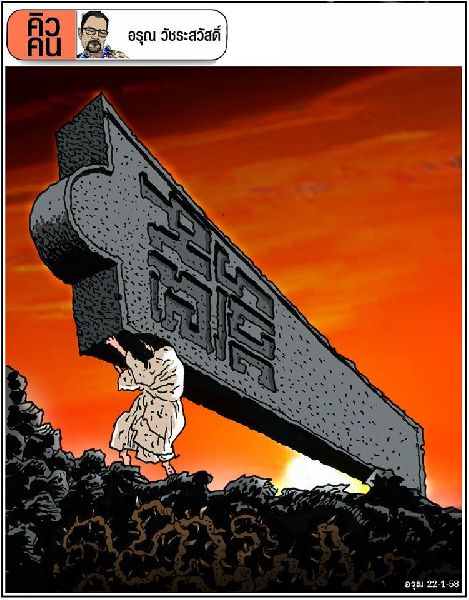
A cartoon published in Matichon newspaper on 22 January by Arun Watcharasawad, depicting former PM Yingluck Shinawatra carrying a large cross engraved with the word "Shinawatra."

BANGKOK — Matichon newspaper has issued a formal apology for publishing a cartoon that likened former Prime Minister Yingluck Shinawatra to Jesus Christ.

The cartoon, published on 26 January 2015, depicted former PM Yingluck wearing a crown of thorns, parodying the biblical tale where Jesus Christ is forced to wear a crown of thorns by Roman soldiers before his execution. 

\

Drawn by Arun Watcharasawad, the cartoon presumably intended to portray Yingluck’s impeachment by the junta-appointed parliament on 23 January as unjust, similar to the persecution of Jesus Christ at the hands of the Romans.

However, the cartoon drew some criticism, leading Matichon’s editorial board to publish an apology.

"Matichon had no intention to cause misunderstanding or commit blasphemy," the statement reads. "If the aforementioned cartoon caused any discomfort, the editorial board would like to express its regret and offer an apology."

Matichon and Khaosod English are owned by the same umbrella corporation, the Matichon Group.

Arun, a veteran cartoonist, frequently invokes religious symbols in his cartoons, which mostly satirize contemporary politics. In another cartoon published on 22 January, Arun drew an image of Yingluck carrying a large cross engraved with the word "Shinawatra."

Two years ago he also drew Thida Thawornseth, a top Redshirt leader, wearing a crown of thorns. Thida was at the center of a controversy regarding the election of a new leader for the Redshirt organization the United Front of Democracy Against Dictatorship (UDD). 

Advertisement

Lese Majeste Arrest Prompts Social Media Ban in State Offices

BANGKOK — Bureaucrats across the country have been ordered to refrain from accessing social media sites on their workplace computers after a state employee was arrested for allegedly insulting the monarchy on Facebook.

The ban was spelled out in a document, classified as "Most Urgent," that was sent to every provincial governor by the Ministry of Interior Affairs on 30 January.

The order states that the Ministry has been informed of certain state employees who "use state computers or communication devices in the district offices, city halls, and offices of Department of Provincial Administration to access social media programs, such as Facebook, LINE, email that are not related to bureaucratic operations by sending photos or texts that may violate the Criminal Codes or cause damages to others."

As a result, state officials are no longer permitted to access Facebook or other social media sites on their workplace computers, according to the notice. The order also warns supervisors of all levels that they will be held responsible for any violations by their subordinates. 

Krissada Boonrat, director of the Department of Provincial Administration, told reporters that the order is a response to the recent arrest of a state employee in Sa Kaeo province who allegedly published anti-monarchy photos and text from a computer at a local administrative office.

Police announced the arrest of the official, identified as Chayo Anchaleewachara, on 14 January. He has been charged with Section 112 of the Criminal Codes, which prohibits criticizing the monarchy. Offenders face up to 15 years in prison.

"His case is ongoing," said Krissada. "If he is found guilty, we will take action in accordance with state regulations." He added that state employees can still access Facebook and other social media websites on their personal computers or smartphones. 

"This is not a restriction on civil rights or liberties. It is a measure to prevent bureaucrats from using state equipment to cause any damages," Krissada explained.

At the police press conference on 14 January, a spokesperson for the Thai police force, Pol.Maj.Gen. Prawut Thawornsiri, said that the state official confessed to the crime. 

According to Pol.Maj.Gen. Prawut, the suspect told police he was "misled" by photos and audio on Facebook that criticized the Thai monarchy, and decided to publish more anti-monarchy material. The suspect has been committing the crime for a year, police say. 

Pol.Maj.Gen. Prawut also claimed that the suspect belongs to an underground anti-monarchy network that actively attacks the Royal Family on the internet, and has helped some lese majeste suspects flee from Thailand to Laos. 

"I would like to warn the public that such actions are against the law," Pol.Maj.Gen. Prawut said. "All the [negative] messages about the monarchy are untrue. They are intended to cause disputes in society."

Although discussion of the monarchy remains largely taboo in public, internet forums and social media sites have opened up new spaces for dialogue in recent years. 

After seizing power in a coup d’etat on 22 May 2014, Thailand’s military junta has stepped up efforts to monitor internet users and enforce the draconian lese majeste law, granting martial courts jurisdiction over lese majeste cases and other crimes related to "national security." Appeals are not permitted under the military tribunals.

"We will use legal measures, social-psychological measures, and telecommunications and information technology to deal with those who are not mindful of their words, are arrogant at heart, or harbour ill intentions to undermine the important Institution of the nation," junta leader and Prime Minister Prayuth Chan-ocha told parliament last September. 

For comments, or corrections to this article please contact: [email protected]

You can also find Khaosod English on Twitter and Facebook
http://twitter.com/KhaosodEnglish
http://www.facebook.com/KhaosodEnglish

Advertisement

Editorial: Grow Up Thai Junta, and Learn About Democracy

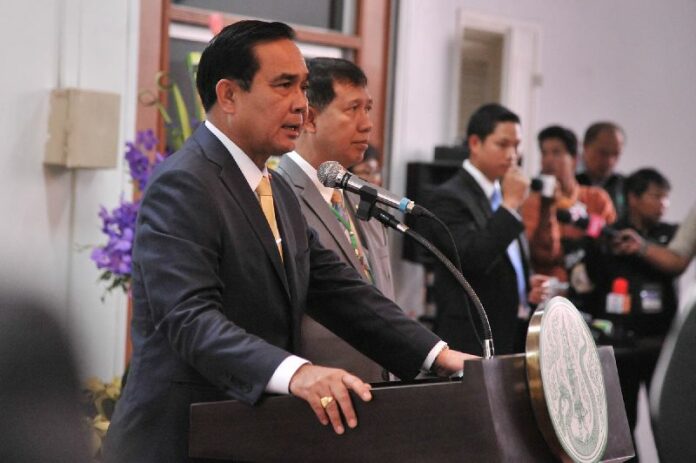
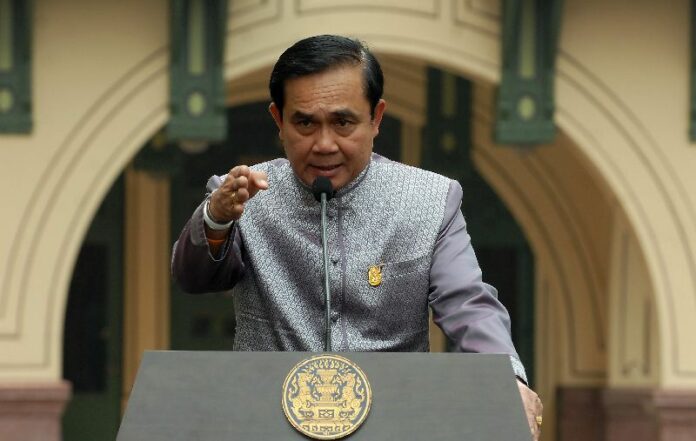
Junta chairman and PM Gen. Prayuth Chan-ocha at a press conference on 29 January 2015

Instead of throwing a juvenile temper tantrum, the Thai military should comply with the United States government's calls for lifting martial law and returning to democratic rule immediately.

In a speech given to a crowd at Chulalongkorn University this week, Daniel Russel, the US Assistant Secretary of State for East Asian and Pacific Affairs, aptly observed that Thailand’s military government has imposed "significant restraints on freedom" since it seized power in a coup d’etat on 22 May 2014.

Russel, the highest-level US official to visit Thailand since the coup, went on to advocate for the repeal of martial law and all restrictions on civil liberties in Thailand.

"Ending martial law throughout the country and removing restrictions of speech and assembly – these would be important steps as part of a generally inclusive reform process that reflects the broad diversity of views within the country," Russel said. 

Russel's reasoned, diplomatic, and politely-delivered remark has caused an uproar among Thai junta leaders and their supporters, who have angrily accused the US diplomat of acting "inappropriately, " "violating diplomatic protocols" and "interfering in Thai politics." 

However, it is Thai officials who have acted inappropriately by publicly lambasting Russel one after another, and repeatedly misrepresenting his speech (which largely focused on uncontroversial aspects of the two countries' historic alliance). Pro-coup Thais have also turned rabid with their anti-American sentiment, spamming the US Embassy’s Facebook page, announcing the return of the “Ugly American” in newspaper op-eds, and even supporting ISIS threats of beheading US President Barack Obama on social media. 

The junta and its supporters insist that the US government does not understand Thailand’s political situation. However, the US is hardly alone in its assessment of the deteriorating human rights climate in Thailand that has followed the 22 May coup.

This week, the independent watchdog Freedom House downgraded Thailand from a "Partly Free" to "Not Free" country in its annual assessment of political rights and civil liberties around the globe. On the same day, Human Rights Watch report described the Thai junta as sending Thailand’s human rights situation "into free fall."

It is true that the US government's rhetoric of promoting democracy and liberty around world is often fraught with hypocrisy; for instance, the excess of military power over Thailand can be traced to US’s financial aid during the Cold War.

However, the Thai military cannot have it both ways. Junta chairman and PM Gen. Prayuth Chan-ocha cannot proclaim his "democratic heart" and commitment to restoring democracy in Thailand, while also denouncing Russel's call for the restoration of civil liberties, a founding principle of any democratic society. 

The reaction to Russel’s sound counsel is disturbing in that it illustrates just how little the Thai junta – who is responsible for shaping Thailand’s next constitution and political system – understands the basic building blocks of democracy.

The Thai government should heed the US’s friendly advice, and it should also learn how to distinguish a mountain from a molehill. The embarrassing racket that has followed Russel’s remarks suggests that, at the very least, the junta would do well to develop some thicker skin.

For comments, or corrections to this article please contact: [email protected]

You can also find Khaosod English on Twitter and Facebook
http://twitter.com/KhaosodEnglish
http://www.facebook.com/KhaosodEnglish

Advertisement

Prayuth Asks Thais to Stop 'Whining' to Foreign Nations

Thai PM and junta chairman Gen. Prayuth Chan-ocha at the Government House on 27 Jan 2015.

BANGKOK — Junta chairman and Prime Minister Gen. Prayuth Chan-ocha has asked Thais to keep their complaints at home, following an American diplomat's public urging that Thailand's post-coup government cease its suppression of civil rights.

The row started after Daniel Russel, the US Assistant Secretary of State for East Asian and Pacific Affairs, called upon the Thai military to repeal martial law and all restrictions on freedom of expression in a speech at Chulalongkorn University in Bangkok on 26 January.

Thai officials have repeatedly denounced the speech, calling it “inappropriate” and “disappointing.” Two days after the speech, the Ministry of Foreign Affairs summoned US Charge d'Affaires to Thailand, W. Patrick Murphy, to discuss Russel's remarks.

In his weekly televised speech last night, Gen. Prayuth urged the public to unite under his mission to "reform" the country, instead of complaining to foreign nations.

"They like to accuse this person, that person. Aren't you ashamed of yourself? You like to whine about your problems to all the foreign nations. Stop doing that," Gen. Prayuth said. 

"I have never denied the fact of how this government came into power, but everyone must understand that we did it to take care of the country," he continued. "If we cannot take care of each other and solve our problems, should we let other nations do it for us? Thailand is an independent country. We were never colonized by anyone. Today, why are we letting some people air their problems to this person or that person to solve problems for us? It's shameful."

Gen. Prayuth seized power from the elected government on 22 May 2014 with the stated aim of ending prolonged street protests and returning peace and order. He was later chosen as Prime Minister by an interim parliament whose members he had handpicked. 

Gen. Prayuth, who is still chairman of the ruling junta, has retained nationwide martial law eight months after the military takeover, enabling the military to detain and search individuals without warrants, censor the media, ban public protests, and try civilians in military courts, among other powers. According to Human Rights Watch, his administration has thrown Thailand’s human rights situation into “free fall.”

In response to the US’s calls for repealing martial law, Gen. Prayuth said last night that he does not need any advice from foreign nations. 

"I want to tell everyone in the international community: give this government some time. Give Thai people some time," Gen. Prayuth said, "I don't need anyone to help. I want us to be strong."

He continued, "Please ask Thais across the country what they want. Don't only ask this group and that group and make conclusion on your own. Give fairness to the Thai people. Give fairness to me, as a leader of the government."

Meanwhile, Don Paramatwinai, the Deputy Minister of Foreign Affairs, suggested that the US diplomat should consider why anti-American sentiment has been spreading on Thai social media in the wake of his speech on 26 January.

"Thai people understand other people easily. We don't pick fights with other people. However, there have been certain opinions about America spreading on Facebook and other sites," Don said. "What drove such a feeling? The US should think about it."

When a reporter asked about his meeting with the US Charge d'Affaires, Don replied, "Don't expect him to change his opinion and stance immediately. He only listened to our concerns and said he would consider them."

On 29 January, Murphy, the US Charge d'Affaires, posted on his Twitter account that the US will continue to work with Thailand on important issues, but also continue to the urge the Thai government “to take necessary steps to bring country back to democracy.”

He added, “We believe it is a matter for the Thai people to work together to build democratic future; we don't take sides."


For comments, or corrections to this article please contact: [email protected]

You can also find Khaosod English on Twitter and Facebook
http://twitter.com/KhaosodEnglish
http://www.facebook.com/KhaosodEnglish

Advertisement

Hot News

LATEST NEWS

Bangkok
overcast clouds
30.5 ° C
30.5 °
27.7 °
78 %
1.8kmh
100 %
Sun
32 °
Mon
32 °
Tue
27 °
Wed
26 °
Thu
31 °