
































30.5 C
Bangkok
Monday, July 6, 2026
Home Blog Page 3105

Thai Junta Leader Deflects Concern Over Mass Surveillance Bill

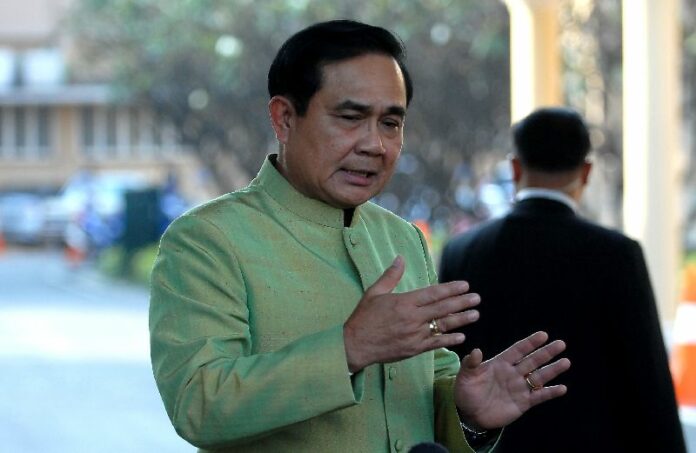
Thai junta chairman and PM Gen. Prayuth Chan-ocha talking to reporters on 20 Jan 2014 at the Government House in Bangkok.

BANGKOK — Thai junta leader and Prime Minister Prayuth Chan-ocha has asserted his authority to pass a mass surveillance bill that would allow officials to inspect any form of communication without a requesting a court warrant.

When a reporter from Isra News asked the junta chairman to comment on the draft of the controversial Cyber Security Act, Gen. Prayuth responded that Thai people should study the "rules" instead of focusing only on the "restriction of their rights."

"Today, have I ever restricted anyone's rights? Have I ever done that?" asked Gen. Prayuth, who imposed martial law after leading a military coup on 22 May 2014, and has banned any political protests or public criticism of his regime. 

The reporter pressed Gen. Prayuth to justify the sweeping nature of the bill, prompting Gen. Prayuth to lose his temper and shout, "I don't have to answer why! I will pass it. You have a problem with that? Otherwise, why the hell am I the Prime Minister? Why am I the Prime Minister?"

Gen. Prayuth then walked away from the reporters and said angrily, "I'm in a very bad mood."

If passed, the Cyber Security Act, a draft of which is available on the Thai Cabinet’s website, would grant officials authority to "access any channel of information and communication, including mails, telegrams, telephones, fax, computer, or any other type of electronic and telecommunication equipment" in order to safeguard the "cyber security" of the state. 

The bill states that officials can exercise those powers per orders from a Committee for Defense of National Cyber Security, which will be formed by the Cabinet, effectively discarding any legal need for authorities to apply for a court warrant first. 

The legislation would allow Thai authorities to access any email, Facebook account, and computers of any individual suspected of engaging in actions that may affect "cyber security."

The draft of the bill also authorizes the Committee to "summon any state agency or individual to give testimony or submit any document beneficial to the operation of this Act," and to "ask" any state or private agency to "perform any task" to protect the national cyber security as decided by the Committee.

According to Thai Netizen, an NGO that campaigns for internet freedom in Thailand, the draft has been approved by the Cabinet, and is now awaiting a vote by the National Legislative Assembly, a body appointed by the junta last year.

Thailand already has two draconian pieces of legislation used by authorities to restrict freedom of expression on the internet: the lese majeste law, which criminalizes any criticism of the monarchy, and the Computer Crime Act.

The Computer Crime Act, which carries a maximum penalty of five years in prison and a 100,000 baht fine, outlaws any use of a computer system that affects "national security," "spreads false information," or damages the "good morality of the people."  

Critics say the law's sweeping scope is regularly abused to restrict freedom of speech. In December 2013, the Royal Thai Navy sued an online news site in Phuket province with the Computer Crime Act for reprinting a Reuters article that accused some members of the navy force of collaborating with human traffickers in Thailand's southern coast

Deputy Prime Minister Visanu Krue-ngam told Daily News yesterday that the Cabinet will invite opinions from many Ministries and may amend the surveillance bill accordingly before it sends a draft to the NLA. 

"Each Ministry will submit its opinion in different issues, including human rights," Visanu was quoted as saying. 


For comments, or corrections to this article please contact: [email protected]

You can also find Khaosod English on Twitter and Facebook
http://twitter.com/KhaosodEnglish
http://www.facebook.com/KhaosodEnglish

Advertisement

Thai Junta Leader Deflects Concern Over Mass Surveillance Bill

Thai junta chairman and PM Gen. Prayuth Chan-ocha talking to reporters on 20 Jan 2014 at the Government House in Bangkok.

BANGKOK — Thai junta leader and Prime Minister Prayuth Chan-ocha has asserted his authority to pass a mass surveillance bill that would allow officials to inspect any form of communication without a requesting a court warrant.

When a reporter from Isra News asked the junta chairman to comment on the draft of the controversial Cyber Security Act, Gen. Prayuth responded that Thai people should study the "rules" instead of focusing only on the "restriction of their rights."

"Today, have I ever restricted anyone's rights? Have I ever done that?" asked Gen. Prayuth, who imposed martial law after leading a military coup on 22 May 2014, and has banned any political protests or public criticism of his regime. 

The reporter pressed Gen. Prayuth to justify the sweeping nature of the bill, prompting Gen. Prayuth to lose his temper and shout, "I don't have to answer why! I will pass it. You have a problem with that? Otherwise, why the hell am I the Prime Minister? Why am I the Prime Minister?"

Gen. Prayuth then walked away from the reporters and said angrily, "I'm in a very bad mood."

If passed, the Cyber Security Act, a draft of which is available on the Thai Cabinet’s website, would grant officials authority to "access any channel of information and communication, including mails, telegrams, telephones, fax, computer, or any other type of electronic and telecommunication equipment" in order to safeguard the "cyber security" of the state. 

The bill states that officials can exercise those powers per orders from a Committee for Defense of National Cyber Security, which will be formed by the Cabinet, effectively discarding any legal need for authorities to apply for a court warrant first. 

The legislation would allow Thai authorities to access any email, Facebook account, and computers of any individual suspected of engaging in actions that may affect "cyber security."

The draft of the bill also authorizes the Committee to "summon any state agency or individual to give testimony or submit any document beneficial to the operation of this Act," and to "ask" any state or private agency to "perform any task" to protect the national cyber security as decided by the Committee.

According to Thai Netizen, an NGO that campaigns for internet freedom in Thailand, the draft has been approved by the Cabinet, and is now awaiting a vote by the National Legislative Assembly, a body appointed by the junta last year.

Thailand already has two draconian pieces of legislation used by authorities to restrict freedom of expression on the internet: the lese majeste law, which criminalizes any criticism of the monarchy, and the Computer Crime Act.

The Computer Crime Act, which carries a maximum penalty of five years in prison and a 100,000 baht fine, outlaws any use of a computer system that affects "national security," "spreads false information," or damages the "good morality of the people."  

Critics say the law's sweeping scope is regularly abused to restrict freedom of speech. In December 2013, the Royal Thai Navy sued an online news site in Phuket province with the Computer Crime Act for reprinting a Reuters article that accused some members of the navy force of collaborating with human traffickers in Thailand's southern coast

Deputy Prime Minister Visanu Krue-ngam told Daily News yesterday that the Cabinet will invite opinions from many Ministries and may amend the surveillance bill accordingly before it sends a draft to the NLA. 

"Each Ministry will submit its opinion in different issues, including human rights," Visanu was quoted as saying. 


For comments, or corrections to this article please contact: [email protected]

You can also find Khaosod English on Twitter and Facebook
http://twitter.com/KhaosodEnglish
http://www.facebook.com/KhaosodEnglish

 

Advertisement

Court Orders Skytrain to Accommodate Disabled Passengers

Commuters with disabilities who filed suit against City Hall over access to the BTS Skyrtrain gather to hear the verdict at the Supreme Administrative Court, 21 January 2015

BANGKOK – The Supreme Administrative Court has ruled that Bangkok's skytrain system must install more elevators and other equipment to assist disabled passengers.

The ruling followed a lawsuit filed by a group of Thais who use wheelchairs against the operators of the the skytrain, known officially as the Bangkok Mass Transit System (BTS). 

Currently, only five of 23 BTS stations are equipped with elevators for disabled passengers: Siam, Mo Chit, Chong Nonsri, National Stadium, and On Nut – one elevator for each station. No BTS station provides slopes for wheelchairs. 

The lower Administrative Court dismissed the lawsuit in 2009 on the grounds that 2001 legislation protecting the rights of disabled citizens was enacted six years after the BTS system was built. However, prosecutors appealed the verdict, and the Supreme Administrative Court overturned the ruling today.

According to the new verdict, the court has the power to intervene in the BTS operations because the case affects a "large number of people," in accordance with Second Clause of the Section 52 of the Act of Supreme Administrative Court.

In its ruling, the court ordered the BTS and Bangkok Metropolitan Administration (BMA) to build elevators in all of the 23 skytrain stations. The court also instructed the BTS to construct wheelchair slopes, stairs, and signs for disabled passengers in every station within one year. 

The BTS is a major systme of public transportation in Bangkok, a city known for its notorious traffic jams. It is estimated that there are at least 600,000 rides on BTS per day. 


For comments, or corrections to this article please contact: [email protected]

You can also find Khaosod English on Twitter and Facebook
http://twitter.com/KhaosodEnglish
http://www.facebook.com/KhaosodEnglish
 

Advertisement

21 Charged Over Former Govt's 'Fraudulent' Rice Sale

BANGKOK – Thailand’s national anti-graft body has charged 21 people, including a former Minister and his deputy, for allegedly committing fraud in a rice sale that was billed as a transaction between the Thai and Chinese governments.

The National Anti-Corruption Commission (NACC) has accused former Minister of Commerce Boonsong Teriyapirom and 20 other officials and businessmen of entering government-to-government rice deals with private Chinese companies that did not represent the People's Republic of China.    

Fifteen of the 21 suspects charged by the NACC are representatives of the Siam Indica Company, a Thailand-based rice company that allegedly bought rice from the Chinese companies and later sold it to processing plants in Thailand.

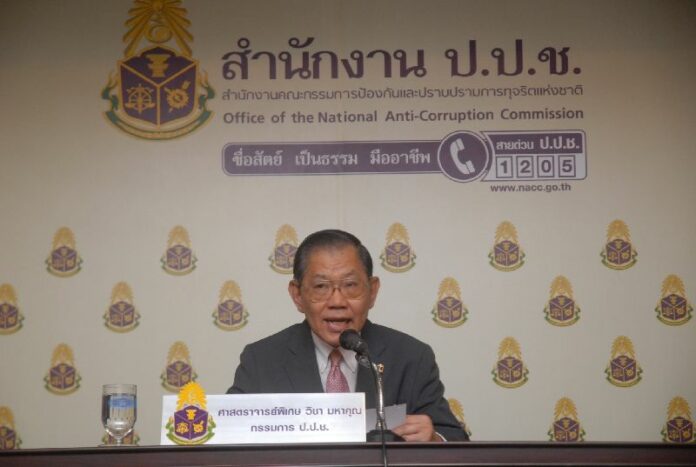
Vicha Mahakhun, a member of the NACC, said the transaction caused "serious damage to the country." He estimated that the sales cost Thailand more than 600 billion baht, and added that the Ministry of Commerce has been authorized to recoup those losses by filing a compensation lawsuit against the 21 suspects.

Vicha said the NACC is also working with the Office of Attorney-General to prosecute the 21 suspects in the Supreme Court's Division for Holders of Political Office. 

The NACC’s decision to take legal action against the so-called G2G deal comes two days before the junta-appointed National Legislative Assembly (NLA) will vote on whether to impeach former Prime Minister Yingluck Shinawatra for failing to stop corruption in the rice-pledging scheme.

The charges were brought against Yingluck by the NACC. If found guilty, she faces a five year ban from politics.

Under the rice-pledging program, a key police of Yingluck’s administration, the Thai government bought rice from farmers at above-market prices, but then struggled to sell the paddies on the international market, accumulating stockpiles and resulting in huge financial loses.

According to the NACC, the scheme was riddled with mismanagement and corruption that cost the country more than 500 billion baht in damages.

Appearing before the NLA on 9 January, Yingluck denied the allegations and insisted that program was meant to improve the livelihood of Thai farmers. Yingluck’s supporters have accused the NACC of being allied to conservative factions in Thailand and conspiring against the former leader and her political party. 


For comments, or corrections to this article please contact: [email protected]

You can also find Khaosod English on Twitter and Facebook
http://twitter.com/KhaosodEnglish
http://www.facebook.com/KhaosodEnglish

Advertisement

21 Charged Over Former Govt's 'Fraudulent' Rice Sale

Vicha Mahakhun at NACC press conference on 20 Jan 2015.

BANGKOK – Thailand’s national anti-graft body has charged 21 people, including a former Minister and his deputy, for allegedly committing fraud in a rice sale that was billed as a transaction between the Thai and Chinese governments.

The National Anti-Corruption Commission (NACC) has accused former Minister of Commerce Boonsong Teriyapirom and 20 other officials and businessmen of entering government-to-government rice deals with private Chinese companies that did not represent the People's Republic of China.    

Fifteen of the 21 suspects charged by the NACC are representatives of the Siam Indica Company, a Thailand-based rice company that allegedly bought rice from the Chinese companies and later sold it to processing plants in Thailand.

Vicha Mahakhun, a member of the NACC, said the transaction caused "serious damage to the country." He estimated that the sales cost Thailand more than 600 billion baht, and added that the Ministry of Commerce has been authorized to recoup those losses by filing a compensation lawsuit against the 21 suspects.

Vicha said the NACC is also working with the Office of Attorney-General to prosecute the 21 suspects in the Supreme Court's Division for Holders of Political Office. 

The NACC’s decision to take legal action against the so-called G2G deal comes two days before the junta-appointed National Legislative Assembly (NLA) will vote on whether to impeach former Prime Minister Yingluck Shinawatra for failing to stop corruption in the rice-pledging scheme.

The charges were brought against Yingluck by the NACC. If found guilty, she faces a five year ban from politics.

Under the rice-pledging program, a key police of Yingluck’s administration, the Thai government bought rice from farmers at above-market prices, but then struggled to sell the paddies on the international market, accumulating stockpiles and resulting in huge financial loses.

According to the NACC, the scheme was riddled with mismanagement and corruption that cost the country more than 500 billion baht in damages.

Appearing before the NLA on 9 January, Yingluck denied the allegations and insisted that program was meant to improve the livelihood of Thai farmers. Yingluck’s supporters have accused the NACC of being allied to conservative factions in Thailand and conspiring against the former leader and her political party. 


For comments, or corrections to this article please contact: [email protected]

You can also find Khaosod English on Twitter and Facebook
http://twitter.com/KhaosodEnglish
http://www.facebook.com/KhaosodEnglish
Advertisement

Woman Convicted of Filing False Rape Charge Against Former Minister

Phakkapon Santalunai (R) arriving at court this morning, where she was sentenced to 3 years in prison for filing a false rape charge against a former Cabinet minister.

BANGKOK — Thailand's Supreme Court has sentenced a state employee to three years in prison for filing a false rape charge against a former Cabinet member.

The case dates back to 2003 when Phakkapon Santalunai, an employee at the Trat Provincial Department of Public Work and City Planning, told police that she was raped in a hotel room in Bangkok’s Pradipat district by Sombat Uthaisang, who served as Deputy Minister of Transport from 1995-1996 and Deputy Minister of Interior Affairs from 2001-2005.

Sombat disputed the charge and told the press that the sex was consensual. The Minister alleged that Phakkapan was accusing him of rape because he would not pay her 1 million baht in "silence money."

Lower courts acquitted Sombat of the rape charges, and found Phakkapan guilty of filing a false report with police. The Supreme Court upheld that decision today.

"Mr. Sombat was 67 year old at the time. Although Ms. Phakkapon was smaller in physical build, she could resist, struggle, or call for help," the verdict reads. "Yet Ms. Phakkapon did not such things. The staff at the hotel also testified that they did not hear any call for help." 

Citing the "horrendous" nature of her crime, judges sentenced Phakkapon to three years in prison. She is also required to pay a damage fee of 1 million baht to the former Minister, and publish a summary of the verdict in four newspapers for 10 days. 

There was no immediate reaction from Phakkapon or Sombat at the time this article was published. However, Phakkapon insisted to Manager ASTV yesterday that she was a victim of sexual assault.

"I would like to tell other women who fell prey to sexual harassment: don't be afraid. Stand up and straight. Don't let anyone take advantage of you," Phakkapon was quoted as saying by Manager ASTV.

"I have been pressured by society and my workplace while I have been fighting for truth in the last 12 years," she said. "Women must not give up. You must have faith that justice system will eventually prove the truth."

For comments, or corrections to this article please contact: [email protected]

You can also find Khaosod English on Twitter and Facebook
http://twitter.com/KhaosodEnglish
http://www.facebook.com/KhaosodEnglish
 

Advertisement

Japan Seeks International Help to Resolve Hostage Crisis

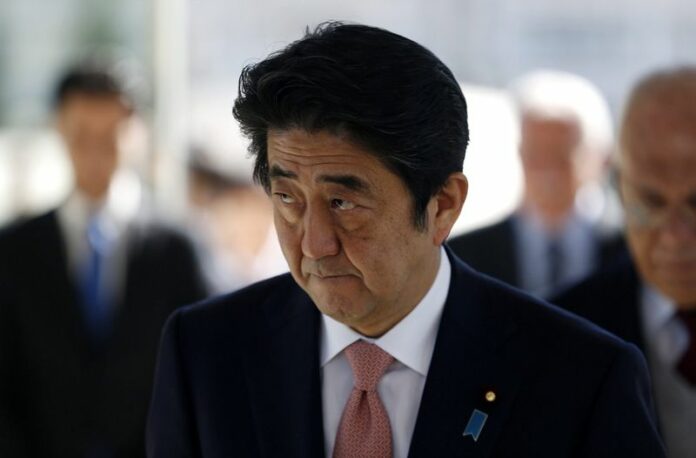
Japan's Prime Minister Shinzo Abe (center) visits the tomb of late Palestinian leader Yasser Arafat upon his arrival to the West Bank city of Ramallah, on January 20, 2015. Abe cancelled part of his trip to the Middle East to deal with reports that the Islamic State militia threatened to kill two Japanese hostages unless 200 million dollars in ransom is paid within 72 hours. EPA/MOHAMAD TOROKMAN / POOL

By Take Kambayashi and Maher Abukhater

TOKYO (DPA) — The Japanese government Wednesday called on the United States as well as European and Middle Eastern countries to help save two Japanese men held by the Islamic State militant group, as Prime Minister Shinzo Abe flew home to deal with the crisis.

Japan will "send a message calling on an immediate release of the hostages through diplomatic channels and all kinds of media," Chief Cabinet Secretary Yoshihide Suga told a news conference.

The group threatened in a video posted on the internet Tuesday to kill the two captives unless a 200-million-dollar ransom payment was made within three days.

Suga confirmed the identities of the men as Kenji Goto, a freelance journalist, and Haruna Yukawa, who works for a private security firm.

On Tuesday, Abe told reporters in Jerusalem that the threats to the hostages were "unforgivable" and demanded their immediate release.

The premier, who had planned to travel around the region until Saturday, cut short his trip and was to return to Tokyo later Wednesday to deal with the hostage situation, the Kyodo News agency reported.


For comments, or corrections to this article please contact: [email protected]

You can also find Khaosod English on Twitter and Facebook
http://twitter.com/KhaosodEnglish
http://www.facebook.com/KhaosodEnglish


Advertisement

Taxi Association Condemns 'No Japanese Passengers' Sign

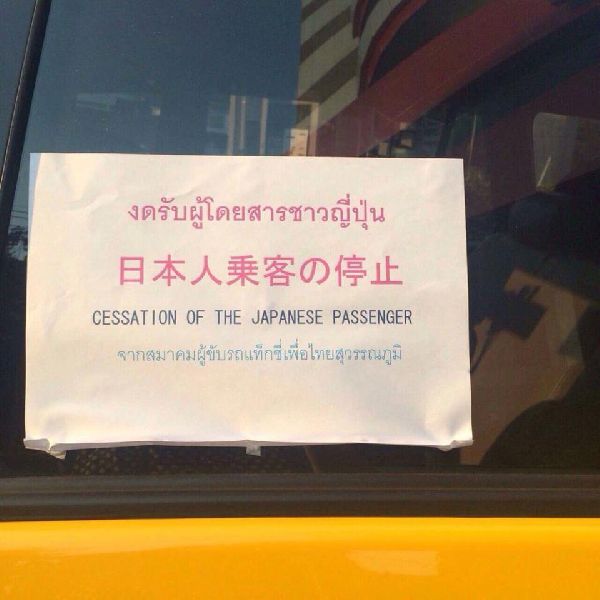
A photo widely shared on social media this morning shows a sign posted on a taxi window that says in English, Japanese, and Thai: "No picking up of Japanese passengers."

BANGKOK — A taxi association at Bangkok's international airport has condemned a cabbie who is reportedly refusing to take Japanese passengers, one day after a Japanese man made headlines with his rant against a driver who refused to turn on his meter at the airport.

A photo (below) widely shared on social media this morning shows a sign posted on a taxi window in English, Japanese, and Thai. The Thai text reads: "No picking up of Japanese passengers."  

The notice ends with the text, "From: Association of Suvarnabhumi Airport's Taxi Drivers."

\

The photo surfaced a day after airport authorities fined a taxi driver 1,000 baht and banned him from picking up passengers at Suvarnabhumi Airport for trying to overcharge a Japanese man. The punishment was carried out after the Japanese man's harsh rebuke of the cab driver, who reportedly demanded a flat-rate of 700 baht for a ride to Bangkok's Saphan Kwai district, went viral on social media.

However, Sadit Jaitiang, director of Association of Suvarnabhumi Airport's Taxi Drivers, told Khaosod in a phone interview that he had nothing to do with the notice, and only found out about the sign from social media today. 

"I have not seen the sign with my own eyes, but I have seen photos of it. Let me stress that the Association is not related to such notice in any way," Sadit said. "Taxi drivers cannot be picky. We cannot choose to take or refuse passengers of certain nationalities. If we do that, we won't have any money. We have to take care of our families."

Sadit said he is looking into who is responsible for sign, and will hold that person accountable if he or she is a member of the airport taxi association. 

"As the director of the Association, I condemn this action. The Association wholeheartedly disagrees with it. We are working to find out which driver put up the sign. If we discover that one of our members indeed put up the sign, that person will be held responsible," Sadit said. 

Hundreds of Thai internet users have vented anger at the "No Japanese" sign, with some accusing the taxi driver of racism, discrimination, and refusing to obey the regulation. Others have jokingly commented that the driver should stop using a Japanese car.

Read more:
Online Complaint Prompts Ban of BKK Airport Cab Driver

For comments, or corrections to this article please contact: [email protected]

You can also find Khaosod English on Twitter and Facebook
http://twitter.com/KhaosodEnglish
http://www.facebook.com/KhaosodEnglish

 

Advertisement

'Karaoke Dispute' Leaves One Dead in Chonburi

Rescue workers come to the aid of a man injured in a brawl at a karaoke bar in Chonburi province on 21 Jan 2015.

CHONBURI — A 31-year-old man was stabbed to death in a brawl at a karaoke bar in Chonburi province early this morning.

The victim, a 31-year-old man, died from knife wounds to his stomach, medical workers at Chonburi Hospital told reporters. Another customer is also being hospitalised for severe injuries to the head. 

Chonnidcha Inpetch, a 20-year-old waitress at the karaoke bar on Chonburi Bypass Road, told police that two groups of men were drinking at the bar that night, taking turns singing two songs per table. According to the waitress, one man's rendition of a "northeastern song" upset customers at another table, who were annoyed by his "awful singing" and tried to turn off the karaoke screen.

A fistfight between the two groups quickly erupted, with some men using knives, the waitress told police. She added that everyone fled the area soon after the fight ended, leaving the dead and the wounded at the bar.

Police say they are looking for all of the suspects. 


For comments, or corrections to this article please contact: [email protected]

You can also find Khaosod English on Twitter and Facebook
http://twitter.com/KhaosodEnglish
http://www.facebook.com/KhaosodEnglish

 

Advertisement

'Karaoke Dispute' Leaves One Dead in Chonburi

Rescue workers come to the aid of a man injured in a brawl at a karaoke bar in Chonburi province on 21 Jan 2015.

CHONBURI – A 31-year-old man was stabbed to death in a brawl at a karaoke bar in Chonburi province early this morning.

The victim, a 31-year-old man, died from knife wounds to his stomach, medical workers at Chonburi Hospital told reporters. Another customer is also being hospitalised for severe injuries to the head. 

Chonnidcha Inpetch, a 20-year-old waitress at the karaoke bar on Chonburi Bypass Road, told police that two groups of men were drinking at the bar that night, taking turns singing two songs per table. According to the waitress, one man's rendition of a "northeastern song" upset customers at another table, who were annoyed by the "awful singing" and tried to turn off the karaoke screen.

A fistfight between the two groups quickly erupted, with some men using knives, the waitress told police. She added that everyone fled the area soon after the fight ended, leaving the dead and the wounded at the bar.

Police say they are looking for all of the suspects. 


For comments, or corrections to this article please contact: [email protected]

You can also find Khaosod English on Twitter and Facebook
http://twitter.com/KhaosodEnglish
http://www.facebook.com/KhaosodEnglish

 

Advertisement

Hot News

LATEST NEWS

Bangkok
overcast clouds
30.5 ° C
32.2 °
30.5 °
78 %
4kmh
100 %
Mon
32 °
Tue
35 °
Wed
30 °
Thu
32 °
Fri
31 °