26.1 C
Bangkok
Tuesday, July 14, 2026
Home Blog Page 3246

Junta Leader Advises Thais Not To Be 'Slaves of Alcohol'

Giant candle parade in Korat for the start of Buddhist Lent, 12 July 2014.

BANGKOK — The leader of Thailand’s military junta, Gen. Prayuth Chan-ocha, has presented the public with a new slogan for this year's no-alcohol day.

"Develop Citizens to the Future, Stop Being Slaves of Alcohol," Gen. Prayuth has advised the public, according to official reports. 

Thai authorities designated the first day of Buddhist Lent as the "national no-alcohol day" in an effort to educate citizens about the hazards of alcohol.

Alcoholic beverages also cause disputes and assaults, said Narong Sahamethawat, permanent secretary of the Ministry of Public Health.

"We would like to invite the public and Thai youths not to support the businesses of intoxicating beverages, and refrain from drinking any type of alcohol during important Buddhist holidays," Mr. Narong said.

Consumption of alcohol is banned under the Fifth Precept of Buddhism. To observe the religious dogma, Thai authorities ban sales of alcohol across the country on important Buddhist holidays, such as Asalha Puja Day and first day of Buddhist Lent, which fell on yesterday and today respectively. 

However, alcohol is widely sold and consumed by Thais in the rest of the year. 


For comments, or corrections to this article please contact: [email protected]

You can also find Khaosod English on Twitter and Facebook
http://twitter.com/KhaosodEnglish
http://www.facebook.com/KhaosodEnglish

Advertisement

Junta Leader Advises Thais Not To Be 'Slaves of Alcohol'

Gen. Prayuth Chan-ocha at a press conference on 26, May 2014.

BANGKOK — The leader of Thailand’s military junta, Gen. Prayuth Chan-ocha, has presented the public with a new slogan for this year's no-alcohol day.

"Develop Citizens to the Future, Stop Being Slaves of Alcohol," Gen. Prayuth has advised the public, according to official reports. 

Thai authorities designated the first day of Buddhist Lent as the "national no-alcohol day" in an effort to educate citizens about the hazards of alcohol.

Alcoholic beverages also cause disputes and assaults, said Narong Sahamethawat, permanent secretary of the Ministry of Public Health.

"We would like to invite the public and Thai youths not to support the businesses of intoxicating beverages, and refrain from drinking any type of alcohol during important Buddhist holidays," Mr. Narong said.

Consumption of alcohol is banned under the Fifth Precept of Buddhism. To observe the religious dogma, Thai authorities ban sales of alcohol across the country on important Buddhist holidays, such as Asalha Puja Day and first day of Buddhist Lent, which fell on yesterday and today respectively. 

However, alcohol is widely sold and consumed by Thais in the rest of the year. 


For comments, or corrections to this article please contact: [email protected]

You can also find Khaosod English on Twitter and Facebook
http://twitter.com/KhaosodEnglish
http://www.facebook.com/KhaosodEnglish

Advertisement

Robber of Two Chinese Tourists in Koh Samui Arrested: Police

SURAT THANI — A burglar who robbed and slashed two 26-year-old Chinese tourists in their room on Koh Samui island has been arrested, police say.

Wutthipong Yaworn, 23, has been accused of entering a bungalow on Chaweng beach in Bo Put district and slashing two women with a knife before robbing them of their belongings. The two Chinese women were later found and sent to hospital to treat their severe injuries. 

The attack took place on the night of 26 May, during the curfew imposed by the military junta after it staged a coup several days earlier. 

At the police press conference today, Mr. Wutthipong confessed to plotting the burglary and stalking one of the two tourists to find a window of opportunity. He said he eventually entered the room through an open window when he was certain that the women were sleeping.

Mr. Wutthipong told police he took 100,000 baht in cash, an iPhone, and an iPad from the victims. After the robbery Mr. Wutthipong fled the popular resort island and hid in his hometown in Loei province, where police eventually arrested him.

Police say Mr. Wutthipong was identified by CCTV footage obtained from the hotel where the burglary took place. 

At the press conference, Mr. Wutthipong said he merely intended to rob the two women and had no intention to sexually assault the victims. His comment was likely an attempt to avoid the fate that befell a rape suspect in Trang province this week — he was beaten to death in custody by his inmates. 

Police say Mr. Wutthipong has been charged with armed burglary and carrying weapons into residential area without due cause.


For comments, or corrections to this article please contact: [email protected]

You can also find Khaosod English on Twitter and Facebook
http://twitter.com/KhaosodEnglish
http://www.facebook.com/KhaosodEnglish

Advertisement

China Outlines More Curbs For Journalists, Stifles Press Freedom

Journalists raise their hands to ask questions during a press conference by Chinese Premier Li Keqiang following the closing of the National People's Congress at the Great Hall of the People in Beijing, China, on March 13, 2014 [DPA].

By Stephan Scheuer (DPA)

BEIJING (DPA) — China has broadened its restrictions on journalists for the second time in a week, with its media regulating agency forbidding Chinese reporters from passing on any information to foreign media or publishing sensitive information on blogs and other social media.

In an attempt to bypass censorship reporters would routinely pass on their work to foreign media for publication.

In its announcement Thursday on the fresh curbs, the State Administration of Press Publication, Radio, Film and Television criticized investigative journalists and said that those who worked for state media "had abused their position."

One journalist based in Beijing called it "a disturbing development."

On Tuesday, the regulator said rules governing the disclosure of state and commercial secrets by journalists would be tightened.

It said news workers must not store, copy or record national and commercial secrets and information that has not been made public.

The new rules also force media outlets to increase oversight of sensitive material and to require its journalists and other employees to sign confidentiality agreements.

China ranks 175 of 180 countries on the press freedom index assessed by Reporters Without Borders, an international watchdog group.

On June 18, the Chinese regulator said reporters must not research contentious topics or publish critical material without prior approval.

Journalists were also barred from publishing contentious reports on blogs and other non-mainstream news websites, a strategy that was widely used to circumvent state censorship.

Those restrictions "are part of a much larger government crackdown aimed at suppressing criticism of any subject deemed harmful by the government of President Xi Jinping to its own interests," said Bob Dietz, the Asia programme coordinator of the New York-based Committee to Protect Journalists.

"It effectively undermines the watchdog role of the media by threatening to punish any journalist or media organization reporting news that has not been approved by the government," he said.

China adopted tough measures to rein in online reporting last year in the wake of Xi taking on the presidency in November 2012. Critics said the campaign aims to curb criticism of his ruling Communist Party.

Advertisement

Pro-Execution Group Defies Ban On Public Protests

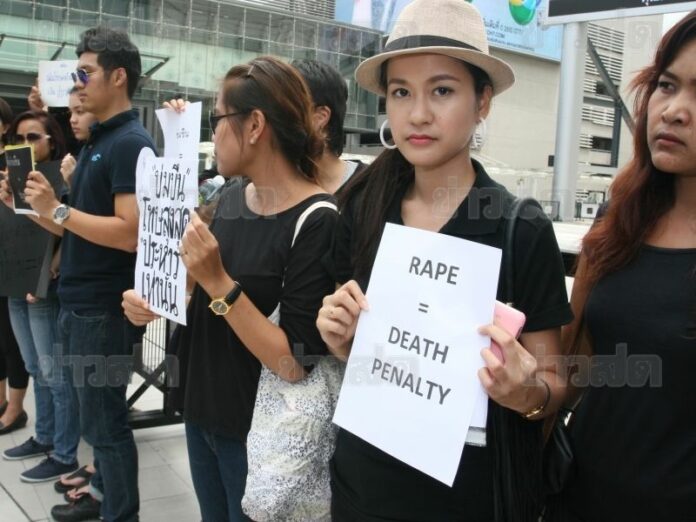
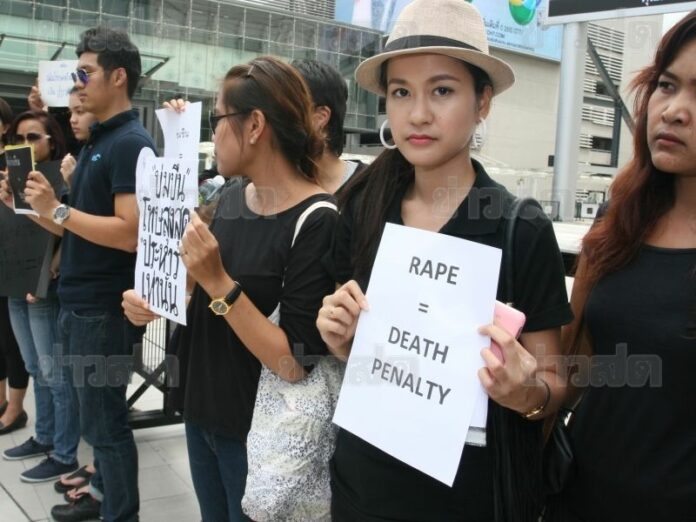
BANGKOK — Activists in favour of punishing convicted rapists with the death penalty staged a rally in downtown Bangkok today despite the military junta's warning that doing so would violate martial law.

Black-clad activists showed up at the fountain plaza in front of Siam Paragon shopping mall at around 11 am today and held signs advocating for the execution of convicted rapists.

The protest was sparked by the rape and murder of a 13-year-old girl aboard an overnight train last Sunday. An employee of the State Railway of Thailand (SRT) was arrested several days after the incident and reportedly confessed to sexually assaulting the girl and throwing her body out of the moving train. 

Although the suspect, Wanchai Saengkhao, will likely face death penalty due to his murder charge, the case has ignited an online campaign in favor executing all convicted rapists in order to deter sexual assailants in Thailand. 

Today's rally was organised by the Facebook page, "We want death penalty for rape cases."

The administrator of the Facebook page, Salita Pongsawat, 23, spoke at today’s rally.

"I want all societies in the world to be aware of importance of punishment for sexual crimes," Ms Salita said. "I don't want this kind of case to happen ever again."

According to Ms. Salita, those who assist rapists should also face the death penalty and courts should never reduce the sentences of rapists who confess. 

"There should be no leniency because if the perpetrators had hearts of humans and conscience, they would not have committed the crime when the victims plead for their lives," Ms. Salita said.

She added that an online petition to enforce the death penalty for all rapists has garnered more than 30,000 signatures and will eventually be submitted to the ruling National Council for Peace and Order (NCPO) by Thai actress Panadda Wongpoodee, another prominent supporter of death penalty for rape cases.

Selective ban on protests

Today’s rally was held in direct defiance of the NCPO's ban on public gatherings, which has been in place since the army staged a coup on 22 May. 

NCPO spokesperson Col. Winthai Suwaree warned several days ago that a rally in support of the death penalty would violate the ban. He suggested that the group submit a proposal to change the criminal code to the NCPO instead.

Scores of police officers monitored the pro-death penalty protest from afar today, but there were no attempts to stop or arrest the participants.

Several undercover police officers reacted, however, to a black-clad woman whodisplayed the anti-coup "pigeon" hand gesture next to the pro-execution activists. She left the scene shortly afterwards, trailed by the undercover police officers. Her fate is not immediately known. 

The NCPO has harshly enforced its ban on public gatherings against protesters who participate in any kind of anti-coup demonstrations, including flashing the three-finger salute, reading George Orwell's 1984, or eating sandwiches. Those who violate the NCPO's ban on protests may face a trial in military court and up to two years in prison.

However, the NCPO has not made a single arrest of anyone participating in a pro-coup or pro-army rally, including the man who showed up in front of the US Embassy in Bangkok on 29 July to protest the American government’s criticism of the 22 May coup. 

In contrast, the police issued an arrest warrant on an anti-coup activist who placed a placard that read "Long Live the USA" in front of the embassy compound on 4 July. She has since been released without charges after being held in military custody for four days. 

Ms. Panadda, the pro-execution actress, has not yet been approached by authorities for leading a pro-death penalty demonstration at a train station in Nakhon Ratchasima province on 10 July. 


Read more:
Rape-Murder Suspect Exposes State Railway's Shortcomings 
Editorial: Death Penalty Is Not The Solution To Rape


For comments, or corrections to this article please contact: [email protected]

You can also find Khaosod English on Twitter and Facebook
http://twitter.com/KhaosodEnglish
http://www.facebook.com/KhaosodEnglish


Advertisement

Pro-Execution Group Defies Ban On Public Protests

Activists in favour of punishing convicted rapists with the death penalty staged a rally in downtown Bangkok today despite the military junta's warning that doing so would violate the martial law, 12 July 2014.

BANGKOK — Activists in favour of punishing convicted rapists with the death penalty staged a rally in downtown Bangkok today despite the military junta's warning that doing so would violate martial law.

Black-clad activists showed up at the fountain plaza in front of Siam Paragon shopping mall at around 11 am today and held signs advocating for the execution of convicted rapists.

The protest was sparked by the rape and murder of a 13-year-old girl aboard an overnight train last Sunday. An employee of the State Railway of Thailand (SRT) was arrested several days after the incident and reportedly confessed to sexually assaulting the girl and throwing her body out of the moving train. 

Although the suspect, Wanchai Saengkhao, will likely face death penalty due to his murder charge, the case has ignited an online campaign in favor executing all convicted rapists in order to deter sexual assailants in Thailand. 

Today's rally was organised by the Facebook page, "We want death penalty for rape cases."

The administrator of the Facebook page, Salita Pongsawat, 23, spoke at today’s rally.

"I want all societies in the world to be aware of importance of punishment for sexual crimes," Ms Salita said. "I don't want this kind of case to happen ever again."

According to Ms. Salita, those who assist rapists should also face the death penalty and courts should never reduce the sentences of rapists who confess. 

"There should be no leniency because if the perpetrators had hearts of humans and conscience, they would not have committed the crime when the victims plead for their lives," Ms. Salita said.

She added that an online petition to enforce the death penalty for all rapists has garnered more than 30,000 signatures and will eventually be submitted to the ruling National Council for Peace and Order (NCPO) by Thai actress Panadda Wongpoodee, another prominent supporter of death penalty for rape cases.

Selective ban on protests

Today’s rally was held in direct defiance of the NCPO's ban on public gatherings, which has been in place since the army staged a coup on 22 May. 

NCPO spokesperson Col. Winthai Suwaree warned several days ago that a rally in support of the death penalty would violate the ban. He suggested that the group submit a proposal to change the criminal code to the NCPO instead.

Scores of police officers monitored the pro-death penalty protest from afar today, but there were no attempts to stop or arrest the participants.

Several undercover police officers reacted, however, to a black-clad woman who displayed the anti-coup "pigeon" hand gesture next to the pro-execution activists. She left the scene shortly afterwards, trailed by the undercover police officers. Her fate is not immediately known. 

The NCPO has harshly enforced its ban on public gatherings against protesters who participate in any kind of anti-coup demonstrations, including flashing the three-finger salute, reading George Orwell's 1984, or eating sandwiches. Those who violate the NCPO's ban on protests may face a trial in military court and up to two years in prison.

However, the NCPO has not made a single arrest of anyone participating in a pro-coup or pro-army rally, including the man who showed up in front of the US Embassy in Bangkok on 29 July to protest the American government’s criticism of the 22 May coup. 

In contrast, the police issued an arrest warrant on an anti-coup activist who placed a placard that read "Long Live the USA" in front of the embassy compound on 4 July. She has since been released without charges after being held in military custody for four days. 

Ms. Panadda, the pro-execution actress, has not yet been approached by authorities for leading a pro-death penalty demonstration at a train station in Nakhon Ratchasima province on 10 July. 


Read more:
Rape-Murder Suspect Exposes State Railway's Shortcomings 
Editorial: Death Penalty Is Not The Solution To Rape


For comments, or corrections to this article please contact: [email protected]

You can also find Khaosod English on Twitter and Facebook
http://twitter.com/KhaosodEnglish
http://www.facebook.com/KhaosodEnglish


Advertisement

Thai Halal Food Industry Eyes Indonesian Market

Samples of Thai halal food product shown at an exhibition (Prachachart file photo).

BANGKOK — Indonesian markets may provide a boost to Thai halal food exporters, a recent public panel on halal trade says.

The panel was chaired by Dujduen Sasanawin, deputy secretary of National Bureau of Agricultural Commodity and Food Standards (ACFS), and Sirindhra Chantapan, the director of Ministry of Foreign Affairs' international economy section, Prachachart reported.

Indonesian consumers are increasingly interested in halal processed food, providing a big opportunity for Thai food exporters, the panelists said. 

According to the panelists, Thailand already has an established presence of halal food producers with over 60 years of experience and strict oversight measures to ensure that no contamination occurs in assembly lines.

Indonesia, home to more than 245 million people, has been very receptive to Thai food products in the past, the panelists say. Therefore, Thai halal food processors may have an advantage in their effort to crack the Indonesian market.

However, the panelists warned that Indonesia's notorious tax wall may discourage many Thai exporters and that Malaysia could prove to be a tough competitor.

According to official data, there are over 3,200 registered halal food production companies in Thailand, with more than 90,000 types of halal products in circulation. 

 
For comments, or corrections to this article please contact: [email protected]

You can also find Khaosod English on Twitter and Facebook
http://twitter.com/KhaosodEnglish
http://www.facebook.com/KhaosodEnglish

Advertisement

Hunt For Ayutthaya Elephant Killer, Ivory Smuggler

A 40-year-old elephant was found dead, with its tusks missing, near Lopburi River yesterday morning

AYUTTHAYA — Police are searching for those responsible for killing a male elephant and sawing off its tusks, presumably to sell its ivory on the black market.

The 40-year-old male elephant was found dead with its tusks missing near Lopburi River yesterday morning. The elephant, nicknamed Klao, was owned by a local elephant breeder based in Suan Prik district. 

Pan Sala-ngam, the elephant keeeper or mahout in charge of Klao, said the elephant was separated from its herd because of its aggressive manner. A group of mahouts had been watching the elephant as he grazed in a field during the day, but no watch was set up around the field at night, Mr. Pan said. 

Police believe the perpetrators sneaked into the field at night and fed Klao a banana stuffed with sleeping pills, after which they killed the elephant and cut off its tusks.

"I wonder what the hearts of the culprits are made of. How could they be so cruel to elephants like this?" Mr. Pan said bitterly. "In the past there have been perpetrators stealing tusks from elephant enclosures in many provinces, but there haven’t been any arrests.”

Laithongrian Meepan, owner of the Wang Chang Lae Paniad elephant enclosure, said he moved more than 30 elephants into the elephant village for better security after he heard many stories of ivory traders killing elephants to remove their tusks in other provinces. Mr. Laithongrian said Klao was singled out to live outside the enclosure because of his aggressive behaviour.

"Previously, mahouts were given rifles and patrolled at night to look out for elephant killers, but recently the NCPO cracked down on the possession of firearms so mahouts have only been able to ride motorcycles to check on the elephants," Mr. Laithongrian said, referring to the military junta's National Council for Peace and Order.

He urged the authorities to take the case seriously as past perpetrators have rarely been punished. 

"This elephant was right in the middle of the city, not in a forest. They have no fear of the law," Mr. Laithongrian said. 

Based on the way in which the tusks were removed, Mr. Laithongrian said he believes the perpetrators were not mahouts or ivory experts. 

"The perpetrators must be local teenagers who are addicted to drugs." Mr. Laithongrian said. 

The elephant breeder estimated that the removed tusks are worth more than 60,000 baht in the ivory market, though they would have been worth at least 4 million baht if they were removed by experts. 

Police say they are investigating the matter.

"The illicit removal of tusks and sale of ivory is an issue that many countries are opposing," said Pol.Maj.Gen. Sermkid Sitthichaiyakan. "It causes great damage to Thailand's reputation. We will find the perpetrators." 

Calls for a ban on ivory trade

Although Thai laws criminalise the sale of ivory originating from foreign countries or wild elephants, trading ivory from domesticated elephants is legal with a proper permit. 

Ivory-crafted items are considered luxury goods and used as decorations by social institutions such as the Royal Family and the Buddhist church. The decorative fan held by the Buddhist Patriarch, for instance, is made of ivory. 

Animal rights organisations, such as the World Wildlife Fund (WWF), have repeatedly called on Thailand to ban its domestic ivory trade, arguing that it is extremely difficult to distinguish domesticated ivory from wild ivory. Ivories smuggled in from African countries are routinely "white-washed" in Thailand and sold on the market. 

According to WWF, Thailand’s ivory market is the largest unregulated ivory market in the world. 

Thailand's recent governments have refused to heed the calls for a ban on the domestic ivory trade. In the latest international conference for the Convention on the International Trade of Endangered Species (CITES), held in Thailand in 2013, then-Prime Minister Yingluck Shinawatra refused to enact legislation that would ban the ivory business. 

 
For comments, or corrections to this article please contact: [email protected]

You can also find Khaosod English on Twitter and Facebook
http://twitter.com/KhaosodEnglish
http://www.facebook.com/KhaosodEnglish

Advertisement

Hunt For Ayutthaya Elephant Killer, Ivory Smuggler

A 40-year-old elephant was found dead, with its tusks missing, near Lopburi River yesterday morning.

AYUTTHAYA — Police are searching for those responsible for killing a male elephant and sawing off its tusks, presumably to sell its ivory on the black market.

The 40-year-old male elephant was found dead with its tusks missing near Lopburi River yesterday morning. The elephant, nicknamed Klao, was owned by a local elephant breeder based in Suan Prik district. 

Pan Sala-ngam, the elephant keeeper or mahout in charge of Klao, said the elephant was separated from its herd because of its aggressive manner. A group of mahouts had been watching the elephant as he grazed in a field during the day, but no watch was set up around the field at night, Mr. Pan said. 

Police believe the perpetrators sneaked into the field at night and fed Klao a banana stuffed with sleeping pills, after which they killed the elephant and cut off its tusks.

"I wonder what the hearts of the culprits are made of. How could they be so cruel to elephants like this?" Mr. Pan said bitterly. "In the past there have been perpetrators stealing tusks from elephant enclosures in many provinces, but there haven’t been any arrests.”

Laithongrian Meepan, owner of the Wang Chang Lae Paniad elephant enclosure, said he moved more than 30 elephants into the elephant village for better security after he heard many stories of ivory traders killing elephants to remove their tusks in other provinces. Mr. Laithongrian said Klao was singled out to live outside the enclosure because of his aggressive behaviour.

"Previously, mahouts were given rifles and patrolled at night to look out for elephant killers, but recently the NCPO cracked down on the possession of firearms so mahouts have only been able to ride motorcycles to check on the elephants," Mr. Laithongrian said, referring to the military junta's National Council for Peace and Order.

He urged the authorities to take the case seriously as past perpetrators have rarely been punished. 

"This elephant was right in the middle of the city, not in a forest. They have no fear of the law," Mr. Laithongrian said. 

Based on the way in which the tusks were removed, Mr. Laithongrian said he believes the perpetrators were not mahouts or ivory experts. 

"The perpetrators must be local teenagers who are addicted to drugs." Mr. Laithongrian said. 

The elephant breeder estimated that the removed tusks are worth more than 60,000 baht in the ivory market, though they would have been worth at least 4 million baht if they were removed by experts. 

Police say they are investigating the matter.

"The illicit removal of tusks and sale of ivory is an issue that many countries are opposing," said Pol.Maj.Gen. Sermkid Sitthichaiyakan. "It causes great damage to Thailand's reputation. We will find the perpetrators." 

Calls for a ban on ivory trade

Although Thai laws criminalise the sale of ivory originating from foreign countries or wild elephants, trading ivory from domesticated elephants is legal with a proper permit. 

Ivory-crafted items are considered luxury goods and used as decorations by social institutions such as the Royal Family and the Buddhist church. The decorative fan held by the Buddhist Patriarch, for instance, is made of ivory. 

Animal rights organisations, such as the World Wildlife Fund (WWF), have repeatedly called on Thailand to ban its domestic ivory trade, arguing that it is extremely difficult to distinguish domesticated ivory from wild ivory. Ivories smuggled in from African countries are routinely "white-washed" in Thailand and sold on the market. 

According to WWF, Thailand’s ivory market is the largest unregulated ivory market in the world. 

Thailand's recent governments have refused to heed the calls for a ban on the domestic ivory trade. In the latest international conference for the Convention on the International Trade of Endangered Species (CITES), held in Thailand in 2013, then-Prime Minister Yingluck Shinawatra refused to enact legislation that would ban the ivory business. 

 
For comments, or corrections to this article please contact: [email protected]

You can also find Khaosod English on Twitter and Facebook
http://twitter.com/KhaosodEnglish
http://www.facebook.com/KhaosodEnglish

Advertisement

Junta Leader To Fight Rape With Clampdown On 'Sexually Suggestive' Media

Wanchai points to the sleeping car where he allegedly raped and murdered 13 year old girl on 6 July 2014. (Photo taken on 8 July 2014).

BANGKOK — The leader of Thailand’s military junta has vowed to crack down on sexually suggestive media in response to the rape and murder of 13-year-old girl on a state railway train last weekend.

"The print media should not present sexually provocative content which go against the good Thai tradition. This has to be cut down," said Gen. Prayuth Chan-ocha in his weekly address to the nation last night.

He said celebrities, singers, and actors should also refrain from dressing in inappropriately. 

On Tuesday, an employee of the State Railway of Thailand (SRT) reportedly confessed to raping the 13-year-old girl in a sleeping car, after which he threw her body out of the moving train. The suspect, Wanchai Saengkhao, is facing charges of premeditated murder, sexual assault, theft, and drug abuse.

The incident has sparked an outrage in Thai society, with many accusing the SRT of failing to protect to its passengers and properly screen its employees.

The state railway's widespread nepotism has also come under scrutiny after the former governor of the SRT admitted in an interview this week that some employees are hired on the basis of their connections, which may allow their possible criminal records to be overlooked.

The case has also ignited a online campaign for punishing convicted rapists with the death penalty. Under current Thai laws, those convicted of rape can face 5-20 years in prison. 

In his speech last night, Gen. Prayuth urged authorities to have "a sense of responsibility" and design strict measures to prevent such crimes from happening in the future.

"At this moment, we are solving problems like 'erecting enclosures after the cows have escaped,'" Gen. Prayuth said, using a Thai idiom. "We must solve problems in a more sustainable way. Commanding officers at all levels should be responsible for what happened – all the flaws, damages and calamities within their own organization."

On Thursday, the NCPO issued a televised announcement firing the SRT’s governor, Prapat Chongsanguan.


Read more:
Rape-Murder Suspect Exposes State Railway's Shortcomings 
Editorial: Death Penalty Is Not The Solution To Rape


For comments, or corrections to this article please contact: [email protected]

You can also find Khaosod English on Twitter and Facebook
http://twitter.com/KhaosodEnglish
http://www.facebook.com/KhaosodEnglish

Advertisement

Hot News

LATEST NEWS

Bangkok
overcast clouds
26.1 ° C
26.1 °
26.1 °
71 %
2.3kmh
100 %
Tue
38 °
Wed
39 °
Thu
32 °
Fri
35 °
Sat
36 °