
























30 C
Bangkok
Monday, July 13, 2026
Home Blog Page 3260

"Voluntourism" in Cambodian Orphanages Comes at a Cost

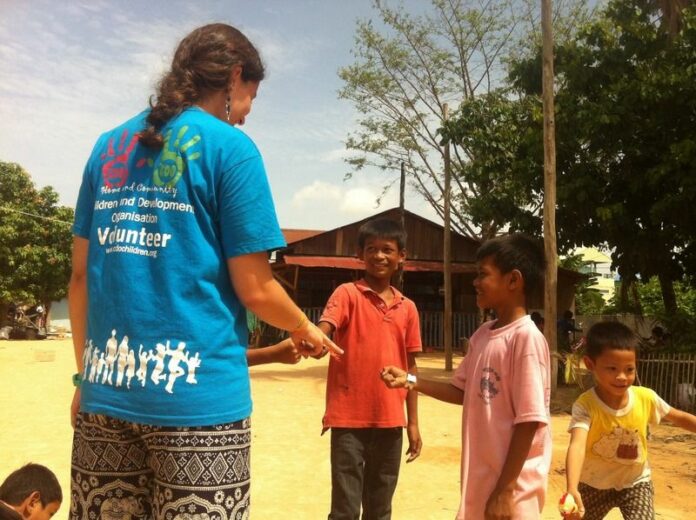
Volunteer plays with children at the CDO Orphanage in Siem Reap, Cambodia. (Credit: Kate Bartlett)

By Kate Bartlett

SIEM REAP (DPA) — A young Swedish volunteer is trying to get a gaggle of unruly Cambodian children to repeat the English alphabet, but they are much more interested in playing with the sparkly stickers they just received from a visiting tourist.

The lesson, in an outdoor classroom only a few kilometres away from Cambodia's main tourist magnet, Angkor Wat, is being given by one of the many young volunteers who are spending their summer vacations in one of the world's poorest countries.

"I was here in Siem Reap, so I just walked in and got a position. I was looking for somewhere to volunteer and teach kids who can't get an education," says Fredrick, a friendly 24-year-old backpacker who has been teaching at the orphanage for one week.

Like many other so-called "voluntourists," Fredrick has no university degree or any teaching experience.

As well as backpackers like Fredrick, Siam Reap's "orphanages" often attract Western university students who arrive during what is actually low season for visitors, with the aim of doing something altruistic on their vacation.

But Friends International, a leading child-protection group, warns that voluntourists do more harm than good.

"Although they mean well, they're fundamentally supporting flawed institutions," says James Sutherland, the organization's communications officer.

Advertisements for Friends' campaign, displayed on the backs of tuk-tuks and on leaflets in travel agencies, say, "Children are not Tourist Attractions," showing an image of Westerners photographing Cambodian children in an enclosure, like animals in a zoo.

The group points to a lack of background checks on the volunteers and inadequate training as reasons why the practice should be stopped.

In addition, Sutherland says, most of the children are not orphans at all, just children from poor families.

At Fredrick's orphanage, called the Children and Development Organization (CDO), founder and director Mom Savorn readily admits that of the 25 children in her care, only two are actually parentless.

However, she stresses, they come from a poor village and her orphanage offers them an opportunity to receive food and education.

Sutherland believes this approach is "breaking families apart."

"We firmly believe that family-based care is the best alternative," he says.

Cambodia's Ministry of Social Affairs agrees that residential care should be a "last resort."

A study by the ministry in 2012, conducted alongside Unicef, found there were 269 orphanages in Cambodia and that only 23 per cent of the almost 12,000 children in them were real orphans.

The children at CDO are relatively well-dressed but scrawny, and their dormitories are squalid. The boy's dorm, made from corrugated iron and wood, sleeps 16, the mattresses have no sheets and there is no fan.

Sara, 21, from Portugal, recently finished a degree in business and has been working at CDO for two months.

"I know some people don't understand why we bring the kids here when they have families," she said, but "they can have a better life here."

The orphanage costs approximately 2,000 US dollars per month to operate, Mom says, and receives funding from outside organizations and visitors.

"But my funds come mainly from visitors, and then they find a way to raise money [after their visits]," she says.

While Sara and Fredrick are not paying the orphanage for their experience, many websites that organize similar placements charge thousands of dollars for the favour, a practice Mom does not follow.

"In Cambodia, they always complain of corruption, so I can't charge my volunteers," Mom says.

Emma, a university student from Sydney, Australia, paid one such organization, called Projects Abroad, about 3,000 US dollars to volunteer for a few weeks at an orphanage in Siem Reap in 2012.

She now regrets doing so.

"When I got home I learned more about the tourism trade there, and it made me feel sick to think I was involved in that," she says.

"In a way it did feel like the kids were exploited for my 'experience.' They prey on the fact that some people want to help and get involved, and I think that sucks people in," she says.

CDO director Mom makes no apology for wanting to draw people into the orphanage. A billboard outside the compound reads: "Visitors Are Welcome."

The orphanage is only able to keep going through donations from tourists, she says.

Another billboard at a nearby orphanage called Acodo advertises a daily "Charity Show" with "performance, music, and songs by the vulnerable children."

The merry-go-round of voluntourists at orphanages is another serious problem, according to Friends.

"The psychological damage from these … short-term bonds causes attachment disorder," Sutherland says.

CDO has five European volunteers, including Sara and Fredrick. Asked if he's worried how his leaving will affect the children who seem very attached to him, the Swede says that is why he will stay for one or two months.

"Some people just come for a week," he says. "Why do that?"
Advertisement

"Voluntourism" in Cambodian Orphanages Comes at a Cost

Volunteer plays with children at the CDO Orphanage in Siem Reap, Cambodia. (Credit: Kate Bartlett)

By Kate Bartlett

SIEM REAP (DPA) — A young Swedish volunteer is trying to get a gaggle of unruly Cambodian children to repeat the English alphabet, but they are much more interested in playing with the sparkly stickers they just received from a visiting tourist.

The lesson, in an outdoor classroom only a few kilometres away from Cambodia's main tourist magnet, Angkor Wat, is being given by one of the many young volunteers who are spending their summer vacations in one of the world's poorest countries.

"I was here in Siem Reap, so I just walked in and got a position. I was looking for somewhere to volunteer and teach kids who can't get an education," says Fredrick, a friendly 24-year-old backpacker who has been teaching at the orphanage for one week.

Like many other so-called "voluntourists," Fredrick has no university degree or any teaching experience.

As well as backpackers like Fredrick, Siam Reap's "orphanages" often attract Western university students who arrive during what is actually low season for visitors, with the aim of doing something altruistic on their vacation.

But Friends International, a leading child-protection group, warns that voluntourists do more harm than good.

"Although they mean well, they're fundamentally supporting flawed institutions," says James Sutherland, the organization's communications officer.

Advertisements for Friends' campaign, displayed on the backs of tuk-tuks and on leaflets in travel agencies, say, "Children are not Tourist Attractions," showing an image of Westerners photographing Cambodian children in an enclosure, like animals in a zoo.

The group points to a lack of background checks on the volunteers and inadequate training as reasons why the practice should be stopped.

In addition, Sutherland says, most of the children are not orphans at all, just children from poor families.

At Fredrick's orphanage, called the Children and Development Organization (CDO), founder and director Mom Savorn readily admits that of the 25 children in her care, only two are actually parentless.

However, she stresses, they come from a poor village and her orphanage offers them an opportunity to receive food and education.

Sutherland believes this approach is "breaking families apart."

"We firmly believe that family-based care is the best alternative," he says.

Cambodia's Ministry of Social Affairs agrees that residential care should be a "last resort."

A study by the ministry in 2012, conducted alongside Unicef, found there were 269 orphanages in Cambodia and that only 23 per cent of the almost 12,000 children in them were real orphans.

The children at CDO are relatively well-dressed but scrawny, and their dormitories are squalid. The boy's dorm, made from corrugated iron and wood, sleeps 16, the mattresses have no sheets and there is no fan.

Sara, 21, from Portugal, recently finished a degree in business and has been working at CDO for two months.

"I know some people don't understand why we bring the kids here when they have families," she said, but "they can have a better life here."

The orphanage costs approximately 2,000 US dollars per month to operate, Mom says, and receives funding from outside organizations and visitors.

"But my funds come mainly from visitors, and then they find a way to raise money [after their visits]," she says.

While Sara and Fredrick are not paying the orphanage for their experience, many websites that organize similar placements charge thousands of dollars for the favour, a practice Mom does not follow.

"In Cambodia, they always complain of corruption, so I can't charge my volunteers," Mom says.

Emma, a university student from Sydney, Australia, paid one such organization, called Projects Abroad, about 3,000 US dollars to volunteer for a few weeks at an orphanage in Siem Reap in 2012.

She now regrets doing so.

"When I got home I learned more about the tourism trade there, and it made me feel sick to think I was involved in that," she says.

"In a way it did feel like the kids were exploited for my 'experience.' They prey on the fact that some people want to help and get involved, and I think that sucks people in," she says.

CDO director Mom makes no apology for wanting to draw people into the orphanage. A billboard outside the compound reads: "Visitors Are Welcome."

The orphanage is only able to keep going through donations from tourists, she says.

Another billboard at a nearby orphanage called Acodo advertises a daily "Charity Show" with "performance, music, and songs by the vulnerable children."

The merry-go-round of voluntourists at orphanages is another serious problem, according to Friends.

"The psychological damage from these … short-term bonds causes attachment disorder," Sutherland says.

CDO has five European volunteers, including Sara and Fredrick. Asked if he's worried how his leaving will affect the children who seem very attached to him, the Swede says that is why he will stay for one or two months.

"Some people just come for a week," he says. "Why do that?"
 

Advertisement

Postal Service Offers 2,000 Baht for Losing 1.7 Mil in Lotto Tickets

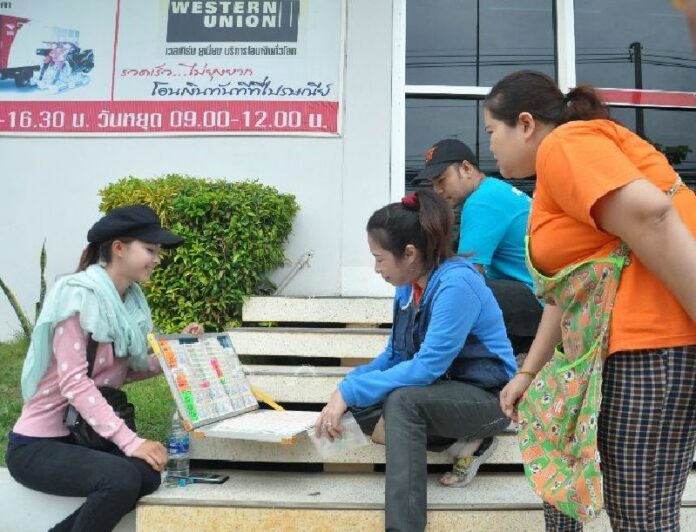
Fortune seekers buy lottery tickets from a vendor in Kanchanaburi province, 12 June 2014 [MATICHON].

BANGKOK — Thailand’s postal service will compensate the Governmental Lottery Office (GLO) a meager sum of 2,000 baht for losing 1.7 million baht worth of lottery tickets in the mail.

"Its much less than the actual damage," complained Kunthira Tantirangsi, deputy director of the GLO. 

The loss occurred on 5 June when a mail truck carrying 16 bundles of lottery tickets in Ayutthaya province lost two packages of lotteries en route to its destination. The truck was driven by an employee of the state-owned Thailand Post who was accompanied by a GLO official.

The pair told police they realised on their way home that the back of the truck had been open. The two missing bundles contained a total of 42,800 lottery tickets, which have since been nullified by the GLO. 

The GLO will only be given 2,000 baht for the damages because Thailand’s postal service allows a maximum compensation of 1,000 baht per lost package, Ms. Kunthira said.

She said the GLO did not apply for insurance because it would have greatly raised the price of transportation. She added that this is the first time in the 30 years that GLO has been using Thailand Post that there has been a problem. 

"The GLO would like to ask Thailand Post to consider additional help for us," Ms. Kunthira said, adding that the GLO is also planning to insure all of its lottery packages from now on.

The police say they are investigating incident. No suspects have been charged of any crimes in connection with the missing lottery tickets yet. 


For comments, or corrections to this article please contact: [email protected]

You can also find Khaosod English on Twitter and Facebook
http://twitter.com/KhaosodEnglish
http://www.facebook.com/KhaosodEnglish

Advertisement

Russia Expects "Straightforward" Extradition of Alleged Mob Boss

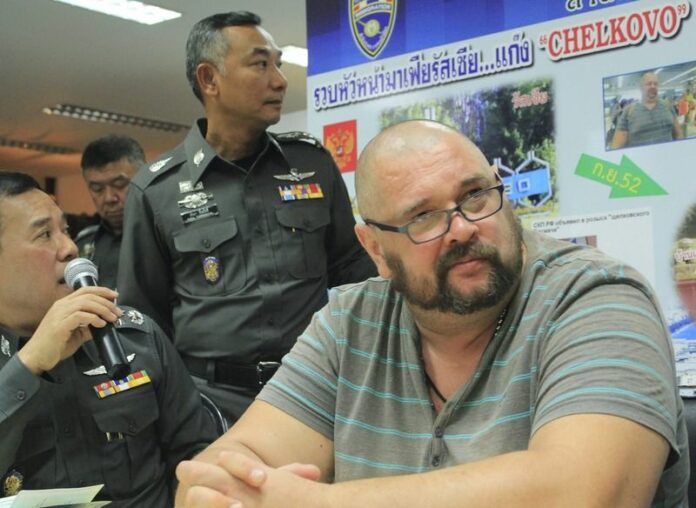
Alleged Russian born mafia leader Alexander Matusov (R) attends a press conference with police at the Immigration Bureau in Bangkok, Thailand, 25 June 2014. Thai police have arrested the alleged Russian mafia leader of the Chelkovo gang who is thought to be involved in the murder of more than 60 people and other criminal activities since 1995 in Moscow, police said. EPA/STR

BANGKOK (DPA) — Russia does not foresee problems in extraditing a suspected mob boss that was captured in Thailand, an embassy official said Thursday.

"We are just waiting for Interpol officers to come to Bangkok and begin the extradition process," said Alexander Myrkin, a press officer at the Russian embassy in Bangkok.

Alexander Matusov was captured on Wednesday in the city of Chonburi, 100 km east of Bangkok.

He is of accused of leading a criminal group in Russia that has been responsible for over 60 murders and other criminal activity.

Matusov entered Thailand in 2009 using a fake passport and has been living in the country on a retirement visa ever since, Thai immigration police in Chonburi said.

"This (extradition) will not be a long process like the Viktor Bout case. We expect it to be straightforward," Myrkin said. 

Arms dealer Viktor Bout was at the centre of a long extradition battle between Russia and the United States.

He was extradited to the US in 2010 after spending two years in a Thai prison.


Advertisement

160 Dead And Thousands Displaced by Taliban Offensive in Afghan South

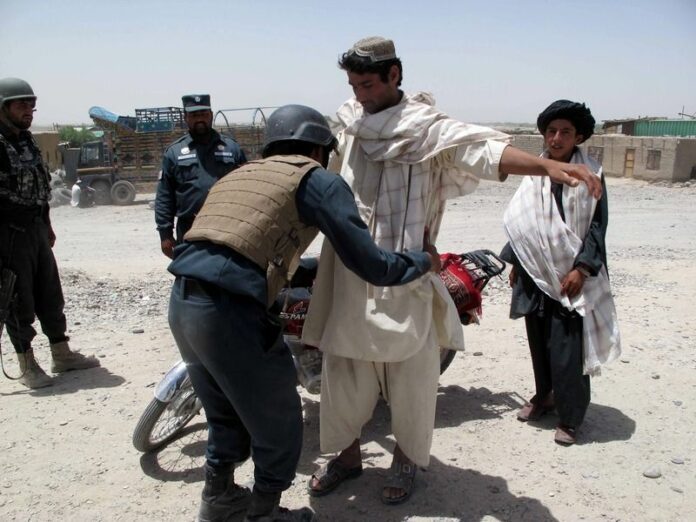
An Afghan security official frisks a man at a check point in Helmand, Afghanistan. According to media reports 100 Taliban militants, 35 civilians and 21 security officials were killed during a gunbattle in Sangin district of volatile Helmand (DPA).

KABUL (DPA) — 160 people have died and thousands displaced by clashes between Taliban militants and Afghan security forces in four volatile districts in the country's south, officials said Wednesday.

"Overnight attacks by militants on security force checkpoints have been carried out since Friday targeting police in Nawzad district," said Abdul Bari Barakzai, head of Helmand provincial council.

"Later on, they spread their attacks to Sangin, Kajaki and Musa Qala districts," Barakzai told dpa.

He said 40 civilians "have so far died, while some 2,000 families have fled their villages," adding that 21 security forces and 100 militants had been killed in the fighting.

Barakzai added that reinforcements were sent to the districts. "We have more than 20,000 soldiers and enough police in Helmand who can repel the insurgents," he said.

Qari Yousuf Ahmadi, a spokesman for the Taliban, said: "The mujahideen captured several checkpoints and killed and injured dozens of soldiers and police."

President Hamid Karzai called on the Taliban to refrain from killing civilians, and ordered a 5 million-Afghani (90,000-dollar) donation to the victims of the attacks.

In Brussels, meanwhile, NATO Secretary General Anders Fogh Rasmussen said the alliance had taken another step towards handing over full security responsibility to Afghan forces at the end of 2014, and shifting its presence to a training and support mission.

"Today, we endorsed the detailed operational plan for that new mission," Rasmussen said, adding that NATO ministers had made "concrete and also quite substantial" troop commitments, ahead of a force generation conference due to take place early next month.

The US has already pledged an initial 9,800 troops to the post-2014 mission, codenamed Resolute Support.

But Rasmussen said the "next step" now lies with Afghanistan, which must sign key agreements forming the legal underpinning for NATO to remain in the country.

This is not expected to happen before Afghanistan's appoints its next president, once the outcome of recent elections is known. Karzai's successor could be inaugurated on August 2, Afghan deputy Foreign Minister Ershad Ahmadi said in Brussels.

The alliance hopes that most details of its post-2014 mission will be settled in time for leaders to give their formal approval at a NATO summit taking place in September in Newport, Wales.

Back in Afghanistan, meanwhile, a district police chief and his bodyguard were killed in Ghazni province.

"Hadi Moayyat, police chief for Khoja Omari distric was on his way to the district when a roadside bomb hit his car on the outskirts of the district at 1 pm (0830 GMT)," said Mohammad Ali Ahmadi, deputy provincial governor.

He said that three other police officers in the car were injured. In the northern province of Faryab, four civilians including two children were killed by a remote-controlled bomb

"The militants had concealed the bomb in a water container in Dawlat Abad district, and asked a child to carry the container to the district governor's house," said Javed Bedar, the spokesman for the provincial governor.

Nine civilians and a police officer were injured in the explosion, Bedar said.

Advertisement

Chiang Mai Army Hunts Down 'Red Buffalo' Shirts

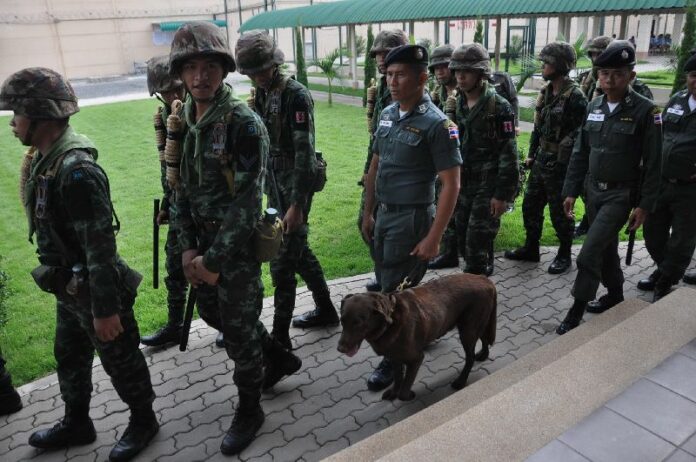
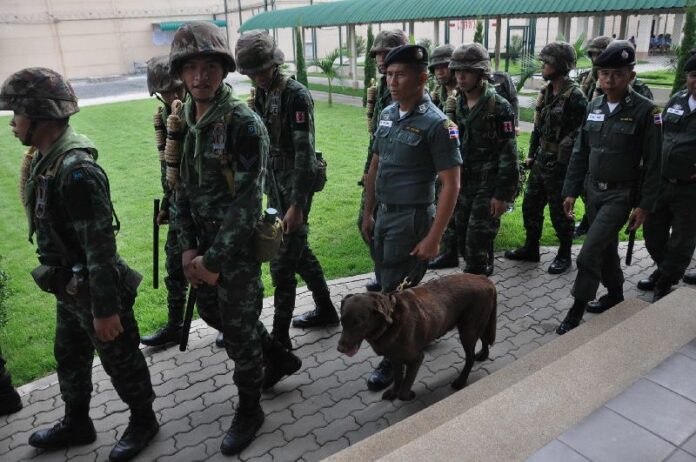
Military officers inspect a prison in Chiang Mai.

CHIANG MAI — Military officers in Chiang Mai are scouring every market in the city to search for ‘red buffalo’ t-shirts they say are causing a conflict in society.

The controversial t-shirts depict a red buffalo stamping on a cockroach in a symbolic representation of Thailand’s rival political factions. Critics of the Redshirt movement commonly refer to its supporters as “buffalos,” a Thai idiom for “stupid people,” because many of the group’s members hail from Thailand’s rural North and Northeast. The opposing Yellowshirt faction is mostly composed of Bangkok-based middle and upper class elites.

The cockroach depicted on the t-shirt refers to Redshirts’ nickname for the Democrat Party, which is allied to the Yellowshirt movement. Redshirts commonly refer to the establishment-backed party as “the cockroach party” because it has been around for so long and “refuses to die.” The Democrat Party is the oldest political party in Thailand, although it has not won a national election for more than two decades.

Today, soldiers were dispatched to all of Chiang Mai city’s markets, including Ton Lam Yai market and Warorot market, to search clothes shops for the “offensive” t-shirts that have become popular among Redshirt activists in Chiang Mai province.

A leader of the local Redshirt group "Love Chiang Mai 51" said some Redshirts were told that the shirts violate the atmosphere of reconciliation imposed by the military junta's National Council for Peace and Order (NCPO). The activist advised all Redshirt supporters to refrain from wearing the shirts for their own safety. 

Since staging a coup on 22 May, the NCPO has harshly cracked down on the Redshirt movement, which supported the former government led by Ms. Yingluck Shinawatra. The junta has summoned and detained scores of politicians, activists, and academics, many of whom are seen as sympathetic to Redshirt causes. Those released from military custody have been forced to promise they will not participate in any political activities. 

The crackdown has caused many Redshirt supporters to stop wearing their iconic red shirts or publicly express their loyalty to former Prime Minister Thaksin Shinawatra, Ms. Yingluck's brother and the Redshirt movement’s de facto leader.

Although military spokespersons have insisted that the junta treats all political groups in Thailand equally, Redshirt critics say the military's crackdown on freedom of expression has been disproportionately directed at supporters of their movement. 


For comments, or corrections to this article please contact: [email protected]

You can also find Khaosod English on Twitter and Facebook
http://twitter.com/KhaosodEnglish
http://www.facebook.com/KhaosodEnglish

Advertisement

US: Coup Will Not Lead To Reconciliation That Thailand Needs

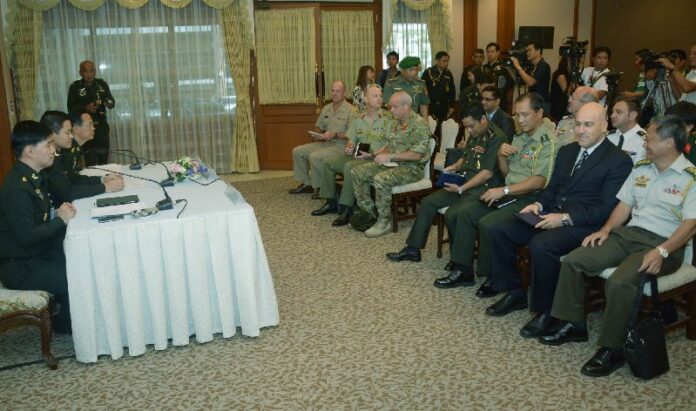
Spokespersons for the Thai military junta speak to a room of foreign military attaches, 25 June 2014.

BANGKOK — A senior US official has asked for support from the US Congress to help move Thailand back to a democratic system of government.

“The coup and post-coup repression have made it impossible for our relationship with Thailand to go on with ‘business as usual,’” Scot Marciel, Principal Deputy Assistant Secretary of Asian Affairs, said in a congressional hearing yesterday.

“Strong, enduring, bipartisan Congressional support for our efforts to move Thailand back towards its democratic tradition and to preserve our long-term friendship and interests are essential for a successful outcome.”

Mr. Marciel told a Foreign Affairs subcommittee that he initially hoped the Thai military would return power to a civilian government soon after staging a coup d’etat on 22 May. “However, recent events have shown that the current military coup is both more repressive and likely to last longer than the last one,” Mr. Marciel said.  

After the Thai army staged  a coup d'etat last month, the United States suspended more than $4.7 million in military aid and cancelled a number of training programs with the Thai military. Mr. Marciel said the US is ready to “consider further measures as circumstances warrant.”

Since seizing power, the Thai military junta, dubbed The National Council for Peace and Order, has launched a series of repressive measures to silence dissent. The coupmakers have severely restricted freedom of expression through bans on political demonstrations, media censorship, and arbitrary detainment of perceived critics.

“We do not believe that true reconciliation can come about through fear of repression,” Mr. Marciel said yesterday. “The deep-rooted underlying issues and differences of opinion that fuel this division can only be resolved by the people of Thailand through democratic processes.” 

The US's criticism of the military coup has provoked backlash among pro-coup Thais, most of whom are supporters of the country's conservative and royalist political faction. 

Some pro-coup supporters have launched a campaign on social media calling for a "boycott" of products made in or imported from the US as a retaliatory gesture against the American government, though no concrete action has been taken so far. 
 
Anti-American rhetoric has been also been featured on a number of conservative media agencies in Thailand that support the military takeover. For instance, an editorial published by ultra-nationalist Naewna newspaper criticises the US government for "taking stance against the military coup and harbouring prejudice against the Thai authorities without bothering to consider the facts."
 
"Although the Thai authorities, especially the Ministry of Foreign Affairs, have been unceasingly trying to inform the American authorities about the facts, the American authorities ignore these explanations, and continue to evaluate the situation based on their own opinion, which is in clear contradiction with reality," said the editorial, which was published on 23 June. 
 
Supporters of the coup have frequently argued that foreign critics do not understand the political situation in Thailand. “Thai people are used to coup d’états, it’s the Thai style," a pro-Army activist told Khaosod English at one of the army's "Returning Happiness" concerts. 
 
"The US is snooping," said the concertgoer, who asked not to be named. "I hear they support coups in some countries, so why not here?"
 
 
For comments, or corrections to this article please contact: [email protected]

You can also find Khaosod English on Twitter and Facebook
http://twitter.com/KhaosodEnglish
http://www.facebook.com/KhaosodEnglish

 
Advertisement

Chiang Mai Army Hunts Down 'Red Buffalo' Shirts

Military officers inspect a prison in Chiang Mai.

CHIANG MAI — Military officers in Chiang Mai are scouring every market in the city to search for ‘red buffalo’ t-shirts they say are causing a conflict in society.

The controversial t-shirts depict a red buffalo stamping on a cockroach in a symbolic representation of Thailand’s rival political factions. Critics of the Redshirt movement commonly refer to its supporters as “buffalos,” a Thai idiom for “stupid people,” because many of the group’s members hail from Thailand’s rural North and Northeast. The opposing Yellowshirt faction is mostly composed of Bangkok-based middle and upper class elites.

The cockroach depicted on the t-shirt refers to Redshirts’ nickname for the Democrat Party, which is allied to the Yellowshirt movement. Redshirts commonly refer to the establishment-backed party as “the cockroach party” because it has been around for so long and “refuses to die.” The Democrat Party is the oldest political party in Thailand, although it has not won a national election for more than two decades.

Today, soldiers were dispatched to all of Chiang Mai city’s markets, including Ton Lam Yai market and Warorot market, to search clothes shops for the “offensive” t-shirts that have become popular among Redshirt activists in Chiang Mai province.

A leader of the local Redshirt group "Love Chiang Mai 51" said some Redshirts were told that the shirts violate the atmosphere of reconciliation imposed by the military junta's National Council for Peace and Order (NCPO). The activist advised all Redshirt supporters to refrain from wearing the shirts for their own safety. 

Since staging a coup on 22 May, the NCPO has harshly cracked down on the Redshirt movement, which supported the former government led by Ms. Yingluck Shinawatra. The junta has summoned and detained scores of politicians, activists, and academics, many of whom are seen as sympathetic to Redshirt causes. Those released from military custody have been forced to promise they will not participate in any political activities. 

The crackdown has caused many Redshirt supporters to stop wearing their iconic red shirts or publicly express their loyalty to former Prime Minister Thaksin Shinawatra, Ms. Yingluck's brother and the Redshirt movement’s de facto leader.

Although military spokespersons have insisted that the junta treats all political groups in Thailand equally, Redshirt critics say the military's crackdown on freedom of expression has been disproportionately directed at supporters of their movement. 


For comments, or corrections to this article please contact: [email protected]

You can also find Khaosod English on Twitter and Facebook
http://twitter.com/KhaosodEnglish
http://www.facebook.com/KhaosodEnglish

Advertisement

Pheu Thai Denies Links to Anti-Coup Group in Exile

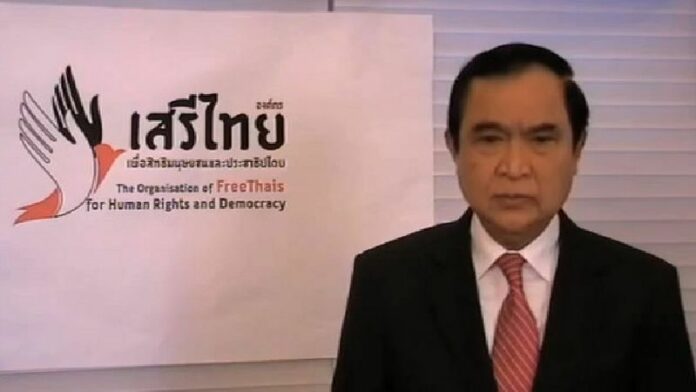
Mr. Jarupong unveiled a group called The Organization of Free Thais for Human Rights and Democracy (FTHD) in a video published on social media, 24 June 2014.

BANGKOK — The ruling party of the former government has denied any link with the anti-coup organisation founded in exile by its former leader, Jarupong Ruangsuwan.

"It's just a personal opinion," said Chawalit Witchayasutthi, deputy secretary-general of Pheu Thai Party. "We respect Mr. Jarupong's ideas and ideologies, but the Pheu Thai Party must stay under the framework of rules and laws."  

Mr. Jarupong, the leader of the Pheu Thai Party until the 22 May coup, announced the formation of an anti-coup group on 24 June, coinciding with 82nd anniversary of the 1932 Revolution that replaced Thailand’s absolute monarchy with a constitutional democracy.

Mr. Jarupong unveiled the group, called The Organization of Free Thais for Human Rights and Democracy (FTHD), in a video published on social media. Another video showed former minister and prominent activist Jakrapob Penkair reading the group's founding statement in English. Both leaders are thought to be currently residing in Cambodia.

The FTHD has not yet outlined how it will campaign against the Thai military junta, and it remains unclear how influential the group will be in organizing resistance among Redshirts, the Northern-based populist group allied to the Pheu Thai party.

The Redshirt’s umbrella organisation, the United Front of Democracy Against Dictatorship (UDD), has not lent its support to Mr. Jarupong's group.

Mr. Chawalit, the deputy secretary of Pheu Thai Party, insisted yesterday that no high-ranking party members will oppose the military junta in any way.

"We won't do anything that will affect the peace of the country, to allow the NCPO to proceed with its road map to return democracy to Thailand," Mr. Chawalit told reporters, referring to the military junta’s National Council for Peace and Order (NCPO). "We want to be a part of the process to return democracy to Thailand.

Col. Weerachon Sukondhapatipak, a spokesperson of the NCPO, said today that Thai people should judge for themselves whether they support the movement founded by Mr. Jakrapob and Mr. Jarupong.

"They don't have to think of the NCPO or the military. Please think of the entire population of Thailand," Col. Weerachon said. "They should weigh who is more important, the pair [Mr. Jakrapob and Mr. Jarupong] or the entire Thai people."

Col. Weerachon added that he believes both former politicians are still residing in foreign countries, and that the Ministry of Foreign Affairs will use its diplomatic channels to seek legal prosecution against the FTHD founders.

Mr. Jakrapob fled to Cambodia in 2009 after he was accused by conservative politicians of insulting the Thai Royal Family, while Mr. Jarupong is understood to have left the country soon after the 22 May coup.


For comments, or corrections to this article please contact: [email protected]

You can also find Khaosod English on Twitter and Facebook
http://twitter.com/KhaosodEnglish
http://www.facebook.com/KhaosodEnglish

Advertisement

EU Condemnation Prompts Thai Military To End 'Special Detention'

Redshirt activist Kritsuda Khunasen was released yesterday after spending nearly three weeks in military secret custody, 24 June 2014.

BANGKOK — The European Union’s move to cut ties with Thailand in protest of last month’s coup has prompted the Thai military to release all detainees who were held in "special circumstances," says the junta’s spokesperson.

"The NCPO would like to confirm that we have now released all detainees who had been held in special circumstances," said Col. Winthai Suwaree, spokesperson of the ruling National Council for Peace and Order (NCPO). 

"We will send information about their release, the situation of human rights, and our efforts to return Thailand to democracy to inform and create understanding with foreign countries, especially the EU members," Col. Winthai added.

It is still unclear what "special circumstances" means, but it could refer to detainees that are held in undisclosed locations for more than seven days, which is the maximum amount of time permitted under martial law. Yesterday, Redshirt activist Kritsuda Khunasen was released after spending nearly three weeks in military custody.

Col. Winthai's comments came several days after the EU suspended official visits to and from Thailand and placed a hold on signing a cooperation agreement in an effort to pressure the Thai military junta to restore an electoral democracy.

The military leadership's plan for the country “falls short of the credible roadmap for a return to constitutional rule which the situation requires,” the EU statement said. “Fully functioning democratic institutions must be brought back to ensure the protection and welfare of all citizens."

The EU added that it "will consider further possible measures, depending on circumstances."

The governments of the United States and Australia have also scaled back relations with Thailand in opposition to the 22 May coup d'etat. 

In response to condemnation from these western allies, the Thai junta has argued that the coup was necessary to restore stability and that foreign observers do not understand the situation in Thailand correctly.

"We try to epxlain that a democratic regime has many details and complications. Elections are just a part of democracy. We have to ensure that expression under democracy does not lead to bloodshed," Col. Winthai said today.

For comments, or corrections to this article please contact: [email protected]

You can also find Khaosod English on Twitter and Facebook
http://twitter.com/KhaosodEnglish
http://www.facebook.com/KhaosodEnglish

Advertisement

Hot News

LATEST NEWS

Bangkok
overcast clouds
30 ° C
30 °
30 °
71 %
5.6kmh
100 %
Mon
35 °
Tue
37 °
Wed
30 °
Thu
32 °
Fri
34 °