


























28.8 C
Bangkok
Sunday, July 12, 2026
Home Blog Page 3264

Defender of Fake Bomb Detector Appointed Top Forensic Science Job

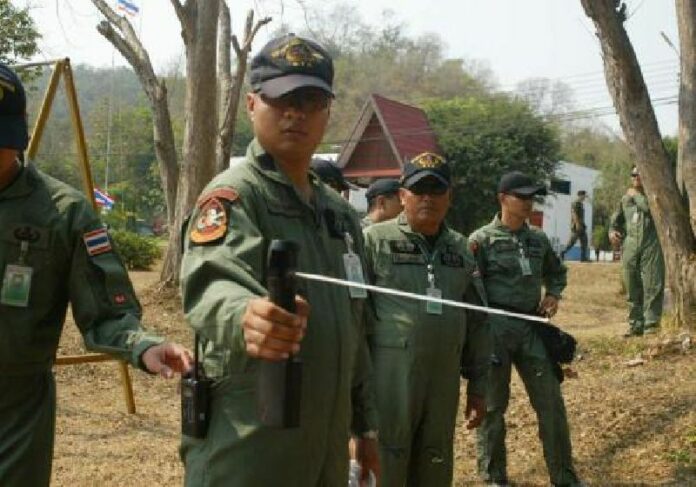
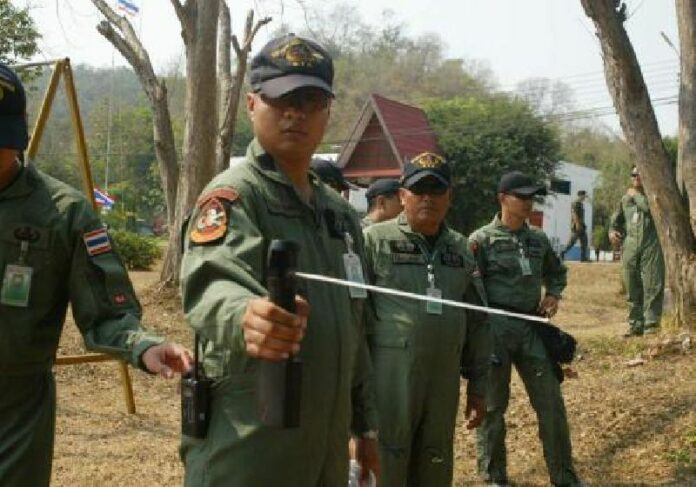
Soldiers in Pathani province display the GT200 in 2010.

BANGKOK — A previously-vocal supporter of fake bomb detectors has been re-appointed as the head of the Central Institute of Forensic Science in Thailand.

Porntip Rojanasunan confirmed to Khaosod English today that the military junta’s National Council for Peace and Order (NCPO) approved her reinstatement on Tuesday, but the official order was only relayed to the Ministry of Justice yesterday.

“I am a bureaucrat. I am ready to work to my best ability,” Ms. Porntip replied when asked how she felt about the reinstatement. “I would also like to thank the NCPO for giving me this opportunity.”

Ms. Porntip’s return to the helm of the forensic science institute did not come as a surprise to many. Ms. Porntip was a staunch supporter of the political faction that protested against the previous government and widely celebrated the military’s coup d’etat on 22 May.

After seizing control of the country’s government, the NCPO has removed many top officials known for their affiliation with former Prime Minister Yingluck Shinawatra and replaced them with those who are sympathetic to the coup.

Ms. Porntip’s reinstatement has also raised concerns that she may decide to resume the uses of GT200, a version of the fake bomb-detecting device sold by a British businessman to Thailand several years ago. British businessman James McCormick sold thousands of the phony detectors were at extortionate prices to countries such as Iraq, Pakistan, and Thailand.

Thai security officers used them for several years to look for potential explosives in the southern border provinces, where separatist violence has claimed over 6,000 lives since 2002.

Mr. McCormick, who was convicted of fraud and sentenced to 10 years in jail, claimed the devices could detect a wide range of substances, such as explosives or narcotics, by analysing molecular components from a distance. Mr. McCormick’s company told customers that the long dials attached to the detectors would swing and point to any suspicious materials.

In reality, the devices were completely ineffectual and modeled after $20 golf-ball finders Mr. McCormick had purchased in the United States.

After a number of scientists challenged the validity of the devices, the Thai authorities staged a scientific test of GT200 in 2010. The result established the GT200’s accuracy to be as good as random chance.

But Ms. Porntip, who was the head of the CIFS at the time, defended the effectiveness of the device. She admitted that the GT200 has failed scientific tests, but insisted that it did not matter because the devices themselves not operate on any scientific principle.

“GT200 is not scientific either, it depends on the operators. The officials of the CIFS have used it with great efficiency,” Ms. Porntip was quoted as saying in February 2010.

However, in the phone interview with Khaosod English today, Ms. Porntip claimed that the media misunderstood her position.

“I was only criticising people who criticised scientists and the military and called them stupid for having faith in the devices,” Ms. Porntip said.

She explained that she sympathised with security officers in the Deep South who trusted the devices, despite their inaccuracy, because they had no other tools to rely on.

Asked whether that means GT200 will be brought back, Ms. Porntip replied that security officers stopped using the devices a long time ago and refused to comment further on the question.

“This question is like asking for trouble,” Ms. Porntip said.

Meanwhile, former CIFS director Anek Yomchinda said he did not dispute the NCPO’s decision to replace him with Ms. Porntip.

“I am ready to follow any orders in strict manner. I do not dispute them. I have no feelings about them,” Mr. Anek said.
Advertisement

Defender of Fake Bomb Detector Appointed Top Forensic Science Job

Soldiers in Pathani province display the GT200 in 2010.

BANGKOK — A previously-vocal supporter of fake bomb detectors has been re-appointed as the head of the Central Institute of Forensic Science in Thailand.

Pornthip Rojanasunand confirmed to Khaosod English today that the military junta's National Council for Peace and Order (NCPO) approved her reinstatement on Tuesday, but the official order was only relayed to the Ministry of Justice yesterday. 

"I am a bureaucrat. I am ready to work to my best ability," Ms. Pornthip replied when asked how she felt about the reinstatement. "I would also like to thank the NCPO for giving me this opportunity."

Ms. Pornthip's return to the helm of the forensic science institute did not come as a surprise to many. Ms. Pornthip was a staunch supporter of the political faction that protested against the previous government and widely celebrated the military's coup d'etat on 22 May. 

After seizing control of the country's government, the NCPO has removed many top officials known for their affiliation with former Prime Minister Yingluck Shinawatra and replaced them with those who are sympathetic to the coup.

Ms. Pornthip’s reinstatement has also raised concerns that she may decide to resume the uses of GT200, a version of the fake bomb-detecting device sold by a British businessman to Thailand several years ago. British businessman James McCormick sold thousands of the phony detectors were at extortionate prices to countries such as Iraq, Pakistan, and Thailand. 

Thai security officers used them for several years to look for potential explosives in the southern border provinces, where separatist violence has claimed over 6,000 lives since 2002. 

Mr. McCormick, who was convicted of fraud and sentenced to 10 years in jail, claimed the devices could detect a wide range of substances, such as explosives or narcotics, by analysing molecular components from a distance. Mr. McCormick's company told customers that the long dials attached to the detectors would swing and point to any suspicious materials.

In reality, the devices were completely ineffectual and modeled after $20 golf-ball finders Mr. McCormick had purchased in the United States.

After a number of scientists challenged the validity of the devices, the Thai authorities staged a scientific test of GT200 in 2010. The result established the GT200's accuracy to be as good as random chance.

But Ms. Pornthip, who was the head of the CIFS at the time, defended the effectiveness of the device. She admitted that the GT200 has failed scientific tests, but insisted that it did not matter because the devices themselves not operate on any scientific principle.

“GT200 is not scientific either, it depends on the operators. The officials of the CIFS have used it with great efficiency,” Ms. Pornthip was quoted as saying in February 2010.

However, in the phone interview with Khaosod English today, Ms. Pornthip claimed that the media misunderstood her position.

"I was only criticising people who criticised scientists and the military and called them stupid for having faith in the devices," Ms. Pornthip said. 

She explained that she sympathised with security officers in the Deep South who trusted the devices, despite their inaccuracy, because they had no other tools to rely on. 

Asked whether that means GT200 will be brought back, Ms. Pornthip replied that security officers stopped using the devices a long time ago and refused to comment further on the question. 

"This question is like asking for trouble," Ms. Pornthip said. 

Meanwhile, former CIFS director Anek Yomchinda said he did not dispute the NCPO's decision to replace him with Ms. Pornthip. 

"I am ready to follow any orders in strict manner. I do not dispute them. I have no feelings about them," Mr. Anek said. 


For comments, or corrections to this article please contact: [email protected]

You can also find Khaosod English on Twitter and Facebook
http://twitter.com/KhaosodEnglish
http://www.facebook.com/KhaosodEnglish


Advertisement

Myanmar's Religious Affairs Minister Fired For Embezzlement

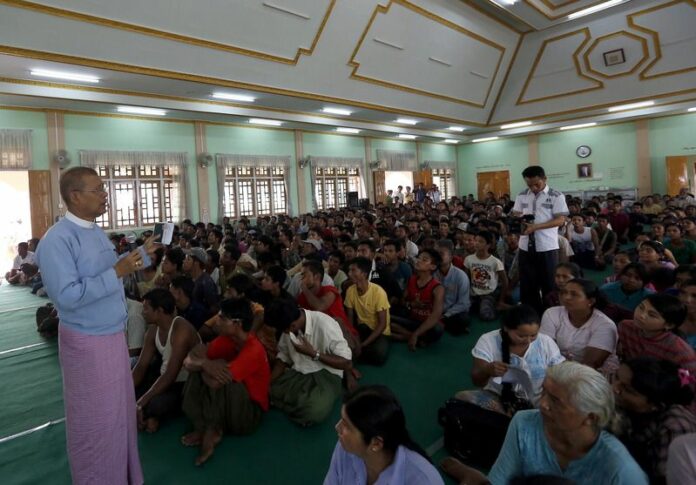
Hsan Sint (L), Myanmar's Minister of Religious Affairs, gives a speech to a group of Muslims at a temporary shelter in a Buddhist monastery in Lashio, Northern Shan State, Myanmar, 31 May 2013. Hsan Sint has been fired and charged with the misuse of around 10,000 US dollars. EPA/NYEIN CHAN NAING

YANGON (DPA) — Myanmar's minister of religious affairs has been fired and charged with the misuse of around 10,000 dollars, a government official said Friday.

The departure of Religious Affairs Minister Hsan Sint coincides with the arrest of five Buddhist monks last week after a well-known monastery was raided in a late-night operation in Yangon.

"He is now under investigation for misuse of a fund of around 10,000,000 kyat (10,225 dollars)," said a government official from the president's office who asked not to be named.

Some local media reports said Hsan Sint was sacked because opposed the monastery raid.

Officials from the Ministry of Religious Affairs, accompanied by around 300 riot police, seized the monastery in Yangon on June 10.

Its ownership is disputed between the government-appointed high-ranking Buddhist monk association, the State Sangha Maha Nayaka Committee, and the popular abbot Pyinya Wuntha.

Five senior monks were defrocked and sent to Yangon's Insein prison by the authorities on June 13. They will be charged with trespassing, police said last week.

The government also announced on state media that the chief minister of Rakhine state has retired but gave no explanation.

Rakhine state has seen a series of sectarian clashes between Buddhists and Muslims since June 2012 that has brought international criticism.


Advertisement

Anti-Coup Minister Gets New Charge, Could Face 14 Years Behind Bars

Chaturon Chaisang, former Education minister, heard a third charge of violating the Computer Crimes Act in martial court, 20 June 2014.

BANGKOK — A cabinet member of the former government could face up to 14 years in prison for the press conference he gave to foreign correspondents prior to his arrest.

Chaturon Chaisang, who served as Education Minister in the previous government, was summoned by the National Council for Peace and Order (NCPO) shortly after it staged a coup on 22 May. 

Mr. Chaturon initially refused to surrender himself and went into hiding. Five days later, he staged a press conference at the Thailand's Foreign Correspondent Club (FCCT) in Bangkok to announce that he was willing to turn himself in. 

Soldiers stormed the club and detained Mr. Chaturon as he was giving an interview to more than 100 foreign reporters. He was sent to martial court to face charges of defying the NCPO's summons order and inciting unrest, after which he was released on bail.

But at a second court hearing today Mr. Chaturon was informed that he will also be charged with violating the Computer Crimes Act. 

Mr. Chaturon told reporters that his prosecutors claimed he violated Section 14.3 of the Computer Crime Act, which criminalises “the input, into a computer system, of any computer data that is an offence related to national security or an offence related to terrorism.”

According to Mr. Chaturon, the prosecution argued that his speech at the FCCT, which he typed and distributed to the foreign press, constituted a violation of the Computer Crimes Act. His speech criticized the coup and called for an immediate return to democracy.

The three charges could amount to a maximum of 14 years in prison, Mr. Chaturon said.

"They only told me about the charge of the Computer Crimes Act 15 minutes before the hearing," Mr. Chaturon said. "I am very surprised and suspicious about this irregularity. I wonder if they intended to use it as an excuse for more witness examination so they could ask for the power to detain me."

However, the court rejected prosecutors' request to detain Mr. Chaturon for questioning and renewed the former minister’s release on bail.

Mr. Chaturon insisted that he would fight his case to the very end.

"This is the first case in 30 years of a civilian being tried in a military court for having different opinions, " said Mr. Chaturon, a former student activist who watched fellow activists stand trials in military court in late 1970s. 

He also insisted that he would continue to use his limited freedom during his bail release to develop and propose ideas for Thailand's democracy. 

"I am thinking and reading a lot at the moment, because I can't meet with anyone," Mr. Chaturon said. "When it is appropriate, I will present my ideas. As for now, I would like to comment that in order to have democracy, reforms, and reconciliation, many sides must be able to participate in the process."

The NCPO  is currently pursuing a heavy-handed campaign to bring about reconciliation, reform, and "happiness" to Thai society. To accomplish these ambitious goals, the junta has formed "reconciliation centres" for dialogues between rival political groups, established a reform committee, and staged free fairs and concerts around the country. 

The campaign has been accompanied by the NCPO's harsh crackdown on any voices of dissent. Since it seized power from the elected government last month, the military junta has summoned and detained hundreds of individuals, censored the press, banned public protests, and threatened to punish anyone who critises the junta's mission. 

Despite the junta's ban on public gatherings, moer than 100 people showed up at the military court to express their support for Mr. Chaturon this morning. 


For comments, or corrections to this article please contact: [email protected]

You can also find Khaosod English on Twitter and Facebook
http://twitter.com/KhaosodEnglish
http://www.facebook.com/KhaosodEnglish


Advertisement

Human Rights Watch Slams Thai Regime Over Migrant Exodus

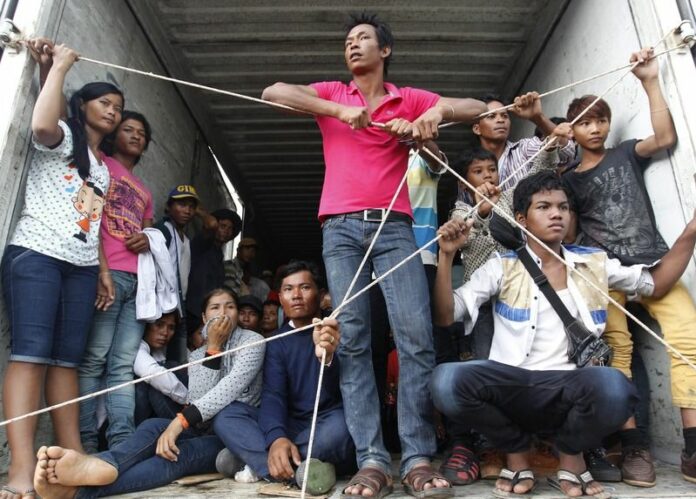
Cambodian migrant workers arrive at the Thailand-Cambodia border town of Poipet, in Banteay Meanchey province, Cambodia, 18 June 2014. Human Rights Watch on Friday strongly criticised the Thai military junta, saying it caused over 200,000 Cambodian migrant workers to flee the country in the past two weeks. EPA/MAK REMISSA

PHNOM PENH (DPA) — Human Rights Watch on Friday strongly criticised the Thai military junta, saying it caused over 200,000 Cambodian migrant workers to flee the country in the past two weeks.

The junta, which took over in a coup on May 22, denied there was a crackdown on migrants, despite having earlier announced that illegal migrant workers would be arrested and deported.

"The Thai junta's new regulations have caused a massive flight of migrant workers, who have long endured abuses from officials and unscrupulous employers," said Brad Adams, Asia director at Human Rights Watch, a US-based organization.

"The junta needs to reverse this disaster by quickly putting into place genuine reforms that would protect migrant workers' rights, not threaten them."

The huge exodus of workers initially caused chaotic scenes at the Thai-Cambodia border crossing of Poipet, but rights workers there say the situation is now under control, with food and water supplies available as well as transportation to take the workers back to their home provinces.

On Tuesday, Cambodia's Interior Minister Sar Kheng placed the blame for the situation squarely on the Thai regime, saying: "I think the current Thai junta leader must be responsible for the problems happening, including loss of lives."

At least eight Cambodians migrants died in crashes en route to the border.

"Migrant workers make huge contributions to Thailand's economy, but their daily life is unsafe and uncertain, and they face abuses from many quarters," Adams said.

"If the military authorities are serious about rights-respecting reforms in the way Thailand handles migrant workers, they should prosecute those who abuse migrants and get rid of discriminatory regulations that violate migrant workers' rights."

There are an estimated 400,000 Cambodian migrant workers in Thailand.


Advertisement

Southern Police Inspect Fishing Boats In Search Of Human Traffickers

Marine police in Satul province inspected fishing boats manned by Burmese workers to look for potential human traffickers and drug use, 19 June 2014.

SATUL — Marine police in Satul province inspected fishing boats manned by Burmese workers today to look for potential human traffickers and drug use.

The inspection was overseen by Prayoon Rattanasenee, deputy governor of Satul, and carried out by a combined force of police officers, Royal Thai Navy servicemen, and social workers.

The officials selected fishing boats at random off of Thailand’s western coast and boarded them to inspect their crews. According to Mr. Prayoon, the inspection found no breach of laws on any of the boats.

Mr. Prayoon told Khaosod that the officials want to ensure the welfare and safety of workers on Thai fishing boats, especially migrant workers. 

"Many agencies in Satul are enforcing strict measures to monitor the condition of workers' lives, food, residences," Mr. Prayoon said. "We are also working to root out the human trafficking network in the fishing industry. It's a major problem in Satul province."

The search came after a series of events have brought Thailand's weak record of combating human trafficking into global spotlight. Earlier this month, the British newspaper The Guardian revealed that more than 200,000 Burmese migrants are trafficked into Thailand to work as slaves in the Thai seafood and fishing industry. According to the investigative report, thousands of Burmese migrants pay brokers to help them cross the border and find work in Thailand, but are instead sold on to "slave vessels" and subject to deplorable working conditions and abuse.

Days later, Thailand incurred a fresh wave of criticsim from human rights groups after it was the only country to vote against a U.N. treaty requiring countries to punish perpetrators of forced labor.  

Before reversing its decision, the Thai Ministry of Foreign Affairs said the country voted against the protocol because “Thailand has to seriously consider her own readiness to implement such an instrument, in conformity with relevant Thai laws.”

After a week of bad press, Thai officials are now bracing themselves for another blow. The US State Department is set to release its annual human Trafficking in Persons report (TIP) on Friday, and Thailand is expected to drop down to the lowest rank. If Thailand is downgraded to Tier 3, it may face economic sanctions and the withdrawal of financial aid. 

In the past week, over 200,000 Cambodians have fled Thailand out of fear that the Thai military regime is preparing to crackdown on migrant workers. 

However, deputy governor of Satul Mr. Prayoon said he has not received any reports of migrant workers in Satul heading back to their home countries. Most of the migrant workers in Satul are from Myanmar, not Cambodia. 

Mr. Prayoon also urged operators of fishing boats in Satul who have not legally registered their migrant workers to do so in the near future. 

 
For comments, or corrections to this article please contact: [email protected]

You can also find Khaosod English on Twitter and Facebook
http://twitter.com/KhaosodEnglish
http://www.facebook.com/KhaosodEnglish


Advertisement

Thailand Demands Lese Majeste Suspect Extradited, UK Says No

Screenshot of a video of a Thai royalist in the UK spray-painting the Thai national flag on a lese majeste suspect's front door.

BANGKOK — Thai police continue to demand the UK government extradite a lese majeste suspect the British Ambassador to Thailand’s public refusal.

Pol.Gen. Ake Angsananon, deputy chief of the Royal Thai Police, said in a press conference today that the police will do everything they can to bring Chatwadee Amornchat to Thailand to face a trial in military court on charges of lese majeste (insult of monarchy).

“We are not idle about this,” Pol.Gen. Ake assured reporters.

Ms. Chatwadee, aka London Rose, is wanted by the Thai police for posting messages on social media that are critical of the Thai monarchy. Under Thai law, defaming the Thai Royal Family is a criminal offense that can carry a prison sentence of up to 15 years.

Pro-monarchy activists in Thailand have been pressing the Thai police to take legal action against Ms. Chatwadee. Her father also personally filed a lese majeste charge against his own daughter several months ago. He said he decided to press charges against her after receiving constant intimidation from royalists in Thailand.

However, the prospect of Ms. Chatwadee being extradited to Thailand appears to be slim. Ms. Chatwadee has acquired British citizenship and lives in London where she works as a hairdresser.

Inquiries to the British Embassy in Bangkok about whether the UK government will extradite Ms. Chatwadee went unanswered, but British Ambassador to Thailand, Mark Kent, said on his Twitter account that the extradition is not possible because unlike Thailand, the UK has no lese majeste laws.

“In brief, extradition treaties cover only offences in both states,” Mr. Kent said in a reply to British blogger Andrew Spooner, “UK position clear.”

However, the Thai police have vowed to keep pushing forward.

“The Foreign Affairs section will proceed to request extradition of the suspect. At the moment, we are waiting for relevant documents to arrive at the Foreign Affairs section.” Pol.Gen. Ake said.

Over the past week, there have been two incidents of Thai royalists in the UK threatening Ms. Chatwadee because of her political views. In the first incident, a Thai woman filmed herself as she arrived at Ms. Chatwadee’s house with a carton of eggs she said she intended to throw at Ms. Chatwadee.

In another incident, a Thai man who claimed to work as a DJ at the well-known Thai-themed restaurant and nightclub Thai Square, filmed himself spray-painting the Thai national flag on Ms. Chatwadee’s front door.

The man also showed his fake gun in the video, claiming that he intended to use it to frighten Ms. Chatwadee if he encountered her.

Ms. Chatwadee was not seen in either video.

Advertisement

Southern Police Inspect Fishing Boats In Search Of Human Traffickers

Marine police in Satul province inspected fishing boats manned by Burmese workers to look for potential human traffickers and drug use, 19 June 2014.

SATUL — Marine police in Satul province inspected fishing boats manned by Burmese workers today to look for potential human traffickers and drug use.

The inspection was overseen by Prayoon Rattanasenee, deputy governor of Satul, and carried out by a combined force of police officers, Royal Thai Navy servicemen, and social workers.

The officials selected fishing boats at random off of Thailand’s western coast and boarded them to inspect their crews. According to Mr. Prayoon, the inspection found no breach of laws on any of the boats.

Mr. Prayoon told Khaosod that the officials want to ensure the welfare and safety of workers on Thai fishing boats, especially migrant workers. 

"Many agencies in Satul are enforcing strict measures to monitor the condition of workers' lives, food, residences," Mr. Prayoon said. "We are also working to root out the human trafficking network in the fishing industry. It's a major problem in Satul province."

The search came after a series of events have brought Thailand's weak record of combating human trafficking into global spotlight. Earlier this month, the British newspaper The Guardian revealed that more than 200,000 Burmese migrants are trafficked into Thailand to work as slaves in the Thai seafood and fishing industry. According to the investigative report, thousands of Burmese migrants pay brokers to help them cross the border and find work in Thailand, but are instead sold on to "slave vessels" and subject to deplorable working conditions and abuse.

Days later, Thailand incurred a fresh wave of criticsim from human rights groups after it was the only country to vote against a U.N. treaty requiring countries to punish perpetrators of forced labor.  

Before reversing its decision, the Thai Ministry of Foreign Affairs said the country voted against the protocol because “Thailand has to seriously consider her own readiness to implement such an instrument, in conformity with relevant Thai laws.”

After a week of bad press, Thai officials are now bracing themselves for another blow. The US State Department is set to release its annual human Trafficking in Persons report (TIP) on Friday, and Thailand is expected to drop down to the lowest rank. If Thailand is downgraded to Tier 3, it may face economic sanctions and the withdrawal of financial aid. 

In the past week, over 200,000 Cambodians have fled Thailand out of fear that the Thai military regime is preparing to crackdown on migrant workers. 

However, deputy governor of Satul Mr. Prayoon said he has not received any reports of migrant workers in Satul heading back to their home countries. Most of the migrant workers in Satul are from Myanmar, not Cambodia. 

Mr. Prayoon also urged operators of fishing boats in Satul who have not legally registered their migrant workers to do so in the near future. 

 
For comments, or corrections to this article please contact: [email protected]

You can also find Khaosod English on Twitter and Facebook
http://twitter.com/KhaosodEnglish
http://www.facebook.com/KhaosodEnglish


Advertisement

Thailand Braces For Possible Downgrade By US Anti-Trafficking Body (DPA)

A Thai fish-seller sorts shrimp at Klong Toey fresh food market in Bangkok, Thailand, 19 June 2014. Allegations have been made, and denied by Thai frozen food companies, that Thailand uses slave labour in the fishing industry as Thai officials are bracing themselves for a possible downgrade when the US State Department releases 20 June 2014 its annual human trafficking report (TIP). For the past year Thailand has been on the watch list of Tier 2 countries and a downgrade to Tier 3 would see it join the likes of Syria, Cuba and Iran in the lowest category. EPA/BARBARA WALTON

By Cod Satrusayang

BANGKOK (DPA) — Thai officials are bracing themselves for a possible downgrade when the US State Department releases its annual human Trafficking in Persons report (TIP) this week.

For the past year the country has been on the watch list of Tier 2, and a downgrade to Tier 3 would see it join the likes of Syria, Cuba and Iran in the lowest category.

"We definitely come very close to Tier 3 and serious discussion must have taken place [on where] to rate Thailand" in the upcoming report, said Fuadi Pitsuwan, a fellow at Harvard University's Asia Center, and a Thai native.

"In comparison to its neighbours, the trafficking situation is not as bad," he said. "But the US expects more from Thailand as its oldest ally in Asia and as once a bastion of democracy in Asia."

Thai officials have insisted that the country has more than met the minimum requirements to maintain Tier 2 status.

"Thailand's demonstrated awareness, cooperation and progress in combating human trafficking in 2013 clearly exceeds the US State Department's criteria for an upgrade on the 2014 TIP Report," said Thailand's Ambassador to the United States Vijvat Isarabhakdi.The Foreign Ministry insists that the government has been working with various NGOs and rights groups to combat human trafficking, calling it "one of the worst forms of human indignity."

In a separate meeting with the US ambassador, Thailand's acting foreign minister stressed that the country places "great importance on combatting and eradicating human trafficking."

He said this year's rise in reported trafficking cases demonstrated authorities' determination to tackle the issue.

The TIP report will come just over a week after Thailand was the only country to briefly vote against a motion that would enforce the International Labour Organization's convention against slave labour.

The Foreign Ministry defended its decision by saying that before supporting the adoption of "any specific instrument, Thailand has to seriously consider her own readiness to implement such an instrument, in conformity with relevant Thai laws."

The reaction from NGOs and rights groups was harsh, with the executive director of the Environmental Justice Foundation calling the decision an "absolute disgrace and one that brings further shame onto an already embattled government."

"It also fuels the suspicion that much of Thailand's public statements regarding its commitment to tackling forced labour amount to little more than a PR exercise."

Thailand subsequently rescinded its abstention and voted in favour of the protocol.

The country was also in the crosshairs of a report in Britain's Guardian newspaper last week that said Thailand's shrimp farmers were buying feed made from fish caught using forced labour.

The Guardian report said "large numbers of men [are] bought and sold like animals and held against their will on fishing boats off Thailand."

Many were illegal migrants from neighbouring countries hoping for jobs in plantations or factories, but who stumbled into the clutches of brokers who sold them to the boat operators, it said.

Human Rights Watch wrote to US Secretary of State John Kerry recommending that Thailand be downgraded to Tier 3.

"The Government of Thailand does not meet the minimum standards of the Trafficking Victims Protection Act, nor is it taking real steps to meet those standards," the group said in an open letter.

HRW cited irregularities within the seafood industry in Thailand as well as the detention and reported trafficking of Rohingya refugees from Myanmar by Thai security forces as a basis for its recommendation.

If Thailand is downgraded to the lowest tier it may face economic sanctions and the withdrawal of aid funds.

Multinational companies will also be encouraged to stop trading in industries where forced labour may play a role.


Advertisement

Police Probe Video of Mother Beating Son For Not Selling Enough Souvenirs

Police at Ms. Kaew's house in Ayutthaya province.

AYUTTHAYA — Police are investigating the case of a woman who was filmed beating her 5-year-old son because he failed to sell enough key rings to foreign tourists in the historic town of Ayutthaya.

The investigation came after a video (below) of the woman repeatedly hitting her son was widely circulated on social media. The video appears to be filmed inside the compound of Viharn Phra Mongkol Bopit temple in Ayutthaya’s historic old quarters, a popular tourist destination.

In the video, the child is crying and begging his mother to stop hitting hum, but she continues to beat and yell at him for failing to sell enough key rings to foreign tourists.

“That guy runs, he catches up with customers! Why didn’t you run like him, damn you!” the mother shouts at her son in the video.

Today police officers and social workers visited the home of the woman in the now-infamous video, but no one was home when the police force arrived.

A neighbour, Ploenchit Noirangsi, told police that the woman is known by locals as Kaew, and that she lives with her son and husband. According to Ms. Ploenchit, Ms. Kaew used to work at a factory, but recently lost her job and decided to take her son to sell keyrings to tourists. Ms. Kaew also reportedly takes her son sell keyrings to tourists at restaurants at night.

"It's already 10-11 pm when they get home each day," Ms. Ploenchit said.  She added that Ms. Kaew's son attends a local kindergarten.

Ms. Ploenchit also told police she has seen Ms. Kaew beating her son from time to time, but she has never seen an outburst of violence like in the video.

"I am very sad. I  used to take care of the boy when he was small. I feel so much pity for him,” Mr. Ploenchit said.

She added that Ms. Kaew and her family fled the house after the video surfaced on social media.

Pol.Maj.Gen. Sermkit Sitthichaiyakan, a commander of Ayutthaya police force, said the police tracked down the woman's home soon after the video first surfaced in order to intervene and help the family.

"We didn't intend to make any arrest. We want to find a solution and help them, because violence against children will imprint violent memories on the child. He may repeat the violence in the future and affect society on a wider scale," Pol.Maj.Gen. Sermkit explained. "That's why we want to [determine] what was the cause of the violence."

He added that parents should not force their children to hawk goods to tourists during the day or at night, as children should be in school instead. 

Wicharapon Chairattana, an official of the Ministry of Social Development and Human Security in Ayutthaya province, said authorities will attempt to locate Ms. Kaew and determine whether she is capable of raising her child in a safe environment.

"We believe the family was stressed by their situation of poverty, and so [Kaew] committed violence against her child," said Mr. Wicharapon.

Once Ms.Kaew is found, she will be reprimanded and could face legal prosecution if she abuses her child again, Mr. Wicharapon said. 


For comments, or corrections to this article please contact: [email protected]

You can also find Khaosod English on Twitter and Facebook
http://twitter.com/KhaosodEnglish
http://www.facebook.com/KhaosodEnglish

Advertisement

Hot News

LATEST NEWS

Bangkok
overcast clouds
28.8 ° C
28.8 °
25 °
79 %
4kmh
100 %
Sun
35 °
Mon
36 °
Tue
28 °
Wed
30 °
Thu
32 °