(Prachatai English)
Note: Khaosod English is not responsible for content on other websites.
(Prachatai English)
Note: Khaosod English is not responsible for content on other websites.
(Chiang Mai City News)
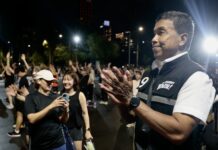
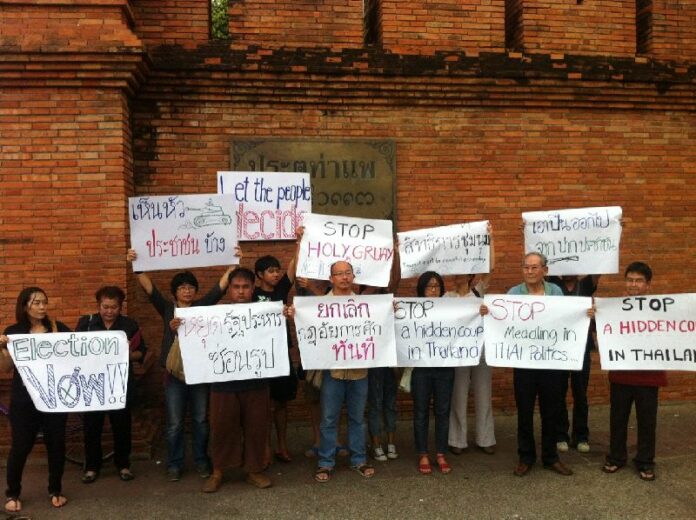
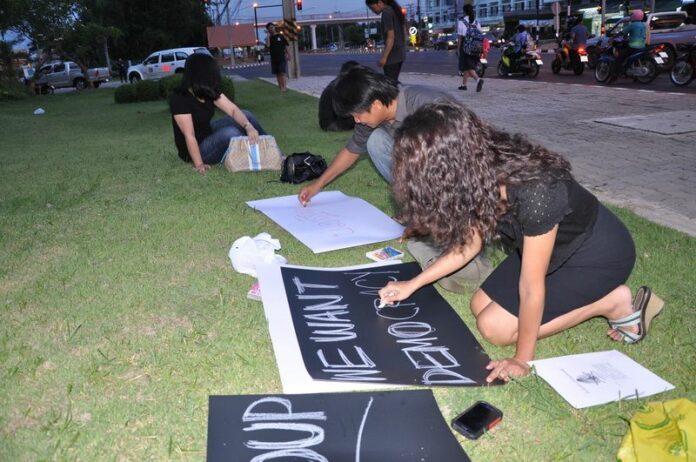
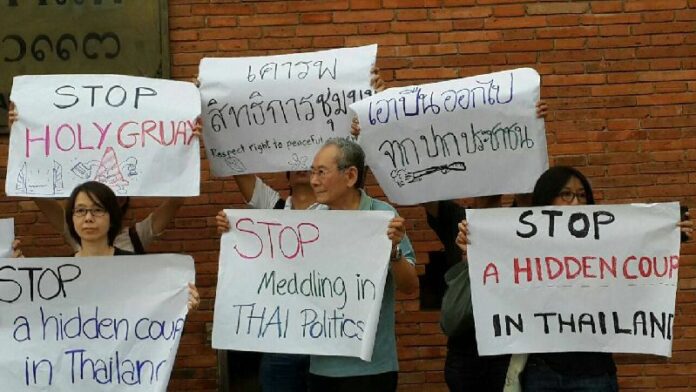
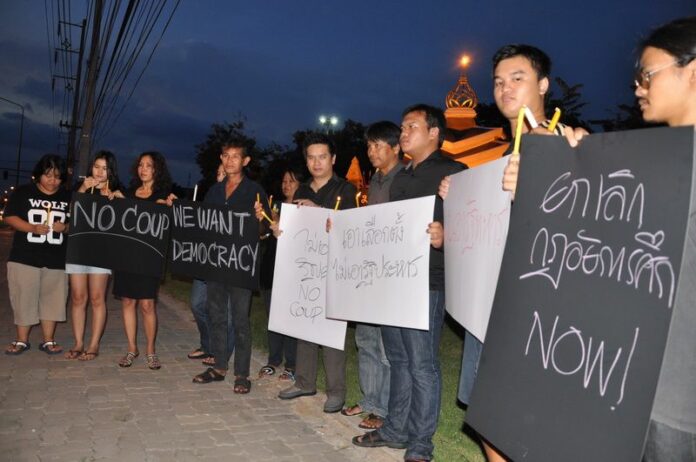
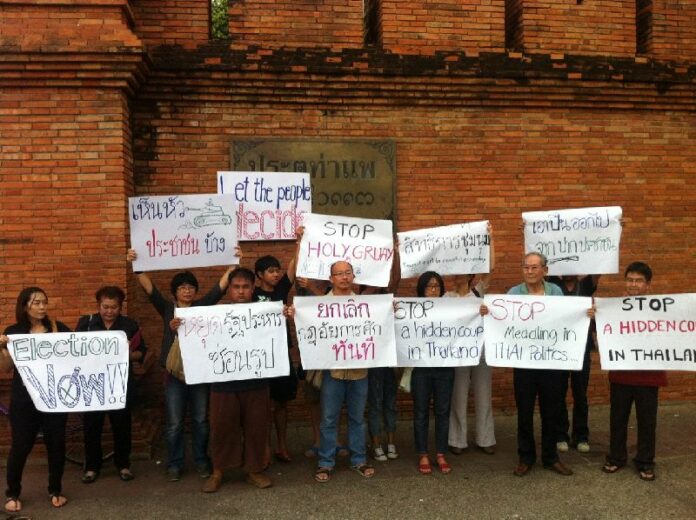
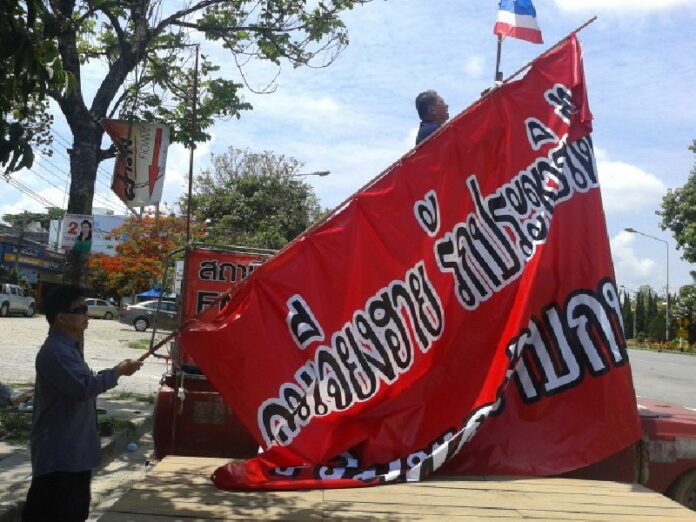
CHIANG MAI — A group of scholars gathered to write messages protesting against the army, a possible coup, and martial law in Chiang Mai on Tuesday night, in full view of many spectators and in defiance of the nationwide ban against gatherings of more than five people.
At 6 p.m. on 20 May, scholars and students from various institutes in Chiang Mai gathered at Thapae Gate to write messages on signboards.
Read the rest of the story here: http://www.chiangmaicitynews.com/news.php?id=3877
Note: Khaosod English is not responsible for content on other websites.
Regardless of the pretext or intention, the martial law imposed by the Royal Thai Army today infringes on the rights of Thai citizens and should be repealed without delay.
Citing potential bloody clashes between the pro- and anti-government protest factions, army chief Gen. Prayuth Chan-ocha imposed martial law at 3:00 a.m. this morning and installed the Peace and Order Maintaining Command (POMC) to oversee the invocation of the 100-year-old law.
The military has insisted that this is not a coup. But coup or no coup, the martial law is already restricting a number of human rights and freedoms guaranteed under the Thai constitution.
There is no basis for Gen. Prayuth to impose the martial law. Although there has been sporadic violence over the past few months, the situation has not reached the full-scale "unrest" that Gen. Prayuth said last week was the condition for a military intervention.
Thailand’s martial law explicitly says that it may only be declared by the military in a time of war or insurrection. Neither is happening in Thailand at the moment.
On the first day of the martial law regime alone, at least 14 TV stations and local radio stations were shut down by the POMC, ostensibly to avoid dissemination of "distorted" information to the public.
More intrusion into the media rights by the POMC appears to be on the horizon; just hours ago, the POMC warned the media against giving platforms to commentators that stand in the way of the POMC’s mission, and threatened to shutdown social media sites that the military deems unacceptable.
Thai media deserves the right to operate without censorship or intimidation. The martial law is only worsening the already fragile state of media freedom in Thailand.
Direct military intervention rarely ends well in Thailand. The fact that Gen. Prayuth decided to impose the martial law on the 4th anniversary of the unrest in 2010 — in which more than 90 people were killed in the clashes between the army and Redshirt protesters — is particularly uncouth. One can only wonder whether the military has learned its lesson.
It is not too late for Gen. Prayuth to step back from the brink and repeal the draconian state of martial law.
Regardless of the pretext or intention, the martial law imposed by the Royal Thai Army today infringes on the rights of the Thai citizens and should be repealed without delay.
Citing potential bloody clashes between the pro- and anti-government protest factions, army chief Gen. Prayuth Chan-ocha imposed the martial law at 3:00 a.m. this morning and installed the Peace and Order Maintaining Command (POMC) to oversee the invocation of the 100-year-old law.
The military has insisted that this is not a coup. But coup or no coup, the martial law is already restricting a number of rights and freedoms guaranteed under the Thai constitution.
There is no basis for Gen. Prayuth to impose the martial law. Although the protests have turned violent in the past few months, the situation has not reached the full-scale "unrest" that Gen. Prayuth said last week was the condition for a military intervention.
Thailand’s martial law explicitly says that it may only be declared by the military in a time of war or insurrection. Neither is happening in Thailand at the moment.
On the first day of the martial law regime alone, at least 14 TV stations and local radio stations were shut down by the POMC, ostensibly to avoid dissemination of "distorted" information to the public.
More intrusion into the media rights by the POMC appears to be on the horizon; just hours ago, the POMC warned the media against giving platforms to commentators that stand in the way of the POMC’s mission, and threatened to shutdown social media sites that the military deems unacceptable.
Thai media deserves the right to operate without censorship or intimidation. The martial law is only worsening the already fragile state of media freedom in Thailand.
Direct military intervention rarely ends well in Thailand. The fact that Gen. Prayuth decided to impose the martial law on the 4th anniversary of the unrest in 2010— in which more than 90 people were killed in the clashes between the army and Redshirt protesters— is particularly uncouth. One can only wonder whether the military has learned its lesson.
It is not too late for Gen. Prayuth to step back from the brink and repeal the draconian state of martial law.
BANGKOK — After declaring martial law before dawn on Tuesday morning, the military issued ten statements over the course of the day spelling out the specifics of its new, wide-ranging powers.
Citing the need to “restore law and order to the country,” the military has begun a heavy-handed crackdown on the media, which it is now authorized to do under section 11 of the martial law.
Thailand’s martial law, which was written in 1914 when the country was still ruled by an absolute monarch, grants the military “superior power over the civilian authority” and the power to curb a number of human rights.
So far, the military has ordered 14 television stations, affiliated with both pro- and anti-government political factions, off the air.
The military has also prohibited all news outlets and social media sites from publishing any content that “misleads the public” or “escalates the conflict,” warning that transgressors could be shut down and summoned for prosecution.
In addition, academics, bureaucrats, justice officials, and independent agencies have been strictly forbidden from giving any media interviews that “distort the facts, cause confusion among the public, or lead to further violence.”
In several other televised announcements spaced throughout the day, the military restricted the movement of both pro- and anti-government protest groups in Bangkok, and called upon local authorities to suppress any demonstrations that go against the mission of the military’s new peacekeeping organisation, the Peace and Order Maintaining Command (POMC).
Army commander-in-chief Gen. Prayuth Chan-ocha said in a press conference that it was necessary to invoke martial law in order to prevent possible "bloodshed" between the pro- and anti-government protesters that are both rallying in the capital city.
At least 25 people have died since anti-government protesters first began their street campaign to oust the current government last November.
The caretaker government, led by acting Prime Minister Niwatthamrong Boonsongphaisarn said that it was not consulted before the military declared martial law at 3:00 a.m. this morning.
Yet Mr. Niwatthamrong insisted that the government does not object to the military's decision.
"For martial law, they didn't need to tell us in advance," Prime Minister Niwatthamrong said in a press conference, "It's something they can do. The government understands the [military's] intention of keeping order and avoiding clashes … which is a good thing."
He also dismissed the rumour that the government is contemplating to remove Gen. Prayuth from his position.
Asked by a reporter whether the general election on 20 July will go ahead as planned, Mr. Niwatthamrong said it is likely that the election will be postponed to 3 August.
The caretaker Prime Minister added that he has already suggested the new date to the Election Commission and awaiting their response.
For comments, or corrections to this article please contact: [email protected]
You can also find Khaosod English on Twitter and Facebook
http://twitter.com/KhaosodEnglish
http://www.facebook.com/KhaosodEnglish
BANGKOK — Various human right groups have slammed the Royal Thai Army's unilateral declaration of martial law, with one prominent right organisation calling the move a "de facto coup."
"Thailand's friends in the world's capitals should make it clear that they expect this de facto coup to be reversed immediately," Human Rights Watch (HRW) director Brad Adams said in a statement.
Thailand’s military unexpectedly declared martial law at 3:00 am this morning, without consulting the caretaker government.
The military is granted a wide range of powers under martial law, including the authority to censor the media, search and detain suspects without warrants, and "burn any house or thing which may be useful to the enemy.”
In the first 24 hours of martial rule, the military has already gone after politicized news outlets, forcing ten TV channels and numerous community radio stations to go off the air.
"Censorship and shutting down of both anti-government and pro-government satellite TV channels and radio networks raises serious concerns that freedom of expression will be the first victim of the de facto coup,” Mr. Adams of HRW said.
The martial law invoked today was written in 1914, when Thailand was still governed by an absolute monarchy.
"It's a law that pre-dates the creation of all international human rights standards, and it shows," Mr Adams added.
The Asian Human Rights Commission (AHRC) said "General Prayuth’s statement is at best, misguided, and at worst, facetious," referring to army commander-in-chief Gen. Prayuth Chan-ocha’s advice that the public should refrain from panicking and carry on with their lives as normal.
"There is nothing normal about martial law, nor the conditions of political and legal life that it creates,” the AHRC said. ”Martial law is a grave threat to human rights."
The AHRC also called on Gen. Prayuth to provide a clear justification for why martial law has been imposed, or else revoke the law immediately.
The Assembly for Defence of Democracy (AFDD), a group of political scientists and law academics, also criticised the army's move, insisting that it will only worsen the political conflict in Thailand.
The AFDD urged the government of caretaker Prime Minister Niwatthamrong Boonsongphaisarn to seek Royal Approval from His Majesty the King to repeal the martial law if the military violates protesters’ rights of peaceful political expression.
"The military's only duty is to maintain peace and order of the country, namely by cooperating with the caretaker government and the Election Commission to organise the general election in timely manner," the AFDD said.
Despite the military’s new authority to ban political gatherings, hundreds of protesters gathered this evening in front of the Bangkok Art and Cultural Centre (BACC) to voice their opposition to the declaration of martial law. Other smaller gatherings were held in Chiang Mai and Ubon Ratchatani provinces.
For comments, or corrections to this article please contact:[email protected]
You can also find Khaosod English on Twitter and Facebook
http://twitter.com/KhaosodEnglish
http://www.facebook.com/KhaosodEnglish
BANGKOK — Various human right groups have slammed the Royal Thai Army's unilateral declaration of martial law, with one prominent right organisation calling the move a "de facto coup."
"Thailand's friends in the world's capitals should make it clear that they expect this de facto coup to be reversed immediately," Human Rights Watch (HRW) Asia director Brad Adams said in a statement.
Thailand’s military unexpectedly declared martial law at 3:00 am this morning, without consulting the caretaker government.
The military is granted a wide range of powers under martial law, including the authority to censor the media, search and detain suspects without warrants, and "burn any house or thing which may be useful to the enemy.”
In the first 24 hours of martial rule, the military has already gone after politicized news outlets, forcing ten TV channels and numerous community radio stations to go off the air.
"Censorship and shutting down of both anti-government and pro-government satellite TV channels and radio networks raises serious concerns that freedom of expression will be the first victim of the de facto coup,” Mr. Adams of HRW said.
The martial law invoked today was written in 1914, when Thailand was still governed by an absolute monarchy.
"It's a law that pre-dates the creation of all international human rights standards, and it shows," Mr Adams added.
The Asian Human Rights Commission (AHRC) said "General Prayuth’s statement is at best, misguided, and at worst, facetious," referring to army commander-in-chief Gen. Prayuth Chan-ocha’s advice that the public should refrain from panicking and carry on with their lives as normal.
"There is nothing normal about martial law, nor the conditions of political and legal life that it creates,” the AHRC said. ”Martial law is a grave threat to human rights."
The AHRC also called on Gen. Prayuth to provide a clear justification for why martial law has been imposed, or else revoke the law immediately.
The Assembly for Defence of Democracy (AFDD), a group of Thai political scientists and law academics, also criticised the army's move, insisting that it will only worsen the political conflict in Thailand.
The AFDD urged the government of caretaker Prime Minister Niwatthamrong Boonsongphaisarn to seek Royal Approval from His Majesty the King to repeal the martial law if the military violates protesters’ rights of peaceful political expression.
"The military's only duty is to maintain peace and order of the country, namely by cooperating with the caretaker government and the Election Commission to organise the general election in timely manner," the AFDD said.
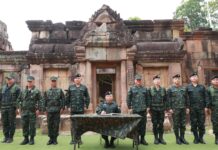
Despite the military’s new authority to ban political gatherings, hundreds of protesters gathered this evening in front of the Bangkok Art and Cultural Centre (BACC) to voice their opposition to the declaration of martial law. Other smaller gatherings were held in Chiang Mai and Ubon Ratchatani provinces.
For comments, or corrections to this article please contact: [email protected]
You can also find Khaosod English on Twitter and Facebook
http://twitter.com/KhaosodEnglish
http://www.facebook.com/KhaosodEnglish

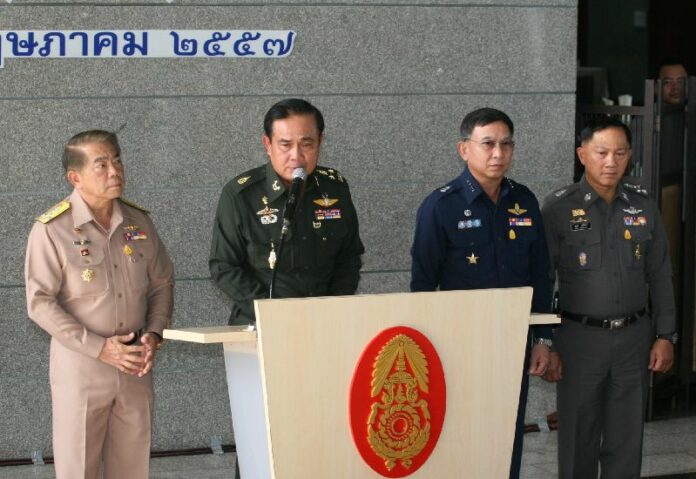
BANGKOK — In a press briefing today on the military's rationale for declaring martial law, the commander-in-chief of the Royal Thai Army took an aggressive tone with reporters who asked him about the country's future.
"Didn't you hear what I just said?" Gen. Prayuth Chan-ocha lashed at a reporter when she asked him how long martial law was expected to last. "When peace and safety returned to the country, when there's stability, we will repeal the martial laws," the army commander-in-chief answered.
When another reporter asked whether the declaration of the martial law means the military can now wield authority without the government's approval, Gen. Prayuth responded, "Where is the government? Where are they now?"
He continued, "Let me put it this way, I will let the officials work. I won't be interfering with the government. The army and bureaucrats will continue to work. Don't worry. Things are still normal in this country. We will try not to violate human rights — too much. We will try not to cause inconvenience to the public."
The press conference is the first time Gen. Prayuth, who is now chairman of the recently-installed Peace and Order Maintaining Command (POMC), spoke publicly since the martial law was unexpectedly invoked at 3:00 a.m. this morning.
Prior to the press conference, Gen. Prayuth met with state officials and heads of government agencies at the Army Club on Viphavadee Road, which the POMC has adopted as a temporary headquarters, to discuss the solutions for the current political crisis.
Gen. Prayuth also insisted that putting the country under martial law was necessary to prevent possible "bloodshed" between pro- and anti-government protesters who are both rallying in the capital city.
On Saturday, the anti-government People's Committee for Absolute Democracy With the King As Head of State (PCAD) announced plans to launch "one last fight" to topple the government of caretaker Prime Minister Niwatthamrong Boonsongphaisarn and replace it with an unelected "People's Council" headed by an appointed "nonpartisan" PM.
The Redshirts, who have been organising their own rally on Aksa Avenue in western Bangkok, adamantly oppose the plan and have warned to "escalate" their protests if an unelected Prime Minister is installed.
To defuse the conflict between the rival protest groups, Gen. Prayuth said the army may summon both groups to meet with the military for a dialogue aimed at resolving their disputes.
When a reporter asked Gen. Prayuth when the meeting will occur, he responded,"They will come here anyway whenever I tell them to.”
He added, "I will summon all sides. All sides. We will talk with all sides. Don't ask me what sides we will talk to. We will summon all sides. That's why we need power under martial laws, okay? Otherwise who would listen to us?"
The caretaker government has yet to publicly respond to the military's declaration of the martial law.
An abbreviated transcript of the Q&A between Gen. Prayuth and reporters:
(You can watch the video in Thai here)
Reporter: Commander, what is the time frame of the martial laws?
General Prayuth Chan-oha: Didn't you hear what I just said? When peace and safety returns to the country, when there's stability, we will repeal the martial laws.
Reporter: So if peace doesn't return in 3 or 6 months, the martial laws–
Prayuth: I don't think it would reach that point.
…
Reporter: Will the army serve as mediator and invite both sides for a dialogue?
Prayuth: That matter is still under discussion. It's something we have to do, okay? Today we invited bureaucrats for dialogue. In the future we will invite the adversaries in this conflict. We will do this under an atmosphere of peace. If there is no peace, if there are still attempts to incite violence or chaos, then there will be no way to reach understanding. Therefore, all sides must stop first. Otherwise there will be no understanding.
Reporter: Will the army invite them soon to defuse the situation?
Prayuth: They will come here anyway whenever I tell them to.
Reporter: You mean you will summon Kamnan [Suthep Thaugsuban] and–
Prayuth: I will summon all sides. All sides. We will talk with all sides. Don't ask me what sides we will talk to. We will summon all sides. That's why we need power under martial laws, okay? Otherwise who would listen to us?
Reporter: What about the government, the Senate —
Prayuth: Alright, alright, we will take it step by step. It's my business. Don't ask me everything. If you ask me everything, nothing will get done. No one can answer about the future; there are things no one can answer. Just wait and see what will happen. But I can assure you we will not let bloodshed happen in Thailand.
Reporter: Do you think there should be election?
Prayuth: I suggest you go visit a doctor and do something about your ear.
Reporter: What is the status of the government at the moment?
Prayuth: Well, you should go… You already know the answer. Why are you asking me this?
Reporter: I don't know the answer. That is why I am asking you.
Prayuth: Go ask someone who knows the answer. I am here to maintain peace and order.
Reporter: So the army can do things without having to seek approval from the government?
Prayuth: Where is the government? Where are they now? Well, they should continue working. For the country. Working. Okay, let me put it this way, I will let the officials work. I won't be interfering with the government. The army and bureaucrats will continue to work. Don't worry. Things are still normal in this country. We will try not to violate human rights — too much. We will try not to cause inconvenience to the public. There are still many provisions in the martial laws we have not used.
Reporter: Commander, will curfew be imposed?
Prayuth: I am talking about that right now. I have not imposed it.
Reporter: Is there a possibility of curfew?
Prayuth: Do you want me to impose one? I will place a curfew on the media first. Alright, that's it. Thank you all of you. And please give your support to the military and the police.
For comments, or corrections to this article please contact: [email protected]
You can also find Khaosod English on Twitter and Facebook
http://twitter.com/KhaosodEnglish
http://www.facebook.com/KhaosodEnglish

BANGKOK — After declaring martial law before dawn on Tuesday morning, the military issued ten statements over the course of the day spelling out the specifics of its new, wide-ranging powers.
Citing the need to “restore law and order to the country,” the military has begun a heavy-handed crackdown on the media, which it is now authorized to do under section 11 of the martial law.
Thailand’s martial law, which was written in 1914 when the country was still ruled by an absolute monarch, grants the military “superior power over the civilian authority” and the power to curb a number of human rights.
So far, the military has ordered 14 television stations, affiliated with both pro- and anti-government political factions, off the air.
The military has also prohibited all news outlets and social media sites from publishing any content that “misleads the public” or “escalates the conflict,” warning that transgressors could be shut down and summoned for prosecution.
In addition, academics, bureaucrats, justice officials, and independent agencies have been strictly forbidden from giving any media interviews that “distort the facts, cause confusion among the public, or lead to further violence.”
In several other televised announcements spaced throughout the day, the military restricted the movement of both pro- and anti-government protest groups in Bangkok, and called upon local authorities to suppress any demonstrations that go against the mission of the military’s new peacekeeping organisation, the Peace and Ordre Maintaining Command (POMC).
Army commander-in-chief Gen. Prayuth Chan-ocha said in a press conference that it was necessary to invoke martial law in order to prevent possible "bloodshed" between the pro- and anti-government protesters that are both rallying in the capital city.
At least 25 people have died since anti-government protesters first began their street campaign to oust the current government last November.
The caretaker government, led by acting Prime Minister Niwatthamrong Boonsongphaisarn said that it was not consulted before the military declared martial law at 3:00 a.m. this morning.
Yet Mr. Niwatthamrong insisted that the government does not object to the military's decision.
"For martial law, they didn't need to tell us in advance," Prime Minister Niwatthamrong said in a press conference, "It's something they can do. The government understands the [military's] intention of keeping order and avoiding clashes … which is a good thing."
He also dismissed the rumour that the government is contemplating to remove Gen. Prayuth from his position.
Asked by a reporter whether the general election on 20 July will go ahead as planned, Mr. Niwatthamrong said it is likely that the election will be postponed to 3 August.
The caretaker Prime Minister added that he has already suggested the new date to the Election Commission and awaiting their response.
For comments, or corrections to this article please contact: [email protected]
You can also find Khaosod English on Twitter and Facebook
http://twitter.com/KhaosodEnglish
http://www.facebook.com/KhaosodEnglish
CHIANG RAI — As nationwide martial law takes hold in Thailand, pro-government Redshirts in Chiang Rai province "temporarily" suspended their political campaign, while soldiers were ordered to raid a state-owned television station in nearby Chiang Mai province.
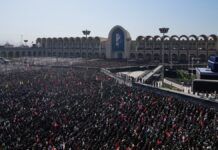
Chiang Rai Redshirts had been organising a rally near Chiang Rai’s old city wall in league with the mass demonstration in Bangkok called by the United Front of Democracy Against Dictatorship (UDD).
But today’s declaration of martial law by Royal Thai Army commander-in-chief Gen. Prayuth led protesters to call off their demonstration – for now.
"We understand that the military imposed martial law because they want to see peace and order in the country," said Attakorn Kanthachai, leader of the local Redshirt group Love Democracy Network. "So we have to dismantle the stage for the moment."
"Also, we cannot broadcast the footage of the [UDD] rally on Aksa Road, so there's no point in maintaining the stage any longer," Mr. Attakorn added.
This morning, the military shut down ten TV stations, including Asia Update, which had been televising the UDD rally on Aksa Avenue in Western Bangkok.
Nevertheless, the Chiang Rai Redshirts insist that their retreat is only temporary.
"If there's an attempt to find a neutral Prime Minister under Article 7, we will come out to protest such action," said Songtham Kid-an, another activist of the Redshirt group.
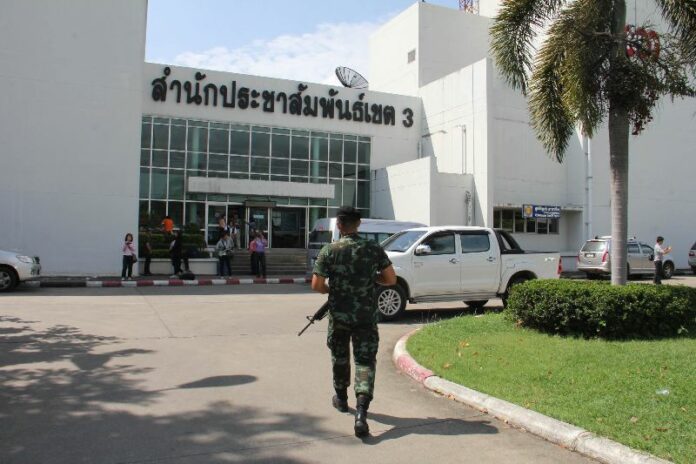
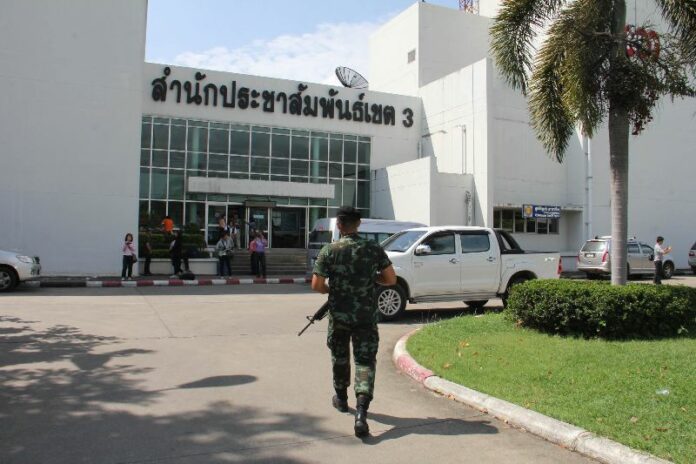
Meanwhile in nearby Chiang Mai province, armed soldiers raided the provincial television station of the state-owned Channel 11 in Mae Rim district.
The raid was ordered by the army's newly-formed Peace and Ordre Maintaining Command (POMC), which has invoked its powers under martial law to censor the media to prevent information that might "mislead" the public.
After arriving at the Chiang Mai branch of the National Broadcasting Services of Thailand (NBT), the troops confiscated broadcasting equipment and ordered the staff to delete footage of the raid.
Director of Chiang Mai's NBT Duangman Srikitwilaikul and two of her assistants were later escorted to a military base. The soldiers left the station soon afterwards.
A local Redshirt "community radio" in Chiang Mai has been similarly taken off the air.
"The military has not seized power. We merely want to end violence," said Maj.Gen. Sarayut Sangsri, a commander of Chiang Mai military region, "I don't believe there would be violence, because the military is now resolving the problem."
However, Maj.Gen. Sarayut advised against political gathering of any kind in the meantime. "Unless it is really necessary, there should be no meeting or seminar related to politics."
Chiang Mai and Chiang Rai provinces are major strongholds of the pro-government Redshirt movement.
For comments, or corrections to this article please contact:[email protected]
You can also find Khaosod English on Twitter and Facebook
http://twitter.com/KhaosodEnglish

http://www.facebook.com/KhaosodEnglish