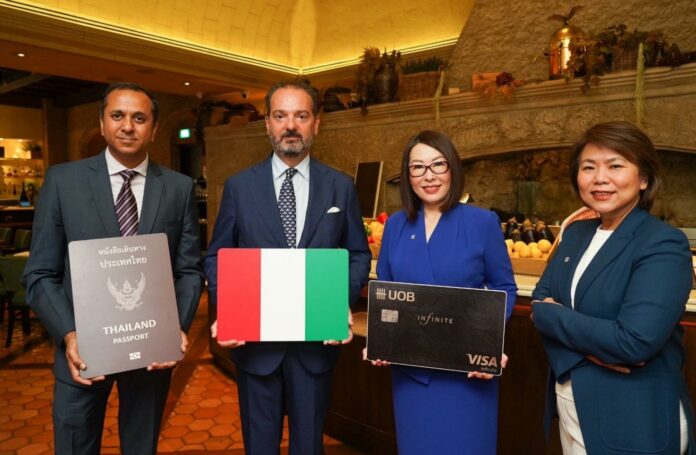
Bangkok, 6 June 2023 – UOB Thailand announces an exclusive visa application privilege for UOB InfinitecardholdersandCiti premium segment cardholders planning totravel to Italy. Effective today the exclusive benefit expedites the visa application process, providingcustomers with a delightful experience.
Mrs Vira–Anong ChiranakhornPhutrakul,Head of Retail and Brand, UOB Thailandsaid “We understand that UOB Infinite customers and Citi premium segment cardholders are avid globetrotters with packed schedules. Theyconstantly crave exceptional dining, travel and retail experiences. Thus, we do the necessary work to enhance their lives, making it easier and more convenient for them to indulge in the things they love.”
Customers with a UOB Infinite card and Citi premium segmentcardholders can apply for the Italy visa in the exclusive Premium Lounge oftheVFS Visa Application Centre without a prior appointment by displaying their card. They will be exempted from providing any further proof of financial or employment documents.
In addition, customers with a UOB Infinite card and Citi premium segment cardholders can enjoy dining privileges at leading Italian restaurants including Giglio Trattoria Fiorentina, La Bottega di Luca, L’OLIVA Ristorante and Wine Bar, La Dotta, Enoteca and Cantina Wine Bar & Italian Kitchen. They will also receive a 10 per cent discount when shopping at all nine branches of Rinascente, Italy.
UOB Infinite card is available exclusively by invitation only. Experience the ultimate luxurious lifestyle with UOB Infinite, which offers exclusive privileges such asa red–carpet experience, personalised bespoke service, and an unforgettable first–class journey. Please visit http://go.uob.com/infinite for more detail.
Pita Limjaroenrat, PM candidate gave an interview at Pheu Thai Party thathe has transferred the ITV shares to prevent some people from reviving the TV station in order to disqualify him from becoming PM.
Just a day after not answering the media questions about the sale of shares in ITV, Pita Limjaroenrat, leader of the Mover Forward Party and candidate to be Thailand’s next prime minister, revealed on June 6, he has recently transferred the shares, which he inherited from his late father, to another inheritor to prevent some people from reviving the TV station in order to disqualify him from becoming PM.
Before giving an interview at Pheu Thai Party, Pita posted on his Facebook: “I am ready to fight against the efforts to revive ITV and block us.”
He said that since March 7, 2007, the Office of the Permanent Secretary notified ITV Public Company Limited (ITV) of the termination of the contract and the Ultra High-Frequency (UHF) operating agreement, which led to the end of the joint agreement. As a result, ITV could no longer use the frequency for its operations and lost its status as a mass media.
“On March 16, 2007, the court assigned me the administrator of my father’s estate, with the ITV shares no longer having any economic value. In 2014, the ITV shares were delisted from the Stock Exchange of Thailand, so they can no longer be traded on the stock exchange. Since becoming a Member of Parliament, I have disclosed my assets and liabilities to the National Anti-Corruption Commission and have been extremely transparent in this matter.
Pita Limjaroenrat, PM candidate, came to Pheu Thai Party for the weekly meeting of the 8-party coalition on June 6, 2023.
Recently, however, there have been attempts to revive ITV as a mass media platform to attack me. For example, controversial changes were made to ITV’s financial statement filing form by changing the previously stated description from “a holding company principally engaged in the non-financial business” to “television media” in 2022, even though the business cannot be operated. And most recently it was changed to “advertising media and returns from investments” in 2023.
During the shareholders’ meeting on April 26 2023, some shareholders asked a question: “Is ITV in the media business?” Do you in your fair mind believe that this question was asked with a political agenda? And please answer for yourself whether you think this is an attempt to revive ITV as a mass media platform, yes or no.
Pita Limjaroenrat, PM candidate, answered the question at Pheu Thai Party for the weekly meeting of the 8-party coalition on June 6, 2023.
In view of various contentious issues that have arisen, I have taken the decision to seek a successor to inherit and manage the ITV shares to avoid problems arising from the process of reviving ITV as a mass media platform.
I wish to assure everyone that I am fully prepared to give clarity to the Election Commission (EC) on this matter without any misgivings or worries. I will not neglect my work. From now on, I will continue with the preparations for the transfer of power and the formation of the Move Forward government with Pita as the Prime Minister to ensure its successful implementation,” said Pita.
On the same day, Ruangkrai Leekitwattana, a Palang Pracharath Party member who was the first to file a petition with the Election Commission (EC) demanding an investigation into Pita’s involvement in ITV, submitted additional information to the EC for the seventh time on the grounds that Pita had not answered questions about the sale of ITV shares.
Ruangkrai speculated that Pita may have transferred the shares to someone else after filing the complaint on May 10, 2023.
Jamal Hussein’s boat in the storm. (AP Illustration/Peter Hamlin)
KRISTEN GELINEAU reported from TEKNAF, Bangladesh
The wind had whipped the waves to nearly three times the woman’s height when her panicked voice crackled over the phone.
“Our boat has sunk!” Setera Begum shouted, as a storm threatened to spill her and around 180 others into the inky black sea south of Bangladesh. “Only half of it is still afloat!”
On the other end of the line, hundreds of miles away in Malaysia, was her husband, Muhammed Rashid, who picked up the phone at 10:59 p.m. his time on Dec. 7, 2022. He had not seen his family in 11 years. And he had only learned days earlier that Setera and two of their daughters had fled surging violence in Bangladesh’s camps for ethnic Rohingya refugees.
Now, Rashid feared, his family’s frantic bid to escape would cost them the very thing they were trying to save — their lives. For despite Setera’s pleas, no help would come, not for her or for the babies, the 3-year-old afraid of the sea or the pregnant women also on board.
Rashid listened to his wife’s terrified voice with growing dread.
“Oh Allah, it’s sunk by the waves!” Setera cried. “It’s sunk by the storm!”
The call disconnected.
Rashid tried to call back. On board the boat, the satellite phone rang. But no one answered.
Rashid tried again. He tried more than 100 times.
The phone rang out.
___
The Rohingya are a people nobody wants.
This stateless Muslim minority has suffered decades of persecution in their homeland of Myanmar, where they have long been viewed as interlopers by the Buddhist majority. Around one million have fled across the border to Bangladesh, only to find themselves trapped for years in a squalid camp and held hostage by migration policies that have given them almost no way out.
And so, in a bid to get somewhere — anywhere — safe, they are taking to the sea.
It is a life-or-death gamble. Last year, more than 3,500 Rohingya attempted to cross the Bay of Bengal and the Andaman Sea — a 360 percent increase over the previous year, according to United Nations figures that are almost certainly an undercount. At least 348 people died or went missing, the highest death toll since 2014.
It’s impossible to know whether any of those lives could have been saved, because almost no one was looking to save them in the first place. Instead, the Rohingya are often abandoned and left to die on the water, just as on land. Even when officials knew the boats’ locations in recent months, the United Nations’ refugee agency says its repeated pleas to maritime authorities to rescue some of them have gone ignored.
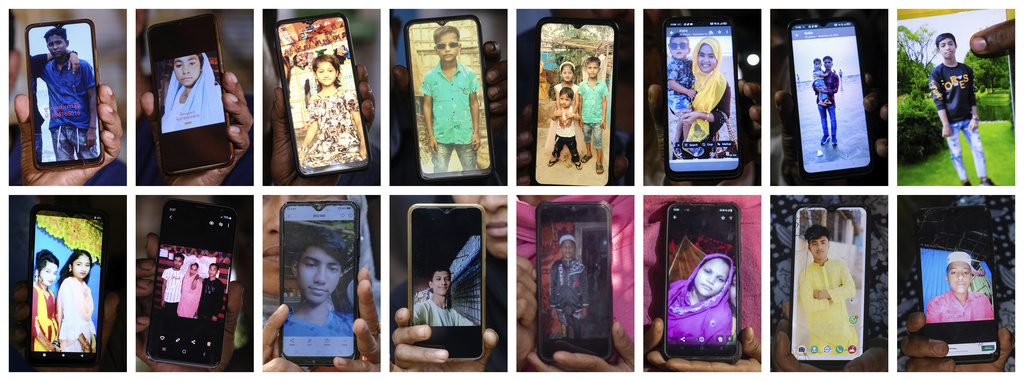
In this combination of photos, relatives hold images of some of those lost when their crowded boat carrying around 180 people sank in the sea south of Bangladesh on Dec. 7, 2022.(AP Photo)
Governments ignore the Rohingya because they can. While multiple international laws mandate the rescue of vessels in distress, enforcement is difficult.
In the past, the region’s coastal nations hunted for boats in trouble — only to push them into other countries’ search and rescue zones, says Chris Lewa, director of the Arakan Project, which monitors the Rohingya crisis. But now, they rarely even bother to look.
The lucky ones are eventually towed to shore in Indonesia by local fishermen. Yet even rescue can be perilous — a Vietnamese oil company saved one boat, then promptly handed the Rohingya over to the same deadly regime in Myanmar from which they’d fled. And the Myanmar authorities themselves patrol for Rohingya migrants.
There is no reason why regional governments could not or cannot coordinate and rescue these boats, says John Quinley, director of human rights group Fortify Rights.
“It was a total lack of political will and extremely heartless,” he says. “The accountability and the onus really lies on everyone.”
Several countries in the region did not immediately respond to requests for comment.
The reasons the Rohingya escape are written on face after gaunt face, in haunted eyes and across slumped shoulders. Any hope that once existed in the Bangladesh camps has long since died, replaced by a stoic sadness and a palpable fear. These are a people who have come to expect nothing, and often get that or worse.
Most of the Rohingya in these camps fled what the United States has declared a genocide in Myanmar in 2017. In recent years, however, brutal killings by gangs and warring militant groups — many in broad daylight — have become commonplace.
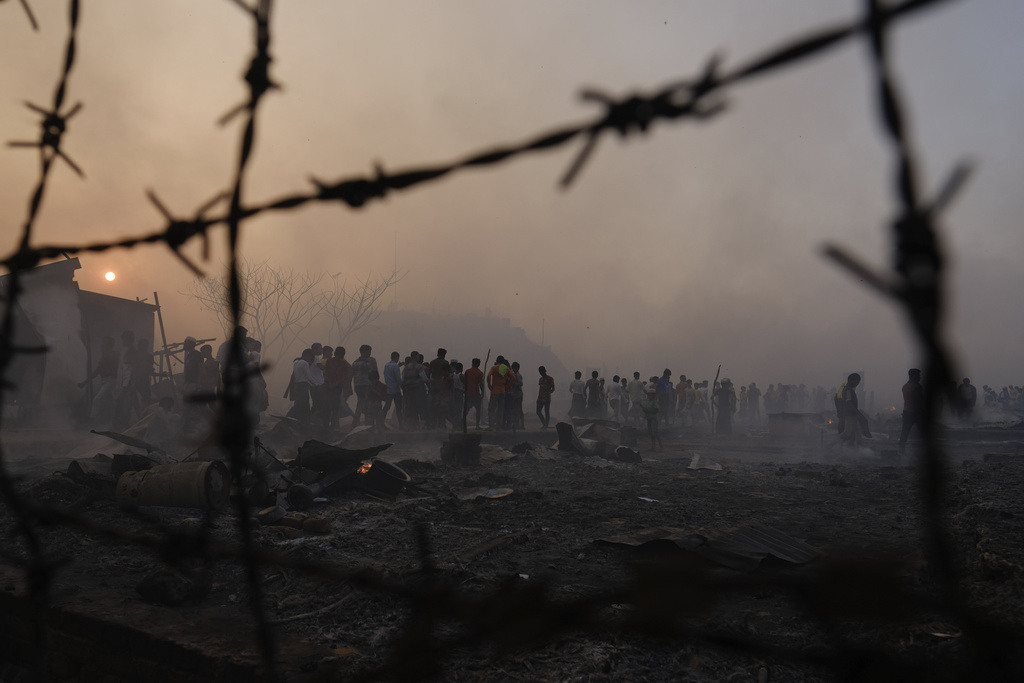
Fires are frequent, some of them acts of arson. One afternoon in March, a blaze that investigators say was set by criminals tore through thousands of shelters. The billowing smoke was so thick and black it blocked the view of the sun. Wide-eyed children huddled together, crying, as the inferno left 15,000 homeless.
Beyond fear is hunger. The Rohingya are banned from working and rely on food rations, which have been slashed due to a drop in global donations. Meanwhile, a military coup in 2021 in Myanmar has made any safe return home at best a distant dream.
And so, out of options, they do again what they have done before: They flee.
___
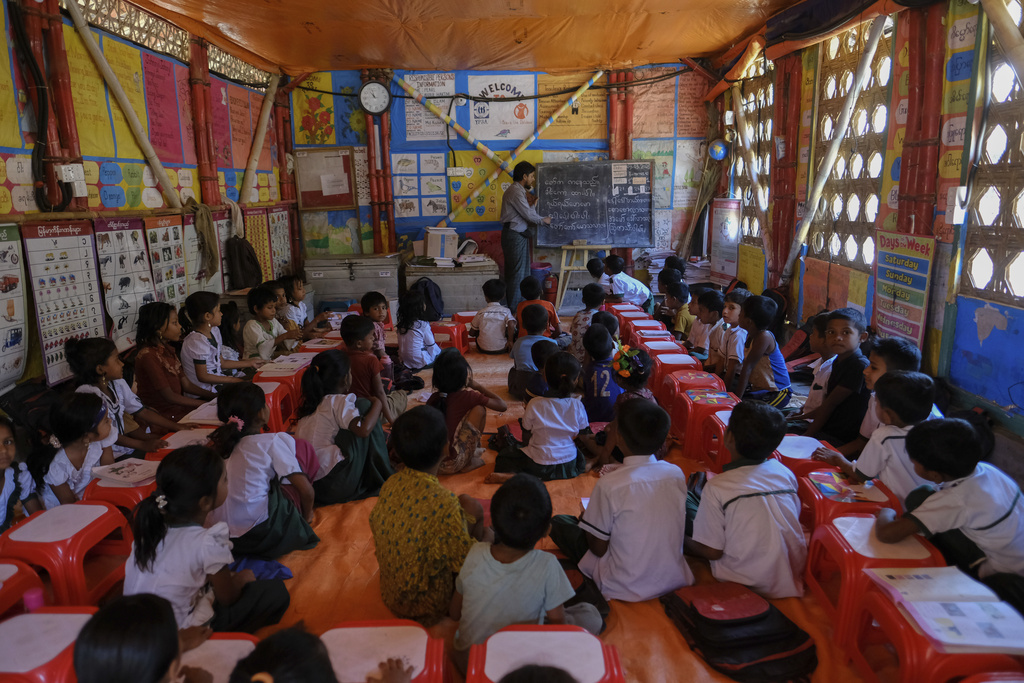
Rohingya refugee children sit together in the classroom of a school at a refugee camp in the Cox’s Bazar district of Bangladesh, on March 9, 2023. (AP Photo/Mahmud Hossain Opu)
Jutting up from the dust and the dirt of Nayapara camp in Bangladesh are bamboo, tarp and tin huts jammed along labyrinthine pathways.
This tight-knit warren is Block H, home to Setera and 64 other passengers, including the boat’s captain, Jamal Hussein.
Virtually everyone in Block H was connected to the boat somehow. Many residents have spent most, or all, of their lives here, after fleeing Myanmar during earlier waves of violence. Their shelters now bake below sun-scorched mountains that are home to violent gangs.
Jamal himself was afraid for his life, says his sister, Bulbul. Inside her shadowy shelter, she weeps at the memories of her brother. “He was my heart,” she says.
Back in Myanmar, Jamal was a rice farmer and a youth leader of their village. After his dad died, he became a father figure to his younger siblings, including Bulbul, who was 15 years his junior.
Their life in the camps was difficult, she says, but they managed. More recently, though, Jamal had received death threats, Bulbul says. He started making plans to get out.
He bought a boat and took a video of it to share with prospective passengers. In the video, obtained by the Associated Press, the wooden vessel sits docked in murky brown water. It appears old and shabby, with a cramped compartment below deck, and clearly too small to safely carry 180 people 1,800 kilometers (1,100 miles) to Indonesia, Jamal’s target.
From there, most passengers planned to make their way to their ultimate destination, Malaysia.
Though Bulbul denies it, residents of Block H say Jamal was a seasoned captain who had successfully guided several other boats of Rohingya refugees across the sea. It was his experience, they say, along with his willingness to put 16 of his own relatives on the boat — including his wife, six children, five grandchildren and two pregnant daughters-in-law— that prompted so many to trust him. One mother said Jamal promised her he would watch over her teenage son and daughter along with his children.
In a shelter a short walk from Jamal’s, Setera’s father holds up a photo of his daughter, with her full lips and wide-set eyes so much like her mother’s.
“She was the most beautiful person in our family,” says Abdu Shukkur.
Rohingya refugees look on after a major fire which left thousands homeless in the Balukhali camp in the Cox’s Bazar district of Bangladesh, Sunday, March 5, 2023. (AP Photo/Mahmud Hossain Opu)
Shukkur had never heard anyone say a bad word about Setera, a warm and doting mother to her own daughters. She rarely complained, despite raising her girls on her own in the misery of the camps since 2012. That’s the year her husband, Rashid, fled to Malaysia to support his family with the wages he sent from his restaurant job.
But the money had also made the family targets of kidnappers, Shukkur says, and Setera had begun to fear for their lives. The local gangs know which of the block’s residents have relatives abroad who could afford a ransom.
Two years ago, they snatched Setera’s 4-year-old nephew and took him to the mountains, Shukkur says. They held him there for 6 days, drugging him to keep him quiet. The family eventually paid a ransom of 300,000 taka ($2,800) to get him back — a fortune in the camps.
In late November, Setera went to her father and asked his permission to go on Jamal’s boat, along with her two younger daughters, aged 18 and 15. Her eldest daughter was married and would stay behind.
Shukkur forbade her to go.
“If you want to go to Malaysia by boat, just divorce your husband,” he told her. “It’s too dangerous.”
His wife, Gul Faraz, intervened. “She’s been living without her husband here for 11 years now,” Faraz said. “Let her go.”
Shukkur relented.
Grief steals his breath as he recounts his goodbye with his granddaughters, and he pauses to calm himself. They had a habit of stealing Shukkur’s unripe guavas, plums and mangoes whenever they visited, prompting scoldings from their grandfather.
“Grandpa, you will not need to scold us anymore,” one of the girls told Shukkur. “Everything will be all right.”
Setera, angry that her father had tried to stop her, did not come to say goodbye.
In a nearby shelter, another family was in agony.
Jamal’s cousin, Muhammed Ayub, was fighting to stop his daughter, Samira, and her children, aged 6 and nine months old, from getting on the boat. But his son-in-law, Kabir Ahmed, was resolute. Villagers outside the camps had beaten him with an iron rod, and he was afraid.
“It is not safe here. People are getting killed every day,” Ahmed told his father-in-law. “If you stop me from leaving, I will not visit you anymore.”
And so, powerless, Ayub hugged his daughter and son-in-law goodbye. Then, riddled with anxiety, he wrapped his grandsons in an embrace. His entire body ached as he watched them leave.
“They were my lovely ones,” he says.
___
At the southernmost tip of mainland Bangladesh lies a wild, wind-swept beach, fringed to the east by forest and mountains and to the west by the Bay of Bengal. This stretch of grey sand is barren but for a few wooden fishing boats and an army of bright red crabs that hide in their holes when any human comes near.
It was from here that a small fishing boat began ferrying passengers to Jamal’s waiting vessel. The AP has reconstructed their journey based on interviews with 28 relatives of those on board, audio recordings of calls from the boat, interviews with three eyewitnesses, and photos and videos.
Late on the night of Dec. 1 and through around 4 a.m. the following day, many of those on Jamal’s boat called their anxious families.
It was only then that Setera told her husband she and two daughters were headed his way.
Rashid had told them countless times never to get on a boat. But this time, Setera would not be stopped. She told him she’d sold her jewelry to help pay for their passage, a total of 360,000 taka ($3,400).
Rashid was stunned. He apologized to Setera for any mistakes he’d made in their 20 years of marriage. And then, he says, he heard Jamal tell Setera to get off the phone. She hung up.
Rashid began to cry with excitement and fear. He couldn’t believe he might soon see his girls.
Setera made at least one more call, to her father, Shukkur.
“The boat is waiting for fuel,” Setera said. “We’re leaving soon, and we’ll be out of service.”
Shukkur was too angry to speak. He couldn’t believe she hadn’t even come to say goodbye. So he passed her mobile number onto his nephew in Malaysia, and told him to ring Setera and order her to come home.
Meanwhile, Jamal’s daughter-in-law, Bibi Ayesha, called her parents to say she and her family had also made it on board. Alongside Bibi was her 17-year-old brother, her husband, and her 3-year-old son, Abu.
The little boy was frightened of the water. Bibi and her husband passed him back and forth, trying to comfort him, as they spoke with her parents. “Pray for us,” they said.
Jamal got on the phone with the parents to reassure them. “The boat is big,” Jamal said, according to the couple. “We have enough food for 15 days.”
Asma Bibi, who was married to another of Jamal’s sons, also made a call to her mother, Hasina Khatun. Eighteen-year-old Asma was 9 months pregnant, and excited to meet her child after a stillbirth with her first baby one year earlier.
Asma hadn’t wanted to go on the boat, says Hasina. But Asma’s husband did.
“How can I stay here without my husband? I’m pregnant,” Asma had told her nervous mother days earlier. “How can my child survive without a father?”
And so, Hasina gave her daughter two sets of baby clothes — one pink, and one white, since they didn’t know the baby’s gender. She also gave her daughter medicine, towels and a green blanket to wrap the newborn in after birth.
Asma packed them along with snacks from her father’s shop, plus three sets of clothes to fit her pregnant and postpartum body. Then Asma reluctantly followed her husband onto Jamal’s boat, along with her 13-year-old brother.
At 4:04 a.m., back in Block H, Jannat Ara’s phone rang. It was her aunt, Kurshida Begum, who said she’d boarded with her husband and two sons, aged 3 and 4.
In the recorded call, shared with the AP, Kurshida recites a prayer, then asks her niece to do the same.
“The journey has begun,” Kurshida told her niece.
News of the call quickly reached Kurshida’s mother-in-law, Momina Begum, who became hysterical. She had no idea Kurshida and the boys were on the boat.
“Where are you going with these children?” Momina screamed. “Why are you crossing the dangerous sea with these children?”
But it was too late. Jamal’s boat was headed into the Bay of Bengal.
___
What happened next is best told through the eyes of the refugees on yet another boat that set out for Indonesia one day later.
On board were 104 people, including a man named Kafayet Ullah. According to Kafayet, he was merely a passenger. According to others, he was the captain.
Not long into the journey, Kafayet spotted a boat in the distance. As they moved closer, they realized the boat was Jamal’s. And it was in trouble.
Jamal called out that his engine was having problems. He borrowed some electrical wire from Kafayet’s boat and went to work repairing the fault.
Kafayet was worried. His own niece and nephew were aboard Jamal’s vessel, which looked old and overloaded, the passengers packed in tight like animals.
But unlike Kafayet, Jamal had experience and a satellite phone. So when Jamal finished fixing the engine, he set off again, and Kafayet followed.
Four days later, the sky cracked open.
A powerful storm descended upon them. The boats thrashed in the merciless waves. Kafayet’s terrified passengers sobbed as the rain pounded down and the tempest washed their supplies overboard.
The water in Kafayet’s boat began to rise, and a man on board spotted sharks. The passengers prepared themselves to die.
Through the darkness, they could see a light shining on Jamal’s boat. It was still above water.
But not for long.
___
The recording of Setera’s call to Rashid lasts 44 seconds.
“Oh Allah, our boat has sunk!” Setera shouts into the satellite phone. “Only half of it is still afloat! Please pray for us and tell my parents!”
“Where are you?” Rashid asks.
“We are about to reach Indonesia.”
“Indonesia?” Rashid repeats.
“Please tell me the name of the place,” Setera says to someone else on board, before replying to her husband: “Yes, it is India. Please try to send…”
“Are you in India?” Rashid asks, bewildered.
“Our boat has sunk! Our boat has sunk!”
“Who?” Rashid replies in a panic.
“Oh Allah, it’s sunk by the waves, it’s sunk by the storm!”
“Oh, is it sunk by the storm?” Rashid repeats. “Oh Allah…”
The call cut out.
Rashid began to pray.
___
Not even the shrieking wind could drown out the screams of Jamal’s passengers.
Kafayet could just make out the shape of Jamal’s boat as it made a sharp turn in the waves, and then flipped over. Kafayet threw empty water drums overboard in case his niece or nephew or any of the others could grab onto them.
He says he couldn’t see anyone in the water. But he could hear them screaming.
Then the screams stopped. The light on Jamal’s boat blinked out.
“I saw with my own eyes,” Kafayet says. “The boat sank.”
___
Within hours, the recording of Setera’s call spread through Block H. In shelter after shelter came the wails of families cracking apart.
Jamal’s cousin, Muhammed Ayub, was lying on his mat when he received the recording. As he listened, he began to howl in agony.
All he has left now of the grandsons he called his “lovely ones” are their clothing and his memories. He stares at a pair of little brown shoes with Velcro straps that 6-year-old Tasin once wore, and weeps. When he holds them, he says, he feels he is holding his grandson.
Crouched on the floor next to him, his wife, Minara Begum, inhales the scent from their daughter Samira’s yellow dress. Then she presses a pair of 9-month-old Samir’s tiny blue shorts to her face, the fabric growing damp with her tears.
“Oh, my grandson, why did you leave?” she moans. “Where have you gone?”
Families already pushed to breaking point are now broken. One man who lost four relatives tried to kill himself.
Momina Begum, whose young grandsons were on board, feels she is burning in a fire or sinking under water. She sits next to a plastic basket of her 4-year-old grandson’s toys and searches for the will to live.
“It would be better to kill us by poison instead of taking away my family,” she says.
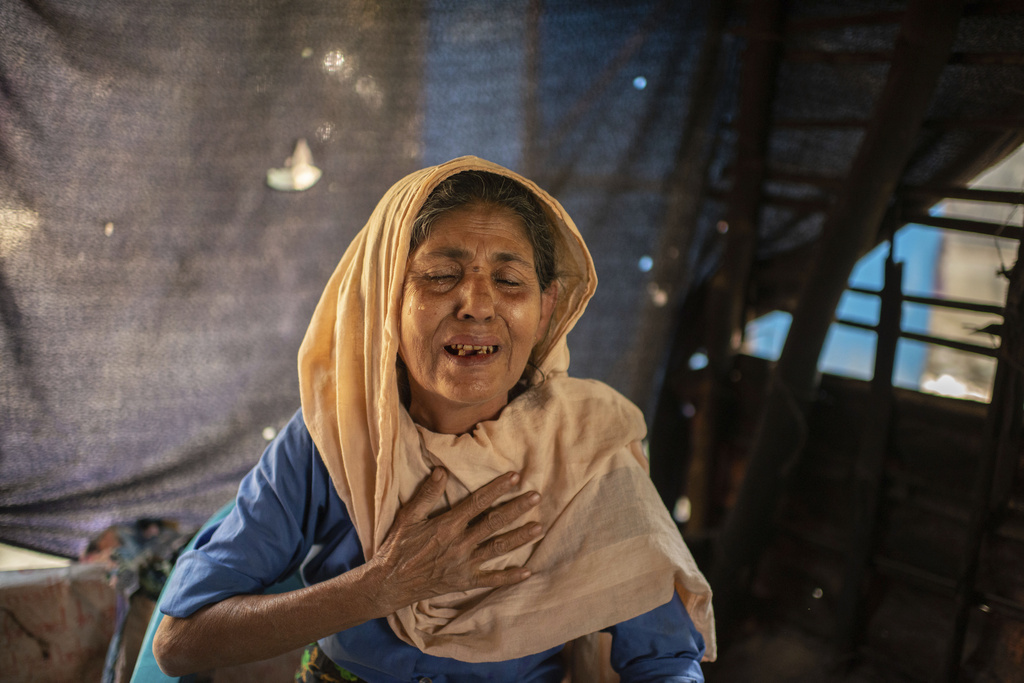
Momina feels she is burning in a fire or sinking under water. “It would be better to kill us by poison instead of taking away my family,” she says. (AP Photo/Mahmud Hossain Opu)
Hasina Khatun, whose pregnant daughter, Asma, and 13-year-old son were on the boat, now finds herself begging to hold other people’s babies. She wasn’t able to hold her daughter’s stillborn baby, either, she says through tears.
Hasina, like some others, still holds out hope her loved ones are alive. Without their bodies, they say, their deaths are difficult to accept.
One man, Muhammed Rashid, believes he sees his teenage son, Saiful, in an online photo of Rohingya refugees in Indonesia. He had it laminated.
Muhammed cradles Saiful’s backpack in his lap. He pulls down a sack of his boy’s belongings and dumps it on the bed, a strangled sob erupting from his throat. Then he tenderly kisses his son’s English book, on which Saiful had scrawled: “I love you.”
“My son is everything,” Muhammed murmurs. “We believe he is alive.”
But the only known survivors from that night were Kafayet and his passengers.
After Jamal’s boat sank, they drifted for another 10 days, their engine damaged, their food and water gone. Kafayet’s brother could not stop crying, thinking about what must have happened to their niece and nephew.
Delirious with thirst and hunger, they suddenly spotted a speed boat in the distance and frantically waved their clothes in the air. The Sri Lankan navy towed Kafayet’s boat to shore.
“Allah gave me a new life,” Kafayet says from a Colombo shelter.
His brother, Muhammed, knows how close they came to death. He hopes no one else will attempt to do what they did.
Yet back in the camps, such plans are already underway. In early March, Jamal’s sister, Bulbul, listened in horror as her 20-year-old son told her he was preparing to leave by boat.
Her heart stopped. “I will never allow you to go on this dangerous journey,” she told him. “My brother died on a boat.”
So he agreed to stay — for now. If he flees, she says, she will die of worry.
Rashid’s eyes are ringed with black, a result, he says, of crying for months for Setera and their daughters.
He accepts now that they drowned in the dark, screaming for help from a world gone deaf.
“I spent a long time here for my family. But now I’ve lost them,” he says.
Summit Green Valley Chiangmai Golf Course offers a Hole-In-One Big Prizes Challenge with luxury cars every month to stimulate revenue to promote Chiangmai a golf destination for Thailand
The Summit Green Valley Golf Course with Navakij Insurance Public Company Limited on Saturday 27th May 2023 held a press conference to announce its Hole-In-One Big Prize program with special prize as a luxury car worth 1.25 Million Baht for any tournament meeting the golf course criteria throughout the years 2023-2024. On this press meeting day, Siam Nissan Chiangmai has also launched its new Almera and the new MU-X was also on the show by Isuzu Sala Faster Chiangmai as part of the big prize cars.
The Summit Hole-In-One Big Prize campaign was initiated by Summit Green Valley Chiangmai Country Club, a renown 18 holes-golf course, designed by the golf expert and architect Denis Griffith located in the green valley of Mae Rim District of Chiangmai, only 30 minutes from Chiangmai airport. The golf course is open throughout the year for all Thais and foreign golfers.
“We partnered with Thailand’s top notch brands, said Mr. Narongridh Sukchaiprakarn, the general manager of the golf course, including Thai Viet Jet airline, Siam Nissan, Isuzu, Nakakij Insurance, 3K Battery, Movenpick Suriwongse Hotel Chiangmai, Betagro to design the Big Prize campaign to attract the golfers under the associations and clubs throughout the country to hold the tournaments at the golf course.
This campaign costs more than 24 million Baht for the whole years of 2023-2024. This aims to attract high-value golfers to visit Chiangmai and Thailand with estimated spending per head around 4,000 – 6,000 Baht. This will further stimulate and connect the entire eco system to drive both the economy and Bio Circular and Green Economy as well as local cultures and products.
The Summit Hole-In-One Big Prize campaign starts with 25,000 Baht prize value for every golfer, except the registered golf professionals, who hit the hole-in-one both in individual and tournament categories every day. The special big prizes start with a tournament with 70 – 90 golfers who break the hole-in-one will be awarded with a motorcycle worth 50,000 to 100,000 Baht value.
The tournament starting with 120 golfers will be awarded with 500,000 Baht car when any golfers hit the hole-in-one. Any tournament with 220 golfers onward will be awarded with a prize with 1,250,000 Baht value. Conditions and more information are available at the golf course for further application for the tournament organizing,” elaborated Mr. Narongridh.
“Summit Green Valley is the world class golf course meeting the international tournament standards that Siam Nissan Chiangmai as a sole distributor of Siam Nissan Thailand fully supports this campaign initiative.”, conquered Mr. Chulanit Wangwiwat who serves as CEO of Siam Nissan Chiangmai and the President of Chiangmai Chamber of Commerce. As local business operator, we all support this campaign with anticipation that it will stimulate the economy as well as the sports and wellness industry. Not only the sports and golf industry will benefit from this initiative but also the travel and tourism, accommodation and food business in the province, said Mr. Chulanit.
“Besides Nissan, on behalf of Chiangmai Chamber of Commerce, I believe that this Summit Big Prize, as a creative economy campaign created by Summit and Navakit will benefit all stakeholders at all levels”, added Mr. Chulanit.
Also attended as keynote speaker at the press meeting, Mr. Pallop Sae Jiew, as President of the Federation of Tourism Industry, in charge of 17 Northern provinces including Chiangmai confirmed that this campaign is well in support of the Federation’s policy to promote Chiangmai as the golf destination of Thailand and Asia.
Chiangmai is besides well known for its rich culture and environment, it also the golf destination for East Asian and European countries during the winter season. But we wan to make Chiangmai every day the high season for local and international golfers in Thailand. We also support this initiative by Summit golf course and Navakit Insurance to attract golfers to spend not only for golfing but also on other business services, confirmed Mr. Pallop.
Navakij Insurance PLC. is very proud to be a part of this first time ever initiative to award the big prize campaign for the next 24 months together with Summit Green Valley Chiangmai Country Club. This campaign not only builds up the safety awareness in all golfers during golfing but also to recognize the achievements of the golfers both in private sessions and in tournaments, added Dr. Maneerat Kor-Udom, Director of Special Accounts and Direct Businesses of Navakij Insurance PLC. who represents the company in the press conference.
She also noted that Navakij Insurance PLC. also provides special daily Golfer’s Indemnity Insurance package to cover the maximum limit of Baht 500,000 for golf equipment, personal accident and third party liability during golfing as well as up to Baht 15,000 for hole-in-one prize for every Thai and foreign insurance policyholder. We will continue the partnership program with more innovative insurance products for the golf industry with the collaboration with Summit Green Valley and its affiliates.
Navakij Insurance PLC. is one of the country’s oldest firms with 90 years history in the insurance business. Navakij is also the expert in the hole-in-one insurance product but this 2 years long Big Prize Campaign is the first initiative it has collaborated with the leading golf course operator, Summit Corporation who owns not only Summit Green Valley in Chiangmai but also Summit Windmill in Bangkok.
The Summit Green Valley Hole-In-One Big Prize Challenge Campaign is the joint product and service innovation of its partners including Navakit Insurance PCL, Thai Vietjet Air, Nissan Motor Thailand and Siam Nissan Chiangmai, Saree Viangping Chiangmai, Boonrawd Trading, Gongkham Restaurant Chiangmai Local Food, Beyond Green, Vabila Apparel, Plus Golf & Pallas AG, Absolute Golf, File Art Advertising, Jebsen & Jessen Technology (T), VARS Chiangmai, Movenpick Chiangmai, Parapatch Electro Motive, Nothern SP Pipe and Khun Tim Beer House Mae Rim Chiangmai, Nakornping Boutique Mae Rim Chiangmai, Isuzu Sala Faster Chiangmai, Caddy Q, Thai Energy Storage (3K Battery), Betagro Kaset Industry.
All golfers, associations, clubs who are interested to play golf or hold the tournaments to win the Hole-In-One Big Prize Challenge at Summit Green Valley Chiangmai Country Club please contact its service team at Tel. 094 613 91 91 or www.summitgreenvalley.com
Lalisa Manobal, also known as Lisa,Blackpink, a Thai member of the South Korean girl group BLACKPINK, visited Ayutthaya, the ancient city of Thailand, at the end of May and shared photos of herself dressed in Thai traditional attire on her Instagram on June 5.
Not only did the post acquire 7.6 million Likes from BLINKS or her fan club, but Ayutthaya has become more active in order to attract tourists.
LISA (@lalalalisa_m) instagram
Ayutthaya is the capital of the Kingdom of Siam during 1350 – 1767, and also a prosperous international trading port. The ruins of the old city now form the Ayutthaya Historical Park, an archaeological site that contains palaces, Buddhist temples, monasteries and statues.
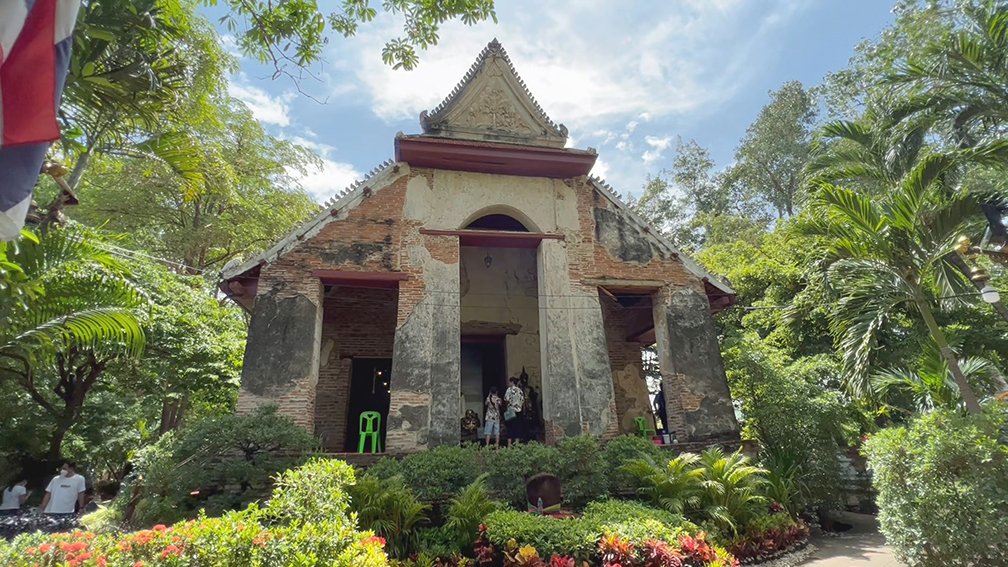
Lisa has visited the ancient site of Wat Mahathat, which is located within the Phra Nakhon Si Ayutthaya Historical Park. Many people, both Thai and foreigners, came to visit, including groups of young people who intended to follow in the footsteps of “Lisa” and shoot photographs.
Officials from the Fine Arts Department stated that numerous tourists have visited the areas Lisa has visited in the last 2-3 days.
Lisa’s fan club member, Ms. Suparat Nochak, 24, said she was thrilled to attend and follow in her idol’s footsteps. The old place is even more amazing than the photographs depict.
Wat Mae Nang Pluem is another location Lisa and her friends, including Channel 3 actress Diana Flipo visited. Tourists gather to pay their respects to Luang Pho Khao within the old temple in order to make a wish.
Ms. Dara Thauan, 54, a vendor at Mae Nang Pluem Temple, said that many people questioned if “Lisa” came today, so she told them that the superstar came last Saturday, and someone asked where Lisa went and where she snapped photos.
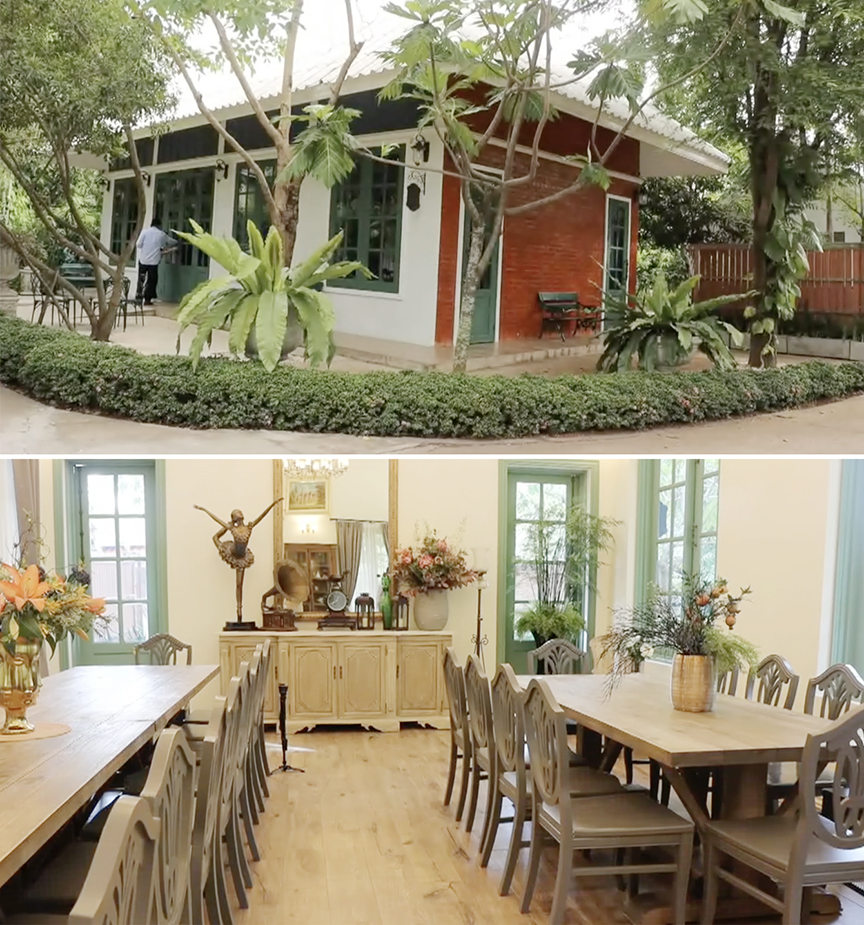
Lisa and her companions dined at Khao La-or Restaurant, which is located along the Chao Phraya River in Ban Pom Subdistrict, Phra Nakhon Si Ayutthaya District. It’s a Thai restaurant with European styles in the middle of nature. Tourists were also following Lisa.
Khao La-or Restaurant
Noina, a make-up artist at Malai Thai Fabric Shop, adjacent to Wat Chaiwatthanaram, claimed that when Lisa wore a sarong dress, the trend of wearing Thai traditional dresses emerged. The shop has to order more dresses and sarongs for customers to rent. Children’s sets cost 100 baht per set, while adults pay between 200 and 300 baht.
“Thank you to Lisa for dressing in traditional clothes to photograph ancient sites in Phra Nakhon Si Ayutthaya, boosting the economy’s recovery, and inviting tourists to rent Thai dresses or dress in sarongs to photograph ancient sites,” Noina added.
A lawyer (2nd from L) holds a banner that reads "unjust ruling" outside the Fukuoka High Court's Miyazaki branch in Miyazaki Prefecture on June 5, 2023, after the court denied a retrial for Ayako Haraguchi, who served 10 years in prison for the murder of her brother-in-law in 1979. (Kyodo)
Miyazaki, Japan – A Japanese high court on Monday denied a retrial for a 95-year-old woman who served 10 years in prison for the murder of her brother-in-law in 1979 in Kagoshima Prefecture, southwestern Japan.
The Fukuoka High Court’s Miyazaki branch rejected a call by Ayako Haraguchi to reopen the case, saying there was “no error in judgment” in the previous decision in June 2022 by the Kagoshima District Court that had deemed new evidence presented by the defense to be insufficient.
“It cannot be said that (the new evidence) is highly credible, as the body was not inspected directly,” said Presiding Judge Masao Yasu.
Haraguchi’s defense had claimed that the brother-in-law died from respiratory arrest after suffering a cervical cord injury when he fell into a ditch, and had photographs from the autopsy reexamined by a doctor.
Prosecutors appealed a district court’s decision to grant a retrial for Ayako Haraguchi, who served a 10-year term in prison for a murder in 1979. | DEFENSE LAWYERS / VIA KYODO
They had also submitted evidence pointing to the unreliability of the testimony of two neighbors.
The district court decided that the additional material “did not serve as clear proof to acquit her.”
“We are extremely disappointed,” said Masami Mori, who led Haraguchi’s defense team. “We will file a special appeal. This is an egregious violation of human rights.”
Meanwhile, deputy chief prosecutor of the Fukuoka High Public Prosecutors Office Tsunekazu Kobashi, said, “We believe it was an appropriate decision.”
Haraguchi has consistently denied any wrongdoing. Among four previous requests for a retrial, two were approved by a lower court but later rejected by upper courts.
She was arrested in October 1979, along with three other family members including her husband at the time, on suspicion of strangling Kunio Nakamura with a towel and abandoning his body in a cattle barn beside his home in the town of Osaki earlier that month.
In the 1980 ruling, the district court found Haraguchi guilty of killing Nakamura on grounds that a relative said she had proposed the murder, suggesting she had been unhappy about Nakamura’s conduct.
She filed her first request for a retrial in 1995 after fully serving her 10-year term through 1990. The Kagoshima District Court in 2002 decided to reopen the case, but it was overturned by a high court in 2004.
Her third retrial request was granted by the district court in 2017, a decision upheld by a high court, but the Supreme Court rejected it in 2019.
A couple of cases have been granted retrials in recent months.
In February, the Osaka High Court approved a posthumous retrial for Hiromu Sakahara, who had been convicted of robbing and murdering a 69-year-old woman in 1984. He died in 2011 of illness at the age of 75 while still incarcerated.
In March, the Tokyo High Court decided to grant a retrial of Iwao Hakamata, a former professional boxer who was sentenced to death over a 1966 quadruple murder case in Shizuoka Prefecture.
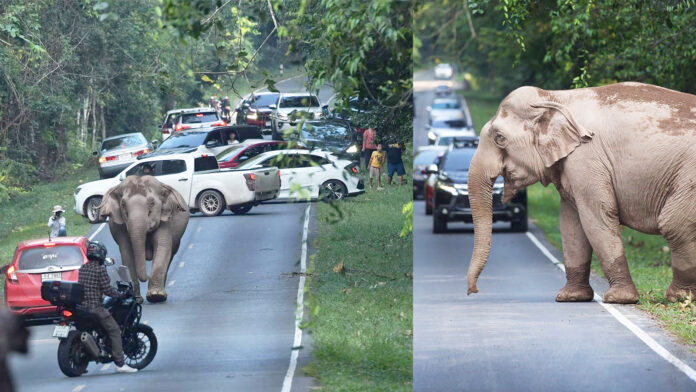
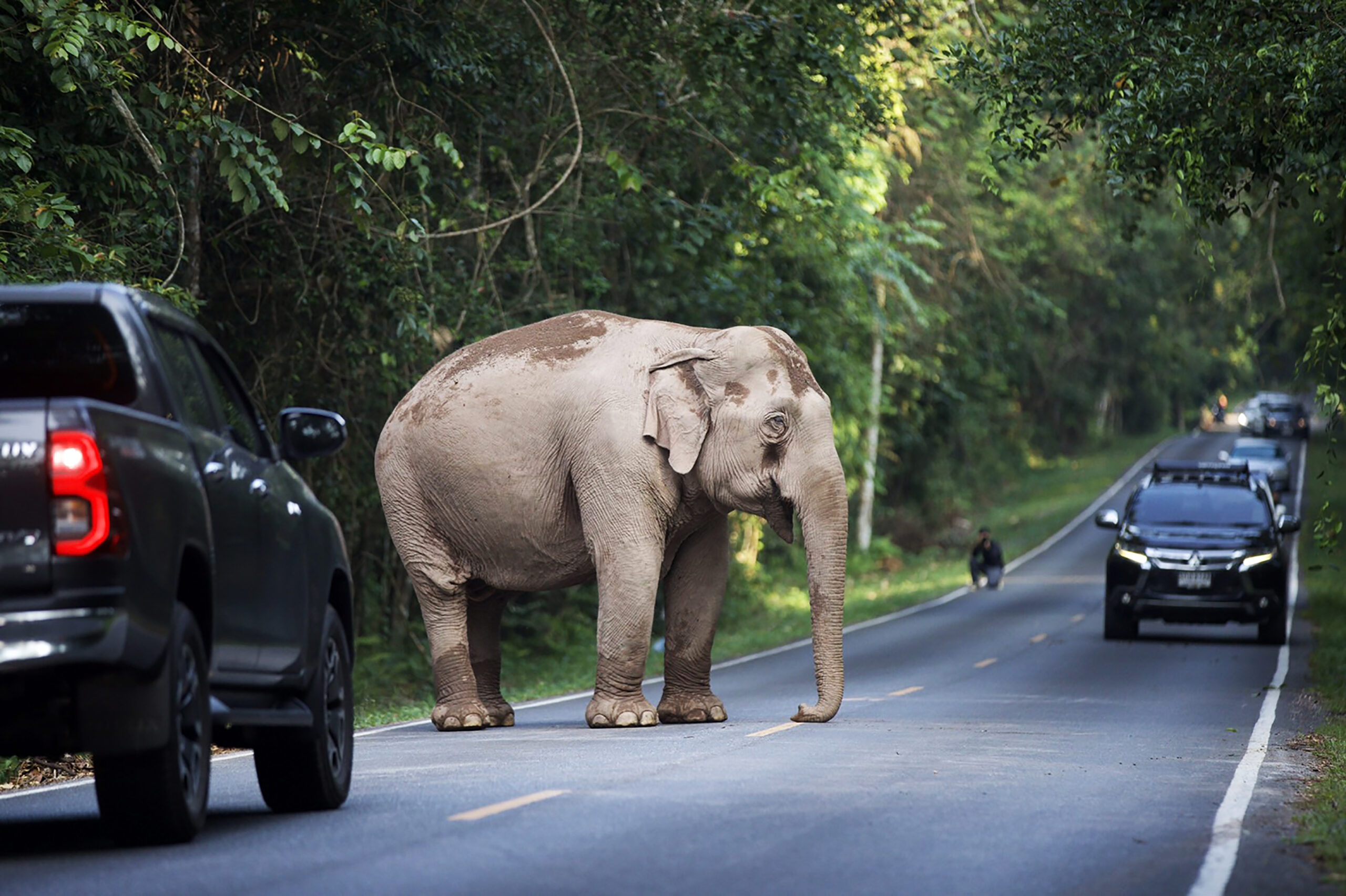
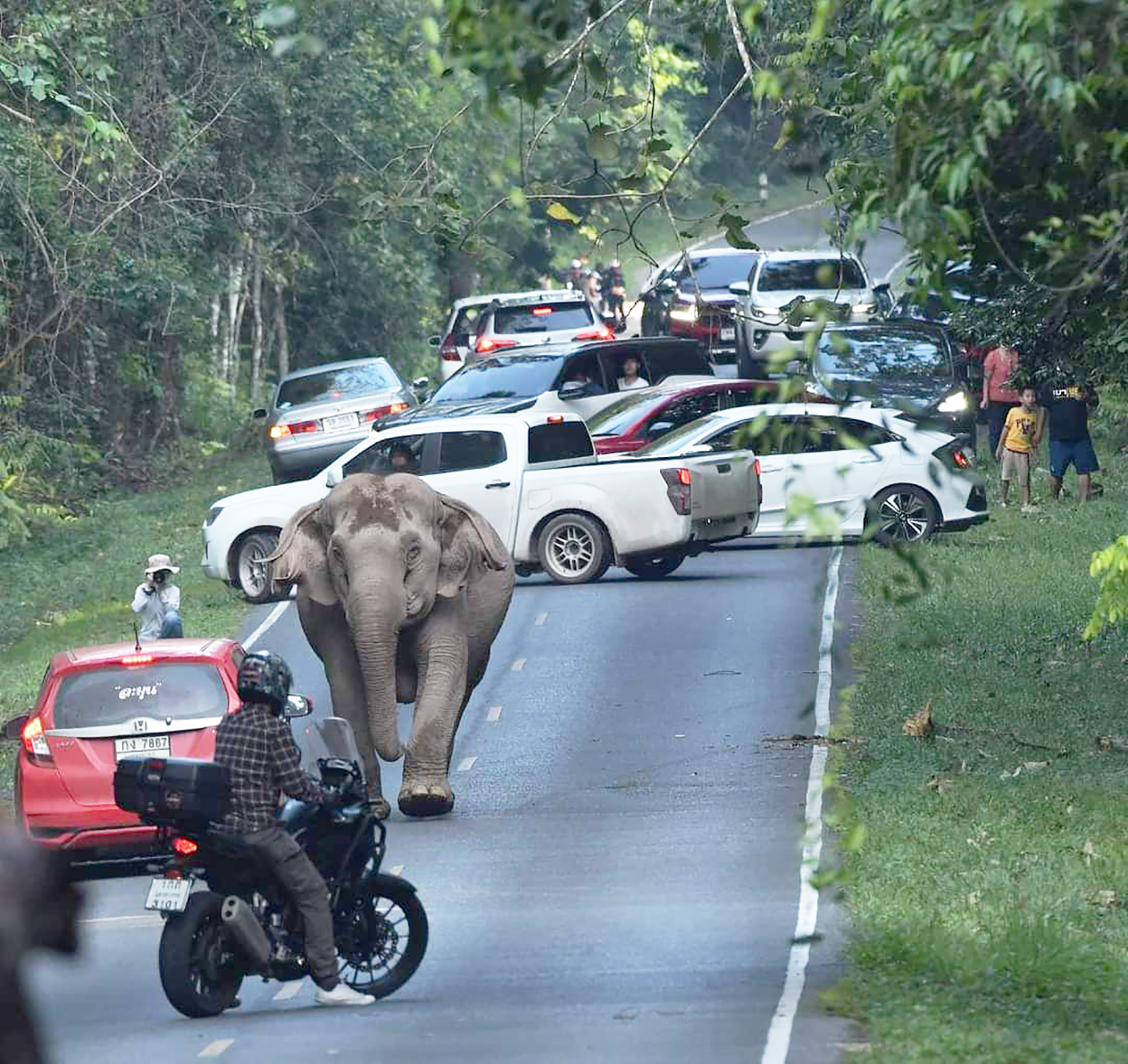
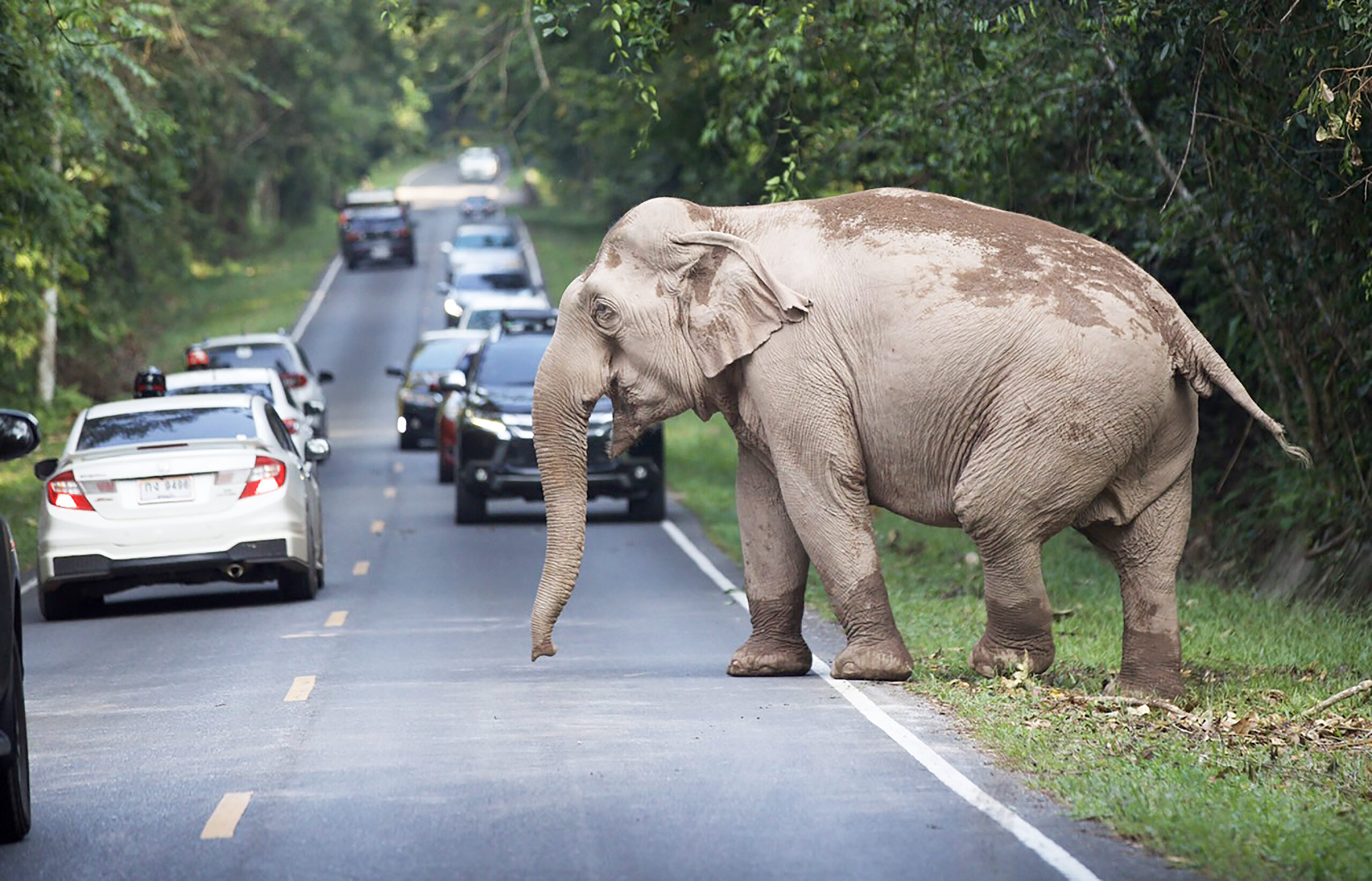
A 14-year-old boy captured these breathtaking images of a wild elephant emerging and wandering on the road of Khao Yai National Park in Nakhon Nayok Province.
Images published on the page “The Sound of a Sobbing Forest” (เสียงป่าสะอึ้น) were taken by Krishna Rojanaburanont, 14, son of Mr. Asampinpong Rojanaburanont, the headman of Ban Pong Pratun, Pak Chong Sub-district, Pak Chong District, Nakhon Ratchasima Province, and page members who travelled up with him to photograph nature on Khao Yai on June 5.
Krishna Rojanaburanont / เสียงป่าสะอื้น
The elephant, which was about 15-18 years old, without tusks, and was of unknown gender, strolled out of the forest on the way out, leading automobiles to want to drive away but were unable to do so due to the large number of cars following after. The wild elephant then proceeded down into the forest.
Krishna Rojanaburanont / เสียงป่าสะอื้น
Mr. Chaiya Huaihongthong, the head of Khao Yai National Park, stated that wild elephants occasionally come out to walk on the road that leads to the Prachinburi side. Mr. Sittiporn Product, an officer who is experienced with wild elephants, is usually in charge of looking after and assisting visitors and others who utilise this route.
Krishna Rojanaburanont / เสียงป่าสะอื้น
“Since I took the position of head of the Khao Yai National Park for almost 2 years, I have never seen wild elephants attack anyone. Because wild elephants in Khao Yai are good-natured. Just tourists, don’t go to stir up the elephants. Stay 50 meters away from elephants. Don’t turn off the engine. Don’t blow the horn. Don’t make noise. Wild elephants won’t do anything harm,” said Chaiya.
Pita Limcharoenrat waved to the photographers at the Move Forward Party.
Move Forward Party PM candidate Pita Limcharoenrat’s stake in the ITV television network remains unresolved, which could prevent him from becoming Prime Minister. It could be negatively affected to the formation of a liberal government. Regardless of the fact that ITV has been defunct since 2007.
Pita declined to comment on the matter on Monday, after it was revealed that he sold 42,000 shares of ITV Media at the end of the post-election period in May. He just stated, “The party secretary has explained this matter.”
The MFP’s secretary general, Chaitawat Tulanon, did not mention Pita’s selling shares of ITV. He just expressed confidence in the party’s ability to clarify and battle the issue. The party’s legal experts confirmed that this matter did not breach Article 4 of the Constitution. They’re just waiting for the Election Commission to contact them.
At the same time, Ruangkrai Leekitwatana, a former candidate for the Palang Pracharat MPs party list and the petitioner to the Election Commission to inspect Pita, stated that he will submit a letter to the Election Commission again on June 6 at 10:00 a.m. to determine whether Mr. Pita has sold ITV shares or not.
“If Mr. Pita said it was not wrong to own shares in ITV, why did he sell them so quickly?” The qualifications for candidates for the House of Representatives and the prime ministerial nominee are specified in the constitution. The minister stated clearly that he did not own any media shares. Even if you only own 1-2 shares, this is incorrect. It has nothing to do with the quantity of shares held,” Ruangkrai said.
He also discussed the possibility of filing a complaint with the Election Commission of Thailand to investigate disagreements between the Office of the Permanent Secretary and ITV. If the Supreme Administrative Court rules in favour of ITV, it will be able to restart its media operations. As a result, ITV has not ceased to exist as a medium. To say that ITV has not yet been out.
BANGKOK (AP) — The United States military released video Monday of what it called an “unsafe” Chinese maneuver in the Taiwan Strait on the weekend, in which a Chinese navy ship cut sharply across the path of an American destroyer, forcing the U.S. ship to slow to avoid a collision.
The incident occurred Saturday as the American destroyer USS Chung-Hoon and Canadian frigate HMCS Montreal were conducting a so-called “freedom of navigation” transit of the strait between Taiwan and mainland China.
China claims the democratic self-governing island of Taiwan as part of its own territory, and maintains the strait is part of its exclusive economic zone, while the U.S. and its allies regularly sail through and fly over the passage to emphasize their contention that the waters are international.
During the Saturday transit, the Chinese guided-missile destroyer overtook the Chung-Hoon on its port side, then veered across its bow at a distance of some 150 yards (137 meters), according to the U.S. Indo-Pacific Command. The American destroyer held its course, but reduced speed to 10 knots “to avoid a collision,” the military said.
The video released Monday shows the Chinese ship cutting across the course of the American one, then straightening out to start sailing in a parallel direction.
The incident occurred as the American destroyer and Canadian frigate HMCS Montreal were conducting a so-called “freedom of navigation” transit of the strait between Taiwan and mainland China. (Mass Communication Specialist 1st Class Andre T. Richard/U.S. Navy via AP)
Indo-Pacific Command said the actions violated maritime rules of safe passage in international water.
The Chinese ship did not attempt a similar maneuver on the Canadian frigate, which was sailing behind the American destroyer.
“Chung-Hoon and Montreal’s transit through the Taiwan Strait demonstrates the combined U.S.-Canadian commitment to a free and open Indo-Pacific,” Indo-Pacific Command said. “The U.S. military flies, sails, and operates safely and responsibly anywhere international law allows.”
The U.S. recently accused China of also performing an “unnecessarily aggressive maneuver” in the air, saying a Chinese J-16 fighter jet late last month flew directly in front of the nose of a U.S. Air Force reconnaissance aircraft over the South China Sea.
The close-calls have raised concerns of a possible accident that could lead to an escalation between the two countries’ militaries at a time when tensions in the region are already high.
The incident in the Taiwan Strait came on a day when both U.S. Defense Secretary Lloyd Austin and Chinese Defense Minister Gen. Li Shangfu were in Singapore for an annual defense conference.
Li on Sunday suggested that the U.S. and its allies have created the danger with their patrols, and was intent on provoking China.
“The best way is for the countries, especially the naval vessels and fighter jets of countries, not to do closing actions around other countries’ territories,” he said through an interpreter. “What’s the point of going there? In China we always say, ‘Mind your own business.’”
Austin had invited Li to talk on the sidelines of the conference; Li refused.
A video of a shocking incident is circulating, showing a man assaulting his wife on the street and damaging a car due to jealousy in Songkhla province. The perpetrator, a police officer, turned himself in on June 5.
After receiving a warrant for arrest on 2 charges from the Na Thawi Provincial Court, Police Senior Sergeant Major Pongsak Rajchanai, 51, squad leader and deputy investigator of Mueang Satun Police Station, surrendered to officers of Sadao Police Station.
He was informed of the charges, which included robbery by snatching a necklace from his wife’s neck and using force to harm others without causing serious bodily or mental harm.
The investigators spent more than three hours investigating, but Pongsak refused to cooperate and insisted on testifying in court. As a result, they took him to Na Thawi Provincial Court and opposed the bail. His agency also proceeded to remove Pongsak from his position.
This policeman attacked his wife out of jealousy on the night of June 4 after his wife had celebrated a friend’s birthday at a nightclub on the outskirts of Samnak Kham district, Sadao sub-district.
According to the Women and Men Progressive Movement Foundation, which collected data from media reports on domestic violence in 2021, 52.4 per cent of cases were found to be domestic incidents resulting in death.
The highest percentage of these cases involved the killing of the wife by the husband ( 63.4 per cent). The leading causes were jealousy and suspected infidelity (60 per cent) and failed attempts to reconcile with the spouse (14.7 per cent).