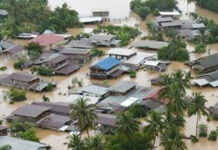



































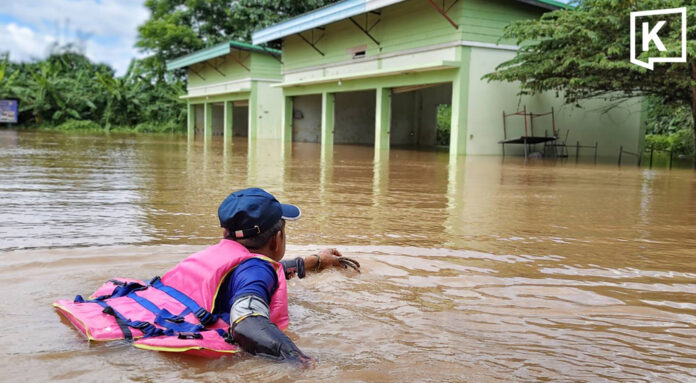
NAKHON PHANOM — The Mekong River has overflowed its banks and flooded a Thai-Lao border trading market in Nakhon Phanom, with water levels reaching 11.98 metres on 12 August, just 2 centimetres below the critical level.
Hydrological officials recorded the river level at 06:00 on Wednesday, showing a 15-centimetre increase from the previous day. Authorities warned that the level could reach the critical threshold by the afternoon.
The Nakhon Phanom municipal authorities have ordered all four floodgates at key pumping stations to be closed to prevent the Mekong from flowing back into the city.
Runoff from Bueng Kan province and the Lao side of the river has also flooded agricultural areas along the riverbank in Ban Klang subdistrict, Muang district, about 28 kilometres from Nakhon Phanom town.
More than 100 rai of banana, bamboo and aromatic coconut plantations have been inundated, with water reaching about 1 metre deep. A concrete road stretching more than 3 kilometres has also been flooded.
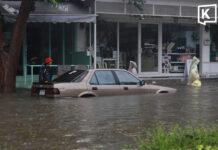
The temporary border trading area and OTOP goods buildings have been particularly affected. Five or six rubbish bins were swept away, while ice boxes, tables and chairs belonging to vendors at the market were left floating in the floodwaters after traders failed to move their belongings in time. Some used ropes to secure their possessions.
Daosawan, 59, said she had three bamboo plantations covering more than 30 rai, with more than 200 clumps of bamboo.
The rapidly rising Mekong has flooded two of her plantations to a depth of about 1 metre since 9 August. She normally harvests bamboo shoots for sale to fresh markets in the town, with daily orders of at least 50 kilogrammes.
On Wednesday, a vendor placed an order for 2,000 kilogrammes. Only one plantation, with about 50 bamboo clumps, remains above the floodwaters, leaving her uncertain whether she can fulfil the order.
She said she may suffer substantial losses and could have to use a boat to harvest bamboo from the two flooded plantations.
Booncharoen Phrombutr, 67, a kamnan inspector in Ban Klang subdistrict, said rapid runoff from upstream areas combined with heavy rain had caused the Mekong to gradually overflow its banks over the past two to three days.
Floodwaters have reached about 1 metre in some areas and as deep as 1.5 metres in others.
Traders from Pak Peng on the Lao side, opposite Ban Nad village in Ban Klang subdistrict, have also struggled to cross the border to sell forest products such as rats, squirrels, mushrooms and insects, as flooding has affected the Lao side as well.
Some goods that traders were unable to remove from the temporary border trading buildings have been swept away and are still floating on the water, awaiting collection by boat.
Meanwhile, the Songkhram River in Si Songkhram district overflowed its banks on the afternoon of 11 August.
Flooding has particularly affected Tha Bo Songkhram village in Tha Bo Songkhram subdistrict and Pak Un village in Si Songkhram subdistrict. Water has entered homes built close to the river, inundating around eight to 10 houses to an average depth of 50 centimetres to 1 metre.
Si Songkhram district chief Kornkan Kaewdee led staff from two health-promoting hospitals and village leaders in taking flat-bottomed boats into the affected areas to deliver essential supplies and provide support to residents.
Officials have been instructed to pay particular attention to waterborne diseases and the needs of elderly people, children and patients requiring special care until the situation returns to normal.
Niwat Chiawiriyabunya, mayor of Nakhon Phanom Municipality, said the Mekong level had continued to rise.
Four automatic pumping stations along the Mekong — on Thetsapradit Road, Samut Banharn Road, at the post office junction and in front of Wat Pho Si — normally pump water from the city into the river.
However, the river level has now risen beyond the stations’ capacity, prompting authorities to close all floodgates at the four locations.
Authorities will instead deploy remote pumping equipment and more than 10 large mobile water pumps from the Department of Disaster Prevention and Mitigation’s Sakon Nakhon regional office.
The equipment will be stationed at key locations and along the Mekong so that if heavy rain causes floodwater to flow back into the city, officials can quickly pump it back into the river.