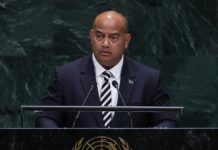

















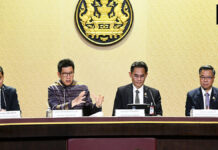











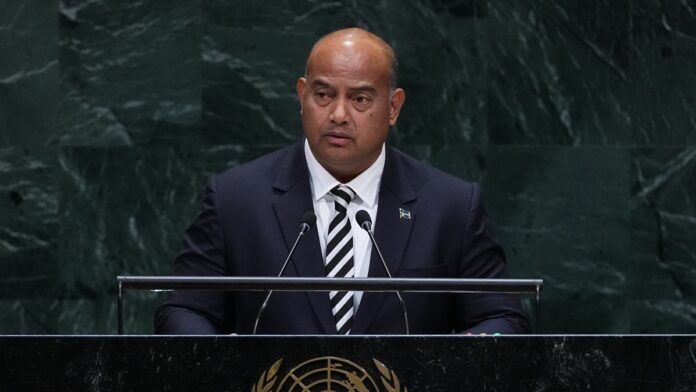
WELLINGTON, New Zealand (AP) — Nauru’s president, David Adeang, has said all opposition lawmakers in parliament have joined his government, a move he said reflected “unity, stability and shared purpose” in the Pacific Island country’s politics.
The unusual move leaves the 19-member parliament without any political opposition. While it’s common for island countries in the South Pacific Ocean to take fluid approaches to forming government and opposition blocs or for lawmakers to switch between them, political debate is habitually robust and Nauru is rare in having no opposing politicians at all.
In a Facebook post Tuesday, Adeang didn’t explain what had prompted the change beyond a “shared commitment” to put Nauru’s interests first. He also didn’t suggest who would supply the scrutiny usually provided by opponents in a country with a single house of parliament.
“There will still be a diversity of views and robust debate as in any strong and healthy democracy,” Adeang wrote.
No political opposition is a first for Nauru
The appointment of two lawmakers, Pyon Deiye and Jason Bingham Agir, as deputy cabinet ministers meant that Nauru’s parliament was in total support of the government for the first time since the country’s independence in 1968, Adeang said.
Government Facebook posts announcing the change were the sole source of information about it; all news outlets in the country of 12,000 people are government-owned. Foreign reporters are discouraged from traveling there, with journalist visa applications priced at 8,000 Australian dollars ($5,445).
Adeang made global news headlines in August when he said his country would officially become known as Naoero, making it the latest state to formally adopt the local spelling of its name. It brought international attention to a country visited by few.
Power competition in the Pacific Islands has directed keener attention to local politics
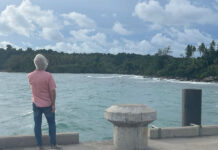
Nauru, a constitutional republic and United Nations member, is one of the world’s smallest countries by both population and size. Limited infrastructure, a remote location and the environmental damage wrought by phosphate mining mean it attracts few visitors, unlike many other Pacific islands where foreign tourism is the main economic driver.
But it’s among the South Pacific countries where domestic politics have drawn keener outside interest in recent years as the sprawling ocean where Nauru is located has become the site of geopolitical contest between major powers.
The potentially wealthy exclusive economic zones surrounding some of the poorest Pacific nations and the strategic importance of their locations in times of global volatility have provoked a race between China and Western countries with interests in the region to win influence with governments there.
Nauru is no exception. In 2024, it was one of a dwindling number of countries to hold diplomatic relations with Taipei, but severed them in order to resume ties with Beijing, which holds that Taiwan is part of China. It’s become one of Beijing’s warmest allies in the region since.
Australia in turn signed a lucrative pact with Adeang later in 2024 in which Nauru promised Canberra veto power over any security deals with Beijing.
The newest members of Adeang’s government have traveled with him to China
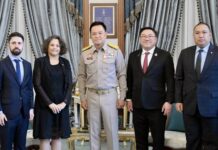
Adeang’s government said Friday that the president had arrived in China for meetings with officials, accompanied by other lawmakers including newly appointed cabinet members Deiye and Agir.
The president has led the country since 2023 when a no-confidence motion ousted his predecessor. He was chosen unopposed to continue in the job among lawmakers sworn in after the 2025 election.
In 2014, then Justice Minister Adeang suspended opposition lawmakers from Parliament for remarks they made to international news outlets. Most lawmakers in Nauru run as independents and don’t belong to political parties, which is common in Pacific Island countries.
Freedom House, a Washington-based organization that promotes democracy, said in its 2026 report that Nauru’s people “generally enjoy political rights and civil liberties” but that corruption was “an ongoing challenge.” The country was one of the world’s richest per capita at the height of phosphate exports but the economy plummeted when the industry collapsed.
Nauru experimented with a golden passport scheme and became a tax haven for a period. It now subsists on foreign aid, sales of tuna fisheries licenses in its waters and funding from Australia first to host that country’s offshore detention facilities for asylum seekers and later to accommodate foreign criminals Australia wanted to deport.