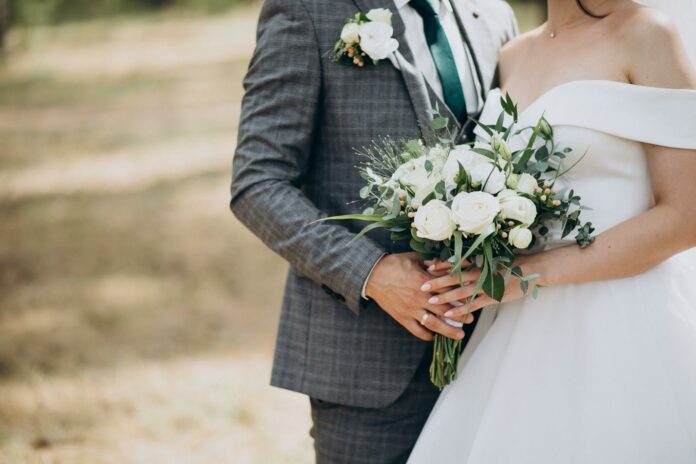
When you are planning a wedding, you want to make sure that everything is perfect so you can have the wedding of your dreams. One of the most important parts of any wedding is finding the perfect backdrop for your special day. Selecting a wedding venue can be stressful since you will need a convenient location that provides the right atmosphere. This article will give you tips on finding the perfect wedding venue in Nonthaburi.
Talk To Your Planner
The first step to deciding which wedding venue in Nonthaburi will be best for you is to discuss with your wedding planner. Since planners coordinate weddings all the time, they are very familiar with different spaces in the area and the best aspects of each one. You can tell them the kind of wedding atmosphere you are looking for, and they will be able to give you some choices that will fit into your budget and aesthetic.
Look At Your Guest List
Another factor to keep in mind when selecting a wedding venue in Nonthaburi is your guest list. You will, of course, need to find a space that has enough space for your guests. In addition, you may want to think about if you have any guests that will be visiting from out of town for your wedding. If so, it would be best to find a wedding venue that is in or near a good hotel where guests can stay overnight for wedding festivities.
See What Is Included
Another key factor when finding a wedding venue in Nonthaburi is to look at what is included in your booking. Some locations may only provide the venue, but you need to bring all decorations, tableware, chairs, and other items there. On the other hand, some wedding venues can help you with decorations and venue preparation on the day of your event. You should also ask if they include catering, staff to wait tables at the event, bar staff or other services you might need for your wedding. Finding a venue with many included services could greatly ease your stress in planning such a large event, but be sure to ask what the price difference would be.
Find the Perfect Wedding Venue For You
The most important part of planning your wedding is ensuring it is perfectly planned to fit your needs. You will need to consult experts, check your guest list, and see what’s included to ensure that any spaces you are considering will work for you. You should also see that spaces fit into your budget and your ideal wedding aesthetic. Take your time and make sure to visit spaces in person so you can be sure that you book the perfect wedding venue in Nonthaburi for your special day.
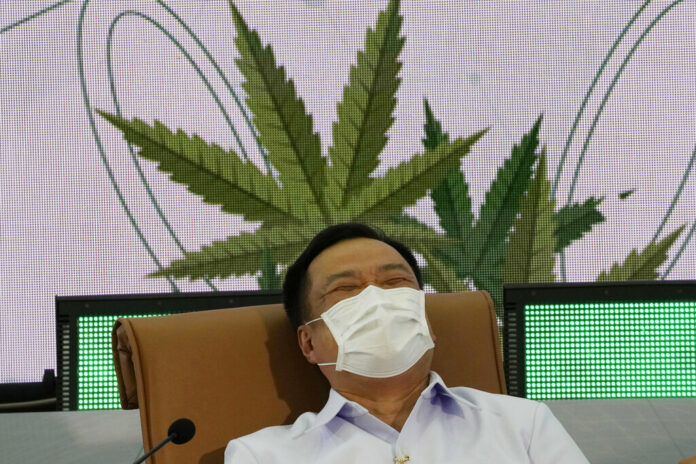
Public Health Minister Anutin Charnvirakul reacts during news conference Tuesday, Feb. 8, 2022, at the Public Health Ministry in Nonthaburi, Thailand, after signing a measure that drops cannabis from his ministry's list of controlled drugs. Photo: Sakchai Lalit / AP
BANGKOK (AP) — Thailand on Tuesday moved one step closer toward being the first Asian nation to decriminalize marijuana, after its health minister signed a measure officially dropping cannabis from a list of controlled drugs.
The delisting will mean all parts of cannabis, including flowers and seeds, are allowed to be used in Thailand. However, extracted content will remain illegal if it contains more than 0.2% of the psychoactive ingredient that produces a “high” — tetrahydrocannabinol, or THC.
At a signing ceremony, Public Health Minister Anutin Charnvirakul said he hoped to set out a “new history for cannabis” in Thailand and remove the stigma around it.
“Cannabis actually has plenty of medical benefits, not different from other herbs, and we are trying our best to make the Thai people enjoy both medical and economic benefits from it,” Anutin said Tuesday.
Production, sale and possession of cannabis will remain partially regulated, however, meaning recreational use of marijuana is not yet legal. The ministry’s stated policy is to promote the use of cannabis for medicinal purposes and build an industry around derived products.
Thailand in 2020 became the first Asian nation to allow the production and use of cannabis for medicinal purposes, under tight controls. Anutin’s Bhumjai Thai Party, a major partner in the current coalition government, campaigned in the previous year’s election for the legalization of cannabis production to aid farmers.
The delisting will take effect 120 days after its publication in the government gazette. In the period ahead of it becoming effective, the ministry will seek to have a bill on cannabis approved by Parliament to clarify several legal points.
The proposed Cannabis Act would allow only patients whose diseases can be eased with marijuana, such as cancer and depression, to grow the plants at home, said Tonnam Niyamapar, a member of The Alliance of Citizens’ Cannabis Association, a lobbying group.
He said that the act would also allow people to smoke marijuana for medicinal purposes. Flowers of the plant had been on the list of controlled drugs, so until now cannabis oil had been permitted only for treatments.
The ministry’s list of controlled drugs regulates a number of substances — from heroine, which is banned, to prescription and over-the counter medicine.
Tonnam questioned why Thailand cannot legalize cannabis for recreational use, in the same legally-controlled manner it does with cigarettes and alcoholic beverages.
“I hope Thailand will finally liberalize cannabis for both medical and recreational use like the United States or Canada,” he said. “But I understand that it will take more years to make that happen.”
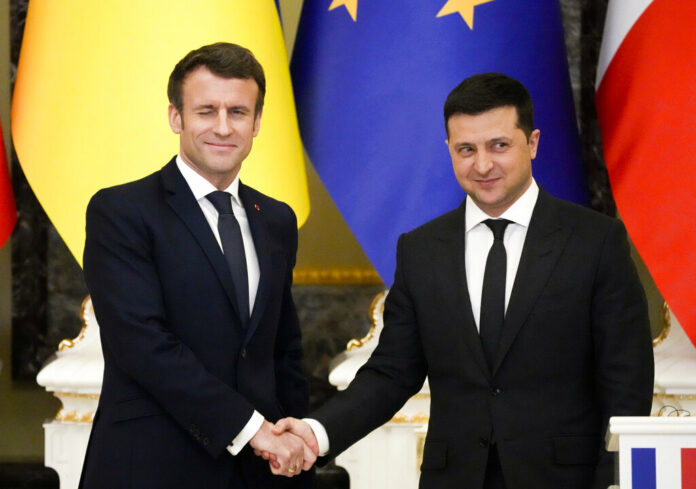
French President Emmanuel Macron, left, winks as he shakes hands with Ukrainian President Volodymyr Zelenskyy after a joint news conference following their talks in Kyiv, Ukraine, Tuesday, Feb. 8, 2022. Photo: Efrem Lukatsky / AP
KYIV, Ukraine (AP) — French President Emmanuel Macron said Tuesday that Russian President Vladimir Putin told him that Moscow would not further escalate the Ukraine crisis.
Macron also said it would take time to find a diplomatic solution to the rising tensions, which represent the biggest security crisis between Russia and the West since the Cold War.
His remarks on a visit to Kyiv came as the Kremlin denied reports that he and Putin struck a deal on de-escalating the crisis. Kremlin spokesman Dmitry Peskov said that “in the current situation, Moscow and Paris can’t be reaching any deals.”
Macron met with Ukrainian President Volodymyr Zelenskyy amid mounting fears of a Russian invasion. Moscow has massed over 100,000 troops near Ukraine’s borders, but insists it has no plans to attack.
The Kremlin wants guarantees from the West that NATO will not accept Ukraine and other former Soviet nations as members, that it halt weapon deployments there and roll back its forces from Eastern Europe — demands the U.S. and NATO reject as nonstarters.
At a news conference after meeting Zelenskyy, Macron said Putin told him during their more than five-hour session Monday that “he won’t be initiating an escalation. I think it is important.”
According to the French president, Putin also said there won’t be any Russian “permanent (military) base” or “deployment” in Belarus, where Russia had sent a large number of troops for war games.
Peskov said withdrawing Russian troops from Belarus after the maneuvers was the plan all along.
Zelenskyy said he would welcome concrete steps from Putin for de-escalation, adding he didn’t “trust words in general.”
Macron also sought to temper expectations.
“Let’s not be naive,” he said. “Since the beginning of the crisis, France hasn’t been inclined to exaggerate, but at the same time, I don’t believe this crisis can be settled in a few hours, through discussions”
Zelenskyy called his talks with Macron “very fruitful.”
“We have a common view with President Macron on threats and challenges to the security of Ukraine, of the whole of Europe, of the world in general,” Zelenskyy said.
He said France was giving 1.2 billion euros ($1.3 billion) in financial aid to Ukraine and helping restore infrastructure in the war-ravaged east of the country.
Western leaders in recent weeks have engaged in high-level talks, and more are planned against the backdrop of military drills in Russia and Belarus. On Tuesday, the Russian Defense Ministry said that six amphibious landing ships were moving from the Mediterranean to the Black Sea for exercises and two Tu-22M3 long-range nuclear capable bombers flew another patrol over Belarus.
Macron said he had not expected Putin to make any “gestures” Monday, saying his objective was to “prevent an escalation and open new perspectives. … That objective is met.”
Macron said Putin “set a collective trap” by initiating the exchange of documents with the U.S. Moscow submitted its demands to Washington in the form of draft agreements that were made public, and insisted on a written response, which was then leaked.
“In the history of diplomacy, there was never a crisis that has been settled by exchanges of letters which are to be made public afterward,” he said, adding that’s why he decided to go to Moscow for direct talks.
Macron later flew to Berlin, where he briefed Polish President Andrzej Duda and German Chancellor Olaf Scholz, who said their stance was unified, with a joint goal “to prevent a war in Europe.”
U.N. Secretary-General Antonio Guterres was pleased to see the high level of diplomatic activity, spokesman Stephane Dujarric said. “The secretary‑general could not be clearer in the need to increase diplomatic activity to avoid any sort of escalation,” Dujarric said.
Putin said after Monday’s meeting that the U.S. and NATO ignored Moscow’s demands, but signaled readiness to continue talking. He also reiterated a warning that NATO membership for Ukraine could trigger a war between Russia and the alliance should Kyiv try to retake the Crimean Peninsula, which Moscow annexed in 2014.
NATO, U.S. and European leaders reject the demands that they say challenge NATO’s core principles, like shutting the door to Ukraine or other countries that might seek membership; but they have offered to discuss other Russian security concerns in Europe.
U.S. President Joe Biden has said any prospect of Ukraine entering NATO “in the near term is not very likely,” but he and other alliance members and NATO itself refuse to rule out Ukraine’s future entry.
Biden met Monday with Scholz, who also will travel to Kyiv and Moscow on Feb. 14-15. They threatened Russia with grave consequences if it invaded, and Biden vowed that the Nord Stream 2 Russia-to-Germany gas pipeline, which has been completed but is not yet operating, will be blocked. Such a move would hurt Russia economically but also cause energy supply problems for Germany.
British Prime Minister Boris Johnson, in an article in the Times of London, also urged allies to finalize heavy economic sanctions that would take effect if Russia crosses into Ukraine. He said the U.K. is ready to bolster NATO forces in Latvia and Estonia as he prepared to meet the Lithuanian prime minister in London to show support for the Baltic nations.
Johnson said he was considering dispatching RAF Typhoon fighters and Royal Navy warships to southeastern Europe. Britain said Monday it is sending 350 troops to Poland to bolster NATO’s eastern flank. It already has sent anti-tank weapons to Ukraine.
More than 100 U.S. military personnel arrived in Romania ahead of a deployment of about 1,000 NATO troops expected in the country in the coming days, Romania’s Defense Minister Vasile Dincu said.
U.S. officials have said that about 1,000 alliance troops will be sent from Germany to Romania, a NATO member since 2004. Romania borders Ukraine to the north. About 1,700 U.S. soldiers from the 82nd Airborne are also going to Poland.
U.S. officials have portrayed the threat of an invasion of Ukraine as imminent — warnings Moscow has scoffed at, accusing Washington of fueling tensions.
Russia and Ukraine have been locked in a bitter conflict since 2014, when Ukraine’s Kremlin-friendly president was ousted, Moscow annexed Crimea and then backed a separatist insurgency in the east of the country. The fighting between Russia-backed rebels and Ukrainian forces has killed over 14,000 people.
In 2015, France and Germany helped broker a peace deal, known as the Minsk agreements, that ended large-scale hostilities but failed to bring a political settlement of the conflict. The Kremlin has repeatedly accused Kyiv of sabotaging the deal, and Ukrainian officials in recent weeks said that implementing it would hurt Ukraine.
After meeting Macron, Putin said without elaboration that some of the French president’s proposals could serve as a basis for a settlement of the separatist conflict, adding that they agreed to speak by phone after Macron’s visit to Kyiv.
Peskov said such a call would take place “in the nearest future.”
Macron said both Putin and Zelenskyy confirmed they were willing to implement the Minsk agreements — “the only path allowing to build peace … and find a sustainable political solution.”
Macron also said the presidential advisers of France, Germany, Russia and Ukraine will meet Thursday in Berlin on the next steps. “It will take time to get results,” he said.
Zelenskyy was mum on where Ukraine stands on implementing the Minsk agreements and whether he assured Macron that Kyiv is committed to do so, saying only that his country views Thursday’s meeting “very positively” and hoped for a subsequent meeting by the four leaders.
German Foreign Minister Annalena Baerbock, visiting the front line in eastern Ukraine’s Donbas region, said she wanted “to get an impression of what it means that we still have war in the middle of Europe.”
Germany has given Ukraine about 1.8 billion euros in aid since 2014, part of which is helping those displaced by fighting.
___
Story: Sylvie Corbet and Dasha Litvinova. Litvinova reported from Moscow. Jill Lawless in London, Yuras Karmanau in Kyiv, Ellen Knickmeyer in Washington, Stephen McGrath in Bucharest, Romania, Frank Jordans in Berlin and Edith M. Lederer at the United Nations contributed.
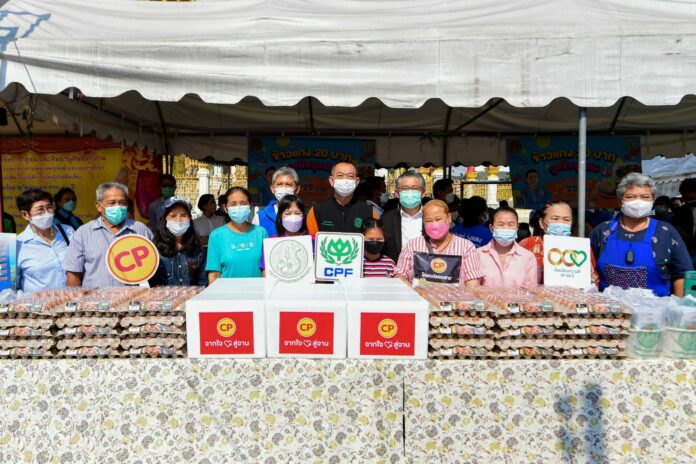
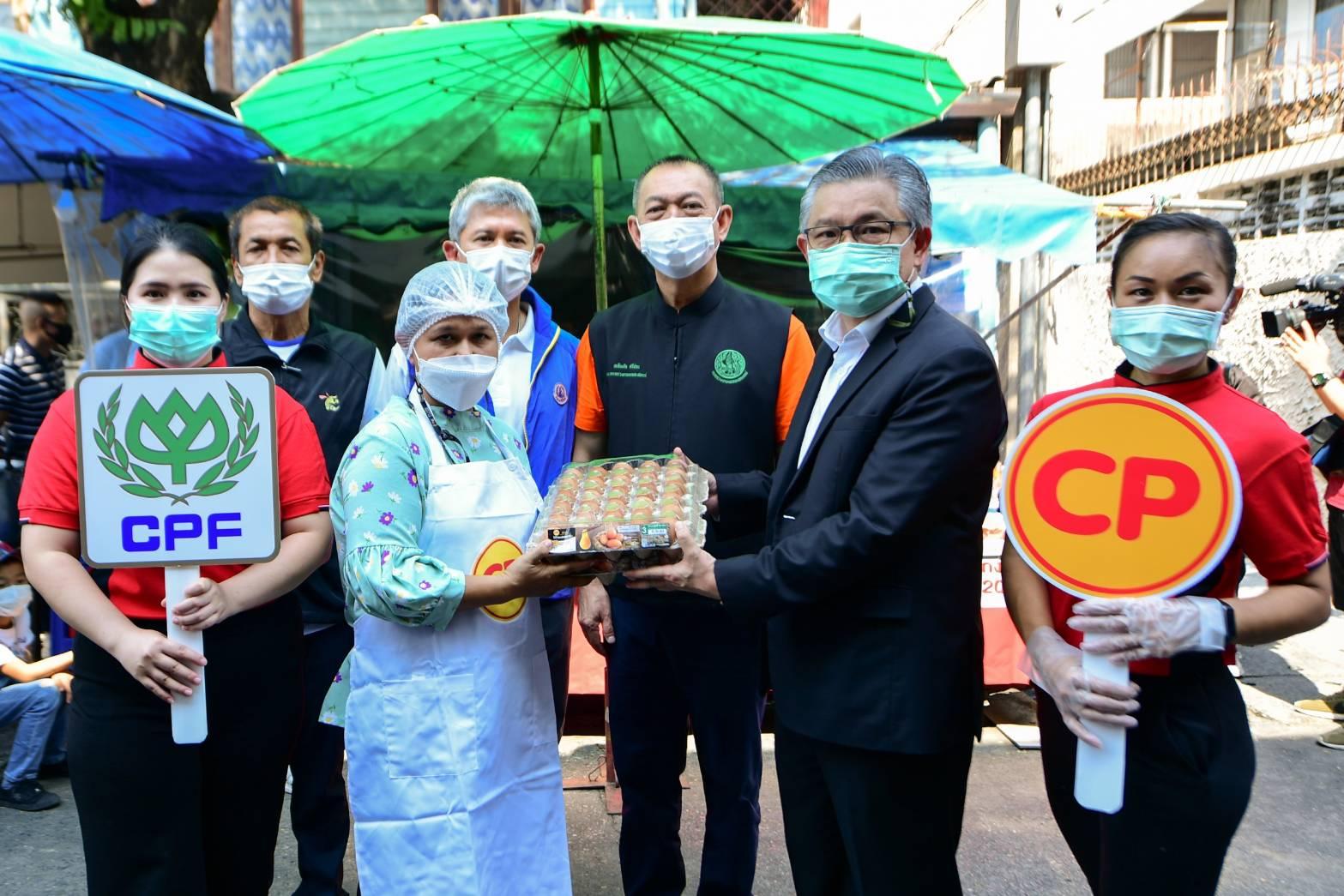
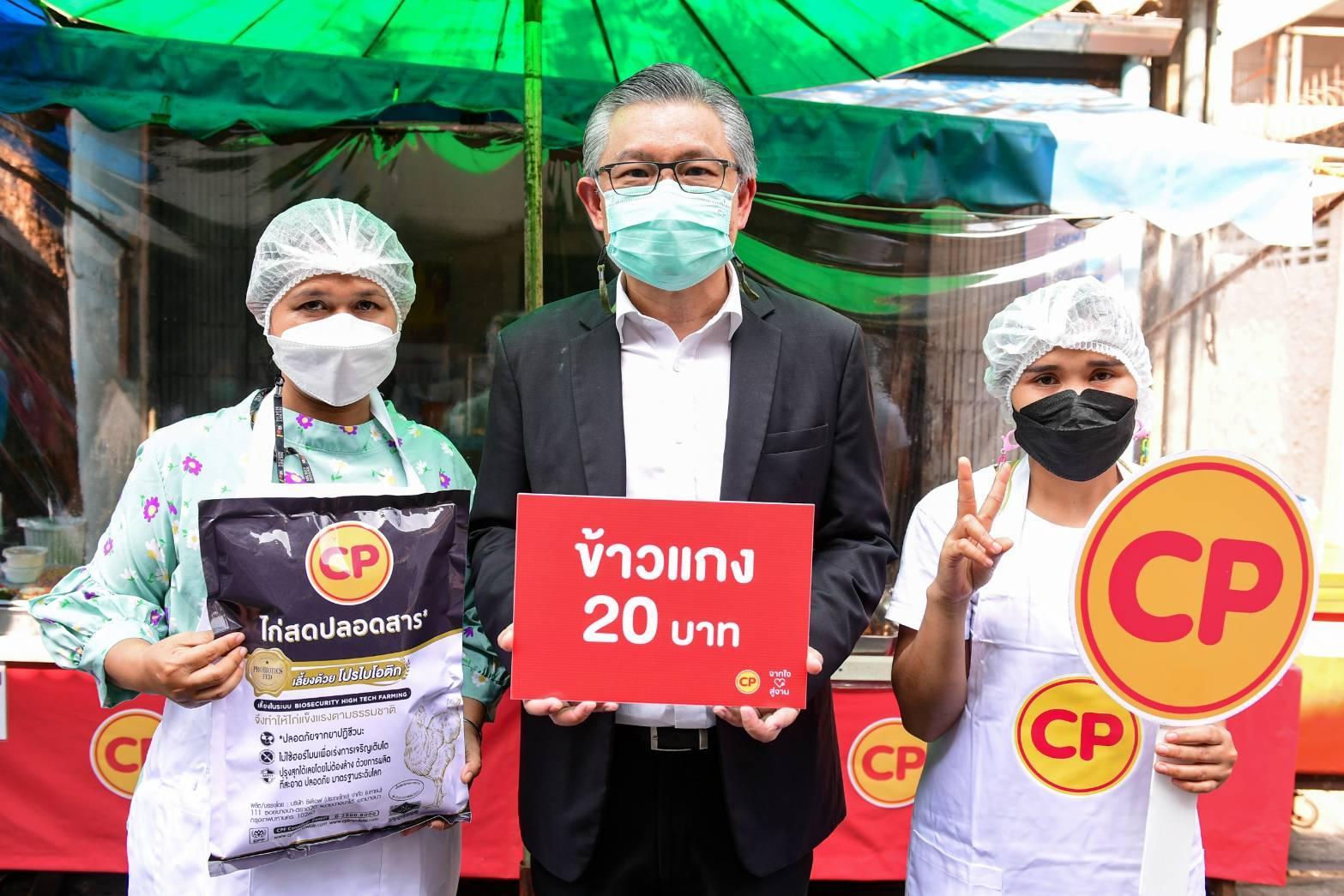
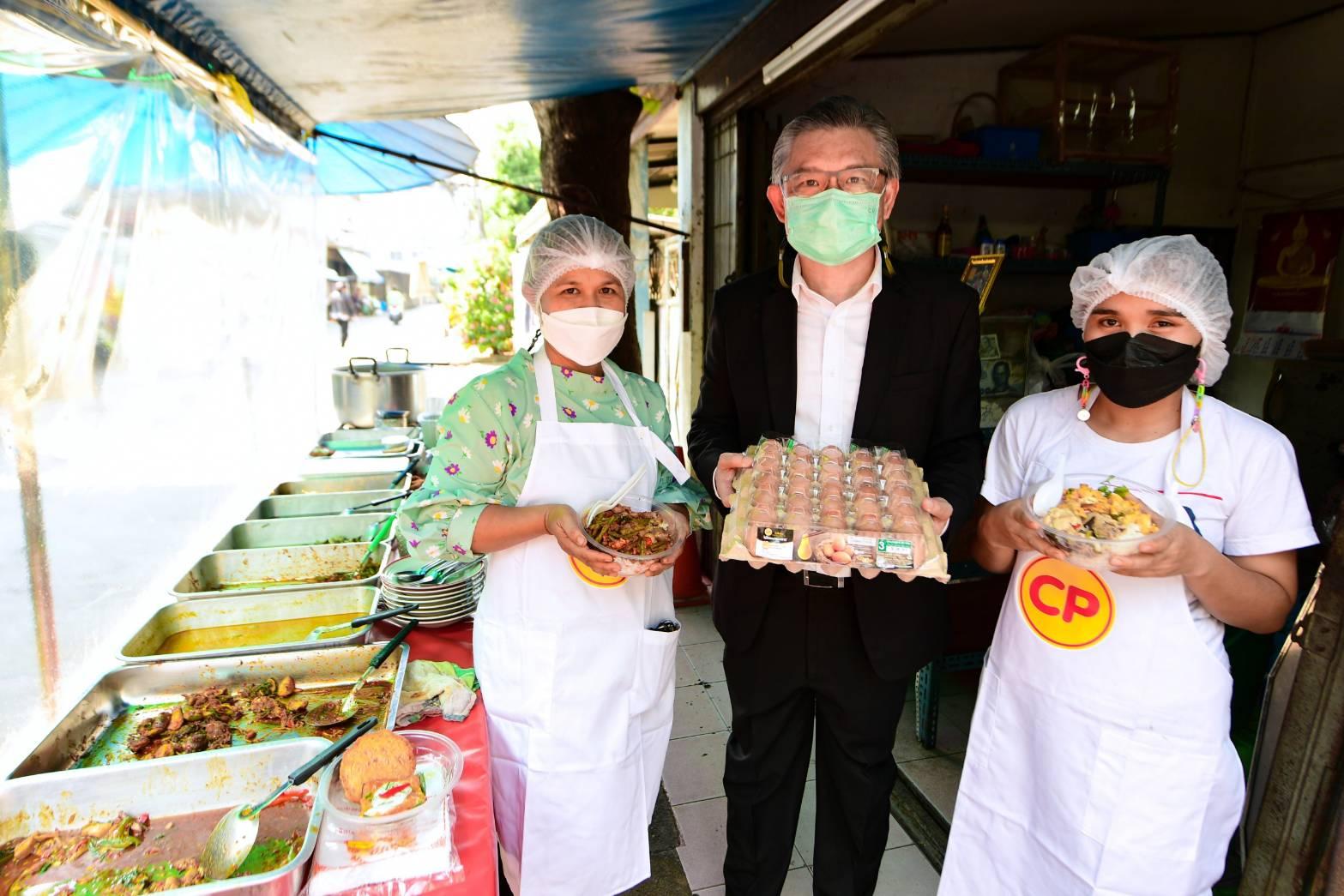
Charoen Pokphand Foods Public Company Limited (CP Foods), in collaboration with the Ministry of Agriculture and Cooperatives, the Ministry of Commerce, MR Seni Pramoj Foundation, and other private partners, launched 20-baht food stalls program in a neighbourhood of Bang Phlat and Bangkok Noi Bangkok in an effort to reduce cost of living.
Mr. Chalermchai Sri-on, Minister of Agriculture and Cooperatives and secretary of the Seni Pramoj foundation, said that the project was initiated to alleviate cost of living for people living in Bang Phlat and Bangkok Noi districts who have been affected by the spread of COVID-19.
He added that the project will help generating income for local food shops and, at the same time, offering good quality foods at affordable price to consumers.
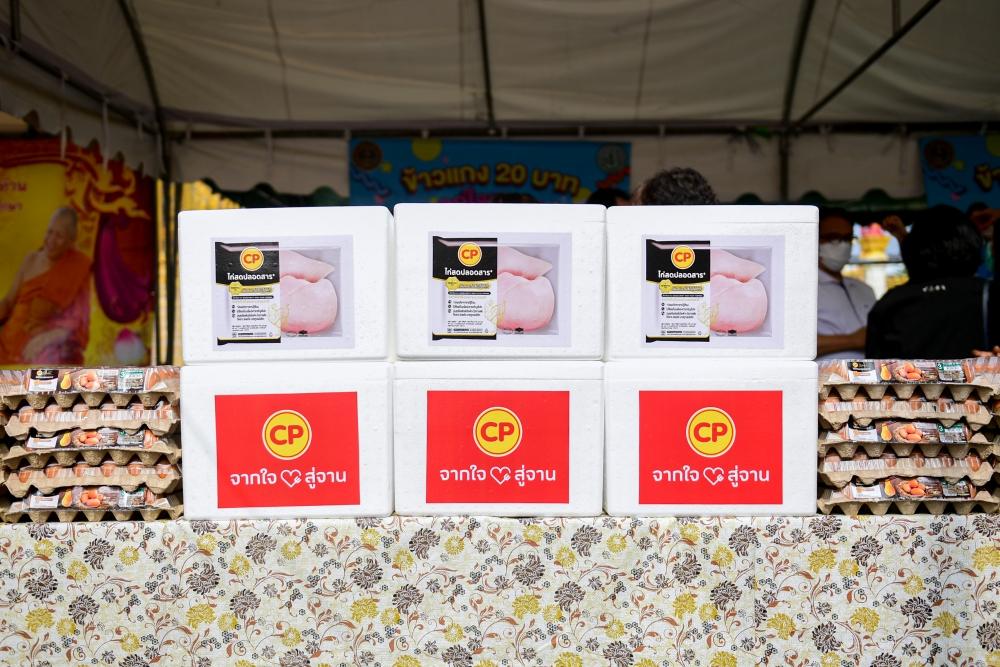
Mr. Siripong Aroonratana, Chief Operating Officer of CP Foods, said that the company is very pleased to be a part of this project to deliver safe and good quality food to the consumers. The company supported high quality chicken meat and egg to ten pilot shops that will cook these ingredients into nutritious meals at a price of 20 baht. It is in line with CP Foods’ ‘3-Benefit’ principles that aims at creating prosperity and well-being for the country, local communities as well as the company and its people.
“The project significantly reduces ingredient cost, enable us to gain reasonable profits while our customers will get delicious and cheap foods daily,” Mrs. Chanjira Phanket, owner of Pu 20-baht restaurant said.
Aside this relief effort, CP Foods has previously worked with public-private partners to provide food to people affected by COVID-19 on several occasion, including providing “CPF Food Truck” under “CPF Food from heart against COVID-19” project to give away ready meal to communities across Bangkok, and CP Group’s Krua Pun Imm project to delivering freshly cooked meal to affected people in several communities.
The company also collaborated with Ministry of Commerce to sell food products in a reasonable price and free delivery with no minimum to alleviate the burden of Thai people amid the crisis.
The award marks a spectacular success for ICONSIAM and Blue by Alain Ducasse, which has previously won one Michelin star for two consecutive years.
Le French Design 100 honors 100 international creations by French designers that earn France’s design industry global recognition.
Siam Piwat has moved beyond local competition and won a world-class award on a global stage, reinforcing its leadership as the Visionary Icon and continuing to deliver experiences beyond expectation.
Siam Piwat Co. Ltd., the world’s leading retail property developer, owner and operator of world-class projects, and one of the joint owners of ICONSIAM Co., Ltd., marked another milestone in Thailand’s retail history with Blue by Alain Ducasse, the Michelin-starred restaurant at ICONSIAM, winning the prestigious Le French Design 100 award. The awards that honor French designers for their work outside of France is another accolade on the list of international awards for Thailand, further bolstering its reputation on the global level.
The award ceremony at France’s Presidential Palace was attended by the French President Emmanuel Macron and his wife Brigitte Macron, Minister of Culture Roselyne Bachelot-Narquin, Hervé Lemoine, the head of the jury, and guest of honor Philippe Starck. At the ceremony, Jouin Manku, a leading French design agency, was honored with the Le French Design 100 award for its design for Blue By Alain Ducasse at ICONSIAM in Bangkok.
Ms. Chadatip Chutrakul, Chief Executive Officer of Siam Piwat Group and Director of ICONSIAM, said, “ICONSIAM is reinforcing its position as a destination where the best of Thailand and the best of the world converge, setting a new benchmark for the retail industry. We have made history and bolstered Thailand’s reputation by winning as many as 13 global awards across different categories. All of this is thanks to Siam Piwat’s vision and determination to inject creativity into every project and creating a perfect symphony of art, culture, and innovation through never-before-seen concepts and stories. In this endeavor, Siam Piwat has collaborated with world-renowned designers as well as Thailand’s leading designers and artists to set itself apart and consistently introduce new and extraordinary experiences to the industry.”
“We are beyond proud to have successfully earned Thailand global recognition for its real estate development capabilities. All of our projects, namely Siam Paragon, Siam Center, Siam Discovery, and ICONSIAM, have won numerous global awards over the years. Blue by Alain Ducasse is another business born out of our key philosophy to deliver ‘experiences beyond expectation’. Our intention was to invite one of the world’s best-known chefs to open a restaurant here in Thailand to deliver a first-ever experience and bolster Thailand’s position as one of the world’s top gastronomic destinations. That is why Blue by Alain Ducasse is exclusive to Thailand. We worked closely with Alain Ducasse and Jouin Manku, the French design agency that meticulously oversaw every detail of the interior design to bring the ultimate dining experience and a unique aesthetic to life.”
A vital element of ICONSIAM, Blue by Alain Ducasse is Thailand’s first-ever world-class contemporary French restaurant by legendary Alain Ducasse recognized with an astounding 21 Michelin stars. Prominently positioned on the coveted Chao Phraya riverfront with unparalleled panoramic views, the restaurant has since its opening in 2019 become a prime destination for epicures and gastronomes. Ever since, it has delivered world-class French cuisine using the finest ingredients and has been awarded one Michelin star for two consecutive years. Blue By Alain Ducasse also won the ‘Best of the Year Award’ in the fine dining category from Interior Design magazine, the most influential authority in the design industry worldwide.
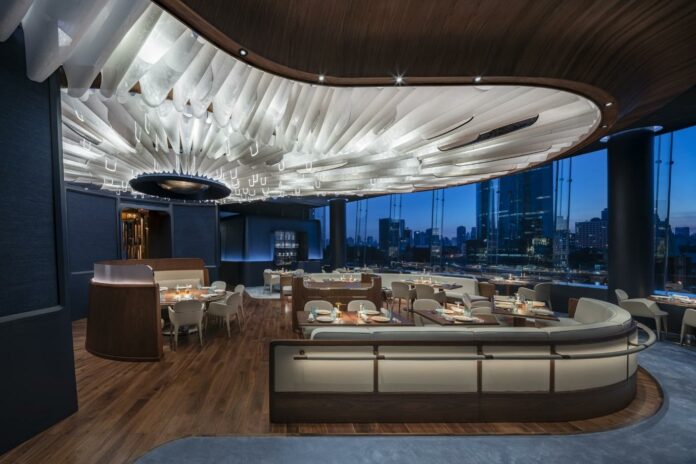
The Le French Design 100 award for Blue by Alain Ducasse recognizes the spectacularly meticulous interior design of the restaurant. A design that perfectly complements the majestic vistas of the Chao Phraya River, and reflects a design philosophy that understands the importance of design and ambience for a complete dining experience. The team at Jouin Mankuhave designed several of Alain Ducasse’sMichelin-starred restaurants in various countries, each time with great success. In Bangkok, Jouin Manku conjured a uniquely captivating space that melds Thai and French influences into a unique space. Walnut wood and brass lamps, which draw inspiration from the intimate gardens – the bosquets – of the Palace of Versailles lend a warmth to the front lounge next to the entrance foyer. An awe-inspiring handmade pleated chandelier dominates the main dining area. With luxurious royal blue walls echoing the restaurant’s name and expansive floor-to-ceiling windows framing views of the river and city, Jouin Manku has created a magnificent stage for the contemporary French dishes and the superb wine list.
Le French Design 100 is the only design award in France that honors the international creations of French designers, and each year 100 objects and spatial design projects are selected for bringing global recognition to the French design industry. Launched in 2019, Le French Design 100 is supported by the French Ministry of Culture and sponsored by the illustrious designer Philippe Starck. The second edition was held in January 2022 under the patronage of the French President Emmanuel Macron.
The Le French Design 100 award that Jouin Manku has won for Blue by Alain Ducasse marks the first global accolade in 2022 for Siam Piwat and ICONSIAM and highlights their continued success in creating experiences beyond expectation. Over the years, ICONSIAM has garnered 13 global awards at various world-class competitions, including the Best Design of the Year at the World Retail Awards 2019 hosted by the World Retail Congress, the first prize in the Best Shopping Center category at the MAPIC Awards 2019 in Cannes, France, the 2020 VIVA Best-of-the-Best Design and Development Award, and being ranked in the top four in the Best Shopping Center Category at the MIPIM Awards 2021.
BANGKOK — Veteran political cartoonist Stephff, whose real name is Stephane Peray, has been based in Bangkok since 1989. His works were published on many papers in Thailand and the region including The Nation, Bangkok Post, and currently Prachatai.
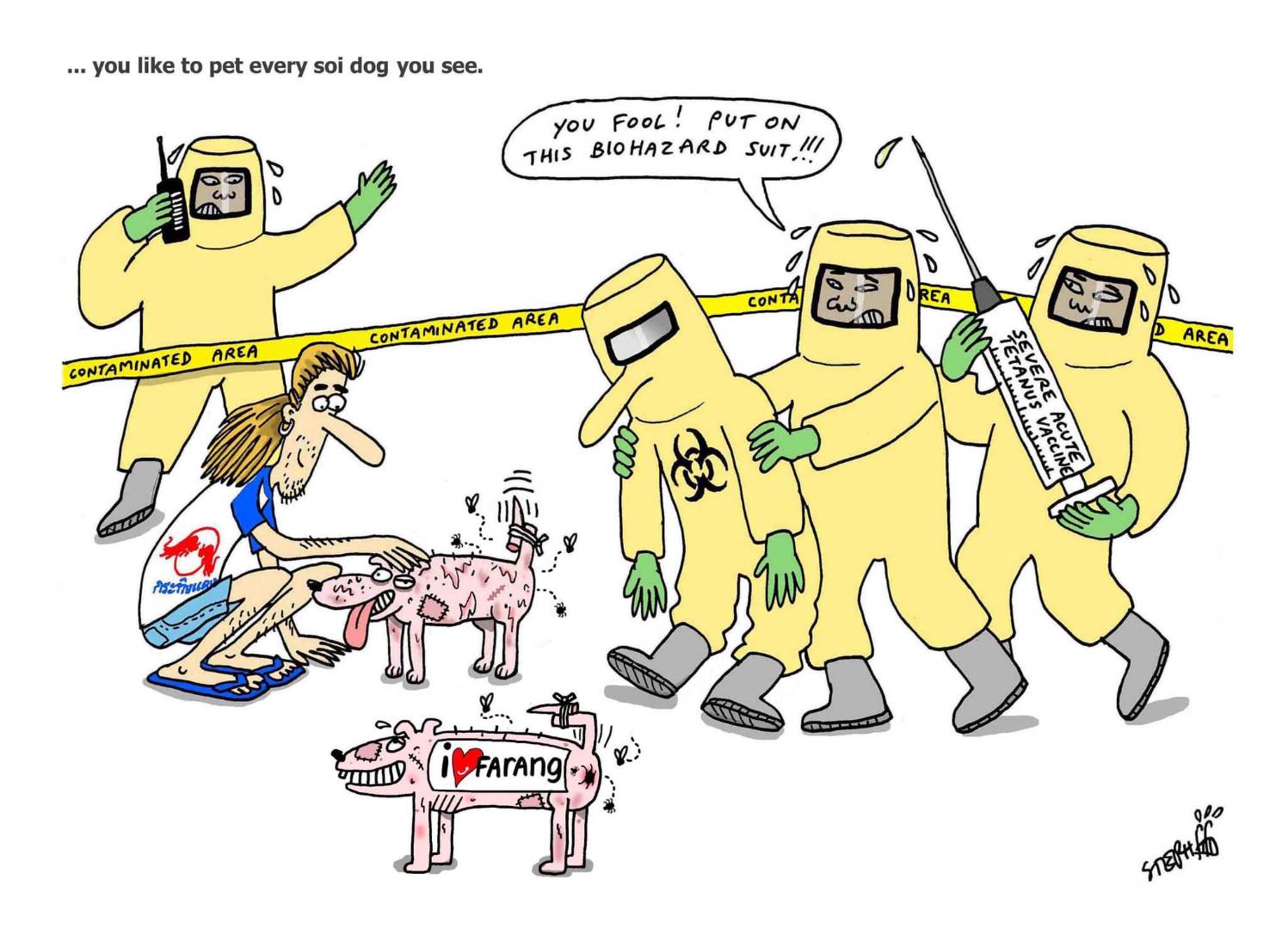
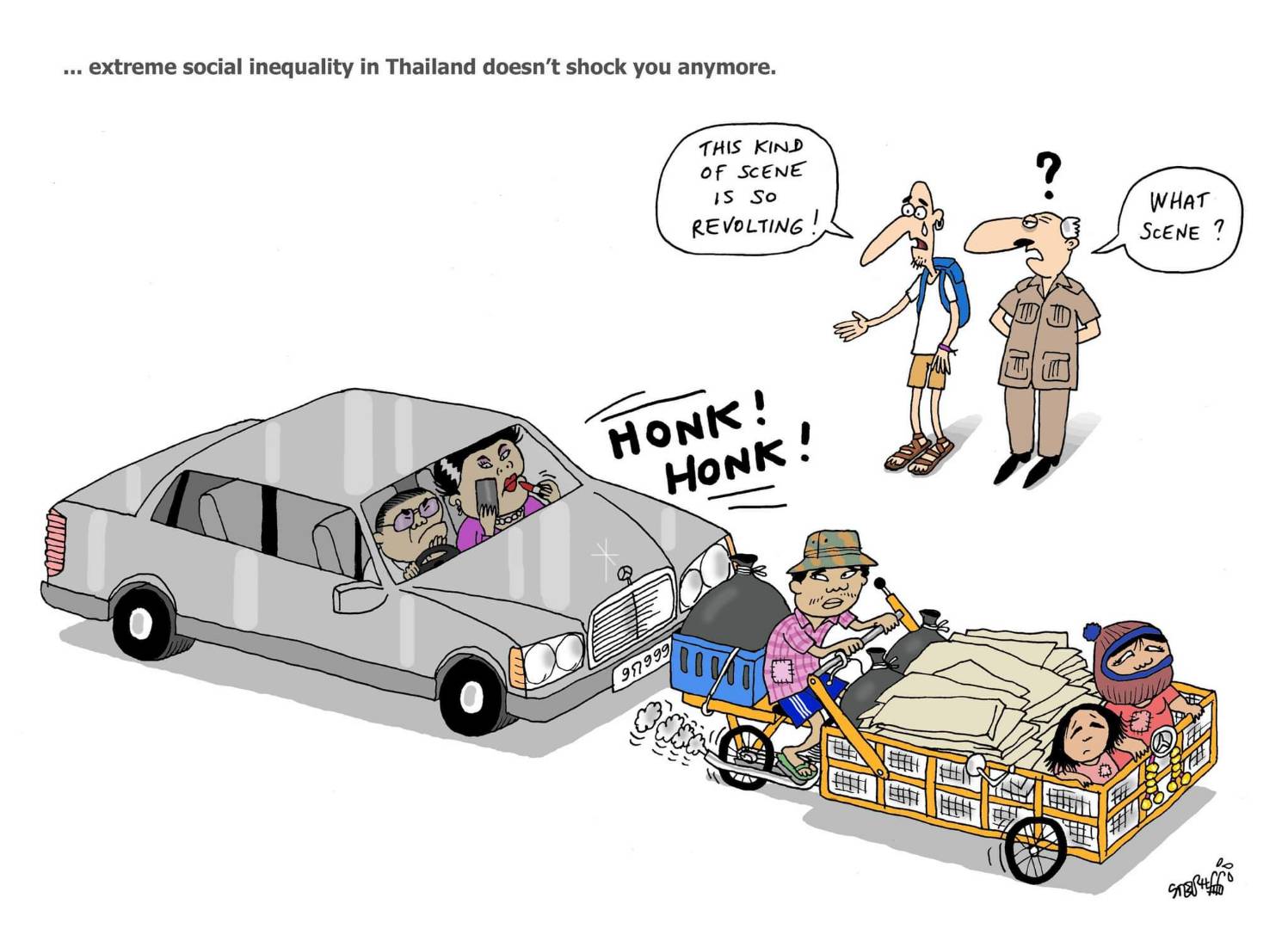
The French man self-published a cartoon book “Farang Affairs” in 2020 making fun of farangs and Thai people alike. Khaosod English asked him a few questions on his works and what is it like to be a farang in the Land of Smiles.
Do you think the word farang is offensive? Why or why not?
Image: Stephane Peray / Courtesy
Well, I kinda like this word and I don’t find it offensive. It is meant to acknowledge a difference of ethnicity in a rather naïve, childish way. I’ve been often called a ‘farang’ by Thai friends who sometimes were teasing me or simply were using the word with affection instead of using the word ‘Westerner.’
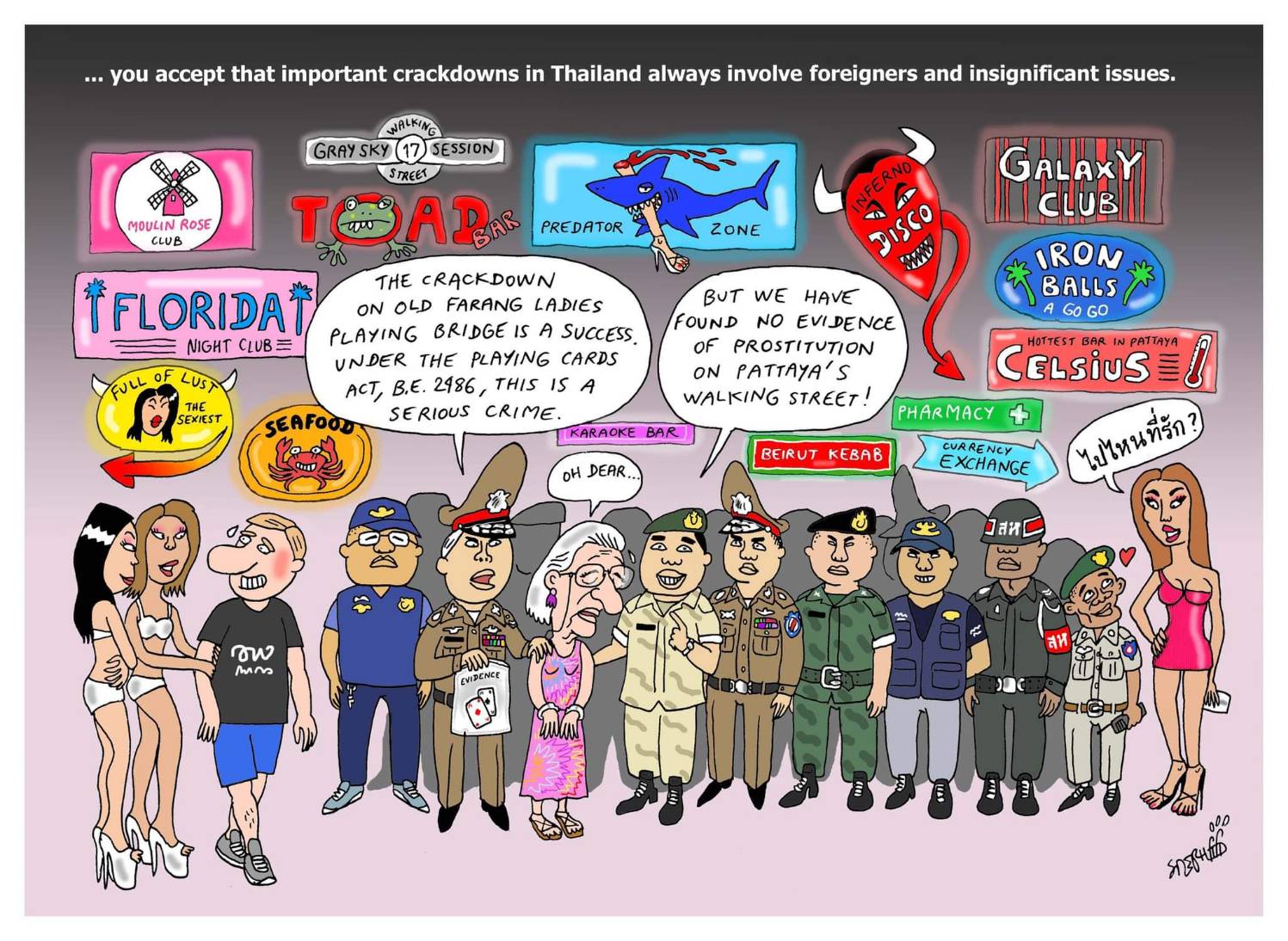
There are – of course – cases when it can be a bit insulting and racist like in the pejorative expression “farang kee nok” aimed at making fun of cheap and dirty Western backpackers. But overall, most of the time, it’s not meant to be racist and most farangs who’ve been here long enough have learnt to be at peace with this word.
Westerners who get upset just started to live here and still make comparisons with ugly racist slang words used in the West.
One example that comes to my mind is the word ‘chink’ (apologies for using it by the way). This word is unmistakably racist and loaded with the intention to hurt. So it’s dishonest to compare the word ‘chink’ and the word ‘farang.’
I am aware that the word ‘farang’ is not very political correct but it’s rarely used as an insult. And in the rest of Asia, you also find similar words to describe Westerners which are neither meant to be offensive: “ang moh” in Singapore, “gwailo” in Hong Kong, and “gaijin” in Japan.
Do you think most farangs exoticize and orientalize Thailand, particularly Thai women?
Well, exotic destinations sell themselves by playing on exoticization. All you have to do is look at Thai Airways advertising or Tourism Authority of Thailand campaigns. When I was 18, I went to live for a while in French Polynesia and it was my first encounter with a tropical country.
Tahiti – if you know the story of the mutineers of the Bounty – is the quintessence of exoticization and Tahitian women – in the white man’s mind – are the ultimate sexual fetish.
So yes, a lot of farangs exoticize Thailand and fetishize Thai women but I think this exoticization and fetishization – which are probably a relic of the colonial mentality – exist for many other places in the world like Africa or Latin America (all you have to do is listen to the stories of those white men expats who have been living there to realize that).
Anyway, this is very good material for cartoons because it’s pure culture shock: the fantasy versus the reality. No matter how perfect your idea of the Asian woman was, no matter how perfect the dream of living in a tropical country was, reality always hits back very hard. But don’t forget this delusional exoticization exists the other way too: how many Thai women from poor backgrounds have fantasized marrying a handsome, tall, blue-eyed farang, and living in a rich country where it snows in winter?
Remember the ultimate exotic dream for many Thai people are Swiss mountains covered by snow while we – farangs – dream of white sand beaches and coconut trees.
Do you think Thai society is welcoming to foreigners who stay long term like yourself and not just tourists? Is the Siamese Smile a genuine smile?
Image: Stephane Peray / Courtesy
Yes and no. The ideal westerner for the Thai government (and it’s true for all the Thai governments I’ve known since PM Chatichai Choonhavan) is a rich foreigner who creates businesses, employs a lot of Thai people, spends a lot of money and doesn’t stay too long. Some long-term foreigners with small incomes like teachers in Thai schools, freelance journalists, NGO people, researchers or artists are not interesting for Thailand.
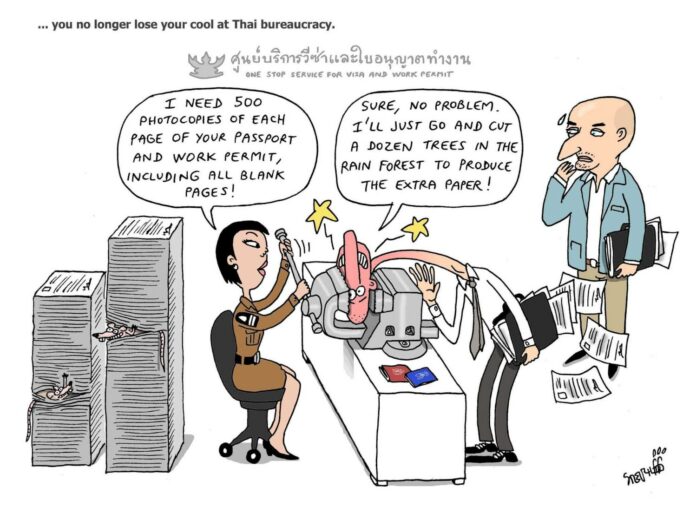
Even less interesting if we earn little, live a sober life in a semi-Thai way, and buy a little piece of land under the name of the Thai spouse. Consequently, we – the low-status Farang migrants – often find out that there is no clear and easy administrative way to obtain a proper long-term visa and work permit and it’s a headache year after year.
For example, there is absolutely no special case visa for foreign artists. It says a lot about a certain Thai mentality: valuing only money. But an artist, an animal activist or a teacher are bringing something valuable to Thai society. But it’s not money.
So I wish the Thai authorities could be more open minded – like Singapore’s “foreign talents” scheme and not emphasize only on material criteria but on what could be beneficial for Thai society in general. A foreigner who comes to spend all his time and money to save elephants – doing the job that the Thai authorities should actually be doing – should be helped in every way.
Look at the way this government is trying, right now, to make life even more difficult for civil society and foreign NGOs. I also feel young foreign migrants who come to try to create a business here should be given more chances. Don’t give them a contemptuous look because today they have not much money.
Every successful person has to start first in his garage. I have many farang friends who are extremely successful today but came here with just a few bucks in their pockets. And for me, that was the magic of the 90’s in Thailand. This Siamese smile? To me it’s still genuine and authentic because the majority of the Thai people are naturally nice, generous and kind. But at the same time it’s also a kind of national myth, a little story that Thailand sells around the world.
What’s the most obvious misconception about Thailand that farangs or Westerners have about the kingdom – and Thais about farangs and Westerners?
Image: Stephane Peray / Courtesy
The most obvious misconception would be that Thai women are easy.
It’s totally the opposite.
Dating a Thai girl takes a lot of patience – well at least – in my time – when I was dating. But we all know that prostitution is responsible for this serious misunderstanding. Another misconception is that Thai people are lazy. The majority of Thai people work very hard to make a living and don’t have an easy life.
So labeling people “lazy” is not fair. But we all know that inside the Thai society itself, we also find those clichés like Thai-Chinese would find Isaan people lazy. I can’t really think of a misconception about farangs. Maybe – in the case of French people – Thai women have this whole idea that France is the country of romanticism but when they go there for the first time, all they see is rude and bad-mood people.
So you see, France’s national myth we sell around the world is romanticism.
How hard is it to be a cartoonist in Thailand? Is it easier to mock Thai politicians or farangs?
Well, not hard. The only real obstacle is (again) the administrative part and it seems when the authorities are fed up with you, this is exactly where they will ambush you.
Making an income is not easy but that’s true everywhere in the world for an editorial cartoonist. Newspapers have no more money and they only think of saving money on the small things (and cartoons are small things in the mind of editors). But so far, it’s still possible to make a correct living and if I don’t, it’s not necessary the fault of Thailand but rather my lack of talent.
I feel quite free in doing my art but of course, satire in Thailand is limited under Article 112. However I have no right no complain about it. By living here since 1989, I knew the rules from the beginning and I have – as a non-Thai – accepted to live under those rules (but it doesn’t mean deep inside me, I agree with those rules but that’s another matter).
Mocking Thai politicians is quite easy – never had any complain from authorities themselves (maybe that’s because nobody at the top ever read my cartoons hahaha). Here, there’s no ‘lese-prime minister’ like it exists or existed for Hun Sen, Mahathir or Lee Kuan Yiew in their respective country.
Now of course the political cartoonist always makes many people angry and that’s what makes this job hard. Whether your hero is Prayut, Yingluck or Suthep, when your hero is taken down from his/her pedestal by a cartoon, bird’s names are flying. And it’s even more true nowadays when the society is so polarized.
In the past, getting insults would mean I am doing my job correctly. But today, I am not even sure of that. I feel being insulted all the time means that – somehow – I participate to the polarization myself.
Maybe that’s when it’s hard to be a cartoonist – when you realize that maybe you’re not really bringing positive thinking with your art – just drawing what some people in your so-called ‘camp’ want to hear – and isn’t the definition of demagoguery?
Mocking farangs is rather easy but I make some people very angry too – ironically it’s the real life caricature people who don’t accept to become a cartoon caricature hahaha! And don’t forget that I am not only making fun of farangs in my book. When I make fun of farangs who start to drive as carelessly as Thai people, I obviously make fun of the Thai way of driving.
Is Thai sense of humor different from Europeans?
Image: Stephane Peray / Courtesy
Yes it is. Maybe that’s how I can get away with certain things. Second degree, for example, or sarcasm are not things that Thai people immediately understand. It doesn’t take a genius to see that Prayut‘s humour is not sophisticated but rather primitive. The basic Thai way of humour can accommodate more sexist, racist jokes as well since political correctness has not full reached here.
You could compare it to humour 40 years ago in the West when it was still acceptable to make fun of everything. I must confess – to my bid shame – that I am still a sucker for stupid sexist jokes Benny Hill-style. I know it’s very bad but I cannot help it, it’s my latin side sorry!
As a matter of fact, my book had a lot of success with French, Belgian, German, Italian, Spanish, and Russian people, not so much with Americans and British expats and I suppose it had to do with the good dose of political incorrectness I put in there. The biggest surprise, though, was that many Thai people enjoyed my book, including Thai women.
I wasn’t expecting this at all. But to be fair, it’s probably because Angel (my Thai wife) helped me with the book and managed to embed a little jenesaisquoi of Thai humour. But even if the Thai people have different humour, I must say they still have a lot of humour and can laugh about the themselves. I couldn’t live in a country where people had no humour.
What has been the most rewarding aspect of your work?
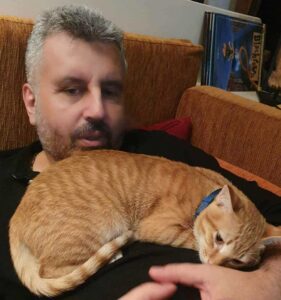
Stephff and his cat. Photo: Stephane Peray / Courtesy
Certainly not the money hahaha.
But still, earning an income, no matter how modest – while doing what you love the most in your life, is very rewarding. It’s the famous Japanese “Ikigai” concept of happiness in life. But the most rewarding part is of course when people come back to you and thank you for making them laugh.
It really makes me happy to know that I’ve brought a big smile or a laugh to somebody. Still, it’s not the end. An editorial cartoon has two major objectives: make you laugh and make you think.
So I would say that the ultimate rewarding part is when I manage to bring a serious issue inside a cartoon that made you laugh and later make you think. Making the reader laugh is like first getting their attention and then when you get it, you try to tell them something meaningful that will induce some thinking.
“Funny and so true,” that’s what you want to hear from a reader! It really gives you a sense of purpose. The fact that I self-published my book gave me complete freedom (nearly complete because you know … Article 112) about serious issues I wanted to talk about.
Like in the Rohingya cartoon that reminds the reader the double-standards of hospitality in Thailand. It’s not even supposed to be a funny cartoon if you consider what happened to some of these poor souls. Drawing and publishing a cartoon is not something in vain if, somehow, you’ve managed to say a few things that were important to you.
That’s the rewarding part of my work.
Limited edition copies of “Farang Affairs” retail online for 1,400 baht.
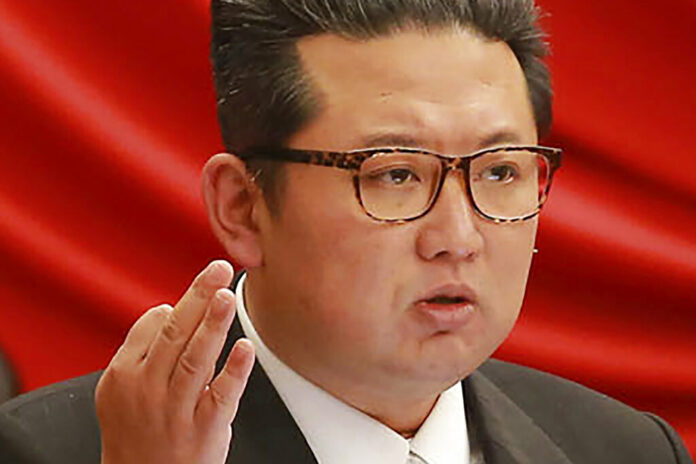
FILE - In this photo taken during Dec. 27 - Dec. 31, 2021 and provided on Jan. 1, 2022 by the North Korean government, North Korean leader Kim Jong Un attends a meeting of the Central Committee of the ruling Workers' Party in Pyongyang, North Korea. Independent journalists were not given access to cover the event depicted in this image distributed by the North Korean government. The content of this image is as provided and cannot be independently verified. Photo: Korean Central News Agency / Korea News Service via AP
SEOUL (AP) — North Korea plans to increase its government spending on pandemic measures by one-third this year to carry out leader Kim Jong Un’s calls for a more “advanced and people-oriented” virus response, state media said Tuesday.
The budget plans were passed during a session of Pyongyang’s rubber-stamp parliament on Sunday and Monday, which came weeks after the North tentatively restarted its railroad freight traffic with China following two years of extreme border closures and economic decay.
Kim had hinted at broader changes to the country’s pandemic response during a political conference in December, when he called for a transition toward advanced anti-virus measures based on a “scientific foundation.”
The Korean Central News Agency said North Korea’s Supreme People’s Assembly passed plans to increase spending on anti-virus measures by 33.3% compared to last year. The report didn’t describe those spending plans in monetary terms.
Kim Tok Hun, premier of North Korea’s Cabinet, a key institution handling economic policies, described the North’s pandemic response as the top priority in state affairs, but also that the measures will be “put on a scientific basis to guarantee the security of the country and the people,” KCNA said.
It appeared Kim Jong Un did not attend the parliamentary session and state media didn’t mention any comments by senior officials toward Washington or Seoul amid a deepening diplomatic freeze.
Kim in recent political speeches has vowed to further bolster his nuclear arsenal. KCNA said 15.9% of the North’s total government spending last year was invested in the nuclear weapons program and the same percentage of its budget this year would go to expanding military capabilities.
Cheong Seong-Chang, an analyst at South Korea’s private Sejong Institute, said North Korea’s description of its budget clearly reflected its plans to gradually expand trade and other exchanges with China, its main ally and economic lifeline, while reshaping its virus response. He said the North could possibly adopt China’s approach of sealing certain regions to stem transmissions, instead of locking down its entire country.
North Korea still claims to have a perfect record in keeping out COVID-19 from its territory — a claim widely doubted. But the closure of its border to nearly all trade and visitors for two years further shocked an economy already damaged by decades of mismanagement and crippling U.S.-led sanctions over Kim’s nuclear weapons and missile program.
The North’s resumption of railroad freight traffic with China last month came between a flurry of missile tests clearly aimed at pressuring the Biden administration over stalled nuclear diplomacy, which some experts say possibly shows the urgent need for outside relief.
The border reopening possibly shows the North is exploring more sustainable ways to deal with the coronavirus threat that may go on for years. It could also provide glimpse into the North’s plans for vaccines against COVID-19.
North Korea so far has shunned vaccines offered by the U.N.-backed COVAX distribution program, possibly because those have international monitoring requirements. But some experts say the North may still seek the help of China and Russia to provide regular testing and vaccinations of workers and troops in border areas, where access from other regions will be tightly restricted.
North Korea’s resumed trade with China will almost certainly be driven by imports as much of the country’s major export activities are banned under international sanctions tightened since 2016, when Kim began accelerating weapons development. The country needs fertilizers to boost food production, construction materials to support Kim’s ambitious development projects and factory goods to spur industrial production decimated by the two years of halted trade.
Still, North Korea’s trade with China is expected to be significantly smaller compared to pre-pandemic levels.
North Korea likely doesn’t have enough foreign currency reserves to swiftly purchase a huge amount of goods, considering the toll of sanctions and pandemic-related difficulties. It would also be a major policy mistake to expand imports too quickly when an explosion in pent-up demand could further destabilize a fragile economy, experts say.
“It seems North Korea’s employing a ‘taste and test’ approach – it will continue to reopen its border in phases if the COVID-19 situation stabilizes but seal itself again if the virus situation worsens,” said Kim Byung-yeon, a professor of economics at Seoul National University. “It’s also likely that the state will try to enforce greater control over trade compared to the past and clampdown on activities like smuggling, so the trade activity likely won’t be as dynamic as it once was.”
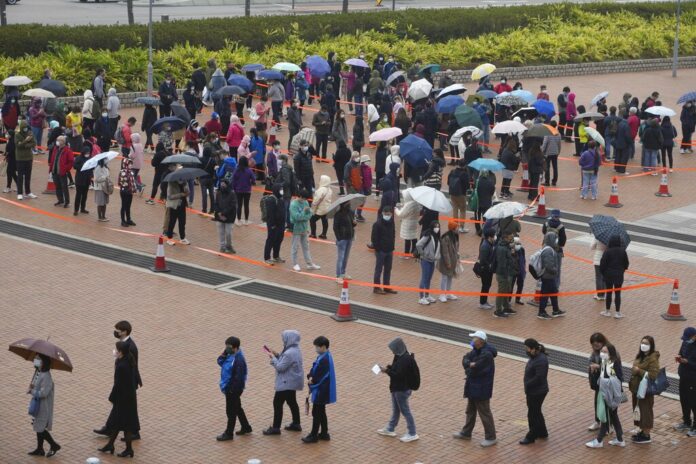
Residents line up to get tested for the coronavirus at a temporary testing center for COVID-19 in Hong Kong Monday, Feb. 7, 2022. Photo: Vincent Yu / AP
SINGAPORE (AP) — Many Asian countries are facing a spike in COVID-19 infections after the widely-celebrated Lunar New Year holidays, as health officials grapple with the highly-transmissible omicron variant and expectations that numbers will continue to rise in coming weeks.
The Lunar New Year, which is China’s biggest holiday, was celebrated across Asia on Feb. 1 even as pandemic restrictions in many countries kept crowds and family outings to a minimum.
Hong Kong’s authorities are confronting record cases that are straining its so-called “zero-COVID” policy. On Monday, the city reported a new high of 614 local infections.
“We expect there will be more cases coming in a few days. We consider this as some effects after the holiday events and clusters,” told reporters on Monday Edwin Tsui, an official with the Centre for Health Protection.
“With our current containment measures, we hope we can still contain the disease.”
Hong Kong currently requires all cases to be hospitalized. On Monday, authorities announced that close contacts of infected persons will be allowed to isolate at home, starting from Tuesday. Those who test positive while in home isolation will be transferred to a hospital.
Hong Kong has aligned itself with China’s “zero-COVID” policy that aims to totally stamp out outbreaks, even as many other countries change their approach to living with the virus. Authorities look to impose lockdowns on residential buildings wherever clusters of infections are identified, and have banned public dining after 6 p.m.
In Singapore, a dramatic rise in coronavirus infections followed last week’s holiday, with cases tripling to 13,000 on Friday.
Daily infections have since dipped to 7,752 on Sunday, amid restrictions that include limited capacity for restaurants and capping the number of unique visitors to each household.
Singapore has reported over 100,000 cases spanning the last month, although over 99% of the cases are mild or asymptomatic.
Across Asia, authorities are confronting a similar pattern as the more easily transmissible omicron becomes dominant, even as health officials in several countries report that omicron surges are not driving hospitalizations or deaths as high as the previous delta variant.
In Japan, nearly 90,000 new cases nationwide were reported on Sunday, including 17,526 in Tokyo, as local omicroninfections showed no signs of slowing.
Experts say the infections are now spreading to vulnerable elderly people who are beginning to fill more hospital beds. Less than 5% of the country’s population has received their third dose of the coronavirus vaccine.
Local outbreak numbers are similarly rising in Indonesia, edging toward the caseloads that marked the height of last year’s devastating delta outbreak.
On Jan. 6, Indonesia recorded 533 new COVID-19 cases and seven deaths. A month later on Sunday, the daily figure had soared to 36,057. Daily deaths have also climbed to 57, almost four times the rate a week ago.
In Thailand, officials on Monday reported more than 10,000 daily cases for the third day in a row, but the Department of Disease Control said that the number of severely ill patients was dropping, while the fatality rate has remained stable.
Department chief Opas Karnkawinpong said that Thailand might consider relaxing some of the country’s pandemic restrictions, as the omicron variant seemed to be less severe.
“The global situation of COVID-19 seems to be moving in the same direction,” he was quoted as saying in The Bangkok Post. “Many countries have started to ease measured despite spikes in daily infections.”
In other countries where the Lunar New Year is a major holiday, governments are likewise on high alert ahead of expectations that omicron will continue to stoke higher infections.
New cases in Malaysia have been hovering higher, with the health ministry reporting 11,034 on Monday. The rise came after the Lunar New Year when many Malaysians travel, but health officials said most of the cases were asymptomatic or have light symptoms.
Top health official Noor Hisham Abdullah has warned that daily cases could double by the end of March and urged Malaysians to take their booster dose. Some 98% of adults in the country have completed their vaccination and half of them have received their third jab.
In South Korea, health experts warn that the country may see daily jumps of 130,000 or 170,000 by late February.
The country reported 38,691 new cases of the virus, a nine-fold increase from the levels seen in mid-January, when omicron became the country’s dominant strain.
In Vietnam, authorities have warned that infections may rise after the popular new year holiday.
Vietnam reported 192 cases of the omicron variant in the past month, with most of those showing only mild symptoms or no symptoms at all. With low hospitalization and death rates, Vietnam had previously moved toward resuming most social activities.
The Philippines has moved to ease coronavirus restrictions and open its doors to tourists as outbreak numbers eased to about 8,300 on Sunday, down from a peak of 39,000 in mid-January.
But social distancing restrictions remain in place amid fears of an outbreak ahead of the country’s presidential and general elections May 9. Campaigning begins on Tuesday, with a ban in place on handshakes, kissing, hugging and large crowds.
In mainland China, new local infections continue to fluctuate, falling as low as nine on Friday, but rising again to 45 on Monday, most of them in the southern region of Guangxi.
Recent cases have included a handful of omicron infections, though such outbreaks have been tightly contained. Chinese authorities have imposed strict local lock downs and mass testing, as the country kicked off the Beijing Winter Olympics last week.
Meanwhile, the far-flung Pacific archipelago nation of Tonga has beentrying to contain its first outbreaksince the start of the global pandemic, which might have been brought in with the delivery of emergency medical supplies and water after last month’s volcanic eruption and tsunami.
Two Tongan men who worked handling shipments tested positive last week. Over the weekend, Prime Minister Siaosi Sovaleni said two more positive cases were confirmed, bringing the total of active cases to seven.
___
Story: Zen Soo. Associated Press writers Kim Tong-hyung in Seoul, Jim Gomez in Manila, Hau Dinh in Hanoi, David Rising in Bangkok, Mari Yamaguchi in Tokyo, and Niniek Karmini in Jakarta contributed to this report.
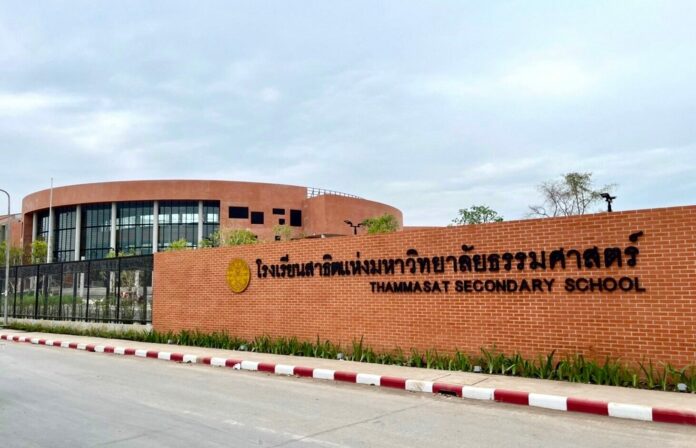
BANGKOK — The demonstration school of Thammasat University on Sunday refuted allegations that it has distorted the teaching of Thai history and the monarchy.
The statement issued by the school, known officially as Thammasat Secondary School, came after allegations of it becoming a hotbed for anti-government and anti-monarchy indoctrination of the youth.
The accusations, which have been featured on several pro-establishment media, even reached PM Prayut Chan-o-cha, who last week ordered related agencies to look into the school and its syllabus.
The school said in the statement posted online Sunday that it “emphasizes the development of its course and pedagogical innovation based on modern knowledge.”
Part of the statement also added that the school respects diverse views and aims to prepare students to be able to competently adapt to changes.
While the statement gave no details directly related to the allegations, chairman of the school’s administrative board and the university’s vice rector Anuchart Puangsamlee on Sunday defended the school’s invitation of historian Thongchai Winichakul for consultation. Thongchai is known for his staunch criticism of the monarchy and the state’s notion of Thai nationalism.
Anuchart said there was nothing wrong since Thongchai is a noted historian.
The school, located inside Thammasat’s main campus in Pathum Thani province, teaches students from Mattayom 1 to Mattayom 6. It offers distinctive curriculum to other Thai schools where students can make their own subject choices including survival skills and media literacy.
It also does not require students to wear uniforms or participate in mandatory activities such as scouting and morning flag raising ceremony.
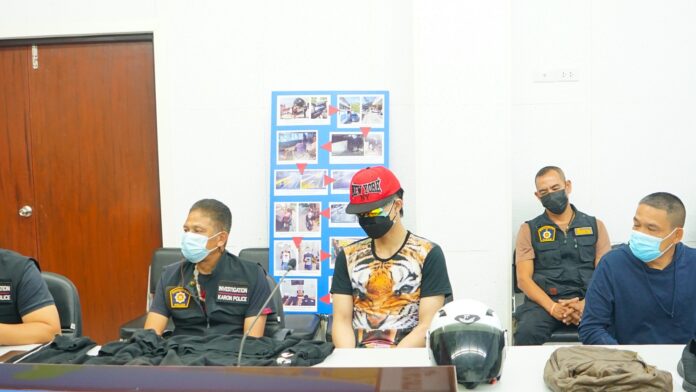
Kanapong Sakhoncharoen, 24, during a news conference at Karon Police Station on Feb. 6, 2022.
PHUKET — Police said Sunday a man is under arrest for stealing 4,900 euros vacation cash from a Greek tourist’s car.
Kanapong Sakhoncharoen, 24, was arrested in Phuket 11 days after he took the cash of about 200,000 baht from a car parked inside a condominium’s parking lot near Kata Beach in the night of Jan. 25.
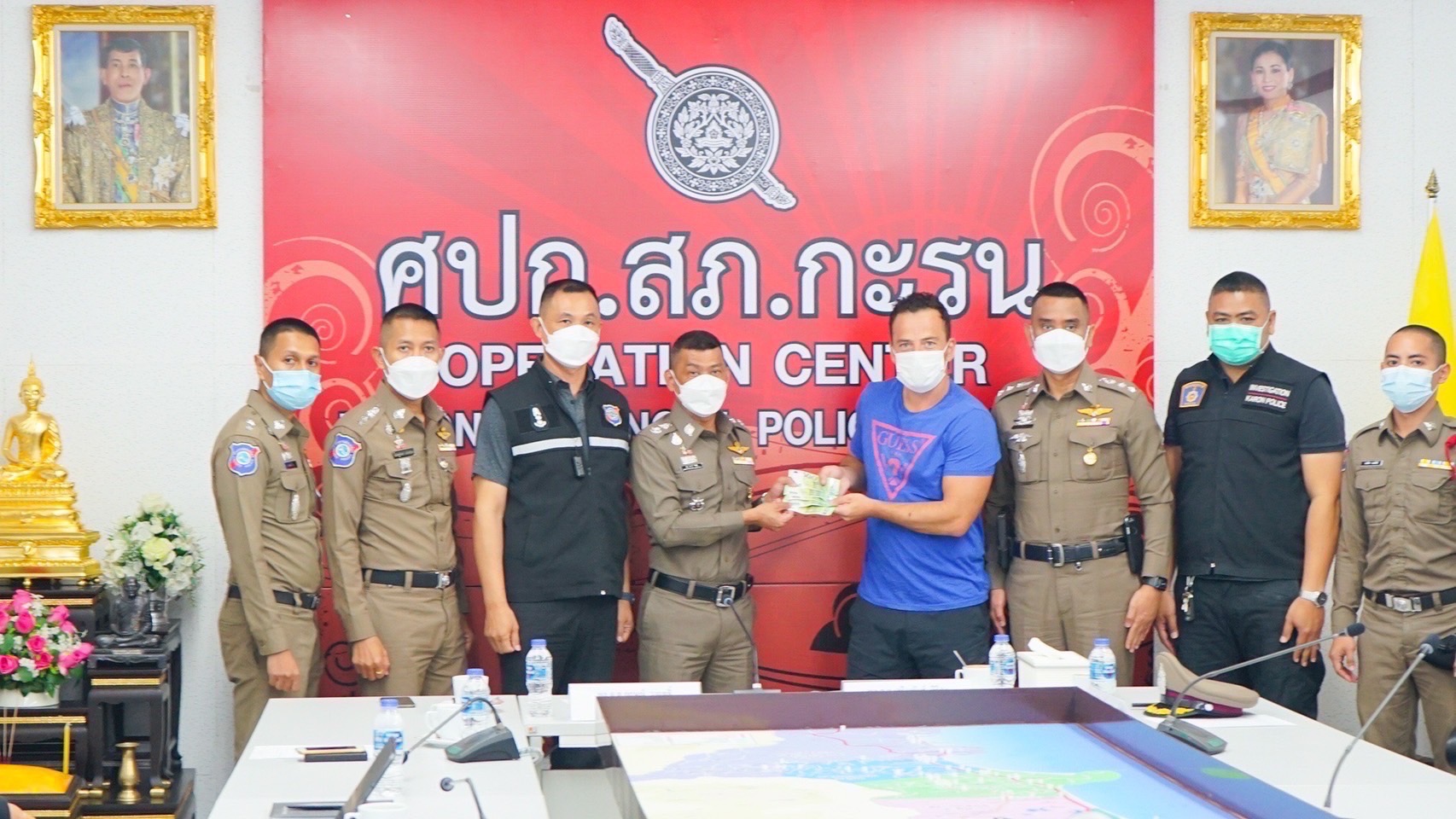
Police return 500-euros cash to Greek tourist Alexiadis Alexandos.
Police said the suspect noticed a light coming from the car, which was unlocked, so he ransacked the car and took off with the cash. He later spent the cash and had 500 euros left of money he stole.
Kanapong was charged with nighttime burglary. He reportedly confessed to the crime.