BANGKOK — One of Bangkok’s most popular night markets is not only struggling with disappearance of Chinese tourists, but also the perception among some Thais that it is a place to avoid amid coronavirus fears.
Vendors at Ratchada Train Night Market said they witnessed a plunge in number of visitors from China after the Chinese government imposed a ban on overseas group tours and anxiety about the novel strain of coronavirus took hold in Thailand.
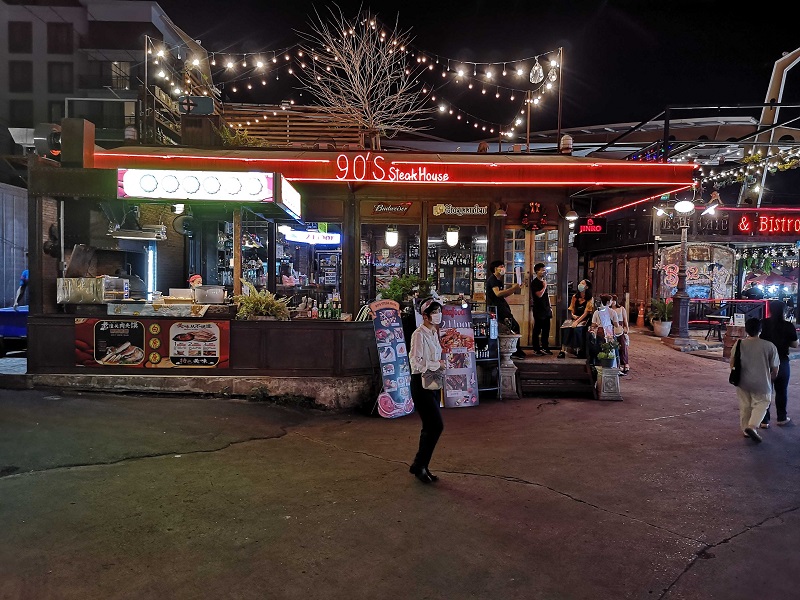
In a recent visit on Friday night – normally a peak time of business – the courtyard of a steakhouse popular with Chinese tourists was empty. A waiter said he has been asked not to show up for work for two days per week, instead of one as usual, for the past two weeks now.
“It used to be very crowded,” said Kaeng, 25, the waiter at 90s Steak House. “I hope things will improve within two to three months.”
He said even many Thai customers are also staying away because they fear they might contract the coronavirus at the crowded market, which has long been known as the favorite landmark of Chinese tourists.
A file photo of 90’s Steakhouse on a Friday night.90’s Steakhouse on the night of Friday Feb. 7, 2020.
“I hope something can be done about confidence in the market’s safety ,” Kaeng said. A shopping mall nextdoor, the Esplanade, recently posted photos of staff spraying disinfectant on the ground floor in order to reassure shoppers of their hygiene.
Kaeng’s assessment of drop in visitors is shared by others. A Chinese-styled pork bun vendor at the market said he usually sold 100 pieces of buns each night, now it’s down to 10.
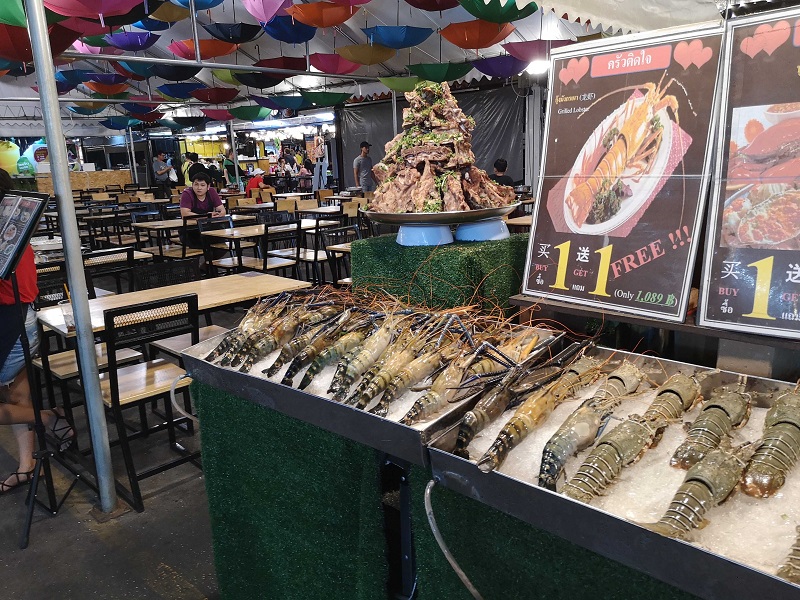
About half of the stalls in the souvenir area called “Nai Dome” were closed. A vendor who identified herself as Joy kept her dried fruits shop open, but she said business is hard.
“There’s nobody now. I only made 300 baht so far tonight. I would be happy if I could sell 2,000 baht worth of goods tonight,” Joy said, while selling a pack of dried mango to two Western tourists.
She estimated that, if the situation does not improve, her shop will last for another 30 days. Then she will pack up and look for another location to sell. Many of her fellow vendors already gave up, she said, because the cost of electricity is simply not worth it. Stall owners are charged 10 baht per lightbulb each night.
“The profits may not cover even the electricity bill,” said Joy, who switched off three of the eight lightbulbs at her shop. “I have no hope for the government’s assistance.”
Ratchada Train Market on Feb. 7, 2020.
The coronavirus crisis is expected to hit the Thai tourism industry hard. The Tourism Authority of Thailand said the travel bans and health concerns would result in the loss of two million Chinese tourists this year, down from 10.9 million in 2019.
Not everyone is complaining about the loss of Chinese tourists, however.
A female employee running the market, who asked not to be named, insisted that they are seeing an increase in Korean and Japanese tourists. Asked about the market being listed on social media as a place to avoid for health safety, the employee said she has no comment but insisted the market is clean.
Some are downright nonchalant. A restaurant owner where all the 20 tables are empty said he accepted the turn of fortunes caused by the coronavirus scares because there’s nothing to be done anyway.
“Even a big country like China couldn’t do anything about it,” said the owner, who asked not to be named. “We must try to understand them. I do not expect any help from the government but we will keep fighting.”
CHAIYAPHUM — Police in the northeast said Monday they arrested a man for threatening to shoot up a local shopping mall, days after a gunman killed a score of victims at a mall in Korat.
Peerapat Choosang, 28, was arrested in Chaiyaphum province and charged with cybercrime after he posted his threat on social media. Police said they tracked down and apprehended him after they received complaints from fearful netizens.
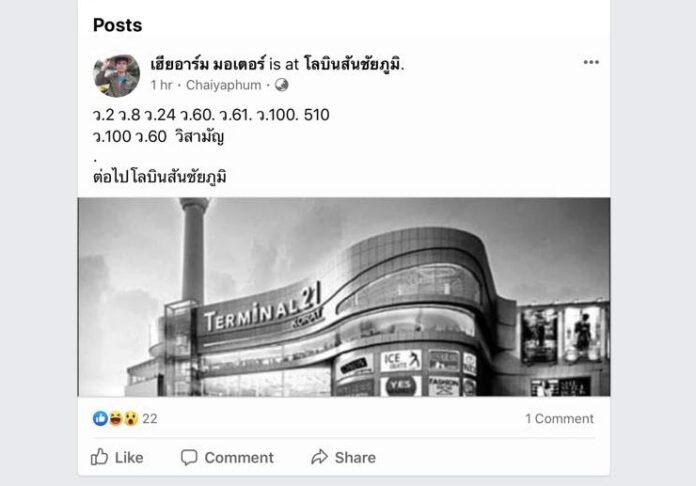
“Terminal 21 Korat, already done. My turn, Robinson Chaiyaphum,” Peerapat wrote in a caption to a photo showing two handguns.
“Next stop: Robinson Chaiyaphum,” he wrote in another public post, this time showing a photo of Terminal 21 shopping mall, where police and army commandos spent 15 hours hunting down a soldier who murdered at least 30 people.
Police said Peerapat confessed to writing those messages because he was drunk and having a personal dispute with his partner. He was charged with violating the Computer Crime Act, which bans importing material into the computer system that caused widespread panic.
Bong Joon Ho, right, reacts as he is presented with the award for best picture for "Parasite" from presenter Jane Fonda at the Oscars on Sunday, Feb. 9, 2020, at the Dolby Theatre in Los Angeles. Looking on from left are Kang-Ho Song and Kwak Sin Ae.(AP Photo/Chris Pizzello)
LOS ANGELES (AP) — Subtitle this: “Parasite” is the first non-English language film to win best picture in the 92-year history of the Academy Awards.
Bong Joon Ho’s masterfully devious class satire took Hollywood’s top prize at the Oscars on Sunday night, along with awards for best director, best international film and best screenplay. In a year dominated by period epics — “1917,” “Once Upon a Time … In Hollywood,” “The Irishman” — the film academy instead went overseas, to South Korea, to reward a contemporary and unsettling portrait of social inequality in “Parasite.”
True to its name, “Parasite” simply got under the skin of Oscar voters, attaching itself to the American awards season and, ultimately, to history. The win was a watershed moment for the Academy Awards, which has long been content to relegate international films to their own category.
Multiple standing ovations greeted Bong’s several wins. “I am ready to drink tonight,” Bong said, prompting roars from the crowd. Unexpectedly called up again for best director, Bong saluted his fellow nominees, particularly Martin Scorsese, and concluded: “Now I’m ready to drink until tomorrow.”
The win for “Parasite” — which had echoes of the surprise victory of “Moonlight” over “La La Land” three years ago — came in year in which many criticized the lack of diversity in the nominees and the absence of female filmmakers. But the triumph for “Parasite” enabled Hollywood to flip the script, and signal a different kind of progress.
In doing so, the film academy turned away another history-making event, again denying Netflix its first best-picture win despite two contenders in “The Irishman” and “Marriage Story,” and a big-spending awards campaign blitz.
All of the acting winners — Brad Pitt, Renee Zellweger, Joaquin Phoenix and Laura Dern — went as expected.
Few categories were more certain coming into Sunday’s Oscars than best supporting actor, which Pitt has had locked down all awards season. While Pitt (who in 2014 shared in the best picture win for “12 Years a Slave,” as was a producer) has regaled audiences with one-liners in the run-up to the Oscars, he began his comments on a political note.
“They told me I have 45 seconds to speak, which is 45 seconds more than the Senate gave John Bolton this week,” Pitt said, alluding to the impeachment hearings. “I’m thinking maybe Quentin does a movie about it.”
Pitt said the honor had given him reason to reflect on his fairy-tale journey in the film industry, going back to when he moved to Los Angeles from Missouri. “Once upon a time in Hollywood,” said Pitt. “Ain’t that the truth.”
Most of the early awards went according to forecasts, including Dern winning for her performance as a divorce attorney in Noah Baumbach’s “Marriage Story.” Accepting her first Oscar, Dern thanked her in-attendance parents, “my legends, Diane Ladd and Bruce Dern.”
For the 87th time, no women were nominated for best director this year, a subject that was woven into the entire ceremony — and even into some attendees’ clothing. Natalie Portman wore a cape lined with the names of female filmmakers who weren’t nominated for best director, including Lulu Wang (“The Farewell”), Greta Gerwig (“Little Women”) and Mati Diop (“Atlantics”).
Coming on a rare rainy day in Los Angeles, the ceremony was soggy and song-heavy. Some performances, like Eminem’s performance of “Lose Yourself,” were unexpected (and drew a wane response from Martin Scorsese). All of the song nominees performed, including Elton John who won with his longtime songwriting partner Bernie Taupin for their “Rocketman” tune.
The hostless ceremony opened on a note of inclusion, with Janelle Monae performing “A Beautiful Day in the Neighborhood” and her own song, “Come Alive,” with an assist from Billy Porter. “I’m so proud to be standing here as a black queer artist telling stories,” Monae said. “Happy Black History Month.”
Two former Oscar hosts, Chris Rock and Steve Martin, provided the opening monologue. “An incredible demotion,” Martin called it. Martin also reminded that something was missing from this year’s directing nominees. “Vaginas!” Rock replied.
There were milestones, nevertheless. In winning best adapted screenplay for his Nazi satire “Jojo Rabbit,” the New Zealand filmmaker Taika Waititi became the first indigenous director ever to win an Oscar. He dedicated the award to “all the indigenous kids in the world who want to do art, dance and write stories.”
“We are the original storytellers,” Waititi said.
“Joker” composer Hildur Gudnadottir became only the third woman to ever win best original score. ”To the girls, to the women, to the mothers, to the daughters who hear the music opening within, please speak up,” said Gudnadottir. “We need to hear your voices.”
Awards were spread around to all of the best-picture nominees, with the lone exception being Martin Scorsese’s 10-time nominee “The Irishman.”
“1917,” acclaimed for its technical virtuosity, took awards for Roger Deakins’ cinematography, visual effects and sound mixing. The car racing throwback “Ford v Ferrari” was also honored for its craft, winning both editing and sound editing. Gerwig’s Louisa May Alcott adaptation “Little Women” won for Jacqueline Durran’s costume design. “Once Upon a Time … in Hollywood” for Barbara Ling’s production design.
Netflix came in with a leading 24 nominations. Along with the win for “Marriage Story,” the streamer’s “American Factory” won best documentary. The film is the first release from Barack and Michelle Obama’s Higher Ground Productions. No studio has spent more heavily this awards season than Netflix, which is seeking its first best picture win after coming up just shy last year with “Roma.”
Pixar extended its domination of the best animated film category, winning for “Toy Story 4.” It’s the 10th Pixar film to win the award and second “Toy Story” film to do so, following the previous 2010 installment.
It was an early award for the Walt Disney Co. which despite last year amassing a record $13 billion in worldwide box office and owning the network the Oscars are broadcast on, played a minor role in the ceremony. The bulk of its awards came from 20th Century Fox (“Ford v Ferrari”) and Fox Searchlight (“Jojo Rabbit”), both of which the company took control of after its $71.3 billion acquisition of 21st Century Fox last year.
Disney’s ABC, which is broadcasting the show live, hoped a widely watched field of nominees — including the $1 billion-grossing “Joker,” up for a leading 11 awards — will help viewership. Last year’s show garnered 29.6 million viewers, a 12% uptick.
In a year of streaming upheaval throughout the industry, this year’s Oscar favorites were largely movies released widely in theaters. They also predominantly featured male characters and came from male directors.
After a year in which women made significant gains behind the camera, no female directors were nominated for best director. The acting categories are also the least diverse since the fallout of #OscarsSoWhite pushed the academy to remake its membership. Cynthia Erivo (“Harriet”) is the only actor of color nominated. Those results, which have been a topic in speeches through awards season, stand in contrast to research that suggests the most popular movies star more people of color than ever before.
The AP’s Amanda Lee Meyers contributed to this report.
LOS ANGELES — The Thai voice of Elsa serenades the Oscar pomp on Monday, marking the first time a Thai performs at the event.
Wichayanee “Gam” Pearklin joined nine other voice actresses who play Elsa in “Frozen II” from different countries in their performance of “Into the Unknown” at the 92nd Academy Awards.
“Or are you someone out there who’s a little bit like me?” was the line Gam sang in the performance.
Idina Menzel, the English voice actress, sang most of the song. Norwegian singer Aurora sang the mysterious voice. Takako Matsu from Japan, Kasia Laska from Poland, Gisela from Spain, Willemijn Verkaik, Lisa Stokke from Norway, Anna Buturlina from Russia, Maria Lucia Heiberg Rosenberg from Denmark, and Carmen Garcia Saenz who voices the Latin American version switched off their lines.
On the red carpet, Gam wore a couture gray-blush pink ombre Poem brand gown by designed by Chavanon “Sean” Caisiri.
Zhang Long lifts Chen Xiao's red veil at their wedding, Feb. 6, 2020. (Xinhua)
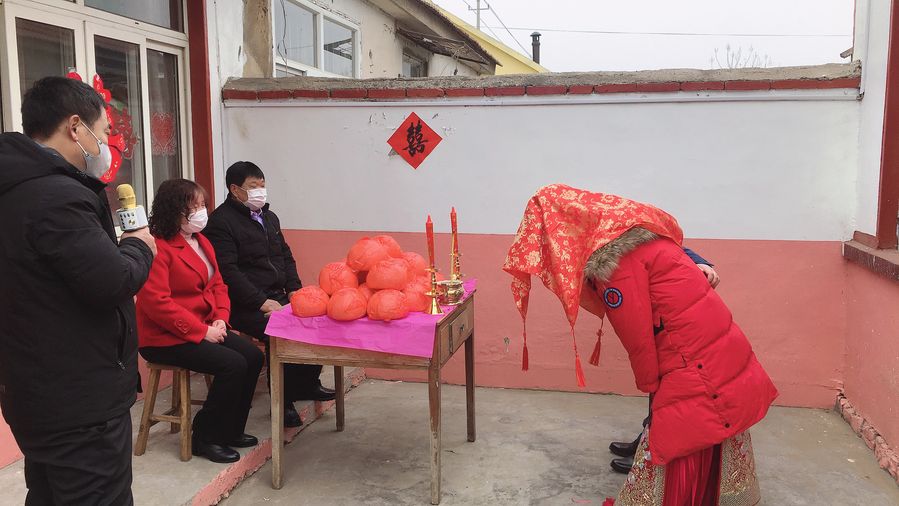
QINGDAO (Xinhua) — How to hold a safe wedding amid the novel coronavirus outbreak? A Chinese couple just set an example with a two-minute service attended by only six people, all wearing masks the entire time.
Zhang Long and Chen Xiao in eastern China’s Shandong Province held a special wedding last Thursday in the bridegroom’s courtyard, with the bride’s father as the host and her mother as the photographer.
Answering the government call for staying at home and avoiding crowds amid the novel coronavirus outbreak, many Chinese couples have chosen to postpone weddings, but Zhang and Chen agreed to press on with their schedule but scrapped all the festive trappings.
“We’re in a critical time of epidemic prevention and control, so we decided not to invite guests or hold a banquet,” said Zhang, the bridegroom. “After all, a wedding is just a ceremony, and the most important thing is our happiness.”
Zhang Long and Chen Xiao hold their wedding in the bridegroom’s courtyard, Feb. 6, 2020. (Xinhua)
On the day of the wedding, Zhang, wearing a mask, followed the custom to drive to the bride’s house in Licha Town, the city of Qingdao. There, in a romantic ritual, he lifted the bride’s red veil to see a mask on her face.
“Because of the mask, I didn’t even know the color of the lipstick she was wearing,” the bridegroom recalled.
Presided by the bride’s father, the wedding lasted no longer than two minutes.
“My father in law spoke very quickly. Bow to heaven and earth, bow to parents, bow to each other, and the wedding was over. We didn’t even have the chance to say our wedding vows,” Zhang said.
Before the novel coronavirus swept the nation, Zhang’s plan was to have a typical Chinese wedding complete with all the pompous rituals. He booked a 50-table feast, 20 wedding cars and invited four pairs of groomsmen and bridesmaids.
“Everything was canceled. He only spent several hundred yuan to marry me, but it doesn’t matter, as long as he is the right man for me,” said Chen Xiao, the bride.
Zhang Long drives to the bride’s house in Licha Town, Qingdao, Feb. 6, 2020 (Xinhua)
On the way back to the groom’s house, they passed three checkpoints for measuring body temperatures.
“The volunteers there congratulated us during the checks,” Chen said. “Although no relatives or friends came in-person to congratulate us, I believe more people blessed us from their hearts.”
Many villagers gave them thumbs up in the WeChat group chat after Zhang Long’s father announced the no-guest wedding. “We are in a critical time of novel coronavirus prevention. The villagers support their decision,” said Liu Jingming, party chief of Licha Town.
This is not the first no-guest wedding held amid China’s anti-coronavirus fight. On Jan. 27, Sun Wenlong and Liu Miaomiao also had a no-guest masked wedding in Qingdao. “When the epidemic is over, I will definitely make it up to her,” said Sun.
Kyodo photo taken at Tokyo station on Feb. 10, 2020 shows a ticket vending machine out of order.
TOKYO (Kyodo) — Railway firms including East Japan Railway Co. and West Japan Railway Co. experienced a technical glitch with their ticketing system Monday morning that temporarily prevented credit card purchases, their ticketing system management company said.
Cash purchases and Central Japan Railway Co.’s “Smart EX” online shinkansen reservation service were unaffected, according to Railway Information Systems Co.
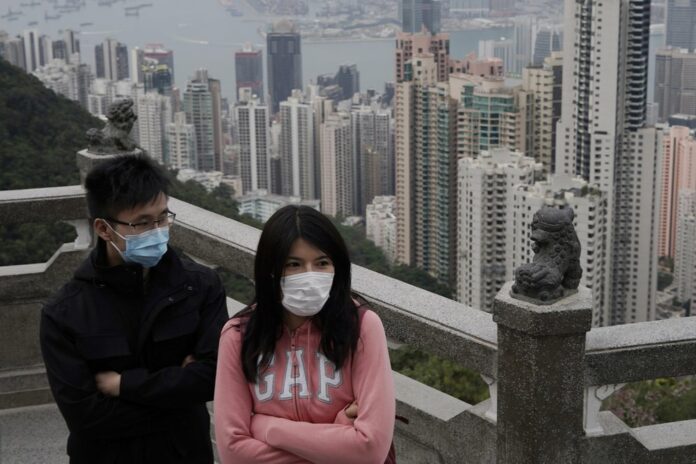
Tourists wear masks at the Peak, a popular tourist spot in Hong Kong, Sunday, Feb. 9, 2020. (AP Photo/Kin Cheung)
BEIJING (AP) — Mainland China reported another rise in cases of the new virus Monday after a sharp decline the previous day, while the number of deaths grew by 97 to 908, with at least two more outside the country.
China’s health ministry said another 3,062 cases had been reported over the previous 24 hours, raising the Chinese mainland’s total to 40,171. Monday’s rise was a turnaround from a significant reduction in new cases reported Sunday, less than 2,700, that briefly prompted optimism prevention methods such as a strict quarantines may be working.
“Dramatic reductions” in the pace of the disease’s spread should begin this month if containment works, Dr. Ian Lipkin, director of Columbia University’s Center for Infection and Immunity, said in an online news conference on Sunday. He assisted the World Health Organization and Chinese authorities during the outbreak of SARS, or severe acute respiratory syndrome.
Warmer weather will reduce the new virus’s ability to spread and bring people out of enclosed spaces where it is transmitted more easily, Lipkin said. However, he said, if new cases spike as people return to work after the Lunar New Year holiday, which was extended to try to reduce the spread of the virus, then “we’ll know we’re in trouble.”
Deaths from the new virus have passed the 774 people believed to have died of SARS, and the number of cases vastly exceeds the 8,098 identified in that 2002-03 outbreak. SARS and the new virus both are part of the coronavirus family, which includes the common cold but also viruses that come from animals and have caused serious illness.
China has built hospitals and converted public buildings to treat the thousands of patients in the epicenter of the outbreak, the central city of Wuhan, which has been under a strict quarantine for more than two weeks. It’s trying to keep food flowing into the region, and state media reported the Hubei provincial government will pay subsidies to farmers, other food producers and supermarkets because of the crisis.
Elsewhere in China, the industrial metropolis of Chongqing in the southwest told residential communities to close their gates and check visitors for fever. The government said the spread of the virus through “family gatherings” had been reported in Chongqing but gave no details.
Earlier, France closed two schools and medical authorities there are testing hundreds of children and their families for the virus after a 9-year-old British boy who goes to school in the French Alps contracted it.
French Health Minister Agnes Buzyn visited a ski resort where five Britons were found to have the virus, Contamines-Montjoie, and tried to reassure residents and tourists that they can “live normally.” She said there’s a “very weak risk” for the population at large, at least so far.
France also stepped up its travel alert, recommending against all visits to China except for “imperative reasons.” Several countries have made similar recommendations and are restricting Chinese visits as a containment measure.
More than 360 cases have been confirmed outside mainland China, most associated with Chinese travel or close contact with those travelers.
Hong Kong reported seven more cases, raising its total to 36. The new cases were people who attended large family gathering for the Lunar New Year that included mainland Chinese visitors.
Hong Kong has shut all but two of its land and sea border points to the mainland and on Saturday began enforcing a 14-day quarantine on arrivals from mainland China to try to prevent the spread of the virus.
Meanwhile, the mother of a physician who died last week in the hardest-hit city of Wuhan said she wants an explanation from authorities who reprimanded her son for warning about the virus early in the outbreak.
The death of Li Wenliang, 34, prompted an outpouring of public anger at Wuhan officials. Some postings left on his microblog account said officials should face consequences for mistreating Li.
“My child was summoned by the Wuhan Police Bureau at midnight. He was asked to sign an admonishment notice,” Lu Shuyun said in a video distributed by Pear Video, an online broadcast platform. “We won’t give up if they don’t give us an explanation.”
The video released Sunday shows flowers in her home with a note that says, “Hero is immortal. Thank you.”
Armed commando soldiers carry a person out of Terminal 21 Korat mall in Nakhon Ratchasima, Thailand, Sunday, Feb. 9, 2020. (AP Photo/Wason Wanichakorn)
NAKHON RATCHASIMA (AP) — Sirirat Nualraksa blinked back tears as the ambulances delivered gurneys bearing cloth-shrouded bodies to the morgue of a public hospital after a vengeful Thai soldier killed 29 people and wounded dozens of others in a shopping mall rampage.
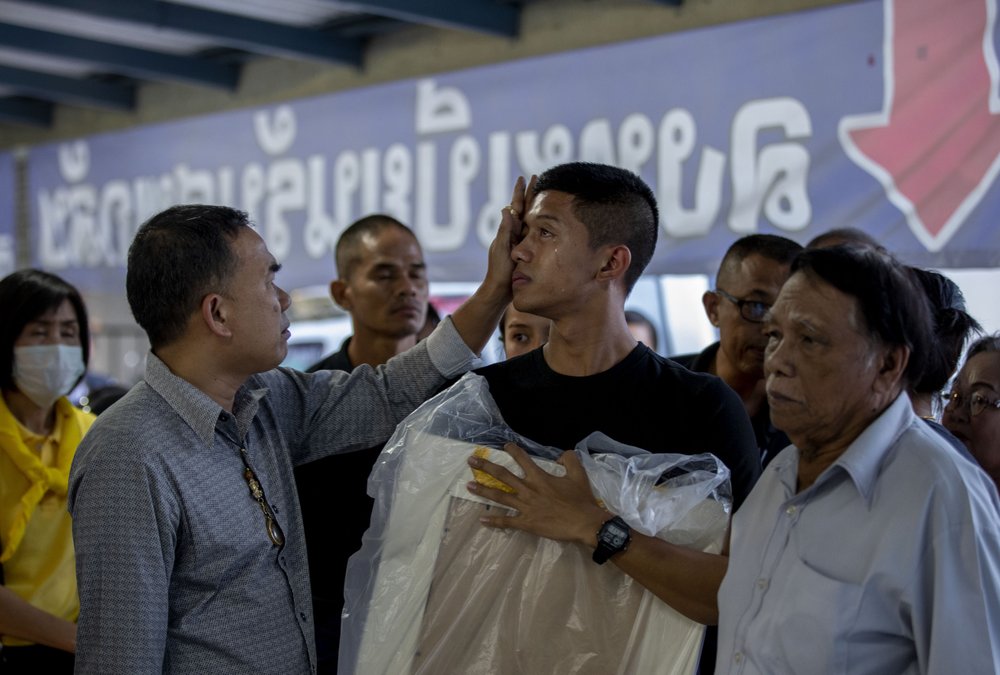
Sirirat lost her sister, brother-in-law and young nephew in the attack. She was among dozens of victims’ relatives sitting in plastic chairs and on concrete benches outside the morgue Sunday, waiting to fill out paperwork to lay claim to their loved ones and receive compensation from the Thai government’s criminal victims’ fund.
On Facebook, she had talked with her sister, 33-year-old Papatchaya Nualraksa, as she hid with her husband and their 2-year-old in a supermarket storage room. Sirirat advised her sister to nurse her son so he wouldn’t make noise and risk revealing the family to the gunman, whose rounds of automatic fire echoed around the seven-story mall.
In a Facebook call, Papatchaya told her sister that she was scared.
A family member comforts as they wait at a morgue in Korat, Nakhon Ratchasima, Thailand, Sunday, Feb. 9, 2020. (AP Photo/Gemunu Amarasinghe)
“Gunshots could be heard endlessly and loudly. But there was no sign” of a rescue, Sirirat said. Still, “both of us thought that she would be able to get out.”
They exchanged several Facebook messages before Papatchaya went quiet.
About 13 hours later, the standoff ended when Thai special forces fatally shot the gunman, whom authorities identified as Sgt. Maj. Jakrapanth Thomma.
Sirirat, 43, later received photos from a friend, an officer who responded to the mall, of the body of her sister, arms wrapped around her 2-year-old, and the boy’s father nearby.
At the hospital, a team from the government mental health department handed out cake and tissues, screening people for abnormal expressions of grief, according to Wimonwan Panyawong, a clinical psychologist who traveled from Bangkok northeast to Nakhon Ratchasima, a city of 150,000 people about 250 kilometers (150 miles) away.
The hospital’s lone forensic pathologist was joined by two others from out of town, but officials said it could be days before autopsies were complete and the bodies could be handed to families.
Kanokphon Watchawan, 28, came from Bangkok to retrieve the body of her brother, Wanchai, who was killed while working at a store on the mall’s second story. Kanokphon said hospital authorities told her to come back for him on Tuesday.
Officials said the assailant was angry over a financial dispute, first killing his commanding officer and the officer’s mother-in-law and then seizing several assault weapons and ammunition from his army camp. He opened fire and wounded at least three soldiers before stealing an army vehicle to flee, shooting as he drove to the mall where shoppers ran in terror.
Relatives of mass shooting fatalities wait outside a morgue at Korat, Nakhon Ratchasima, Thailand, Sunday, Feb. 9, 2020. (AP Photo/Gemunu Amarasinghe)
A funeral was held Sunday for a 13-year-old middle school student who was riding his motorbike when Jakrapanth fatally shot him en route to the mall.
Gun violence is not unheard of in Thailand, and the shooting in Nakhon Ratchasima comes just a month after another high-profile mall shooting in the central Thai city of Lopburi. In that case, a masked gunman carrying a handgun with a silencer killed three people, including a 2-year-old boy, and wounded four others as he robbed a jewelry store.
By Sunday evening, survivors were streaming back to the site of the rampage, Terminal 21 Korat, a gleaming airport-themed shopping mall, to retrieve vehicles abandoned during the police evacuation. The ground floor was spotless, with lights on, shops left open and a Haagen-Dazs ice cream kiosk freezer humming.
Palawan Ployudee, 50, whose gift shop on the mall’s third floor sells her hand-painted clothes, bags and other decor, first hid other shop owners and customers in the back of her store. When they realized they were exposed, they ran to a security guard office and later fled to safety down an internal fire escape.
Family members visit their relative, a victim of the mass shooting, at a morgue, in Korat, Nakhon Ratchasima, Thailand, Sunday, Feb. 9, 2020. (AP Photo/Gemunu Amarasinghe)
“The security guard instructed us to take off our shoes so we won’t make any noise and notify the culprit,” she said.
Elsewhere in the city, under a full moon, about 1,000 people gathered around the city’s most important monument, a statue of Thao Suranari, who is credited with saving her people from an invading Lao king in the early 19th century.
People chanted prayers along with a slate of Buddhist priests leading funeral rites, holding candles in one hand and with the other, pointing to the sky, a gesture Buddhists believe directs souls to heaven.
Sanan Thisara by a water resource pool in Doi Pu Parn in January 2020.
Above: Sanan Thisara by a water resource pool in Doi Pu Parn in January 2020.
As PM2.5 air pollution rose to a toxic high in Bangkok and other parts of Thailand, the public turned its attention once again to the long-tolerated practice of open field burning – to get rid of dead vegetation, rice residue, weeds, and clear the lands for the next crop cycle.
Farmers say the burnings are necessary despite the environmental toll because they are the cheapest way to clear the crops. They simply do have no much of a choice; Thai farmers often labor for little money to repay debts, selling crops for a loss.
Dead corn stalks on Doi Pokkalong.
But the National Innovation Agency, together with a number of private firms, believe that there’s hope for boosting the income and livelihood of farmers – while protecting the environment.
These five initiatives, funded with around 4 million baht, are being tested in Mueang Chang tambon (subdistrict) in Nan. Those that gain a foothold with the tambon’s residents may be employed in other poverty-stricken areas nationwide.
Nan is the 19th poorest province, according to the Office of the National Economic and Social Development in 2018. They eased their way up from being the fifth poorest in 2015, but nearly one in five residents still live under the poverty line.
“People think of climate change with fear and think there’s no options,” Somruay, 56, Mueang Chang mayor said. “Well, here’s some options.”
Solar-Powered Water Pumps
Most of Mueang Chang – population 6,000 – subsists on corn monoculture. The pay is little since the corn is sold for cheap animal feed and farmers often encroach onto protected land since corn stalks take up a lot of space. The local mayor, however, believes that new solar-powered water pumps could turn barren mountainsides into rich harvest areas.
Solar-powered pumps have been placed on top of Doi Pokkalong and Doi Pu Parn mountains, where they drew water up from a natural spring in a deep valley up to a mountaintop reservoir.
Somruay Padpon stands at the water reservoir pool on top of Doi Pokkalong.
“Nan is a tourist province, so we could grow things like salad greens, mushrooms, even tea or coffee. These crops take up much less space and sell for more,” Somruay Padpon, mayor of Mueang Chang sub-district said. “It’s basically 0 baht to run the pump. If we used an older method, we would have to pay for fuel or get hit with an electricity bill.”
Water stored on high ground can then flow down to surrounding villages as far as 3 kilometers away via a series of pipes, using the free power of gravity. The system can supply water to 1,370 rai of land around Doi Pokkalong, and 700 rai around Doi Pu Parn.
Solar-Powered Water Pumps in Mueang Chang
1 of 4
Tanaboon Trachoo at the Doi Pokkalong solar pumps.
Floatable solar cells which will be installed in Doi Pokkalong.
Doi Pokkalong’s natural spring.
One of Doi Pu Parn’s pools.
But they are designed to do more than pump up water. Tanaboon Trachoo, 45, the engineer who helped design them said residents will be able to request for water from the reservoir via a smartphone app, which tambon officials can approve or reject requests based on the farmer’s previous agricultural yields.
Farmer Sanan Thisara, 60, is already using the pools to water his trees on Doi Pu Parn.
“Now we can grow mango, lychee, and longan. It’s still for a loss, but I hope one day we can start growing crops that sell more like cocoa and coffee,” Sanan said.
Dead cornstalks and a solar cell on Doi Pu Parn.
Food Dehydrator Dome
Kingkarn Pantuwanit shows her solar-dried bananas in the food dehydrator dome.
Other innovations by the National Innovation Agency in Mueang Chang are on a smaller scale and serve to provide supplementary income to locals.
Housewives at the Mueang Chang Women’s Learning Center used to make only 2,500 baht to 5,000 baht a month by selling rice crackers, but with the addition of a food dehydrator dome in December, they were able to increase their monthly income to 9,000 baht by also selling solar dried bananas.
Instead of being exposed to the pollution-ridden atmosphere, the bananas are dehydrated using tech designed specially for the club by Naresuan University. A combination of solar heat, LPG gas, and heated ceramic plates do the magic. The dome cost 350,000 baht.
“Before, we had difficulty drying bananas because they would get contaminated with rain, dust, and bugs,” Kingkarn Pantuwanit, a woman at the learning center said.
Trash Compressor
Pongthorn Wijitkul demonstrates the use of Yaksa trash compressor.
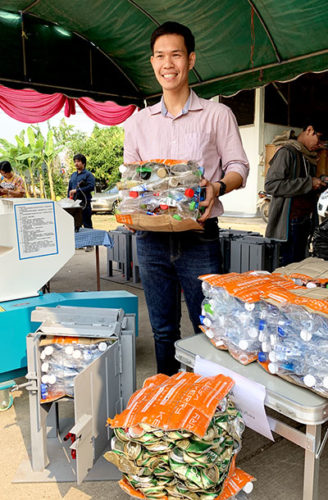
In Mueang Chang’s most far-flung rural areas, garbage trucks might visit once every three months. That’s where the Yaksa-hand powered trash compressor comes in, designed for stay-at-home elderly and children to clean up their neighborhoods while making extra cash.
The innovator, lecturer Pongthorn Wijitkul from Rajabhat Uttaradit University, says a family can make about 6,000 baht per year just by compressing plastic bottles and aluminum cans into 30 by 30 blocks to sell for about five baht each. Machines have already been distributed to 14 areas in the tambon, as well as some districts in Uttaradit.
Warayuth Wuthi, a social development worker, said only a handful of the 1,264 registered eldery people in the Mueang Chang can make a living since most of them are confined to their homes. Those who are able to earn income weave handicrafts or grow plants for sale.
Colorful Concrete
Concrete Blocks from Plastic Trash Initiative
1 of 2
A concrete block decorated with colorful bits of plastic trash.
Prachum Kumputh.
To help combat local waste, the NIA also launched a project to produce cheap concrete blocks using industrial byproducts such as cement dust and plastic waste. Colorful bits of plastic from single use plastic bottles are embedded into the blocks, which can sell as much as 70 baht apiece.
“The cement dust is cheap; the plastic is cheap. It’s an innovation that does something with the stuff we don’t know what to do with,” Prachum Kumputh, a lecturer at Rajamangala University of Technology Thanyaburi who is spearheading the project said. “These plastic pieces are from a green tea brand. If we sprinkle it on top of a block and sand it, it could look as pretty as marble.”
After a year of introducing the prototype to locals, Prachum says they’re ready to roll out their own production this year.
Zero Waste Farming
Sheep eat grass at the Joko Learning Center.
But not all green initiatives are welcomed by locals.
At the Joko Learning Center, experts from Chulalongkorn University failed to convince farmers to convert to a radical, zero-waste way of farming in which microorganisms, instead of pesticides, are used to treat soil. Under this model, sheep are also set free in orchards to graze and fertilize.
“To convince farmers the change the way they’ve been doing things is for decades is almost impossible, and an academic presentation is not the way to reach them,” Kwanpracha Wangsanit, who works at the center said.
“They say, ‘no way’ when I try to tell them that sheep poo and microorganisms are more effective than chemical fertilizers,” Kwanpracha said. “No way that they could sell a pile of veggies for 100 baht per kilo – instead of a huge pile for 20 baht – if they just switch to selling organic produce.”
Still, the tambon mayor seemed optimistic about the innovations as a whole.
“If it’s cheap and simple to understand, the farmers will use it. They won’t if it’s too academic and complicated. I hope these inventions will put power, rather than fear, into the hands of farmers,” Somruay said.
A view of the natural spring in Doi Pokkalong’s valley where the solar pump is installed, taken from the vantage point of the reservoir pool on the mountaintop.
Photo released by the police shows a group of police officers taking a rest after mass shooter Sgt. Jakkrapanth Thomma was killed in a shootout inside Terminal 21 shopping mall in Korat City, Feb. 9, 2020.
KORAT — Army officials on Sunday said they will implement additional security measures at military bases to prevent another mass shooting like the one that left 30 people dead in Nakhon Ratchasima over the weekend.
Following intense scrutiny from the public over how a lone soldier could loot military-grade weapons and hundreds of ammos from a base in Korat before engaging in the killing spree, army spokesman Winthai Suvaree said security officers would increase their vigilance when guarding arsenals inside military installations.
Col. Winthai said the gunman, Sgt. Jakkrapanth Thomma, was close to other soldiers inside the base, including the servicemen guarding the armory, so his attack caught them completely off-guard. He called the incident “unprecedented.”
“The force is currently in the process of assisting the wounded and compensating those affected to the best of our ability as a priority,” Col. Winthai said. “After the situation improves, we will [investigate] the chains of events … so that we can adjust the measures in place to be more efficient.”
Police said Sgt. Jakkrapanth – himself a professional shooting athlete – used a weapon he was carrying during his guard duty to kill sentries guarding the armory on Saturday. He then left the base with firearms including a Heckler & Koch rifle, an M60 machine gun, a shotgun, a handgun, several types of grenades, and over 700 rounds of ammunition.
Army chief Apirat Kongsompong today announced changes to armament for soldiers on base guard duties, banning them from carrying machine guns. They must also remove bolts from their firearms and hand them over to commanding officers, and keep the weapons unloaded with magazines.
But the army later said Apirat was merely repeating security protocol already in place, and no new hanges were added. The rules apply to all military bases nationwide, except in border provinces.
Photo released by the police shows aftermath of a shootout with the gunman inside Korat’s Terminal 21 shopping mall on Feb. 9, 2020.
Nakhon Ratchasima’s regional army commander Thanya Kriatisarn said he already instructed soldiers under his command to increase security after the incident, which appeared to be Thailand’s worst mass shooting.
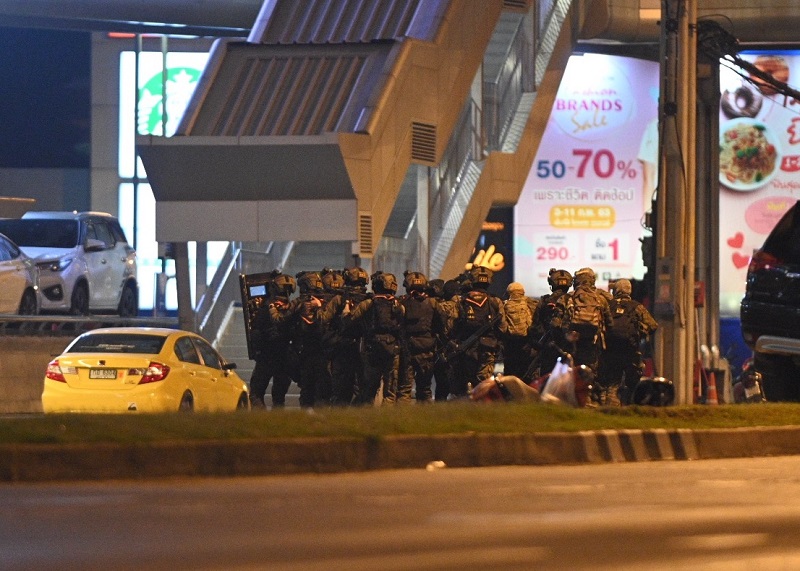
Sgt. Jakkrapanth’s military-grade weapons and tactical knowledge posed a crucial challenge to police and army commandos who spent over 10 hours trying to neutralize him inside Terminal 21 shopping mall, according to several police officers familiar with the operation.
The soldier reportedly switched to a machine gun loaded with armor-piercing rounds when fighting the besiegers, leading to the death of one police commando.
Soldiers approach Korat’s Terminal 21 shopping mall on Feb. 8, 2020. Photo released by the police shows aftermath of a shootout with the gunman inside Korat’s Terminal 21 shopping mall on Feb. 9, 2020.