30 C
Bangkok
Sunday, June 28, 2026
Home Blog Page 1439

Japan OKs Divisive Plan to Send Naval Troops to Mideast

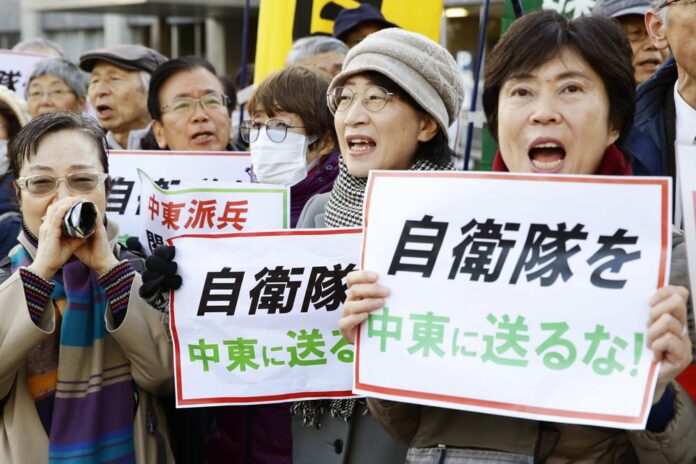
Protesters hold placards reading "Do not send Japan's Self-Defense Forces to Middle East" outside the prime minister's official residence in Tokyo Friday, Dec. 27, 2019. (Hiroki Yamauchi/Kyodo News via AP)

TOKYO (AP) — Japan on Friday approved a contentious plan to send its naval troops to the Middle East to ensure the safety of Japanese ships transporting oil to the energy-poor country that heavily depends on imports from the region.

The Cabinet’s decision reflects tensions that have escalated between Iran and the U.S. since President Donald Trump withdrew from Iran’s 2015 nuclear deal.

”Taking into consideration the escalating tension in the Middle East, it is necessary to strengthen our information gathering effort,” Chief Cabinet Secretary Yoshihide suga told a news conference. Citing Japan’s heavy dependence on oil imports from the region, Suga added that “it is extremely important to secure the safe navigation of Japan-affiliated ships.”

Despite being a U.S. ally, Japan’s troop dispatch is not part of a U.S.-led coalition protecting Middle East waterways, apparently an attempt to maintain neutrality in a show of consideration to Iran.

Under the plan, Japan will send about 260 Maritime Self-Defense Force personnel with a destroyer and a pair of P-3C reconnaissance aircraft, mainly for intelligence-gathering in the Gulf of Oman, the Arabian Sea and the Bab el-Mandeb Strait connecting the Red Sea and the Gulf of Aden.

Defense Minister Taro Kono issued an order for the troops to start preparing for the operation, which is planned for one year beginning early next year.

Kono is to visit Djibouti on the eastern coast of Africa and Oman this weekend to discuss Japan’s mission. Japanese troops have been based in Djibouti as part of an international anti-piracy effort off the Somali coast, and a P-3C unit currently in that operation will be shifted to the new mission in January, he said.

Japan will stay away from the Strait of Hormuz, where the U.S.-led coalition is operating.

Prime Minister Shinzo Abe explained the plan to Iranian President Hassan Rouhani when he visited Tokyo last week.

Japan, which has friendly ties with both Iran and the U.S., also seeks to serve as a mediator between the two and play a greater role in restoring stability in the region, officials said.

The Middle East supplies more than 80% of Japan’s oil needs.

Sending warships to areas of military tension is a highly sensitive issue in Japan because its pacifist post-World War II constitution limits the use of force by the military strictly to self-defense. Abe, however, has gradually expanded Japan’s military role in recent years.

In June, a Japanese-operated tanker was attacked in the Gulf of Oman. Washington said Iran was responsible and urged Japan to join the U.S.-led military initiative.

Petroleum Association of Japan Chairman Takashi Tsukioka welcomed a troop dispatch in a statement: “The Middle East situation continues to be uncertain and we believe it will contribute to the safety of ship navigation in the Middle East.”

Advertisement

Man Robs Colorado Bank, Throws Cash, Says ‘Merry Christmas’

Suspect David Oliver. A witness tells 11 News the suspect walked out of the Academy Bank at 1 S. Tejon St., tossed money out of the bag, and then walked approximately one shop down to Starbucks to sit and wait for police. (Photo: CSPD)

COLORADO SPRINGS, Colo. (AP) — A 65-year-old Colorado man is jailed after witnesses say he robbed a bank in Colorado Springs, walked outside and threw money out of the bag and then said “Merry Christmas.”

The man walked to the coffee shop next door, “sat down and waited for the cops,” witness Dion Pascale told KKTV.

Colorado Springs Police spokesman Sgt. Jim Jeffcoat would not confirm that money was thrown into the air or that Oliver said “Merry Christmas,” The Denver Post reported Tuesday.

Bystanders picked up money and gave it back to the bank teller, Pascale told KKTV. Some of the money was recovered but thousands of dollars remain missing, Jeffcoat said.

Colorado Springs police say a man walked into Academy Bank just before 12:30 p.m. Monday, claimed to have a weapon in his pocket and took cash. Officers found no evidence that the man had a weapon.

El Paso County jail records indicate the man’s bail is set at $10,000 and is scheduled to appear in court on Thursday afternoon. It’s not clear if any charges have been filed.

Advertisement

China to Complete Beidou Competitor to GPS With New Launches

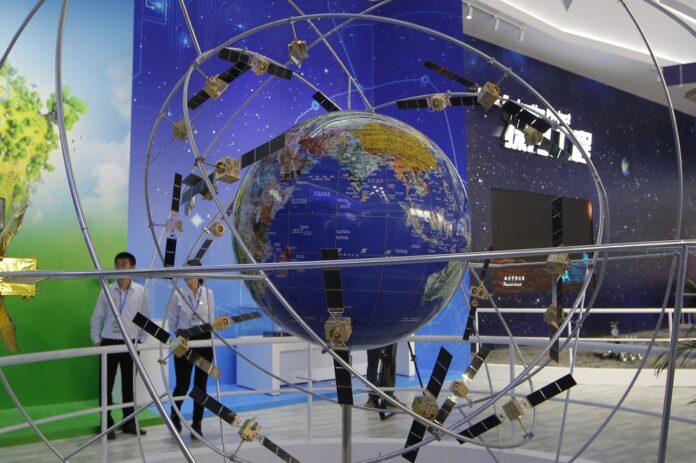
AP file photo.

BEIJING (AP) — China said Friday its Beidou Navigation Satellite System that emulates the U.S. Global Positioning System will be competed with the launch of its final two satellites in the first half of next year.

Project director Ran Chengqi told reporters that the core of the positioning system was completed this month with the launch additional satellites bringing its total constellation to 24.

That was up from 19 the year before, making it one of rising space power China’s most complex projects.

Ran described the system at a rare news conference as having “high performance indicators, new technology systems, high localization, mass production networking and a wide range of users.”

“Before June 2020, we plan to launch two more satellites into geostationary orbit and the Beidou-3 system will be fully completed,” Ran said.

The latest launches mark the third iteration of Beidou, meaning “Big Dipper,” the first of which was decommissioned in 2012. Future plans call for a smarter, more accessible and more integrated system with Beidou at its core, to come online by 2035, Ran said.

“As a major space infrastructure for China to provide public services to the world, the Beidou system will always adhere to the development concept of ‘China’s Beidou, the world’s Beidou, and the first-class Beidou,’ serving the world and benefiting mankind,” Ran said.

China’s space program has developed rapidly along all lines over the past two decades and developing independent high-tech capabilities — and even dominating in fields such as 5G data processing — is a major government priority.

In 2003, China became just the third country to independently launch a manned space mission and has since constructed an experimental space station and sent up a pair of rovers to the surface of the moon. Future plans call for a fully-functioning permanent space station, a mission to mars and a possible crewed flight to the moon.

Advertisement

NHK Sends Erroneous Alert About N. Korean Missile Launch

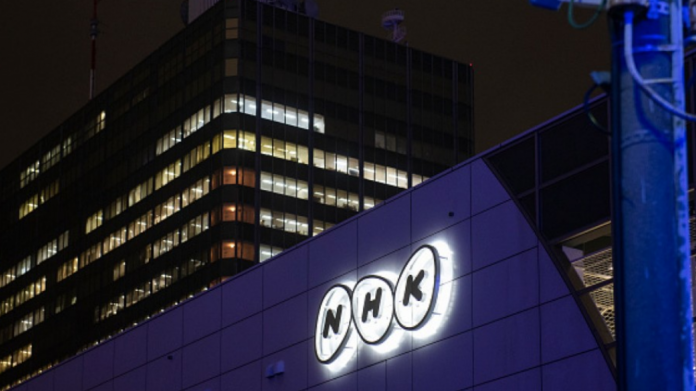
NHK heaquarters in Tokyo

TOKYO (Kyodo) —Public broadcaster NHK sent an erroneous report saying a missile from North Korea appeared to have fallen into the sea off Japan’s Hokkaido early Friday but quickly corrected it, saying the message was posted on its website by accident.

Shortly after midnight Thursday, NHK posted an alert message on its news website saying that a North Korean missile was estimated to have fallen into the sea about 2,000 kilometers east of Cape Erimo in Hokkaido.

Continue reading the story here

Advertisement

New 10 Siberian Tiger Cubs Born in China’s National Park

Photo taken with an infrared camera shows a wild Siberian tiger at the China National Park for Siberian Tigers and Amur Leopards in northeast Heilongjiang Province. (Photo provided to Xinhua)

HARBIN (Xinhua) — The China National Park for Siberian Tigers and Amur Leopards in northeast Heilongjiang Province has seen its wild tiger population increase.

Since it was established as China’s first national park for the endangered species in 2017, the park has seen 10 wild Siberian tiger cubs newly bred, said Liang Zhuo, a veteran tiger expert.

He said he now worries about his personal safety when making field trips to the park as the number of the big carnivores has increased.

Spanning an area of over 1.46 million hectares in the provinces of Jilin and Heilongjiang, the park covers long stretches of mountain forests.

79358117 973333766385669 310988282571784192 o 7
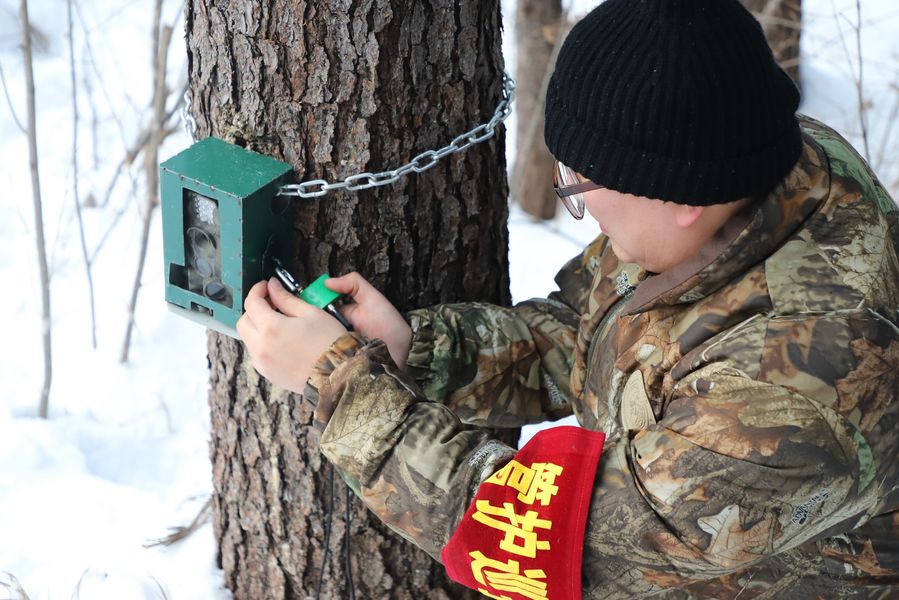
A forest official introduces a far-infrared camera which can record the condition of wild tigers at the China National Park for Siberian Tigers and Amur Leopards in northeast China’s Heilongjiang Province, Nov. 21, 2019. (Photo provided to Xinhua)

The 10 tiger cubs were born to the original 27 wild Siberian tigers living in the area. The habitats of the endangered species are mostly distributed in the Russian Far East and the northeast China region.

China has been intensifying the efforts to save the wild animals through the protection of their natural forest habitat, including the introduction of a logging ban in 2014.

The national park bordering Russia and the Democratic People’s Republic of Korea has created a natural corridor for the wild species to traverse, said Liang.

The national park administration has set up infrared cameras to monitor the activities of the wild animals. Wardens make regular patrols in the park and replace batteries and memory cards in the cameras.

With the protection efforts, the number of black bears, wild boars, roe deer and other animals in the mountain area has also increased. The park administration found the density of wild boar in 2018 was 1.91 per square km, an increase of 1.34 over 2011. Wild boar and deer are the staple food of wild Siberian tigers.

Jiang Guangshun, executive deputy director of the Feline Research Center of the National Forestry and Grassland Administration, said tigers are at the top of the food chain. The tiger’s revival suggests that the food chain is complete in the national park with forest resources being restored.

Advertisement

At Each End of Pacific, Skepticism Over China Farm Purchases

Farm owner Bill Pellett watches the harvested corn loading into a truck in a field of Pellett family's farm in Atlantic, a small city in Iowa, the United States, Oct. 14, 2019. (Xinhua/Wang Ying)

OMAHA, Neb. (AP) — President Donald Trump likes to joke that America’s farmers have a nice problem on their hands: They’re going to need bigger tractors to keep up with surging Chinese demand for their soybeans and other agricultural goods under a preliminary deal between the world’s two largest economies.

But will they really?

From Beijing to America’s farm belt, skeptics are questioning just how much China has actually committed to buy — and whether U.S. farmers would be able anytime soon to export goods there in the outsize quantity that Trump has promised.

It amounts to $40 billion a year, according to Trump’s trade representative, Robert Lighthizer. If you ask the exuberant president himself, though, the total is actually “much more than’’ $50 billion. To put that in perspective, U.S. farm exports to China have never topped $26 billion in any one year.

What’s more, since Trump’s trade war with Beijing erupted last year, China has increased its farm purchases from Brazil, Argentina and other countries. As a result, Beijing may now be locked into contracts it couldn’t break even if it intended to quickly increase its purchases of American agricultural goods to something approximating $40 billion.

“History has never been even close to that level,” said Chad Hart, an agricultural economist at Iowa State University. “There’s no clear path to get us there in one year.”

“The figure of $40 billion,” added Cui Fan, a trade specialist at the University of International Business and Economics in Beijing, “is larger than I expected, and I wonder whether the United States can ensure the full supply of the products.”

America’s farmers would surely like to. The farm belt has endured much of the impact from Beijing’s retaliatory tariffs since July 2018, when the Trump administration imposed taxes on $360 billion in Chinese imports. Beijing struck back by taxing $120 billion in U.S. exports, including soybeans and other farm goods that are vital to many of Trump’s supporters in rural America.

The impact from China’s retaliatory tariffs was substantial: U.S. farm exports to China, which hit a record $25.9 billion in 2012, plummeted last year to $9.1 billion. Soybean exports to China fell even more — to a 12-year low of $3.1 billion, according to the Department of Agriculture. (Farm imports to China have rebounded somewhat this year but remain well below pre-trade-war levels.)

The so-called Phase 1 deal that the two sides announced Dec. 13 did manage to de-escalate the standoff and offer at least a respite to American farmers. Yet the truce put off for future negotiations the toughest and most complex issue at the heart of the trade war: The Trump administration’s assertion that Beijing cheats in its drive to achieve global supremacy in such advanced technologies as driver-less cars and artificial intelligence.

The administration alleges — and independent analysts generally agree — that China steals technology, forces foreign companies to hand over trade secrets, unfairly subsidizes its own firms and throws up bureaucratic hurdles for foreign rivals. Beijing has rejected the accusations and contended that the administration is instead trying to suppress a rising competitor in international trade.

Under the preliminary U.S.-China deal, Trump suspended his plan to impose new tariffs and reduced some existing taxes on Chinese imports. In return, Lighthizer said, China agreed to buy $40 billion a year in U.S. farm exports over two years, among other things. (Beijing also committed to ending its long-standing practice of pressuring foreign companies to hand over their technology as a condition of gaining access to the Chinese market.)

Many farmers say they’re hopeful but restrained in their expectations.

“At this point, we have to wait to see more details,” said Jeff Jorgensen, who farms about 3,000 acres in southwest Iowa.

Yet the Trump administration has released no text of the agreement. And a fact sheet that Lighthizer’s office issued didn’t specify the target for increased Chinese farm purchases. What’s more, Beijing has so far declined to confirm the $40 billion figure.

“After the agreement is officially signed, the contents of the agreement will be announced to the public,” said Gao Feng, a spokesman for the Commerce Ministry,

Still, Chinese imports of U.S. soybeans more than doubled in November after the Phase 1 agreement was initially announced in mid-October — a sign that reduced tensions might have begun to ease the strain on American farmers, according to AWeb.com, a news website that serves China’s farming industry.

Beijing insists, though, that its farm purchases will be based on consumer demand and market prices, pointedly implying that it won’t buy more than it needs just to satisfy the Trump administration’s promises.

“The purchases should be based on market principles,” said Tu Xinquan, director of the China Institute for WTO Studies in Beijing. “The United States should compete with other countries through price and quality.”

Some analysts suggest that it’s at least theoretically possible for the U.S. to boost its farm exports to China to something close to the figures the administration has promised. Flora Zhu, associate director of China corporate research at Fitch Ratings, calls the $40 billion “achievable.’’

She notes, for example, that China’s demand for soybeans amounts to $40 billion a year. Even before the trade war, the U.S. supplied about a third of that total — “suggesting, Zhu said, that “there is still large room for China to increase its purchases of soybeans from the U.S.”

In addition, China’s demand for imported pork has intensified because its own pig herds have been decimated by an outbreak of African swine fever. Yet that same outbreak could reduce China’s need for American soybeans: Fewer hogs could mean less demand for soybeans and other sources of feed.

But achieving $40 billion a year would likely require diverting market share away from other countries — Argentina, Australia, Brazil, Canada, New Zealand — that export sizable quantities of farm goods to China. Those nations could then argue to the World Trade Organization that they are losing exports not because they can’t compete but because China is being coerced into buying American to avoid Trump’s tariffs.

“It is a situation many countries are concerned about,’’ said Tu of the WTO studies institute in Beijing.

U.S. farmers sound wary. Some worry that the prolonged trade war will brand the United States an unreliable trade partner in China and jeopardize access to a vast Chinese market that had increased its purchases of U.S. farm products from less than $1 billion a year in the early 1990s to nearly $26 billion by 2012. U.S. farm exports to China then fluctuated between about $20 billion to $25 billion a year before Trump’s trade war erupted in earnest last year.

Farmers have watched with frustration as breakthroughs in the trade war appeared several times to have been achieved only to collapse soon thereafter.

“I think it’s a lot of false promises again,” said Bob Kuylen, who grows wheat and sunflowers and raises cattle near South Heart, North Dakota. “I’d love to see $50 billion, but I don’t think it will ever happen … It’s just almost an impossible thing, so why even say it?”

___

Wiseman reported from Washington and McDonald from Beijing.

Advertisement

Thailand to Ring in New Year with Slight Coolness

Students dress up in Santa costumes on Dec. 25, 2019 at Piyamit Wittaya School in Phayao.

BANGKOK — Cuddle up to your loved ones and count down into 2020 as a slight breeze cools your outdoor fair sweat – Thailand is expecting slightly cooler weather as the new year approaches.

Although it’s not the 17C chill Bangkokians felt earlier in December that had everybody scrambling for jackets and tweeting #ColdWeather, Thais should be prepared for slight dips in temperature in the last days of 2019, according to the state weather department.

In Bangkok, the central provinces, and eastern provinces, lows are expected to drop to 23C to 26C, and Saturday through New Year’s Day should see a dip of 1C to 3C to 21C to 25C, with highs at 31C to 34C.

Throughout this time, the northern and Isaan provinces will see a 2C to 4C drop to lows of 10C to18C, to lows of 12C to 14C, with single digits expected on mountaintops.

Southern provinces expect to see lows of 23C to highs of 33C.

Related stories: 

Bangkok Feels the Chill as Temperatures Dip to 17C

Advertisement

Our Person of the Year 2019: Thanathorn Juangroongruangkit

A file photo of Thanathorn Juangroongruangkit

Nearly every major news item in 2019 seemed to involve Thanathorn Juangroongruangkit: billionaire, activist, and founder of the anti-military Future Forward Party.

First there was his stunning debut at the polls, when the Future Forward defied even the most optimistic expectation among his supporters and placed third with over 80 seats gained, despite Thanathorn’s lack of prior experience in electoral politics, and even more dauntingly, the set rules which overwhelmingly favored the pro-military faction.

Thanathorn’s pledges to combat the military’s influence as well as chronic inequality in Thai society struck a chord with millions of voters, especially the youth.

“He’s a rising-star politician who managed to successfully win the hearts of young generations,” Pheu Thai advisor Sudarat Keyuraphan said in an interview.

606619 3
Thanathorn Juangroongruangkit takes selfies with university students in Bangkok on Feb. 21, 2019.

“His popularity faces off against the establishment, threatening their comfort zones and their intertwined networks of interests,” said Satithorn Thananitichote, a political analyst at King Prajadhipok’s Institute. “He gives hope to bring forth change, and challenges the patronage system that paralyzed the country for decades.”

Even a pro-government lawmaker acknowledged Thanathorn as a phenomenon to be reckoned with.

“Although we’re on different sides, I don’t have any prejudice about him. I’m not opposed to his ideas,” Democrat MP Thepthai Seanapong said. “His policies appeal to the youth because they match with the current trends.”

Born in 1978 to a wealthy Thai-Chinese family who owns an auto parts empire, Thanathorn has served as a board member to the Thai Auto Parts Manufacturers Association, the National Science and Technology Development Agency, and Matichon Group, which also owns Khaosod English.

But business wasn’t his only passion – Thanathorn is well known among his peers for participating in NGO works, political protests, and environment campaigns.

นายกพบสื่อ ๑๙๑๒๑๘ 0036 1
The young Thanathorn Juangroongruangkit, center, sits in a family photo.

Thepthai, who’s been in politics since 1992, said Thanathorn’s background as an entrepreneur could prove to be a double-edged sword for his political career.

“He’s a rising-star politician who has great determination, but he’s inexperienced,” the former Democrat spokesman said. “He used to be a businessman, so he continues to do his business in a swift and decisive way.”

Thepthai added, “However, it’s different in politics, where you have to be attentive to petty rules and regulations. This is why he lost his chance to achieve his promises.”

He was referring to a legal complaint that accused Thanathorn of failing to transfer his shares in a media firm in time before he registered to run in the March elections. His failure to do so, the Election Commission argued, meant he violated voting laws.

299823 1
Leaders of Future Forward Party, Thanathorn Juangroongruangkit and Piyabutr Saengkanokkul, speak March 24 at a news conference in Bangkok.

The case proved to be his undoing. The Constitutional Court suspended Thanathorn’s lawmaker status back when it took up the case in May – effectively banning him from parliamentary debates – before finding him guilty of the charge in November and stripping him of his MP seat.


There’s also criticism from his allies who felt that the Future Forward prioritizes crowd-pleasing, “woke” issues like localist and gender identities over crucial matters, such as the economic slump. That’s not to mention Thanathorn’s refusal to speak out against royal defamation laws, which caused much disappointment to some progressives.

Despite backlash from enemies as well as allies, Thanathorn’s popularity appears to steadily hold among his young supporters, many of whom saw him as a rare champion who shares their frustration with the many societal ills afflicting Thailand.

A “flash mob” protest called by Thanathorn earlier this month turned out to be the largest political rally in years, drawing thousands of people.

“His messages touch the hearts of the new generation who felt utterly repressed for almost five years during the junta rule,” political scientist Satithorn said. “The way he talks looks powerful and credible, and his image seems to be approachable to everyone even though he’s a billionaire.”

“Still, he’s not the first man to promise such hopes. We have to wait and see how far he can lead Thailand,” the pundit added.

As 2019 comes to a close, uncertainty hangs over Thanathorn’s fate. The same court that booted him from his Parliament seat is set to rule on Jan. 21 whether his party will be dissolved altogether on suspicions of harboring an intent to overthrow the monarchy – and belonging to the fictitious cult of Illuminati.

If found guilty, Thanathorn faces up to a five year ban from politics.

Honorable Mentions

Chavanon “Sean” Caisiri

Sean
Photo: Sean_Poem / Instagram

Known for his ombre colors, pantsuits, and structured dresses, the designer of Thai couture brand Poem made waves in the fashion world throughout 2019. His clients include Future Forward Party spokeswoman Pannika “Chor” Wanich, actress Wichayanee “Gam” Pearklin, and Burlesque star Dita von Teese.

Parina “Ae” Kraikupt

1329074 5
Parina “Ae” Kraikupt

What is 2019 without the pro-government Ratchaburi MP’s facepalm-inducing antics, like dissing at a fellow lawmaker, claiming an activist set up his own attack, and suspecting that a former PM staged bomb attacks in Bangkok? She sure succeeded in distracting the media from many other scandals and grafts that deserved more airtime.

Somsak Jeamteerasakul

13916729591391673126l
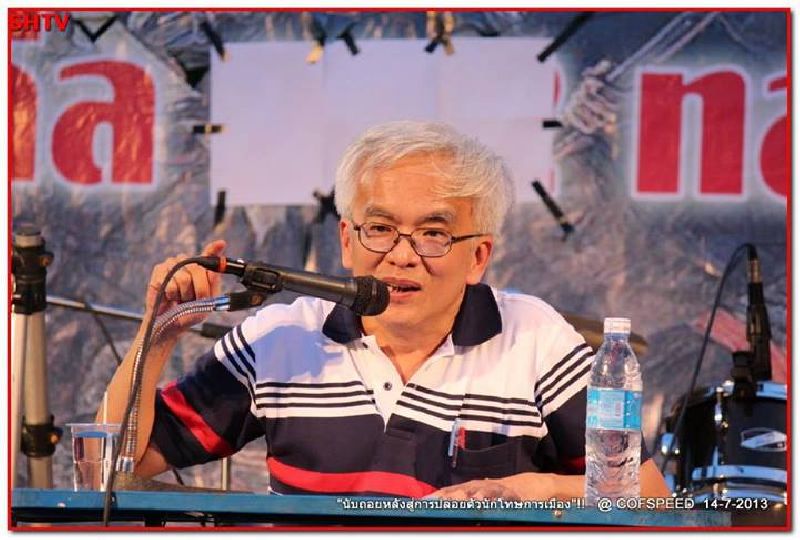
Somsak Jeamteerasakul at a discussion panel, 14 July 2013 (Photo by Speed Horse TV)

The most prominent critic of the monarchy went on radio silence after he suffered a stroke in late 2018. He apparently recovered and returned to social media this year. Though Somsak no longer wrote lengthy analyses like he used to, his commentaries on the monarchy and politics nevertheless bring delight to his cult of followers.

Bin Bunluerit

138554263 15737026082631n 2
Bin Bunluerit

The former TV actor who has since adopted a philanthropic career as a rescue worker came to the aid of rural communities hit by a flood this year by fundraising over 422 million baht in donations.

Related stories:

6 Times in 2019 Thais and Expats Stood Up for the Environment

Our Person of the Year 2018: Prawit Wongsuwan

Our Person of the Year 2017: King Rama X

Advertisement

Families Still Hopeful for Polish Man, Thai Woman Missing at Sea

Werakan Siriprakon and Mateusz Juszkiewicz, who went missing on Dec. 7 in Phuket.

PHUKET — The families of a Polish man and Thai women who disappeared almost three weeks ago at sea in the south said they still have hope for their safe return.

Almost two weeks after search efforts for Polish tourist Mateusz Juszkiewicz, 27, and Werakan Siriprakon, 23, ceased, officials on Wednesday said that reports from locals about a foreign man and Thai woman camping in the area also turned out to be somebody else.

Juszkiewicz and Werakan went missing while kayaking off Yanui Beach on Phuket island on Dec. 7.

Werakan’s mother, Chudarasa Siriprakorn, said by phone Thursday. “I think we haven’t found either their bodies or boat yet, because they must still be alive.”

Juszkiewicz and his friend Werakan had gone out kayaking around 4:40pm at Yanui Beach with six other friends in three other boats, but Werakan’s boat did not return.

“My daughter would be trying her hardest to get back home. She had plans to go overseas in February,” Chudarasa, 46, said. “The man also had travel plans.”

Chudarasa, 46, also dismissed speculation on social media that they might have eloped, because they weren’t in a romantic relationship.

“Perhaps they are stuck or detained somewhere, and they cannot communicate with us,” she said.

Mateusz’s sister Monika Juszkiewicz and other family members were on Phuket and searching for him, aided by a Polish private detective. Monika said “every specialist is saying something different.”

“I do not know what to do,” Monika Juszkiewicz said by message on Thursday. “The worst is the powerlessness that will make us wait and think.”

Monika said their detective will try to do a search via satellite next.

Both families have put out a reward for assistance: 5,000 baht for clues that lead to tracking down the couple, 20,000 baht for confirmed sightings, and 50,000 baht for securing their safe return.

Anongkan “Nok” Srisuphat, the landlady and close friend of Werakan, said that search efforts by officials concluded since Dec. 12. Since then, the families have been searching by themselves on foot and by boat, relying on tips sent in.

The Juszkiewicz family are also offering an additional reward of EUR5,000 (about 168,000 baht) for anyone who finds the couple safe. Those with helpful information are advised to contact Khun Chudarasa at 085-654-2969, or Khun Nok at 064-341-9847.

Advertisement

Hong Kong Clashes Resume in Shopping Centers, Streets

Riot police past by a Christmas decor in a mall during a protest rally on Christmas Eve in Hong Kong on Tuesday, Dec. 24, 2019. More than six months of protests have beset the city with frequent confrontations between protesters and police. Photo: Kin Cheung / AP
Riot police past by a Christmas decor in a mall during a protest rally on Christmas Eve in Hong Kong on Tuesday, Dec. 24, 2019. Photo: Kin Cheung / AP

HONG KONG (AP) — Clashes resumed in Hong Kong on Tuesday between police and anti-government protesters, some of them donned in Santa Claus hats, as the more than 6-month-long demonstrations look set to move into the new year.

Black-clad protesters smashed shop windows, while police responded with tear gas and the arrest of a number of demonstrators.

The protests demanding greater democratic rights show no sign of ending despite the overwhelming victory by anti-establishment candidates in elections for district representatives earlier this month.

Tuesday’s protests were focused on the city’s mainly working class Mong Kok district. In response, police ran down suspected protesters in shopping malls and on subway trains.

A woman wearing Christmas decorations in her hair reacts to tear gas as police confront protesters on Christmas Eve in Hong Kong on Tuesday, Dec. 24, 2019. More than six months of protests have beset the city with frequent confrontations between protesters and police. Photo: Kin Cheung / AP
Advertisement

Hot News

LATEST NEWS

Bangkok
overcast clouds
30 ° C
31.6 °
30 °
75 %
3.5kmh
98 %
Sat
30 °
Sun
34 °
Mon
34 °
Tue
33 °
Wed
32 °