36.1 C
Bangkok
Saturday, June 27, 2026
Home Blog Page 1720

FLEC: Showcase of Thailand’s Efforts to Enhance Fishermen’s Quality of Life

Strong partnerships have been a driving force behind Thailand’s transition toward becoming IUU free country. Fishermen Life Enhancement Center (FLEC) is among many of the public-private cooperations aiming to tackle human rights issues in Thai fishery industry.

The project was set up in 2016 by five organizations, including the Fish Marketing Organization; Ministry of Agriculture and Cooperatives; Department of Labour Protection and Welfare; Family Planning Association of Thailand; Stella Maris Centre Songkhla and Charoen Pokphand Foods, to be a neutral party that ensure equal treatment. In addition, it also upgrades living standards of fishermen in Songkhla province, where 20,000 of them are situated.

5Z9rhV4oEghWlL

FLEC provides a “One-Stop Service” for workers in Thai fishery industry and their families, offering education, health improvement programs, skill development courses, translation supports, and religion activities as well as being coordinator between fishermen, particularly migrant workers, and government agencies.

Last year, FLEC offered legal consultant to 38 victims of human trafficking and abuse. Moreover, it also carried out proactive training courses on labour rights and occupational health and safety to migrant workers. Its other service included first aids training and medical kits distribution to 2,000 fishermen from 76 ships.

It also supports their families by giving education opportunity to migrant children in line with UN Sustainable Development Goals No.4 ; Quality Education, offering basic education to about 30 children at the center each year.

Iy40wOZZ8LzFofzUZxPBHMetRDNqjQFZ7p T21 K04c8u 5EoCnFl0Pa

The learning program has been very successful, since 12 children of migrant workers were able to continue study at kindergarten and elementary school levels in a local municipal school in Songkhla province last year.

Others family support programs includes family planning course, vegetable growing course, religion study, and etc.

These successful activities help the center to gain recognition and trust from the migrant workers, who spread FLEC’s news via word of mouth to their fellow workers and family members, resulting growing numbers of users each year. The average visiting frequency is at 35 times per month.

Even though, the European Commission already lifted Thailand’s Yellow Card for illegal fishing. The center would like to stress that all relevant parties will need to carry on their works and cooperating even more to eliminate human trafficking, child labour, forced labour and any forms of illegal acts from Thai seafood supply chain for good as well as improving quality of life to all fishermen.

YDMYpMO QlkoduHF2fUw93qlc0uDL wdVzi35oQ8EFo1hXFlqoeuDvR6lNkUrrfA76I6gI4tEtvQavuwCdYpyCkBtBBJKAguLQ7fwhiDFudScYBbK JjPyCbfMRa6

FLEC believes that strong partnership is vital for Thailand in order to move toward and IUU-free country and, therefore, the center is looking to further strengthen the relationship with workers to become “a friend that all workers can trust”.

By Nattaya Petcharat, Project Coordinator at Stella Maris Songkla Center and FLEC’s committee

Advertisement

Rare Pangolins Languish in China Wildlife Rescue System

A tree pangolin (Manis tricuspis) seen here in 2009 in central Democratic Republic of the Congo. Photo: Valerius Tygart / Wikimedia Commons

WASHINGTON — When Chinese police found them in the trunk of a smuggler’s car, 33 of the trafficked pangolins – endangered scaly mammals from southern China – were still alive, wrapped in plastic bags soaked with their own urine.

But the fate of the creatures – whose scales are worth nearly their weight in silver on the black market – was not a happy one. Every last pangolin died in government captivity within a few months of the August 2017 seizure.

A pioneering environmental nonprofit in Beijing has launched an investigation, called “counting pangolins,” to figure out what happens to such animals recovered from the illegal wildlife trade. Its findings so far highlight discrepancies between environmental laws and outcomes.

China is hardly unique. The number of environmental laws on the books worldwide has increased 38-fold since 1972, according to an exhaustive U.N. Environment report released Thursday. But the political will and capacity to enforce those laws often lags – undermining global efforts to curb issues like wildlife trafficking, air pollution and climate change, the report found.

“The law doesn’t self-execute,” said Carl Bruch, a study co-author and director of international programs at the Environmental Law Institute in Washington, D.C.

Each of the 33 pangolins transferred to the care of a government-run wildlife rescue center in China’s Guangxi province died within three months – according to records obtained by the nonprofit China Biodiversity Conservation and Green Development Foundation and shown to the Associated Press.

What’s still unclear is what happened to their bodies.

Pangolins are insect-eating, scaly mammals – playfully described by the International Union for Conservation of Nature as “resembling an artichoke with legs and a tail.” Their scales – made of keratin, the same material in human finger nails – are in high demand for Chinese traditional medicine, to purportedly cure arthritis, promote breast-feeding for mothers, and boost male virility, although there is no scientific backing for these beliefs.

The price of pangolin scales in China has risen from $11 per kilogram (2.2 pounds) in the 1990s to $470 in 2014, according to researchers at Beijing Forestry University.

Scientists have designated all eight species of pangolins as being at risk of extinction – four species in Asia, and four in Africa. More than 1 million pangolins were trafficked between 2004 and 2014 – for their scales, meat and blood – with China and Vietnam as the largest markets. In the last two decades, the number of pangolins worldwide has dropped by about 90 percent.

In 2016, the Convention on International Trade in Endangered Species of Wild Fauna and Flora (CITES) adopted a worldwide ban on commercial trade in pangolins, and China later approved that ban. Pangolins are also listed as a protected species in China. While Chinese state-run media have publicized a few high-profile poacher busts, watchdogs say a thriving black market for endangered-animal parts persists.

In November 2017, customs officials in Shenzhen seized 13.1 tons (11.9 metric tonnes) of pangolin scales – reportedly the largest-ever seizure of scales from Africa – according to state media. The penalties offenders face are not always publicized, but in another case involving a smaller shipment of scales, two smugglers received prison sentences of five years, state media said.

“It’s significant that China has adopted laws against trade in many endangered species, but the law itself isn’t enough to protect a species from extinction,” said Jinfeng Zhou, director of the China Biodiversity Conservation and Green Development Foundation.

Zhou wants the government to issue public records tracking all living and dead pangolins seized by authorities – and to offer evidence that contraband, including pangolin scales, is destroyed before it enters black markets.

“We are determined to know what happens to the pangolins,” said Sophia Zhang, a researcher at the biodiversity group. After reading news reports about the August 2017 poaching bust, she filed information requests to government agencies and traveled to Guangxi to visit the wildlife rescue center.

The Guangxi Forestry Department, which manages the wildlife rescue center, declined AP’s requests for an interview and comment. China’s state-run news service Xinhua reported in December 2018 that China remains committed to stopping pangolin trafficking, noting there were 209 pangolin smuggling busts from 2007 to 2016.

Less official attention has been paid to what happens after these busts.

In Guangxi, Zhang saw that pangolins were kept in small cages and fed cat food at the wildlife center, whereas wild pangolins eat termites. She said she had tried to coordinate with Save Vietnam’s Wildlife, a nonprofit, to bring shipments of termites to feed the pangolins, but the center declined the offer.

After the animals died, the center wouldn’t reveal what happened to their scaly bodies. But in other instances, the same center has turned over live pangolins to industry groups – including a steel factory in Guangdong province and a farm associated with a Chinese traditional medicine center in Jiangxi province. The government released this information on its web site.

In response to an information request from Zhang, the Guangxi Forestry Department sent copies of the licenses held by these organizations for handling pangolins. The reason for transferring pangolins remains unclear.

“We want the wildlife center to provide a full explanation,” Zhang said. “We know the trade in pangolins is very lucrative. The public should be able to know what happens.”

The biodiversity nonprofit has filed information requests about trafficked wildlife in nearly 30 Chinese provinces and has attempted to verify what happens to pangolin scales seized by customs officials. Zhang said wildlife rescue centers need better training to properly handle live animals.

“China has a rather complete set of environmental laws,” said Barbara Finamore, the senior strategic director for Asia at the Natural Resources Defense Council in Washington, DC. “But environmental laws are not worth the paper they’re written on unless there’s also strong enforcement and oversight.”

Countries large and small, rich and poor, have passed extensive green legislation since the Rio Earth Summit in 1992. “The world has made incredible progress in adopting environmental laws and environmental impact assessments, in creating environmental ministries and agencies,” said Bruch, co-author of the U.N. report.

Now comes the hard part.

“The legal framework is there in an enormous number of countries,” said Deborah Seligsohn, a political scientist focusing on environmental policy at Villanova University. “But once you have all these laws, you need trained and willing personnel to actually enforce them. You need boots on the ground.”

Green mandates often go unfunded, said Barney Long, director of species conservation at Global Wildlife Conservation, a nonprofit group in Austin, Texas. “Many countries have laws stating the minimum number of park rangers that should be patrolling per square mile in national parks and protected areas. But these aren’t implemented if sufficient money isn’t appropriated.”

Non-governmental groups – like the biodiversity nonprofit in Beijing – try to help close the gap between environmental laws and enforcement action. But in many countries, this is dangerous work. In 2017, at least 207 environmental defenders – including forest rangers, advocates, journalists, and inspectors – were murdered for performing such work, according to Global Witness, a research and advocacy group based in Washington, D.C. and London.

There are some bright spots, experts say.

China is gradually releasing more environmental data to the public, especially on air pollution, even as the government clamps down on other forms of information. And more officials are being held accountable, said Jennifer Turner, director of the Woodrow Wilson Center’s China Environment Forum in Washington, D.C. “Before local officials were only evaluated on economic performance – but now it’s harder to hide from environmental sins.”

Story: Christina Larson

Advertisement

Bangkok Taco Bell Fans Binge on Comfort Food, and Possibly, Regret

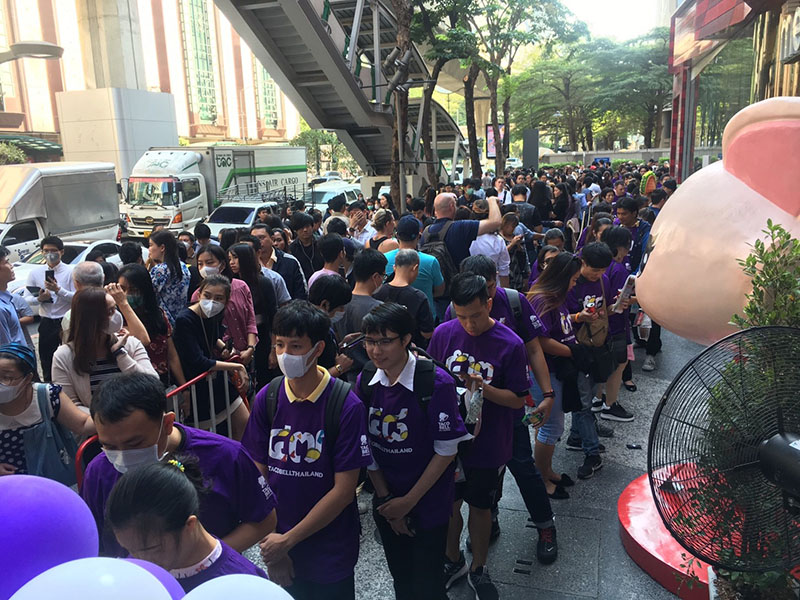
BANGKOK — For almost three hours, Junior stood eagerly waiting in line. After the 27 people before him were served, he would be sinking his teeth into a greasy taco like he did during his teen years in the American midwest.

The last time “Junior”, 18, ate Taco Bell was two years ago, when he would down burritos after school as an exchange student in Grand Haven, Michigan. Thursday morning, he was the 28th customer to queue up for the official opening this morning at Thailand’s first branch of the Tex-Mex fast food chain at The Mercury Ville shopping mall on Chit Lom Road. Other Thai customers in line echoed Junior’s sentiments – they were waiting out of nostalgia for time they lived in the United States.

Little did Junior know that he would bond with No. 32 and 33 in line.

“We’re like, top 30!” No. 32 said, laughing with his new bro-friends. “We just met him in line now.”

For No. 33, it was his first time at Taco Bell – but he said he had found a new source of comfort food.

“It’s great. All I order here is pizza, McDonald’s, so this is a great alternative,” No. 33 said. “This would totally be a great drunk food, man!”

No. 32 ordered almost everything off the menu to share with both No. 33 and his new buddy Junior.

“I’ve been waiting for this place to open for two years. They announced it way earlier, but in the past year it’s been hyped a lot,” he said, demolishing a hard taco.

No 32., an ethnic Russian from New York’s Brighton Beach neighborhood, said he was glad there’s now a cheap alternative to Mexican food in Bangkok, even if he did enjoy other restaurants which have sprung up.20190124 190125 0013

“Sunrise Tacos is overpriced. It’s such a ripoff,” No. 32 said, echoing a popular sentiment. “My favorite place is Tacos and Salsa in On Nut, but that’s for premium-quality food.”

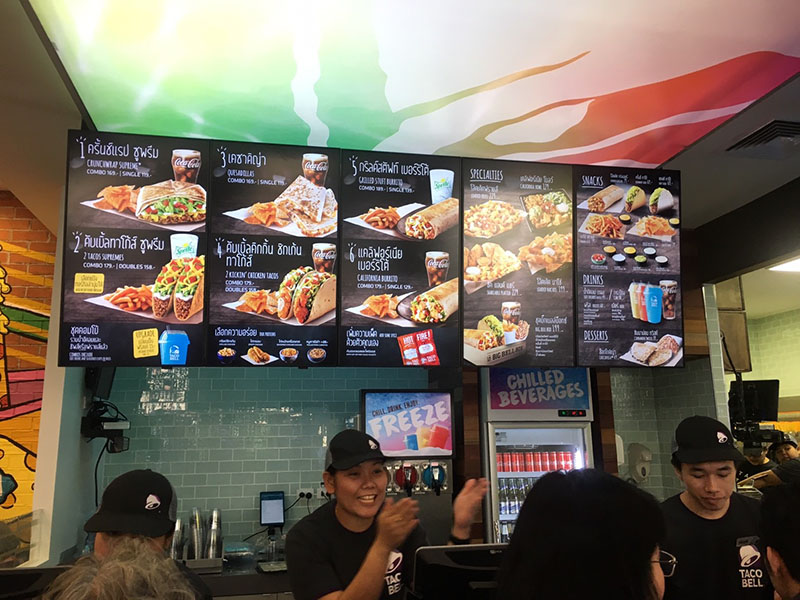
No 32.  said he compared the prices in Bangkok with those back in the states and was satisfied. A review of the menu found some items roughly a third more expensive than their American equivalents. “Double Tacos” are 158 baht (USD$5), while US restaurants sell them for the equivalent of 106 baht. However, other dishes like a Crunchwrap Supreme (114 baht) are about the same.
20190124 190125 0006

The difference is in the servings: There are no XXL Grilled Stuft burritos; the non-XXL Thai version is 139 baht.

Most who have counted Taco Bell a guilty pleasure would admit Taco Bell is about face-stuffing quantity rather than quality that can leave one with a lingering sense of regret.

The chicken taco filling – no beef served yet, the chain says – tastes like the meat layer scraped off of a cafeteria lasagna, and Thai palates will beg for some lime to cut through the creamy greasiness of a chicken quesadilla.

The overall aftertaste is one that leaves the impulse to “make a run to the border” both satisfied yet also staved off for some time. At least until the next drunken stop for sustenance between night clubs, or morning-after hangover remedy.20190124 190125 0001

Like No. 33 said, it’s great drunk food – so long as one’s inebriated between 10am and 10pm.

Expect long queues – as is the case for many foreign chain imports – for the next few weeks.

Taco Bell hopes to expand to 40 branches across Thailand by 2022.

Taco Bell is open 10am to 10pm daily on the ground floor of The Mercury Ville Chidlom shopping mall, which can be reached on foot via skywalk from BTS Chit Lom.

20190124 190125 0013 20190124 190125 0009 20190124 190125 0007 20190124 190125 0003 20190124 190125 0002

Advertisement

In First, Election Rules to Limit Social Media Campaigning

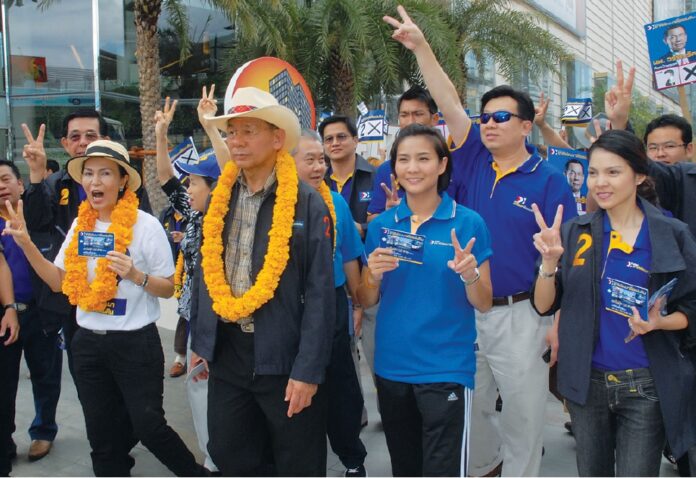
A candidate from Chart Pattana Puea Pandin Party campaigns at Siam Paragon on June 11, 2011.

BANGKOK — Those planning to meme their way to electoral triumph via savvy Facebook campaigns need to think twice. Riding the easy train into parliament and Government House won’t be as simple as hiring the zeitgeist-exploding girls of BNK48 to serenade the youth vote.

New campaign rules implemented yesterday alongside an actual poll date covered everything from how much money can be spent and the wording of campaign posters to a ban on hosting “entertainment” to a political party’s advantage.

And for the first time in history, for the first election since it became the main platform for unfettered discourse, social media is covered by the regulations. Parties must notify the Election Commission what messages they will put out on which platforms for how long before they begin. Infractions may result in “red cards” disqualifying the contenders from running.

Related stories: Election Commission Lays Down Timeline for 2019 Poll

“Violations on social media are digital [crimes], which are not hard to trace,” Election Commissioner Charungwit Phumma told reporters.

Under the regulations, social media campaigns can only contain candidates’ names, their photos, their party names, party logos, policies, slogans and biographical information.

Parties must also refrain from “Liking” and sharing contents that defame rival candidates or contain “false information.”

Social media is the one space that has eluded control of the military government, though some critics, satirists and opponents have been arrested and charged under the vaguely written cybercrimes law.

The commission said it would convene a “war room” to monitor online political discourse during the campaign season.

Citing fear of potential prosecution, some politicians, including Pheu Thai luminary Sudarat Keyuraphan, deactivated their Facebook accounts on Tuesday.

But Thai Raksa Chart Party advisor Chaturon Chaisang said he would maintain his online presence in order to call for a fair election. The former education minister criticized the Election Commission’s rules on social media campaigning as backward.

“Because the Election Commission does not understand the term ‘freedom,’ the rules turned out this way,” Chaturon wrote online. “But there’s no way they can block it. The social media world has gone far ahead. The Election Commission can’t catch up with it.”

Other rules include:

  • Candidates cannot invoke the monarchy in any way for good or ill.
  • Candidates cannot employ actors, musicians, celebrities and media to “use their talents” to the advantage of the candidates and their parties.
  • Candidates cannot use impolite or aggressive language.
  • Candidates cannot leave literature and materials at locations unsupervised but must directly hand it out.
  • Candidates cannot hand out money or any other financial inducements to the public, even where it would traditionally be acceptable, such as at weddings and funerals.
  • Each party can only spend up to 35 million baht in their campaigns. That includes staff salaries, uniform costs, accommodations, venue rental fees, travel expenses, utility bills and money spent on social media.
  • Campaign posters and billboards can only contain candidates’ names, photos, party names, party logos, policies, slogans, party leader photos and prime minister candidate photos.
  • In what’s seen as a rule to prevent Pheu Thai and its allied parties from employing fugitive prime minister Thaksin Shinawatra to influence its base, campaign posters and billboards cannot display individuals unrelated to the parties.
Advertisement

Malaysian Royals Pick Pahang Sultan as New King

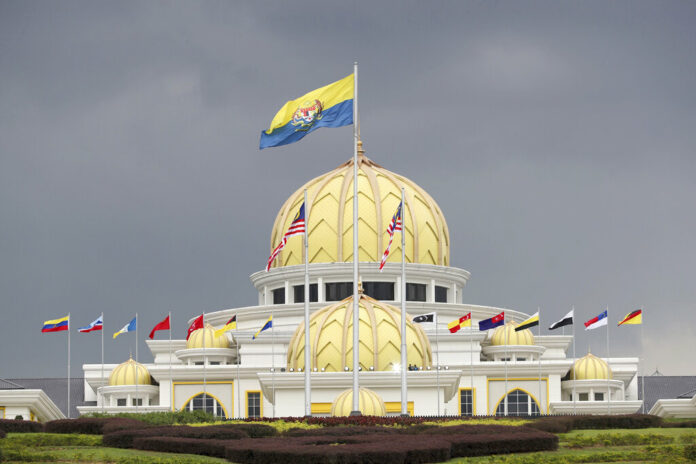
Flags fly Thursday at the Malaysia National Palace in Kuala Lumpur, Malaysia. Photo: Vincent Thian / Associated Press

KUALA LUMPUR — Sultan Abdullah Sultan Ahmad Shah of central Pahang state has been named Malaysia’s new king, replacing Sultan Muhammad V who abdicated unexpectedly after just two years on the throne.

The 49-year-old ruler resigned Jan. 6 as Malaysia’s 15th king, marking the first abdication in the nation’s history and cutting short his five-year term. No reason was given, but the move came after he reportedly married a 25-year-old former Russian beauty queen in November.

Keeper of the Ruler’s Seal, Syed Danial Syed Ahmad, says the Conference of Rulers on Thursday elected Sultan Abdullah under a unique rotating monarchy system.

Sultan Abdullah is a key figure in several international sports bodies. He will be sworn in on Jan. 31 for a five-year term.

Advertisement

Engineers Face Charges After Bangkok Crane Collapse Kills 5

Police and engineers on Thursday at the construction site where a crane collapsed and killed five people in Bangkok.

BANGKOK — Construction engineers face charges after a crane collapsed on Bangkok’s Rama III Road, killing five people, police said Thursday.

Col. Sompot Suwanjarat of the Bang Phong Phang Police Station said investigators and experts are looking for the head engineers of the Lumpini Park Rama 3 Riverine condominium construction project. He said they face charges of fatal negligence after the crane partially collapsed yesterday afternoon.

The accident led to a dramatic rescue operation, as one worker was trapped atop the wreckage about 50 meters above the ground. He was brought down safely but later died at the hospital due to severe blood loss, bringing the death toll to five. Five others were injured.

Read: Rescuers Scramble to Save Worker Trapped in Crane After Collapse Kills 4

Sompot said police are working with engineering experts to determine the cause of the accident. He added that the developer, L.P.N. Development Public Co. Ltd., has yet to contact the authorities.

Construction site accidents and worker fatalities are commonplace and despite frequent assertions of legal action, accountability is in short supply.

Civil engineer Chulert Jitjurjun, who’s assisting the investigation, said after the site inspection that a faulty installment of the crane might have caused the collapse. He also said the crane was old and partly damaged.

The national engineering council will permanently revoke the engineers’ license if found responsible for the accident, Chulert said, adding that the collapse only had a minor impact on the building structure.

Sompot said it’s not yet known if any engineers were at the site when the accident occurred.

The Yan Nawa district administration ordered the site closed and construction work suspended 30 days.

Advertisement

Unlike Elected PMs, Prayuth to Retain Full Power Until Vote

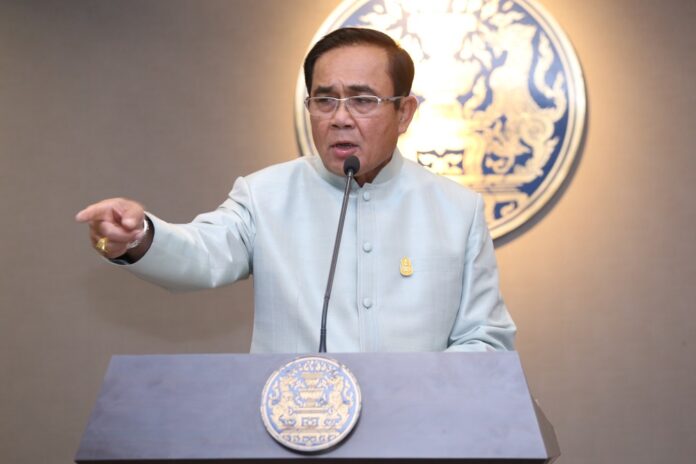
Junta chairman Prayuth Chan-ocha speaks to reporters Jan. 22, 2019.

BANGKOK — The government on Thursday rejected calls for junta chairman Prayuth Chan-ocha to step down in the weeks leading up to the election.

Instead of serving as a caretaker prime minister with limited power – as has been the case when governments call general elections – Gen. Prayuth will continue to wield his authority as the sovereign leader until voters go to the polls March 24.

“This government will not be in a caretaker status but will continue to perform its duties until a new cabinet is place,” deputy prime minister Wissanu Krea-ngam told reporters. “This government will continue to have full power.”

Read: Prayuth’s Ex-Deputy Says Junta Leader Shouldn’t Be PM Again

Unlike a pre-election caretaker government, Prayuth can sign government projects, transfer officials, greenlight emergency funds and propose legislation to the interim legislature.

Most of all, Section 44 of the 2014 charter – which granted Prayuth absolute authority to enact any law he deems fit – will remain in place.

In the past, elected prime ministers were required to assume caretaker status because their parliamentary term was considered expired. Leaders that have come to power through coups have been exempt from such limitations, since there was no formal parliament in the first place.

Like Prayuth, Gen. Surayud Chulanont, who was made prime minister by the coup-makers of 2006, remained in full control of the government until the polls opened in December 2007.

Thai Raksa Chart Party politician Chaturon Chaisang was among critics urging Prayuth to relinquish power. Speaking to reporters today, Chaturon said Prayuth’s government may interfere with the upcoming election if it retains full authority.

“This government came to power under special circumstances,” Chaturon said. “Please don’t stay and work under special circumstances. It would be taking an advantage over other political parties.”

He also slammed the four cabinet members under Prayuth who continue to hold office even as they serve as leaders of a pro-junta party called Palang Pracharat.

Advertisement

Election Commission Lays Down Timeline for 2019 Poll

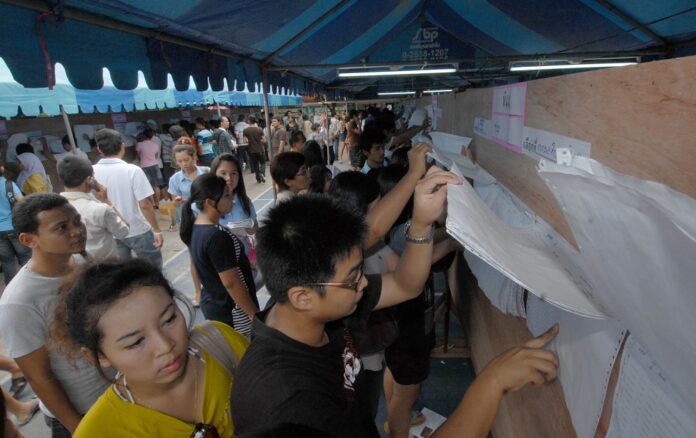
Voters check their registrations in June 2011.

BANGKOK — Thailand is set to vote March 24 on its future government, but the results may not be finalized until early May, according to a timeline laid down by the organizers of the election.

The Election Commission has until May 9 to verify the results and settle any misconduct complaints filed against party candidates. Only after the results are verified can the new government be formed and premier appointed.

By comparison, when Thailand voted in July 2011, the Election Commission had only several weeks to endorse the results. The parliament chose Yingluck Shinawatra as prime minister on Aug. 5 – less than a month after Election Day.

The timeframe for the 2019 election announced by the commission goes as follows:

Jan. 23
Election date was formally set

Jan. 28 – Feb. 19
Registration for advance and overseas voting opens

Feb. 4 – 8
Registration for MP candidates opens; each contending party submits
names of its prime minister candidates

Feb. 15
MP candidates announced

March 1 – 16
Overseas voting

March 17
Advance voting

March 24
General Election Day

May 9
Deadline for endorsement of the results

Advertisement

Korean Accused of Dismembering Compatriot in Rayong

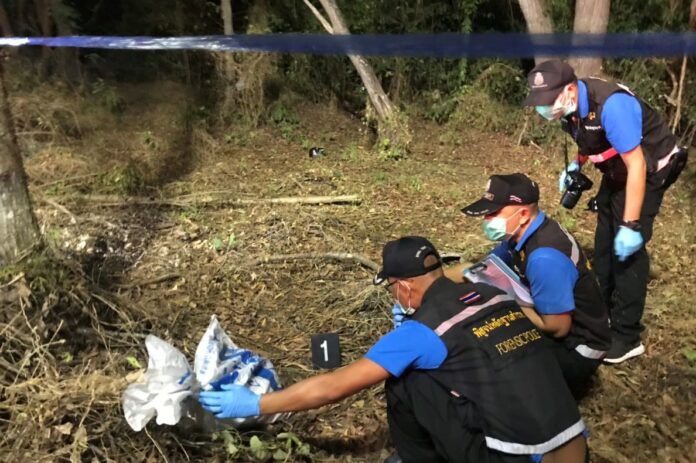
Police investigate a crime scene Monday where a dismembered body, later identified as a South Korean man, was found in Rayong province.

RAYONG — A South Korean man was arrested early Thursday on suspicion of allegedly murdering and dismembering a compatriot in Rayong province earlier this week.

The Crime Suppression Division said the man, identified as Gim Hyeonjun, turned himself in to the South Korean Embassy, which brought him to the Thai authorities at about 1am this morning. Police said he confessed to be an accessory in the killing of Choi Myunghoon, whose remains were found Monday stuffed in bags hidden in a forested part of Rayong City.

According to police, Gim said he and the victim were involved in an online gambling ring, and that he was forced by threats of violence to help dismember Choi and dispose of his body by other two gang members who killed him and are now on the run.

Choi’s identity wasn’t confirmed until last night as his body had been cut into several pieces. His head and arm remain unaccounted for. He was identified by a distinctive tattoo on his torso and a suitcase abandoned near the scene.

Choi had been blacklisted by Thai authorities as he was charged with gambling-related offenses in Bangkok in 2015. Gim was found to be residing illegally in Thailand.

Police said they’re looking for the other two suspects identified by Gim.

Correction: A previous version of this article mistakenly said Gim had confessed to killing Choi. In fact, he confessed to being an accessory of the murder.

Advertisement

Thai Law: Foreigners and the Medical Marijuana Law, Explained

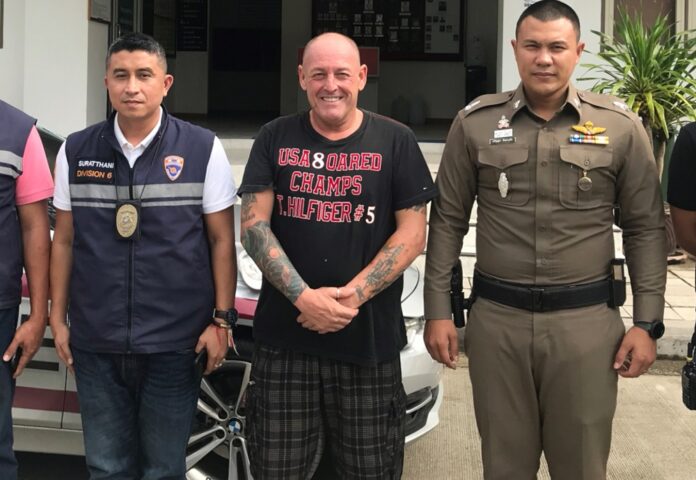
Gary Coughlan stands between two police officers Jan. 16 on Koh Samui after police accused him of cooking tom yum goong with cannabis.

wirot.3Marijuana was legalized in Thailand in the closing days of 2018 when the National Legislative Assembly passed the Narcotics Bill in its third and final reading. Now it awaits publication in the Royal Gazette to become law, which should happen by March 25.

The upcoming general election, which had been expected in the new year’s first quarter, might have been a factor in the decisive enactment of the law, especially considering who it benefits most. People in rural areas constitute the largest pool of voters eligible to form licensed agricultural groups to cultivate hundreds of acres of the new economic crop. Some of these folks will also be able to earn extra income by obtaining licenses to prescribe medical marijuana as Thai traditional medicine practitioners and village healers.

Marijuana For Most – But Not All

People with illnesses requiring marijuana treatment will be allowed by the new law to consume the now-lawful drug provided they can produce a prescription issued by a properly licensed medical practitioners specifying the limited amount they can carry on their person, subject to medical formulations permitted by the Public Health Ministry.

Government research institutes, medical schools, pharmacy schools, pharmaceutical laboratories, public and private universities, hospitals and clinics will all directly benefit in the name of science and medicine, after they are licensed by the Food and Drug Administration.

Foreigners have been expressly excluded from the new law. Foreign companies and foreign-majority companies incorporated in Thailand are prohibited from producing, selling, importing, exporting and possessing cannabis. The restrictions on foreign involvement understandably resulted from a recent “Thailand First” sentiment that resulted from an outcry against foreign applicants with advanced technology and capability applying for Thai patent protection prior to the opening of the domestic market.

Foreigners Not Fully Shut Out

Acknowledging that cooperation with foreign advancements in research and development could add value to the Thai market, the ban on foreigners benefiting from the new law is not absolute and exceptions do exist.

First, easy exceptions are built in for weed medical tourism, that is to say international travelers coming in and out of Thailand with illnesses that can be treated by marijuana. Visitors coming for ganja therapy must first obtain a license from the FDA to “import, export and possess” the necessary amounts of marijuana prescribed for treatment. There’s not much clarity on what that means, yet.

To boost Thailand as one of the world’s major tourism destinations, international airlines, ships, cruise ships or other cross-border vehicles can likewise apply for an FDA license for those amounts of marijuana they need to transport on their craft for first aid and emergency treatment of passengers.

Companies established under Thai law that have a local office qualify for licenses to “produce, sell, import, export and possess” marijuana, if Thai nationals own at least two-thirds of the capital and if at least two-thirds of their directors are Thai. The lawmakers were hoping that one-third foreign ownership in a Thai company could result in the transfer of some technology and know-how for developing marijuana-based pharmaceutical products for local distribution and export.

FDA Leads the Way

The Narcotics Bill differs greatly from the Narcotics Act of 1979 that it amends in that it shifts the licensing authority from the Public Health Ministry to the FDA. This is a significant change from the rare policy approvals for drug use from the minister – which happened on a difficult, case-by-case basis – to mass licensing by the FDA, which means an easier routine basis that treats the substance no different from other types of lawful drugs that require licensing to go to market.

The FDA is bracing for what’s expected to be an overflowing new workload.

Without FDA licensing, marijuana remains an illicit drug, with possession of 10 kilograms or more deemed intent to sell, a crime punishable by up to 15 years in prison and a fine of 1.5 million baht (USD$45,000).

Clearly, only medical and pharmaceutical marijuana area allowed, and the public is not free to consume marijuana for pleasure.  Consumption of marijuana in violation of the new Narcotics Bill carries a jail term of one year and a fine of 20,000 baht (USD$600).

The Narcotics Control Board will continues to play a pivotal, supervisory role over the FDA under the bill, just as it did over the ministry under the original act. One major exception is that for marijuana legalization, the board’s membership has expanded from law enforcement-heavy authorities such as police, prosecutors and military rep by adding over half a dozen new members drawn from the medical, industrial, agricultural, pharmaceutical and Thai traditional medicine sectors — a priming of the pipe, if you will, for long-term, large-scale industrial pharmaceutical production of medical marijuana formulas for medical use to potentially involve investors and banks.

Not the Only Law

Under the bill, seven types of applicants can apply for FDA licenses to produce, sell, import, export and possess marijuana. After five years, the narcotics board will review the types of applicants and their licensing requirements on top of semi-annual assessments of the law’s implementation.

Producing includes cultivating, growing, making, processing scientifically, altering and packaging.

As the focus of the new law is on helping the grassroots – meaning low-income, rural folks – as well as the public at large become marijuana-income earners and users, there are a number of laws applicable: the Narcotics Bill, the Narcotics Act, the Act on Professional Thai Traditional Medicine of 2013, the Act on Promotion of Community Enterprises of 2005; the Sanatorium Act of 1998, as well as other laws and regulations.

Operators of marijuana businesses need to obtain their authorizations consistent with these separate pieces of legislation as well to enable them to finally handle marijuana under the Narcotics Bill.

Wirot Poonsuwan is senior counsel and head of special projects at Blumenthal Richter & Sumet in Bangkok and can be reached at [email protected].

Advertisement

Hot News

LATEST NEWS

Bangkok
overcast clouds
36.1 ° C
36.6 °
35 °
61 %
3.6kmh
100 %
Sat
37 °
Sun
36 °
Mon
35 °
Tue
33 °
Wed
32 °