JOHANNESBURG — One by one, five to a grave, the coffins are buried in the red earth of this ill-kept corner of a South African cemetery. The scrawl on the cheap wood attests to their anonymity: “Unknown B/Male.”
These men were migrants from elsewhere in Africa with next to nothing who sought a living in the thriving underground economy of Gauteng province, a name that roughly translates to “land of gold.” Instead of fortune, many found death, their bodies unnamed and unclaimed more than 4,300 in Gauteng between 2014 and 2017 alone.
Some of those lives ended here at the Olifantsvlei cemetery, in silence, among tufts of grass growing over tiny placards that read: Pauper Block. There are coffins so tiny that they could belong only to children.
As migration worldwide soars to record highs, far less visible has been its toll: The tens of thousands of people who die or simply disappear during their journeys, never to be seen again. In most cases, nobody is keeping track: Barely counted in life, these people don’t register in death , as if they never lived at all.
An Associated Press tally has documented at least 56,800 migrants dead or missing worldwide since 2014 – almost double the number found in the world’s only official attempt to try to count them, by the U.N.’s International Organization for Migration. The IOM toll as of Oct. 1 was more than 28,500. The AP came up with almost 28,300 additional dead or missing migrants by compiling information from other international groups, requesting forensic records, missing persons reports and death records, and sifting through data from thousands of interviews with migrants.
The toll is the result of migration that is up 49 percent since the turn of the century, with more than 258 million international migrants in 2017, according to the United Nations. A growing number have drowned, died in deserts or fallen prey to traffickers, leaving their families to wonder what on earth happened to them. At the same time, anonymous bodies are filling cemeteries around the world, like the one in Gauteng.
The AP’s tally is still low. More bodies of migrants lie undiscovered in desert sands or at the bottom of the sea. And families don’t always report loved ones as missing because they migrated illegally, or because they left home without saying exactly where they were headed.
The official U.N. toll focuses mostly on Europe, but even there cases fall through the cracks. The political tide is turning against migrants in Europe just as in the United States, where the government is cracking down heavily on caravans of Central Americans trying to get in . One result is that money is drying up for projects to track migration and its costs.
For example, when more than 800 people died in an April 2015 shipwreck off the coast of Italy, Europe’s deadliest migrant sea disaster, Italian investigators pledged to identify them and find their families. More than three years later, under a new populist government, funding for this work is being cut off.
Beyond Europe, information is even more scarce. Little is known about the toll in South America, where the Venezuelan migration is among the world’s biggest today, and in Asia, the top region for numbers of migrants.
The result is that governments vastly underestimate the toll of migration, a major political and social issue in most of the world today.
“No matter where you stand on the whole migration management debate….these are still human beings on the move,” said Bram Frouws, the head of the Mixed Migration Centre , based in Geneva, which has done surveys of more than 20,000 migrants in its 4Mi project since 2014. “Whether it’s refugees or people moving for jobs, they are human beings.”
They leave behind families caught between hope and mourning, like that of Safi al-Bahri. Her son, Majdi Barhoumi, left their hometown of Ras Jebel, Tunisia, on May 7, 2011, headed for Europe in a small boat with a dozen other migrants. The boat sank and Barhoumi hasn’t been heard from since. In a sign of faith that he is still alive, his parents built an animal pen with a brood of hens, a few cows and a dog to stand watch until he returns.
“I just wait for him. I always imagine him behind me, at home, in the market, everywhere,” said al-Bahari. “When I hear a voice at night, I think he’s come back. When I hear the sound of a motorcycle, I think my son is back.”
Europe: Boats That Never Arrive
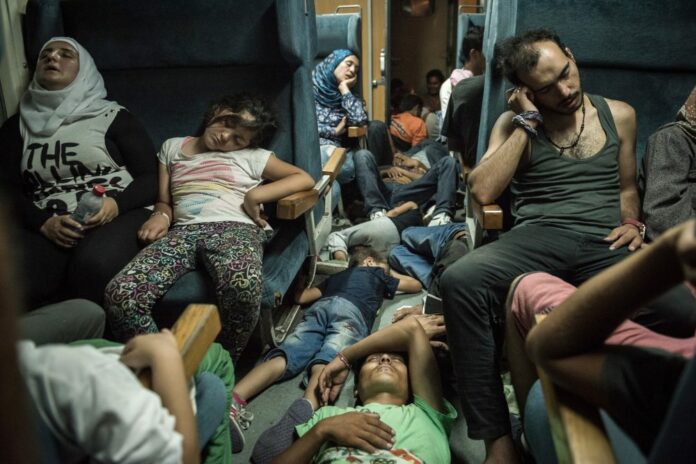
Of the world’s migration crises, Europe’s has been the most cruelly visible. Images of the lifeless body of a Kurdish toddler on a beach, frozen tent camps in Eastern Europe, and a nearly numbing succession of deadly shipwrecks have been transmitted around the world, adding to the furor over migration.
In the Mediterranean, scores of tankers, cargo boats, cruise ships and military vessels tower over tiny, crowded rafts powered by an outboard motor for a one-way trip. Even larger boats carrying hundreds of migrants may go down when soft breezes turn into battering winds and thrashing waves further from shore.
Two shipwrecks and the deaths of at least 368 people off the coast of Italy in October 2013 prompted the IOM’s research into migrant deaths. The organization has focused on deaths in the Mediterranean, although its researchers plead for more data from elsewhere in the world. This year alone, the IOM has found more than 1,700 deaths in the waters that divide Africa and Europe.
Like the lost Tunisians of Ras Jebel, most of them set off to look for work. Barhoumi, his friends, cousins and other would-be migrants camped in the seaside brush the night before their departure, listening to the crash of the waves that ultimately would sink their raft.
Khalid Arfaoui had planned to be among them. When the group knocked at his door, it wasn’t fear that held him back, but a lack of cash. Everyone needed to chip in to pay for the boat, gas and supplies, and he was short about USD$100. So he sat inside and watched as they left for the beachside campsite where even today locals spend the night before embarking to Europe.
Propelled by a feeble outboard motor and overburdened with its passengers, the rubber raft flipped, possibly after grazing rocks below the surface on an uninhabited island just offshore. Two bodies were retrieved. The lone survivor was found clinging to debris eight hours later.
The Tunisian government has never tallied its missing, and the group never made it close enough to Europe to catch the attention of authorities there. So these migrants never have been counted among the dead and missing.
“If I had gone with them, I’d be lost like the others,” Arfaoui said recently, standing on the rocky shoreline with a group of friends, all of whom vaguely planned to leave for Europe. “If I get the chance, I’ll do it. Even if I fear the sea and I know I might die, I’ll do it.”
With him that day was 30-year-old Mounir Aguida, who had already made the trip once, drifting for 19 hours after the boat engine cut out. In late August this year, he crammed into another raft with seven friends, feeling the waves slam the flimsy bow. At the last minute he and another young man jumped out.
“It didn’t feel right,” Aguida said.
There has been no word from the other six – yet another group of Ras Jebel’s youth lost to the sea. With no shipwreck reported, no survivors to rescue and no bodies to identify, the six young men are not counted in any toll.
In addition to watching its own youth flee, Tunisia and to a lesser degree neighboring Algeria are transit points for other Africans north bound for Europe. Tunisia has its own cemetery for unidentified migrants, as do Greece, Italy and Turkey. The one at Tunisia’s southern coast is tended by an unemployed sailor named Chamseddin Marzouk.
Of around 400 bodies interred in the coastal graveyard since it opened in 2005, only one has ever been identified. As for the others who lie beneath piles of dirt, Marzouk couldn’t imagine how their families would ever learn their fate.
“Their families may think that the person is still alive, or that he’ll return one day to visit,” Marzouk said. “They don’t know that those they await are buried here, in Zarzis, Tunisia.”
Africa: Vanishing Without A Trace
Despite talk of the ‘waves’ of African migrants trying to cross the Mediterranean, as many migrate within Africa – 16 million – as leave for Europe. In all, since 2014, at least 18,400 African migrants have died traveling within Africa, according to the figures compiled from AP and IOM records. That includes more than 4,300 unidentified bodies in a single South African province, and 8,700 whose traveling companions reported their disappearance en route out of the Horn of Africa in interviews with 4Mi.
When people vanish while migrating in Africa, it is often without a trace. The IOM says the Sahara Desert may well have killed more migrants than the Mediterranean. But no one will ever know for sure in a region where borders are little more than lines drawn on maps and no government is searching an expanse as large as the continental United States. The harsh sun and swirling desert sands quickly decompose and bury bodies of migrants, so that even when they turn up, they are usually impossible to identify .
With a prosperous economy and stable government, South Africa draws more migrants than any other country in Africa. The government is a meticulous collector of fingerprints – nearly every legal resident and citizen has a file somewhere – so bodies without any records are assumed to have been living and working in the country illegally. The corpses are fingerprinted when possible, but there is no regular DNA collection.
South Africa also has one of the world’s highest rates of violent crime and police are more focused on solving domestic cases than identifying migrants.
“There’s logic to that, as sad as it is….You want to find the killer if you’re a policeman, because the killer could kill more people,” said Jeanine Vellema, the chief specialist of the province’s eight mortuaries. Migrant identification, meanwhile, is largely an issue for foreign families – and poor ones at that.
Vellema has tried to patch into the police missing persons system, to build a system of electronic mortuary records and to establish a protocol where a DNA sample is taken from every set of remains that arrive at the morgue. She sighs: “Resources.” It’s a word that comes up 10 times in a half-hour conversation.
So the bodies end up at Olifantsvlei or a cemetery like it, in unnamed graves. On a recent visit by AP, a series of open rectangles awaited the bodies of the unidentified and unclaimed. They did not wait long: a pickup truck drove up, piled with about 10 coffins, five per grave. There were at least 180 grave markers for the anonymous dead, with multiple bodies in each grave.
The International Committee of the Red Cross, which is working with Vellema, has started a pilot project with one Gauteng morgue to take detailed photos, fingerprints, dental information and DNA samples of unidentified bodies. That information goes to a database where, in theory, the bodies can be traced.
“Every person has a right to their dignity. And to their identity,” said Stephen Fonseca, the ICRC regional forensic manager.
The United States: ‘That’s How My Brother Used to Sleep’
More than 6,000 miles (9,000 kilometers) away, in the deserts that straddle the U.S.-Mexico border, lie the bodies of migrants who perished trying to cross land as unforgiving as the waters of the Mediterranean. Many fled the violence and poverty of Guatemala, Honduras, El Salvador or Mexico. Some are found months or years later as mere skeletons. Others make a last, desperate phone call and are never heard from again.
In 2010 the Argentine Forensic Anthropology Team and the local morgue in Pima County, Ariz., began to organize efforts to put names to the anonymous bodies found on both sides of the border. The “Border Project” has since identified more than 183 people – a fraction of the total.
At least 3,861 migrants are dead and missing on the route from Mexico to the United States since 2014, according to the combined AP and IOM total. The tally includes missing person reports from the Colibri Center for Human Rights on the U.S. side as well as the Argentine group’s data from the Mexican side. The painstaking work of identification can take years, hampered by a lack of resources, official records and coordination between countries – and even between states.
For many families of the missing, it is their only hope, but for the families of Juan Lorenzo Luna and Armando Reyes, that hope is fading.
Luna, 27, and Reyes, 22, were brothers-in-law who left their small northern Mexico town of Gomez Palacio in August 2016. They had tried to cross to the U.S. four months earlier, but surrendered to border patrol agents in exhaustion and were deported.
They knew they were risking their lives – Reyes’ father died migrating in 1995, and an uncle went missing in 2004. But Luna, a quiet family man, wanted to make enough money to buy a pickup truck and then return to his wife and two children. Reyes wanted a job where he wouldn’t get his shoes dirty and could give his newborn daughter a better life.
Of the five who left Gomez Palacio together, two men made it to safety, and one man turned back. The only information he gave was that the brothers-in-law had stopped walking and planned to turn themselves in again. That is the last that is known of them.
Officials told their families that they had scoured prisons and detention centers, but there was no sign of the missing men. Cesaria Orona even consulted a fortune teller about her missing son, Armando, and was told he had died in the desert.
One weekend in June 2017, volunteers found eight bodies next to a military area of the Arizona desert and posted the images online in the hopes of finding family. Maria Elena Luna came across a Facebook photo of a decaying body found in an arid landscape dotted with cactus and shrubs, lying face-up with one leg bent outward. There was something horribly familiar about the pose.
“That’s how my brother used to sleep,” she whispered.
Along with the bodies, the volunteers found a credential of a boy from Guatemala, a photo and a piece of paper with a number written on it. The photo was of Juan Lorenzo Luna, and the number on the paper was for cousins of the family. But investigators warned that a wallet or credential could have been stolen, as migrants are frequently robbed.
“We all cried,” Luna recalled. “But I said, we cannot be sure until we have the DNA test. Let’s wait.”
Luna and Orona gave DNA samples to the Mexican government and the Argentine group. In November 2017, Orona received a letter from the Mexican government saying that there was the possibility of a match for Armando with some bone remains found in Nuevo Leon, a state that borders Texas. But the test was negative.
The women are still waiting for results from the Argentine pathologists. Until then, their relatives remain among the uncounted.
Orona holds out hope that the men may be locked up, or held by “bad people.” Every time Luna hears about clandestine graves or unidentified bodies in the news, the anguish is sharp.
“Suddenly all the memories come back,” she said. “I do not want to think.”
South America: ‘No One Wants To Admit This Is a Reality’
The toll of the dead and the missing has been all but ignored in one of the largest population movements in the world today – that of nearly 2 million Venezuelans fleeing from their country’s collapse. These migrants have hopped buses across the borders, boarded flimsy boats in the Caribbean, and – when all else failed – walked for days along scorching highways and freezing mountain trails. Vulnerable to violence from drug cartels, hunger and illness that lingers even after reaching their destination, they have disappeared or died by the hundreds.
“They can’t withstand a trip that hard, because the journey is very long,” said Carlos Valdes, director of neighboring Colombia’s national forensic institute. “And many times, they only eat once a day. They don’t eat. And they die.” Valdes said authorities don’t always recover the bodies of those who die, as some migrants who have entered the country illegally are afraid to seek help.
Valdes believes hypothermia has killed some as they trek through the mountain tundra region, but he had no idea how many. One migrant told the AP he saw a family burying someone wrapped in a white blanket with red flowers along the frigid journey.
Marta Duque, 55, has had a front seat to the Venezuela migration crisis from her home in Pamplona, Colombia. She opens her doors nightly to provide shelter for families with young children. Pamplona is one of the last cities migrants reach before venturing up a frigid mountain paramo, one of the most dangerous parts of the trip for migrants traveling by foot. Temperatures dip well below freezing.
She said inaction from authorities has forced citizens like her to step in.
“Everyone just seems to pass the ball,” she said. “No one wants to admit this is a reality.”
Those deaths are uncounted, as are dozens in the sea. Also uncounted are those reported missing in Colombia, Peru and Ecuador. In all at least 3,410 Venezuelans have been reported missing or dead in a migration within Latin America whose dangers have gone relatively unnoticed; many of the dead perished from illnesses on the rise in Venezuela that easily would have found treatment in better times.
Among the missing is Randy Javier Gutierrez, who was walking through Colombia with a cousin and his aunt in hopes of reaching Peru to reunite with his mother.
Gutierrez’s mother, Mariela Gamboa, said that a driver offered a ride to the two women, but refused to take her son. The women agreed to wait for him at the bus station in Cali, about 160 miles (257 kilometers) ahead, but he never arrived. Messages sent to his phone since that day four months ago have gone unread.
“I’m very worried,” his mother said. “I don’t even know what to do.”
Asia: A Vast Unknown
The region with the largest overall migration, Asia, also has the least information on the fate of those who disappear after leaving their homelands. Governments are unwilling or unable to account for citizens who leave for elsewhere in the region or in the Mideast, two of the most common destinations, although there’s a growing push to do so.
Asians make up 40 percent of the world’s migrants, and more than half of them never leave the region. The Associated Press was able to document more than 8,200 migrants who disappeared or died after leaving home in Asia and the Mideast, including thousands in the Philippines and Indonesia.
Thirteen of the top 20 migration pathways from Asia take place within the region. These include Indian workers heading to the United Arab Emirates, Bangladeshis heading to India, Rohingya Muslims escaping persecution in Myanmar, and Afghans crossing the nearest border to escape war. But with large-scale smuggling and trafficking of labor, and violent displacements, the low numbers of dead and missing indicate not safe travel but rather a vast unknown.
Almass was just 14 when his widowed mother reluctantly sent him and his 11-year-old brother from their home in Khost, Afghanistan, into that unknown. The payment for their trip was supposed to get them away from the Taliban and all the way to Germany via a chain of smugglers. The pair crammed first into a pickup with around 40 people, walked for a few days at the border, crammed into a car, waited a bit in Tehran, and walked a few more days.
His brother Murtaza was exhausted by the time they reached the Iran-Turkey border. But the smuggler said it wasn’t the time to rest – there were at least two border posts nearby and the risk that children far younger travelling with them would make noise.
Almass was carrying a baby in his arms and holding his brother’s hand when they heard the shout of Iranian guards. Bullets whistled past as he tumbled head over heels into a ravine and lost consciousness.
Alone all that day and the next, Almass stumbled upon three other boys in the ravine who had also become separated from the group, then another four. No one had seen his brother. And although the younger boy had his ID, it had been up to Almass to memorize the crucial contact information for the smuggler.
When Almass eventually called home, from Turkey, he couldn’t bear to tell his mother what had happened. He said Murtaza couldn’t come to the phone but sent his love.
That was in early 2014. Almass, who is now 18, hasn’t spoken to his family since.
Almass said he searched for his brother among the 2,773 children reported to the Red Cross as missing en route to Europe. He also looked for himself among the 2,097 adults reported missing by children. They weren’t on the list.
With one of the world’s longest-running exoduses, Afghans face particular dangers in bordering countries that are neither safe nor welcoming. Over a period of 10 months from June 2017 to April 2018, 4Mi carried out a total of 962 interviews with Afghan migrants and refugees in their native languages around the world, systematically asking a series of questions about the specific dangers they had faced and what they had witnessed.
A total of 247 migrant deaths were witnessed by the interviewed migrants, who reported seeing people killed in violence from security forces or starving to death. The effort is the first time any organization has successfully captured the perils facing Afghans in transit to destinations in Asia and Europe.
Almass made it from Asia to Europe and speaks halting French now to the woman who has given him a home in a drafty 400-year-old farmhouse in France’s Limousin region. But his family is lost to him. Their phone number in Afghanistan no longer works, their village is overrun with Taliban, and he has no idea how to find them – or the child whose hand slipped from his grasp four years ago.
“I don’t know now where they are,” he said, his face anguished, as he sat on a sun-dappled bench. “They also don’t know where I am.”
Story: Lori Hinnant, Bram Janssen

































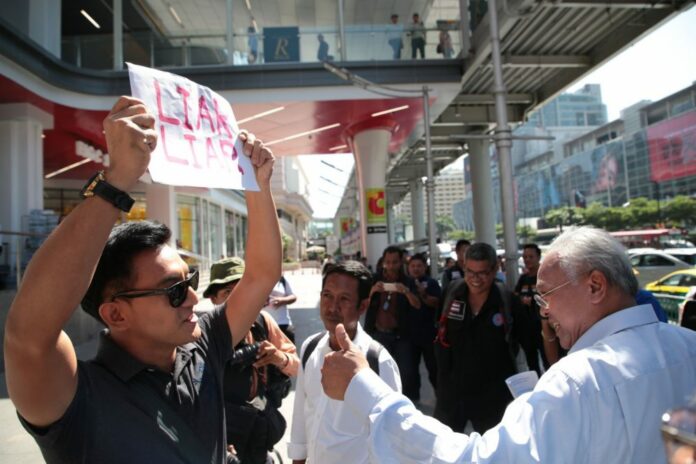
 It was almost sad to watch the once popular Suthep Thaugsuban marching this past week in Bangkok to recruit new party members.