































27.7 C
Bangkok
Thursday, June 25, 2026
Home Blog Page 1813

Cambodian Refugee Who Killed as 14-Year-Old Seeks Pardon

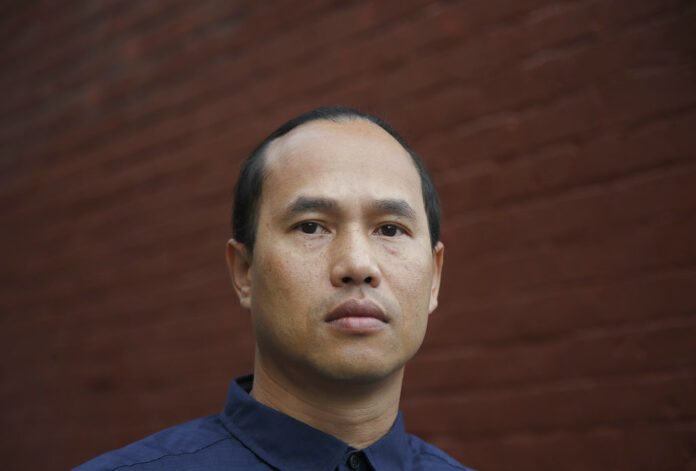
Borey Ai poses for a photo Tuesday outside of the Asian Americans Advancing Justice-Asian Law Caucus in San Francisco, California. Photo: Jeff Chiu / Associated Press

SACRAMENTO, California — By his own account, Borey Ai was a 14-year-old gangster when he killed a woman during a robbery that netted about $300.

He spent 19 years in prison before parole officials decided he had turned his life around. He walked out of San Quentin prison in November 2016 and into the custody of waiting federal immigration agents.

Ai is now 37 and asking California Gov. Jerry Brown to wipe away his criminal conviction and likely prevent his deportation to Cambodia, a nation where his mother was born but he has never seen. After prison, he spent 18 months in federal detention but was freed in May after Cambodia refused to accept him – for now.

Parole officials recommended a pardon for Ai last week. Dozens of advocates turned in more than 36,000 signatures Wednesday asking Brown to pardon Ai and others before he leaves office in January.

They held 60 origami cranes and rang a Buddhist bell 60 times, one for each of the 60 people nationwide they said are facing deportation to Cambodia. About half are from California, given its large Cambodian population, and about a dozen have pardon petitions before Brown, with more on the way, said Angela Chan, a spokeswoman for Asian Americans Advancing Justice-Asian Law Caucus.

The prospect frustrates relatives of Ai’s victim, Manijeh Eshaghoff. The governor in the last 10 months has pardoned seven ex-convicts who otherwise faced the threat of deportation to Cambodia, bringing an angry tweet from President Donald Trump in March.

Ai was tried as an adult, pleaded guilty to second-degree murder and was sentenced to 25 years to life in prison after California dropped the minimum age for trying juveniles as adults from 16 to 14 in 1995. California this year reversed course, barring any 14- or 15-year-olds from being tried outside the juvenile system, even for murder.

According to a Human Rights Watch analysis of California data, 87 14-year-olds were prosecuted for murder as adults from 2007 to 2016. Convictions are not broken down by age.

There are parallels between Ai’s journey and that of the woman he killed. Both are from immigrant families who fled oppression from opposite sides of the world only to tragically intersect in a strip mall convenience store in San Jose shortly before midnight on Feb. 4, 1996.

Ai’s mother fled Cambodia’s genocidal Khmer Rouge regime. He was born in a Thai refugee camp and came to the U.S. when he was 4 as a refugee with permanent legal resident status.

His family lived among Stockton’s large Cambodian community, but Ai recalls growing up in a troubled area plagued by drugs, gangs and prostitution. He saw his 7-year-old cousin and four other children fatally shot at Cleveland Elementary School in 1989 in a mass shooting that targeted immigrant children.

At 12, he joined a street gang that “became like my sense of family,” he said in an interview with The Associated Press.

At 14, he was the youngest of four who robbed Eshaghoff’s convenience store and killed her. Ai said he accidentally shot her when she grabbed his gun and he jerked back with his finger on the trigger. She was 52.

Her son David Esh, who uses a shortened version of his family’s name, was 25 when she died.

“She bled out in less than a minute – it was instant how quickly she died. That’s the only solace I’ve had over the years; she didn’t suffer,” he told AP.

His father, Essag, was standing a few feet away and held his wife as she died, soaked in her blood.

“This was premeditated murder, accident or not,” Esh said. “They already had the money, all he had to do was run.”

Like Ai’s mother, Esh’s father had fled for his life from his home country. An Iranian Jew, he had done work for the shah before the Iranian Revolution in 1979.

“My father fled in the trunk of a car through the desert,” Esh said. “They worked hard. They sacrificed.”

Esh wants the governor to deny Ai’s pardon request. A majority of the state Supreme Court will have to agree that Ai may be pardoned before Brown makes his decision.

By all accounts, Ai turned his life around in prison, joining or starting several anti-gang and anti-violence groups and becoming a counselor – work he continues with three nonprofits while on lifetime parole.

His pardon application includes nearly 300 pages documenting accomplishments and good deeds. Twelve state lawmakers who are part of the California Asian & Pacific Islander Legislative Caucus are among those supporting it.

The Trump administration began cracking down on immigrant communities and pressuring reluctant nations like Cambodia to accept the return of their citizens, said one of Ai’s attorneys, Anoop Prasad of the Asian Law Caucus’ Immigrant Rights Program.

A governor’s pardon doesn’t automatically stop deportation proceedings, but it eliminates the convictions on which authorities based their deportation.

“I understand and appreciate that he’s gone through and served his sentence and perhaps is trying to be a positive person in society,” Esh said. Yet, “he gave us all a life sentence, and he’s going to walk free and have a pardon as if this never happened?”

Ai said he understands.

“My crime caused pain and a ripple effect forever. Because of that, I have a moral responsibility to continue to be a citizen of my community, continue to honor that memory,” Ai said.

The governor usually reserves pardons for offenders who completed their sentences long ago. Santa Clara County Deputy District Attorney Aaron West argued that Ai has been free for only months and has no track record of being a benefit to the community.

Every case is assessed on its own merits, said Brown’s press secretary, Evan Westrup, adding that “the voices of victims and their families are profoundly important in every request the governor considers.”

Story: Don Thompson

Advertisement

February Elections Jeopardize Rollout of Thai Medical Weed

A local district chief in Loei province confiscates marijuana found there in September.

BANGKOK — Health officials said Wednesday that the full rollout of medical cannabis is unlikely to happen as scheduled due to a legislative holdup if February elections go forward and a new government comes to power.

Lawmakers have quibbled over details in a broad rewrite of the Narcotics Act that would partially decriminalize a number of drugs including cannabis and kratom. Although companion legislation enabling medical cannabis is close to passage, it would only allow a limited form of it until the revision of the act is in place.

Meanwhile the military government has proposed fast-tracking a stopgap measure that would decriminalize only cannabis for research and medical use.

On Wednesday, a member of the special parliamentary committee provisioning the new law said it is unlikely to pass before elections slated for February, as the latest debate recently ended with no major breakthroughs.

Chulalongkorn University neurologist Thiravat Hemachudha, a legislative committee expert, said Wednesday that holding the election in February would dampen hopes for medical weed.

“The timeline indicates that these pieces of sub-legislation could be completed by April 2019. But if the election is actually held in February, it won’t be done under this government,” he said.

Despite the military government’s interest in overhauling drug policy before a new administration comes to power, junta leader Gen. Prayuth Chan-ocha has ignored calls to invoke his absolute power to speed up the process.

Thiravat said four additional legislative subcommittees will be set up to devise subordinate laws to make the new bill more effective in terms of regulation and rehabilitation.

The military has meanwhile proposed a separate law that would only legalize cannabis for medical and research purposes, details of which Thiravat said yesterday were still being discussed, such as who would be authorized to prescribe the drug and whether private cultivation would be allowed.

As for a way to fast-track the process, Thiravat said the Food and Drug Administration could propose regulatory changes directly to the Health Ministry, which has been authorized by the National Legislative Assembly to work on the new narcotics bill’s subordinate laws, including reclassifying the Class 5 narcotics into Class 2, which would allow limited medical use.

Tares Krassanairawiwong of the FDA however said the Health Ministry could only legalize the medical use of cannabinoid extract, aka CBD, which is used to treat patients but does not contain THC, the psychotropic narcotic compound found in cannabis.

A grey market for CBD already exists in Thailand, commonly for patients undergoing chemotherapy.

Tares added that the department would assume sole authority over the regulation and distribution of medical cannabis once it becomes legal, under guidelines similar to morphine. Use would be limited to treating nausea in cancer patients, epilepsy in children unresponsive to other treatment, multiple sclerosis and severe pain.

Expert committee member Thiravat said legalization should apply to cannabis – not just CBD extracts – to make it available to folk medicine practitioners and people in remote areas.

“The current use of marijuana as medicine can almost be standardized. We can already tell that how much should be used for a particular symptom or disease,” he said. “This practice exists in every region of the country, but people in general don’t know about it because it’s illegal.”

He said he would collect research data on patients, mostly suffering from cancer, epilepsy, or chronic seizures, who use marijuana to relieve pain and report its benefits to the legislative committee, which includes members from the FDA.

“I want them to know that using marijuana as folk medicine can actually save people’s lives,” Thiravat said. “Although it’s a life-saving method and can improve the quality of life, it’s still illegal.”

Correction: A previous version of this article indicated medical use of opium would also be allowed as it was also a Category 5 drug. In fact it is Category 2 and such uses are already allowed.

Related stories:

Lawmakers Eye Article 44 to Speed Cannabis Law

Medical Thai Weed Gets a Launch Date

Cabinet Green-Lights Medical Weed and Kratom

Advertisement

Police Say Canuck Scammed Thai Students With Bogus US Jobs

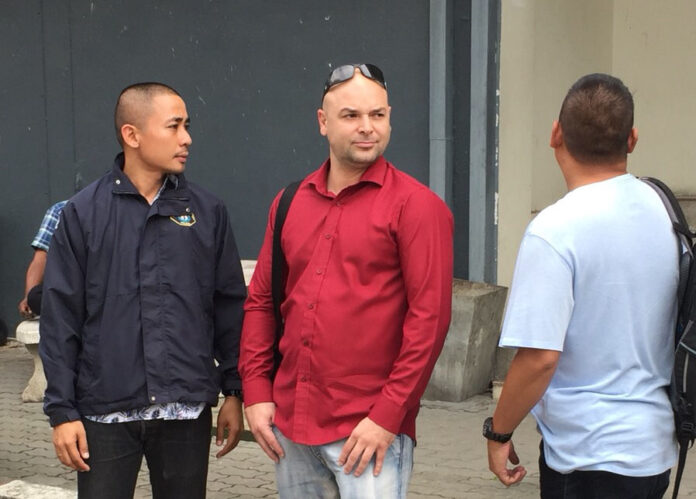
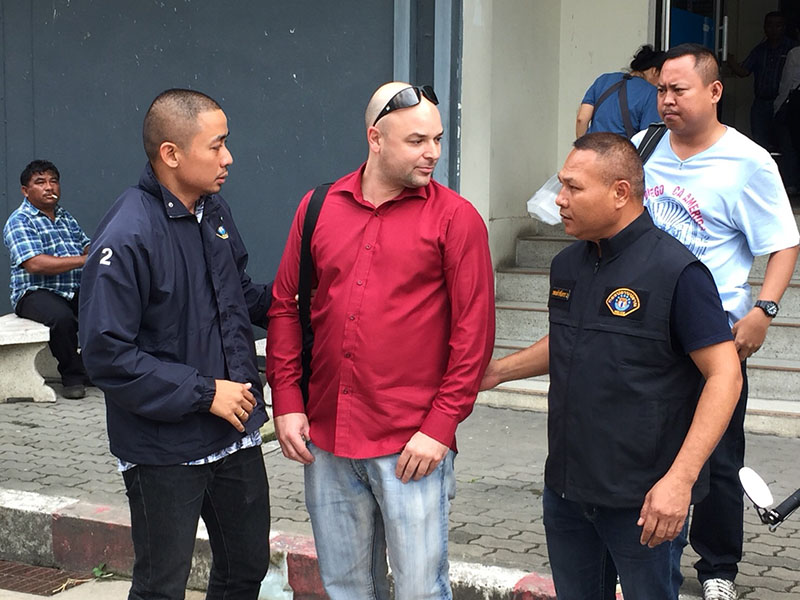
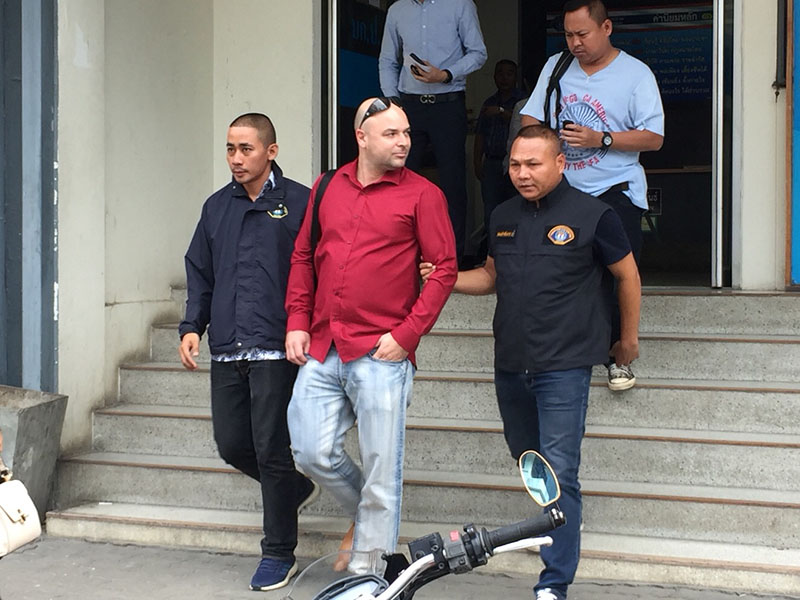
Police arrest Michael Roberge on Thursday morning in Bangkok.

BANGKOK — Police on Thursday morning arrested a Canadian national who allegedly scammed university students by promising them jobs in the United States.

Police Col. Arun Wachirasisukanya arrested Michael Roberge, 37, on the 18th floor of the Amarin Plaza building in Bangkok’s Pathum Wan area. He was charged with scamming dozens of university students for 150,000 baht each after promising them paid internships in the states. Authorities on Thursday were looking for additional possible victims.

“Two people who got scammed came to the police, but there should be more because he opened an entire company to do this. I think some people filed criminal cases, some didn’t,” Arun said by phone. “So we are spreading the word about him first, to see if any more victims come forward.”

Arun said Roberge told university students he could secure them paid internships at the Pittsburgh Marriott City Center hotel in Pennsylvania. Roberge allegedly promised them hourly wages of USD$15 (460 baht), in exchange for 150,000 baht to cover visa, documentation and travel expenses.

Arun also said Roberge advertised life in the Sunshine State to wide-eyed college students. He allegedly scammed the same 150,000 baht from people who believed he would secure them a job at a Thai restaurant in Miami for an hourly salary of USD$8, or 260 baht.

In both cases, students said they couldn’t contact Roberge after transferring the money. Police said he opened a company called Work West in Chiang Mai city to recruit students. The Canadian said he owns Work West, but blamed the scam on a Thai employee.

Roberge’s arrest warrant was issued by a Chiang Mai court in July 2017. He was arrested on charges of illegally running an overseas employment business – punishable by 10 years in prison and a 200,000 baht fine – and benefiting from overseas employment fraud, which carries the same penalties.

Police investigator Visanut Bangnamkhen said he believes there could be dozens of victims.

“Actually, this company processed thousands of students. Some did go overseas and some didn’t. Michael is still denying that he scammed anyone and says the Thai employees did it all, but there’s no police summons for them yet,” Capt. Visanut said, referring to Roberge.

Visanut said the alleged crimes occurred in 2013.

Image from iOS 6 Image from iOS 7

Correction: A previous version of this story said the warrant for Michael Roberge was issued in July. In fact, it was issued in July 2017.

Advertisement

Storm, Flood, Fire Warnings as Cold Season Begins Saturday

Doi Inthanon, Chiang Mai.

BANGKOK — Thais might need sweaters while Europeans will continue wearing shorts come Saturday, which has been deemed the official start of this year’s cold season.

The roughly four-month season will see its coolest weather mid-December and January, according to the national weather agency, with the chilliest temperatures felt the soonest in the north and northeast.

Provinces including Chiang Rai, Tak, Phayao, Nan, Loei, Sakon Nakhon and Nakhon Phanom could see temperatures fall below 8C.

The capital and central region will see a less drastic cooling, with average lows of about 20. Meteorologists said Bangkok should expect weather similar to that of last year.

The south won’t catch much of the cool wave due to ongoing monsoon season conditions. Provinces on the gulf will experience torrential rains and be at risk for flash flooding. Residents on the Andaman side will see colder, drier air with strong winds creating a potential wildfire hazard.

Advertisement

Malaysian Ex-PM, Former Treasury Chief Charged With Graft

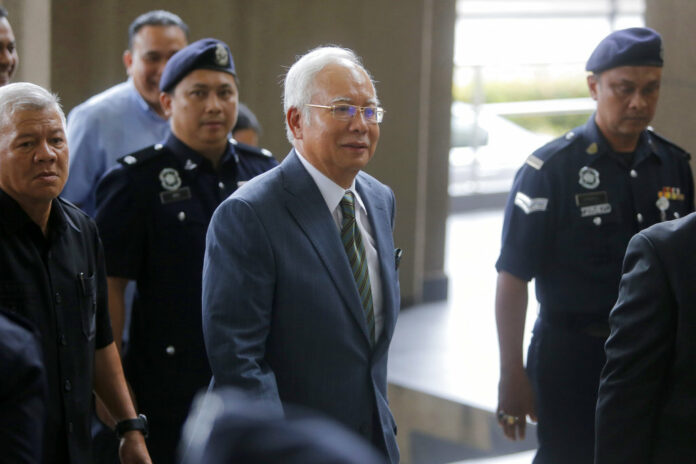
Former Malaysian Prime Minister Najib Razak, center, arrives at High Court of Malaya in Kuala Lumpur, Malaysia, Wednesday, Aug. 8, 2018. Photo: Yam G-Jun/ Associated Press

KUALA LUMPUR — Former Malaysian Prime Minister Najib Razak and his ex-treasury chief have been jointly charged with criminal breach of trust involving 6.64 billion ringgit (USD$1.6 billion).

The six new charges against Najib on Thursday come on top of 32 earlier counts of corruption, breach of trust and money laundering that he face linked to the multibillion-dollar looting of the 1MDB state investment fund. That scandal led to his coalition’s shocking ouster in May’s national polls.

Both Najib and former treasury secretary-general Mohamad Irwan Serigar Abdullah pleaded not guilty to misappropriating government funds between December 2016 and December 2017. The charge sheets said part of the money was subsidy for the poor and airport management budget but gave no further details. Local media reported the funds were used to pay 1MDB debts.

Advertisement

Share Sell-Off Moderates in Asia After Rout on Wall Street

The American flag flies in 2015 above the Wall Street entrance to the New York Stock Exchange. Photo: Richard Drew / Associated Press

BANGKOK — Shares fell moderately in Asia on Thursday after another torrent of selling on Wall Street sent the Dow Jones Industrial Average plummeting more than 600 points, erasing its gains for the year.

Thailand’s SET was trading at 1,602.11, a 1.3 percent drop. Japan’s Nikkei 225 index sank sharply on the open but leveled off, regaining some lost ground. By mid-morning it was down 2.9 percent at 21,443.72. The Shanghai Composite index slipped 1.6 percent to 2,561.36 and Hong Kong’s Hang Seng index skidded 1.8 percent to 24,785.68.

Charts for the entire region were awash with the red that indicates losses, but the declines were mostly in the 2 percent to 3 percent range.

“Coming online with the overtly risk-off backdrop from U.S. markets, investors in the Asian region would be taking the cue to head for the doors,” Jingyi Pan of IG said in a commentary.

In Hong Kong, airline Cathay Pacific’s shares dropped 6.5 percent after it said it had discovered a data breach affecting 9.4 million passengers.

In New York trading overnight, the Nasdaq composite with its hefty roster of tech stocks bore the brunt of the sell-off, falling more than 10 percent below its August peak, what Wall Street calls a “correction.” It slid 4.4 percent to 7,108.40, its biggest drop since August 2011 but is still up 3 percent for the year.

The S&P 500 lost 3.1 percent to 2,656.10 and has lost about 9.4 percent from its Sept. 20 peak. The Dow tumbled 2.4 percent to 24,583.42. The Russell 2000 index of smaller-company stocks gave up 3.8 percent to 1,468.70 and is down 4.4 percent for the year.

Disappointing quarterly results and outlooks are stoking investors’ jitters over future growth in corporate profits. Bond prices rose, sending yields lower as traders sought safe-haven investments.

“Investors are on pins and needles,” said Erik Davidson, chief investment officer at Wells Fargo Private Bank. “There has definitely been a change in sentiment for investors starting with the volatility we had last week. The sentiment and the outlook seems to be turning more negative, or at the very least, less rosy.”

Investors have grown concerned in recent weeks that Corporate America’s tax cut-fueled earnings growth this year will fade in coming months amid rising inflation, uncertainty over the escalating trade conflict between the U.S. and China and the likelihood of higher interest rates. Recent signs that the housing market is slowing are fueling speculation that U.S. economic growth will start to slow next year.

Bond prices rose, sending the yield on the 10-year Treasury note down to 3.12 percent from 3.16 percent late Tuesday. The slide in bond yields came as traders sought out lower-risk assets.

Technology stocks and media and communications companies accounted for much of the selling. Banks, health care and industrial companies also took heavy losses, outweighing gains by utilities and other high-dividend stocks.

Most companies that missed earnings expectations or issued cautionary outlooks were punished.

AT&T sank after reporting weak subscriber numbers, and chipmaker Texas Instruments fell 8.2 percent after reporting slumping demand.

Shares in iRobot plunged 12.3 percent to USD$80.49 after the robotics technology company said tariffs will reduce its profitability in the fourth quarter.

United Parcel Service slid 5.5 percent to $107.93 after the shipping company reported weak international revenue, while the strong dollar and high fuel prices also hurt its results.

About 24 percent of the companies in the S&P 500 had reported third-quarter results as of Wednesday. Of those, 57 percent delivered earnings and revenue results that topped Wall Street’s forecasts.

High-flying companies like Netflix and Amazon took some of the biggest losses Wednesday. Netflix gave back 9.4 percent to $301.83 and Amazon dropped 5.9 percent to $1,664.20.

AT&T was among the big decliners in the media and communications sector, dropping 8.1 percent to $30.36 after the communication giant’s latest quarterly results fell short of Wall Street’s expectations.

Boeing was one of the few gainers Wednesday. It rose 1.3 percent to $354.65 after the defense contractor’s latest quarterly results topped analysts’ forecasts. The company also raised its estimates for the year, citing faster orders for aircraft.

In other trading, benchmark U.S. crude lost 50 cents to $66.34 per barrel in electronic trading on the New York Mercantile Exchange. On Wednesday it edged up 0.6 percent to settle at $66.82 a barrel in New York. Brent crude, used to price international oils, declined 56 cents to $75.61 a barrel.

The dollar weakened to 112.08 yen from 112.23 yen. The euro rose to $1.1412 from $1.1393.

Story: Elaine Kurtenbach

Advertisement

UN Investigator: Genocide Still Taking Place in Myanmar

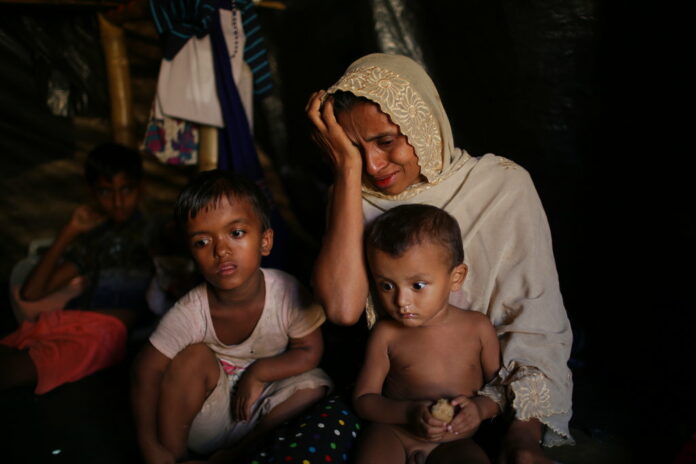
Jamila Begum, 35, cries in 2017 when talking about how members of Myanmar's armed forces accused of massacring civilians in her village Maung Nu, in Myanmar's Rakhine State. Photo: Wong Maye-E / Associated Press

UNITED NATIONS — Genocide is still taking place against Rohingya Muslims remaining in Myanmar and the government is increasingly demonstrating it has no interest in establishing a fully functioning democracy, U.N. investigators said Wednesday.

Marzuki Darusman, chair of the U.N. fact-finding mission on Myanmar, said thousands of Rohingya are still fleeing to Bangladesh, and the estimated 250,000 to 400,000 who have stayed following last year’s brutal military campaign in the Buddhist-majority country “continue to suffer the most severe” restrictions and repression.

“It is an ongoing genocide that is taking place at the moment,” he told a news conference Wednesday.

Darusman said the requirements for genocide, except perhaps for killings, “continue to hold” for Rohingya still in Myanmar’s northern Rakhine state. These include causing serious bodily harm, inflicting conditions designed to destroy the Rohingya, and imposing measures to prevent births, he said.

Myanmar’s U.N. ambassador, Hau Do Suan, called the fact-finding mission “flawed, biased and politically motivated” and said the government “categorically rejects” its inference of “genocidal intent.”

Yanghee Lee, the U.N. special investigator on human rights in Myanmar, said she and many others in the international community hoped the situation under Myanmar leader Aung San Suu Kyi “would be vastly different from the past – but it is really not that much different from the past.”

Lee added later that she thinks Suu Kyi, the Nobel Peace Prize laureate and former political prisoner who now leads Myanmar’s civilian government, “is in total denial” about accusations that the military in Buddhist-majority Myanmar raped, murdered and tortured Rohingya and burned their villages, sending over 700,000 fleeing to Bangladesh since August 2017.

“The government is increasingly demonstrating that it has no interest and capacity in establishing a fully functioning democracy where all its people equally enjoy all their rights and freedoms,” Lee said. “It is not upholding justice and rule of law” that Suu Kyi “repeatedly says is the standard to which all in Myanmar are held.”

If this were the case, she said, fair laws would be applied impartially to all people, impunity would not rein, “and the law would not be wielded as a weapon of oppression.”

Suu Kyi’s government has rejected independent international investigations into the alleged abuses of Rohingya and has commissioned its own probe. The government has also rejected the report by the fact-finding mission, which said some top military leaders should be prosecuted for war crimes, crimes against humanity and genocide against the Rohingya.

“The Myanmar government’s hardened positions are by far the greatest obstacle,” Darusman told reporters.

“Its continued denials, its attempts to shield itself under the cover of national sovereignty and its dismissal of 444 pages of details about the facts and circumstances of recent human rights violations that point to the most serious crimes under international law” strengthens the need for international action because “accountability cannot be expected from the national processes,” he said.

Darusman and Lee spoke ahead of a Security Council meeting that began with a vote on whether Darusman should be allowed to brief members.

He was given a green light with the minimum nine “yes” votes from the U.S., Britain, France, Netherlands, Sweden, Ivory Coast, Kuwait, Peru and Poland. China, which is Myanmar’s neighbor and ally, Russia and Bolivia voted “no” and Equatorial Guinea, Ethiopia and Kazakhstan abstained.

Russian Ambassador Vassily Nebenzia accused supporters of the briefing of “torpedoing consensus” in the council and forcing council members “to engage in loud-speaker diplomacy.”

He said the fact-finding mission didn’t go to Rakhine state, called its report “too biased,” and said the international community should help Myanmar and Bangladesh resolve the Rohingya refugee problem.

Chinese Ambassador Ma Zhaoxu later echoed Nebenzia, calling the report’s conclusions “lopsided” and “not credible” and saying the international community should work on returning the refugees.

Lee stressed that their “repatriation is not possible now.”

“I will not encourage any repatriation,” the U.N. envoy said. “Conducive conditions means they should not go back to … the oppressive laws, the discrimination. The minimum they need is freedom of movement, access to basic health services.”

Lee said “there’s been a lot of progress in terms of economic development and infrastructure, but in the area of ‘democratic space’ and people’s right to claim back their land … there is no progress.”

“Right now, it’s like an apartheid situation where Rohingyas still living in Myanmar … have no freedom of movement,” Lee said. “The camps, the shelters, the model villages that are being built, it’s more of a cementing of total segregation or separation from the Rakhine ethnic community.”

At the council meeting, Darusman said the fact-finding mission concluded that last year’s events were “a human rights catastrophe that was foreseeable and planned,” and it conservatively estimates there were “10,000 Rohingya deaths.”

“Remaining Rohingya in Rakhine state are at grave risk,” he said, and returning Rohingya from Bangladesh would be “tantamount to condemning them to life as sub-humans and further mass killing.”

Darusman said the Security Council should the situation in Myanmar to the International Criminal Court or another international tribunal and also impose an arms embargo on Myanmar, a ban on transactions with all military-related enterprises and sanctions against those alleged to be most responsible for atrocities against the Rohingya.

“There can be no ‘moving on’ from this crisis without addressing its root causes – all of which continue to exist today, primarily the presence of an unaccountable military that acts with complete impunity,” he said.

The Netherlands’ deputy U.N. ambassador, Lise Gregoire Van Haaren, said her government will push quickly for a Security Council resolution that would refer Myanmar to the ICC.

But council action appeared highly unlikely because of its deep divisions and almost certain opposition from China and Russia, both veto-wielding council members.

“I’m very aware that there might be pushback, but having pushback is never a reason not to try,” Van Haaren said. “So we are going to have a really ambitious aim for the negotiations” on a possible resolution “and let’s see where we get.”

Myanmar’s Suan said the Independent Commission of Inquiry established by the government will investigate alleged human rights violations, and “we will never accept any calls for referral of Myanmar to the ICC.”

Story: Edith M. Lederer

Advertisement

Malaysia’s Mahathir Discusses Insurgency During Thailand Visit

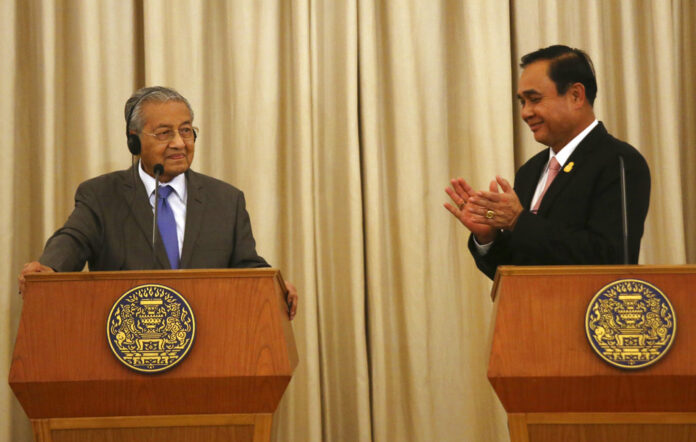
Prime Minister Prayuth Chan-ocha, right claps his hands to Malaysian Prime Minister Mahathir Mohamad during a joint press conference Wednesday at the government house. Photo: Sakchai Lalit / Associated Press

BANGKOK — Malaysian Prime Minister Mahathir Mohamad met Wednesday with the junta leader and discussed peace talks in Thailand’s southern border provinces where a Muslim separatist insurgency has been raging for over a decade.

Malaysia has been a facilitator between rebel groups and the government but so far little progress has been made. Almost 7,000 people have died in the insurgency in Thailand’s three southernmost provinces since 2004.

Prime Minister Prayuth Chan-ocha said he and Mahathir discussed the problems facing the southern border provinces and agreed on greater cooperation.

“We understand each other better on our concerns and limitations,” Prayuth said. “I assured him that the dialogue will continue, with Malaysia as the facilitator.”

“At the same time, the two countries will expand the scope of cooperation to include other areas such as border security, economic development and measures to tackle broader security issues, particularly in countering terrorism, extremism, and transnational crime such as narcotic drugs and human trafficking,” Prayuth said.

Malaysia’s Ministry of Foreign Affairs said on Tuesday that the visit is expected to add momentum to the southern Thailand peace process.

Mahathir briefly addressed reporters at Government House in Bangkok and said closer ties between the two nations could end the conflict.

“I’m quite sure that with both our countries sincerely working toward solving the problem the problem will be reduced if not ended all together,” Mahathir said. “We see this as an opportunity to display our friendship with each other.”

“It’s not just a case of talking or drawing up treaties, it is really cooperation between two friendly neighbors and we want to continue that friendship,” Mahathir said.

Don Pathan, a security analyst based in southern Thailand, said Malaysia has to be part of the dialogue because it has a stake in the border violence and most residents in the region identify as Malay Muslims. Thailand is predominantly Buddhist.

But time is running out for both Mahathir and Prayuth to reach a breakthrough in the negotiations with the rebels, Don said. Mahathir is expected to hand over power to his designated successor, Anwar Ibrahim, in less than two years, and Prayuth’s military-led government has promised to hold elections early next year.

“And this wave of conflict has been going on for the past 14 years. What can they do in 18 months?” Don said, referring to Mahathir’s remaining time in office.

Thailand and Malaysia have each named their own facilitators for the talks who are both high-ranking security officials, but Don said both men are political appointees who will be relieved once their governments undergo administrative changes.

Mahathir is to meet with the president of Thailand’s privy council and with businesspeople and Malaysian expats on Thursday.

Advertisement

Bomb Found at Clintons’ New York Home: US Official

Bill and Hillary Clinton stand in the driveway of their new home in Chappaqua, New York, in a file photo. Photo: Associated Press

WASHINGTON — A U.S. official says a “functional explosive device” was found at Hillary and Bill Clinton’s suburban New York home.

The official says investigators believe the explosive is linked to one found Monday at the compound of liberal billionaire George Soros.

The official wasn’t authorized to publicly discuss an ongoing investigation and spoke on condition of anonymity.

The device was discovered early Wednesday morning at the Clinton’s home in Chappaqua, New York.

Police in New Castle, New York, who cover Chappaqua, say they assisted the FBI, Secret Service and Westchester County authorities in “the investigation of a suspicious package.”

Story: Michael Balsamo

Advertisement

With ‘My Country’s Got,’ Thai Rap Voices Rare Dissent Against Junta

BANGKOK — A rap video criticizing the junta had been watched nearly a million times on Facebook and YouTube as of Wednesday, less than 24 hours since its release.

While a producer and rapper from the Rap Against Dictatorship crew said the song isn’t illegal, he said four of the 10 artists featured in the video covered their faces to remain anonymous for fear it would paint them as pro-democracy activists.

“They don’t want to have their lives implicated with this issue. They are not activists,” said 33-year-old Pratchayaa Surakamchonrot, one of four producers who took part in the collaboration protesting military rule.

Update: Police to Summon Rappers Who Criticized Military Govt

The 10 underground rappers, including Hockhacker, Liberate P and ET, adopted different aliases to maintain their anonymity for the song.

Pratchayaa, a former singer and songwriter with label RS, said their six months of work on the song appeared to pay off, as the song, “My Country’s Got …” (“Prathet Ku Mee”) attracted wide attention on its first day of release.

Former Pheu Thai MP Chaturon Chaisang – himself charged with sedition for challenging the junta’s claim to legitimacy after the 2014 coup – took to Facebook to say he likes the song.

The song is a rare voice of dissent from the popular culture; mainstream performers and celebrities are loathe to speak out on political matters and have been criticized for cooperating with the military government.

That reticence is absent in the 5-minute song in which the 10 rappers take turns denouncing what they see wrong with Thailand.

The lyrics speak about the hypocrisy of being under military dictatorship, the deep political division, deaths on both sides and the failure of self-righteous moralism:

“My country preaches morals but has a crime rate higher than Eiffel / My country’s parliament house is a soldiers’ playground / My country points a gun at your throat. Claims to have freedom but gives no right to choose / “My country’s government is untouchable. The police use laws to threaten people / My country asks you to stay quiet or in jail.”

Pratchayaa, who has been rapping 15 years and considers himself a pro-democracy activist, said they hope the song inspires other performers to recognize that they can make a difference, no matter how little.

“I have no concrete expectations. But I expect the idea to spread so that other hip-hop artists can do it too. They can encourage others to think and express themselves,” the rapper said, adding that he hopes a music festival against dictatorship could be organized soon. He said they would try to go ahead with one, even if it’s banned.

The song, which has been shared more than 20,000 times on Facebook, is not without the usual profanity:

“You can’t say ‘shit’ even though your mouth is full of it / Whatever you do the leader will see you / The country where assholes own the sovereignty / You must choose to either eat truth or bullets.”

On the current state and promised elections, there are more expletives: “Four years already, motherfuckers, still no elections. Free country? Fuck it! Don’t tell me that I can choose. Even the PM is still picked by the army.”

To top up the ambiance, the video was filmed on a set evoking the beating of a lynched student’s corpse during the Oct. 6, 1976, massacre at Sanam Luang by right-wing ultra-royalists.

Pratchayaa said the rappers, himself included, chose the backdrop to highlight the senselessness of Thai society back then that could return if people are not mindful.

Advertisement

Hot News

LATEST NEWS

Bangkok
overcast clouds
27.7 ° C
27.7 °
27.7 °
80 %
2.4kmh
98 %
Thu
28 °
Fri
37 °
Sat
35 °
Sun
37 °
Mon
37 °