





























30 C
Bangkok
Sunday, June 28, 2026
Home Blog Page 1830

Brazil’s Far-Right Candidate Falls Short of Election Stunner

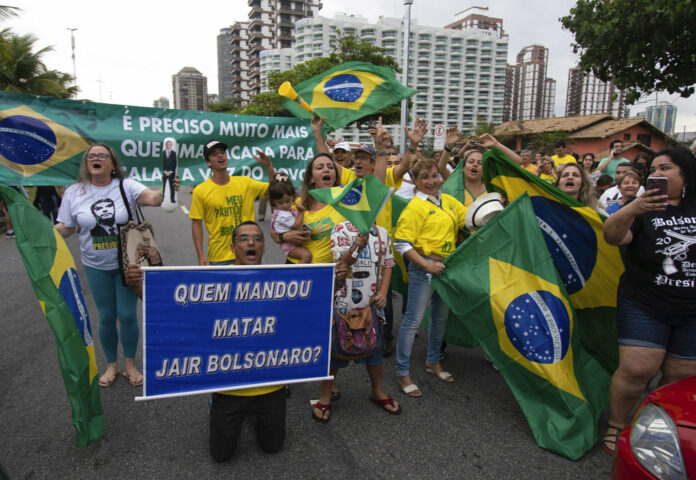
Supporters of Jair Bolsonaro, presidential candidate with the Social Liberal Party, gather in front of his house after general elections Sunday in Rio de Janeiro, Brazil. Photo: Ricardo Borges / Associated Press

SAO PAULO — A far-right former army captain who expresses nostalgia for Brazil’s military dictatorship won the first round of its presidential election by a surprisingly large margin Sunday but fell just short of getting enough votes to avoid a runoff against a leftist rival.

Jair Bolsonaro, whose last-minute surge almost gave him an electoral stunner, had 46 percent compared to 29 percent for former Sao Paulo Mayor Fernando Haddad, according to figures from Brazil’s Superior Electoral Tribunal with 99.9 percent of the vote counted. He needed over 50 percent support to win outright.

Polls predicted Bolsonaro would come out in front on Sunday, but he far outperformed expectations, blazing past competitors with more financing, institutional backing of parties and free air time on television.

Despite the sizable victory, polls have shown the two candidates are neck-and-neck for the Oct. 28 runoff, and much could shift in the coming weeks. Two other candidates, one center-left and one center-right, said they would decide in the coming days if they would endorse anyone.

Ultimately, Bolsonaro’s strong showing reflects a yearning for the past as much as a sign of the future. The candidate from the tiny Social and Liberal Party made savvy use of Twitter and Facebook to spread his message that only he could end the corruption, crime and economic malaise that has seized Brazil in recent years – and bring back the good old days and traditional values.

“This is a victory for honest people, who want the best for Brazil,” said Bianca Santos, 40-year-old psychologist, who added Bolsonaro would end high crime rates.

Brazil is the largest economy in Latin America and it is a diplomatic heavyweight in the region. Bolsonaro has promised to shake up its foreign policy, including taking a harder line on Venezuela and other leftist regimes and forging closer ties with the United States. He won over many foreign investors by promising smaller government and a more open economy.

But the election largely turned on domestic matters, on which Bolsonaro has alienated nearly as many people as he has attracted. Many fear what Brazil will look like if he wins.

Barbara Aires, a transgender woman who unsuccessfully ran for Rio de Janeiro state representative, said Bolsonaro’s first-round victory represented a “step backward” that could lead to “taking back rights and more violence toward the LGBT community.”

The two candidates have painted starkly different visions of the country’s past and future.

Bolsonaro has portrayed a nation in collapse, where drug traffickers and politicians steal with equal impunity, and moral rot has set in. He has advocated loosening gun ownership laws so individuals can fight off criminals, giving police a freer hand to use force and restoring “traditional” Brazilian values – though some take issue with his definition of those values in light of his approving allusions to the 1964-1985 dictatorship and his derisive comments about women, blacks and gay people.

He once told a fellow congresswoman that she was too ugly for him to rape and said that he would not be able to love a gay son.

While those comments have disgusted many, Bolsonaro has capitalized on Brazilians’ deep anger with their traditional political class and “throw the bums out” rage after a massive corruption investigation revealed staggering levels of graft.

Beginning in 2014, prosecutors alleged that Brazil’s government was run like a cartel for years, with billions of dollars in public contracts handed out in exchange for kickbacks and bribes.

Revelations of suitcases of cash, leaked recordings of incriminating exchanges between powerbrokers and the jailing of some of the of the country’s most powerful people, including da Silva, unfolded like a Hollywood script – and then became one: Netflix released a (barely) fictionalized account of the probe this year.

The Workers’ Party was at the center of that investigation, and many have turned to Bolsonaro as a tactic to keep the party out of office.

“I voted against thievery and corruption,” said Mariana Prado, a 54-year-old human resources expert. “I know that everyone promises to end these two things, but I feel Bolsonaro is the only one can help end my anxieties.”

Meanwhile, the party has struggled to stage a comeback with Haddad after da Silva was barred from running. He has said that many of the allegations against Workers’ Party politicians are political persecution and portrayed a country hijacked by an elite that will protect its privileges at all costs and can’t bear to see the lives of poor and working class Brazilians improve.

Haddad has promised to roll back President Michel Temer’s economic reforms that he says eroded workers’ rights, increase investment in social programs and bring back the boom years Brazil experienced under his mentor, da Silva.

Bolsonaro’s poll numbers jumped after he was stabbed during a campaign event on Sept. 6. He was unable to campaign or participate in debates as he underwent surgeries during a three-week hospital stay, but instead brought messages directly to voters via Facebook and Twitter.

“For a front-runner, the best thing to do is commit as few errors as possible,” said Andre Portela from Getulio Vargas Foundation, a leading university and think tank. “Getting stabbed helped Bolsonaro in that. He wasn’t exposed to debate, to people questioning him.”

The campaign to run Latin America’s largest economy, which is a major trade partner for countries in the region, has been unpredictable and tense. Da Silva led initial polls by a wide margin, but was banned from running after a corruption conviction. Bolsonaro’s stabbing forced candidates, and Bolsonaro himself, to shift strategies and recalibrate.

All along, Brazilians have said their faith in leaders and their hopes for the future are waning.

This election was seen as the great hope for ending a turbulent era in which many politicians and business executives were jailed on corruption charges, a president was impeached and removed from office in controversial proceedings, and the region’s largest economy suffered a protracted recession.

Instead, the two front-runners merely reflect the rabid divisions that have opened up in Brazilian politics following former President Dilma Rousseff’s impeachment and the revelations emerging from the “Car Wash” graft probe.

Caught in the middle are Brazilians who dislike both candidates and see them as symbols of a broken system.

“I think we’re going to continue with the same polarization,” if either Haddad or Bolsonaro wins, said Victor Aversa, a 27-year-old massage therapist who voted for center-left candidate Ciro Gomes, who had been polling third. “We’ve been on this path of crazy bipolarity. Haddad and Bolsonaro will both lead populist governments.”

Story: Sarah Dilorenzo, Mauricio Savarese, Peter Prengaman
Advertisement

UN Report on Global Warming Carries Life-or-Death Warning

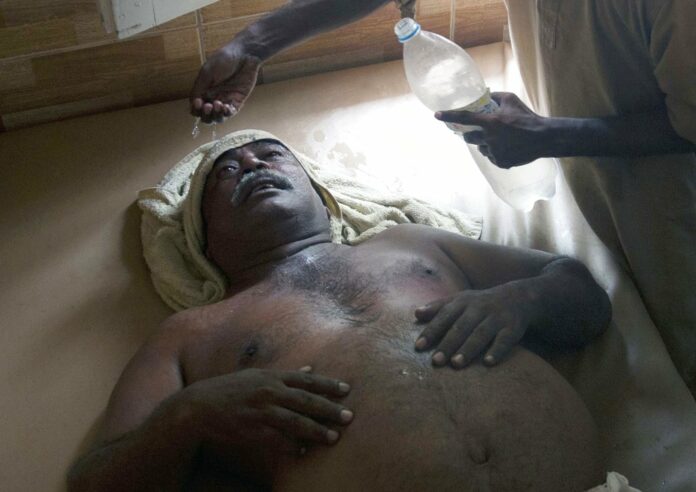
A Pakistani boy sprinkles water on his father who is suffering from heatstroke in 2015 in Karachi, Pakistan. Photo: Shakil Adil / Associated Press

WASHINGTON — Preventing an extra single degree of heat could make a life-or-death difference in the next few decades for multitudes of people and ecosystems on this fast-warming planet, an international panel of scientists reported Sunday. But they provide little hope the world will rise to the challenge.

The Nobel Prize-winning Intergovernmental Panel on Climate Change issued its gloomy report at a meeting in Incheon, South Korea.

In the 728-page document, the U.N. organization detailed how Earth’s weather, health and ecosystems would be in better shape if the world’s leaders could somehow limit future human-caused warming to just 0.9 degrees Fahrenheit (a half degree Celsius) from now, instead of the globally agreed-upon goal of 1.8 degrees F (1 degree C). Among other things:

— Half as many people would suffer from lack of water.

— There would be fewer deaths and illnesses from heat, smog and infectious diseases.

— Seas would rise nearly 4 inches (0.1 meters) less.

— Half as many animals with back bones and plants would lose the majority of their habitats.

— There would be substantially fewer heat waves, downpours and droughts.

— The West Antarctic ice sheet might not kick into irreversible melting.

— And it just may be enough to save most of the world’s coral reefs from dying.

“For some people this is a life-or-death situation without a doubt,” said Cornell University climate scientist Natalie Mahowald, a lead author on the report.

Limiting warming to 0.9 degrees from now means the world can keep “a semblance” of the ecosystems we have. Adding another 0.9 degrees on top of that – the looser global goal – essentially means a different and more challenging Earth for people and species, said another of the report’s lead authors, Ove Hoegh-Guldberg, director of the Global Change Institute at the University of Queensland, Australia.

But meeting the more ambitious goal of slightly less warming would require immediate, draconian cuts in emissions of heat-trapping gases and dramatic changes in the energy field. While the U.N. panel says technically that’s possible, it saw little chance of the needed adjustments happening.

In 2010, international negotiators adopted a goal of limiting warming to 2 degrees C (3.6 degrees F) since pre-industrial times. It’s called the 2-degree goal. In 2015, when the nations of the world agreed to the historic Paris climate agreement, they set dual goals: 2 degrees C and a more demanding target of 1.5 degrees C from pre-industrial times. The 1.5 was at the urging of vulnerable countries that called 2 degrees a death sentence.

The world has already warmed 1 degree C since pre-industrial times, so the talk is really about the difference of another half-degree C or 0.9 degrees F from now.

“There is no definitive way to limit global temperature rise to 1.5 above pre-industrial levels,” the U.N.-requested report said. More than 90 scientists wrote the report, which is based on more than 6,000 peer reviews.

“Global warming is likely to reach 1.5 degrees C between 2030 and 2052 if it continues to increase at the current rate,” the report states.

Deep in the report, scientists say less than 2 percent of 529 of their calculated possible future scenarios kept warming below the 1.5 goal without the temperature going above that and somehow coming back down in the future.

The pledges nations made in the Paris agreement in 2015 are “clearly insufficient to limit warming to 1.5 in any way,” one of the study’s lead authors, Joerj Roeglj of the Imperial College in London, said.

“I just don’t see the possibility of doing the one and a half” and even 2 degrees looks unlikely, said Appalachian State University environmental scientist Gregg Marland, who isn’t part of the U.N. panel but has tracked global emissions for decades for the U.S. Energy Department. He likened the report to an academic exercise wondering what would happen if a frog had wings.

Yet report authors said they remain optimistic.

Limiting warming to the lower goal is “not impossible but will require unprecedented changes,” U.N. panel chief Hoesung Lee said in a news conference in which scientists repeatedly declined to spell out just how feasible that goal is. They said it is up to governments to decide whether those unprecedented changes are acted upon.

“We have a monumental task in front of us, but it is not impossible,” Mahowald said earlier. “This is our chance to decide what the world is going to look like. ”

To limit warming to the lower temperature goal, the world needs “rapid and far-reaching” changes in energy systems, land use, city and industrial design, transportation and building use, the report said. Annual carbon dioxide pollution levels that are still rising now would have to drop by about half by 2030 and then be near zero by 2050. Emissions of other greenhouse gases, such as methane, also will have to drop. Switching away rapidly from fossil fuels like coal, oil and gas to do this could be more expensive than the less ambitious goal, but it would clean the air of other pollutants. And that would have the side benefit of avoiding more than 100 million premature deaths through this century, the report said.

“Climate-related risks to health, livelihoods, food security, water supply, human security and economic growth are projected to increase with global warming” the report said, adding that the world’s poor are more likely to get hit hardest.

Princeton University climate scientist Michael Oppenheimer said extreme weather, especially heat waves, will be deadlier if the lower goal is passed.

Meeting the tougher-to-reach goal “could result in around 420 million fewer people being frequently exposed to extreme heat waves, and about 65 million fewer people being exposed to exceptional heat waves,” the report said. The deadly heat waves that hit India and Pakistan in 2015 will become practically yearly events if the world reaches the hotter of the two goals, the report said.

Coral and other ecosystems are also at risk. The report said warmer water coral reefs “will largely disappear.”

The outcome will determine whether “my grandchildren would get to see beautiful coral reefs,” Princeton’s Oppenheimer said.

For scientists there is a bit of “wishful thinking” that the report will spur governments and people to act quickly and strongly, one of the panel’s leaders, German biologist Hans-Otto Portner said. “If action is not taken it will take the planet into an unprecedented climate future.”

Story: Seth Borenstein

Advertisement

‘Wild Boars’ Play Friendly Match in Argentina

Kapol Jantawong, coach and captain of Thai team Wild Boars, left, fights for the ball Sunday during a friendly soccer match against River Plate Youth Team at Monumental stadium in Buenos Aires, Argentina. Photo: Eitan Abramovich / Associated Press

BUENOS AIRES, Argentina — The 12 boys and football coach who were found in a partially flooded cave in Chiang Rai once again found themselves capturing the media’s attention on Sunday.

The team played a friendly match against the prestigious River Plate youth football team of Argentina – which was somewhat of a dream come true for the young Thais who want to become professional football players.

A day prior, the Wild Boars football team participated in the opening ceremony of the Youth Olympic Games, which are taking place from Oct. 6 to 18 in the South American country.

Thomas Bach, president of the International Olympic Committee, called the boys “brave” and said they “showed us all the importance of sports values.” They were loudly applauded by thousands of people attending the event.

The boys and their coach became well-known after they got trapped in a cave on June 23. They were found by two British divers and brought out in a daring rescue mission that ended on July 10.

Nearly 4,000 athletes between the ages of 15 and 18 will participate in the youth games.

Advertisement

Marquez Wins Thailand MotoGP to Extend Championship Lead

Spain's rider Marc Marquez of the Repsol Honda Team rides Oct. 6 during Thailand's inaugural MotoGP qualifying at the Chang International Circuit in Buriram. Photo: Gemunu Amarasinghe / Associated Press

BURIRAM — Marc Marquez of Honda narrowly beat archrival Andrea Dovizioso of Ducati to win the inaugural MotoGP Thailand at the Chang International Circuit for his seventh win of the season on Sunday.

After a tight duel between the championship leaders, Marquez took the lead on the final corner to seal victory, 0.115 seconds ahead of Dovizioso, to extend his championship lead by 77 points.

“In the past I always lost to Ducati’s riders in the last lap, but this time I would give my 100 percent,” Marquez said. “It was amazing to win here after a difficult weekend.

“We move one more step to the final dream (of winning the championship).”

It was the successive second race where Dovizioso led late in the race only to lose in the final stages to Marquez.

“It’s not nice to lose the last corner,” Dovizioso said. “This track isn’t for us. We came here struggling a little bit like we did in February (winter test). We battled for the victory and we did incredible work.

Advertisement

Doctors in Squalor, Patients on Balconies at Cash-Starved Hospitals

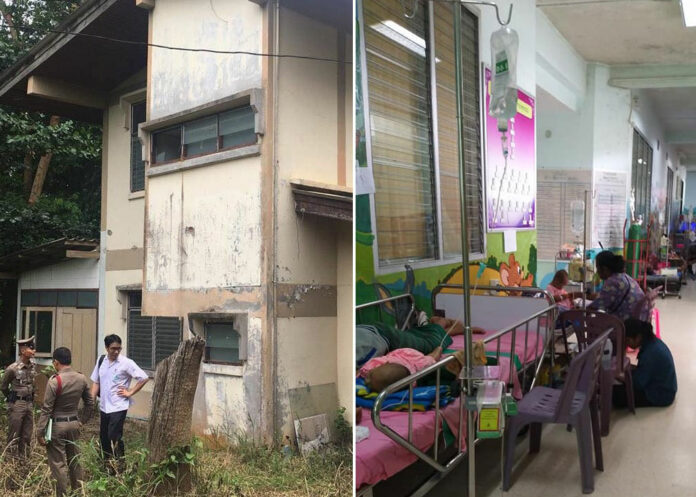
Left: A doctor speaks to police officers Aug. 17 at his hospital home after a break-in. Right: In this undated photo, patient lie in beds along a hallway at a hospital in Tak province. Photo: Nicky Somsai / Facebook
Left: A doctor speaks to police officers Aug. 17 at his hospital home in Khon Kaen province after a break-in. Right: In this undated photo, patient lie in beds along a hallway at a hospital in Tak province. Photo: Nicky Somsai / Facebook

BANGKOK — Cracked windows, peeling paint, moldy walls and water stains mark the house as being long abandoned. But there, surrounded by overgrown woods and weeds, a medical doctor lived five years until someone recently broke in to steal his valuables.

Khon Kaen doctor Thiti Chanmeyka first made headlines in August when his stolen surgical loupes worth 80,000 baht were returned following his appeal on social media. But when people saw his dire living conditions in hospital housing, it renewed concern for the poor welfare of overworked medical personnel.

Nearly a year after a rock star ran nationwide to raise money for notoriously underfunded state hospitals, hardships continue despite the money and pledges. And not just for the large volume of patients competing for space. Health officials recently acknowledged they’ve been unable to provide for tens of thousands of staff, many of whom are chronically overworked to the point a few have succumbed to illness and died.

The situation is enough to regularly spark public anxiety that the whole health care system is on the verge of collapse.

“The government, health ministry and people have to realize that the downfall has already happened, and almost everything is falling apart,” Chulalongkorn University neurologist Thiravat Hemachudha said online last week in a post showing overcrowded wards at an unidentified hospital in the northeast.

Of the more than 130,000 hospital employees eligible for housing assistance, nearly 65,000 do not receive any, according to the Health Ministry. More than 7,600 homes are beyond repair and must be rebuilt.

A doctor at Srinagarind Hospital lived in this dilapidated home in Khon Kaen province that was burglarized for his expensive medical equipment in August.

After the pictures of Thiti’s home spread, representatives of Srinagarind Hospital – also a Khon Kaen University medical school – went on television a few days later to say that all the old homes, said to be built about 30 years ago, had been well maintained and it was up to the residents to take care of them.

Thiti, who moved out after the robbery, responded by saying it was already uninhabitable when he first arrived.

“When I got the house in 2013, I could not live there. It was filled with nests of rats and pigeons, termites, and covered in dust,” he wrote online shortly after. “I paid for all the renovations: the ceiling, the floor, electricity, plumbing, doors, structures, etc. It cost me hundreds of thousands of baht.”

He later told Khaosod that he had to spend about 300,000 baht to fix it because the hospital had no budget for staff housing maintenance.

“I’d like to ask executives to take better care of their staff’s well-being,” he said. “Some have to live in very poor accommodations, both in terms of safety and surroundings.”

Officials on Wednesday announced an additional 500 million baht accommodation funding for each of the 12 regional health departments.

Permanent health secretary Sukhum Kanchanapimai said the problem is not new, but one the ministry has been trying to solve for several years.

“I’ve instructed inspectors of the 12 regional health offices to issue a report detailing what they need,” he said, adding that their reports were due Friday.

Worked to Death?

Sukhum said providing homes or apartments near or at hospitals is fundamental to the welfare of employees, especially for those who have relocated from their hometowns and may be on call 24/7.

But in reality, the housing shortage is not the only thing making their work arduous, or even perilous.

It did not go over well last week when a national nursing organization rallied to the defense of one of their own caught on camera roughly treating an elderly, comatose man. Though the public seemed little swayed by arguments the woman was overworked, data supports the heavy demands placed on medical professionals.

Read: Hospital Apologizes for Violent Treatment of Coma Patient

A 2012 study by Khon Kaen University’s medical school found nine-in-10 new doctors at public hospitals work over 80 hours a week, with many being called in 72 hours straight. Researchers at Chiang Mai University’s faculty of nursing in 2014 found that the average nurse works 54 hours every week.

In May 2017, 30-year-old doctor Thapakorn Thongkeu died in Buriram province from an acute lung infection his colleagues said he contracted from a patient after too many hours on call. The case drew attention to the death a few weeks earlier of 25-year-old Pitcha-orn Pongprasert, whose family said had contracted the same disease after working too many 72-hour shifts.

The downfall has already happened, and almost everything is falling apart.

The national Medical Council months later issued new regulations barring doctors from working more than 40 hours per week or being on call over 16 hours, citing increased risk of infection, depression and accidents.

New rules did not seem to flip the situation as the reasons they are overworked – shortages of facilities, equipment and personnel – remain unresolved.

Patients lie on beds in what appears to be a staff office. Photo: Thiravat Hemachudha / Facebook

Money may only be part of the problem. The nation’s 896 public hospitals receive about 12 billion baht in annual funding. Official data indicated that almost 400 suffer a capital loss in the previous fiscal year worth 3.1 billion baht combined.

As it became apparent many were deeply in debt and at risk of closing, musician Artiwara “Toon Bodyslam” Kongmalai became hailed as a national hero last year when he ran across the country and raised 1.3 billion baht for 11 state hospitals said to be underfunded.

Several months before he started running, the government said it would give an additional 5 billion baht to state hospitals after it was revealed that at least 18 of them were under a financial crisis.

Teerapong Tunak of the health administration department said the ministry receives about 7 billion to 8 billion baht annually for facilities – which is split by the 12 regional offices.

Saturated Wards

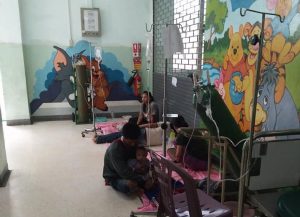
Thiravat, the neurologist who shared images of severe overcrowding, wrote that a former student complained that his hospital in the northeast has too few staff to handle a patient load already two to three times over daily capacity. Those meant to be treated in intensive care units are overflowing out of the fully equipped rooms of up to 20 people per ward.

Sukhum, health ministry permsec, acknowledged that many hospitals put patients in hallways or on balconies when beds fill. He said his ministry has been pushing several measures to fix the issue.

An undated photo shows patients on the floor at a hospital in Tak province. Photo: Nicky Somsai / Facebook

Prapon Tangsrikertikul, acting deputy permanent secretary, said major hospitals nationwide have about 110 percent bed occupancy rate. He said the number of outpatients is overwhelming, giving doctors less time to offer diagnoses. This have led to case after case of online rants about reckless treatment.

The Health Commission last year said Thailand has an adequate amount of doctors and nurses, but they are unevenly distributed across the country.

The World Health Organization in 2015 reported Thailand had just shy of one doctor for every 2,000 people, less than half its recommended ratio of 1 doctor per 1,000.

Prapon said one effective measure has been transferring stable patients to smaller hospitals.

For those who don’t need to be admitted, Sukhum said they are developing an online appointment system to help schedule the load for both doctors and patients. However, he said the most sustainable way to reduce the number of people coming to hospitals is educating them on how to keep healthy.

Prapon agrees, saying about half of all patients show up with conditions that can be treated at home.

But don’t blame the system: He said that doesn’t mean state-subsidized health care encourages people to seek unnecessary coverage.

As elsewhere, Thailand’s health care is a political issue, and the military government has expressed interest in dismantling the free health care system. Just last month, junta leader and prime minister Prayuth Chan-ocha claimed that it was making people not take care of themselves because they could see doctors at no cost.

Prapon said better awareness would be good for everyone.

“We need to promote more health knowledge to people,” Prapon said. “No one should think that a lot of people come to the hospital because of the free treatment. Being sick is distressing. Being admitted to the hospital makes no one happy.”

Advertisement

Nonthaburi Love Hotel Removes Hitler Mural

NONTHABURI — A love hotel in greater metropolitan Bangkok removed an Adolf Hitler mural in one of its themed rooms Saturday after news of it went viral the past week and sparked outrage from Jewish groups worldwide.

Love Villa Hotel in Nonthaburi city removed the mural in one of its rooms after word spread about the offensive decor via local press.

An employee at the hotel, who refused to give their name, said the hotel had been open for five years under its manager Sittichai Suproongreung.

The employee said they spotted a couple of farang men going to inspect the room Wednesday. Soon after, district administration officials and soldiers arrived at the hotel and asked that the image be removed, he added.

Love Villa Hotel contains various other themed rooms, including one with Japanese motives and a light-up hammer-and-sickle mural.

S 21307416

S 21307414

S 21307413

Advertisement

Srisaket Retains WBC Super Flyweight Belt With Points Win

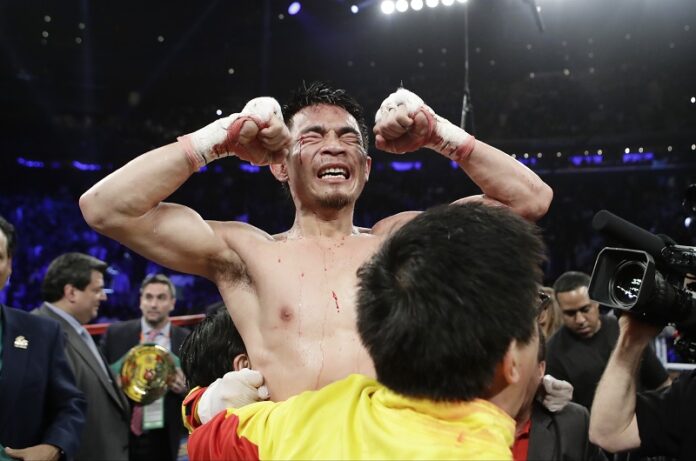
Srisaket Sor Rungvisai, of Thailand, celebrates after a super flyweight championship boxing match against Roman Gonzalez, of Nicaragua, last year in New York. Photo: Frank Franklin II / Associated Press

NONTHABURI — Srisaket Sor Rungvisai successfully defended his WBC super flyweight belt by beating Iran Diaz of Mexico on a unanimous decision in front of 12,000 home fans in Nonthaburi on Saturday.

Srisaket received 119-109, 120-108, and 119-109 scores from the judges to win his first home title fight and third defense since taking the belt from Roman Gonzalez last year at Madison Square Garden.

Read: ‘You Will Shine,’ Amir Khan Tells Aspiring Thai Boxers

“I’m not surprised that Diaz stayed with me until the 12th round as he really trained hard for this fight,” Srisaket said.

The Thai (47-4-1, 47 KO) took the initiative from the start, moving forward and putting Diaz (14-3-3) on defense for most of the bout.

Srisaket had Diaz rattled twice in round seven, and the challenger started bleeding from a cut under his right eye in round nine. Then a cut above his left eyebrow began bleeding in round 10, but he hung on to the end at Impact Arena Muang Thong Thani.

Advertisement

Time to Improve the Thai Tourism Experience

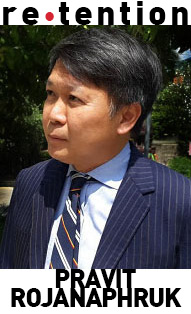
Re•tention: Pravit Rojanaphruk

The physical assault against a Chinese tourist by a security guard Sunday in Bangkok’s Don Mueang Airport, was a reminder on how service-minded attitude is still low among some Thais in the tourism industry.

It was an unnecessary act which became a necessary reminder of the need for improvement.

Whether the Chinese tourist was really attacked after failing to pay illegal “extra service fees” as he claimed or not, there’s no excuse for the security guard to overreact.

It’s like one rotten fish ruining the whole industry in the eye of Chinese tourists – who are currently the largest group of foreign tourists in Thailand, with more than 9 million expected to land in the kingdom this year. Captured on video, the incident has been watched by millions in China the past few days.

What a way to promote tourism in Unseen or Amazing Thailand!

While we may be among the most popular tourist destinations in the world – judging from numerous surveys in which cities such as Bangkok, Chiang Mai or Phuket score very high – there is no excuse for complacency, as we compete with other countries and seek to attract repeated visits and quality tourists.

The only way to be sustainable is to improve the quality of the tourism experience, and that requires training and improving the service-minded standard of people working in the industry.

As costs of living continue to rise and the environment strains under the impact of mass tourism – both foreign and domestic – and with many visitors having been to Thailand, it’s a challenge to continue growing.

Airport and hotel security guards should be taught basic protocol on how to handle tourists. There is also a need to better train taxi drivers and tuk-tuk operators to be more professional and cordial. Even a campaign for the general public, training and giving tips on how to be better hosts, can help.

We can be good hosts if we place ourselves in their shoes and think about what we would expect if we were tourists in a foreign land.

Be a good host. Be a better host. This shouldn’t be too difficult if we see them not primarily as a source of revenue but as fellow human beings, as travelers from a foreign land, and visitors that may need a helping hand if lost – or a friendly smile. Let us see tourists more as visitors, as guests, as potential friends and see ourselves as a good host.

On the other hand, we cannot seriously expect service improvement if those at the bottom of the industry such as security guards, taxi drivers and restaurant waiters and waitresses do not earn a decent minimum income. It is a challenge to ensure that these people earn a decent income so they can be happy, in hope that the overall quality of their services will be better and make tourists happy too.

Speaking long-term, we need to stop relying on being cheaper in order to attract more tourists and improve to offer higher value-added tourism services and experience instead.

The indefinite closure of the famous but over-visited Maya beach announced Tuesday is a crucial move in the right direction, as it places long-term environmental regeneration over short-term tourism gain. We should be thinking about how Thailand can sustain and improve the quality of tourism in the long term, with a stress on service quality and better attitude, not short-term goals which rest in maximizing the arrival of tourists and money.

Advertisement

Montserrat Caballe, Iconic Opera Singer, Dead at 85

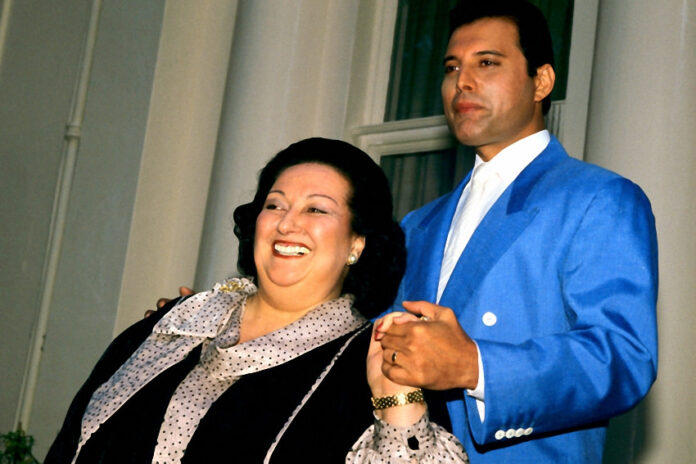
Montserrat Caballe, left, with Queen's lead singer Freddie Mercury in 1987 in Barcelona, Spain.

BARCELONA, Spain — Montserrat Caballe, a Spanish opera singer renowned for her bel canto technique and her interpretations of the roles of Rossini, Bellini and Donizetti, has died. She was 85.

Caballe died early Saturday at Hospital San Pau in Barcelona, hospital spokesman Abraham del Moral told The Associated Press. Caballe’s family requested the cause of death not be released, saying that she had been in the hospital since September, del Moral said.

Spanish media said that Caballe entered the hospital last month because of a gall bladder problem.

“A great ambassador of our country has died,” Spanish Prime Minister Pedro Sanchez said in a tweet . “Her voice and tenderness will remain with us forever.”

Born into a working class family in Barcelona, Caballe unveiled her musical talents early on, singing Bach cantatas at the age of 7.

In her almost unlimited repertoire, she starred in 90 opera roles with nearly 4,000 stage performances.

At 8, Caballe entered the Liceo’s Conservatory in Barcelona with Eugenia Kenny, Conchita Badea, and Napoleone Annovazzi among her first teachers. She won the school’s Gold Medal on graduating in 1954. She went on to study opera in Milan and in 1956 joined the Basel Opera and played her first major role that year in the city’s Staatstheater as Mimi in Puccini’s “La Boheme.”

Four years later, she was a principal singer with the Bremen Opera.

In 1964, Caballe gave a highly praised performance of Jules Masenet’s “Manon” in Mexico City, but it was a year later in New York that a lucky break launched her on the road to international stardom.

On short notice, Caballe stood in for indisposed American soprano Marilyn Horne in a concert performance in Donizetti’s “Lucrezia Borgia” at New York’s Carnegie Hall and achieved a thunderous success. It opened the doors to all the major opera venues around the world.

She produced a highly-acclaimed performance as Elisabetta of Valois in an all-star cast of Verdi’s “Don Carlo” at the Arena di Verona in 1969. The concert became famous for her “la” on the final “ah” at the very end of the opera, which lasted for more than 20 bars up, driving the audience wild with delight.

Caballe was also a noted recitalist, particularly of songs of her native Spain. She was particularly admired for her purity of voice, vocal shadings and exquisite pianissimos.

In a brief excursion into pop music, Caballe’s duet “Barcelona” with Freddie Mercury, of the rock group Queen, was a hit single in 1987, accompanied by an album of the same name. The title track later became the anthem of the 1992 Summer Olympics in the city.

Caballe performed the song live, accompanied by a recording of the late Mercury, at the 1999 UEFA Champions League soccer final in Barcelona’s Camp Nou stadium. In 1997, she sang on two tracks on an album by New Age composer Vangelis.

In 2015, Caballe was convicted of tax fraud and was given a suspended sentence of six months in prison, which she avoided since first convictions resulting in sentences of less than two years in Spain can be suspended by a judge. She had failed to pay the Spanish treasury more than 500,000 euros (USD$550,000) in taxes on her earnings.

Caballe, who was born Maria de Montserrat Viviana Concepcion Caballe i Folch, dedicated herself to various charities and was a UNESCO Goodwill Ambassador. She also established a foundation for needy children in Barcelona. In 1964, she married Spanish tenor Bernabe Marti. They had two children, Bernabe Marti, Jr. and Montserrat Marti, herself a successful soprano.

Story: Ciaran Giles, Joseph Wilson

Advertisement

Interpol President Reported Missing During Trip to China

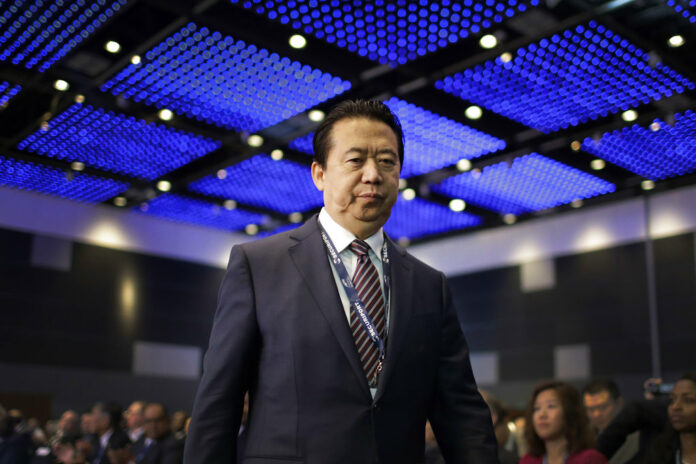
Interpol President, Meng Hongwei, walks toward the stage to deliver his opening address in 2017 at the Interpol World congress in Singapore. Photo: Wong Maye-E / Associated Press

PARIS — He left his home in Lyon, France, for a visit to his homeland, and then vanished – putting the International Criminal Police Organization, best known as Interpol, at the center of its own missing persons case.

Meng Hongwei, Interpol’s president, boarded a plane and arrived in China, according to a French judicial official. But then, nothing. His wife, who put out a call on Friday, said she hasn’t heard from her 64-year-old husband since the end of September, the official said.

To make matters murkier, Meng is not just the head of Interpol: He’s also a vice minister for public safety in China.

Interpol, based in Lyon, would say only that reports that its president is missing is “a matter for the relevant authorities in both France and China.”

France launched its own investigation on Friday morning, according to the judicial official who wasn’t authorized to speak publicly and asked for anonymity.

Whether China was taking action was unknown. But the South China Morning Post, a Hong Kong newspaper, hinted that Meng may have been the latest target of an ongoing campaign against corruption in China.

The newspaper said that upon landing last week Meng was “taken away” for questioning by what it said were “discipline authorities.” The term usually describes investigators in the ruling Communist Party who probe graft and political disloyalty. The Central Commission for Discipline Inspection, the party’s secretive internal investigation agency, had no announcements on its website about Meng and could not be reached for comment.

Meng is the first from his country to serve as Interpol’s president, a post that is largely symbolic but powerful in status and not without political weight. But because Interpol’s secretary general is responsible for the day-to-day running of the police agency’s operations, Meng’s absence may have little operational effect.

Far from being a Hollywood-style agency with agents toting weapons across the globe, Interpol is low-profile and discrete about its cases, unless it wants to talk.

The organization links up police officials of its 192 member states, who can use Interpol to disseminate their search for a fugitive, or a missing person. Only at the behest of a country does the information go public via a “red notice,” the closest thing to an international arrest warrant. “Yellow notices” are issued for missing persons.

But Interpol walks a fine line between its noble mission – facilitating international police cooperation – and the politics and policies of some of its member countries.

Meng’s appointment as president in 2016 – amid Chinese leader Xi Jinping’s sweeping anti-corruption drive – alarmed some human rights organizations, fearful it would embolden China to strike out at dissidents and refugees abroad.

Such actions would be contrary to Interpol’s mission statement: “Action is taken within the limits of existing laws in different countries and in the spirit of the Universal Declaration of Human Rights.” It adds that “intervention or activities of a political, military, religious or racial character” are prohibited.

Meng has a shiny curriculum vita, having held down various positions within China’s security establishment, including as a vice minister of public security – the national police force – since 2004. In the meantime, he served as head and deputy head of branches of the coast guard, all while holding positions at Interpol. His term in Lyon runs until 2020.

His duties in China would have put him in close proximity to former leaders, some who had fallen afoul of Xi’s campaign. He likely dealt extensively with former security chief Zhou Yongkang, now serving a life sentence for corruption.

Xi has placed a premium on getting officials and businesspeople accused of fraud and corruption to return from abroad, making Meng’s position even more sensitive.

The anti-corruption drive recently drew headlines after the disappearance three months ago of “X-Men” star Fan Bingbing, one of the country’s best-known actresses.

Her whereabouts remain unknown. But on Thursday, Chinese tax authorities spoke publicly about her disappearance public, ordering her and companies she represents to pay taxes and penalties totaling USD$130 million. Fan is being fined around $70 million personally for tax evasion. Still out of the public eye, she issued a statement apologizing for her actions.

China, in the midst of a weeklong holiday, offered no comment on the disappearance of Meng.

In France, there were only questions.

The French are “obviously aware of the disappearance but know nothing more at this stage,” said one diplomatic official, unauthorized to comment publicly on the matter and speaking only on condition of anonymity.

Story: Christopher Bodeen, Elaine Ganley

Advertisement

Hot News

LATEST NEWS

Bangkok
overcast clouds
30 ° C
31.6 °
30 °
75 %
3.5kmh
98 %
Sat
30 °
Sun
34 °
Mon
34 °
Tue
33 °
Wed
32 °