30.5 C
Bangkok
Saturday, July 18, 2026
Home Blog Page 1841

Missing American Found in Some Rocks on Koh Lipe

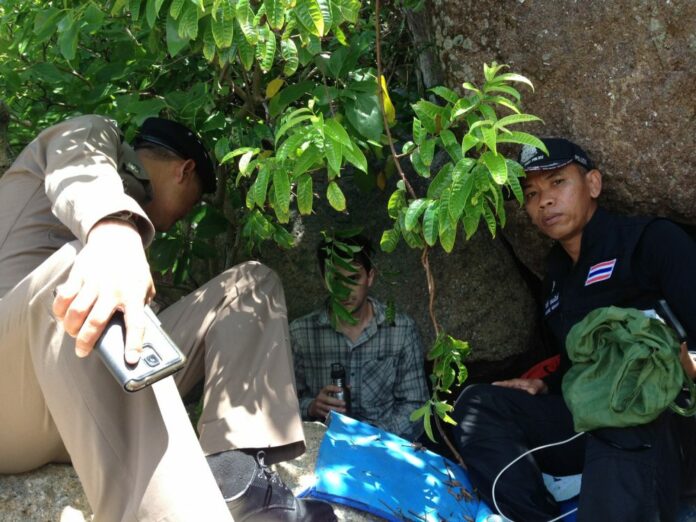
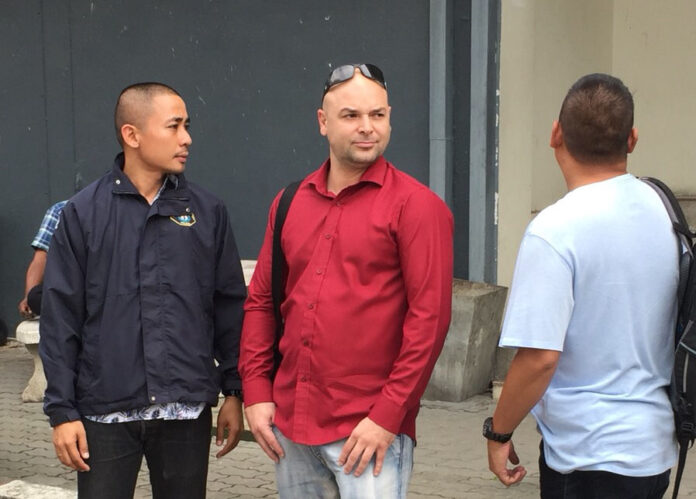
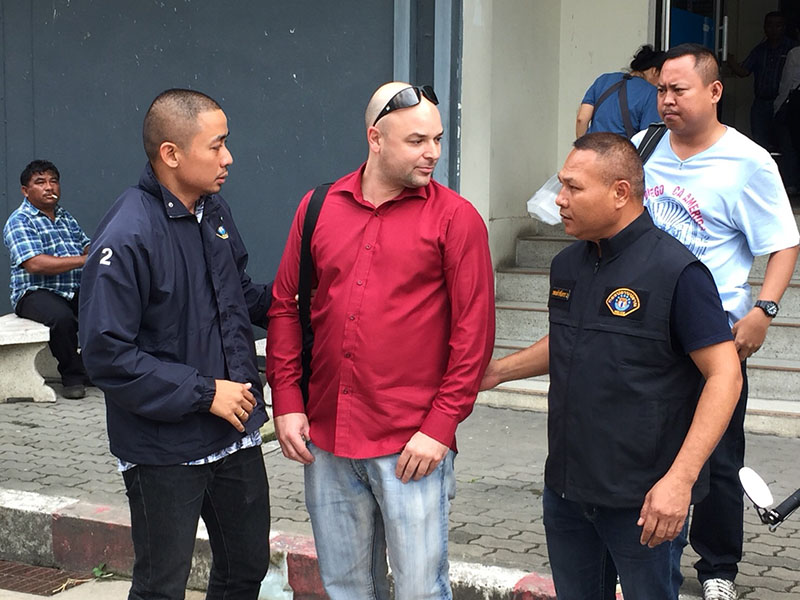
Police with Charles Kosydar on Thursday under a pile of rocks on Koh Lipe's Sunset Beach.

SATUN — A missing American tourist was found hiding in a pile of boulders Thursday on Koh Lipe after his worried friends went to the police.

Satun police said Charles Kosydar, 39, was reported missing in the early hours of Tuesday. He was found at 12:30pm today after island residents told police a man resembling him was seen near the rocks on Sunset Beach.

Police discovered an exhausted Kosydar under the rocks with small cuts on his hand. He was taken to a local health office for treatment.

Kosydar, who came to Lipe with three friends, reportedly apologized to the authorities for having caused a hassle. In an email to Khaosod English in July 2019, Kosydar said he was “incapacitated and needed to be rescued.”

“I was injured when I was by myself and unable to get help on my own,” he wrote.

He told police he would continue the trip with his friends and promised he wouldn’t go missing again.

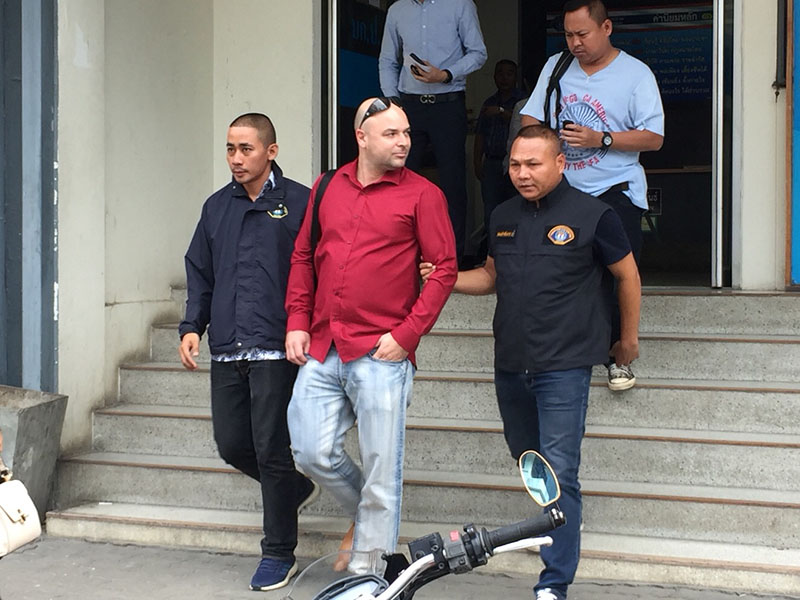
Police lead Charles Kosydar away Thursday from a pile of rocks where he sought solitude on Koh Lipe's Sunset Beach.
Police lead Charles Kosydar away Thursday from a pile of rocks on Koh Lipe’s Sunset Beach.

Update: The article has been updated July 2019 following an email from Kosydar. He said he was not seeking solitude on the rocks, but was incapacitated and needed rescue.

Advertisement

Rocker Sek Loso Found Guilty, Gets Long Prison Sentence

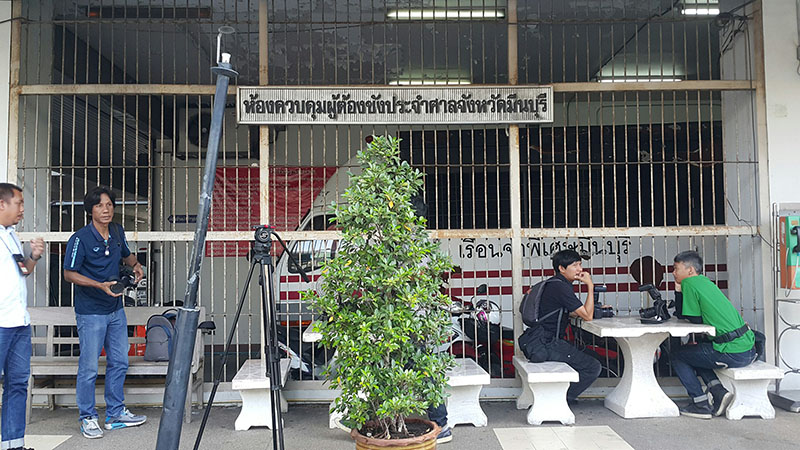
Sek Loso in custody Thursday at the Minburi Provincial Court.

BANGKOK — A poster boy for bad boy rock stars who is said to be struggling from mental illness was sentenced to almost four years in prison Thursday for firing a gun in the air and other related charges.

Seksan “Sek Loso” Sukpimai, 44, was convicted on multiple counts by the Minburi Provincial Court and given three years and nine months in prison, capping off a year of erratic behavior that began with his resisting arrest over the incident and culminated in an apparent psychological rupture live-streamed to the world.

On Dec. 30, 2017, Sek fired an automatic 9mm handgun into the air at a temple, an incident he also live-streamed over Facebook. When police arrived to apprehend him on New Year’s Eve, Sek refused to surrender and threatened to open fire on police in a standoff that ended with officers rushing his home.

For that episode, he got 18 months for armed obstruction of justice, six months for drug use and six months for discharging a gun in a residential area, making for two and a half years.

The court also handed down an additional 15 months months for physically assaulting Chanokkorn Boonpeng, his ex-wife’s partner, in 2016.

S 22200330
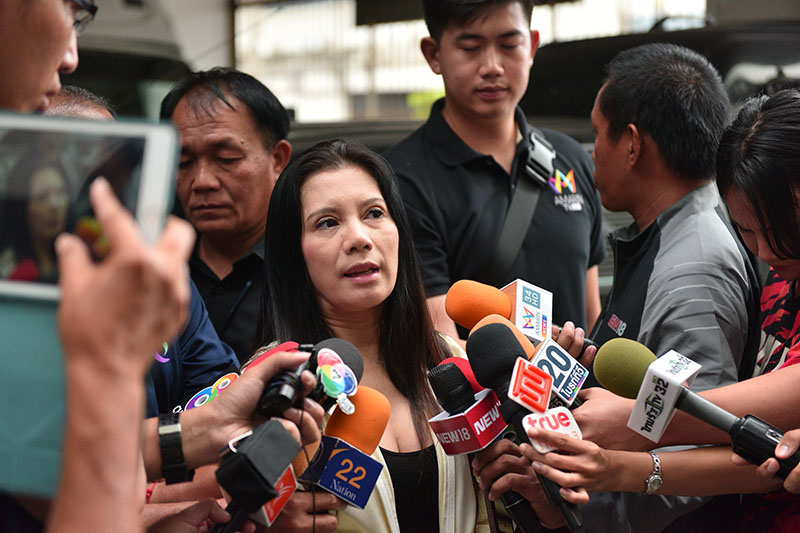
Wiphakorn “Karn” Sookpimay, Sek Loso’s ex wife Thursday at Minburi Provincial Court.

The court said that they took into consideration Sek’s bipolar disorder, for which he recently underwent a month of hospital treatment. Still, the court ruled he was cognizant enough to realize that he was breaking the law; therefore, his sentence was not reduced or suspended.

Sek was later released on bail pending an appeal.

Sek has remained popular despite episodes of domestic violence and drug abuse over the years. In August, he made headlines for a series of bizarre, long-running videos streamed five days straight on Facebook. His wife and girlfriend staged an intervention, and his family told the public he had been suffering from mental health issued for years.

After he was discharged, he went live online again on Sept. 21 to tell his fans he was feeling fine.

Even his ex-wife, who has helped fill pages of tabloid ink during their stormy relationship, expressed concern.

“Why do you always make me cry?” Wiphakorn “Karn” Sookpimay, Sek’s ex-wife posted on her social media Thursday. “Even though you’ve hurt me a lot, I’m always ready to help you. We may not understand each other, but who cares. When you’re in trouble, I’ll never abandon you. I love you, my wandering friend.”

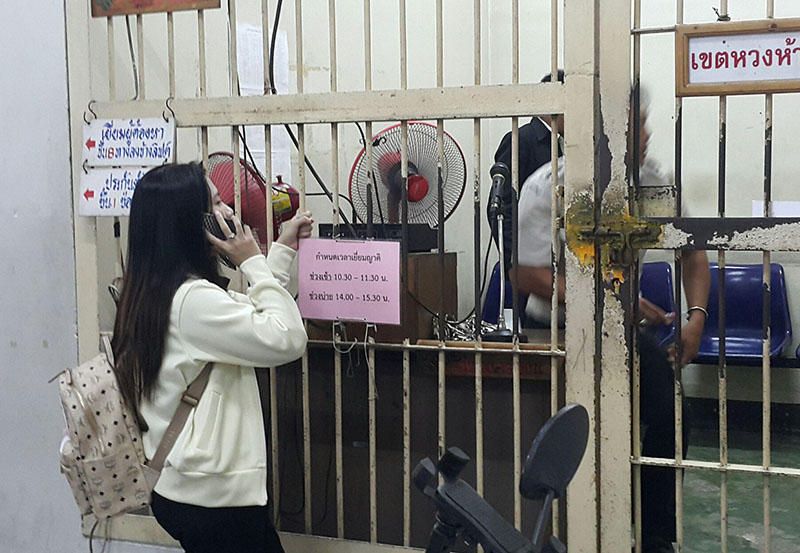
She also visited Sek in police custody in this Khaosod live video:

“To be honest, he’s not completely well yet. He’s still bipolar. So this stress makes me worried for his mental health,” Karn said. “I feel so sorry for him.”

S 22200323 1391333 1390713

Related stories:

Out of Hospital, Sek Loso Back Online to Say He’s Fine

Sek Loso is No-Show For Court Verdict

Untreated Mental Illness Left Sek Loso Delusional, Living in Filth: Son

Girlfriend, Ex-Wife Drag ‘Sek Loso’ to Hospital

Sup With Sek Loso’s Five-Day Facebook Live Meltdown?

Rocker Sek Loso Arrested After Police Standoff

Update: Police Seek Trigger-Happy Sek Loso on Gun Charge

Advertisement

Hospitals Imprison Patients in Thailand, Kenya, Congo, China

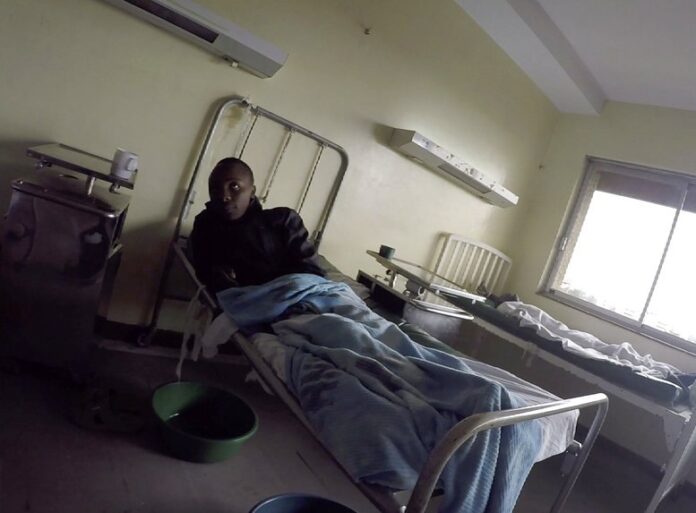
Detained patients lie on beds in August in the Kenyatta National Hospital in Nairobi, Kenya. Photo: Desmond Tiro / Associated Press

NAIROBI, Kenya — The Kenyatta National Hospital is east Africa’s biggest medical institution, home to more than a dozen donor-funded projects with international partners – a “Center of Excellence,” says the U.S. Centers for Disease Control and Prevention.

The hospital’s website proudly proclaims its motto – “We Listen … We Care” – along with photos of smiling doctors, a vaccination campaign and staffers holding aloft a gold trophy at an awards ceremony.

But there are no pictures of Robert Wanyonyi, shot and paralyzed in a robbery more than a year ago. Kenyatta will not allow him to leave the hospital because he cannot pay his bill of nearly 4 million Kenyan shillings (USD$39,570). He is trapped in his fourth-floor bed, unable to go to India, where he believes doctors might help him.

This is the first of a two-part series on hospitals that detain patients if they cannot pay their bills.

At Kenyatta National Hospital and at an astonishing number of other hospitals around the world, if you don’t pay up, you don’t go home.

The hospitals often illegally detain patients long after they should be medically discharged, using armed guards, locked doors and even chains to hold those who have not settled their accounts. Mothers and babies are sometimes separated. Even death does not guarantee release: Kenyan hospitals and morgues are holding hundreds of bodies until families can pay their loved ones’ bills, government officials say.

Dozens of doctors, nurses, health experts, patients and administrators told The Associated Press of imprisonments in hospitals in at least 30 other countries, including Nigeria and Congo, China and Thailand, Lithuania and Bulgaria, and others in Latin America and the Middle East.

The AP investigation built on a report last year by the British think-tank Chatham House; its experts found more than 60 press reports of patient detention in 14 countries in Asia and sub-Saharan Africa.

“What’s striking about this issue is that the more we look for this, the more we find it,” said Dr. Ashish Jha, director of the Harvard Global Health Institute, who was not involved in the British research. “It’s probably hundreds of thousands if not millions of people that this affects worldwide. It is not something that is only happening in a small number of countries, but the problem is that nobody is looking at this and it is way off the public health radar.”

Some examples:

– In the Philippines, Annalyn Manalo was held at Mount Carmel Diocesan General Hospital in Lucena City for 1½ months starting last December following treatment for heart problems. Administrators refused initially to allow her family to pay in installments – and the cost of each extra day in detention was added to the bill.

“We were treated like criminals,” said Manalo’s husband, Sigfredo. “The security guards would come and check on us all the time.”

– In Congo’s second city of Lubumbashi, the AP visited more than 20 hospitals and clinics and found that all but one routinely detained patients who failed to pay, even though the practice is illegal there.

– In Bangalore, India, Emmanuel Malagi was detained in a private hospital for three months after he was treated for a spinal tumor, according to his brother, Christanand. Prevented from seeing him, his family scrambled unsuccessfully to pay his nearly 1.4 million rupee ($19,281) bill – and when he died, the hospital demanded another 10 lakh ($13,771) to release the body.

– In Malaysia, a medical student from the Netherlands on a diving trip got the bends. He couldn’t afford his decompression treatment; the hospital locked him in a room for four days, with no food or drink, until he was able to get the money, according to Saskia Mostert, a Dutch academic who has researched hospital detentions.

–In Bolivia, a government ombudsman reported that 49 patients were detained in hospitals or clinics in the last two years because they couldn’t pay, despite a law that prohibits the practice.

During several August visits to Kenyatta National Hospital, The Associated Press witnessed armed guards in military fatigues standing watch over patients, and saw where detainees slept on bedsheets on the floor in cordoned-off rooms. Guards prevented one worried father from seeing his detained toddler. All despite a court ruling years ago that found the detentions were illegal.

Health experts decry hospital imprisonment as a human rights violation. Yet the United Nations, U.S. and international health agencies, donors and charities all have remained silent while pumping billions of dollars into these countries to support splintered health systems or to fight outbreaks of diseases including AIDS and malaria.

“It’s the dirty underbelly of global health that nobody wants to talk about,” said Sophie Harman, a health academic at Queen Mary University of London.

“People know patients are being held prisoner, but they probably think they have bigger battles in public health to fight, so they just have to let this go.”

Hospital detentions, some experts argue, can be traced to policies pushed decades ago by the World Bank, the World Health Organization, UNICEF and others who made loans to developing countries on condition that they charge patients fees for medical services. Without explicit protections in place to protect the poor, they say, the policies gave countries the freedom to extract health care payments however they saw fit – including detaining patients.

The practice appears to be most prevalent in countries with fragile, underfunded health systems where there is little government accountability. But the problem has also surfaced in wealthier countries, with patients being detained in hospitals in countries including India, Thailand, China and Iran.

In many countries when patients cannot afford to pay for health care, they are usually either sent to a public hospital where treatment is covered by the state or refused help altogether. In some hospitals in Cameroon and elsewhere, for example, the problem of patient imprisonment was solved by some institutions by simply demanding payment upfront.

Where patients are imprisoned, hospitals acknowledge it is not necessarily profitable. But many say it often leads at least to partial payment and serves as a deterrent.

Unlike many hospitals in developed countries, African hospitals don’t always provide food, clothing or bedding for patients, so holding onto them does not necessarily incur a significant cost. Detained patients typically rely on relatives to bring them food while those without obliging family members resort to begging for help from staff or other patients.

Dr. Festus Njuguna, a pediatric oncologist at the Moi Teaching and Referral Hospital in Eldoret, about 300 kilometers northwest of Nairobi, said the institution regularly holds children with cancer who have finished their treatment, but whose parents cannot pay. The children are typically left on the wards for weeks and months at a time, long after their treatment has ended.

“It’s not a very good feeling for the doctors and nurses who have treated these patients, to see them kept like this,” Njuguna said.

Still, some officials openly defend the practice.

“We can’t just let people leave if they don’t pay,” said Leedy Nyembo-Mugalu administrator of Congo’s Katuba Reference Hospital. He said holding patients wasn’t an issue of human rights, but simply a way to conduct business: “No one ever comes back to pay their bill a month or two later.”

At many Kenyan hospitals, including Kenyatta, officials armed with rifles patrol the hallways and guard the hospital’s gates. Patients must show hospital guards a discharge form to prove they’re allowed to leave and even visitors must sometimes surrender their identification cards before seeing patients.

In its 2016 financial report, Kenyatta’s auditor-general said the hospital lost more than $470,000 in fees from patients who “absconded” without paying. That year, the hospital reported total revenue of more than $115 million.

Patient detentions at Kenyatta have been flagged for years, among other concerns. In January, demonstrators called for an investigation into allegations of rape and sexual harassment of patients at the hospital. Kenya’s Human Rights Commission attempted to conduct an audit of Kenyatta, but officials refused to cooperate and have ignored all requests for information about detained patients.

“This is something that hospital authorities have been trying to keep under wraps,” said George Morara, vice chairperson of the country’s national commission on human rights. He said the number of Kenyans imprisoned in hospitals is “disturbingly high” and that the practice is “ubiquitous in public and private hospitals.”

He said patients have been held at Kenyatta for up to two years, and it was reasonable to suspect that hundreds of patients could be detained there at any time.

Kenya’s ministry of health and Kenyatta canceled several scheduled interviews with the AP and declined to respond to repeated requests for comment.

After she was elected to Kenya’s Parliament, Esther Passaris visited Kenyatta last December to check on supporters who were injured in election violence. She was stunned to find that patients were incarcerated.

“There was one lady I met in the corridor and she was crying, ‘please let me go home,'” Passaris said. The woman had hurt her back and hip. She had been medically cleared to leave, but wasn’t allowed to go home because she hadn’t paid her bill. “I just thought, ‘Oh my goodness, it’s almost Christmas, how can these people not go back to their families?'”

Passaris started an online campaign to have the patients released. Just before the holidays, Kenyatta let more than 450 leave – a victory, Passaris says, though the problem remains.

“Unfortunately,” she said, “you can’t get water from a rock, so some of these patients stay for a year because they don’t have the money.”

Foreign agencies and companies that operate where patients are held hostage typically have very little to say about it. Some experts said the international health community’s failure to address the issue has undermined its own goals.

“Aid money becomes ineffective and useless in an environment where people are terrified they’re going to be locked up,” said Robert Yates, a health policy expert at Chatham House, the British think tank that reported on imprisoned patients. “It’s very embarrassing for the global health community that these detentions have become so embedded into countries that they seem normal, and so the whistle needs blowing on all of us.”

Said Harvard’s Jha: “There are basic human rights abuses that we cannot ignore in the 21st century. It is not too much to ask that when private companies like pharmaceuticals or federal agencies like the CDC become aware that their partners engage in such a fundamental violation of human rights, that they hold them accountable and work to end these practices.”

The CDC provides about $1.5 million every year to Kenyatta and Pumwani Maternity Hospital, via funding from the President’s Emergency Plan for AIDS Relief, or PEPFAR. At Kenyatta, the CDC covers treatment costs for patients with HIV and tuberculosis, trains health workers and helps with HIV testing, among other programs. The agency declined to comment on whether it was aware that patients were regularly detained at Kenyatta and Pumwani or if the agency condones the practice.

Among its other partnerships, Kenyatta has been working with the University of Washington for more than 30 years. Dr. Carey Farquhar, director of the university’s Kenya Research and Training Center, said she didn’t recall seeing any detained patients at Kenyatta, though was not surprised that it happened – she knew of no hospitals there that did not detain patients.

“It does make me uncomfortable,” she said.

Farquhar said the issue “doesn’t cross our radar as much” since her university is focused on medical research, rather than patient care. She added that she might raise the issue with her colleagues at Kenyatta but that “the solution has to come from within.”

The drugmaker Novartis also partnered with Kenyatta for several years, helping pay for some of its doctors to study kidney transplant techniques at a Barcelona hospital. Novartis declined to comment on whether its staffers had seen detained patients at Kenyatta or whether it approved of the practice.

Dr. Agnes Soucat of WHO said the U.N. agency was aware of hospital detentions and confirmed they happened “quite frequently.”

“We do not support this in any way, but the problem has been documenting where it happens,” said Soucat, director of WHO’s department of health systems, financing and governance. To date, WHO has made no attempt to collect data on hospital detentions and says such information is hard to find. The AP obtained patient lists, records and bills from about a dozen hospitals in Congo detailing imprisonment practices.

And though WHO has issued hundreds of health recommendations – from treating AIDS to Zika – the agency has never published any guidance advising countries not to imprison people in their hospitals.

Soucat said WHO officials in more than a dozen countries had expressed their concerns about detained patients to ministers of health, but that those discussions were private.

One international organization did fight publicly for detained patients.

Researchers for the Center for Reproductive Rights, which acts to support women’s health around the world, were conducting a study of maternal health care in Kenya in early 2012 when they learned of the cases of Maimuna Awuor Omuya and Margaret Oliele.

Unable to pay her bill at Pumwani Maternity Hospital after the delivery of her sixth child, Omuya and her baby were imprisoned along with more than 60 other women in a damp ward, in September 2010. She often slept on the wet ground next to a flooded toilet. Mother and child were released after nearly a month, but only when one of Omuya’s friends appealed to the mayor to intervene.

Two months later, Oliele arrived at Pumwani. During a botched cesarean section, doctors left a pair of surgical scissors inside Oliele’s stomach; a second surgery was needed to remove the scissors and she later suffered a ruptured bladder and a blood infection. When she couldn’t pay her hospital fees, Oliele was taken to a detention ward.

“I tried to escape, but when I got to the main gate, I was taken by the security guards,” Oliele told AP. “I had no clothes on and still had the catheter in my stomach. The guards then forcefully took me back to the hospital where they handcuffed me to a bed, while claiming that I had gone mad.” She was held for six days.

Center for Reproductive Rights lawyers resolved to take up the cause of detained patients, bringing suit on behalf of Omuya and Oliele.

“These were two very appalling cases and their treatment was very degrading,” said Evelyne Opondo, a senior regional director at the center who oversaw the case.

They won. In September 2015, Kenya’s High Court ruled the women’s detention violated numerous human rights enshrined in the constitution and was therefore illegal. The High Court described the women’s detention as “cruel, inhuman and degrading.” The court further ordered the Kenyan government to “take the necessary steps to protect all patients from arbitrary detention in health care facilities.”

But three years later, it appears little has changed.

“People are still being detained,” Oliele said. “They should stop treating people like animals and treat them as fellow human beings.”

Opondo said detentions continue because nobody has asked hospitals “to provide answers, because they’ve not been held accountable.” She estimated there could be many thousands of people across the country detained, based on information received by the center and news reports.

Although the court instructed the government to produce guidelines on how hospitals should waive fees for patients unable to pay, Opondo said the proposed fixes have not gone far enough. A program that provides free maternity care is only available at a select number of private hospitals and does not include post-delivery care.

Earlier this month, Kenya’s High Court ruled again that imprisoning patients “is not one of the acceptable avenues (for hospitals) to recover debt.” The case involved a man detained at Nairobi Women’s Hospital since June 25; the judge ordered his immediate release despite the outstanding bill. Kenyan politicians also will soon debate a proposed amendment to the country’s health law that will explicitly make patient detentions illegal.

The latest amendment was submitted by MP Jared Okelo, a member of Parliament who described the imprisonment of mothers as “rampant.”

Omuya is still scarred by her detention at Pumwani. She says she developed chronic pneumonia after being held in the damp, cold conditions there and has not been able to work full-time since.

Neither Omuya nor Oliele have been paid the damages awarded to them by the court: Omuya was to receive 1,500,000 shillings ($14,842) from the hospital while Oliele was to receive 500,000 shillings ($4,948).

And Omuya’s family has had another run-in with a Nairobi hospital.

Several months ago, Omuya’s youngest brother was admitted to Mbagathi District Hospital after falling ill and collapsing.

“We don’t know what it was, but the doctors told us he needed many medications to treat, that it was a poisoning,” she said.

Doctors completed their treatment and presented her brother with a bill of about 134,000 shillings ($1,326).

When Omuya and her family were unable to raise the necessary funds, the situation took an unwelcome but familiar turn: her brother was imprisoned. Hospital managers asked the family to pay at least half the outstanding amount, but after about a month and a half, they had only scraped together about $120. Omuya said her brother was freed only when his doctor negotiated his release.

“Detentions still go on because there are no rights here,” she said. “What I suffered, I want no one else to suffer.”

Story: Maria Cheng

Related stories:

Doctors in Squalor, Patients on Balconies at Cash-Starved Hospitals

Advertisement

Asia Shares Skid, Tokyo Down 3.6%, After Rout on Wall St

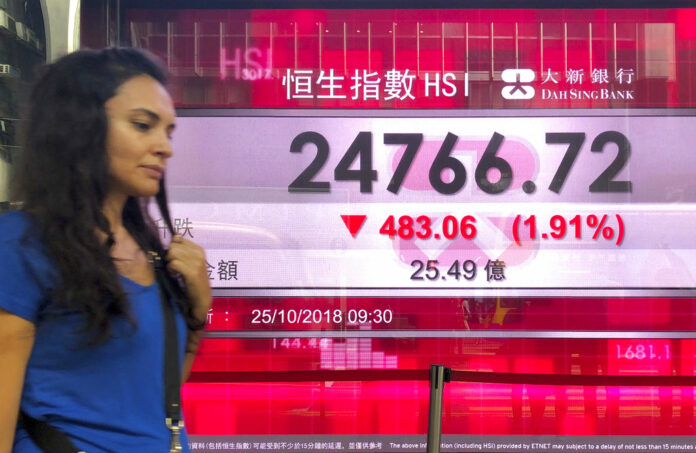
A woman walks past an electronic board showing Hong Kong share index outside a local bank Thursday in Hong Kong. Photo: Vincent Yu / Associated Press

BANGKOK — Shares tumbled in Asia on Thursday, led by declines in semiconductor makers and other technology-oriented shares, after another torrent of selling on Wall Street.

Japan’s Nikkei 225 index sank sharply on the open but regained some lost ground, falling 3.7 percent to 21,267.18. The Shanghai Composite index slipped 1.4 percent to 2,567.92 and Hong Kong’s Hang Seng index skidded 2.1 percent to 24,721.31. Thailand’s SET was trading at 1,602.11 on Thursday morning, a 1.3 percent drop.

As in New York, losses were heaviest for technology companies. Semiconductor maker Tokyo Electron lost 4 percent and Taiwan Semiconductor Manufacturing Co. dropped 4.4 percent. South Korea’s Samsung Electronics sank 3.8 percent. Japanese telecoms and energy giant Softbank lost 4.1 percent.

But other sectors also felt the pain.

Toyota Motor Corp. gave up 2.1 percent while Hong Kong-based retail supply chain giant Li & Fung Ltd. lost 2 percent. Also in Hong Kong, airline Cathay Pacific’s shares dropped as much as 6.5 percent after it said it had discovered a data breach affecting 9.4 million passengers.

Futures trading suggested losses might reverse on the open in New York. The contract for the S&P 500 was up 0.2 percent at 2,670.80 while that for the Dow Jones Industrial Average edged up less than 0.1 percent to 24,620.00.

Recent volatility in U.S. markets has weighed on Asian markets for some time, despite relatively strong growth in the region.

“If people are struggling to find a driver I suggest, they wake up and smell the coffee,” Stephen Innes of OANDA said in a commentary.

“With the worrisome prospect of U.S. tax cuts having a much shorter shelf life than expected and with the asynchronous global growth sinkhole expanding, equities will have no place to go except into the tank, taking global risk sentiment along with it,” he said.

Elsewhere in Asia, South Korea’s Kospi fell 2 percent to 2,053.75 and the S&P ASX/200 dropped 2.2 percent to 5,701.80. India’s Sensex fell 0.7 percent to 33,781.56. Shares were lower in most markets apart from Indonesia.

Still, some market observers were taking the latest volatility in stride.

“I think the Hong Kong market is really very close to bottom, because when you look at the value, it’s very extremely cheap. So how low can it get? Maybe it will reach 24,000 before we find the bottom,” said analyst Francis Lun of Geo Securities.

New York trading overnight saw the Nasdaq composite with its hefty roster of tech stocks bear the brunt of the sell-off. It has now fallen more than 10 percent below its August peak in what Wall Street calls a “correction,” losing 4.4 percent on Wednesday to 7,108.40. That was its biggest drop since August 2011 but it is still up 3 percent for the year.

The S&P 500 lost 3.1 percent to 2,656.10 and has lost about 9.4 percent from its Sept. 20 peak. The Dow tumbled 2.4 percent to 24,583.42. The Russell 2000 index of smaller-company stocks gave up 3.8 percent to 1,468.70 and is down 4.4 percent for the year.

Disappointing quarterly results and outlooks are stoking investors’ jitters over future growth in corporate profits. Bond prices rose, sending yields lower as traders sought safe-haven investments.

“Investors are on pins and needles,” said Erik Davidson, chief investment officer at Wells Fargo Private Bank. “There has definitely been a change in sentiment for investors starting with the volatility we had last week. The sentiment and the outlook seems to be turning more negative, or at the very least, less rosy.”

Investors are increasingly concerned that corporate America’s tax cut-fueled earnings growth this year will fade in coming months amid rising inflation, uncertainty over the escalating trade conflict between the U.S. and China and the likelihood of higher interest rates. Recent signs that the housing market is cooling are fueling speculation that U.S. economic growth will start to slow next year.

Bond prices rose, sending the yield on the 10-year Treasury note down to 3.12 percent from 3.16 percent late Tuesday. The slide in bond yields came as traders sought out lower-risk assets.

Technology stocks and media and communications companies accounted for much of the selling. Banks, health care and industrial companies also took heavy losses, outweighing gains by utilities and other high-dividend stocks.

Most companies that missed earnings expectations or issued cautionary outlooks were punished.

AT&T sank after reporting weak subscriber numbers, and chipmaker Texas Instruments fell 8.2 percent after reporting slumping demand.

Shares in iRobot plunged 12.3 percent to USD$80.49 after the robotics technology company said tariffs will reduce its profitability in the fourth quarter.

United Parcel Service slid 5.5 percent to $107.93 after the shipping company reported weak international revenue, while the strong dollar and high fuel prices also hurt its results.

About 24 percent of the companies in the S&P 500 had reported third-quarter results as of Wednesday. Of those, 57 percent delivered earnings and revenue results that topped Wall Street’s forecasts.

High-flying companies like Netflix and Amazon took some of the biggest losses Wednesday. Netflix gave back 9.4 percent to $301.83 and Amazon dropped 5.9 percent to $1,664.20.

AT&T was among the big decliners in the media and communications sector, dropping 8.1 percent to $30.36 after the communication giant’s latest quarterly results fell short of Wall Street’s expectations.

Boeing was one of the few gainers Wednesday. It rose 1.3 percent to $354.65 after the defense contractor’s latest quarterly results topped analysts’ forecasts. The company also raised its estimates for the year, citing faster orders for aircraft.

In other trading, benchmark U.S. crude lost 71 cents to $66.11 per barrel in electronic trading on the New York Mercantile Exchange. On Wednesday it edged up 0.6 percent to settle at $66.82 a barrel in New York. Brent crude, used to price international oils, declined 72 cents to $75.45 a barrel.

The dollar weakened to 112.04 yen from 112.23 yen. The euro rose to $1.1408 from $1.1393.

Story: Elaine Kurtenbach

Advertisement

Cambodian Refugee Who Killed as 14-Year-Old Seeks Pardon

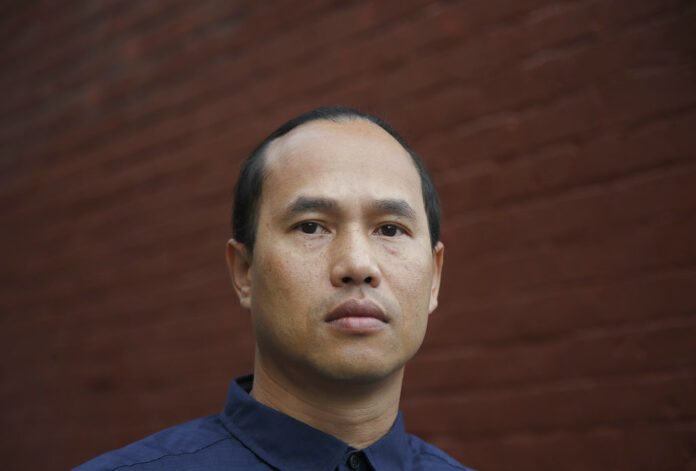
Borey Ai poses for a photo Tuesday outside of the Asian Americans Advancing Justice-Asian Law Caucus in San Francisco, California. Photo: Jeff Chiu / Associated Press

SACRAMENTO, California — By his own account, Borey Ai was a 14-year-old gangster when he killed a woman during a robbery that netted about $300.

He spent 19 years in prison before parole officials decided he had turned his life around. He walked out of San Quentin prison in November 2016 and into the custody of waiting federal immigration agents.

Ai is now 37 and asking California Gov. Jerry Brown to wipe away his criminal conviction and likely prevent his deportation to Cambodia, a nation where his mother was born but he has never seen. After prison, he spent 18 months in federal detention but was freed in May after Cambodia refused to accept him – for now.

Parole officials recommended a pardon for Ai last week. Dozens of advocates turned in more than 36,000 signatures Wednesday asking Brown to pardon Ai and others before he leaves office in January.
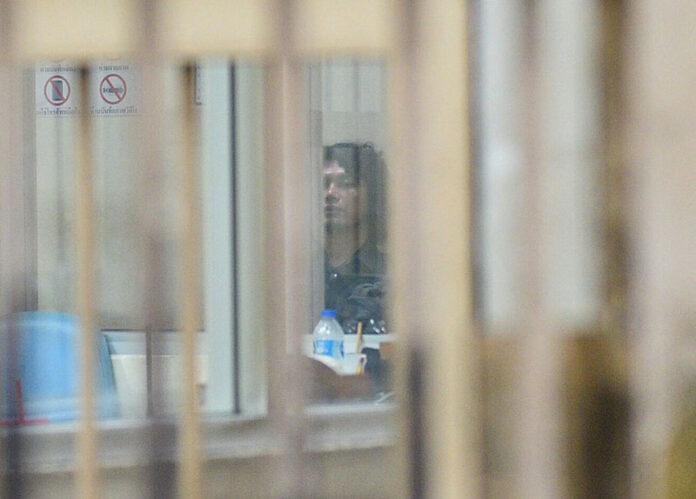

They held 60 origami cranes and rang a Buddhist bell 60 times, one for each of the 60 people nationwide they said are facing deportation to Cambodia. About half are from California, given its large Cambodian population, and about a dozen have pardon petitions before Brown, with more on the way, said Angela Chan, a spokeswoman for Asian Americans Advancing Justice-Asian Law Caucus.

The prospect frustrates relatives of Ai’s victim, Manijeh Eshaghoff. The governor in the last 10 months has pardoned seven ex-convicts who otherwise faced the threat of deportation to Cambodia, bringing an angry tweet from President Donald Trump in March.

Ai was tried as an adult, pleaded guilty to second-degree murder and was sentenced to 25 years to life in prison after California dropped the minimum age for trying juveniles as adults from 16 to 14 in 1995. California this year reversed course, barring any 14- or 15-year-olds from being tried outside the juvenile system, even for murder.

According to a Human Rights Watch analysis of California data, 87 14-year-olds were prosecuted for murder as adults from 2007 to 2016. Convictions are not broken down by age.

There are parallels between Ai’s journey and that of the woman he killed. Both are from immigrant families who fled oppression from opposite sides of the world only to tragically intersect in a strip mall convenience store in San Jose shortly before midnight on Feb. 4, 1996.

Ai’s mother fled Cambodia’s genocidal Khmer Rouge regime. He was born in a Thai refugee camp and came to the U.S. when he was 4 as a refugee with permanent legal resident status.

His family lived among Stockton’s large Cambodian community, but Ai recalls growing up in a troubled area plagued by drugs, gangs and prostitution. He saw his 7-year-old cousin and four other children fatally shot at Cleveland Elementary School in 1989 in a mass shooting that targeted immigrant children.

At 12, he joined a street gang that “became like my sense of family,” he said in an interview with The Associated Press.

At 14, he was the youngest of four who robbed Eshaghoff’s convenience store and killed her. Ai said he accidentally shot her when she grabbed his gun and he jerked back with his finger on the trigger. She was 52.

Her son David Esh, who uses a shortened version of his family’s name, was 25 when she died.

“She bled out in less than a minute – it was instant how quickly she died. That’s the only solace I’ve had over the years; she didn’t suffer,” he told AP.

His father, Essag, was standing a few feet away and held his wife as she died, soaked in her blood.

“This was premeditated murder, accident or not,” Esh said. “They already had the money, all he had to do was run.”

Like Ai’s mother, Esh’s father had fled for his life from his home country. An Iranian Jew, he had done work for the shah before the Iranian Revolution in 1979.

“My father fled in the trunk of a car through the desert,” Esh said. “They worked hard. They sacrificed.”

Esh wants the governor to deny Ai’s pardon request. A majority of the state Supreme Court will have to agree that Ai may be pardoned before Brown makes his decision.

By all accounts, Ai turned his life around in prison, joining or starting several anti-gang and anti-violence groups and becoming a counselor – work he continues with three nonprofits while on lifetime parole.

His pardon application includes nearly 300 pages documenting accomplishments and good deeds. Twelve state lawmakers who are part of the California Asian & Pacific Islander Legislative Caucus are among those supporting it.

The Trump administration began cracking down on immigrant communities and pressuring reluctant nations like Cambodia to accept the return of their citizens, said one of Ai’s attorneys, Anoop Prasad of the Asian Law Caucus’ Immigrant Rights Program.

A governor’s pardon doesn’t automatically stop deportation proceedings, but it eliminates the convictions on which authorities based their deportation.

“I understand and appreciate that he’s gone through and served his sentence and perhaps is trying to be a positive person in society,” Esh said. Yet, “he gave us all a life sentence, and he’s going to walk free and have a pardon as if this never happened?”

Ai said he understands.

“My crime caused pain and a ripple effect forever. Because of that, I have a moral responsibility to continue to be a citizen of my community, continue to honor that memory,” Ai said.

The governor usually reserves pardons for offenders who completed their sentences long ago. Santa Clara County Deputy District Attorney Aaron West argued that Ai has been free for only months and has no track record of being a benefit to the community.

Every case is assessed on its own merits, said Brown’s press secretary, Evan Westrup, adding that “the voices of victims and their families are profoundly important in every request the governor considers.”

Story: Don Thompson

Advertisement

February Elections Jeopardize Rollout of Thai Medical Weed

A local district chief in Loei province confiscates marijuana found there in September.

BANGKOK — Health officials said Wednesday that the full rollout of medical cannabis is unlikely to happen as scheduled due to a legislative holdup if February elections go forward and a new government comes to power.

Lawmakers have quibbled over details in a broad rewrite of the Narcotics Act that would partially decriminalize a number of drugs including cannabis and kratom. Although companion legislation enabling medical cannabis is close to passage, it would only allow a limited form of it until the revision of the act is in place.

Meanwhile the military government has proposed fast-tracking a stopgap measure that would decriminalize only cannabis for research and medical use.

On Wednesday, a member of the special parliamentary committee provisioning the new law said it is unlikely to pass before elections slated for February, as the latest debate recently ended with no major breakthroughs.

Chulalongkorn University neurologist Thiravat Hemachudha, a legislative committee expert, said Wednesday that holding the election in February would dampen hopes for medical weed.

“The timeline indicates that these pieces of sub-legislation could be completed by April 2019. But if the election is actually held in February, it won’t be done under this government,” he said.

Despite the military government’s interest in overhauling drug policy before a new administration comes to power, junta leader Gen. Prayuth Chan-ocha has ignored calls to invoke his absolute power to speed up the process.

Thiravat said four additional legislative subcommittees will be set up to devise subordinate laws to make the new bill more effective in terms of regulation and rehabilitation.

The military has meanwhile proposed a separate law that would only legalize cannabis for medical and research purposes, details of which Thiravat said yesterday were still being discussed, such as who would be authorized to prescribe the drug and whether private cultivation would be allowed.

As for a way to fast-track the process, Thiravat said the Food and Drug Administration could propose regulatory changes directly to the Health Ministry, which has been authorized by the National Legislative Assembly to work on the new narcotics bill’s subordinate laws, including reclassifying the Class 5 narcotics into Class 2, which would allow limited medical use.

Tares Krassanairawiwong of the FDA however said the Health Ministry could only legalize the medical use of cannabinoid extract, aka CBD, which is used to treat patients but does not contain THC, the psychotropic narcotic compound found in cannabis.

A grey market for CBD already exists in Thailand, commonly for patients undergoing chemotherapy.

Tares added that the department would assume sole authority over the regulation and distribution of medical cannabis once it becomes legal, under guidelines similar to morphine. Use would be limited to treating nausea in cancer patients, epilepsy in children unresponsive to other treatment, multiple sclerosis and severe pain.

Expert committee member Thiravat said legalization should apply to cannabis – not just CBD extracts – to make it available to folk medicine practitioners and people in remote areas.

“The current use of marijuana as medicine can almost be standardized. We can already tell that how much should be used for a particular symptom or disease,” he said. “This practice exists in every region of the country, but people in general don’t know about it because it’s illegal.”

He said he would collect research data on patients, mostly suffering from cancer, epilepsy, or chronic seizures, who use marijuana to relieve pain and report its benefits to the legislative committee, which includes members from the FDA.

“I want them to know that using marijuana as folk medicine can actually save people’s lives,” Thiravat said. “Although it’s a life-saving method and can improve the quality of life, it’s still illegal.”

Correction: A previous version of this article indicated medical use of opium would also be allowed as it was also a Category 5 drug. In fact it is Category 2 and such uses are already allowed.

Related stories:

Lawmakers Eye Article 44 to Speed Cannabis Law

Medical Thai Weed Gets a Launch Date

Cabinet Green-Lights Medical Weed and Kratom

Advertisement

Police Say Canuck Scammed Thai Students With Bogus US Jobs

Police arrest Michael Roberge on Thursday morning in Bangkok.

BANGKOK — Police on Thursday morning arrested a Canadian national who allegedly scammed university students by promising them jobs in the United States.

Police Col. Arun Wachirasisukanya arrested Michael Roberge, 37, on the 18th floor of the Amarin Plaza building in Bangkok’s Pathum Wan area. He was charged with scamming dozens of university students for 150,000 baht each after promising them paid internships in the states. Authorities on Thursday were looking for additional possible victims.

“Two people who got scammed came to the police, but there should be more because he opened an entire company to do this. I think some people filed criminal cases, some didn’t,” Arun said by phone. “So we are spreading the word about him first, to see if any more victims come forward.”

Arun said Roberge told university students he could secure them paid internships at the Pittsburgh Marriott City Center hotel in Pennsylvania. Roberge allegedly promised them hourly wages of USD$15 (460 baht), in exchange for 150,000 baht to cover visa, documentation and travel expenses.

Arun also said Roberge advertised life in the Sunshine State to wide-eyed college students. He allegedly scammed the same 150,000 baht from people who believed he would secure them a job at a Thai restaurant in Miami for an hourly salary of USD$8, or 260 baht.

In both cases, students said they couldn’t contact Roberge after transferring the money. Police said he opened a company called Work West in Chiang Mai city to recruit students. The Canadian said he owns Work West, but blamed the scam on a Thai employee.

Roberge’s arrest warrant was issued by a Chiang Mai court in July 2017. He was arrested on charges of illegally running an overseas employment business – punishable by 10 years in prison and a 200,000 baht fine – and benefiting from overseas employment fraud, which carries the same penalties.

Police investigator Visanut Bangnamkhen said he believes there could be dozens of victims.

“Actually, this company processed thousands of students. Some did go overseas and some didn’t. Michael is still denying that he scammed anyone and says the Thai employees did it all, but there’s no police summons for them yet,” Capt. Visanut said, referring to Roberge.

Visanut said the alleged crimes occurred in 2013.

Image from iOS 6 Image from iOS 7

Correction: A previous version of this story said the warrant for Michael Roberge was issued in July. In fact, it was issued in July 2017.

Advertisement

Storm, Flood, Fire Warnings as Cold Season Begins Saturday

Doi Inthanon, Chiang Mai.

BANGKOK — Thais might need sweaters while Europeans will continue wearing shorts come Saturday, which has been deemed the official start of this year’s cold season.

The roughly four-month season will see its coolest weather mid-December and January, according to the national weather agency, with the chilliest temperatures felt the soonest in the north and northeast.

Provinces including Chiang Rai, Tak, Phayao, Nan, Loei, Sakon Nakhon and Nakhon Phanom could see temperatures fall below 8C.

The capital and central region will see a less drastic cooling, with average lows of about 20. Meteorologists said Bangkok should expect weather similar to that of last year.

The south won’t catch much of the cool wave due to ongoing monsoon season conditions. Provinces on the gulf will experience torrential rains and be at risk for flash flooding. Residents on the Andaman side will see colder, drier air with strong winds creating a potential wildfire hazard.

Advertisement

Malaysian Ex-PM, Former Treasury Chief Charged With Graft

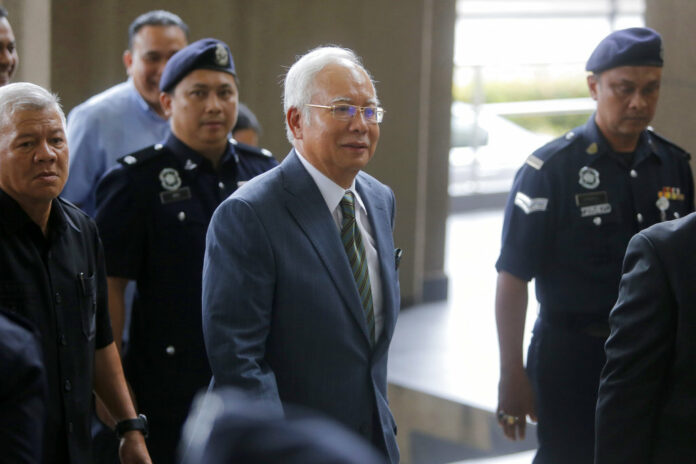
Former Malaysian Prime Minister Najib Razak, center, arrives at High Court of Malaya in Kuala Lumpur, Malaysia, Wednesday, Aug. 8, 2018. Photo: Yam G-Jun/ Associated Press

KUALA LUMPUR — Former Malaysian Prime Minister Najib Razak and his ex-treasury chief have been jointly charged with criminal breach of trust involving 6.64 billion ringgit (USD$1.6 billion).

The six new charges against Najib on Thursday come on top of 32 earlier counts of corruption, breach of trust and money laundering that he face linked to the multibillion-dollar looting of the 1MDB state investment fund. That scandal led to his coalition’s shocking ouster in May’s national polls.

Both Najib and former treasury secretary-general Mohamad Irwan Serigar Abdullah pleaded not guilty to misappropriating government funds between December 2016 and December 2017. The charge sheets said part of the money was subsidy for the poor and airport management budget but gave no further details. Local media reported the funds were used to pay 1MDB debts.

Advertisement

Share Sell-Off Moderates in Asia After Rout on Wall Street

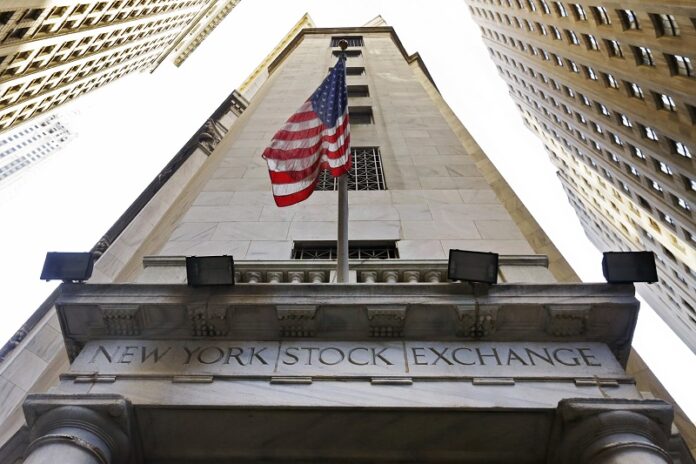
The American flag flies in 2015 above the Wall Street entrance to the New York Stock Exchange. Photo: Richard Drew / Associated Press

BANGKOK — Shares fell moderately in Asia on Thursday after another torrent of selling on Wall Street sent the Dow Jones Industrial Average plummeting more than 600 points, erasing its gains for the year.

Thailand’s SET was trading at 1,602.11, a 1.3 percent drop. Japan’s Nikkei 225 index sank sharply on the open but leveled off, regaining some lost ground. By mid-morning it was down 2.9 percent at 21,443.72. The Shanghai Composite index slipped 1.6 percent to 2,561.36 and Hong Kong’s Hang Seng index skidded 1.8 percent to 24,785.68.

Charts for the entire region were awash with the red that indicates losses, but the declines were mostly in the 2 percent to 3 percent range.

“Coming online with the overtly risk-off backdrop from U.S. markets, investors in the Asian region would be taking the cue to head for the doors,” Jingyi Pan of IG said in a commentary.

In Hong Kong, airline Cathay Pacific’s shares dropped 6.5 percent after it said it had discovered a data breach affecting 9.4 million passengers.

In New York trading overnight, the Nasdaq composite with its hefty roster of tech stocks bore the brunt of the sell-off, falling more than 10 percent below its August peak, what Wall Street calls a “correction.” It slid 4.4 percent to 7,108.40, its biggest drop since August 2011 but is still up 3 percent for the year.

The S&P 500 lost 3.1 percent to 2,656.10 and has lost about 9.4 percent from its Sept. 20 peak. The Dow tumbled 2.4 percent to 24,583.42. The Russell 2000 index of smaller-company stocks gave up 3.8 percent to 1,468.70 and is down 4.4 percent for the year.

Disappointing quarterly results and outlooks are stoking investors’ jitters over future growth in corporate profits. Bond prices rose, sending yields lower as traders sought safe-haven investments.

“Investors are on pins and needles,” said Erik Davidson, chief investment officer at Wells Fargo Private Bank. “There has definitely been a change in sentiment for investors starting with the volatility we had last week. The sentiment and the outlook seems to be turning more negative, or at the very least, less rosy.”

Investors have grown concerned in recent weeks that Corporate America’s tax cut-fueled earnings growth this year will fade in coming months amid rising inflation, uncertainty over the escalating trade conflict between the U.S. and China and the likelihood of higher interest rates. Recent signs that the housing market is slowing are fueling speculation that U.S. economic growth will start to slow next year.

Bond prices rose, sending the yield on the 10-year Treasury note down to 3.12 percent from 3.16 percent late Tuesday. The slide in bond yields came as traders sought out lower-risk assets.

Technology stocks and media and communications companies accounted for much of the selling. Banks, health care and industrial companies also took heavy losses, outweighing gains by utilities and other high-dividend stocks.

Most companies that missed earnings expectations or issued cautionary outlooks were punished.

AT&T sank after reporting weak subscriber numbers, and chipmaker Texas Instruments fell 8.2 percent after reporting slumping demand.

Shares in iRobot plunged 12.3 percent to USD$80.49 after the robotics technology company said tariffs will reduce its profitability in the fourth quarter.

United Parcel Service slid 5.5 percent to $107.93 after the shipping company reported weak international revenue, while the strong dollar and high fuel prices also hurt its results.

About 24 percent of the companies in the S&P 500 had reported third-quarter results as of Wednesday. Of those, 57 percent delivered earnings and revenue results that topped Wall Street’s forecasts.

High-flying companies like Netflix and Amazon took some of the biggest losses Wednesday. Netflix gave back 9.4 percent to $301.83 and Amazon dropped 5.9 percent to $1,664.20.

AT&T was among the big decliners in the media and communications sector, dropping 8.1 percent to $30.36 after the communication giant’s latest quarterly results fell short of Wall Street’s expectations.

Boeing was one of the few gainers Wednesday. It rose 1.3 percent to $354.65 after the defense contractor’s latest quarterly results topped analysts’ forecasts. The company also raised its estimates for the year, citing faster orders for aircraft.

In other trading, benchmark U.S. crude lost 50 cents to $66.34 per barrel in electronic trading on the New York Mercantile Exchange. On Wednesday it edged up 0.6 percent to settle at $66.82 a barrel in New York. Brent crude, used to price international oils, declined 56 cents to $75.61 a barrel.

The dollar weakened to 112.08 yen from 112.23 yen. The euro rose to $1.1412 from $1.1393.

Story: Elaine Kurtenbach

Advertisement

Hot News

LATEST NEWS

Bangkok
scattered clouds
30.5 ° C
30.5 °
30.5 °
73 %
5.3kmh
46 %
Sat
30 °
Sun
36 °
Mon
36 °
Tue
32 °
Wed
35 °