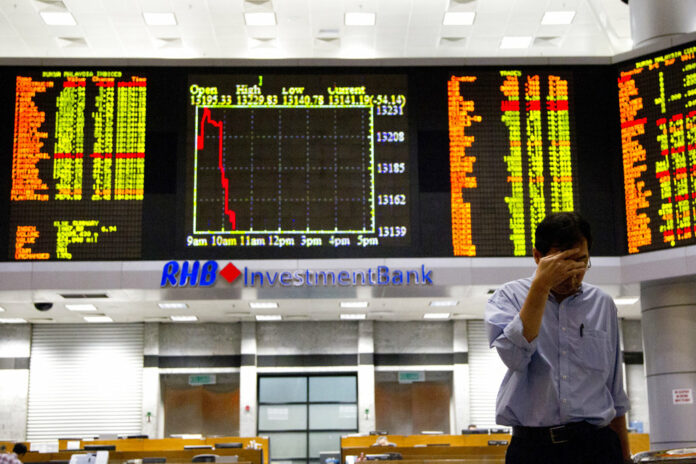
An investor walks in front of trading boards at a private stock market gallery in September in Kuala Lumpur, Malaysia. Photo: Yam G-Jun / Associated Press
SINGAPORE — Asian shares are mixed, trading in a narrow range Thursday after news of a fresh round of tariffs by the U.S. on USD$200 billion in Chinese goods drew a muted reaction on Wall Street.
Keeping Score
Japan’s Nikkei 225 was less than 0.1 percent higher at 23,674.93 after the ruling Liberal Democratic Party gave Prime Minister Shinzo Abe the go-ahead for a third term, ending in 2021. The Kospi in South Korea added 0.7 percent to 2,325.45. Hong Kong’s Hang Seng index was flat at 27,401.53. The Shanghai Composite index dropped 0.1 percent to 2,727,31. Australia’s S&P/ASX 200 shed 0.3 percent to 6,170.90. Shares rose in Indonesia and Thailand but fell in Taiwan and Singapore.
Wall Street
Major U.S. indexes were mixed on Wednesday as gains by banks and other financial companies balanced out losses elsewhere in the market. Bond yields surged to their highest level in four months, driving demand for bank stocks and triggering a sell-off in utilities and real estate companies. The S&P 500 index gained 0.1 percent to 2,907.95. The Dow Jones Industrial Average added 0.6 percent to 26,405.76. The Nasdaq composite fell 0.1 percent to 7,950.04. The Russell 2000 index of smaller-company stocks dropped 0.5 percent to 1,702.93.
US-China Trade
Starting Monday, the U.S. will place a 10 percent tariff on $200 billion more in Chinese goods. The tariffs will rise to 25 percent on Jan 1. Beijing has said it would take “counter measures,” which includes hitting $60 billion worth of U.S. imports, including coffee, honey and industrial chemicals, with retaliatory taxes. There was no word on whether China would back out of trade talks it said it was invited to by the U.S., but a Chinese Commerce Ministry statement said the U.S. increase “brings new uncertainty to the consultations.” The Trump administration has said it remains open to negotiations with China.
Analyst’s Take
“Indeed, U.S investor and traders, in general, are showing little sensitivity to U.S tariff implementations, at least at current levels anyway,” Stephen Innes of OANDA said in a commentary. “So, with investors in evaluation mode and with both the U.S and China likely to resume negotiations, expectations are still there for a resolution before President Trump deems it necessary to double down on tariffs,” he added.
Energy
Oil prices rose on news that U.S. crude inventories fell last week and are now running at about 3 percent lower than the five-year average for this time of the year. Benchmark U.S. crude gained 51 cents to $71.28 a barrel in electronic trading on the New York Mercantile Exchange. The contract settled at $70.77 a barrel on Wednesday. Brent crude, used to price international oils, added 38 cents to $79.78 a barrel. It added 0.5 percent to $79.40 a barrel in London.
Currencies
The dollar eased to 112.20 yen from 112.29 yen. The euro strengthened to $1.1689 from $1.1674.
Empty shelves, normally stocked with strawberry punnets, are seen Friday at a Coles Supermarket in Brisbane, Australia. Photo: Dan Peled / Associated Press
MELBOURNE — Public fears about sewing needles concealed inside strawberries on supermarket shelves have spread across Australia and New Zealand as growers turn to metal detectors and the Australian government launches an investigation to restore public confidence in the popular fruit.
The government of Queensland state, where the contamination scare started last week, offered a 100,000 Australian dollar (USD$72,000) reward for information leading to the arrest of the person responsible for inserting needles into strawberries after six brands – Donnybrook Berries, Love Berry, Delightful Strawberries, Oasis, Berry Obsession and Berry Licious – were recalled.
The scare had spread across the nation by Monday, with needles reported found in strawberries in all six Australian states. No injuries have been reported.
Federal Health Minister Greg Hunt ordered the national food safety watchdog to investigate Queensland’s handling of the needle scare.
He directed Food Standards Australia New Zealand to investigate whether there are supply chain weaknesses that need to be fixed.
“The job is very, very clear. Protect the public and keep them safe,” Hunt told Australian Broadcasting Corp.
Both of New Zealand’s major food distributors, Foodstuffs and Countdown, announced on Monday they are taking Australian strawberries off their shelves because of the scare.
New Zealand imports Australian strawberries when they are out of season locally from April to September, and both chains say the home-grown product will be on supermarket shelves soon.
Queensland Strawberry Growers Association vice president Adrian Schultz said what had started as a single act of “commercial terrorism” had brought a multimillion-dollar industry to its knees.
“I’m angry for all the associated people, it’s the farmers, the people who supply them, the packaging people, the truckies with families to support, who suddenly lose their jobs … it’s far-reaching,” Schultz said.
Major Australian supermarket chains Coles and Aldi have pulled all strawberries from their shelves across Australia except in Western Australia state as a precaution.
But Western Australia police announced Monday that the first suspected needle contamination case has been reported in locally grown fruit.
A man in the town of York reported to police that he found a needle in a sink after washing strawberries.
The report came after a 7-year-old girl in South Australia state found a needle in a Western Australia-grown strawberry on Saturday.
Western Australia Health Minister Roger Cook said the needle could have been inserted in the fruit after it arrived in South Australia.
Strawberry Growers Association of Western Australia president Neil Handasyde said growers had received requests from major retailers and insurance companies to scan fruit for needles.
“As an industry we are sure that (the needles) are not coming from the farm, but we’re trying to get confidence into consumers that when they buy … strawberries, that there isn’t going to be anything other than strawberries in there and they’re safe to eat,” Handasyde told ABC.
“Industry are looking at lots of different ways of tackling this issue. There’s been metal detectors purchased and tamper-proof packaging looked at,” he said.
Handasyde said he paid AU$20,000 for a metal detector for his berry farm.
Actor Tarinda Kanasoot filed complaints with police Wednesday over a crane that collapsed near her house in Silom.
BANGKOK — Police on Thursday said the construction company responsible for a crane that collapsed and injured three will seek to avoid criminal liability by privately settling with the victims tomorrow.
After several victims accused the contractor behind last week’s accident of dodging responsibility, police said they should seek compensation from the company’s insurer Friday at the local police station. An investigator said they haven’t been able to file any charges yet, nearly a week after the accident.
“Many victims have come forward since the accident,” Capt. Mongkol Praisoon said. “We still can’t file any charges because we’re waiting for medical reports of those injured to see how serious their condition was.”
“As for compensation, that will be the responsibility of the insurance company,” he added
The crane fell Friday morning at the site where an apartment complex is being built in the middle of Sala Daeng Road. Three people were injured. It also caused several million baht in damage to a number of utility poles, trees, cars, nearby buildings and sidewalks.
A 60-year-old woman was said to be seriously injured after the crane crushed her passing car while a pedestrian and motorcycle taxi driver were slightly injured.
The crane operator, originally identified as Burmese and now said to be Cambodian, as well as the site’s head engineer are the main targets of the investigation, but Mongkol said both are on the run.
“We’re looking into whether he has fled the country or not,” he said of the operator.
He added that investigators are also waiting for official statements from expert engineers who have been probing the cause of the accident. The preliminary results suggest the 27-meter crane was too heavy for the base it was secured to, which was found ripped apart.
On Wednesday, a group of victims filed complaints against Kiatprasert Marketing with Thung Maha Mek police, saying the firm had not contacted them to offer any compensation.
Among them was actor Tarinda Kanasoot, who said her car was damaged by falling debris from a building the crane crashed into. She said it nearly broke through the wall of her bedroom across the road.
Tarinda told reporters that someone at the insurance company said it would pay for damage to her car but wouldn’t promise to cover other damages. She was also told that the insurance policy would cover a maximum of 5 million baht in total damages, though she believes the costs could run much higher.
“We have no idea what’s going on now with the construction and are living in fear,” she said. “None of the authorities has suggested what to do, so we have to take action by ourselves.”
Left: Gen. Prawit Wongsuwan and Thaksin Shinawatra. Right: Kai Maew X / Facebook
BANGKOK — Another day, another political pissing match to launch a thousand memes.
This time, it’s the social media tit-for-tat between a leader in the ruling junta and a prime minister ousted in a prior coup. After Gen. Prawit Wongsuwan laid into Thaksin Shinawatra for causing a decade of strife, the former PM recalled a time the 73-year-old defense minister purred rather than growled at him.
After Prawit threw shade at Thaksin on Wednesday, blaming him for the nation’s ills on the 12th anniversary of the coup that drove him from Thailand, the exiled former PM responded by recalling a time he said Prawit supplicated himself for favors.
“Your actions and the tone of your voice are so stern and scary, unlike your delicate and sweet manner when you perched on my desk and asked to be army commander,” Thaksin tweeted.
His sassy clapback triggered a social media avalanche of memes and has been retweeted nearly 60,000 times since Wednesday.
Satirical webcomic Kai Maew X was quick to weigh in. In a cartoon, Thaksin uses Doraemon’s Time Cloth, which can send an object through time, to revert Prawit from fearsome general to a meek supplicant.
A popular Thai Harry Potter fanpage compared the two politicians’ dynamic to that of Dumbledore and Voldemort.
“Your actions and the tone of your voice are so stern and scary, unlike your delicate and sweet manner when you perched on my desk and asked to be a teacher here,” Dumbledore says in the comic.
Some observers faulted both men for encapsulating politics as usual with the exchange, which began after Prawit suggested it was Thaksin and not the military government to blame for Thailand’s “chaos.”
Thai Post columnist Plew Seengun said the episode unintentionally exposed the color-neutral nepotism endemic in the country’s ruling class.
“If criminal Maew and Big Pom are gonna yell at each other, go ahead, because the country won’t improve either way. … Today we know that because Big Pom perched on his table, Thaksin let him be army commander,” he wrote. “Thaksin is a businessman-politician who looks out for his own needs rather than following the rules.”
Still, the internet fixated on the sparks and sparkle.
A film fanpage riffed on Anakin Skywalker’s risible “I hate you” moment at the end of “Revenge of the Sith.”
“Your actions and the tone of your voice are so stern and scary, unlike your delicate and sweet manner when you perched on my desk and asked to be a jedi,” Obi Wan Kenobi says.
“Pain suddenly shoots up,” the Basement Karaoke page captioned an image of Prawit as a character in a Chinese period film, feeling the savage burn.
Back where shots were fired, #TablePerch has been trending in the Thai twitterverse.
User @Wannabeyour16 posted photos of the then-PM Thaksin walking with Gen. Prawit and the then-PM Yingluck Shinawatra walking with Gen. Prayuth Chan-ocha.
“One likes to throw shade at the elder brother, the other likes to throw shade at the younger sister. But you still had to walk behind the both of them,” she tweeted.
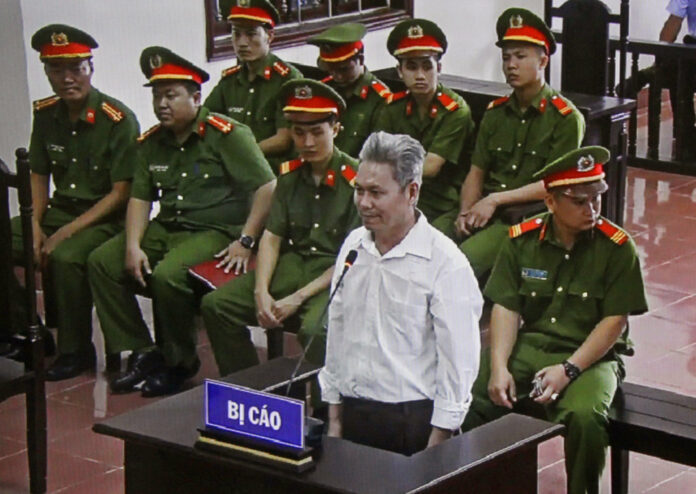
In this Wednesday, Sept. 19, 2018, photo, activist Dao Quang Thuc stands trial in Hoa Binh, Vietnam. Photo: Vu Thi Ha / Associated Press
HANOI — A court in northern Vietnam has sentenced a former primary schoolteacher to 14 years in prison after finding him guilty on charges of attempting to overthrow the communist government.
The official Vietnam News Agency says Dao Quang Thuc (Dow Kwang Tooc) was convicted of posting on his Facebook page articles with “reactionary contents.” The People’s Court in Hoa Binh province on Wednesday also convicted him of associating with a California-based exiled anti-communist group called the Provisional Central Government of Vietnam, which the Hanoi government declared a terrorist organization.
The court also ordered Thuc to serve five years of house arrest following his sentence.
Court officials were not available for comment Thursday.
Dozens of activists have been convicted for violating the national security law since the beginning of the year.
BANGKOK — A crisis that has driven millions from their homes around the world gets an intimate telling in “Manta Ray,” a story of two strangers.
When Thailand was first condemned for pushing motorless boats loaded with Rohingya back to sea and likely death, it got the attention of a Thai cinematographer. Nine years after Phuttiphong Aroonpheng became interested in the persecuted ethnic group, his first feature film addressing the crisis became thefirst Thai film to win a top prize at the Venice International Film Festival.
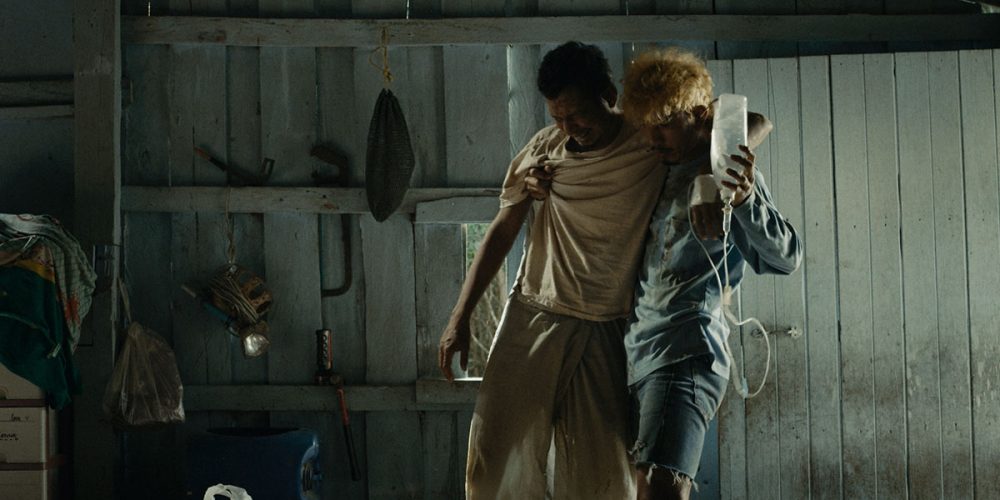
Telling a simple story of a fisherman (Wanlop Rungkamjad) who nurses an unconscious man (Aphisit Hama) back to health only to disappear and leave the stranger to find his place in a new world, “Manta Ray” (or “Kraben Rahu” in Thai) boldly projects its dedication to Rohingya victims and all refugees.
“I just hope that the film can reflect this fragility and imperfection of humans,” director Phuttiphong Aroonpheng wrote about his film. “At the end, I just would like to make a film with a good intention towards human beings.”
Critics have praised “Manta Ray,” which won the Orizzonti Award for Best Film in Venice, for its “spellbinding imagery,” “haunting” sound design and “richly layered humanist tale.”
“Manta Ray” is making the rounds and will travel to Spain, South Korea, France and beyond in the coming months. It remains unknown when – or if – it will show in Thailand.
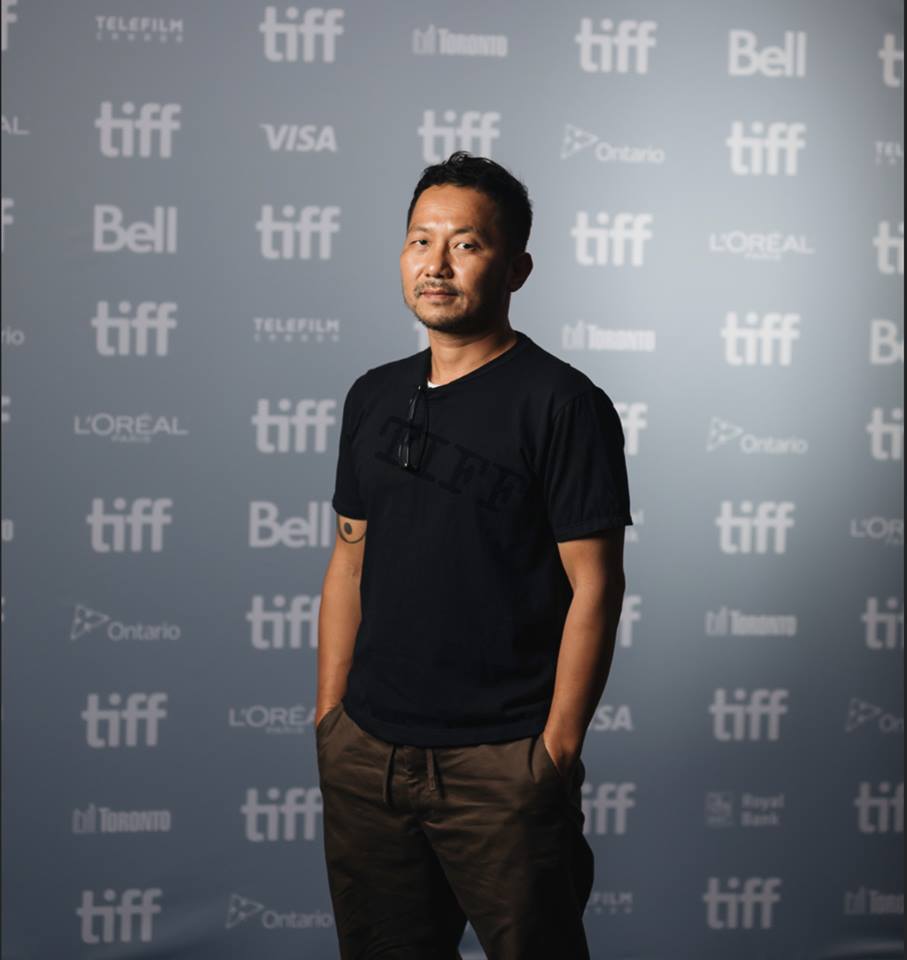
After returning this week from the Toronto Film Festival, 42-year-old Phuttiphong sat down with Khaosod English to talk about bringing “Manta Ray” to life. Some plot points are discussed.
Phuttiphong Aroonpheng
KE: Why Rohingya? You started this project eight years ago, when many Thais were still unaware of them.
Phuttiphong: It was 2009 when six boats carrying 300 Rohingya were pushed back into the ocean and left to die. That made me think that too much nationalism can hurt people. Since then, I closely followed news on the Rohingya and what I saw was all tragic. That’s when I wanted to make a movie, but not just to speak up for the Rohingya.
What really struck me was how many people, including my friends, aggressively hate the Rohingya. I know that Thai people normally look down on people from our neighboring countries, but those kind of insults never caused a crisis this bad. When it comes to Rohingya, Thais try to project their hatred on them. So I thought I could take this angle and make it into a movie.
KE: How did you do your research?
Phuttiphong: When I released the movie, some thought I’m a human rights defender or an NGO official. But I am not. Not at all. What I did was try to find as much information about Rohingya as possible. I went to Ranong to do research, but this certain issue has been sensitive since 2015. It was very difficult to get information and none of the organizations would help me, which I understood because they didn’t know me well. They might have thought I would use the information to harm the refugees. But eventually, I got to interview some Rohingya, about 30 to 40 of them.
I was worried, too, that the audience would expect my movie to specifically talk about Rohingya people when in fact it doesn’t. In the movie, I try to be neutral, not judge who is right or wrong. For me, I understand the conflict. It’s like the world today is undergoing globalization and everything is integrating. I understand that some identities are fighting against each other. One country’s natives try to express their own identity. I don’t think nationalism is wrong, but the kind of nationalism that looks down on other people, labeling them to be the bad guys, is wrong.
KE: Let’s talk about the cast. Why did you select Aphisit Hama to play the stranger and singer Rasmee “Isan Soul” Wayrana as Saijai, the fisherman’s wife, when neither had any acting experience?
Phuttiphong: Aphisit is a totally fresh face who was among 30 to 40 to audition for the role of the mute stranger. He said he was from the Sai Buri district of Pattani province and lived in Bangkok over 10 years. But he still felt like an outsider, probably because he is muslim and comes from the troubled Deep South. Aphisit said he can feel Bangkok residents looking differently at him. That’s why I think Aphisit was a perfect fit for the character.
For Rasmee, I think the character needed to narrate the story differently, after the fisherman, who talked and talked to the mute stranger, disappears. I thought the second part should be a singing character. At the time I was seeking a female singer, and I found Rasmee, who was already popular on YouTube. My staff found her in Chiang Mai and Rasmee agreed, even though she had never acted in her life.
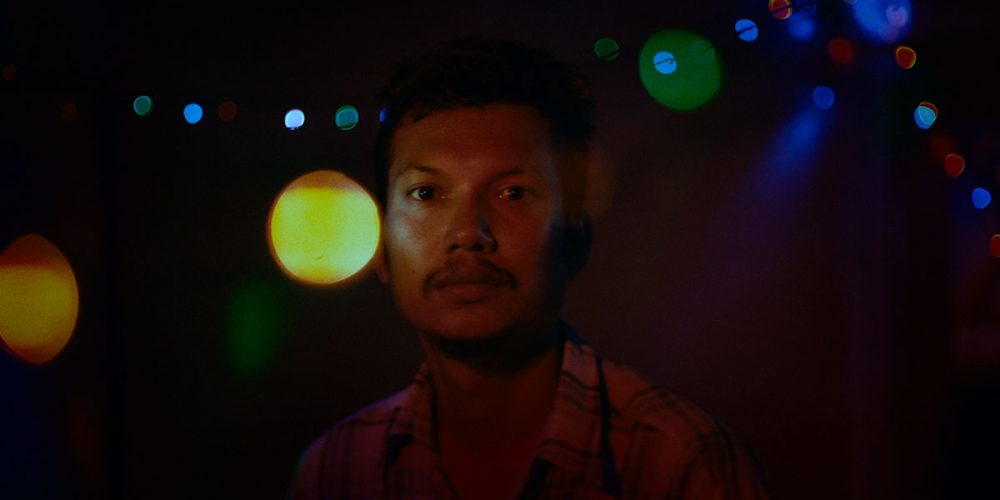
Rasmee Wayrana and Aphisit Hama in ‘Manta Ray’
KE: Why did you decide the stranger must be mute?
Phuttiphong: In my opinion, this character shouldn’t speak because I didn’t know which language he should speak. I don’t want to exactly point out that this guy is Rohingya. I think that the refugee crisis is a universal issue, thus a universal language.
I wanted this mute stranger to represent those who are oppressed, but it’s already suggested that he’s Rohingya because my inspiration in making this movie comes from the Rohingya refugees whom I got to know and met in person for the first time.
KE: Why “Manta Ray?”
Phuttiphong: It was almost 10 years ago, around 2009, when I took my first dive trip in the Andaman Sea, and that was when I saw a manta ray for the first time. It was giant, and it was swimming right toward me. At the time I was a rookie so I was scared of it. But then the manta ray flew past me without doing any harm.
Actually my project was named “Departure Day,” but I didn’t know why I didn’t see the name fit anymore. So I changed it to “Manta Ray.” I like the creature as it’s a plankton-eater and it keeps moving, like whales, to feed on plankton, so the name manta ray partly symbolizes the concept of borderlessness. Plus, it lives in the Andaman Sea where many migrants and refugees live.
Wanlop Rungkamjad as a local fisherman who rescues a stranger portrayed by Aphisit Hama
KE: The film has received a lot of positive feedback, do you think because of its cinematic elements or its message about refugees?
Phuttiphong: I got a chance to talk to the jurors [in Venice] after the award announcement. They said they liked my film for its unconventional cinematic language. It gave them bizarre feelings, they said. Actually, I didn’t think beforehand what my cinematic language should be, because my roots are far from being a screenwriter. I couldn’t even write the script. My script was only 30 pages, when movie scripts in general should be over 100 pages. I really don’t know how to make characters speak that much. So I made the dialog very, very minimal. And I focused on the film’s visuals and sound instead.
For the soundscape, I chose to use recordings of the actual refugees. I didn’t want to show any real-life refugee in my movie, because I don’t know what’s the point of reproducing tragedy. So I used their human voices instead. I asked each refugee I interviewed to hum “Ummmm” before I merged each recording harmoniously into a song for the film’s ending. Hearing a low vocal tone can make our hearts beat differently, so I thought if I filled the whole film with low-frequency audio, it should put the audience under pressure. Plus, it could make the visuals more powerful.
KE: What did winning the Orizzonti Award in Venice mean to you as a Thai director?
Phuttiphong: After finishing the movie, I knew that I had to find a way to screen it at an international film festival. If I debuted it in Thailand, Thai audiences wouldn’t be interested in watching it. At the time, the Venice Film Festival was calling for entries, so I submitted the film. Only a few days later they replied back, agreeing to screen my film. I was already happy. The idea of winning an award was beyond my expectation.
Anyway, I was also worried that Thai people would think my film was pretentious because it debuted in a foreign country. I know that some people think this way, but the thing is I showed “Manta Ray” in Venice four times, and each time had audiences of 700 to 800. I got so much feedback in return and I see this as an opportunity to develop my work and my team. I don’t think showing movies at an international film festival first is for being cool; we actually benefit from it in terms of performance and quality improvement.
KE: Do you think that your film has any chance of making a difference in the refugee crisis?
Phuttiphong: Not at all. Maybe because I’m biased, having sympathy for the Rohingya already. I think I’m biased because I know more about them, I went to see and talk to them personally. But my duty as a director is creating a conversation about the Rohingya, to just once again make people interested in them. That would be enough for me. I may not have to change the world that significantly; I don’t have that much power. But if I can make people question, rethink what they think about these people, that would be just enough.
KE: What’s next?
Phuttiphong: Actually, I should strike while the iron’s hot (laughing). I was contacted by a producer who wants to work with me for the next project already. For now it’s still a rough idea of making a film of headless people living in a city. But this time the subjects wouldn’t be migrants or refugees, but other minority groups.
Aphisit Hama as a mute stranger who rescued by a fisherman in ‘Manta Ray.’
A navy frigate escorts a Hua Hin - Pattaya ferry on Jan. 5, 2017.
Update Oct. 31: Officials today confirmed that the ferry service will resume tomorrow.
PRACHUAP KHIRI KHAN — Less than two years after it opened with much fanfare, a ferry connecting the resort towns of Hua Hin and Pattaya has been suspended, a tourism official said Thursday.
Citing financial losses and low monsoon season ticket sales, provincial tourism official Orasa Awutkhom announced the service would resume Nov. 1.
“It’s currently a period of decreased tourism, or low season, so there are very few customers,” Orasa said. “Therefore, the company has halted its service from Sept. 20 to Oct. 31.”
Opened in January 2017, the ferry is run by a private company called Royal Passenger Line, a state contractor. With the ships, travel time between Hua Hin and Pattaya on the other side of the Gulf was cut from five hours to 90 minutes.
It launched with a rough start. Its maiden voyage, set to take place on New Year’s Day, was canceled due to strong waves. A navy patrol ship was dispatched to escort the ferry when it finally took to the sea four days later.
NEW YORK — Arthur Mitchell, who broke barriers for African-Americans in the 1950s as a ballet dancer with the New York City Ballet and who would go on to become a driving force in the creation of the Dance Theatre of Harlem, has died. He was 84.
Mitchell died Wednesday at a New York City hospital according to his niece, Juli Mills-Ross. She said the death came after renal failure led to heart failure.
Born in Harlem, Mitchell started dancing with the New York City Ballet in 1955 under famed choreographer George Balanchine.
Balanchine put him in several leading roles, including one pairing him with a white female dancer in “Agon” in 1957.
In a January interview with The New York Times, Mitchell recalled the daring of that choice.
“Can you imagine the audacity to take an African-American and Diana Adams, the essence and purity of Caucasian dance, and to put them together on the stage?” he said.
In 1968, impacted by the assassination of Martin Luther King Jr., Mitchell started a dance school that grew the next year to include the Dance Theatre of Harlem.
Anna Glass, the executive director of the Dance Theater, told The Associated Press that Mitchell “truly was a visionary.”
“He believed in a world where all people could have access to this beautiful art form,” she said. “He really sought to ensure that all people saw themselves in” ballet.
Among those recognizing his impact following his death was Misty Copeland, the first African-American female principal dancer with the American Ballet Theatre.
In a post on Instagram, she wrote, “You gave me so much, through our conversations, your dancing and by simply existing as a brown body in ballet. But you were so much more than a brown body. You’re an icon and hero.”
Choreographer and television producer Debbie Allen tweeted, “The world has lost another visionary” with Mitchell’s death.
“Arthur Mitchell claimed ballet as an American art form,” she said. “His legacy lives through all of us.”
Mitchell was born in 1934, and grew up with four siblings. He started formal dance training in high school, and upon graduating, took the offer of a ballet scholarship with the School of American Ballet, founded by Balanchine and Lincoln Kirstein.
His dancing years also included choreographing his own works, performing on Broadway, and working with dance companies in other countries. The Dance Theatre of Harlem performed internationally and has been artistically acclaimed even as it went through some periods of financial upheaval. He stepped down as director almost a decade ago.
Glass said Mitchell had most recently spent time at the company last month, during a two-week residency in which he restaged one of his older ballets to be performed next April as the company marks its 50th anniversary.
“This was a moment that all of us were looking forward to,” Glass said. “I know we will miss him tremendously.”
GENEVA — Real Madrid managed to win easily in the Champions League without Cristiano Ronaldo. So did Juventus, after its superstar signing was tearfully sent off within 30 minutes.
Three-time defending champion Madrid eased to a 3-0 win over Roma on Wednesday, with Francisco “Isco” Alarcon scoring from the kind of free kick only Ronaldo got to take in his nine years with the club.
Ronaldo, making his Juventus debut in a competition he has won five times, also had a new experience – getting a red card against Valencia for tangling with Jeison Murillo.
Seemingly frustrated that Murillo went to ground too easily, Ronaldo reached down to tug or ruffle the defender’s hair.
German referee Felix Brych did not have access to a video review but showed a red card after consulting his assistant behind the goal.
It was Ronaldo’s first sending off in 154 games in the competition and left him in tears.
Still, Juventus went on to win 2-0, scoring twice from penalties despite designated spot-kick taker Ronaldo not being there. Miralem Pjanic scored both times.
Elsewhere, one of the favorites to dethrone Madrid this season, Manchester City, lost at home and Manchester United won away to further dispel its uneasy start to the season.
City was lackluster in a 2-1 loss to Lyon, while rival United had little trouble winning 3-0 at Swiss champion Young Boys.
Here’s a look at Wednesday’s games:
Madrid Masters
It could have been tricky for Madrid. No Ronaldo on the field, no Zinedine Zidane in the dugout, and facing Roma, a semifinalist last season.
But it was business as usual for the 13-time European champion under new coach Julen Lopetegui.
Isco, Gareth Bale – who seemed sure to leave if Zidane stayed – and Mariano Diaz got the goals.
Bale finished off an accurate pass by Luka Modric, and goalkeeper Keylor Navas kept a clean sheet after being preferred to new signing Thibaut Courtois.
Also in Group G, CSKA Moscow trailed 2-0 at halftime, but a stoppage time penalty from Nikola Vlasic made it 2-2 at Czech champion Viktoria Plzen.
Pjanic Over
A troubled opening half hour for Juventus in Valencia saw Mario Mandzukic and Sami Khedira miss clear chances before Ronaldo left the field in tears.
Just before halftime, Joao Cancelo hit the crossbar with a shot and was then fouled by a high boot to the face while chasing the rebound.
Miralem Pjanic converted that penalty kick, and scored again six minutes into the second half when Murillo was penalized for a foul.
There was a third penalty in stoppage-time, but Juve goalkeeper Wojciech Szczesny saved Daniel Parejo’s kick to preserve the 2-0 win.
Pogba Stars
Paul Pogba scored twice and set up Anthony Martial for Man United’s third goal in a comfortable win at Swiss champion Young Boys.
Though Pogba has been unsettled at United this season, his curling shot and trademark slow-trot penalty within eight first-half minutes suggested he is feeling happier now.
United had lost on its last two trips to Switzerland, both against Basel, but is in a good position to welcome Valencia in two weeks’ time.
Old Trafford could also be denied a reunion with Ronaldo for Juve’s Oct. 23 visit depending on the ban UEFA imposes.
City Beaten
With coach Pep Guardiola watching in the stand, serving a ban carried over from last season, Man City was surprisingly beaten 2-1 by visiting Lyon.
City trailed by two goals at halftime, when errors were punished by Maxwel Cornet and Nabil Fekir, a member of France’s World Cup squad.
The manner of City’s Premier League title win last season has persuaded many that Guardiola can add to his two Champions League crowns with Barcelona.
But the stadium was far from full Wednesday, and City only managed to pull one goal back in the 67th from Bernardo Silva.
The other Group F game saw Hoffenheim make its Champions League debut in Ukraine. Playing at its adopted home city Kharkiv, Shakhtar Donetsk got a late leveler in a 2-2 draw.
Renato Returns
Renato Sanches has often looked like a lost talent since helping Ronaldo and Portugal win the 2016 European Championship.
Then 19, a move from Benfica to Bayern Munich seemed to happen too soon and he was sent to Premier League struggler Swansea on loan.
Back in Lisbon on Wednesday, Sanches scored Bayern’s second goal in a 2-0 win after Robert Lewandowski got Bayern’s early opener.
Also in Group E, Ajax marked its return after a four-year absence to join Madrid as the only home teams winning Wednesday, also by 3-0.
In the Johan Cruyff Arena, Ajax dispatched AEK Athens with the help of two goals from Argentina defender Nicolas Tagliafico.
An undated image of Khaw Kim-sun, center, in Hong Kong. Image: The Star Online / YouTube
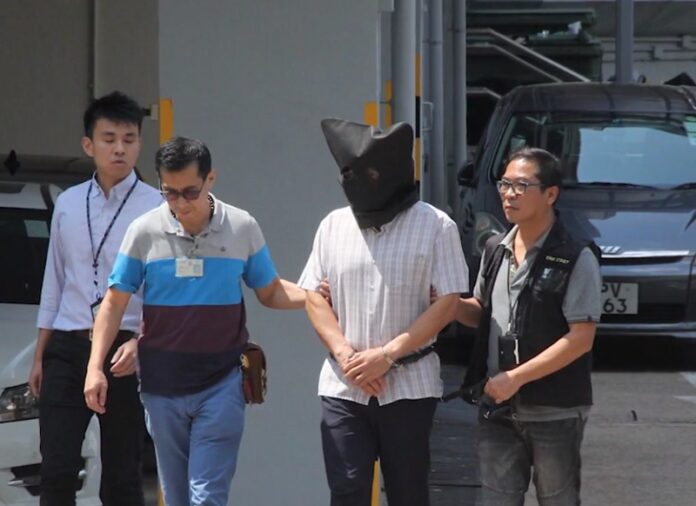
HONG KONG — An anesthesiologist convicted of killing his wife and daughter by placing a yoga ball that leaked carbon monoxide in their car has been sentenced to life in prison in Hong Kong.
Malaysian citizen Khaw Kim-sun, 53, had become estranged from his wife, Wong Siew Fing, 47, and four children, although they continued to live together while he had an affair with a student.
A jury of five men and four women found him guilty at Hong Kong’s High Court after seven hours of deliberation Wednesday.
Khaw was accused of putting the gas-filled yoga ball in the trunk of a Mini Cooper driven by his wife, Wong Siew-fung, on May 22, 2015.
Wong and their 16-year-old daughter were found unconscious in the car about an hour after leaving home.