





























25.5 C
Bangkok
Saturday, June 20, 2026
Home Blog Page 2046

Putin Wins Re-election To Remain in The Kremlin

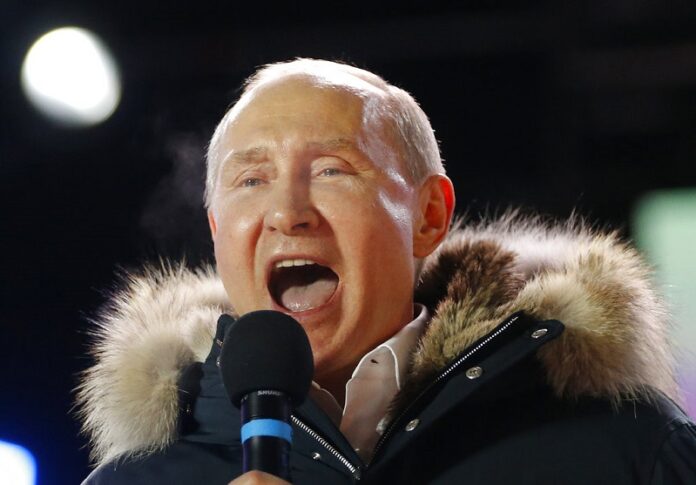
Russian President Vladimir Putin speaks to supporters during a rally near the Kremlin in Moscow on Sunday. Photo: Alexander Zemlianichenko / Associated Press

MOSCOW — Vladimir Putin rolled to a crushing re-election victory Sunday for six more years as Russia’s president, and he told cheering supporters in a triumphant but brief speech that “we are bound for success.”

There had been no doubt that Putin would win in his fourth electoral contest; he faced seven minor candidates and his most prominent foe was blocked from the ballot.
His only real challenge was to run up the tally so high that he could claim an indisputable mandate.

With ballots from 80 percent of Russia’s precincts counted by early Monday, Putin had amassed 76 percent of the vote. Observers and individual voters reported widespread violations including ballot-box stuffing and forced voting, but the claims are unlikely to dilute the power of Russia’s longest-serving leader since Josef Stalin.

As the embodiment of Russia’s resurgent power on the world stage, Putin commands immense loyalty among Russians. More than 30,000 crowded into Manezh Square adjacent to the Kremlin in temperatures of minus 10C (15 Fahrenheit) for a victory concert and to await his words.

Putin extolled them for their support – “I am a member of your team” – and he promised them that “we are bound for success.”

Then he left the stage after speaking for less than two minutes, a seemingly perfunctory appearance that encapsulated the election’s predictability.

Since he took the helm in Russia on New Year’s Eve 1999 after Boris Yeltsin’s surprise resignation, Putin’s electoral power has centered on stability, a quality cherished by Russians after the chaotic breakup of the Soviet Union and the “wild capitalism” of the Yeltsin years.

But that stability has been bolstered by a suppression of dissent, the withering of independent media and the top-down control of politics called “managed democracy.”
There were widespread reports of forced voting Sunday, efforts to make Russia appear to be a robust democracy.

Among them were two election observers in Gorny Shchit, a rural district of Yekaterinburg, who told The Associated Press they saw an unusually high influx of people going to the polls between noon and 2 p.m. A doctor at a hospital in the Ural mountains city told the AP that 2 p.m. was the deadline for health officials to report to their superiors that they had voted.

“People were coming in all at once, (they) were entering in groups as if a tram has arrived at a stop,” said one of the observers, Sergei Krivonogov . The voters were taking pictures of the pocket calendars or leaflets that poll workers distributed, seemingly as proof of voting, he said.

Other examples from observers and social media included ballot boxes being stuffed with extra ballots in multiple regions; an election official assaulting an observer; CCTV cameras obscured by flags or nets from watching ballot boxes; discrepancies in ballot numbers; last-minute voter registration changes likely designed to boost turnout; and a huge pro-Putin sign in one polling station.

Election officials moved quickly to respond to some of the violations. They suspended the chief of a polling station near Moscow where a ballot-stuffing incident was reported and sealed the ballot box. A man accused of tossing multiple ballots into a box in the far eastern town of Artyom was arrested.

Overall national turnout was expected to be a little more than 60 percent, which would be several points below turnout in Putin’s electoral wins in 2000, 2004 and 2012. He did not run in 2008 because of term limits, but was appointed prime minister, a role in which he was widely seen as leader.

Putin’s most vehement foe, anti-corruption campaigner Alexei Navalny, was barred from running Sunday because he was convicted of fraud in a case widely regarded as politically motivated. Navalny and his supporters had called for an election boycott but the extent of its success could not immediately be gauged.

The election came amid escalating tensions with the West, with reports that Moscow was behind the nerve-agent poisoning this month of a former Russian double agent in Britain and that its internet trolls had waged an extensive campaign to undermine the 2016 U.S. presidential election. Britain and Russia last week announced expulsions of diplomats over the spy case and the U.S. issued new sanctions.

In his first public comments on the poisoning, Putin on Sunday referred to the allegations against Russia as “nonsense.”

Moscow has denounced both cases as efforts to interfere in the Russian election. But the disputes likely worked in Putin’s favor, reinforcing the official stance that the West is infected with “Russophobia” and determined to undermine both Putin and traditional Russian values.

The election took place on the fourth anniversary of the 2014 annexation of Crimea from Ukraine, one of the most dramatic manifestations of Putin’s drive to reassert Russia’s power.

Crimea and Russia’s subsequent support of separatists in eastern Ukraine led to an array of U.S. and European sanctions that, along with falling oil prices, damaged the Russian economy and slashed the ruble’s value by half. But Putin’s popularity remained strong, apparently buttressed by nationalist pride.

In his next six years, Putin is likely to assert Russia’s power abroad even more strongly. Just weeks ago, he announced that Russia has developed advanced nuclear weapons capable of evading missile defenses.

The Russian military campaign that bolsters the Syrian government is clearly aimed at strengthening Moscow’s foothold in the Middle East, and Russia eagerly eyes any reconciliation on the Korean Peninsula as an economic opportunity.

At home, Putin must face how to groom a successor or devise a strategy to circumvent term limits, how to diversify an economy still dependent on oil and gas, and how to improve medical care and social services in regions far removed from the cosmopolitan glitter of Moscow.

Authorities struggled against voter apathy, putting many of Russia’s nearly 111 million voters under intense pressure to cast ballots.

Yevgeny, a 43-year-old mechanic voting in central Moscow, said he briefly wondered whether it was worth voting.

“But the answer was easy … if I want to keep working, I vote,” he said, speaking on condition that his last name not be used out of fear his employer – the Moscow city government – would find out.

First-time voters in Moscow were given free tickets for pop concerts and health authorities were offering free cancer screenings.

Voters appeared to be turning in out in larger numbers Sunday than in the last presidential election in 2012, when Putin faced a serious opposition movement and there were instances of multiple voting, ballot stuffing and coercion.

Navalny, whose group also monitored the vote, dismissed Putin’s challengers on Sunday’s ballot as “puppets.” He urged a boycott of the vote and vowed to continue defying the Kremlin with street protests.

Ukraine, insulted by the decision to hold the election on the anniversary of Crimea’s annexation, refused to let ordinary Russians vote. Ukraine security forces blocked the Russian Embassy in Kiev and consulates elsewhere as the government protested the voting in Crimea, whose annexation is still not internationally recognized.

Ukrainian leaders are also angry over Russian support for separatists in eastern Ukraine, where fighting has killed at least 10,000 people since 2014.

Polls show that most Russians view the takeover of the Black Sea peninsula as a major achievement despite subsequent Western sanctions.

“Who am I voting for? Who else?” said Putin supporter Andrei Borisov, 70, a retired engineer in Moscow. “The others, it’s a circus.”

The Central Election Commission also claimed it had been the target of a hacking attempt from 15 unidentified nations that was deterred by authorities.

Story: Jim Heintz and Vladimir Isachenkov
 

Advertisement

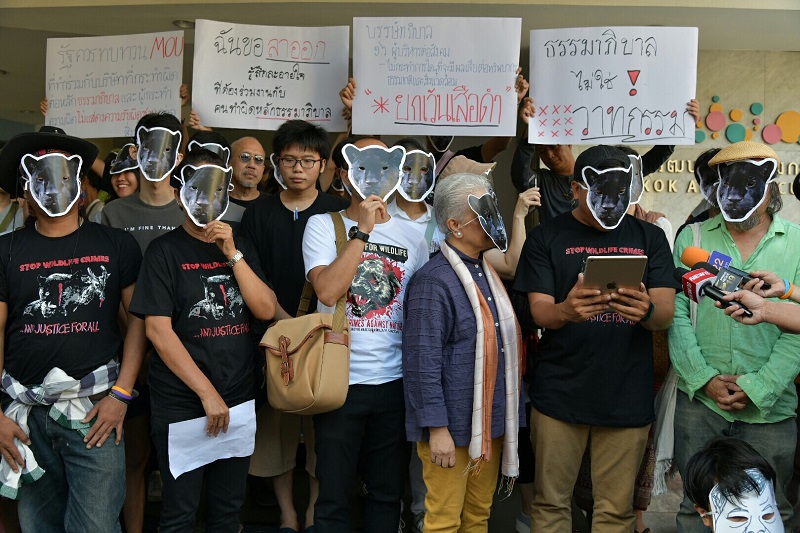
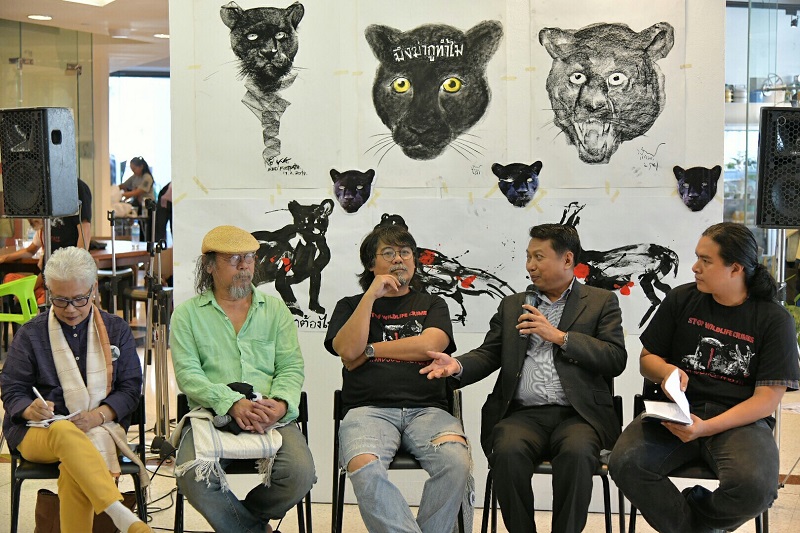
Panther Activists Lead 3rd Protest Against Premchai at BACC

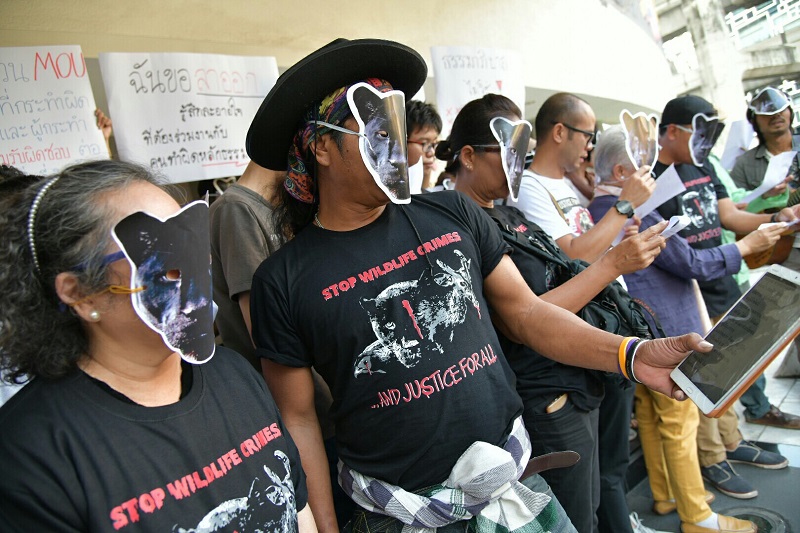
BANGKOK — Dozens of environmental activists joined a protest against a construction mogul accused of killing a black panther late Sunday afternoon at a downtown art gallery.

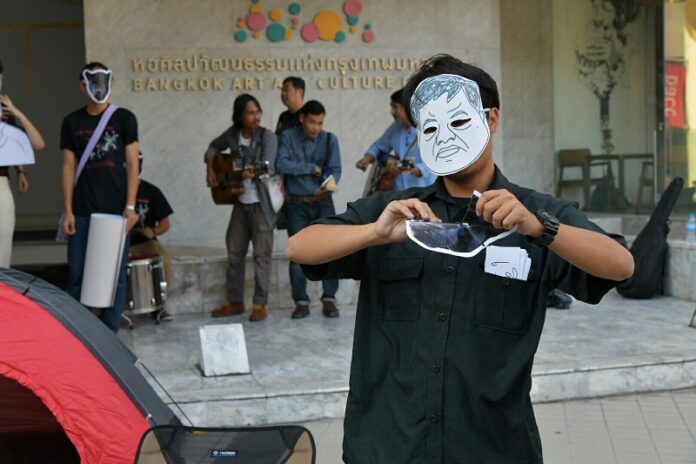
T’Challa, a group of student activists from Rangsit University, staged a protest for the third time at the Bangkok Arts and Culture Center to call for justice to be done to Premchai Karnasuta, accused to hunting and consuming a black panther from a wildlife sanctuary.

“It’s not just about killing the black panther or preserving the environment. It’s about inequality in the justice system between the rich and the poor. This blank panther is the soul that binds people, animals and the forest together,” the group” said Thatchapong “Boy” Kaedum, leader of the group.

Among the protesters was student activist Netiwit Chotiphatphaisal.

Thatchapong called for businesses and government agencies to cease operations with Italian-Thai Development.

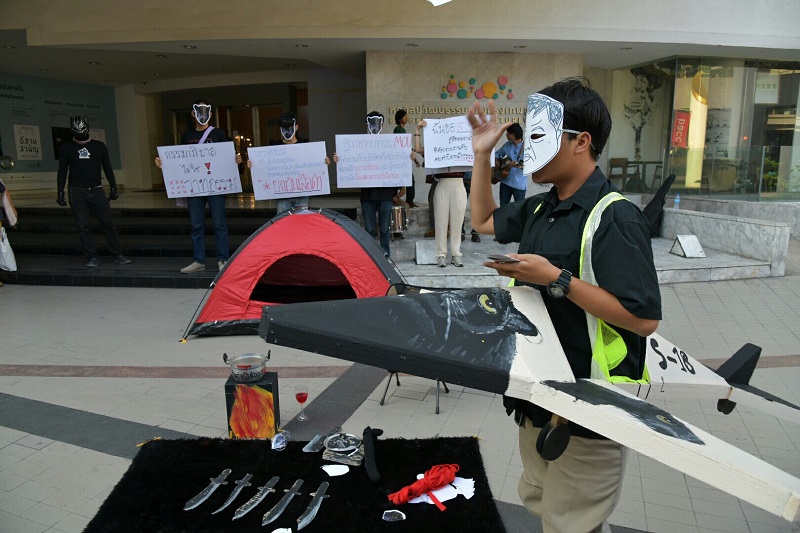
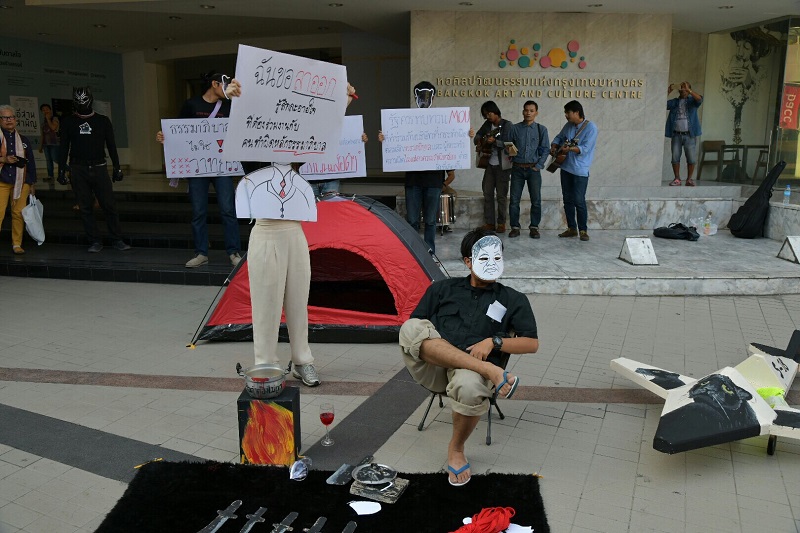
The activists made a mock re-enactment of the mogul at his camp in Thungyai Naresuan Wildlife Sanctuary, where he was caught with the panther carcass in early February.

Saksith “Tor” Popangpum, 23, who played Premchai, sat with spread legs in a makeshift camp while chopping up a fake penis, boiling it in a pot and then pretended to eat it.

Image uploaded from iOS 4 4 Image uploaded from iOS 3 4 Image uploaded from iOS 2 4Image uploaded from iOS 8 3 Image uploaded from iOS 7 2

Related stories:

Black Panther Death Ignited Young ‘T’Challa’ Activists

Advertisement

UK Probing Facebook After Cambridge Analytica Suspension

Facebook logo is displayed on an iPad in Philadelphia. Photo: Matt Rourke / Associated Press

­LONDON — Britain’s information commissioner is investigating whether Facebook data was “illegally acquired and used,” after the social network suspended Cambridge Analytica, a firm that worked for U.S. President Donald Trump’s 2016 campaign.

Facebook suspended the company over allegations it retained improperly obtained user data after claiming it had deleted the information.

The British probe is part of a broader inquiry into how political parties, data companies and social media platforms use personal information to target voters during political campaigns, including Britain’s 2016 Brexit referendum on EU membership.

Information Commissioner Elizabeth Denham said Saturday it’s important “the public are fully aware of how information is used and shared in modern political campaigns and the potential impact on their privacy.”

She said “any criminal and civil enforcement actions arising from the investigation will be pursued vigorously.”

Advertisement

Shi Upsets Lin to Win All England Badminton Final

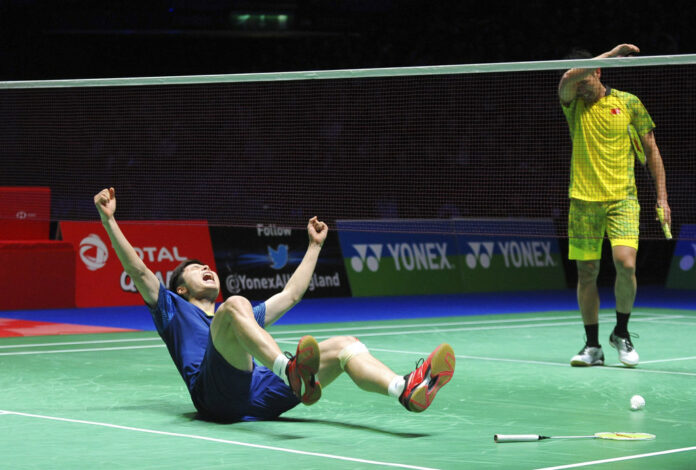
China's Shi Yuqi reacts after defeating China's Lin Dan, right, in the men's singles final match at the All England Open Badminton tournament Sunday in Birmingham, England. Photo: Rui Vieira / Associated Press

BIRMINGHAM, England — Seventh-seeded Shi Yuqi beat six-time champion Lin Dan 21-19, 16-21, 21-9 Sunday in a major upset at the All England Championships to win the men’s singles title.

The 22-year-old Shi was given time and room to make use of his speed and well-disguised overhead attacks against badminton great Lin in the all-Chinese final.

The 34-year-old left-hander Lin would have been the oldest player in 63 years to win the title.

Shi had a one-sided loss to Lee Chong Wei of Malaysia in last year’s final.

Lin’s play revived in the second game before Shi was allowed to grow in confidence.

“I was more patient and controlled my pace, which helped me get the match back,” said Shi. “I am quite young and in good condition, and this all played a part.”

Lin said he was pleased to still be playing “at this level,” adding that “I feel good about myself and I want to congratulate my younger opponent.”

Lin became the first player to appear in 10 All England men’s singles finals, and it was the first all-Chinese men’s final for a decade. But it was the only title which China, once dominant in all events, was able to win.

Top-ranked Tai Tzu Ying of Taiwan became the first women’s singles player in more than a decade to successfully defend her title. Tai saved a game point in the first game before beating second-ranked Akane Yamaguchi of Japan 22-20, 21-13.

Tai wasn’t pleased with her performance despite winning.

“I made a lot of mistakes, and in the end I just had to run with her,” Tai said, with reference to taking a more patient approach with one of the game’s most tenacious movers. “I would like to come back again next year and play better.”

Unseeded Yuta Watanabe and Arisa Higashino became the first Japanese pair to win the mixed doubles title. They beat fifth-seeded Chinese pair, Zheng Siwei and Huang Yaqiong, 15-21, 22-20, 21-16.

Advertisement

Myanmar Leader Welcomed to Australian Parliament House

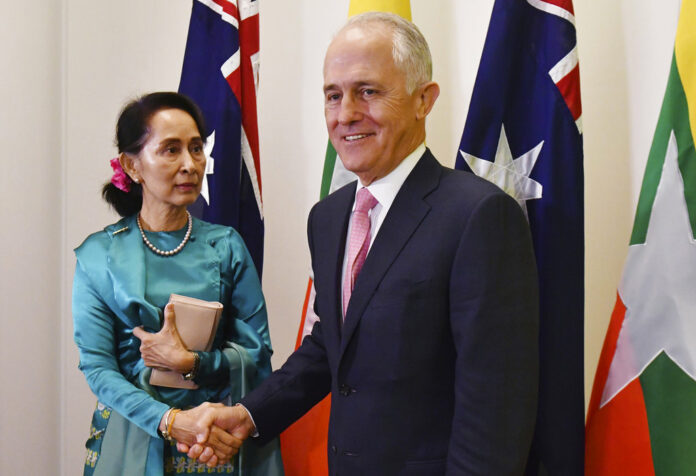
Myanmar's leader Aung San Suu Kyi, left, is welcomed to Parliament House by Australian Prime Minister Malcolm Turnbull during her Monday state visit in Canberra. Photo: Mick Tsikas / Associated Press

CANBERRA, Australia — Myanmar’s leader Aung San Suu Kyi was welcomed to Australia’s Parliament House on Monday for the official start of a state visit that has provoked protests over her muted response to a military crackdown against Rohingya Muslims.

The Nobel Peace laureate arrived in Sydney at the weekend for a summit of Southeast Asian leaders. Australian Prime Minister Malcolm Turnbull said on Sunday that Suu Kyi had sought humanitarian help from her fellow members of the Association of Southeast Asian Nations and Australia to deal with the crisis.

Malaysian Prime Minister Najib Razak told the summit the refugee crisis was no longer solely a domestic issue for Myanmar, as fleeing Rohingya could be prime targets for terrorist radicalization.

Some 700,000 Rohingya refugees have fled from Buddhist-dominated Myanmar to Bangladesh since late August, when Myanmar security forces began massive “clearance operations” after the Arakan Rohingya Salvation Army insurgent group attacked security posts.

Myanmar staunchly denies that its security forces have targeted civilians in Rakhine state. Suu Kyi has bristled at the international criticism. But Myanmar’s denials have appeared increasingly tenuous as horrific accounts from refugees have accumulated and satellite imagery and other evidence of destroyed Rohingya villages have been assembled.

The Associated Press last month documented through video and witness accounts at least five mass graves of Rohingya civilians. Witnesses said the military used acid to erase the identity of victims. The government denied it, maintaining that only “terrorists” were killed and then “carefully buried.”

Suu Kyi was under house arrest for almost 15 years before she was released in 2010. She last visited Canberra in 2013 on a five-day Australian tour, before she was allowed to stand for election.

The then-Prime Minister Tony Abbott described her as an “icon of democracy” and Foreign Minister Julie Bishop said Suu Kyi had inspired her to enter politics.

Story: Rod McGuirk

Advertisement

Throw Coups, Deny Visas at Political Games Exhibit

BANGKOK — As the immigration officer of an authoritarian country, smash the “visa denied” stamp onto passports of huddled masses waiting in line. As an agent for Big Brother, tap into phones and stalk social media accounts. As the pet cat of Iran’s first democratically elected prime minister, meow along as the CIA ignites a coup to end his reign.

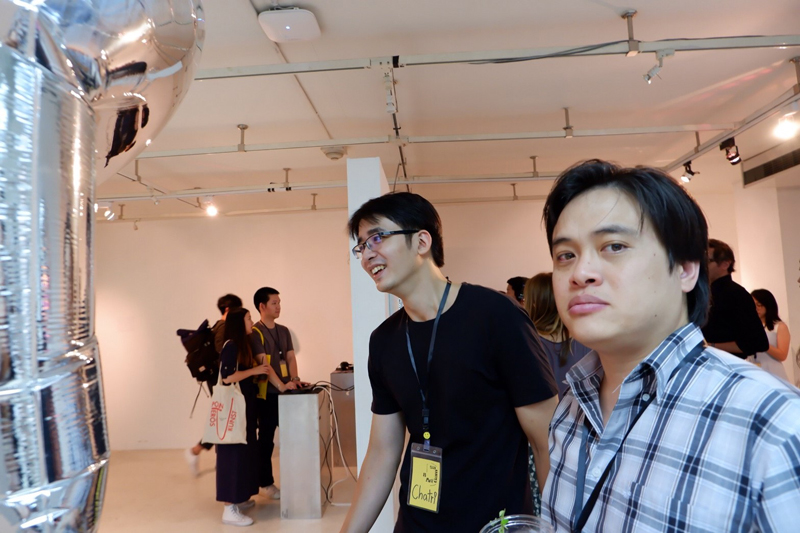
These and other political games can be played at the Games and Politics Exhibition, which started Friday and showcases 18 games with deeply political underpinnings organized by the Goethe-Institut.

“Games are pleasure and art, but also a medium to convey political messages,” Patota Tambunan, 27, and one of the organizers of the exhibition said Friday. “A lot of times people are passive when they consume something political: they read news or watch TV. But with games, people are actively involved.”

Patota points to one of the games on display: Papers, Please, in which one plays as an immigration officer and can decide to search or detain people based on race, criminal records or even just arbitrary reasons. Another is The Cat and the Coup, Patota says you can “walk through the pages of Iranian history” and follow along from the point of view of a feline as Mohammad Mossadegh is overthrown by a CIA-engineered coup.

When playing these games, the Indonesian Patota hopes that “Thai people can reflect on themselves. Thailand is a monarchy but you can experience worldwide democracy and politics through games,” he said, pointing to Democracy 3, a game in which you play as the president of a democratic country.

Gender-related games, such as the Coming Out Simulator and Dys4ria – a short pixel game where one takes the role of a transgender woman – will also hopefully strike a chord with Thai players, said Patota.

“These games allow people to take on different roles in life,” Maren Niemeyer, director of Goethe-Institut, said in front of a display of the game 1378 (km). “For example in this game you try to escape from East to West Germany. By playing this you can feel with your own mind what being a refugee is like.”

The German ambassador at the inaugural Friday event said that games could be used to generate awareness of social ills – whether about gender, refugees, media power, police states or authoritarian regimes – and that games had political power.

“In Germany 42 percent of people play computer games, sometimes even more popular than Hollywood movies,” Ambassador Peter Pruegel said. “Games can also be used to reach certain groups normally not reached by politics, too. ISIS made a computer game to recruit potential terrorists and the FBI counteracted by making another game.”

Thailand is the 13th country to host the German-originated exhibition. Thai game developers are also encouraged to join a political game contest hosted by Goethe-Institut.

Chatri Krongsiriwat, 27, one of the exhibition attendants and a freelance game designer who planned on entering the contest, said his favorite game was Papers, Please.

“Thailand isn’t as authoritarian as the country in this game. But it’s really interesting how you can choose to deny someone entry without reason and have your salary cut, or let in someone you know is dangerous after they bribed you,” Chatri said.

Some of the 18 games in the exhibition are free to play on Steam. Others, such as Orwell – where you act as Big Brother’s social media spy – must be bought. Games at the exhibition are listed online.

Games and Politics opens 10am to 6pm from Tuesdays through Fridays and 10am to 4pm on weekends in the Design Center at Chulalongkorn University’s Faculty of Architecture. The exhibition is closed on Monday. Entry is free.

20180317 180317 0019

20180317 180317 0018

20180317 180317 0017

20180317 180317 0016

20180317 180317 0015

20180317 180317 0014

20180317 180317 0013

20180317 180317 0012

20180317 180317 0010

20180317 180317 0009

20180317 180317 0008

20180317 180317 0007

20180317 180317 0006

20180317 180317 0005

20180317 180317 0004

20180317 180317 0003

20180317 180317 0001

Advertisement

Podolski Goal Powers Vissel Kobe to 1st Win in J-League

Germany's Lukas Podolski after scoring the opening goal during a friendly match between Germany and England in 2017 in Dortmund, Germany. Photo: Ina Fassbender / Associated Press

KOBE, Japan — German striker Lukas Podolski scored late in the second half on Sunday as Vissel Kobe beat Cerezo Osaka 2-0 for its first win of the J-League season.

Naoyuki Fujita gave the hosts a 1-0 lead in the 33rd minute and Podolski secured the win on a left-foot shot with eight minutes remaining in regulation.

It was the first goal of the season for Podolski, who last year moved from Turkish club Galatasaray after signing a deal with Kobe estimated to be worth USD$5.3 million.

Elsewhere, Thai midfielder Chanathip Songkrasin scored late in stoppage time to lift Consadole Sapporo to a 2-1 win over V-Varen Nagasaki.

Takuma Abe scored midway through the second half to give Vegalta Sendai a share of the points in a 1-1 draw with Shimizu S-Pulse, while Diego Oliveira scored his first goal of the season as FC Tokyo beat Shonan Bellmare 1-0.

Gamba Osaka and Kashiwa Reysol finished 2-2.

Advertisement

Deputy Governor Apologizes for Letter Branding Locals Stupid

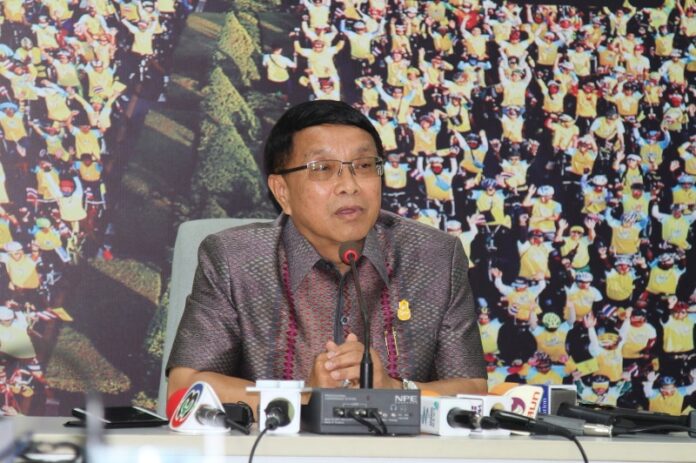
Suchai Butrsara during Sunday's press conference in Khon Kaen province. Photo: Matichon

KHON KAEN — The deputy governor of a northeastern province apologized on Sunday after an official letter he signed urging bureaucrats to end local people’s “stupidity.”

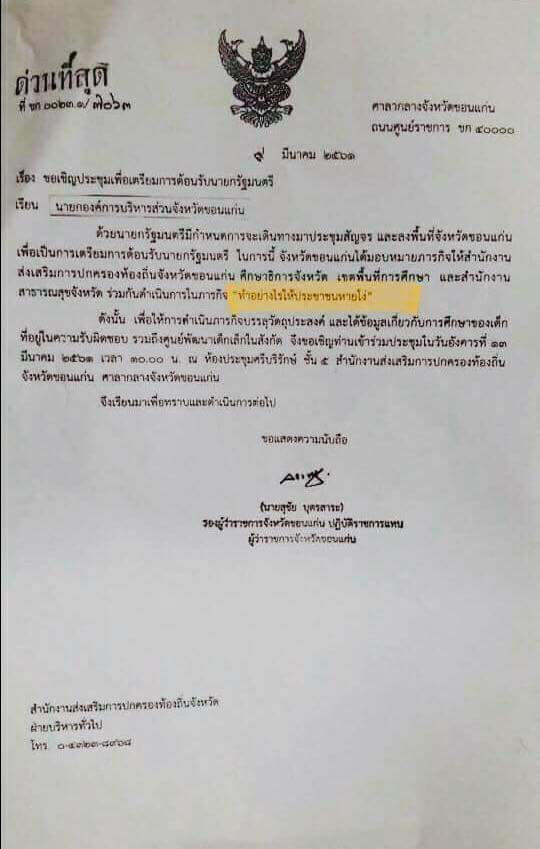
Suchai Butrsara, deputy governor of Khon Kaen province said on Sunday he apologized for a letter he signed March 9 urging various government agencies to work toward eradicating local people’s stupidity before an upcoming visit by Prime Minister Gen. Prayuth Chan-ocha.

During a Sunday press conference, Suchai said he was deeply sorry and had no intention of looking down on residents when he urged provincial agencies to work on “how to stop local people from being stupid.”

“The previous letter contained inappropriate words that led to a misunderstanding,”

Suchai said in a revised letter published March 12, in which the controversial wording was changed to “How to make people knowledgeable in coping with the changing world.”

Neither letter specified when Prayuth would visit the province – widely known to have a strong Reshirt base critical of the military junta.

The letter led to angry reactions, with National Human Rights Commissioner Angkhana Neelapaijit saying in a Saturday Facebook post that people in Khon Kaen were not stupid and knew their rights.

“It’s unbelievable that the first letter was issued by a leader of a state agency. Besides demonstrating their thinking and looking down on people, it shows their approach [to solving problems] is also top down,” Angkhana wrote, adding that the dignity of Khon Kaen people had to be restored.

Independent scholar and Facebook user Somrit Luechai said in a Sunday post that the problem lies not in whether local people are stupid but in those in power who are stupid but unaware.

The original March 9 letter.
Advertisement

Voranai: A Song of Rice and Fire

Voranai Vanijaka

About a week ago, CLSA Thailand organized a panel talk called ASEAN Forum 2018. On the panel were three smiling men in dark suits. They were Anuthin Charnvirakul of Bhumjaitai Party, Abhisit Vejjajiva of the Democrat Party and Chaturon Chaisang of Puea Thai Party. I wasn’t at the talk, but I saw the photo on a Facebook feed.

My reaction was, here is how democracy may defeat dictatorship in the coming general election (slated for February, at least until the junta leader changes his mind again). The three largest political parties banding together. Let’s say Pheu Thai throws down about 250 seats. The Democrats put in about 150. Bhumjaitai musters about 50. That’s 450 voices in the House of Parliament of 500 seats. Bickering, whining and conflicting voices though they may be but 450 voices nonetheless.

It will take a number like this to convincingly defeat the 250 voices of junta-appointed senators when the time comes to set up a government. That was my reaction, as I see the game as democracy versus dictatorship. But of course, others may see it differently.

I last interviewed Anuthin Charnvirakul a couple of months ago. He offered assurance that he and his party will stand by democracy and the democratic process. That the government must only come from the votes of the people. It’s also safe to say that Puea Thai, the elected government that was overthrown by a military coup d’etat, is on the side of the democratic process, and care not for junta appointed senators or the concept of a handpicked prime minister.

That leaves us with the Democrat Party, which still is on the fence, because Abhisit Vejjajiva sits on that fence. Suthep Thuagsuban may very well set up a new political party – and take the southern MPs in his patronage network with him – to support Gen. Prayuth Chan-ocha in the coming election. The Democrat Party would be gutted, leaving Abhisit between a rock and a hard place. This is because from the Democrat leadership’s point of view, the game isn’t just democracy versus dictatorship, but also their political patronage network versus the Thaksin Shinawatra patronage network. As recent news confirmed, the Democrats aim to stand firm against what they called “the Thaksin system,” or Thaksinocracy.

And just like that, 150 voices leave the battlefield, with a chunk of it likely to follow Suthep and into the open arms of the junta leader. Thaksinocracy may be defeated, but so will democracy.

Let’s take a look at what is Thaksinocracy. According to Teerayut Bunmee of Thammasat University’s Faculty of Sociology and Anthropology,, it is the combination of the terms “Thaksin” and “democracy” and entails the following characteristics:

1)      Electoral democracy and “policy corruption”

2)      Cronyism and nepotism

3)      A double standard and biased judiciary

4)      Populism

5)      Conflicts of interests

6)      Tax evasion

As far as I’m concerned, these are more or less the characteristics of any Thai government or any Third World government or any government period. Only in the context of Thailand, Thaksin did it better than others, but perhaps, arguably, the current junta regime may be outdoing him.

But here’s the key to the game, to defeat the Night King and his horde of frozen zombies, Jon Snow (aka Aegon Targaryen) knew he had to form an alliance with the breaker of chains and mother of dragons, Daenerys Targaryen. This wasn’t a tough choice, as Daenerys is kind, good and courageous, not to mention sizzling hot. However, to truly make sacrifices for the greater good, Jon Snow had to also make an alliance with Cersei Lannister, cruel, hateful and destructive, but also sizzling hot. Now Cersei may have already betrayed the alliance, but last we saw, Jaime Lannister is leading his troops up north. So again, it takes the three largest Houses, Stark, Targaryen and Lannister to prevent a zombie apocalypse.

Allow me to offer these two scenarios:

1) The three big parties do not band together. Gen. Prayuth continues to reign following the general election. He will also have the full weight of the Kor Sor Chor (NCPO, National Council for Peace and Order) behind him. The 250 senators singing his songs. The elected members of parliament, cowed and submissive. World history tells us that once you elect a coup leader, he may continue winning every successive election until he dies of old age.

2) The three big parties band together. A Thaksin nominee might become prime minister. But the Democrats and their 150 voices can work fully in the democratic process as check & balance, with a real chance to change the government every four years.

Noted that even if Puea Thai takes 300 seats, that’s unlikely enough to combat 250 appointed senators, plus the MPs that would surely come over Gen. Prayuth. Don’t forget, a stalemate leads to a handpicked prime minister.

It’s one battle at a time, just a matter of which battle should be fought first.

Advertisement

Legal Crusader Warns Thai Airways Over Seating ‘Obese’ Passengers

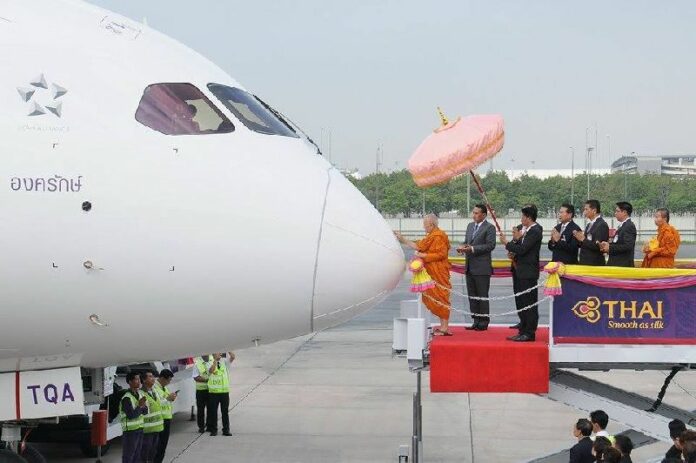
A monk blesses a Boeing plane newly acquired by Thai Airways at Suvarnabhumi Airport, 28 October 2014

BANGKOK — A constitutional rights activist and serial litigant warned Thai Airways on Saturday that it is breaking the law by barring obese passengers from buying business class seats on two of its new jets.

Srisuwan Janya, a prominent activist and secretary general of the Association of Thai Constitution Protection, issued a statement Saturday to take Thai Airways International to court if it does not withdraw a policy announced on Friday, saying such practice is unconstitutional and discriminatory to people.

Srisuwan said the policy violates four Articles within the 2017 charter, namely Articles 4, 26, 27 and 61.

On Friday, the airline said passengers with a waistline wider than 56 inches (142 centimeters) would no longer be allowed in the business class sectio of two new Boeing 787-9s because the seatbelts are limited due to FAA-mandated airbags.

“Due to safety regulations, we reserve the right of booking ticket to passengers who have waists wider than 56 inches and passengers with lap-held infants,” airline safety official Capt. Prathana Patthanasiri was quoted as saying on Friday.

The airways added two new Boeing 787-9s to its fleet in September. The planes connect Bangkok to Auckland and Taipei.

Srisuwan said there is no reason Thai Airways cannot modify the seatbelts to ensure they accommodate all passengers. He said such policy is demeaning toward human dignity, adding that if the airline cannot make an adjustment it should resell the new aircraft to Boeing and avoid buying such planes in the future.

If it fails to do so, Srisuwan said, the association would launch a litigation suit against the national carrier.

Advertisement

Hot News

LATEST NEWS

Bangkok
overcast clouds
25.5 ° C
25.5 °
25.5 °
93 %
3.2kmh
100 %
Fri
25 °
Sat
32 °
Sun
35 °
Mon
37 °
Tue
37 °