36.1 C
Bangkok
Sunday, June 21, 2026
Home Blog Page 2105

Venus Williams Out of Australian Open in 1st Round

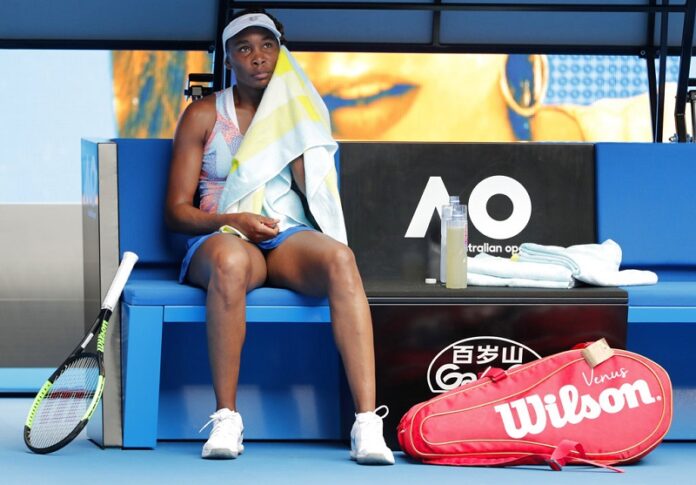
United States' Venus Williams dries her face off with a towel during a break while playing Switzerland's Belinda Bencic in their first round match at the Australian Open tennis championships Monday in Melbourne, Australia. Photo: Vincent Thian / Associated Press

MELBOURNE, Australia — Last year’s finalist Venus Williams is out of the Australian Open, beaten 6-3, 7-5 by Belinda Bencic at Rod Laver Arena.

The turning point in the match came late in the first set when play was stopped to allow for the roof to be closed because of rain at Melbourne Park. After already saving five break points at 4-3, Bencic returned from an almost 30-minute suspension to win six consecutive points to take the first set.

Bencic broke Williams’ serve in final game of the match, winning the last four points. She clinched it when Williams, who had slipped on the far side of the court, couldn’t get to a ball in the open corner.

Williams was among four American women to lose early on the opening day of the tournament. Bencic warmed up for the Australian Open by combining with Roger Federer to win the Hopman Cup for Switzerland.

Williams lost to her younger sister Serena in last year’s Australian final. Serena is not defending her title after giving birth to her first child in September.

Advertisement

Tourist Boat Bursts Into Flames, 16 Injured

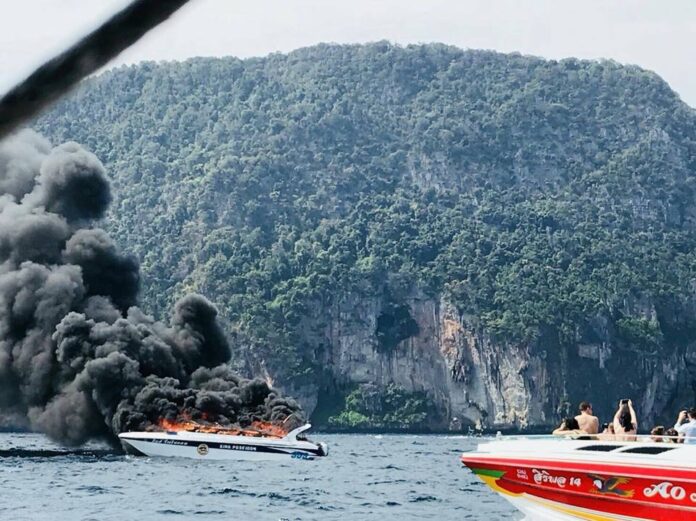
KRABI — A speedboat carrying tourists between islands in the south caught fire Sunday, injuring at least 16 people on board including the boat operator.

The boat, named Kings Poseidon 959, was traveling between Phuket and Phi Phi islands Sunday with 31 people on board when it caught fire, forcing passengers to jump into the water, said Lt. Santipot Nguanruang of Phi Phi island police.

Col. Boontawee Toraksa, deputy commander of Krabi police, said Monday morning that no one died from the accident.

People on nearby boats pulled the passengers from the water, Santipot said. The injured included 14 Chinese passengers and two Thai crew members.

Boat operator Kriangkrai Boonsri, 28, suffered severe burns and was undergoing treatment in a hospital’s intensive care unit Monday morning.

Story: Associated Press and Chayanit Itthipongmaetee

Advertisement

Thousands Attend Vigil for California Mudslide Victims

Pinit Sutthithepa. Photo: Santa Barbara County Sheriff's Office

MONTECITO, California — Thousands of people attended a candlelight vigil to pay tribute to the 20 people who were killed when mudslides ravaged a Southern California town.

The vigil was held Sunday night in Santa Barbara. Mourners raised candles and shared hugs as they remembered the victims who were killed when flash floods sent debris cascading through Montecito early Tuesday.

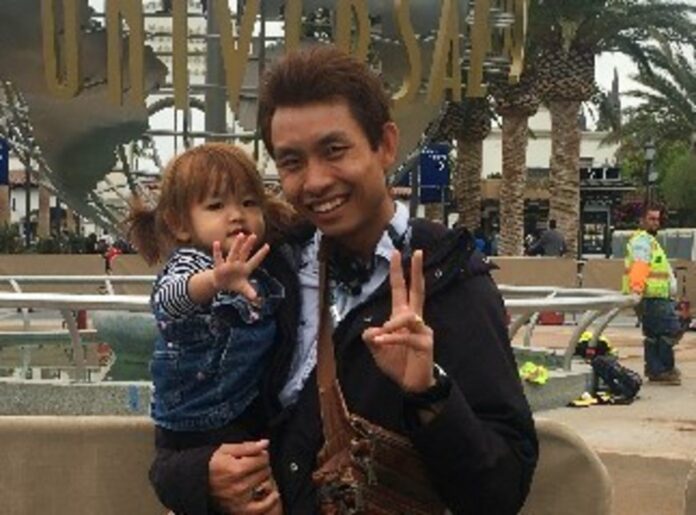
A moment of silence was also held for the victims who were killed, including 30-year-old Pinit Sutthithepa, whose body was found Saturday afternoon. His two-year-old daughter is still missing.

Read: Americans Raise Money For Thai Immigrant Family ‘Decimated’ by Mudslide

His 6-year-old son and 79-year-old father-in-law were also killed.

Santa Barbara County Supervisor Das Williams said the damage in Montecito was “breathtakingly horrible” and the community is “going through something it has never gone through.”

Advertisement

Prayuth Eyes Staying on With Little Stopping Him

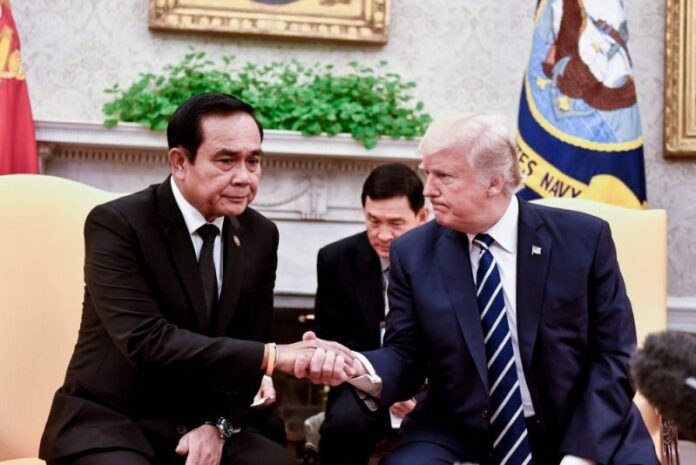
Prime Minister Gen. Prayuth Chan-ocha shakes US President Donald Trump's hand in 2017.

BANGKOK — When Prayuth Chan-ocha seized control of Thailand in a military coup, he vigorously denounced politicians as responsible for the country’s ills and positioned himself and his fellow generals as the cure.

Four years on, with many of the country’s problems still festering and the public growing impatient for long-delayed elections, the junta leader made a declaration that for many seemed to confirm suspicions that he planned to stay in power long past any polls.

“I am no longer a soldier. Understand? I’m just a politician who used to be a soldier,” the 63-year-old former-army-chief-turned-prime-minister told reporters at the turn of the year, adding, “But I still have a soldier’s traits.”

The world’s only nation still under formal military rule, Thailand is under increasing pressure both at home and abroad to return to civilian governance. The message now appears clear: In one form or another, the gruff general wants to be that civilian.

Should Prayuth decide to stay on, there’s little stopping him. For one, he still holds absolute power under rules he implemented when he staged the 2014 coup and he could simply put off elections yet again.

But even if he decides to follow his latest timeline and hold polls later this year, he and his junta have carefully crafted a strategy to ensure the military commands politics, society and even the economy for decades to come.

While Prayuth has not flatly stated whether he will seek to lead the next government, several days after declaring himself a politician he remarked: “I can be whatever you want me to be. I can be it all.”

Thailand has suffered more than a decade of political unrest and upheaval, including two coups and numerous rounds of sometimes deadly street protests, as its conservative establishment struggled with the grassroots political success of billionaire businessman Thaksin Shinawatra and later his sister Yingluck Shinawatra.

The Shinawatras fundamentally changed Thai politics with populist policies aimed at wooing the country’s poor rural majority, but their time in power was also marred by allegations of corruption. Both Thaksin and Yingluck watched their governments topple in coups and both now live in exile to avoid court convictions they say were politically motivated.

To prevent a return to what it says was a “lost decade” of national peril, the junta drafted a constitution that neuters political parties in favor of non-elected bodies and even allows for an appointed prime minister. The junta itself gets to appoint many who would do the appointing, including the entire upper house of Parliament, which would also have some seats directly reserved for the military.

Deputy Prime Minister Prawit Wongsuwan, another former army chief and key junta member, said last week that he thought Prayuth should lead the next government but seemed to hint it should be by running in the election. “It must be the voice of the people,” he said.

Even if a traditional politician or party were to come to power, they would be legally bound to follow a junta-devised national strategy that encompasses the next 20 years and that critics say will put a military stamp across a broad spectrum of future public policy.

For some in Thailand  where the junta has banned protests and political gatherings  all this spells doomsday for democracy.

“Our democratic future is going down the drain. Democratic space is closed, and public space is also closing. I don’t know if we can find any hope in the years ahead,” Naruemon Thabchumpon, a political scientist at Chiang Mai University, told an international conference. “But we must at least understand the path along which we are going. We can’t just murmur and complain in our backyards.”

The military views things very differently, arguing that it intervened to save the country from a possible civil war as deep cleavages in society erupted into violence, and from corrupt politicians who manipulated a flawed political process.

“The military stepping in was the last resort,” Lt. Gen. Weerachon Sukhontapatipak, the deputy regime spokesman, said in an interview. “It may seem contradictory to say we staged a coup to restore democracy but it is indeed the case in Thailand. Military intervention this time, we hope, will be the last time.”

Similar arguments had been voiced in the past. The self-styled “Land of Smiles” has witnessed 12 coups since the end of the absolute monarchy in 1932. Uniformed or retired military men have helmed the country for 58 of the 86 years since despite minimal threat of foreign aggression: The last invasion, by the Burmese, occurred 250 years ago.

Critics contend the coup has resulted in the military’s strongest grip since the Cold War era of the 1970s.

“Thailand is heading at full speed to a dark, dictatorial past,” said Brad Adams, Asia director of the U.S.-based Human Rights Watch, noting that the country has gone from “democratic governance concerned about human rights to dictatorial military rule that systematically prosecutes and imprisons activists.”

The junta has placed a particular emphasis on going after violators of the harsh les majeste law, which forbids insults to the royal family, and the cases are now heard in military courts rather than civilian. About 120 people have been arrested since the 2014 coup including a 14-year-old boy, a prominent human rights lawyer facing up to 171 years in prison for Facebook comments, and a Buddhist scholar who questioned whether a heroic battle 400 years ago actually took place.

Nonetheless, and as expected in a society as polarized as Thailand, Prayuth’s administration has proved popular among some segments of the population. “Some good, some bad,” is not infrequently heard among Bangkok residents, citing as positive some the junta’s policies but especially its having halted “khwaam wun wai,” chaos and confrontation, a fear deeply rooted in Thai culture.

Some Bangkok residents say they still have nightmares about political protests that ended with bloodshed on their doorsteps, buildings torched, and their businesses shuttered.

The junta’s pledge to get tough on corruption initially earned it some praise, but repeated scandals involving its members  including a current saga involving the deputy prime minister’s penchant for luxury watches and bejeweled rings  has added to public skepticism.

While Thais have in the past risen up against military rule  there were deadly protests against it in both the 1970s and early 1990s  many have also become conditioned to regard army control as normal and some soldiers have come to see it as their right.

“There is a political culture of acquiescence, a deep legacy of authoritarianism,” said Paul Chambers, a political scientist at northern Thailand’s Naresuan University.

Historically the traditional Bangkok-centered elite  the military, monarchy and senior bureaucrats  have “permitted democracy to come but only a form of democracy which won’t threaten their interests,” he said. “You see in Thailand a defective democracy or an ousted democracy.”

Which of these will emerge if and when elections are finally held is being debated.

Among the uncertainties this time is the future relations between the military and King Maha Vajiralongkorn, who has shown signs of expanding the monarchy’s powers since his father died in 2016 after a 70-year reign, including some last-minute changes to the junta-drafted constitution.

Another is whether deep social and economic rifts  which the junta has done little to heal — can be bridged. Thailand has some of the worst economic inequality in the world and long-standing tensions between the haves and have-nots remain in check only out of fear of the junta. In many poorer provinces, the home to the Shinawatra family’s power base, there is simmering anger and many privately denounce the military and Bangkok elite.

Some analysts argue that while the military and conservative forces may now seem entrenched, perpetual military rule is impossible in today’s globalized Thailand where the spread of information through social media is transforming society.

For the foreseeable future, political commentator Thitinan Pongsudhirak says the best available option would be a civil-military power-sharing along with reforms of traditional institutions in favor of strengthening democracy.

“Manipulating the constitution and staying in power at all costs are likely to lead to an inevitable showdown with forces from political parties and civil society,” he recently wrote. Anything short of a compromise “will keep Thailand stuck in a cul-de-sac, going into yet another circle to nowhere.”

Story: Denis D. Gray

Advertisement

Thai Potterheads Tap Into Their Inner Kid for Children’s Day
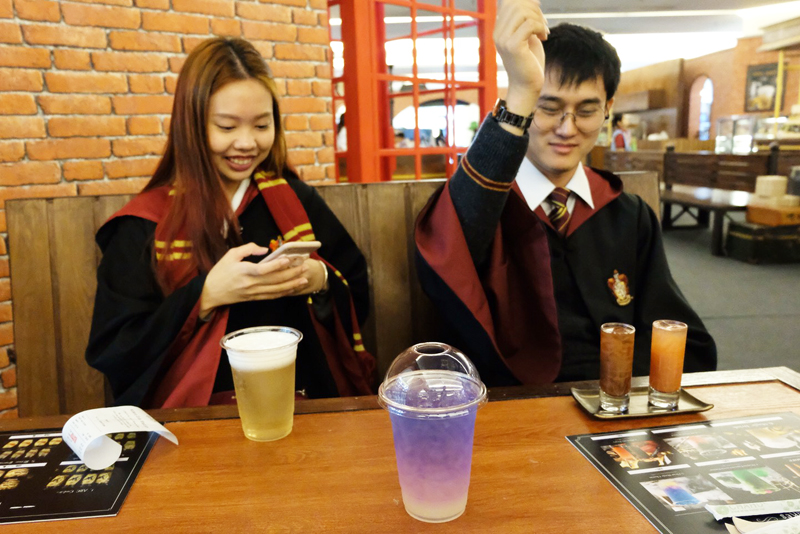
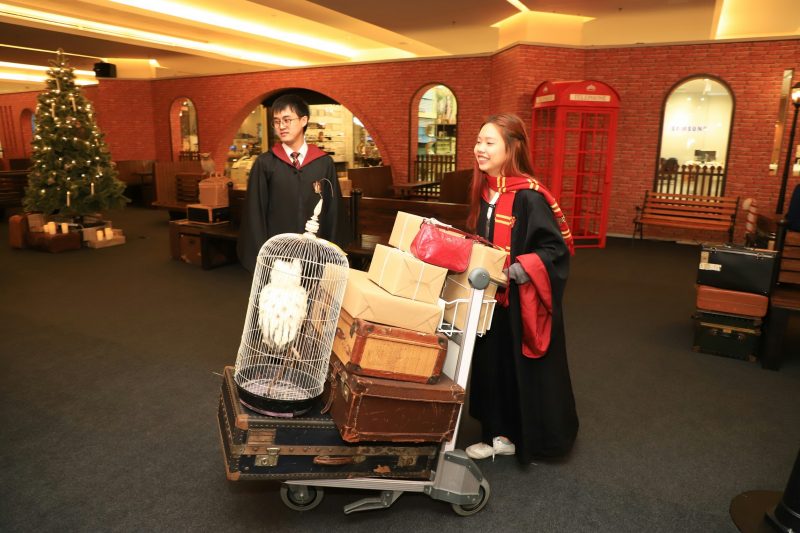
Sirapat ‘Som Joog’ Kidwisala, 22at left, and Akira Akkarakhitapisuit, 32, dress up as Ginny Weasley and Harry Potter for Children’s Day at Siam Paragon.
BANGKOK — “Lumos!” Akira Akkarakhitapisuit uttered in full Harry Potter garb as he waved his franchise-licensed wand.

Akira, a youthful 32, and fellow cosplayer Sirapat “Som Joog” Kidwisala, 22, joined eager boys and girls to spend their Children’s Day on Saturday at the Harry Potter Christmas in the Wizarding World shops at Siam Paragon, reconnecting with their inner-child wizard and witch.

“Harry Potter came into our lives when we were children. And as the years passed, the books and then the movies finished. Now the fans are grown up and have money to spend doing things like this,” said Som Joog, laughing in her Ginny Weasley costume in the middle of the downtown mall.

On Saturday would-be Harry and Ginny were twice denied access to the pop-up store after missing its hourly entrance times.

180113 0003 e1515916406962

Still, their spirits weren’t dampened as they strolled to a sorcery-themed cafe on the second floor – unlicensed but hoping to catch in on some of the baht magic – to take photos in their garb while waiting for another chance.

While younger children lapped up the stuffed Hedwigs and Honeydukes in the window displays, adult fans waxed nostalgic and sentimental about the series and were eagle-eyed for nits to pick about the presentation of their beloved franchise.

“I wish Warner Bros. would see that Thailand has a huge fanbase for Harry Potter. There’s continuing, crazy amounts of interest in it. Even for this small store, stuff is already being sold out. Fans are ready to pay. Don’t just have exhibitions in Japan or Singapore,” Akira said.

180113 0021 e1515916486701Some fans online have complained that the store only lets a set amount of people in at a time, how management charged 100 baht to book advance tickets online to do so, and Siam Paragon’s attempt to cash in on the franchise by surrounding it with an unofficial cafe and merch.


“I don’t think there should be a fee charging people to go into the shop,” Akira said. “It’s like paying to go into a 7-Eleven.”

While waiting in the Magic Club cafe, a wait staff came over and recommended their Magic Drink, a magically similar beverage to the series’ famous “Butterbeer.”

“This is my second time drinking this,” Som Joog said. “Fans that got to drink butterbeer at Universal Studios overseas will know that it’s supposed to taste like caramel and butterscotch, not like vanilla Fanta or A&W rootbeer.”

Akira and Som Joog said that attempts to cash in on their nostalgia – such as the overpriced drinks or BTS Rabbit cards stamped “Wizard Club” – don’t get them as giddy as official merchandize, they still wanted to buy it to communicate with their wallets that their Potterlove is undying.

180113 0022 e1515916501620

“I know they tried hard to make fans happy,” she said, “but not all endeavors are successful. Still, because I love the franchise, I want to support it so they can bring in more Harry Potter stuff.”

Younger fans, unburdened by questions of authenticity, happily strolled along the cafe. One even squealed and asked to take pictures with the wizarding duo.

Harry Potter: Christmas in the Wizarding World runs through March 2 and can be found on the first floor of Siam Paragon, located at BTS Siam. It’s open 10am to 10pm, and walk-in entry to the official merchandise shop is available every hour on the hour. Advance booking for 100 baht can be made online.

180113 0012 e1515916970291 180113 0026 e1515916980187

180113 0018 e1515917022430

180113 0015 e1515917037813

180113 0005 e1515917053484

180113 0007 e1515917072220 180113 0006 e1515917079274

S 65863767

S 65863776
Drink prices at the Magic Club cafe.

Related stories:

Harry Potter Shops to Bring Christmas Magic to Bangkok

Advertisement

Three Business Destroyed in Khaosan Road Fire: Police

Photo: Phinghyde_l / Twitter

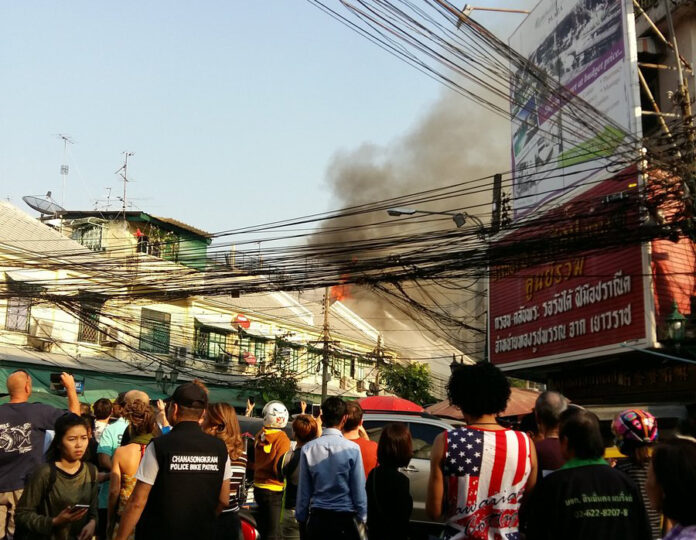
BANGKOK — Police said Sunday that no one was injured in a blaze that consumed several structures yesterday in the Khaosan Road area, an international backpacker destination.

Tourists and merchants fled the fire which began about 4:20pm in Soi Rambutri and spread to engulf three shophouses on Saturday, according to Lt. Col. Boramet Matthana.

The fire started on the second floor of the Lotash Seed restaurant before spreading to neighboring businesses, Magic Thai Food and Cocktail BB Gun, Col. Pitak Suthikul said.

Pitak said cleaners noticed some smoking wires on the restaurant’s second floor, so they fetched a fire extinguisher. They did not know how to use it and by the time they found someone who could, the fire was already burning out of control.

Police said they believe the fire was caused by an electrical short circuit. Fire fighters took about half an hour to douse the flames.

Advertisement

Hawaiians Panic Over Alert of Inbound Missile Strike

This smartphone screen capture shows a false incoming ballistic missile emergency alert sent from the Hawaii Emergency Management Agency system on Saturday, Jan. 13, 2018. Photo: Marco Garcia / Associated Press

HONOLULU, Hawaii — A false alarm that warned of a ballistic missile headed for Hawaii sent the islands into a panic Saturday, with people abandoning cars in a highway and preparing to flee their homes until officials said the cellphone alert was a mistake.

Hawaii officials apologized repeatedly and said the alert was sent when someone hit the wrong button during a shift change. They vowed to ensure it would never happen again.

“We made a mistake,” said Hawaii Emergency Management Agency Administrator Vern Miyagi.

For nearly 40 minutes, it seemed like the world was about to end in Hawaii, an island paradise already jittery over the threat of nuclear-tipped missiles from North Korea.

The emergency alert, which was sent to cellphones statewide just before 8:10 a.m., said: “BALLISTIC MISSILE THREAT INBOUND TO HAWAII. SEEK IMMEDIATE SHELTER. THIS IS NOT A DRILL.”

On the H-3, a major highway north of Honolulu, vehicles sat empty after drivers left them to run to a nearby tunnel after the alert showed up, the Honolulu Star-Advertiser reported. Workers at a golf club huddled in a kitchen fearing the worst.

Professional golfer Colt Knost, staying at Waikiki Beach during a PGA Tour event, said “everyone was panicking” in the lobby of his hotel.

“Everyone was running around like, ‘What do we do?'” he said.

Cherese Carlson, in Honolulu for a class and away from her children, said she called to make sure they were inside after getting the alert.

“I thought, ‘Oh my god, this is it. Something bad’s about to happen and I could die,'” she said.

The Hawaii Emergency Management Agency tweeted there was no threat about 10 minutes after the initial alert, but that didn’t reach people who aren’t on the social media platform. A revised alert informing of the “false alarm” didn’t reach cellphones until about 40 minutes later.

The incident prompted defense agencies including the Pentagon and the U.S. Pacific Command to issue the same statement, that they had “detected no ballistic missile threat to Hawaii.”

The White House said President Donald Trump, at his private club in Florida, was briefed on the false alert. White House spokeswoman Lindsay Walters said it “was purely a state exercise.”

Hawaii House Speaker Scott Saiki said the system Hawaii residents have been told to rely on failed miserably. He also took emergency management officials to task for taking 30 minutes to issue a correction, prolonging panic.

“Clearly, government agencies are not prepared and lack the capacity to deal with emergency situations,” he said in a statement.

For their part, Hawaii Gov. David Ige and Miyagi, the emergency management administrator, apologized and vowed changes.

“I am sorry for the pain and confusion it caused. I, too, am extremely upset about this and am doing everything I can do to immediately improve our emergency management systems, procedures and staffing,” Ige said.

The alert caused alarm across social media.

At the PGA Tour’s Sony Open on Oahu, Waialae Country Club was largely empty and players were still a few hours from arriving when the alert showed up. Workers streamed into the clubhouse trying to seek cover in the locker room, which was filled with the players’ golf bags, but instead went into the kitchen.

Several players took to Twitter. Justin Thomas, the PGA Tour player of the year, tweeted, “To all that just received the warning along with me this morning … apparently it was a ‘mistake’?? hell of a mistake!! Haha glad to know we’ll all be safe.”

In Honolulu, hair salon owner Jaime Malapit texted his clients that he was cancelling their appointments and was closing his shop for the day.

“I woke up and saw a missile warning and thought ‘no way.’ I thought ‘No, this is not happening today,'” Malapit said.

Brian Naeole, who was visiting Honolulu from Molokai, said he wasn’t worried since he didn’t hear sirens and neither TV nor radio stations issued alerts.

“I thought it was either a hoax or a false alarm,” he said.

Others were outraged. Hawaii U.S. Sen. Brian Schatz tweeted the false alarm was “totally inexcusable” and was caused by human error.

“There needs to be tough and quick accountability and a fixed process,” he wrote.

Federal Communications Commission Chairman Ajit Pai said on social media the panel would launch an investigation.

With the threat of missiles from North Korea in people’s minds, the state reintroduced the Cold War-era warning siren tests last month that drew international attention. But there were problems there, too.

Even though the state says nearly 93 percent of the state’s 386 sirens worked properly, 12 mistakenly played an ambulance siren. At the tourist mecca of Waikiki, the sirens were barely audible, prompting officials to add more sirens there and to reposition ones already in place.

Story: Audrey McAvoy and Jennifer Kelleher

Advertisement

Voranai: Let the Shinawatras Be

A portion of an unsourced image purportedly showing former Prime Minister Yingluck Shinawatra in London recently has been circulating online.

Voranai VanijakaIt’s the same story, repeated over and over. Whenever a photo of Thaksin or Yingluck Shinawatra shows up, living the good life abroad, the anti-Shinawatra crowd in the kingdom is up in arms. Calls are made for extradition. Demands are made to lock’em up.

Of course, judicially speaking, they should be extradited and imprisoned. After all, they were both found guilty of corruption by Thai courts. Emotionally speaking, just imagine the collective euphoria that would sweep across the kingdom, or at least Bangkok. It would be as if Thailand had won the World Cup and Miss Universe pageant on the same day. They’d be whistling in the streets, I tell you.

Realistically speaking however, this is never going to happen. As time and again, reality has proven that no country is going to extradite either Thaksin or Yingluck. I’m no fan of the siblings, and I do believe they are guilty of corruption. However, I’m a big fan of logic and reason, of fact and evidence; therefore, allow me to explain something that many readers likely already know as to why the Thai government cannot make a strong enough case to persuade other countries to extradite the Shinawatra duo.

Firstly, they both are democratically elected prime ministers of Thailand, ousted by military coups d’etat. That makes them political refugees. Neither England nor France would extradite them. North Korea might, but not Western democracies. As such, unless Yingluck is strutting around the streets of Pyongyang with her Hermes bag, don’t hold your breath for extradition.

Secondly, though both have been found guilty of corruption, it’s not exactly a free and fair judicial process when they were first ousted by coups. Especially in Yingluck’s case, where she was tried and found guilty under a military regime. Here, we have the recurring theme of a military coup d’etat. If the siblings had been charged and found guilty of corruption under democratic circumstances, certainly Thailand could make a stronger case with Interpol and the international community for extradition. But throw a coup into the equation, and the entire argument is ruined, at least in the eyes of Western democracies. North Korea, on the other hand, might say, “Sure, we’ll send them back, you want us to torture them a little bit first, just for fun?”

Thirdly, the military junta does not actually want them extradited. Talks of extradition are just to appease the raging emotions of the anti-Shinawatra crowd. If the junta wanted them in prison, then the junta would not have “allowed” Yingluck to escape the country in the first place.

Furthermore, consider this: In the 2001 general election, Thaksin and Thai Rak Thai party won more than 11 million or 40.6 percent of the popular vote, leading them to capture 248 seats in parliament. In 2005, they won more than 14 million or 56.4 percent of the popular vote for 375 seats. In 2011, Yingluck and Puea Thai party exceeded 15 million or 48.41 percent of the electorate and garnered 265 seats.

Between March and May 2010, the pro-Shinawatra, Redshirt group United Front for Democracy Against Dictatorship marched on the capital following a court verdict to seize USD$1.4 billion worth of Thaksin’s assets. The Democrat-led Abhisit Vejjajiva government estimated the number of protesters to be around 50,000. The Redshirts claimed the number to be 300,000. The truth is definitely somewhere in between. By the end of the protests, 91 people died, more than 2,000 were injured and billions of baht was lost in property damage, destroyed or burned. Thailand was ripped into two tribal warring factions.

From elections to protests, if those numbers and a dozen years of conflict tell us anything, it is that the Shinawatra family has strong support among the people. As such, any move to actually and physically put either Thaksin and Yingluck in prison would be met with widespread protests that could consequently lead to another, even uglier round, of violence and civil unrest. With that in mind, perhaps this was the reason Yingluck was “allowed” to escape in the first place.

So no, the military junta does not want them back. Nor should any of us, given the context.

Lastly, and of personal importance to Gen. Prayuth Chan-ocha, everything is pretty much planned out, with a new constitution, new electoral landscape and new political party. The junta leader has set himself up to likely become the handpicked prime minister of Thailand following the next general election slated (perhaps) for November this year. So why would he want to potentially create uncertainty and unrest that might jeopardize this grand scheme?

Gen. Prayuth, more than most, wants to let the Shinawatras be.

Advertisement

Americans Raise Money For Thai Immigrant Family ‘Decimated’ by Mudslide

Pinit Sutthithepa and his daughter Lydia and son Peerawat. Photo: GoFundMe.com

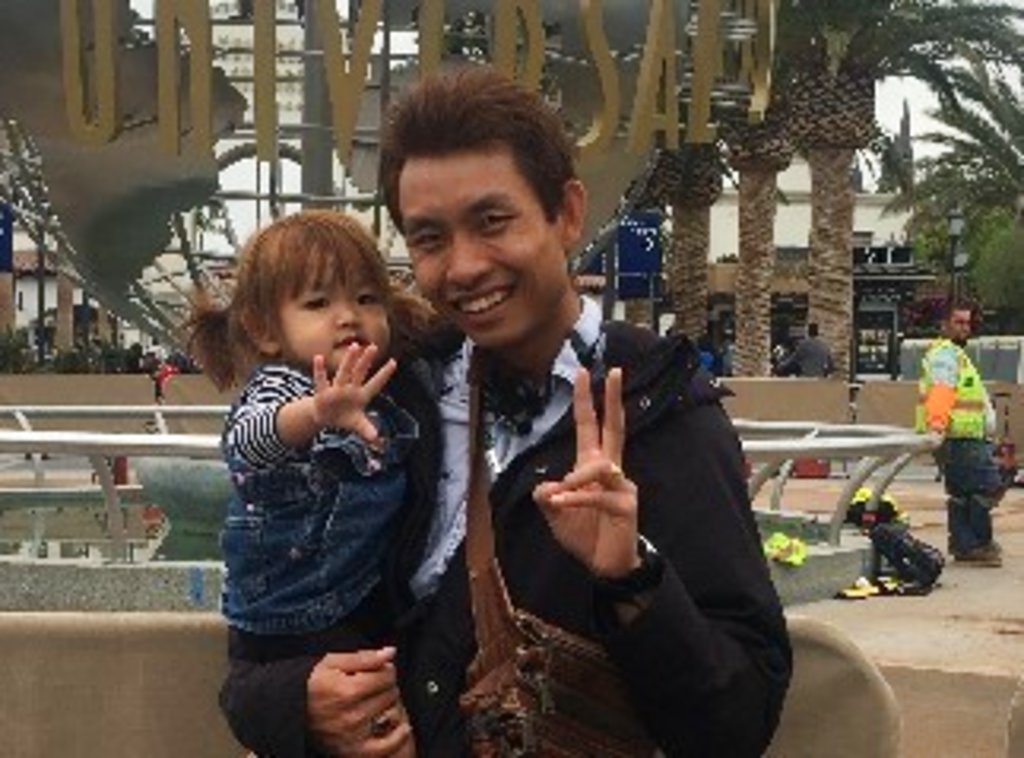
MONTECITO, California — Pinit Sutthithepa, originally from Khon Kaen, immigrated from Thailand, leaving behind his wife and two children but sending them money for years until he could bring them to the United States, a friend, Poy Sayavongs, told the media.

“They finally were able to make it to the states in the summer of 2016,” Poy told Lee Central Coast News in California. “It’s cruel — they only had a short time together before this tragedy struck.”

On Tuesday, a wall of mud decimated Pinit’s family home in Montecito, California, killing his 6-year-old son Peerawat and stepfather, Richard Loring Taylor, 79. Pinit and his 6-year-old daughter, Lydia, are still considered missing.

His wife Yuphawan “Aw” Sutthithepa and mother Banphoem “Perm” Loring were at work at a supermarket and survived. Another relation, Sirithorn “May” Janthorntho, was pulled from the rubble by firefighters.

Nineteen people were killed when devastating mudslides brought tragedy and sorrow to the idyllic coastal community.

Pinit Sutthithepa and his daughter Lydia. Photo: Santa Barbara County Sheriff's Office
Pinit Sutthithepa and his daughter Lydia. Photo: Santa Barbara County Sheriff’s Office

“At 4 a.m. the house was obliterated by mud, boulders and rushing water. Literally nothing is left,” Mike Caldwell, Pinit’s boss at Toyota of Santa Barbara, wrote on a GoFundMe page seeking help for the family.

As of Sunday, USD$85,155 (2.7 million baht) of the $100,000 goal has been raised, mostly through more than 700 small donations.

Pinit’s wife and mother were working at the time. Another relative was rescued by firefighters.

“This family has lost everything but the clothes they were wearing,” Caldwell wrote.

A month earlier, the family had evacuated to a Red Cross shelter for a night as the devastating wildfire threatened their home.

“I would’ve never imagined Peerawat would’ve been killed by the mudslides, when they were able to survive the Thomas fire,” family friend Kevin Touly told the Central Coast News. “We’re just so heartbroken.”

Lydia Sutthithepa. Photo: Santa Barbara County Sheriff's Office
Lydia Sutthithepa. Photo: Santa Barbara County Sheriff’s Office

Peerawat, known as Pasta, loved trains, Touly told the Los Angeles Times.

Sometimes, Sutthithepa’s wife would join him at work and bring along their children, co-worker Anneliese Place told the Times.

Peerawat would run around her desk and giggle, she said.

Other victims included a young mother asleep with her 3-year-old daughter as her 10-year-old nephew slumbered nearby, and a woman and her 89-year-old husband of more than 50 years who celebrated his birthday the day before.

Story: John Rogers, Julie Watson, Khaosod English


Advertisement

World Media Struggle to Translate Trump’s Africa Insult

US President Donald Trump speaks Thursday at a prison reform roundtable in the Roosevelt Room of the White House. Photo: Carolyn Kaster / Associated Press
US President Donald Trump speaks at a prison reform roundtable in January in the Roosevelt Room of the White House. Photo: Carolyn Kaster / Associated Press

NAIROBI, Kenya — President Donald Trump’s vulgar insult of Africa was a puzzle for many foreign media organizations, which didn’t have a ready translation of his epithet for their readers or listeners.

While meeting with senators on immigration, Trump had questioned why the U.S. would accept more immigrants from Haiti and “shithole countries” in Africa, according to one participant and people briefed on the conversation.

Japanese media went with translations ranging from “filthy” to “dripping with excrement.” Chinese state media went with “fenkeng,” which means “cesspit.” And some African outlets decided to use a word meaning “dirty countries.”

An editor at a Kenyan paper says there is a direct translation for Trump’s term in Swahili, but they didn’t use it. He says it would be “unprintable.”

Thai-language media translated it as loom kii, literally a hole for defecating, or latrine.

Story: Tom Odula, Khaosod English

Advertisement

Hot News

LATEST NEWS

Bangkok
broken clouds
36.1 ° C
36.6 °
35.5 °
57 %
3kmh
65 %
Sun
35 °
Mon
37 °
Tue
37 °
Wed
37 °
Thu
37 °