BANGKOK — Maria Poonlertlarp Ehren was crowned Miss Universe Thailand on Saturday night at the Siam Paragon shopping mall.
Ehren, 25 of Thai-Swedish descent, graduated from Stockholm Business School and entered the pageant as a favorite for her existing fame as a model, stage presence and English-language skills.
“Equality of men and women in Thailand isn’t equal yet,” Ehren said when asked what was difficult about being a woman. “But to move forward, both men and women have to hold hands and move forward together, because it’s not just an issue about women.”
Ehren will go on to compete on the world stage on Nov. 26 at the Miss Universe pageant in Las Vegas.
Ratapirayarn Aphinanthanapong, winner of the People’s Choice award.
“This stage will help me to succeed and build foundations to help Thailand,” Ehren said when asked why she was competing, adding that she’d most like to tackle issues of teenage pregnancy and ocean pollution.
The first runner-up was Supaporn Ritthipruek. Paweensuda Drouin, Suraphrin Atkhonghan and Ratchanok Naowaset were all chosen as second runner-up from the 40 finalists who went into Saturday’s pageant.
The winner of the People’s Choice Award, selected via SMS votes for the public’s favorite headshot of contestants wearing haute couture, Lanna-style headdresses, was nabbed by No. 24, Ratapirayarn Aphinanthanapong, 24 of Yala.
BANGKOK — While the country is not lacking for teen melodramas, less commonly aired issues of youth sexuality and identity are coming to the screen Thursday in a fusion of documentary and dramatization.
Stories of Bangkok youth and their search for identity and place in the gender spectrum are brought into focus by “#BKKY,” which follows Jojo, a 17-year-old high school senior, as she grows close to a female friend. Jojo becomes uncertain about her sexual identity when she meets skateboarders Jeff and Jasper.
Nontawat is perhaps best known for his banned 2013 documentary “Boundary,” which is about the infamous Thai-Cambodia conflict over possession of the Preah Vihear Temple. The following feature-length documentary released in the same year “By the River” follows the lives of Karen locals who live by a river contaminated by a mine.
However, unlike his first two films, Nontawat chose to mix up fact and fiction in his third to attract a larger teen audience.
Prior to filming and writing the screenplay, Nontawat interviewed 100 adolescent boys and girls in Bangkok – high school juniors and seniors between 17 and 19 – asking them mostly about love, family and their dreams.
“It’s an important transitional period. I remember it was very fun at the time and things changed so fast,” the 34-year-old filmmaker said. “Now I want to know, how are the teenagers doing these days? What do they think? What are the issues?”
For the docudrama, he cast four of his teen interview subjects in roles. And many elements remain true. Jeff (Jeff Watson Kiatmontri) and Jasper (Jasper Dohrs), as in the film, grew up abroad and are skaters. In real life, Jojo (played by Ploiyukhon Rojanakatanyoo) and Q (Anongnart Yusananda), used to date girls.
Asked if he set out to make an LGBT film in the first place, Nontawat said that wasn’t his original intention.
“It’s coincidental that most of the interviewed teens – 60 of 100 – openly talk about their sexual orientation and diverse gender identity. Some said they liked both boys and girls,” Nontawat said. “I also noticed that many kids from all-boys and all-girls schools are more open-minded than those in co-ed schools.”
Having won positive reviews from foreign audiences and media, Nontawat hopes the same will hold for Thai viewers as well, not just teenagers, but also adults and parents.
“I hope that many parents will watch this and understand their kids in this modern society better, so they can live together in harmony,” Nontawat said.
The film premiered in October at the Busan Film Festival and has shown at LGBT film festivals in many cities including Quezon, Glasgow and Boston. It won the Jury Prize at the Hamburg International Queer Film Festival.
“#BKKY” opens Thursday in Bangkok.
Scene from ‘#BKKY’Scene from ‘#BKKY’Scene from ‘#BKKY’Scene from ‘#BKKY’
WASHINGTON — China appears to have succeeded in eliminating software programs that enable its people to view an uncensored internet.
Companies that let people avoid the government filters said Saturday that their programs have been removed from Apple’s app store in China.
ExpressVPN, one of the companies, posted on its corporate site a message from Apple saying that its program was illegal in China. The British Virgin Islands-based software company says that all major virtual-private network apps were removed from the Apple app store in China. ExpressVPN claimed Apple was “aiding China’s censorship effort.”
Star VPN, another company, said it also received notice of being removed.
Apple said in a statement that China began requiring this year that developers of virtual-private networks have a government license. The California-based tech giant said it had removed apps “in China that do not meet the new regulations.”
People have expressed excitement about the new lawwhich enabled transferring land to a company to pay for shares without any personal income tax burden. Actually getting it done is no easy task, with hiccups here and there, as this is a novel transaction alien to officials at all three relevant government agencies: the Land Office, Revenue Office and Companies Registrar Office. It’s been a challenge to find an expert at any of these agencies to provide counsel.
Wirot Poonsuwan
Land transferors would need to take several trips to each of the three agencies to seek clarification until they can be sure of completing a transaction. In some areas, the advice of different agencies simply contradicts one another, resulting in an inability to register a transfer of land and the abandonment of efforts to enjoy the benefits of the new regulation. The Dec. 31 deadline is fast approaching, causing worries to those who have already set up a new company but become stuck and unable to proceed further to increase its capital and transfer land to pay for the capital increase, tax-free.
It is a shame the much-heralded Royal Decree 630, supposedly a big boon to taxpayers, has shown signs of fizzling.
Here’s what I’ve gleaned to help those still interested in pursuing these generous benefits.
Registration
First of all, citizens are unsure where to start, what to do and what practical steps to take. Now it is clear, they need to complete registration to establish a company first. Then take this company to the Land Office to receive a transfer of land to pay for the shares of the transferor. One area to watch out: You cannot let the appraisal value of the land exceed the amount of the registered capital of the company. Remember: The registered capital of the company can be more than or equal to the land value, but it cannot be less. This is to comply with the Notification of the Director General of Revenue No. 5, dated June 5, 2017.
Capital Concerns
An early milestone to reach is converting the land into shares, after the statutory meeting when you register a company. You should not set up a company first, hoping to increase its capital later and to transfer land to pay for the additional capital. Increases of capital have been the most complicated and confusing issue; the Land Office has refused to accept tax-free transfers of land in event of increased capital, citing that it is in the process of seeking a second ruling from the Revenue Department. The Companies Registrar Office likewise has a practice and opinion, opposite that of the Land Office in regard to capital increases. Capital increases are not recommended.
Prepare Proof
Notification No. 5 also requires that you must use land transferred to a new company to carry on your business, such as land and buildings leased to others. At the time of transferring the land, you will need to present to the Land Office evidence the land is being used for your business on the date of transfer, such as a copy of the lease agreement and receipts of rent collected. In addition, you and the company must, on the date of land transfer, submit a letter in a prescribed form to both the Land Office and the Revenue Office certifying the land has been used for business.
This requirement has just been added to the Notification No. 5 to plug loopholes in the previous notification issued March 20.
The original Notification No. 4 condoned the transfer of any land. Smart individuals owning high-value property, especially that obtained through inheritance, took advantage of of it to save tens of millions of baht in tax expenses. A mere three months later, the new rule was announced to close this possibility by requiring the land be used for business purposes. The theme is pushing individual landlords with personal real estate rental businesses into the company system for more efficient tax collection. The Revenue Department must have calculated that giving up the personal income tax on land transfers was a worthwhile sacrifice, taking into account the amount of corporate income tax to be collected from the land rental companies in the long-term.
The next problem is the seemingly large initial capital outlay, generally understood to be legally required to establish a new company. Superficially, it looks as if the Civil and Commercial Code, or CCC, requires up to 25 percent minimum paid-up share capital before a company can be set up. Individuals just don’t have the appetite to pay one-fourth of the land value in cash to save some tax expenses. Fortunately, this problem is now solved, as the Company Registrar Office has recently accepted registration of a company, with effectively 0.001 percent paid-up share capital in cash, which is perfectly legal. The remaining 99.999 percent share capital was entirely paid by land.
The solution to the above problem can be clarified as follows: The CCC Section 1105, third paragraph says “The money first paid for share capital” must not be less than 25 percent of the par value. This can be substantial. For example, the registered capital of 5 million baht would need initial paid-up capital of one fourth, i.e. 1.25 million baht — which many small individuals cannot afford — before a land transfer to pay for the remaining 75 percent of the registered capital takes place.
The targeted well-to-do individuals could face a worse situation. Who would want to invest hundreds of millions of baht to save tax? For instance, if a wealthy person has parcels of land worth 1 billion baht and considers joining the scheme. Let’s say he is setting up a new company to receive a transfer of the land. He would have to fish from his pocket 25 percent of the registered share capital/land value or 250 million baht in addition to paying official the company registration fee of 200,000 baht (every million baht share capital pays 1,000 baht fee, up to a 200,000 baht cap). This exorbitant cash up-front has deterred participation.
But the problem has been solved by the Companies Registrar having accepted registration of a company with a registered share capital of about 900 million in May 2017. The statutory meeting of this company divided the ordinary shares into two groups, according to the CCC Section 1108(5): The first part of the ordinary shares consists of cash shares to be paid up fully in cash, and the other part is land shares to be paid up entirely by land. The latter part is legally called, “ordinary shares to be allotted as fully paid-up otherwise than in money.”
The first group of ordinary shares is 100 shares with a par value of 100 baht each; the share capital of this group is 10,000 baht. The CCC Section 1105, third paragraph states that these cash shares must be initially paid up at least 25 percent of the par value, namely 2,500 baht as “The money first paid for share capital.” In our case study, in which the Companies Registrar has accepted company registration, this part of shares is paid up 100 percent: 10,000 baht. Mr. A alone owns the cash shares. His stake in the company thus totals 10,000 baht.
For the group of shares that are ordinary shares to be allotted as fully paid-up otherwise than in money or the shares paid-up 100 percent by land, the CCC does not require that this part of the share capital be first 25 percent paid-up, whether in “money” or in land—they can be fully 100 percent paid-up at one time by land. The Companies Registrar therefore accepted the registration of the company set-up so that it can proceed to receive a land transfer to pay for this part of shares at the Land Office. Provided that the company, jointly with the shareholding transferor, must write their separate letters to the Companies Registrar undertaking that the land will be transferred to the company and evidence of the transfer be presented back to the Companies Registrar within 90 days of company registration. A Land Office Certificate certifying the appraisal value of the land must also be delivered to the Companies Registrar as part of the application for company registration.
In our case where the company registration has been completed, the ordinary shares to be paid-up by land are huge: 900 million baht, allotted into 9 million shares of 100 baht each par value, totaling 900 million baht. Mr. B, a wealthy individual, holds these shares.
There must be at least three shareholders under the CCC. The other shareholder is Mr. C, similarly holding land shares. The appraisal value of his land amounts to 500,000 baht (five hundred thousand baht), divided into 5,000 shares of 100 baht each par value. The value of Mr. C’s holding is 500,000 baht.
The total registered share capital of the company from Mr. A, Mr. B and Mr. C combined looks like this: 10,000 baht + 900 million baht + 500,000 baht = 900,510,000 baht, divided into 9,005,100 shares worth 100 baht each. Mr. A holds 100 cash shares, Mr. B holds 9 million land shares and Mr. C has 5,000 land shares.
Effectively, this company chipped in only 10,000 baht initial capital investment in cash to be able to completely establish a 900 million baht company, a mere 0.001 percent of the registered capital – a very attractive proposition for the sponsoring individual landlord. There is no more what appeared to be the initial requirement of 25 percent first payment of over 225 million baht.
The company in our study still had to pay the official company registration fee of 200,000 baht, the ceiling for the 900 million baht registered capital.
The legal option accommodated by the Companies Registrar has proved to be valuable assistance to taxpayers to keep them away from having to pay a large amount of capital for a new company set-up. This will no doubt spur more participation in the tax-free land transfer scheme by individuals renting out land, whether they are the man on the street or high net-worth individuals, and entice them to enter the more desirable world of corporate income tax.
Wirot Poonsuwan is a practicing attorney and can be reached at [email protected].
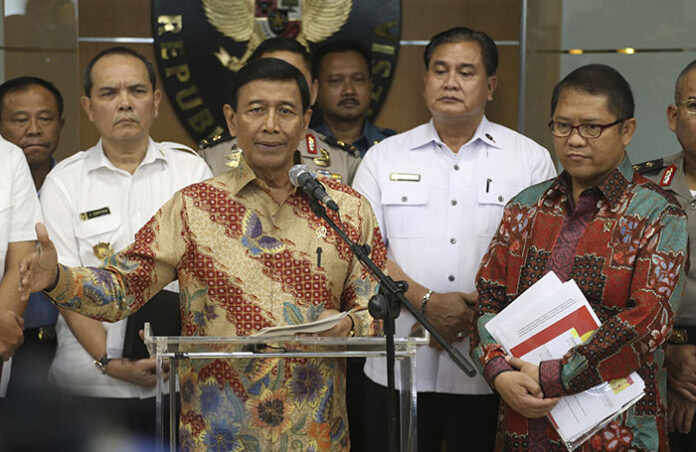
Indonesian officials gesture at a July 12 news conference announcing a presidential decree to amend an existing law regulating mass organization in a bid to rein in radical groups. Photo: Dita Alangkara / Associated Press
MANADO, Indonesia — A six-nation summit co-hosted by Indonesia and Australia agreed Saturday to set up a forum to strengthen cooperation between intelligence services to counter extremist threats in Southeast Asia.
Security ministers and officials from Indonesia, Australia, Malaysia, Brunei, the Philippines and New Zealand held a one-day meeting in Manado, the capital of Indonesia’s North Sulawesi province, focusing on the Islamic State group attack on the southern Philippine city of Marawi.
Indonesia’s top security minister, Wiranto, told a news conference that the six countries agreed to establish the Foreign Terrorist Fighters Forum to strengthen information sharing and cooperation between law enforcement and intelligence services.
The Marawi occupation has raised fears that the Islamic State group’s violent ideology has taken root in the Philippines’ restive south and could destabilize neighboring countries. More than 600 people have been killed in the conflict, including foreign fighters, and the city has been devastated by government air strikes against the militants. Indonesia and Malaysia also face the threat of citizens who went to Syria and Iraq to fight with IS returning home and carrying out attacks.
“We cannot keep silent because terrorism has become a real threat to humanity,” said Wiranto, who uses one name. “Not a single country is free from the threat of terrorism and therefore this threat must be faced together.”
He said immigration procedures should also be strengthened to prevent militants from traveling in the region.
Australian Attorney General George Brandis said in his opening speech that the conflict in Marawi “reminds us in the most immediate possible way of the urgency and the proximity of the threat that is faced by all of us.”
Original baby image: University of British Columbia
Police monitoring social media for booze pictures is just another step toward Thailand becoming a military nanny state.
Four celebrities were placed under investigation last week for possibly promoting booze on social media, leaving netizens unsure if they might break the law by sharing photos of people enjoying a party with a bottle or two in the image.
Last December, the former Alcohol Control Board director warned after the launch of yet another crackdown that ordinary folks were not immune from prosecution. “Just by showing names and brands, whether directly or indirectly, people who post the photos are at risk of violating the same provisions,” Samarn Futrakul told Khaosod English.
Under Thai law, promoting booze online carries a maximum fine of 500,000 baht. If that’s not enough to dissuade people, this week also saw graphic warning labels for alcohol products being contemplated in a bid to further curb consumption. According to Thai Health Promotion Foundation, as of last year, there were 5 million alcoholics in Thailand.
Less cirrhosis among Thais and fewer road deaths due to drunk driving are welcome.
So why am I disturbed by these developments? It’s not that I am alcoholic but the patronizing approach the state and anti-booze campaigners bring to imposing censorship and trampling on liberties.
They continue pushing greater restrictions and one-sided messages. Again, the people cannot be trusted to make their own decisions, and instead of better equipping them to make better ones, the state wants to step in and eliminate the choice.
Thus the government in June 2015 imposed zoning regs wherein alcohol could not be sold within 300 meters of any school property, with enforcement of what was essentially unenforceable focused on some areas frequented by university students.
So instead of teaching students how to be responsible, as Oxbridge does with subsidized booze made available with strings attached, the Thai state took the totally opposite approach. Yet so many cheer these ill-considered and ineffective policies that extending the radius to two kilometers was proposed.
Image: Public Health Ministry
Forget about choosing the government – once there’s no trust that people can make mature and intelligent decision, there’s no end to the list of prohibitions on acceptable behavior, from what to drink to whom to marry. The state will have to come in and make these decisions for everyone.
Fear of punishment will win cooperation as more one-sided information is drilled into everyone’s heads for them to remember the correct information and correct attitude to hew to.
At the rate things are going, we can only expect more restrictions in more areas. For the past three years, for example, the military junta has decided that political gatherings of more than five people is bad for Juntaland Thailand, so they banned them. People who like a night out dancing in Bangkok are now hard-pressedto find anywhere to do so after midnight. And since the public can’t be trusted to differentiate between truth and falsehood, they must live in an environment where only glowing stories about the monarchy are legal. Consume anything else at the risk of breaking a lawcreated long before the coup that has seen jail time increase to 15 from seven years when it was first introduced in 1976.
Thais have for decades accepted the spectacle of freezing in place for the national anthem at 8am and 6pm, at least if they are in earshot of it being played in a public place. This does nothing to better the nation, but a public freezing at attention simply because others freeze does become docile and unthinking.
The logical conclusion is that if the state expands its coercive powers over us and imposes more musts and don’ts, we risk being citizens in favor of becoming a managed population.
A docile population which unthinkingly follow orders is well-suited to military rule, and a threat that is sobering not for lack of alcohol.
BANGKOK — In late 2015, I wrote about a new restaurant in Ekkamai. It was just like any other new restaurant in Ekkamai except for the fact it was owned and operated by North Korea.
Eating at Pyongyang Okryu wasn’t quite like actually eating in North Korea. No, it was even more bizarre because diners from Japan, South Korea, and a slew of Western nations frequented the place, often at the same time.
This strange phenomena shattered the notion that North Korea is reflexively hostile toward the free world. North Korean comrades had built a long table and invited everyone in for a meal. By the clientele, the place came across as more international than many of the restaurants surrounding it, though it was still a relatively hidden gem tucked away in an Ekkamai side soi that took a decent sense of direction to locate.
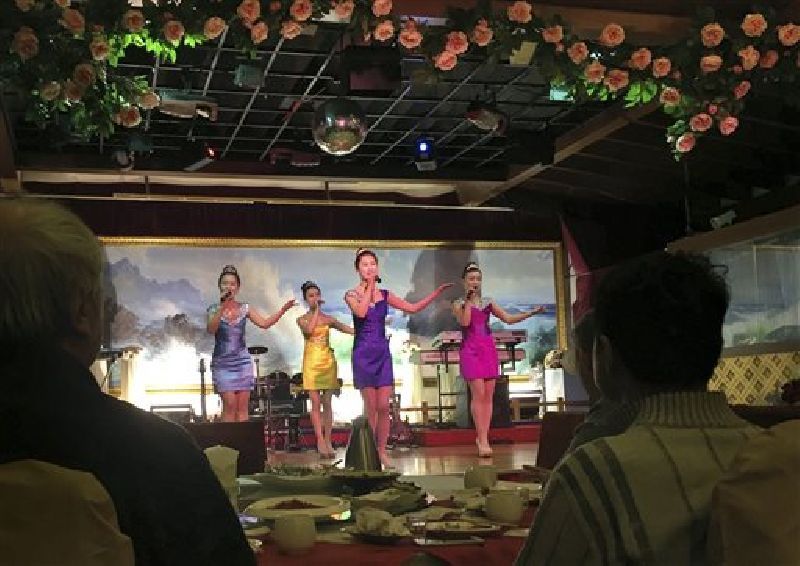
n this Feb. 18, 2016, photo, North Korean performers entertain customers at the Okryugwan restaurant in Beijing. Photo: Ng Han Guan / Associated Press
In June, Pyongyang Okryu shut its doors and reopened in the Bangkok big leagues, smack dab in the middle of Sukhumvit Road, with fresh decor and fancy trimmings to match the new location.
It would seem the restaurant rising to a new standard is in line with the more aspirational North Korean order, from the sparkling skyline of Pyonghattan to intercontinental ballistic missiles that as of today can strike the United States.
Outside the restaurant, two friendly female North Korean party members are stationed on each side of the door, but they’re trained to crack smiles instead of salutes. It’s been widely suggested that women in the service industry sent abroad to work in these restaurants may live under unfavorable conditions. Defections aren’t unknown.
Inside, find a sterile dining environment with, every table surface perfectly polished and every marble accent shimmering. There’s even a small assortment of North Korean souvenirs such as dolls and ginseng soju behind the front counter for sale. The main draw at Pyongyang Okryu, aside from interacting with North Koreans, is the show they put on every evening. Imaginative renditions of Western songs are sandwiched by traditional guitar performances performed by the same multi-talented women serving the food.
Pyongyang Okryu at its new Sukhumvit Road location.
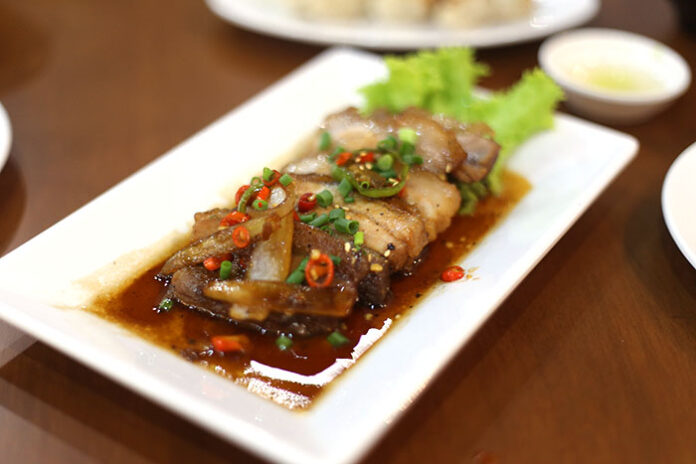
Many come for the novelty and not the food, but perhaps the new location will garner the attention of diners looking for great Korean cuisine as an alternative to the ever-popular southern strain. The cuisine from the north isn’t much different, except there’s an emphasis on a few dishes that aren’t as popular below the DMZ, such as cold noodles. And the fare here has certainly gotten better since the Ekkamai days. On my most recent visit, I found true pork-fection in a plate of sweet and fiery pork belly.
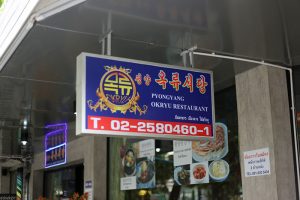
Pyongyang Okyru is next to the Radisson Blu hotel between sois Sukhumvit 25 and 27 in the former home of Washi Sushi Burger. It can be reached at 02-2580460-1.
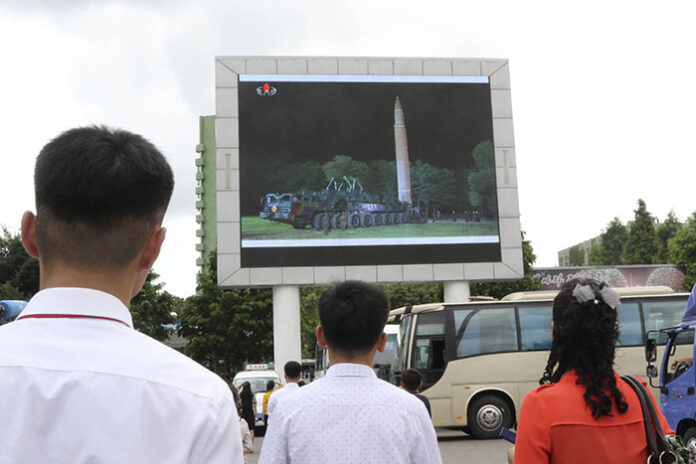
People watch a news broadcast on a missile launch Saturday in Pyongyang, North Korea. Photo: Jon Chol Jin / Associated Press
PYONGYANG, North Korea — North Korean leader Kim Jong Un said Saturday the second flight test of an intercontinental ballistic missile demonstrated his country can hit the U.S. mainland, hours after the launch left analysts concluding that a wide swath of the United States, including Los Angeles and Chicago, is now in range of North Korean weapons.
The Korean Central News Agency said that Kim expressed “great satisfaction” after the Hwasong-14 missile reached a maximum height of 3,725 kilometers (2,314 miles) and traveled 998 kilometers (620 miles) before accurately landing in waters off Japan. The agency said that the test was aimed at confirming the maximum range and other technical aspects of the missile it says was capable of delivering a “large-sized, heavy nuclear warhead.”
Analysts had estimated that the North’s first ICBM on July 4 could have reached Alaska, and said that the latest missile appeared to extend that range significantly.
Immediately after the launch, U.S. and South Korean forces conducted live-fire exercises. South Korean Defense Minister Song Young-moo called for the deployment of strategic U.S. military assets — which usually means stealth bombers and aircraft carriers — as well as additional launchers of an advanced U.S. anti-missile system.
Japanese government spokesman Yoshihide Suga said the missile, launched late Friday night, flew for about 45 minutes — about five minutes longer than the first. The missile was launched on very high trajectory, which limited the distance it traveled, and landed west of Japan’s island of Hokkaido.
The KCNA quoted Kim as saying that the launch reaffirmed the reliability of the country’s ICBM system and an ability to fire at “random regions and locations at random times” with the “entire” U.S. mainland now within range. The agency said that the test confirmed important features of the missile system, such as the proper separation of the warhead and controlling its movement and detonation after atmospheric re-entry.
Kim said the launch sent a “serious warning” to the United States, which has been “meaninglessly blowing its trumpet” with threats of war and stronger sanctions, the KCNA said.
On the streets of Pyongyang, North Koreans welcomed the news of their country’s latest missile test while state media broadcast images of a projectile launched into the night sky. Kim Jong Un was seen in the company of military commanders near a mobile missile launcher.
“I feel really confident. From now on, we will develop and have the strongest weapons, strategic weapons, so we can safeguard our sovereignty and independence, so that we can end up winning against the imperialists and against America,” said Pak Gi Nam, a student. It is normal for North Koreans talking in front of TV cameras to stick to the official version of events.
The North Korean flight data was similar to assessments by the United States, South Korea and Japan.
David Wright, a physicist and co-director of the global security program at the Union of Concerned Scientists, said that if reports of the missile’s maximum altitude and flight time are correct, it would have a theoretical range of at least 10,400 kilometers (about 6,500 miles). That means it could have reached Los Angeles, Denver or Chicago, depending on variables such as the size and weight of the warhead that would be carried atop such a missile in an actual attack.
President Donald Trump issued a statement condemning the missile test as a threat to the world, and rejecting North Korea’s claim that nuclear weapons ensure its security. “In reality, they have the opposite effect,” he said.
Trump said the weapons and tests “further isolate North Korea, weaken its economy, and deprive its people.” He vowed to “take all necessary steps” to ensure the security of the U.S. and its allies.
Japanese Foreign Minister Fumio Kishida said he told U.S. Secretary of State Rex Tillerson in a phone call that the second missile test greatly increased the threat from Pyongyang. He said two sides agreed to consider all means necessary to exert the utmost pressure on North Korea. They reiterated calls for new sanctions and to work closely together with South Korea along with efforts by China and Russia.
China, meanwhile, urged its ally North Korea to abide by U.N. Security Council resolutions and halt any moves that could escalate tensions on the Korean Peninsula.
Washington and its allies have watched with growing concern as Pyongyang has made significant progress toward its goal of having all of the U.S. within range of its missiles to counter what it labels as U.S. aggression. There are other hurdles, including building nuclear warheads to fit on those missiles and ensuring reliability. But many analysts have been surprised by how quickly leader Kim Jong Un has developed North Korea’s nuclear and missile programs despite several rounds of U.N. Security Council sanctions that have squeezed the impoverished country’s economy.
Trump has said he will not allow North Korea to obtain an ICBM that can deliver a nuclear warhead. But this week, the Defense Intelligence Agency reportedly concluded that the North will have a reliable ICBM capable of carrying a nuclear weapon as early as next year, in an assessment that trimmed two years from the agency’s earlier estimate.
The French Foreign Ministry condemned the launch and called for “strong and additional sanctions” by the United Nations and European Union. “Only maximal diplomatic pressure might bring North Korea to the negotiating table,” the ministry said in a statement.
“This is a 4G threat: global, grave, given and growing,” France’s U.N. Ambassador Francois Delattre told The Associated Press. That’s why we call for a firm and quick reaction including the adoption of strong additional sanctions by the Security Council.”
A spokesman for Gen. Joseph Dunford, chairman of the Joint Chiefs of Staff, said that Dunford met at the Pentagon with the commander of U.S. forces in the Pacific, Adm. Harry Harris, to discuss U.S. military options in light of North Korea’s missile test.
The spokesman, Navy Capt. Greg Hicks, said Dunford and Harris placed a phone call to Dunford’s South Korean counterpart, Gen. Lee Sun Jin. Dunford and Harris “expressed the ironclad commitment to the U.S.-Republic of Korea alliance,” Hicks said, referring to the U.S. defense treaty that obliges the U.S. to defend South Korea.
Abe, too, said Japan would cooperate closely with the U.S., South Korea and other nations to step up pressure on North Korea to halt its missile programs.
The Hwasong 14 ICBM test-fired earlier this month was also launched at a very steep angle, a technique called lofting, and reached a height of more than 2,500 kilometers (1,550 miles) before splashing down in the ocean 930 kilometers (580 miles) away. Analysts said that missile could be capable of reaching most of Alaska or possibly Hawaii if fired in an attacking trajectory.
South Korea’s Joint Chiefs of Staff said the missile was launched from North Korea’s northern Jagang province near the border with China. President Moon Jae-in presided over an emergency meeting of the National Security Council, which called for an emergency meeting of the U.N. Security Council and stronger sanctions on North Korea.
July 27 is a major national holiday in North Korea called Victory in the Fatherland Liberation War Day, marking the day when the armistice was signed ending the 1950-53 Korean War. That armistice is yet to be replaced with a peace treaty, leaving the Korean Peninsula technically in a state of war.
Police seen here in 2015 in Oklahoma, Florida. Photo: Oklahoma City Police Department / Wikimedia Commons
CROMWELL, Oklahoma — State investigators have identified a man whose body was found on the side of a highway in central Oklahoma as a native of Thailand who had been living in Florida.
The Oklahoma State Bureau of Investigation said Friday that 41-year-old Thanakrit Thuetong had been living in the United States since 2012 and may have been driving along Interstate 40 to visit relatives in California.
Image: Oklahoma State Bureau of Investigation
OSBI agents say Thuetong parked his 2009 black Pontiac in the parking lot of a Seminole County convenience store Friday afternoon. Surveillance video shows him inside the store with a black backpack, then walking past his car and along the highway. His body was discovered Sunday.
His backpack was missing, and authorities are searching for anyone who may have found it.
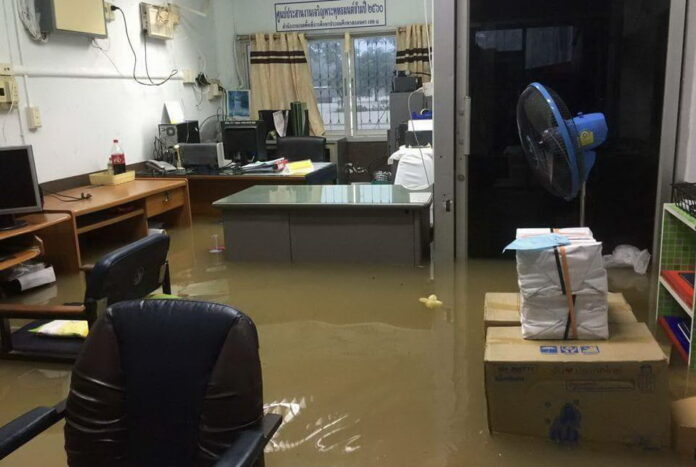
An office building hit by flood in Sakon Nakhon on Friday
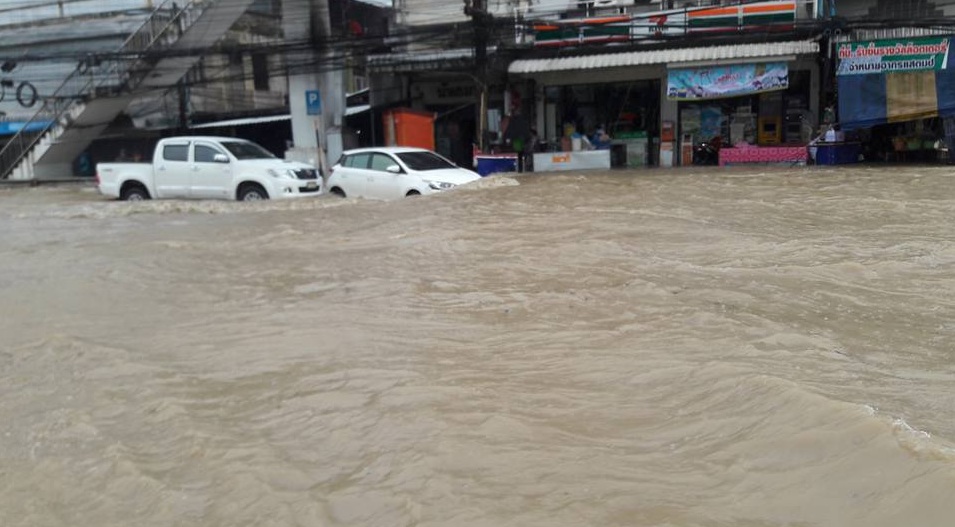
SAKON NAKHON — A number of residential areas in the northeastern region were hit by flash floods Friday as a result of a tropical storm blowing from South China Sea.
The flood – the worst in 40 years by some accounts – was particularly severe in the city of Sakon Nakhon, where residents found water rushing into their homes in a time span of less than a day. The local airport was also forced to shut down by Friday afternoon.
Officials said the airport would reopen Saturday night if the flood lessened.
Some residents in Sakon Nakhon said the flood is the worst in four decades.
“It’s almost like the flood in 1974,” businessman Chupong Khamjuang told reporters. “As far as I remember, it was as bad.”
The flood on Friday afternoon hit the city center and townships around Sakhon Nakhon, after a local reservoir failed to hold back the mass of water there – a consequence of several days of ceaseless rainstorms.
Sakhon Nakhon and other provinces in the northeast are currently affected by Sonca, a tropical storm that made a landfall on Vietnam earlier this week.
Floods were also reported in some provinces in the central plain.









































 So why am I disturbed by these developments? It’s not that I am alcoholic but the patronizing approach the state and anti-booze campaigners bring to imposing censorship and trampling on liberties.