
































30.2 C
Bangkok
Tuesday, June 9, 2026
Home Blog Page 2270

Tailor-made Repression and Unyielding Spirit

Chonticha Jangrew and 13 other pro-democracy activists are arrested in Bangkok on 26 June 2015.

retention.column

In a world of targeted advertisements and surgical strikes, the Thai military junta is apt at tailor-made suppression of its opponents.

If you are among those influencers who haven’t given up opposing, or at least publicly resisting, the military regime, which has taken root since 2014, there’s a high chance you might have encountered junta agents during the past three years.
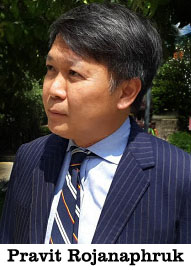
Pravit.mug .column.final

This includes soldiers or police knocking unannounced on your door very early in the morning, soldiers or police ringing you up and requesting you don’t say or do something at a public symposium or touch upon a particular topic if you are a reporter. If you are young enough – as in a university student or a fresh graduate – junta reps will try to befriend or threaten your parents as well, whichever way proves more effective. On social media, junta agents will follow you on Twitter or request you to add them on Facebook. They may visit the odd art gallery to pull something off the wall they don’t like or block the Charlie Chaplin silent film “The Great Dictator” on YouTube, as they did June 24, the anniversary of the revolt which ended absolute monarchy.

Big Brother is watching you, and where they are not physically present, warnings sometimes come from people just genuinely concerned about their children.

“Yesterday I was talking to my dad and he told me if anyone says anything bad about [the] junta, they are sure to go to jail or get sent away,” a 30-something, Western-educated daughter of a former diplomat informed me Wednesday on Facebook.

The junta’s objective in tailor-made repression is to atomise opponents and break their will, one by one – while avoiding a Tiananmen moment. Some 300 people have been tried in military courts for opposing the junta since the coup. At least 94 have been detained inside military camps.

One such dissident, 24-year-old Chonticha Jangrew, a former member of the New Democracy Movement, was diagnosed with PTSD after three years of resistance which included 13 days in prison for violating the ban on political gatherings along with her colleagues back in 2015. Soldiers also visited her parents’ home more than 50 times, during which time she moved five times to avoid their unannounced harassment. She’s currently taking a break upcountry from the stress of resisting the military junta.

Activist Rangsiman Rome, a high-profile anti-junta activist formerly of the New Democracy Movement and now part of the Democracy Restoration Group, was detained again overnight at a police station Sunday before he was scheduled to press the prime minister on the controversial Sino-Thai rail project.

Rangsiman, perhaps recognizing him and his comrades alone cannot prevail, urged people after his release Monday.

“We cannot expect the future to be better than this if we do not do anything today,” he said.

Many opponents of the military regime have already resigned to the fact that the junta will stay on for more than another year until it relents by allowing elections to take place or until it self-destructs.

Compared to those who are unhappy with the junta but decided to lie low, people such as Rangsiman and Chonticha are sharing an unfair amount of burden.

In a way, those still opposing the military junta three years on against all odds may find docile acceptance of military rule more painful and unacceptable than doing something to challenge the junta. They are paying a dear price for doing so because what their free spirits demand of them.

They chose to try to do whatever they could and that’s what counts. Idealism often clashes with the instinct for self-preservation. People balance it out differently.

Winning or losing, three years on, these people have demonstrated man’s unyielding spirit because to be free is to be human and not slaves. The junta may still be in power three years on, but it has failed to win or control these people’s hearts or break their unyielding spirit.
Advertisement

China’s Xi: No Tolerance for Subversion in Hong Kong

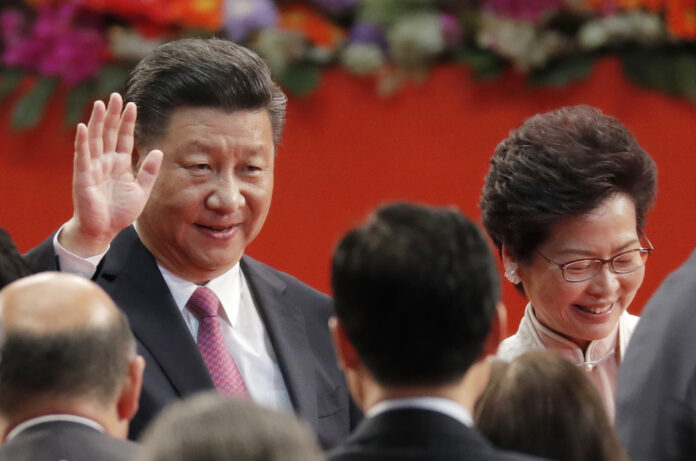
Chinese President Xi Jinping, left, and Hong Kong's new Chief Executive Carrie Lam leave after administered the oath for a five-year term in office at the Hong Kong Convention and Exhibition Center in 2017. Photo: Kin Cheung/ AP.

HONG KONG — Chinese President Xi Jinping on Saturday said any activities in Hong Kong seen as threatening China’s sovereignty and stability would be “absolutely impermissible,” employing some of his harshest language yet toward pro-democracy activities in the territory.

In a speech marking 20 years since the city became a semi-autonomous Chinese region after its handover from Britain, Xi pledged Beijing’s support for the “one country, two systems” blueprint, under which Hong Kong controls many of its own affairs and retains civil liberties including free speech.

However, he said Hong Kong had to do more to shore up security and boost patriotic education, in a veiled reference to legislation long-delayed by popular opposition.

And he appeared to put on notice a new wave of activists pushing for more autonomy or even independence, saying challenges to the power of China’s central government and Hong Kong’s leaders wouldn’t be tolerated.

Any attempt to challenge China’s sovereignty, security and government authority or use Hong Kong to “carry out infiltration and sabotage activities against the mainland is an act that crosses the red line, and is absolutely impermissible,” Xi said.

Hong Kong has been roiled by political turmoil in recent years that brought tens of thousands of protesters onto the streets in 2014 demanding democratic reforms. Those calls were ignored by Beijing and Xi indicated there would be no giving ground in the future.

“Making everything political or deliberately creating differences and provoking confrontations will not resolve the problems,” he said. Hong Kong “cannot afford to be torn apart by reckless moves or internal rifts.”

While former colonial master Britain and other Western democracies have expressed concerns about Beijing’s actions in Hong Kong, China has increasingly made clear it brooks no outside criticism or attempts at intervention.

Xi said China had made it “categorically clear” in talks with Britain in the 1980s that “sovereignty is not for negotiation.”

“Now that Hong Kong has returned to China, it is all the more important for us to firmly uphold China’s sovereignty, security and development interests,” he said.

Chinese foreign ministry spokesman Lu Kang sent a similar message in Beijing on Friday, saying Hong Kong was strictly China’s domestic affair.

The 1984 Sino-British Joint Declaration laying out terms for Hong Kong’s return to Chinese rule is “no longer relevant today, and has no binding force on the Chinese central government’s governance over Hong Kong,” Lu said.

“The U.K. has no sovereignty, governance right or the right of supervision over today’s Hong Kong. We hope the relevant people can be aware of the reality,” Lu said.

Earlier, Xi presided over a swearing-in ceremony for Carlie Lam, Hong Kong’s fifth chief executive since 1997. The life-long bureaucrat and her Cabinet swore to serve China and Hong Kong and to uphold the Basic Law, the territory’s mini-constitution.

In a speech that ran far shorter than Xi’s 32-minute address, Lam reviewed the dynamic financial center’s achievements and challenges, pledged to support central government initiatives and declared that “the future is bright.”

Lam prevailed over a much more popular rival in an election decried by many as fundamentally undemocratic, with only a sliver of a percent of Hong Kong’s more than 3 million registered voters taking part.

Xi was due to return to Beijing midday Saturday. His three-day visit aimed at stirring Chinese patriotism had prompted a massive police presence and also included a visit to the People’s Liberation Army garrison, which usually maintains a low profile in the territory.

Ahead of a flag raising ceremony Sunday, a small group of activists linked to the pro-democracy opposition sought to march on the venue carrying a replica coffin symbolizing the death of the territory’s civil liberties. They were swiftly stopped by police and Chinese flag-waving counter protesters, with the action ending about an hour later.

Xi’s remarks will likely fuel fears among critics that Beijing’s ruling Communist Party is tightening its grip over the city’s political and civil affairs following a string of recent incidents.

Those include the abductions of five Hong Kong booksellers to the mainland starting in late 2015 for selling gossipy titles about elite Chinese politics to Chinese readers. One of the men, Gui Minhai, is still being held.

In a similar case, a Chinese-born tycoon with a Canadian passport went missing earlier this year from his hotel suite. News reports indicated mainland Chinese security agents operating in Hong Kong abducted him — a step that would violate the Basic Law.

A plan to station Chinese immigration officers in a high-speed rail terminal under construction has also raised hackles, along with the establishment of a local branch of Beijing’s Palace Museum without public consultation.

Concerns are also high over the two long-delayed policies Xi referenced in his speech: the so-called patriotic national education in schools that many parents fear is a cover for pro-Communist brainwashing, and the anti-subversion national security legislation.

Inflows of “red capital” from mainland property investors and businesses are also seen as leaving indigenous tycoons at a disadvantage, while further inflating housing prices that make Hong Kong one of the world’s most unequal places.

Story: Kelvin Chan and Christopher Bodeen

Advertisement

Suspected Militant Stabs 2 Indonesian Cops Inside Mosque

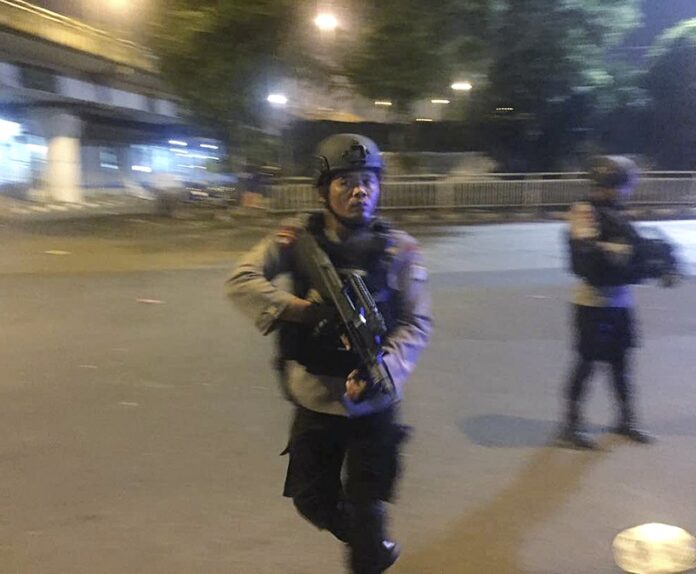
Police officers arrive on the scene after an explosion in May near a bus stop in the Kampung Melayu area of Jakarta, Indonesia. Photo: Achmad Ibrahim / Associated Press

JAKARTA — A suspected Islamic militant stabbed two policemen with a bayonet inside a mosque Friday before being fatally shot by another officer, Indonesian police said.

The attacker used a bayonet to stab the two policemen after they finished Friday night prayers at a mosque near the national police headquarters in Jakarta, national police spokesman Setyo Wasisto said. The officers were hospitalized with injuries to the ear and neck.

Wasisto said the attacker ran out of the mosque and shouted “kafir,” which means “infidel” and “Allah Hu Akbar,” which means “God is great.” Another officer ordered him to surrender, fired warning shots, then shot the attacker.

An identity card was found with the attacker, but Wasisto said that needed to be verified with the address and possibly families before announcing his identity.

It was the second recent attack against police. On Sunday, just before Muslims celebrated the end of Ramadan, two suspected militants attacked a provincial police headquarters in Medan, the provincial capital of North Sumatra, leaving an officer and an assailant dead.

Wielding a knife and a machete, the men stormed the police headquarters and stabbed to death an officer. Responding officers shot the two attackers, killing one and seriously wounding the other.

Indonesia, the world’s most populous Muslim nation, has carried out a sustained crackdown on militants since the 2002 Bali bombings that killed 202 people, but a new threat has emerged from Islamic State group sympathizers. In recent years, smaller and less deadly strikes have been targeting the government, mainly police and anti-terrorism forces.

Twin suicide bombings last month killed three officers in the deadliest militant attack in Jakarta in a year. Police have announced that they had arrested 41 suspected militants following the bombing, allegedly carried out by members of Jemaah Anshorut Daulah, which is affiliated with the Islamic State group.

Advertisement

Myanmar to Bar UN Human Rights Investigators

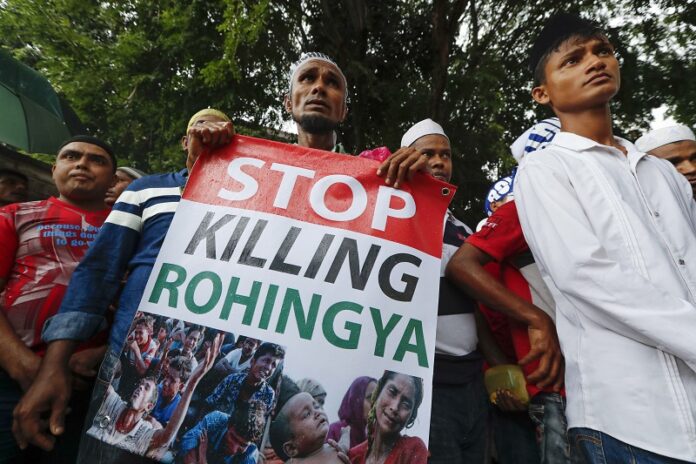
An ethnic Rohingya holds a banner during protest after Friday prayers outside the Myanmar Embassy in 2016 in Kuala Lumpur, Malaysia. Photo: Vincent Thian / Associated Press

YANGON — Myanmar’s government said Thursday it will instruct its embassies around the world to bar members of a U.N.-approved fact-finding mission from entering the country to investigate alleged human rights violations by security forces against the Muslim Rohingya minority and other groups.

Deputy Foreign Minister Kyaw Tin told parliament that the government will not cooperate with the mission, reiterating the position taken by the country’s leader, Aung San Suu Kyi, that its work would be counterproductive.

The U.N. Human Rights Council approved the mission by consensus in March in response to international pressure, and in May, it appointed three legal experts and human rights advocates to lead it.

Last October, the army launched counterinsurgency operations in Rohingya areas in the western state of Rakhine after the killing of nine border guards. U.N. human rights investigators and independent rights organizations charge that soldiers and police killed and raped civilians and burned down more than 1,000 homes during the operations.

The Rohingya face severe discrimination in Buddhist-majority Myanmar and were the targets of inter-communal violence in 2012 that killed hundreds and drove about 140,000 people — predominantly Rohingya — from their homes to camps for the internally displaced, where most remain.

Myanmar officials insist their own efforts to deal with the problem are adequate. Kyaw Tin said the government is complying with and implementing recommendations made by an advisory committee appointed by Suu Kyi and led by former U.N. Secretary-General Kofi Annan. Critics charge the government’s initiatives cannot come up with a fair solution because some of the people involved are biased.

The government’s position was applauded by Than Tun, a senior leader of the Rakhine Buddhist community, which has generally promoted confrontations with its Rohingya neighbors and sought to exclude third party observers and mediators.

“I think the government is doing what they should do,” he said. “We have disagreed since the beginning with the formation of Kofi Annan’s Rakhine Advisory Committee, because this is our country and we have the right to solve the problems under the sovereignty of our country and there shouldn’t be any outsiders’ interference in our issues. That’s why we accept and support the Myanmargovernment’s decision on rejecting the fact-finding mission.”

Story: Esther Htusan

Advertisement

15 Luxury Cars Stolen in UK Seized by Thai Customs

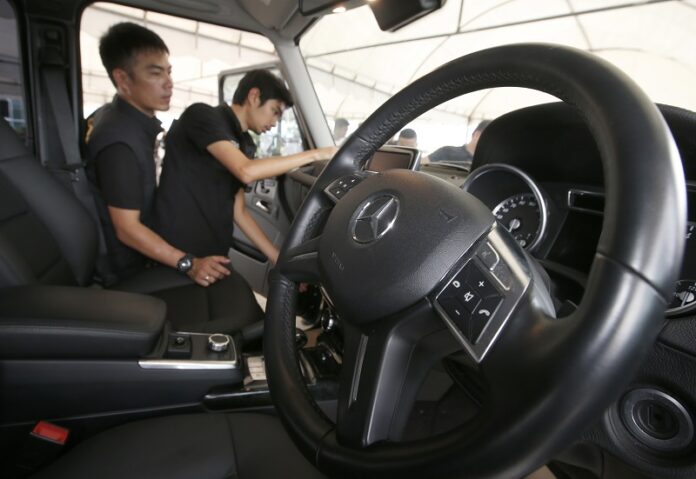
Customs officers check a seized Mercedes GLE 350 during a Friday press conference at the customs office in Bangkok. Photo: Sakchai Lalit / Associated Press

BANGKOK — Thai customs officials said Friday they have seized 15 of 42 luxury cars that British authorities said were stolen and sent to Thailand.

A request from British authorities to find stolen cars believed to have been transported to Thailand has led to the seizure of 122 vehicles imported by Thai dealerships. Of those, 15 were found to be stolen in the U.K. Thai customs officials say they are investigating about 300 other vehicles suspected to have been illegally imported.

Customs officials displayed a Mercedes GLE 350 and a Nissan GTR at a news briefing Friday, part of the batch sought by Britain. The customs bureau said the cars were seized when their Thai importer attempted to ship them out of Thailand to evade officials.

Kulit Sombatsiri, director-general of Thai customs, said the vehicles that British authorities are seeking were partially paid for in monthly installments by U.K. buyers before being sold on the black market.

“The buyers only paid around 5 or 10 percent of the car’s cost and they would then sell it,” he said. “In the United Kingdom, they classify these cars as stolen.”

Police raids on May 18 and 22 resulted in the seizure of 122 cars that included luxury brands such as Lamborghini, Rolls Royce, McClaren and Lotus.

Of the 122 cars seized, 31 Lamborghinis and a Lexus were declared to Thai customs as cheaper models than they actually were, which amounted to around 650 million baht (USD$19 million) worth of losses in tax collection, police said.

Further investigations revealed that eight of 11 Lamborghini Aventadors imported from the U.K. were registered with Thai customs as the cheaper Gallardo model.

Two other Lamborghinis were registered as being shipped partially assembled from the U.K. and later assembled in Thailand. Police suspect the cars were fully assembled before they were shipped.

Cars that are delivered in parts to be assembled in Thailand can be taxed up to 80 percent of their value while authorities can tax fully assembled imports up to 328 percent.

Story: Kaweewit Kaewjinda

Advertisement

UK Man Jailed After Hitting Muslim Teen With Bacon

Photo: Anders Tversted / Flickr

LONDON — A British man has been jailed after hitting a Muslim teen with a slab of bacon after hurling insults at her and her mother.

Alex Chivers was sentenced at a London court on Thursday to six months in jail for assault and a public order offense. The 36-year-old admitted to religiously or racially-aggravated assault.

Police said Friday that he approached two Muslims on June 8 in north London and made abusive Islamophobic comments before striking the teen with bacon.

Detective James Payne said other people were present during the attack including someone who filmed the incident. Payne called the assault “truly shocking.”

It came five days after Islamic extremists attacked people on London Bridge and at Borough Market.

British police have reported a rise in hate crimes.

Advertisement

Xi Visits Hong Kong on 20th Anniversary of China Takeover

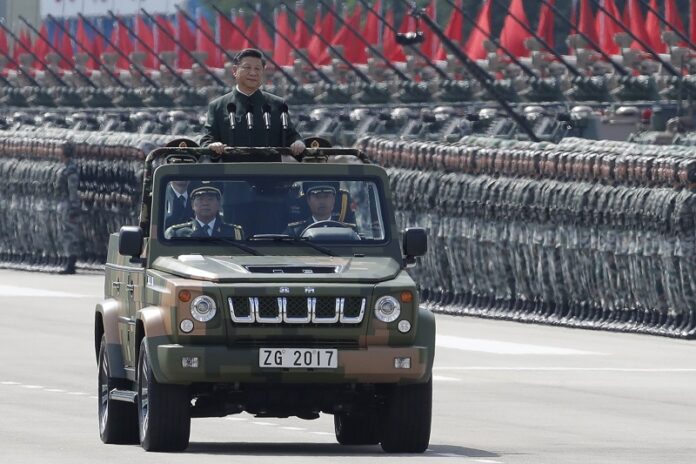
Chinese President Xi Jinping inspects the People's Liberation Army of the Hong Kong Garrison at the Shek Kong Barracks on Friday in Hong Kong. Photo: Kin Cheung / Associated Press

HONG KONG — President Xi Jinping inspected troops based in Hong Kong on Friday as he asserts China’s authority over the former British colony, where anti-China sentiment has been on the rise since Beijing took control 20 years ago.

Xi rode in an open-top jeep past rows of soldiers lined up on an airstrip on his visit to the People’s Liberation Army garrison. He called out “Salute all the comrades” and “Salute to your dedication” as he passed 3,100 soldiers arranged in 20 formations.

Armored personnel carriers, combat vehicles, helicopters and other pieces of military hardware were arrayed behind the troops.

It was a rare display of the Chinese military’s might in Hong Kong, where it normally maintains a low-key presence. China’s first aircraft carrier, the Liaoning, is expected to make a port call next month.

Xi, who’s also chairman of the Central Military Commission, wore a buttoned-up black jacket in the steamy heat during his 10-minute review of troops at the Shek Kong base in Hong Kong’s suburban New Territories. It’s part of a visit to mark the 20th anniversary of Hong Kong’s handover, when Britain gave up control of the Asian financial hub to China on July 1, 1997.

Hong Kong was granted the freedom to run most of its affairs after it came under China’s control under the “one country, two systems” principle. However, Beijing is in charge of the city’s defense and foreign affairs. Troops deployed from the mainland are typically confined to bases scattered across town and at headquarters downtown. Hong Kongers aren’t allowed to join up.

Apart from trying to drum up Chinese national pride, the military display also serves as a warning to groups expressing anti-China sentiment or pushing for independence, said Willy Lam, a political analyst at Chinese University of Hong Kong.

The message is that “when all else fails the PLA will always be the last resort. This, I think, would get people quite worried,” Lam said. “The implications are quite scary.”

Xi’s three-day visit to mark the anniversary includes presiding at the inauguration Saturday of the city’s new leader, Carrie Lam.

Security has been tight for his visit as authorities brace for protests.

Police arrested 26 people, including young activist leader Joshua Wong, after they climbed onto a giant flower sculpture symbolizing Hong Kong’s “reunification” with China on Wednesday. The department said they were later released on bail without charge but are required to report back to police in September. Some were held for more than 30 hours.

Pro-democracy supporters fear Beijing is tightening its grip on Hong Kong and undermining guarantees of wide autonomy under “one country, two systems.”

Nathan Law, a former student protest leader elected to Hong Kong’s semi-democratic legislature last year, was among those arrested.

The action at the statue “aimed to show that for the past 20 years, our human rights, our freedom, our democracy have deteriorated,” Law told reporters Friday.

Another activist, Avery Ng of the League of Social Democrats, said authorities appeared to be increasingly using “thugs” in addition to regular police to intimidate and harass the opposition. Unknown men followed him and at least one other person after their release and refused to identify themselves when confronted, he said.

U.S. officials said they were concerned that China’s Communist leaders weren’t sticking to their promises.

“Looking ahead to the remaining 30 years of ‘one country, two systems,’ we cannot allow Hong Kong to go the way of Beijing’s failed authoritarianism,” U.S. Sen. Marco Rubio, chair of the Congressional-Executive Commission on China, said in a statement.

Story: Kelvin Chan

Advertisement

Junta To Use Article 44 to Delay New Migrant Law

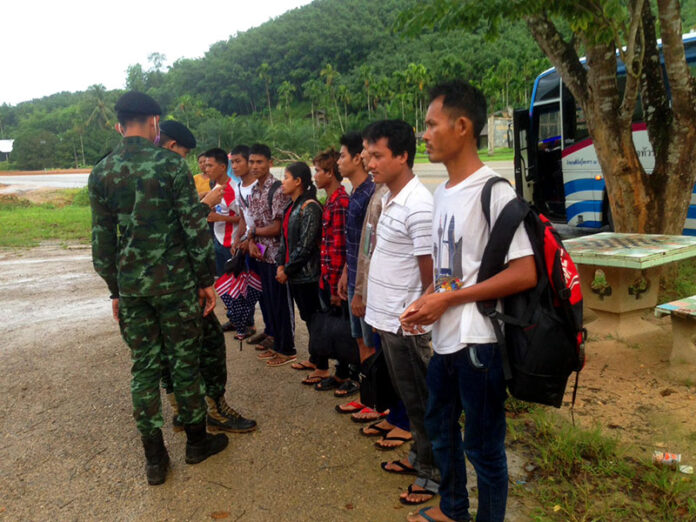
Soldiers arrest 13 Myanmar nationals for entering the country illegally Friday in Ranong province.

BANGKOK — The National Council for Peace and Order announced Friday it will use its absolute power to delay implementation of a law that would levy heavy fines on employers of illegal migrant workers.

Wissanu Krea-ngam, junta legal adviser, said it will use Article 44 to delay by 120 days the new law to allow both employers and workers time to adjust to the regulations. Wissanu did not say when the junta order would be carried out.

Read: New Migrant Law Levies Heavy Fines On Employers

“We will delay the law by 120 days because we want illegal migrant workers to sort out their documents first. They have three options to do this: in their own country, at the border or at the five Nationality Verification Center for Myanmar People in Thailand,” Wissanu said.

Wissanu said the law would allow migrant workers who were not working in the province stated on their work permit the necessary time to submit documents to comply with new legislation.

Since the law went into effect on June 23, employers in Tak province have been deterred from hiring Burmese workers according to Thai and Burmese officials at the Mae Sot border. On Friday, more than 400 Burmese people returned to Myanmar through the checkpoint at Mae Sot in Tak.

Mong Jo, 25, a Burmese worker who returned to Myawaddy through Mae Sot Friday, said he had to pay a middleman 3,000 baht to find work for him at a factory.

“When I got to the factory, they didn’t hire me because he was afraid he would get caught by the police,” Jo said. “So, I have to go back home to Myanmar. I don’t have any money for travel because I paid it all to the middleman.”

Correction: This article was modified to reflect the correct date on which the new law was passed from July 23 to June 23.

Advertisement

Germany Legalizes Same-Sex Marriage After Merkel U-Turn

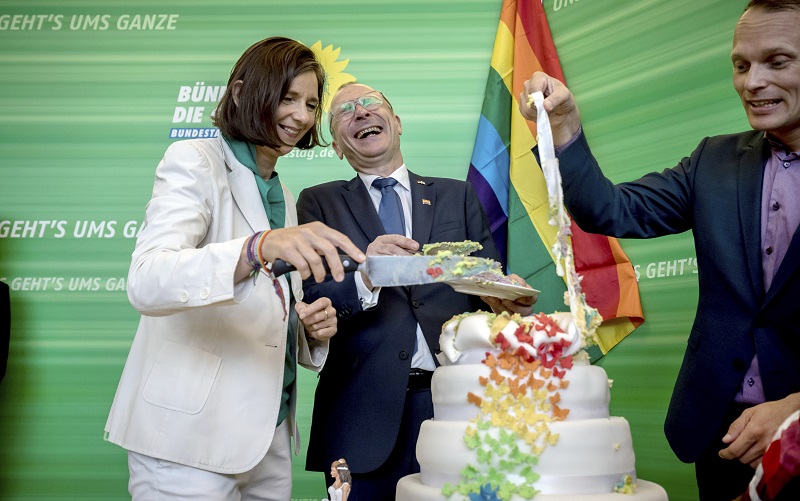
Green Party's gay rights activist Volker Beck, center, and fellow faction members celebrate with a confetti popper after German Federal Parliament, Bundestag, voted to legalize same-sex marriage in Berlin on June 30, 2017. Photo: Michael Sohn / Associated Press

BERLIN — German lawmakers voted Friday to legalize same-sex marriage after a short but emotional debate, bringing the country in line with many of its Western peers. Though Chancellor Angela Merkel voted against the measure, she paved the way for its passage by freeing other members of her party to vote their “conscience.”

Lawmakers voted 393 for legalizing “marriage for everybody” and 226 against, with four abstentions.

Merkel said Monday that lawmakers could take up the issue as a “question of conscience,” allowing members of her conservative coalition, which has been against same-sex marriage, to individually vote for it.

That prompted her center-left rivals to quickly call for a snap vote on the issue, adding it to the agenda Friday on parliament’s last regular session before Sept. 24 elections.

While some in Merkel’s conservative bloc spoke against the measure, Berlin Christian Democrat Jan-Marco Luczak urged his fellow party members to vote for same-sex marriage.

“It would be absurd to try and protect marriage by preventing people to marry,” he told lawmakers.

Many applauded Merkel’s comments that opened the way for the vote, but Social Democrat lawmaker Johannes Kahrs noted in the debate that the chancellor had been a longtime opponent of gay marriage.

“Many thanks for nothing,” he said bluntly.

Germany Gay Marriage Cham 1
Katrin Goering-Eckardt, faction leader of the Green Party, left, and gay rights activist Volker Beck of the Green party, center, symbolically cut a wedding cake at the German Bundestag in Berlin on June 30, 2017. Photo: Michael Kappeler / dpa via Associated Press

Germany has allowed same-sex couples to enter civil partnerships since 2001, but has not granted them full marital rights, which include the possibility to jointly adopt children.

The new law won’t take effect for several months because it still needs to pass the upper house of Parliament and be approved by the president, though those are formalities. It is also expected to face legal challenges.

Merkel told reporters after the vote that her vote against the measure was based upon her reading of the country’s law concerning marriage and that she did think gay couples should be able to adopt.

Germany’s basic law is vague, saying only that “marriage and the family shall enjoy the protection of the state,” but Merkel said that for her “marriage as defined by the law is the marriage of a man and a woman.”

She added, however, that she stood by her contention that the interpretation was a “question of conscience” and urged all views to be respected.

“It was a long, intensive, and for many also emotional discussion, that goes for me personally too, and I’m hopeful not only that there will be respect for either side’s opinions, but that it will also bring about more peace and cohesion in society,” she said.

All of Merkel’s potential coalition partners after the September election, including the center-left Social Democrats of her challenger, Martin Schulz, have been calling for same-sex marriage to be legalized.

It is not clear whether Merkel thought her Monday comments would prompt such a quick vote, but many analysts have suggested that by opening the door to gay marriage the chancellor removed yet another issue that might have helped her opponents in their campaigns against her.

In nearly 12 years as chancellor, Merkel has moved her party to the center and away from conservative orthodoxy, speeding up Germany’s exit from nuclear power and ending military conscription among other moves.

Story: David Rising 

Advertisement

Cop Who Hugged Knife-Wielding Man in Viral Video Speaks Out

BANGKOK — When a man erupted into a police station brandishing a knife, Senior Sgt. Maj. Anirut Malee did not reach for his sidearm or tackle down the assailant.

Instead, Anirut calmly talked to the intruder and eventually convinced him to hand over the knife.

He then gave the man a hug.

The June 17 incident at Huai Khwang Police Station was captured on security camera, footage of which later went viral on social media, where many praised Anirut for using kindness rather than violence to resolve tensions. In a phone interview Friday, the officer said he was merely following a procedure taught to every police cadet: talk first, shoot later.

“We try to negotiate first,” said Anirut, who’s been a cop for 23 years. “I could have wrestled him down and taken his knife away, but what if he ended up hurting himself?”

The officer said he was working that night when he heard shouts that someone had entered the police station armed with a knife.

Anirut said he ordered all other policemen to leave the area and started talking with the intruder. He gathered the man was stressed because his employer had cheated him of his salary and someone had recently stolen his guitar.

“I told him, ‘Please calm down, brother. If you want a guitar, I can give you one. I promise you, but you must lay down your knife first,’” Anirut recalled. “I had to make him feel he could trusts me.”

Anirut said he gave the assailant a hug after he surrendered the knife because he’s a Muslim from Songkhla province, where it is common for people to hug each other as greetings.

The policeman said it’s not the first time he had to defuse a tense situation by talks. Anirut said he once successfully convinced a suicidal person not to jump off a building.

When the video reached social media in the US, many users contrasted Anirut’s calm demeanor with the trigger-happy nature of some American police officers.

“If that was in America he would have been shot dead instantly, then handcuffed, shot again, sued, questioned, shot more and jailed for life,” wrote Chris Tyrrell in a Facebook thread.

Another user, Stevee Jenkins, also wrote in the same thread, “If this had happened in the US that man would be dead, so nice to see a human being that relates and shows compassion to another human!”

However, some questioned whether Anirut needlessly put himself in danger.

“Sorry…. no hugs… and if there is one knife there could be two. Once the knife was seized… the subject would be cuffed and searched,” wrote Cliffy Halaburda. “If this was a police academy and the candidate just all that… fail. It’s too risky dealing with people in this state.”

The officer said he acted within his tactical training.

“It depends on different situations. If a suspect was really threatening, we have a sniper for that,” Anirut said. “But for this case, I could handle myself. It was just a knife … we had training about this.”

The unnamed man was reportedly charged with carrying a weapon without permission, a misdemeanour that carries a 200 baht fine, though police waived the fee for him. Anirut said he also gave the man a guitar he had at the police station as promised.

He did not give police any contact information and requested a lift to Victory Monument, and that’s the last Anirut saw of him.

“I tried to find the gas station he said he worked at, but I couldn’t find it,” the officer said.

Related stories:

Cowboy Cops Shoot Rampaging Gunman’s Trigger Finger Off

Advertisement

Hot News

LATEST NEWS

Bangkok
overcast clouds
30.2 ° C
31.6 °
28.8 °
76 %
4.5kmh
100 %
Tue
34 °
Wed
34 °
Thu
35 °
Fri
31 °
Sat
31 °