Jan Victor R. Mateo
The Philippine Star, Philippines
MANILA — With over 7,000 islands situated in the tropics of the Pacific, the Philippines boast having some of the best beaches in the world.
Ironically, the country also ranks high in terms of the number of people – especially children – who die due to drowning. A recent study released by the World Health Organization (WHO) showed that an average of 2,496 people die in the Philippines due to drowning every year between 1980 and 2011. While the government is implementing various initiatives to address the issue, there is no denying that there is a lot to be done.
This is why, in 2015, a group of Australian students from Griffith University decided to come up with a drowning prevention program that will be implemented in various coastlines across the Philippines.
“We hope that after the implementation of this program lives will be saved on the local beaches,” says Andrew McLean, directing manager of FLOAT Philippines.
FLOAT Philippines, is an initiative that aims to harness engagement between international and local organizations – including the government – to come up with strategies that will lower the drowning mortality in the Philippines.
“Drowning prevention programs are commonplace in Australia and we grow up feeling safe when we are at the beach, both as a result of our swimming culture and the incredible job our surf lifesavers do patrolling the beach,” adds McLean.
The primary idea is to come up with a sustainable program that will raise drowning prevention awareness among those living in coastline communities. The organization envisions to implement “learn to swim” and “surf lifesaving” programs in the country to lower cases of drowning, particularly in tourist spots.
Andrew McLean discussing swimming strategies with the Zambales Swim Team.
Program implementation
Almost two years since they came up with the initial idea, McLean admits challenges in implementing a project in a location thousands of miles from where they are based.
He noted, that they had to go back to the drawing board after they visited the Philippines in January 2016 to conduct a needs assessment analysis, establish partnerships and meet with stakeholders.
But the group remains committed. FLOAT’S local coordinator Kina Santillan Pascua says they’re nearing the implementation phase of the project.
Pascua, a former coordinator for the Australian embassy, said she stayed on with the FLOAT project because she sees the importance of implementing a drowning prevention program in the Philippines.
“I work in a lot of development projects and everywhere I go, I see a lot of communities with kids playing near shorelines. It’s their backyard and we have to implement programs that will make their environment safer,” she says.
Following a second visit in July 2016, FLOAT was able to form partnerships with Zambles Surf Life Saving Inc. and the popular tourist hotel Charlie Does Inn, situated in the resort of Baler. Both organizations are committed to training lifeguards and to developing anti-drowning initiatives.
“FLOAT managed to raise the funds to train two Baler locals as lifesavers and our partners in Baler are currently trying to get a law passed by the government in hopes of securing funds for future employment and training of the surf lifesavers,” says McLean.
The organization also hopes to strengthen ties between Australia and the Philippines, and therefore further increase awareness of the project by meeting both the Australian and the Australian-New Zealand Chamber of Commerce Philippines, both situated in Manila.
Katelyn Pomroy reading a story about Australian Surf Lifesavers to the Baler Primary School
Sustainable, scalable program
While the long-term objective is to promote a culture of safer aquatic spaces in the entire Philippines, the team behind the projects understands that they have to limit their program to make it sustainable and scalable.
“We hope to ensure sustainability through training and developing skills of the local organizations we are working with. In addition to this, we want to provide local and international partnerships to these organizations running the project from the ground level to boost their knowledge and capabilities in the drowning prevention field,” says McLean.
The founding team of Float Philippines – BJ Doyle, Andrew McLean, Marc Bruneau, Tessa McKinnon and Kim Holmes.
FLOAT’s pilot project will be based in Baler, but the team are hoping that in the long term, they will be able to provide surf lifesaving training across the Aurora Province.
“For the ‘learn to swim’ project, we are hoping to partner with Baler Central Primary School to create a sustainable swimming program… By doing this, we hope to extend the current learn to swim teachers expertise and allow them to reach more swimmers,” notes McLean.
There is still much work to be done to address the problem of drowning in the Philippines. But for these Australian students, distance – and the difference in nationality and culture – is not going to be a hindrance to ensure that Filipino children are safe in the water.
“We think that everyone should have the ability to learn to swim and enjoy an aquatic environment,” ends McLean.
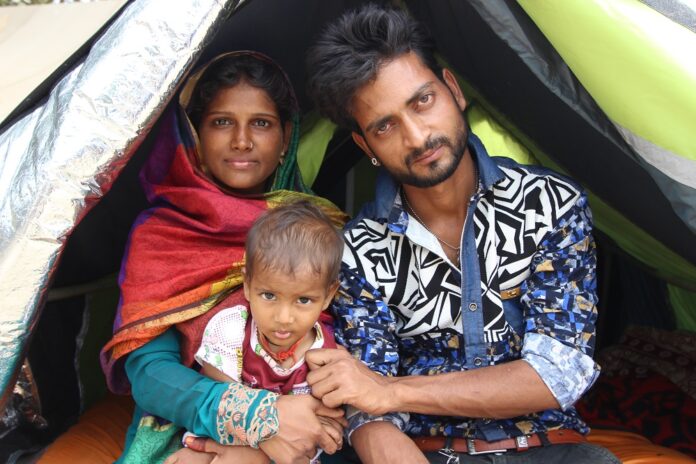
A homeless family on the streets of Mumbai with their recently received weatherHYDE
By Priscilla Goy
The Straits Times, Singapore
SINGAPORE – For six years, a married homeless couple were separated and forced to live apart in Delhi, India. The husband was in one gender-segregated communal shelter and the wife in another. Last year, for the first time, they were able to move into their own “home”.
Their new “home” is a tent, designed by Singapore-based, non-profit organization billionBricks. The tent can be set up by one person in 15 minutes without any tools. It is weather-resistant, offering protection from the city’s extreme temperatures which can range from 5 – 45 degrees Celsius (40 – 115 Fahrenheit). It is also spacious, with the ability to fit a family of two adults and three children. The couple even moved in a bed, explains billionBricks founder, Prasoon Kumar.
BillionBricks is a on-of-a-kind non-profit design studio that innovates shelter and infrastrucure solutions to end homelessness.
More than 20 homeless families pilot-tested the tent in Delhi and Mumbai. Mr. Kumar said homelessness is difficult to eradicate but considers the tents to be an important interim solution. “Time is required to find sustainable solutions, but there’s also a humanitarian need and as time passes, people are dying.”
The lack of adequate housing across the world is a huge problem, with the United Nations estimating that there were approximately 100 million people homeless in 2005, which was the last time a global survey was done. Many more die as a result of exposure to extreme temperatures.
The Singapore-designed weatherHYDE tent is made to be weatherproof. In the winter, the tent’s triple-layer, reversible cover provides insulation, while reflective material on the inside retains body heat. Conversely, in the summer, the other side can be used to reflect solar heat and help people inside the tent stay cool. “But that is only one of the benefits a weatherHYDE tent offers over other typical communal shelters and tents,” said Mr. Kumar.
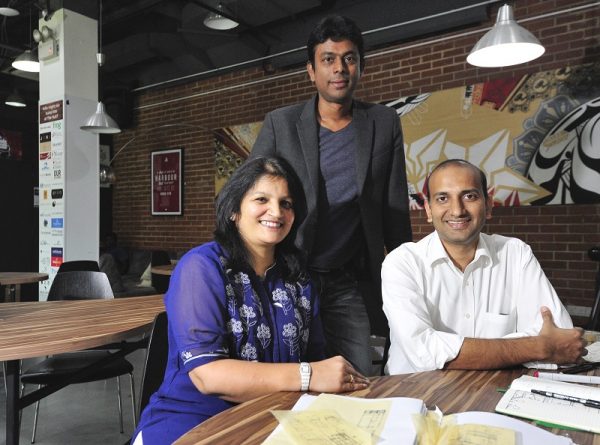
The BillionBricks team include (from left) founding trustee Snehal Mantri, founding trustee and founder Anurag Srivastava, and founder and CEO Prasoon Kumar. Staff and volunteers raise funds, contribute design plans and ensure that the buildings are safe. Photo: Dios Vincoy Jr / The Straits Times
Apart from battling the elements, the weatherHYDE tent provides more privacy because the triple-layer cover also blocks out light, so shadows from movement inside the tent cannot be seen. Its setup is easy and does not require anchoring to the ground with tent pegs, making its use possible in urban settings (areas often hit by natural disasters).
Its unique design has attracted global attention. In July of last year, videos about the tent garnered more than 23 million views within a month of being posted online. Even celebrities shared the videos. Well-known Hollywood actor Ashton Kutcher called it “innovation at its finest” and rapper Lil’ Wayne said it “could save millions of lives”.
Mr. Kumar had been working in architecture for 12 years when he decided to start billionBricks in 2013. Though originally from India, he has lived in Singapore for more than a decade. He sketched out the tent’s first design concept in 2014, after being troubled by an incident the year before. Riots in a town in northern India had left thousands of families homeless and more than 30 children died when temperatures fell to below freezing at night. “Several non-governmental organizations were there to help. The people were given tents, tarps, and blankets, but no one was thinking about the extreme temperatures,” he said. “Sleeping bags aren’t adequate– if a mother has a young child, how will the sleeping bag be big enough for the two of them sleep together? And even if they could squeeze themselves in, their heads would still be exposed to the cold.”
Last year, billionBricks also launched a crowdfunding campaign on Kickstarter and raised more than S$145,000 (just over 100,000 USD) in two months, enabling them to provide 500 tents to needy families. The tents cost S$279 (199 USD). The 500 pre-ordered tents are expected to be shipped from China to India and the US sometime this July.
WeatherHYDE was piloted in New Delhi, India in 2016
billionBricks, in its application for the internationally-acclaimed A’ Design Award’ stated that the tent “does not provide a poor solution to the poor; it provides a dignified solution”. The tent went on to be named one of 12 winners in the Social Design category in 2015.
Meanwhile, there have been several refinements to the tent’s design since the married couple gave it a test run. There are new locking mechanisms and both sides – not just the non-reflective layer – are now waterproof. billionBricks has also relaunched its weatherHYDEwebsite, with a section where donors can type in a tent’s unique ID number to learn more about the homeless family who received the tent they donated. Beyond providing shelter, billionBricks also hopes to offer jobs to the needy. They are in talks with US groups to create jobs for people with disabilities to have them manufacture the tents.
The organization has several sponsors, including DBS Bank’s corporate foundation, DBS Foundation, and Singapore-based design firm Space Matrix. Mr. Kumar hopes to continue to raise money through the weatherHYDE e-commerce platform, where the tents can be purchased and donated on a buy-one-give-one model and shipped anywhere in the world.
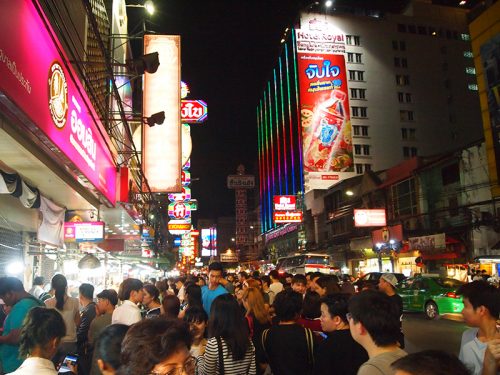
BANGKOK — Walk down Yaowarat Road on a given night and find the area known as Chinatown alive with tourists clamoring for street food unaware of the forces transforming the neighborhood.
Change is afoot. On the streets, the vendors responsible for much activity and aroma are adjusting to new regulations on informal vendors. In the buildings, the working families that have kept it a living neighborhood are vulnerable to rising rents as new arrivals and a pending subway link bring the first wave of gentrification.
Since its construction a century ago, Yaowarat has remained a living Chinese community for trade, gold trade, finance and food. Some of the shophouses that housed big families are now empty, abandoned or converted into warehouses. Higher rents have driven people out to more affordable areas, while the youth prefer living downtown closer to their workplaces.
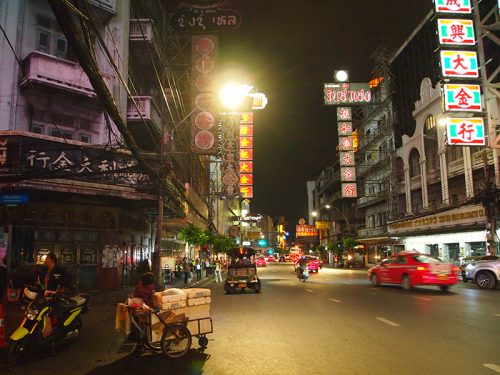
Yaowarat Road
“Development is in progress, with skyscrapers encroaching on the area to build hotels or stores. It’s endangering many historical sites which are part of Bangkok’s unique and historical record,” said Yongtanit Pimonsathean, an urban engineering professor at Thammasat University.
Something already driven to extinction? The shoemaking stores once frequented by king Rama VI, said Yongtanit, an expert on the history and development of the Charoen Krung community.
‘Fading’ Charm?
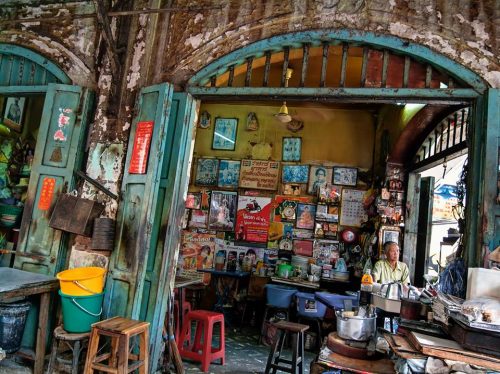
Before opening his traditional tea shop six years ago, Jongrak Kittiworakorn grew up in the area. He saw it rise and fall as a commercial center, and today says it is “fading.”
That loss became apparent when the neighborhood’s restaurants and street food stopped serving the community and instead aimed only for tourists.
Yaowarat Road at night
“The golden age of food in Yaowarat was during the ‘70s and ‘80s, when prices were graded according to quality,” said the owner of retro teahouse Double Dogs Tea Room.
“Its richness is now gone,” he continued. “They no longer aim at customers’ happiness and their pride, now they only seek profit. That is why its charm is fading.”
Another business owner, a third-generation local who wished to remain anonymous for fear of political repercussions, said the neighborhood’s future is in the wrong hands.
“All the government’s concerned with is orderliness. They never focus on the people,” he said. “There’s no master plan for the development. How will they retain Yaowarat’s unique traits after the MRT extension is finished, and more tourists come?”
‘Who’s Going to Build That Again?’
Radiating out from Yaowarat Road, Chinatown extends along Mangkon, Song Wat, Chakkrawat and Charoen Krung roads.
It’s on this fringe of Chinatown that a mix of priced-out, downtown-weary Thai and foreign creatives are bringing their cosmopolitan sensibilities.
Among the swanky bars and culturally woke venues on Soi Nana is Cho Why, a collaborative art space in a two-story, colonial-style shophouse.
An image of buildings in Yaowarat’s Soi Nana posted March 14, 2016. Photo: Cho Why / Facebook.
Somewhat ironically, the venue, despite being part of the change, has been hosting a photo exhibition on the endangered community called Bye Bye Chinatown. The photo exhibition features portraits of residents, images of local craftsmen and lots of stained, peeling paint. It ends June 29. On Saturday, people are invited to join a walking tour to explore the area.
Behind the exhibition is David Fernandez, Cho Why’s project manager, who moved into the space three years ago.
“I want to display the charm of people and neighborhood and create memories of what it is now before everything is gone,” he said.
From his observation during the past years, Fernandez found that there’s no plan to keep the old city’s heritage or the character of the district as he witnessed many rises of condominiums and locals moving out from their homes, leaving the buildings empty – or destroyed.
The sense of community that neighbors greet and talk to one another is what he holds precious. Now, their lives are under threat as they have to renew their real estate contracts each year, not knowing when the landowners will sell to developers.
‘Untitled’ by Graham Meyer exhibits at ‘Bye Bye Chinatown’ exhibition. Photo: Cho Why / Facebook.
“Who’s going to build that again?” he said. “They lose not only buildings and structures but people as well.”
It’s on Charoen Krung, the kingdom’s first paved street, that the Thailand Creative and Design Centre, or TCDC, recently relocated to inside a historically significant structure after giving up its longtime home on Sukhumvit Road.
Along with the Thai Health Promotion Foundation, TCDC has launched Co-Create Charoenkrung, a project meant to involve and engage the existing community in its economic and cultural development.
The project is intended to promote the emergence of boutique hotels, bars, restaurants, galleries and art spaces such as TCDC and the riverside artspace of Duangrit Bunnag’s Warehouse 30. Visitors will eventually be able to discover street art by artists from the Bukruk Urban Arts Festival and enjoy gallery-hopping events.
As with the people behind Cho Why, Speedy Grandma, Tep Bar and El Chiringuito, SoulBar owner Romain Dupuy rode in on the early wave. He said it was always his dream to open a business in what he calls “the only real district in Bangkok.”
He realized his dreams three years ago with SoulBar in Talad Noi. Inside, customers are treated to a decor of repurposed car parts acquired from local shops and nightly live music. More than 75 percent of his customers are Thai, with about 10 percent coming from the neighborhood.
“It’s necessary to know people and do something that’s affordable for the locals,” said the 40-year-old businessman, adding that it takes time for people in the community to visit his bar.
Bottom-Up Preservation
‘Untitled’ by Noah Shahar exhibits at ‘Bye Bye Chinatown’ exhibition. Photo: Cho Why / Facebook.
Plans to preserve the area began six years ago along with the MRT Blue Line extension project. Despite opposition, comments and research from both residents and experts, the project went on to bulldoze a number of historic buildings.
“There are more than 7,000 units of buildings with historical value in the Samphanthawong and Pom Prap Sattru Phai districts, and some of them were destroyed,” said Yongtanit, the Thammasat professor.
Those buildings were neither registered as historic sites nor afforded any protected status, he said, though they deserved to be saved.
From his research, Yongtanit said Yaowarat is one of the first places where different groups, such as the Chinese, Portuguese, Arabs and Indians settled down and set roots for over two centuries. The variety of the community can still be detected in its architecture that blends Thai, Chinese and Western styles. Moreover, those buildings are where very first toilets and fire-proof construction materials were used in edifications to comply with the Bangkok Sanitation Act of 1899.
According to Yongtanit, the Committee on the Conservation of Rattanakosin and Old Towns is looking at extending the preservation areas and will submit a proposal to the cabinet by the end of the year. It could result in the improvement to the principal city plan and enactment of site-specific conservation laws.
He also supports a proposal that would encourage local landowners in historic areas to sell development rights so they can continue earning from their properties and continue living and flourishing in the area.
‘Untitled’ by Raul Gallego exhibits at ‘Bye Bye Chinatown’ exhibition. Photo: Cho Why / Facebook.
Still, he thinks the community must play a part in the transformation.
Some have tried and failed; others have succeeded.
All residents of Werng Nakhon Kasem, aka the Thieves Market, were evicted against their will last year after the land was sold to TCC Land, a development firm owned by ThaiBev founder Charoen Sirivadhanabhakdi.
But a block away to the south, residents of Soi Luean Rit, a traditionally Chinese and Indian textiles district, banded together to avoid a similar fate.
Residents of more than 200 buildings in the neighborhood negotiated with the Crown Property Bureau to renovate historic sites there themselves and will move back in to resume their lives and livelihoods when the work is finished.
“The participation of local residents is very important, along with their pride in their dwellings, which will be beneficial in the long run, especially economic-wise” Yongtanit said.
What’s lacking now, he added, is participation from those without a voice and who are unable to submit heritage buildings for conservation status.
“Foreigners see mystic charms in those resources, which can never be rebuilt or renewed once destroyed, while some Thais don’t see their worth and turn them into lifeless storerooms,” Yongtanit said. “We have to adjust ourselves, or we’ll forever lose an economic opportunity.”
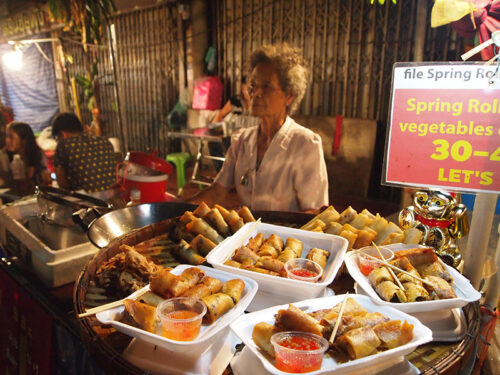
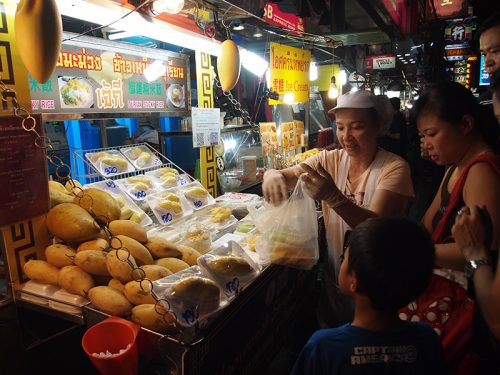
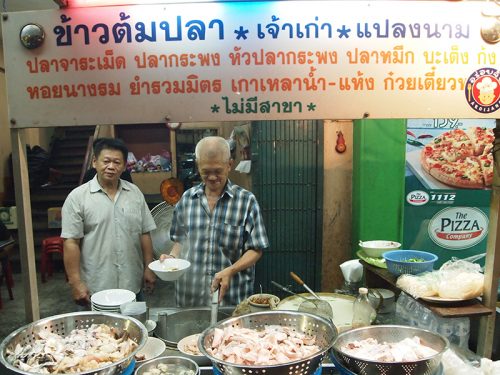
Yaowarat Road at nightSiripan Maneesatien or Je Kee selling mangoes and durian with sticky riceLeft, Hong Sae-Aiew, and his brother at their 80-year-old rice soup shopYaowarat Road at nightYaowarat Road at nightThe construction of MRT Blue Line extension on Charoen Krung Road‘Untitled’ by Landry Dunand exhibits at ‘Bye Bye Chinatown’ exhibition. Photo: Cho Why / Facebook.‘Untitled’ by Igor Prahin exhibits at ‘Bye Bye Chinatown’ exhibition. Photo: Cho Why / Facebook.‘Chinese New Year’ by Jorge Silva exhibits at ‘Bye Bye Chinatown’ exhibition. Photo: Cho Why / Facebook.‘Untitled’ by Biel Calderón exhibits at ‘Bye Bye Chinatown’ exhibition. Photo: Cho Why / Facebook.
LONDON — Boys at a British high school have found a novel way around strict uniform rules banning shorts, as the country swelters through a heatwave.
The schoolboys at Isca Academy in the southwestern city of Exeter donned skirts instead of the officially mandated gray slacks.
Photos in British media show the boys wearing short-sleeved white shirts, school ties and the gray and white plaid skirts that the girls wear.
Devon County Council spokesman David Beasley said about 30 boys turned up to school in skirts on Thursday, when temperatures dropped to a cool 20 degrees Celsius (68F) after days of much hotter weather. None of the skirted students was punished, he said.
The school’s head teacher, Aimee Mitchell, issued a written statement that did not mention the skirts, but pledged to revisit the uniform rules.
“We recognize that the last few days have been exceptionally hot and we are doing our utmost to enable both students and staff to remain as comfortable as possible,” she wrote.
“Shorts are not currently part of our uniform for boys and I would not want to make any changes without consulting both students and their families. However, with hotter weather becoming more normal, I would be happy to consider a change for the future,” she added.
The British students were not alone in challenging dress codes as a way of cooling down.
In the western French city of Nantes, male bus drivers reportedly wore skirts this week that are part of female drivers’ uniform to protest the fact that they were not allowed to wear shorts.
Junta chairman Prayuth Chan-ocha speaks to the military-appointed parliament on June 8.
BANGKOK — The military-installed parliament on Thursday passed a bill that allows the ruling junta to continue to impose its policies after it holds elections and officially relinquishes power.
The National Legislative Assembly voted 281-0 in favor of the legislation, which calls for establishment of a national strategy committee to oversee the long-term plans of governments over the next two decades.
The committee’s primary task is to set new goals every five years, with the proclaimed intent of facilitating social, political and economic development, which the military claims have been hindered by politicians in elected governments.
Government spokesman Weerachon Sukhondhapatipak said in March that reforming Thailand requires a long-term 20-year strategy to address issues such as corruption and the economy because previous governments were unsuccessful in tackling them.
The military has held power since overthrowing an elected government in May 2014. It has said elections will be held next year. The date is considered tentative, since several previous promised dates have come and gone.
Former Prime Minister Abhisit Vejjajiva was quoted Thursday by the newspaper Krungthep Turakij as saying the military government should have asked for people’s opinions about the bill before making it law. He said it would only complicate the work of future governments.
Thailand has been riven by political conflict since 2006, when the army ousted Prime Minister Thaksin Shinawatra in an earlier coup. In its aftermath, supporters and opponents of Thaksin engaged in a sometimes-violent struggle for power. In 2014 the military ousted a government led by Thaksin’s sister, who had also been elected prime minister, after demonstrators staged violent protests against her.
After the 2014 coup, the military promulgated a new constitution designed to limit the power of politicians.
Line characters "Brown" and "Cony" ride a tuk-tuk mock-up at a Line store in Bangkok.
BANGKOK — The text-messaging service Line plans to inaugurate an indoor digital theme park in Thailand’s capital, seeking to squeeze maximum advantage from its popularity in the country, its second biggest market after Japan.
Line Village Bangkok will begin operating Friday as a retail store, selling dolls and similar merchandise, but later this year will expand to a three-story amusement complex with virtual reality rides. Line stores already exist in Japan, South Korea, China and Taiwan, but the Thai location will be the first with an indoor park.
Kampanart Wonghongkul, the project’s chief executive, said he hopes the 500 million baht ($14.7 million) theme park will attract more than 12 million visitors a year. Tourism is a major revenue earner in Thailand, bringing in $71.4 billion last year.
Much of Line’s appeal comes from its stickers that can be attached to messages, especially the company’s anthropomorphic animal figures, such as Brown the bear and Cony the rabbit. Line Village is located in Siam Square, for decades a hangout for young Thais enthralled with fashion and the culture of cute – there is already a Hello Kitty cafe located there.
Since its launch in 2011, Japan-based, Korean-owned Line has amassed more 200 million users worldwide. Thailand has around 44 million cellphone users and 94 percent of them have the Line application installed on their phones, Kampanart said.
Sakdipat Thanee, a 27-year-old lawyer, was one of several shoppers invited for a special store preview Thursday.
“I think it’s hard to find Line merchandise in Thailand,” he said. “You can only buy them from aboard or ask someone to bring them in. For people who love Line characters like me, having a Line store here means that I can easily shop here. I can meet Brown and Cony much more easily.”
Workers prep poultry at the meatpacking company JBS in March in Lapa, Brazil. Photo: Eraldo Peres / Associated Press
RIO DE JANEIRO — In a major blow to Brazil, the United States on Thursday announced the immediate suspension of all imports of beef products from Latin America’s largest nation because of safety concerns.
The decision by U.S. Agriculture Secretary Sonny Perdue came three months after a major scandal into allegations of bribed meat inspectors shook Brazil’s meat industry and prompted several countries to temporarily halt imports.
In a statement, Perdue said that since March, U.S. inspectors have refused entry to 11 percent of Brazilian fresh beef products, about 1.9 million pounds.
“That figure is substantially higher than the rejection rate of one percent of shipments from the rest of the world,” the statement said.
It said the suspension will remain in place until Brazil’s agricultural ministry takes corrective action. The statement did not detail what those actions should be.
The statement noted that Brazil had already addressed concerns of American inspectors by prohibiting five facilities from shipping beef to the U.S., but said that didn’t go far enough.
“Today’s action to suspend all fresh beef shipments from Brazil supersedes the self-suspension,” said the statement.
The office of Brazil’s presidency said late Thursday that it had no comment. After-hours messages left with the Agricultural ministry were not immediately returned. JBS, a Brazilian company that is the world’s largest meat packer, declined to comment.
In March, Brazilian authorities said they were investigating inspectors who allegedly allowed expired meats enter the market in exchange for bribes.
Several countries, including major importer China, temporarily stopped buying Brazilian meats. After assurances from Brazilian officials, most began buying again within a few weeks.
Still, the episode proved a major embarrassment for a nation that prides itself on its beef and it had a large financial impact at a time when Latin America’s biggest economy is struggling to emerge from its worst recession in a generation. For several weeks, the usual tens of millions of dollars in daily exports slowed to less than $100,000, according to Brazilian authorities.
Brazil was the world’s largest producer of beef and veal in 2016 and one of the top exporters, according to U.S. Agriculture Department. The country is also a major exporter of chicken and pork products.
The U.S. is not a major importer of Brazilian beef, since it produces a considerable amount for internal consumption and export, but the decision will create fresh scrutiny on Brazil’s meat industry and is sure to be closely watched by European and Asian nations that are major customers.
It is also sure to put added pressure on President Michel Temer, who is facing several allegations of corruption and has been battered with calls to resign. Temer, who has strenuously denied any wrongdoing, is currently on a trip to Russia and Norway aimed in part at expanding Brazilian markets, including meat exports.
Police and military officers bring two drug suspects to a news conference on June 14 in Chiang Mai province.
BANGKOK — Junta chairman Prayuth Chan-ocha on Friday urged police to end the practice of parading suspects in front of the press and forcing them to talk about their alleged crimes.
It’s the second time Prayuth has publicly spoken out against the tradition of the perp presser, which has long been a hallmark of criminal justice and the symbiotic relationship between the media and law enforcement, despite complaints from civil rights activists. In a speech, the general said it violates suspects’ rights.
“I would like to send a message to police that holding a news conference with a suspect is, I think, not always necessary,” Prayuth spoke at a police award ceremony held at Government House. “They don’t have to bring the suspect. Just only show the images is enough.”
He also urged the media not to participate in police news conferences or report their remarks.
They shouldn’t bring out the suspect and make them talk and turn things messy, because they are suspects,” Prayuth said. “They have the right not to say anything. They should only speak in the court of law, not to the media. And the media shouldn’t ask questions of the suspects. The media must share responsibility. I sympathize that the media want news, but sometimes it can be damaging.”
Like “crime reenactments,” police news conferences are a ritual that has become synonymous with police work and crime news.
In these perp pressers, suspects are usually seated in a police station meeting room behind a table littered with evidence implicating them in their alleged crimes. Police recite to reporters what the suspects are accused of, and at times the latter speak to reporters directly.
They’re popular with both police and media. The former want their work to be featured in the news, while the latter wants images and juicy soundbites. On occasion victims or their relatives have assaulted suspects, providing tabloid-ready images for the press.
Police say the practice helps the public understand the nature of crimes and allows criminals to repent their crimes, though rights activists say it convicts suspects in the court of opinion before they go to trial.
Prayuth first joined the ranks of critics in September when he called for an end to the practice in a letter to the Ministry of Justice. Police commanders refused to comply but said they would only hold news conferences with suspects who consent.
BANGKOK — With sketchpads in hand, a group of artists overran a landmark hotel Sunday to make a record of its distinctive style before it is destroyed.
The interior and exterior of the Dusit Thani Hotel, an icon of the swinging ‘70s, was sketched, drawn, inked and painted by a group called Bangkok Sketchers.
Some of the artists were young enough to not know a Silom Road without the hotel, while others were part of its heyday and reminisced on its meaning to them and the city.
Oyori Asia CEO Ms. Jihye Lee is posing for a photo in front of Spanish restaurant Teranno. Photo: Yeong Wook Byeon
By Suyeon Kim
Dong-A Ilbo, South Korea
Seoul — South Korean-based social enterprise OYORI ASIAwas initiated in 2008 with the aim to “help marginalized women through the restaurant business,” according to founder and CEO Jihey Lee. The company has since trained women across three Asian countries, helping them find their feet again.
“I have been making the broth for twelve hours now. It is not easy to flavor the broth without MSG.”
In the early days of the summer with temperatures reaching 27 °C, Vo Thi Ngoc Nhon (37) was making a broth in a small kitchen. For Ngoc Nhon, who became a single mother after she emigrated from Vietnam to South Korea to marry a Korean in 2006, the kitchen is the only place she can earn an income. After seven years of doing a variety of different jobs while also looking after her new-born baby, she opened a Vietnamese restaurant near Jangsungbagi Station last year. It has been twenty years since the phenomenon of ‘international marriage’ emerged in Korea to relieve the problems of rural men who could not marry. Such international marriage, based on economic interests rather than love, led to a surge in divorce rates. In the last five years, 128,864 international marriages were registered; however, the number of divorces reached 50,853. How does Korean society embrace ‘multicultural single moms’, like Ngoc Nhon, living in economic isolation following divorce?
That’s where OYORI ASIA has stepped in. Jihye Lee, the company’s founder who launched Oyori in 2008, said, “I wanted to help marginalized women through the restaurant business.” The enterprise started its business in a small corner of Sangsu-dong, Mapo-gu, and is now expanding its activities even as far as Nepal.
A cooking license after 19 attempts
Ngoc Nhon became the first entrepreneur produced by Oyori. In 2006, Ngoc Nhon migrated to Korea and gave birth to a child shortly after. However, her marriage did not last long, due to her husband’s gambling addiction and debts. In 2010, she found herself alone with her son, without divorce alimony. Two years later, Ngoc Nhon met the founder of Oyori. She received four years of systematic cooking training from the head chef of Oyori, and finally gained a cooking license in Korean cuisine after 19 attempts.
Last year, she opened a Vietnamese restaurant called ‘Asian Bowl’ on the second floor of a building near Jangsungbagi Station. Her restaurant started with a deposit of 20 million won and a monthly rent of 80 million won. To make profits, she needed to sell more than 80 dishes of 7,000 won. However, this half-year-old restaurant has a maximum of 50 customers per day.
“I do not use MSG. I will find a soup flavor that even babies can eat,” Ngoc Nhon said, as she continued to check the boiling soup. She knows that using a large amount of MSG creates an addictive flavor. However, she prefers to make a homely taste using only natural ingredients. Her principle is to boil the meat broth for twelve hours every day and to discard the unsold portion rather than reusing it.
Her dream is to completely settle in Korea while making food from her homeland with other women like her. She is currently working with another single mother, Pham Thi Thoan (26). Thi Thoan also married at the age of 19, and got divorced in 2011 shortly after her baby was born. The pair collaborate like sisters on the restaurant, which is open from 10 a.m. to 9 p.m.
“If they had been self-reliant in their homelands, they would not have had to come to Korea”
The ultimate goal of the social enterprise OYORI ASIA is to support women like Ngoc Nhon to become self-reliant and live their lives. Why did founder Jihey Lee, who was once an outstanding marketer at an IT company, decide to set up this social enterprise?
“I felt skeptical about the way I made money with the contents full of sensationalism. As a woman, I did not want such anti-feminist things, so I started a new business”, Lee said.
She opened a restaurant with the conviction that the easiest point of entry for socially-vulnerable immigrant women without educational backgrounds or personal networks would be the restaurant business. Lee is also interested in the development of local franchises of Oyori for women in underdeveloped nations. One such franchise is ‘CaféMitini’, launched in 2013 in Kathmandu, Nepal. It offers free tutoring and internship programs for women who cannot afford barista training due to the high costs. She explained, “The reasons why women in poor countries choose international marriage are mostly economic. If they had been self-reliant in their homelands, they would not have had to come to Korea to marry an utter stranger”. She added, “We should extend the support for self-reliance to women in underdeveloped countries in Asia”.
The efforts of Oyori are bearing fruits. Dawa Dabuti Sherpa, who has worked at Café Mitini for four years and first joined as a trainee, has finally realized her dream. Expect the opening of ‘Café Mitini No.2’ in July this year, she said. “I dream of becoming a good barista through the program. I would like to open a big café in my homeland, Nepal, in the future.”