Electric Indigo, at left, and Robert Henke, aka Monolake, at right.
Update: The event was postponedto Aug. 12 and Aug. 13
BANGKOK — A Berlin audiovisual scientist is coming to Bangkok to show off and share his talents via a futuristic, multi-channel live set and tech workshop.
Expand your sonic palate at Ordinary, an event featuring two days of experimental electronic music with live performances from international and local music acts and workshop.
Known for his audiovisual performances and developing music production software, Robert Henke, aka Monolake, will perform an immersive live show syncing surround-sound audio with visual loops.
Viennese veteran Electric Indigo will lead DJ sets followed by local acts including Bangkok-based French DJ Fundamental Harmonics whose style is inspired by ‘90s techno, sci-fi films and comic strips. Nolens.Volens, Koichi Shimizu and more will also perform.
The two-day festival will take place Aug. 12 and Aug. 13 with a focus on live electronic music, ambient, IDM, experimental electronic, experimental techno and live visuals and audio/video performance.
The event runs from 6pm to midnight on Aug. 12 at SRP5 Studio on Soi Ramkhamhaeng 32 Yaek 4. Presale tickets are 750 baht and include two drinks.
On the second day, Electric Indigo and Monolake will host a music workshop at SAE Institute, an audio engineering school located in CentralWorld. The workshop starts at 3pm.
An Emirates airline passenger jet taxis on the tarmac at Dubai International airport in 2010 in Dubai, United Arab Emirates. Photo: Kamran Jebreili / Associated Press
DUBAI, United Arab Emirates — Dubai’s budget carrier FlyDubai says it has canceled its flights to Qatar amid a diplomatic dispute between it and other Arab countries.
The carrier said Monday that all flights starting Tuesday would be suspended. It offered no other details.
FlyDubai’s decision follows that of Emirates and Etihad in canceling flights to Doha.
Bahrain, Egypt, Saudi Arabia and the UAE all cut diplomatic ties earlier Monday to Qatar over its support of Islamist groups and its relations with Iran.
BANGKOK — Explore a biofluorescent jungle, floating mountains and alien creatures of Pandora next month at traveling exhibition tied to the James Cameron blockbuster.
There’s no need for engineered genetics to avatar with the natives of Na’vi and explore the poisonous moon of Pandora when “Avatar: Discover Pandora” kicks off its first Southeast Asia tour in Bangkok.
Based on the 2009 American sci-fi epic “Avatar,” the exhibition will feature interactive art, entertainment and new technology that will lead visitors into the future to explore the compelling environments of Pandora in the Alpha Centauri solar system.
Explore detailed environments featuring 9-foot-tall Na’vi and learn to operate an Amplified Mobility Platform power mech and survive on the moon as a human.
The exhibition first opened in December in Taipei, Taiwan. It’s one of a number of Avatar-related attractions that was to open before the release of the 2009 film’s sequel next year, which has since been pushed back to 2020.
Tickets are 490 baht (390 baht for children 12 and under) and can be purchased online.
The exhibition will be open 9am to 9:30pm on weekdays and 10am to 10pm on weekends from July 1 through Sept. 3 in the MCC Hall at The Mall Bang Kapi, which can be reached by taxi or boat from Airport Rail Link Ramkamhaeng or Hua Mak.
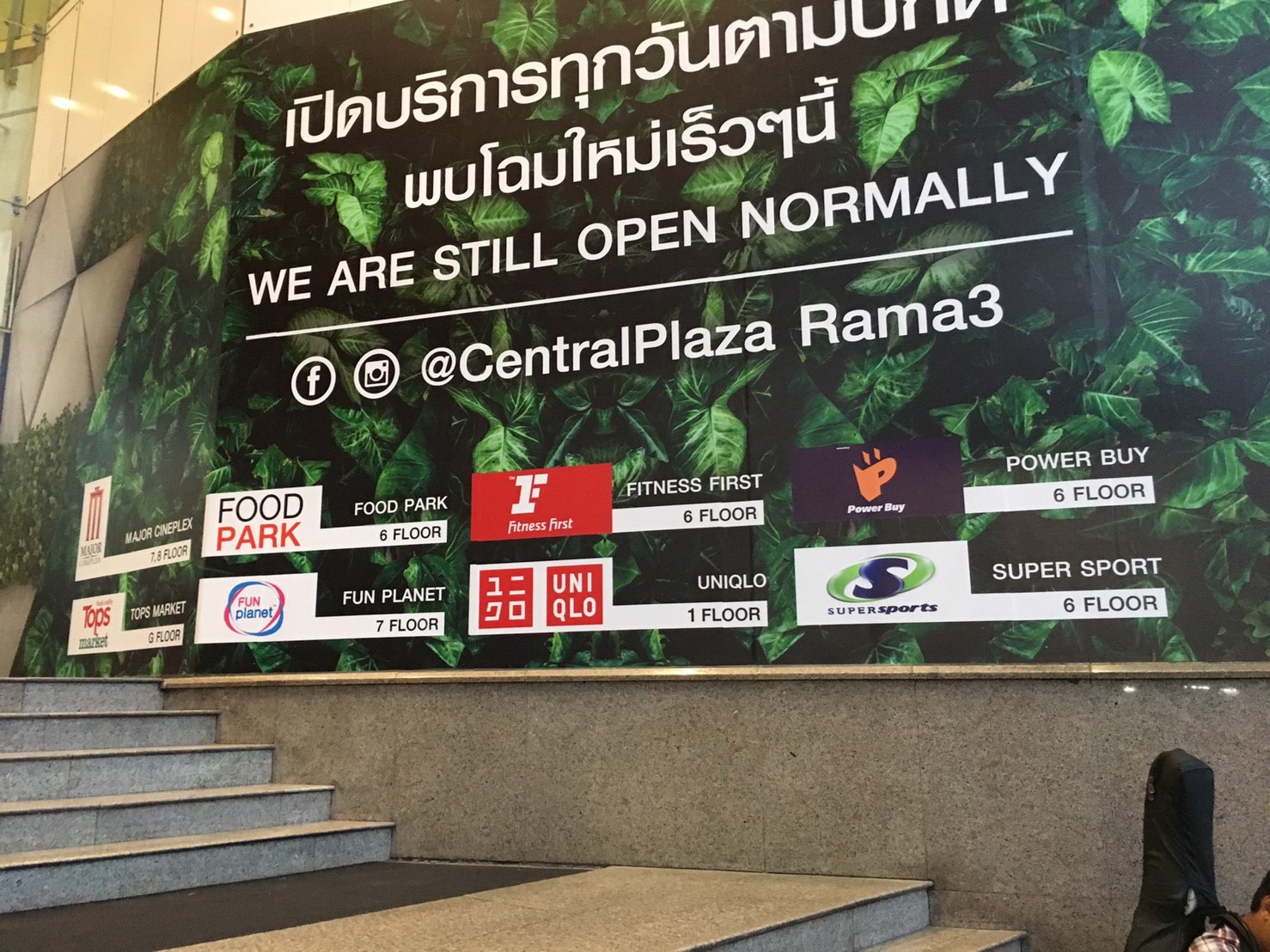
Portions of CentralPlaza Rama III were closed Monday for renovations.
BANGKOK — One of the capital’s largest malls will partially close through year’s end for a facelift on its 20th birthday.
The Central Department Store area at CentralPlaza Rama III in Bangkok’s Yan Nawa district will close June 19 through December for renovations. Some retail stores in the mall will continue operating, including Tops Supermarket, Major Cineplex cinema and Fitness First Gym, mall staff said Sunday.
By Monday afternoon, work was already underway in areas of the mall.
Built in 1997, the aquatic-themed mall is a popular weekend destination for neighborhood families.
The Central Department Store will be closed until December.The cinema, supermarket, food court, gym, electronics section, sports section, children’s play area and Uniqlo will remain operable.Large sections of the mall have been blocked off, leaving narrow hallways where some brands under renovation have set up booths.
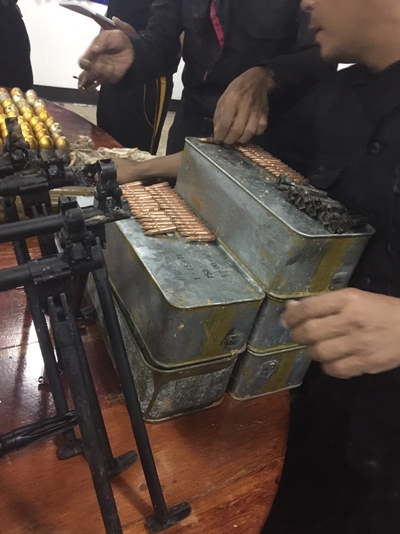
Some of the weapons police said they confiscated from an air force officer in Trat province on Saturday
BANGKOK — Investigators said Monday they are questioning an air force officer accused of trying to smuggle a cache of weapons into Cambodia.
Master Sgt. Phakin Dechpong, 40, stands accused of driving an SUV loaded with assault rifles and grenades to the Cambodian border Saturday night. His arrest came one day after police took a group of men into custody for allegedly sending hand grenades through a capital city courier service, though a junta spokesman said the two incidents are unrelated.
“It is a separate case. There is no connection between them,” Col. Piyapong Klinpan, who’s in charge of national security affairs, said by telephone.
Phakin was arrested after he accidentally crashed his car in Trat province on a road near the border. When police arrived on the scene, they reportedly found more than 30 AK-47s, dozens of grenades and thousands of rounds of ammunition in his car. Two other suspects in the car, a civilian and a Cambodian man, were also arrested.
Discovered in the vehicle were identification documents for the air force and a counter-insurgency agency answering to the prime minister called the Internal Security Operation Command, or ISOC.
Some of the weapons police said they confiscated from an air force officer in Trat province on Saturday
Although officials said Phakin belonged to the former, a spokesman for the latter disowned him. Col. Peerawat Saengthong said the ISOC card found in Phakin’s car was forged.
Peerawat said his agency has asked police to prosecute Phakin for the counterfeit document. He added that ISOC is sharing intelligence on Phakin with the police investigators.
“We have background information on the suspect, but we’d like to not disclose it for now,” Col. Peerawat said by telephone. “ISOC is giving full cooperation to the police in terms of intelligence.”
Phakin and two other suspects are being held at an army base for interrogation. Regional police commander Jitti Rodbangyang declined to answer questions about the incident other than to confirm Phakin is an air force officer.
Jitti said deputy police commissioner Srivara Ransibrahmanakul, who has been appointed to oversee the case, will make formal statements to the press in the afternoon.
Widespread Trade
Despite strict gun laws, Thailand is awash with illegal guns and military-grade equipment sold on the black market. Members of the police and military are occasionally arrested and accused of running guns.
On Friday, police discovered four hand grenades in an unclaimed parcel returned from Chonburi province to a postal service center in Bangkok. Four men were arrested Saturday in Nakhon Si Thammarat province on suspicion of being the intended recipients. An army corporal in Bangkok was accused of being the sender Saturday and taken into military custody.
Police shared this photo of four hand grenades as they were found Friday inside an unclaimed package at a courier service center in Bangkok.
Investigators believe a number of similar packages have moved through Chonburi on their way to ongoing destinations.
Junta spokesman Piyapong said those responsible for the grenade delivery belong to a black market operation that sells illicit firearms and explosives. He said they are not related to Phakin or the three bomb attacks that rocked Bangkok in recent weeks.
“As far as I’ve been told, they are not connected,” the spokesman said. “They sell illegal materials. They don’t mean to use those materials to engage in any incident.”
Three murder suspects are questioned by the national police chief on Sunday at Royal Thai Police Headquarters in Bangkok.
KHON KAEN — Three women arrested on suspicion of murdering and dismembering a former friend were led before throngs of reporters Monday for a ritual police “re-enactment” in the northeastern province of Khon Kaen after they reportedly confessed to the crime.
After the three were brought to Bangkok for a Sunday press briefing, police said 22-year-old Warissara “Amm” Klinjui was murdered as an act of revenge, and not a conspiracy involving transnational drug smuggling, as claimed earlier.
Preeyanuch ‘Preaw’ Nonwangchai, 24, is led through a police ‘re-enactment’ at the resort in Khon Kaen province where she allegedly sawed murder victim Warissara “Amm” Klinjui in two.
The national police chief said the three women had fled to Myanmar of their own volition and did not receive any assistance, as alleged ringleader Preeyanuch “Preaw” Nonwangchai often traveled to Malaysia and Singapore for work he only described as a “personal issue.”
“She said she wanted to have money just like others. She has to take care of her parents,” Gen. Chakthip Chaijinda said Sunday. “It was her personal issue.”
Last week, a top official with the Narcotics Control Board said Preeyanuch, 25, worked for one of the biggest drug dealers in the same Myanmar border town she fled to, where she arranged for drugs to be sent back into Thailand to her friends. This speculation was fueled as Preeyanuch was seen posting a lot of photos showing a large amount of money along with luxurious lifestyle on her social media account.
But the police force said Sunday they were not pursuing that angle.
Preeyanuch ‘Preaw’ Nonwangchai, 24, is led through a police ‘re-enactment’ at the resort in Khon Kaen province where she allegedly sawed murder victim Warissara “Amm” Klinjui in two.
On Sunday, they were taken for questioning by the Central Police in Bangkok as the case, with its tabloid-ready grisly details and pin-up girl suspects – had become a national obsession during the past week, with the women accruing celebrity status.
Chakthip said Preeyanuch confessed to the crime and confirmed earlier reports that she was motivated by revenge because Warissara had implicated her and her boyfriend in drug-related crimes last year. Preeyanuch’s boyfriend was sent to jail.
She said the revenge plot was launched after she ran into Warissara. She said she’d rented a car to take her parents out to eat but became very angry when she saw Warissara. She also said that she only meant to hurt Warissara, and the woman died during the assault.
Preeyanuch told police that a fourth suspect arrested earlier, Wasin Namphrom, 22, had helped her saw Warissara’s body in two and place each half into large buckets they buried 60 kilometers from the place where they dismembered her.
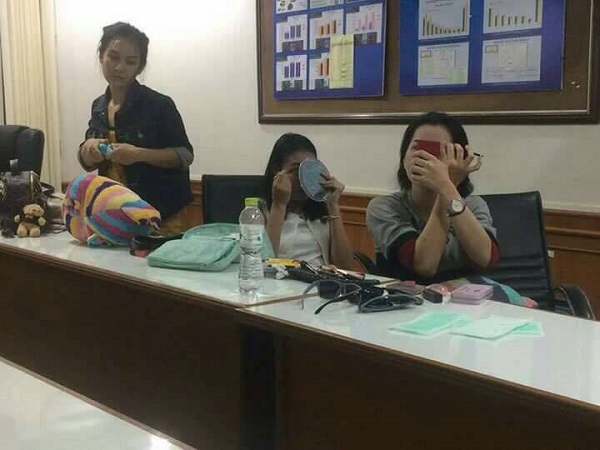
The three suspects are seen applying makeup Saturday night after they were handed over to Thai police by Myanmar authorities.
Following the trio’s arrest, the public was outraged anew by photos of them allowed to smoke, do their makeup, walk unrestrained and pose for photos with officers circulated on social media. Many were furious about the way they were treated.
Chakthip on Sunday gamely suggested it was unnecessary to lock them up because police were confident they would not flee again.
The three were charged with premeditated murder and concealing a corpse.
“Been following the news until the first day up until now, I’ve never talked about them. But seeing all of this, I can only say “It’s not funny.” #PreawDismemberment”
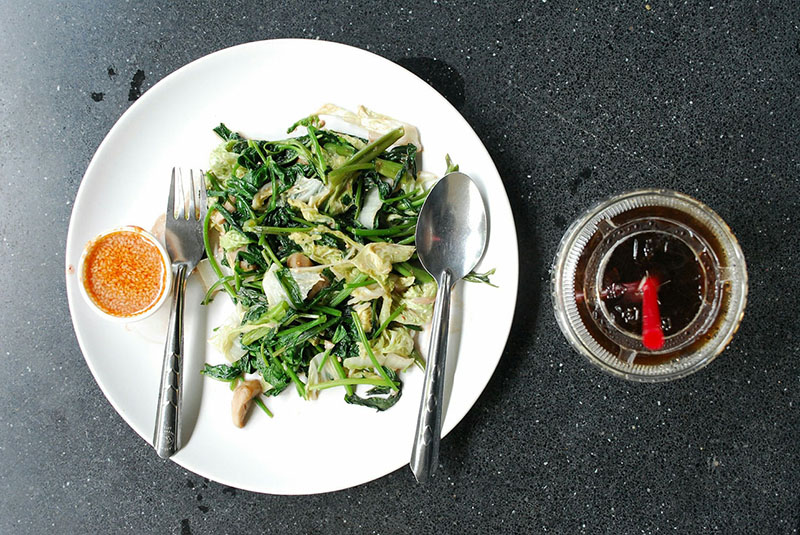
Worada Elstow had just entered university when she was recruited for modeling work. Soon she was subsisting only on black coffee and a small plate of suki haeng without noodles or eggs every day. But it wasn’t enough, so some days – especially when the cafeteria was too full – she’d forgo eating for a cigarette instead.
I don’t need this indication of beauty and sexuality anymore, I’m beautiful the way I am
For Worada, eating had become the precursor to self-induced vomiting like the binge-and-purge cycle of many eating disorders.
By her second year at Chulalongkorn University, Worada’s nails had turned purple and she was fainting between classes. Her teeth were decaying from frequent exposure to the acid in her digestive fluids.
With medication, therapy and support from her loved ones, the more extreme habits of her eating disorder – which has symptoms of both anorexia and bulimia – began to subside.
Worada, now 25, might have ended up in the emergency room with her illness undiagnosed – or dead, were it not for her family recognizing she had a problem.
“My uncle noticed I wasn’t eating and took me to the doctor. I got treated for my eating disorder as well as for depression, which I believe was interrelated,” said Worada. “The anti-depression meds really helped.”
She’s gotten help, and even though she is still recovering, Worada wants to talk about a potentially fatal problem she and the medical community worry other young Thai women are suffering untreated.
‘Under the Radar’
Worada in a 2013 modeling shoot.
A number of doctors and psychologists interviewed for this story said they believe eating disorders are on the rise, particularly among urban youth. But no one knows the scope of the problem because – anecdotal evidence aside – eating disorders in Thailand are under-reported, aren’t tracked and haven’t been studied.
There is no academic research or data concerning the prevalence of eating disorders in the country, according to Kullaya Pisitsungkagarn, a Chulalongkorn University psychology professor.
“By nature, eating disorders are secretive and very personal,” she said. “Since most Thais are petite and want to be thin anyway, they slip under the radar. There has been no substantive research on the number of Thais suffering from eating disorders.”
The Public Health Ministry doesn’t have information either.
“There are definitely eating disorders among Thais, but universities haven’t investigated or researched them yet,” said ministry Chief Advisor Yongyuth Yuthavong. He believed that was because it was relatively new to Thailand.
Without reliable data, practicing doctors can only estimate.
Anuttara Pothikamjorn, a pediatric endocrinologist at Bumrungrad International Hospital, said that generally, private Bangkok hospitals in Bangkok, including where she works, receive five to 10 patients with severe anorexia or bulimia every year.
“But multiply that by all the private hospitals and add them together, and it’s a significant amount,” she said.
A plate of suki haeng without noodles or eggs and one black coffee: Worada’s sole daily meal when she suffered from her eating disorder.
And those are only the diagnosed cases.
Many more likely go unreported due to the social stigma against psychological treatment, or undiagnosed because hospitals aren’t trained to recognize it.
Many Thais are too embarrassed to seek therapy, said Aswin Nakpongpan, a child psychiatrist and lecturer at Chiang Mai University’s Faculty of Medicine.
Friends and family usually don’t bring in loved ones suffering from eating disorders until they have physically broken down, partly due to low awareness of the disease, said Adipat Chaichanasakul, a psychologist at BNH Hospital.
“The average person who has fallen ill from an eating disorder will receive electrolytes and have their body mass index checked out at a public hospital. There is no eating disorder hotline, and no hospital has a full support team ready to take care of someone with an eating disorder,” Adipat said. “Many have only their body treated, not their mind.”
Worada Elstow.
Under Pressure
Rather than identifying one monolithic cause to blame, Anuttara said such disorders are nurtured by a set of common factors – abuse from family members or peers, anxiety about puberty, school and even perfectionist behavior types – which can increase one’s vulnerability.
Young Thai women especially are susceptible to “heavy expectations placed on a lack of self-esteem,” Kullaya said.
Worada knows this well.
“I started modeling in 2012, in my first year at university. All the other models were taller than me. As a petite person with short legs, I thought I’d battle them with my thinness,” she said.
The baht value assigned to her body as a commodity in modeling was psychologically damaging.
“A direct monetary value was assigned to my body. For example, I might charge 3,000 for a photoshoot, but those born-to-be models can get 10,000 baht. I’d think, ‘If only I was this much thinner, I could make a few thousand more,’” she said. “I started to feel guilty whenever I ate. So after eating, I was so stressed that didn’t even have to force myself to purge, it all just came up.”
Worada’s delicate build and doe eyes are belied by her frank recitation of how the disease wracked her body. She speaks casually, almost blithely, when recounting the details in part explanation and part confession.
“Sometimes I puked so much that I had to flush the toilet twice,” she said before smiling and looking off to the side. “You know, I’ve never told anyone that before?”
While she should have been focused on her studies, her life was being taken over by another education.
“Did you know, noodles, including mama noodles are the easiest to puke up? They come out in one lump.”
Worada’s iPhone lock screen says: “note to self: STOP EATING.”
She said she used cigarettes and spicy tom yum soup piled with chili powder “as hot as I could take it” as intense laxatives. She discovered “Pro-ana” or pro-anorexia communities online that helped her rationalize her disease.
“There’s this whole community online that says that they choose to be like this, that having anorexia is a lifestyle that they want to have,” Worada said.
On pro-ana forums, Worada would chat with others in the community about how many calories a glass of water had, or make inspiration boards with pictures of Kate Moss and her infamous quote, “Nothing tastes as good as skinny feels.”
Her favorite pictures, she would set as her iPhone lock screen: sometimes a photo of a Victoria’s Secret model, others, the words “STOP EATING.”
While Worada’s health has returned, the pressures of life are still there, and it’s clear her struggle isn’t over. She admits as much.
“You know, I have an underwear photoshoot tonight? I know I said I was mostly cured of this disease, but if I’m taking people’s cash for a shoot, then I still can’t eat normally,” she said.
At another point, she reached for her phone, where “STOP EATING” still screamed at her from the screen.
“You know I’m planning to shave my head Saturday? I’m telling everyone I don’t give a fuck anymore. It’ll be good for me. I don’t need this indication of beauty and sexuality anymore, I’m beautiful the way I am,” she said, giving voice to her internal dialogue.
Common Causes
Similar to Worada’s case, medical experts agree that Thailand’s social veneration of thin, intense parental pressure and changing urban lifestyles make conditions ripe for women to develop eating disorders.
“This pressure to be thin, combined with the social practice of commenting on people’s bodies can make one feel as if they lack personal space,” Kullaya said. “This can make one feel uncomfortable, and for people with low self esteem … can lead to harmful behaviors.”
While “fit is the new skinny” may be in vogue in the West, skinny is still the same old skinny in Thailand.
“When someone gets thin, they get complimented, and the thinner they keep getting, the more compliments pile on.” Adipat said. “However, this may put pressure – not just women, but also men – to purge, restrict their food intake too much or overexercise.”
Anuttara of Bumrungrad said Thai media doesn’t just represent hyper-thin women as normal, but also hits them with marketing for all manner of diet products.
“Even a NatureGift ad would trigger me,” Worada said, referring to the diet coffee brand advertised with gaunt models. “Later in the bathroom, I’d tell myself that I was fat and ugly and fat and ugly, and then everything would all come up.”
Overbearing parents can factor into eating disorders, Anuttara said, as the ability to binge and purge or not eat is a means for children to gain a sense of control. At Bumrungrad, she says she gets young people from well-off families that have developed eating disorders due to helicopter parents.
“As a kid, my mother was always hard on me. I never felt like I was good enough for anything, and I would act out by seeking attention or self-harm,” Worada said. As she matured and eventually enrolled as a French major, this manifested into depression and ultimately her eating disorder.
Rapidly changing lifestyles – enabled by technology, addicted to unhealthy food and susceptible to fads – are another force at play.
But doctors say it’s mostly a city thing.
Worada Elstow.
Affluent, urban Thais are generally more the vulnerable to eating disorders.
“Only comparatively small groups of urban-dwellers are the most prone to eating disorders. The spread to countryside lifestyle has been rather slow,” said Chiang Mai psychotherapist Aswin.
And though the disease has a gender-bias, it’s not only women suffering.
“Some suffering from eating disorders are gay men concerned about their bodies, as well as straight men, who are usually intense muscle builders,” Anuttara said. Hanging out with a group of body image-focused peers, such as ballet dancers or body builders, can also be pressures for teens.
Anuttara said she’s even treated Bangkok youth with orthorexia, a lesser-known eating disorder in which someone is so obsessed with eating healthy or – as the trend is now – “clean” food, that it creates similar problems.
Shifts in eating habits – from eating for survival to feasting on cheese tarts – also sees eating disorders more prevalent in urban centers.
“Not too long ago, the problem for many Thais was, ‘Do we have enough food to eat?’ Now, it’s shifted quite rapidly to, ‘We have enough food, but how do we eat in a smart and beneficial way?’” Kullaya said.
Not Alone
There are also social norms that counter the pressures that can produce eating disorders.
Aswin, the child psychiatrist in Chiang Mai, said there is relatively less obsession over body image in Thailand than there is elsewhere, as families in Asia are more likely to link self-worth to education and social status.
“The teenagers I treat mostly suffer from other conditions, such as stress from too much studying, engaging in drugs, risky behavior or unprotected sex. I can remember by name the ones who come in for eating disorders,” he said.
BNH psychologist Adipat said communal eating habits, with friends and family sharing dishes and scooping food for each, may discourage some development of eating disorders, compared to the solitary Western dining experience.
Worada remembers how her peers and loved ones came through in that regard.
I began to associate food with joy again.
“During lunch break, my friends who knew about my eating disorder would drag me to the cafeteria. They’d sit across me and made sure I ate,” Worada said. “The people around you really affect your recovery. When they took me out for food, I felt like I was loved. If you can’t love yourself just yet, find someone to help.”
Her boyfriend then would mash chili into rice for her to eat or take her out for meals she couldn’t refuse.
“Once he got me to eat the ramen at Bankara Ramen, and the pork was amazing. I still remember that.” Worada said. “I began to associate food with joy again.”
She worries about others suffering silently.
Worada Elstow.
“This self-harm just isn’t worth it, trust me. You have more to offer than just your body. Don’t feel like you’re not good enough or that you’re unloved. Please go get help from a doctor, or even come talk to me,” she said when asked about advice she would give to those currently suffering from eating disorders.
As for herself, Worada plans to make good on her promise to quit modeling – she hasn’t yet – and pursue a master’s degree in psychology.
As our interview ended, she jumped atop a concrete pedestal – a popular spot for taking photos at Chulalongkorn’s Faculty of Arts.
“How about a picture of me up here? I want people to know that this human is well again,” Worada said.
Serbia's Novak Djokovic plays a shot in his fourth round match against Spain's Albert Ramos-Vinolas at the French Open tennis tournament Sunday at the Roland Garros stadium, in Paris, France. Photo: Christophe Ena / Associated Press
A quick look at the French Open:
Men’s Results Sunday
Third round: No. 8 Kei Nishikori beat Chung Hyeon, No. 15 Gael Monfils beat No. 24 Richard Gasquet (retired), Karen Khachanov beat No. 21 John Isner.
Fourth round: No. 2 Novak Djokovic beat No. 19 Albert Ramos-Vinolas, No. 4 Rafael Nadal beat No. 17 Roberto Bautista Agut, No. 6 Dominic Thiem beat Horacio Zeballos, No. 20 Pablo Carreno Busta beat No. 5 Milos Raonic.
Women’s Results Sunday
Third round: No. 2 Karolina Pliskova beat Carina Witthoeft, No. 5 Elina Svitolina, Petra Martic beat No. 17 Anastasija Sevastova, Veronica Cepede Royg beat Mariana Duque-Marino.
Twenty — Games dropped by Nadal through four matches; the only time he lost fewer on the way to a Grand Slam quarterfinal was 19 at the 2012 French Open.
https://www.youtube.com/watch?v=1gE_QZRFxhw
Quote of the Day
“No. I think she speaks, like, 25 languages.” — Muguruza, the 2016 champion, when asked whether she was annoyed by Mladenovic’s shouting an Italian word to celebrate Muguruza’s unforced errors.
Lookahead to Monday
Andy Murray will be up against an unfamiliar opponent in remaining fourth-round action. The top-ranked British player, last year’s runner-up, has never played Khachanov before. The 21-year-old Russian has only one career title compared to Murray’s 45. While Murray has won three Grand Slam titles, it’s the unseeded Khachanov’s first appearance at Roland Garros and only his third at a major. Murray has won nearly USD $60 million in prize money – which is about 60 times more than Khachanov. Following them onto Court Philippe Chatrier are third-seeded Stan Wawrinka of Switzerland and No. 15 Gael Monfils. The Frenchman has waited a long time to get his own back on Wawrinka: six years, in fact. Wawrinka, the 2015 French Open champion, won the last of their four career meetings six years ago – beating Monfils in straight sets in the third round of the Australian Open. They meet for the fifth time in their careers and are level 2-2. In women’s play, No. 3 Simona Halep of Romania is facing No. 21 Carla Suarez Navarro for the 12th time. Halep leads her 6-5 but has never beaten the Spaniard on clay, losing four times – including in the first round at Roland Garros in 2013. The following year, Halep reached the final.
Qatar's Emir Sheikh Tamim bin Hamad Al-Thani attends a Gulf Cooperation Council summit in 2014 in Doha, Qatar. Photo: Osama Faisal / Associated Press
DUBAI, United Arab Emirates — Four Arab nations cut diplomatic ties to Qatar early Monday morning, further deepening a rift among Gulf Arab nations over that country’s support for Islamist groups.
Bahrain, Egypt, Saudi Arabia and the United Arab Emirates all announced they would withdraw their diplomatic staff from Qatar, a gas-rich nation that will host the 2022 FIFA World Cup. Saudi Arabia also said Qatari troops would be pulled from the ongoing war in Yemen.
All the nations also said they planned to cut air and sea traffic to the peninsular country. It wasn’t immediately clear how that would affect Qatar Airways, one of the region’s major long-haul carriers. The airline and Qatari government officials did not immediately respond to a request for comment.
Qatar is also home to the sprawling al-Udeid Air Base, which is home to the U.S. military’s Central Command and some 10,000 American troops. It wasn’t clear if the decision would affect American military operations. Central Command officials did not immediately respond to a request for comment.
Bahrain blamed Qatar’s “media incitement, support for armed terrorist activities and funding linked to Iranian groups to carry out sabotage and spreading chaos in Bahrain” for its decision. Other countries issued similar statements.
The decision comes after Qatar alleged in late May that hackers took over the site of its state-run news agency and published what it called fake comments from its ruling emir about Iran and Israel. Its Gulf Arab neighbors responded with anger, blocking Qatari-based media, including the Doha-based satellite news network Al-Jazeera.
Qatar long has faced criticism from its Arab neighbors over its support of Islamists. The chief worry among them is the Muslim Brotherhood, a Sunni Islamist political group outlawed by both Saudi Arabia and the UAE as it challenges the nations’ hereditary rule.
Gulf countries led by Saudi Arabia fell out with Qatar over its backing of then-Egyptian President Mohammed Morsi, a Brotherhood member. In March 2014, Saudi Arabia, the United Arab Emirates and Bahrain recalled their ambassadors from Qatar over the rift. Eight months later, they returned their ambassadors as Qatar forced some Brotherhood members to leave the country and quieted others. However, the 2014 crisis did not see a land and sea blockade as threatened now.
In the time since, Qatar repeatedly and strongly denied it funds extremist groups. However, it remains a key financial patron of the Hamas-controlled Gaza Strip and has been the home of exiled Hamas official Khaled Mashaal since 2012. Western officials also have accused Qatar of allowing or even encouraging funding of Sunni extremists like al-Qaida’s branch in Syria, once known as the Nusra Front.
The crisis also comes after U.S. President Donald Trump’s recent visit to Saudi Arabia for a summit with Arab leaders. Since the meeting, unrest in the region has grown.
At that Saudi conference, Trump met with Qatar’s ruling emir Sheikh Tamim bin Hamad Al Thani.
“We are friends, we’ve been friends now for a long time, haven’t we?” Trump asked at the meeting. “Our relationship is extremely good.”
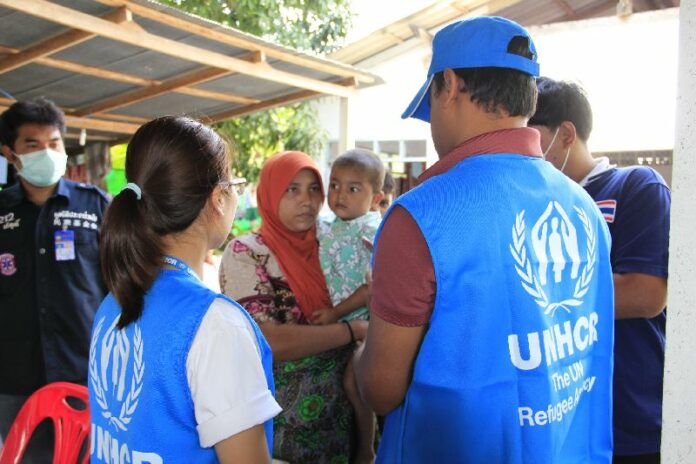
Officials from the United Nations High Commissioner for Refugees (UNHCR) visited a shelter in Hua Sai housing 99 Rohingya refugees, 21 Jan 2015.
BANGKOK — The death of a Pakistani Christian detainee at an immigration police detention center prompted a human rights organization to issue a statement on Saturday calling for the military government to investigate the death and put an end to indefinite detention of asylum seekers.
The death of Ijaz Masih, 39, a Christian Pakistani who suffered from a heart attack May 27 at the Immigration Detention Center in Bangkok, led Human Rights Watch to issue a statement Saturday calling for the investigation of the death and to end the indefinite detention of asylum seekers. An activist working with refugees said the problem is partly to do with Thailand’s lack of laws recognizing asylum seekers and the conditions at detention centers.
The rights organization said Masih had been detained for more than a year on an illegal entry charge and that the United Nations High Commissioners for Refugees, or UNHCR, had rejected his refugee claim the day before. He died shortly after he was transferred to the Police General Hospital, the statement said.
“Thai authorities are putting people who seek refugee protection at grave risk by keeping them in awful conditions in immigration detention centers,” said Brad Adams, Asia Director at Human Rights Watch. “Ijaz Masih’s death should be a wake-up call to end this abusive policy of incarcerating asylum seekers awaiting application results and refugees.”
Adams added that the Thai government should recognize that its punitive detention policy towards asylum seekers is both inhumane and counterproductive.
“Punishing people who are fleeing ghastly conditions at home will not keep them away but just add to their misery,” he said.
Parinya Boonridrethaikul, a veteran activist working with asylum seekers said by phone on Sunday that because there exists no law in Thailand recognizing refugees, they are given status as illegal immigrant.
“So there’s no policy to […] care for these people,” said Parinya.
Thailand is not a party to the 1951 Refugee Convention and there exist no law to recognize refugee status and procedures to assess asylum claim. Many ended up being detained indefinitely, said Parinya.
According to Parinya, there are currently about 260 asylum seekers being detained at the immigration police’s detention center at Soi Suan Plu in Sathorn area in Bangkok. She said there are an estimated 8,000 asylum-seekers from about 40 countries in the kingdom.
The conditions inside the detention center are off-limits to outsiders, said Parinya, who added that descriptions from those who have been detained made it clear they are worse than in Thai prisons – which are already notorious for housing prisoners beyond their capacity.
“If all [detainees] slept on the floor in the detention room at once, there would be no space to walk,” said Parinya, adding that the budget for a day of food for each detainee’s three meals is 45 baht. The same sum can buy you a single meal from street food vendor in Bangkok. A detention room, said Parinya, holds about 60 to 100 people.
Parinya is pinning her hope on government-introduced regulations. She said the cabinet met Jan. 10 and came up with a resolution on the need for new regulations to treat asylum seekers differently. Since then there have been no details or visible progress on the new regulations, Parinya added.
Adams proposed the government adopt alternatives to detention that are being used in other countries such as open reception areas and conditional release programs.