29.9 C
Bangkok
Saturday, June 27, 2026
Home Blog Page 2483

Nintendo Switch Console to Sell for USD $299 in Japan Starting in March

A model of the Nintendo Switch console to be sold starting in March in Japan. Photo: BagoGames / Flickr

TOKYO — Nintendo Co. said Friday that its Nintendo Switch video game console will sell for 29,980 yen (about $260) in Japan, starting March 3.

The Kyoto-based maker of Super Mario and Pokemon games made the announcement in Tokyo.

It said the console will sell for $299.99 in the U.S. The company said customers would need to ask retailers in Europe for prices there.

Anticipation has been growing ahead of the release of the Switch. Nintendo has shown players with a handheld whose remote controller section with buttons detaches from the left and right sides of the main part of the display.

Players can play the device as a regular handheld, place the display on a table, or use the screen of a TV set, connecting by wireless.

“Nintendo Switch is a brand-new kind of home gaming system that offers a wide variety of play modes,” Nintendo’s president Tatsumi Kimishima told reporters.

Nintendo will be hoping the Switch will buttress a turnaround after disappointing sales of the Wii U and the 3DS handheld.

Story: Yuri Kageyama

Advertisement

‘I Have Served My Bad Karma,’ Bureaucrat Says in Epic Resignation Letter

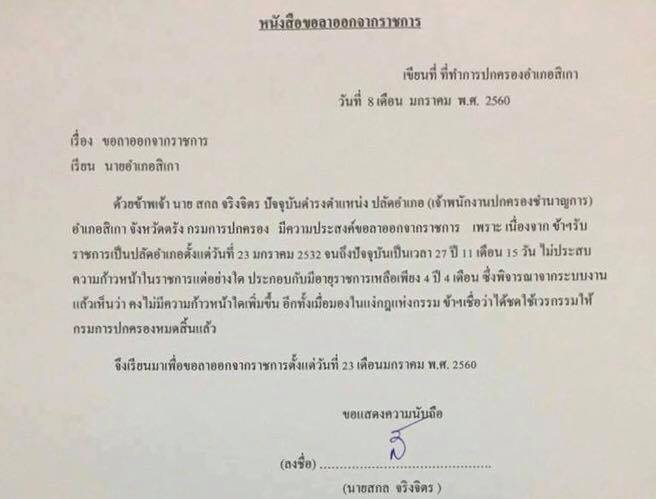
The resignation letter written by Sakon Jingjitr. Image: Ittaporn Kanacharoen / Facebook

TRANG — A cheeky resignation letter penned by a 27-year veteran bureaucrat set social media abuzz Friday, inspiring like-minded internet salarymen who wish they could follow suit.

“Throughout my 27 years, 11 months and 15 days, I have not witnessed any progress in my bureaucratic career,” Sakon Jingjitr, who was permanent secretary to a district chief in the southern province of Trang, wrote in the now-viral letter. “I have only four years and four months left before my bureaucratic retirement, during which I deliberated and concluded that I will not see any further progress.”

Sakon then ended the letter, which asked for the resignation to be effective Jan. 23, with a Buddhist touch.

“Furthermore, when I look at it in the context of the Laws of Karma, I believe I have completely served the bad karma that bound me with the Department of Provincial Administration.”

In one Facebook thread, the photo was shared more than 1,800 times, while many comments praised Sakon for his blunt emotional honesty.

“Someone should make this a template for future use,” Sakon Singha wrote in a comment.

“My idol,” wrote another user, Jom Jam.

Reached for comment by telephone, Sakon confirmed the letter is genuine; in fact, the governor of Trang has already approved it, he said.

He declined to elaborate on the reasons that made him quit his job, citing a government regulation that forbids bureaucrats from discussing internal matters with the media.

“Until Jan. 23 I’m still an official. If I give an interview now … they may convene an investigative panel on me,” Sakon said. “And if that happens, instead of resigning, I would be expelled.”

He said he didn’t intend the letter to be aggressive or rude: He was simply expressing his sincerity.

“I just wanted to use my real reason instead of the generic reasons other people use for their resignation, such as having health problem,” Sakon said.

Responding to the viral letter, department director Arthit Boonyasophat maintained that the bureaucracy offers job progresses to those who are qualified for it, and bureaucrats can move up their ranks by taking relevant examinations.

Advertisement

El Salvador Has Rare Murder-Free Day, 1st in Nearly 2 Years

Gang member Carlos Gonzalez who lost his mother to gang violence, seen here in 2009 in San Salvador, El Salvador. Photo: Moody College of Communication / Flickr

SAN SALVADOR, El Salvador — El Salvador, one of the world’s deadliest countries, has recorded a rare day without a single homicide.

National Civil Police commissioner Howard Cotto said at a news conference Thursday that no murders were reported the previous day in the gang-plagued Central American nation.

The last time the country went a full day without any killings was Jan. 22, 2015, according to records kept by The Associated Press. It also happened once in 2013 and on two days the year before that.

The nation of about 6 million people averaged 14.4 murders a day last year.

Killings peaked at 104 per 100,000 residents in 2015, the highest rate for any nation not in open war that year.

Homicides fell by about 20 percent in 2016, but it was still one of the most violent countries with 81.2 murders per 100,000 residents.

Warring gangs known as “maras” are involved in drug trafficking, organized crime and extortion rackets in the country.

Advertisement

Obama Ends Visa-Free Path for Cubans Who Make It to US Soil

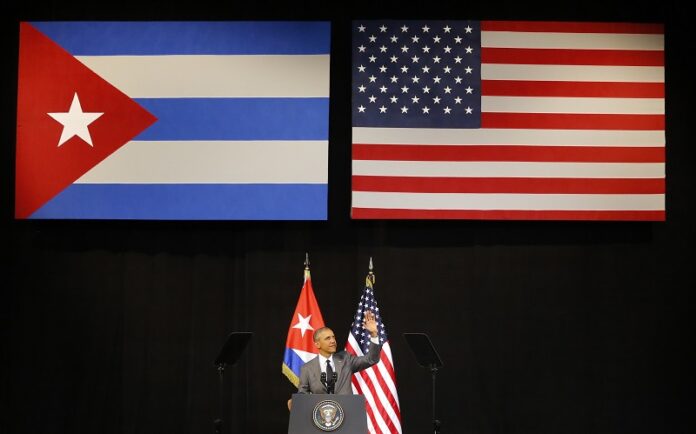
President Barack Obama speaks in 2016 at the Grand Theater of Havana, Cuba. Photo: Desmond Boylan / Associated Press

WASHINGTON — President Barack Obama announced Thursday he is ending a longstanding immigration policy that allows any Cuban who makes it to U.S. soil to stay and become a legal resident.

The repeal of the “wet foot, dry foot” policy is effective immediately. The decision follows months of negotiations focused in part on getting Cuba to agree to take back people who had arrived in the U.S.

“Effective immediately, Cuban nationals who attempt to enter the United States illegally and do not qualify for humanitarian relief will be subject to removal, consistent with U.S. law and enforcement priorities,” Obama said in a statement. “By taking this step, we are treating Cuban migrants the same way we treat migrants from other countries. The Cuban government has agreed to accept the return of Cuban nationals who have been ordered removed, just as it has been accepting the return of migrants interdicted at sea.”

The Cuban government praised the move. In a statement read on state television, it called the signing of the agreement “an important step in advancing relations” between the U.S. and Cuba that “aims to guarantee normal, safe and ordered migration.”

Obama is using an administrative rule change to end the policy. Donald Trump could undo that rule after becoming president next week. He has criticized Obama’s moves to improve relations with Cuba. But ending a policy that has allowed hundreds of thousands of people to come to the United States without a visa also aligns with Trump’s commitment to tough immigration policies.

President Bill Clinton created “wet foot, dry foot” policy in 1995 as a revision of a more liberal immigration policy that allowed Cubans caught at sea to come to the United States become legal residents in a year.

The two governments have been negotiating an end to “wet foot, dry foot” for months and finalized an agreement Thursday. A decades-old U.S. economic embargo, though, remains in place, as does the Cuban Adjustment Act, which lets Cubans become permanent residents a year after legally arriving in the U.S.

Under the terms of the agreement, Cuba has agreed to take back those turned away from the U.S., if the time between their departure from Cuba and the start of deportation hearings in the U.S. is four years or less. Officials said the timeframe is required under a Cuban law enacted after Congress passed the Cuban Adjustment Act.

“For this to work, the Cubans had to agree to take people back,” said Ben Rhodes, Obama’s deputy national security adviser.

Administration officials called on Congress to repeal the Cuban Adjustment Act.

Officials said the changes would not affect a lottery that allows 20,000 Cubans to come to the U.S. legally each year. But Rhodes cast the shift as a necessary step toward Cuba’s economic and political development.

“It’s important that Cuba continue to have a young, dynamic population that are clearly serving as agents of change,” he said.

Rhodes also cited an uptick in Cuban migration, particularly across the U.S.-Mexico border  an increase many have attributed to an expectation among Cubans that the Obama administration would soon move to end their special immigration status.

Since October 2012, more than 118,000 Cubans have presented themselves at ports of entry along the border, according to statistics published by the Homeland Security Department, including more than 48,000 people who arrived between October 2015 and November 2016.

Relations between the United States and Cuba were stuck in a Cold War freeze for decades, but Obama and Cuban President Raul Castro established full diplomatic ties and opened embassies in their capitals in 2015. Obama visited Havana last March. Officials from both nations met Thursday in Washington to coordinate efforts to fight human trafficking.

Obama said the Cuban Medical Professional Parole Program, which was started by President George W. Bush in 2006, is also being rescinded. The measure allowed Cuban doctors, nurses and other medical professionals to seek parole in the U.S. while on assignments abroad. The president said those doctors can still apply for asylum at U.S. embassies around the world.

“By providing preferential treatment to Cuban medical personnel, the medical parole program … risks harming the Cuban people,” Obama said.

People already in the United States and in the pipeline under both “wet foot, dry foot” and the medical parole program will be able to continue the process toward getting legal status.

Reaction to the announcement in Havana was muted Thursday afternoon.

“This was bound to happen at some point,” said taxi driver Guillermo Britos, 35. “It could impose a more normal dynamic on emigration, so that not so many people die at sea, but it could also take an escape valve away from the government, which was getting hard currency from the emigrants.”

Anti-Castro Cubans in Miami were mixed in their responses, with some expressing anger at Obama for what they called another betrayal of ordinary Cubans. Others said they thought the measure would increase pressure for change in Cuba.

“People who can’t leave, they could create internal problems for the regime,” said Jorge Gutierrez, an 80-year-old veteran of the Bay of Pigs invasion. But he added, “From the humanitarian point of view, it’s taking away the possibility of a better future from the people who are struggling in Cuba.”

Rep. Illeana Ros-Lehtinen, a Florida Republican who emigrated from Cuba as a child, decried the elimination of the medical parole programs, calling it a “foolhardy concession to a regime that sends its doctors to foreign nations in a modern-day indentured servitude.”

Story: Alicia A. Caldwell, Julie Pace

Advertisement

Winter Party is for Rock and Art at Brownstone

Photo: Brownstone / Facebook

BANGKOK — Celebrate Bangkok’s cool season with music, art and more in a studio garden in the On Nut area.

Winterfest Bangkok is an arts and freaks fest featuring four bands from Bangkok and Chiang Mai performing live.

The music includes instrumental rock trio Spring Fall Sea, indie rockers Penny Time, electro-psychedelic The Voodoo Asylum, serious garage rockers Sangsom Massacre, and coming from Chiang Mai, The Odd Gods.

Yaan will close the party with some noise mixing Western, classical Indian and traditional Thai sounds. After the outdoor performances finish at about 10pm, the party continues with a DJ spinning in the studio of host Brownstone Studios until late.

The art crew to put their hands to walls and canvases include Josh Roxas, Carla Soledad Rivera, Ekkasit Tanyuvardhana aka HSH, Josephus Bartin and Hannah Theodorou. Some works will be on sale.

Facepainting is 50 baht with bodypainting available at a cost depending on the design and body size. Partygoers who show up in cosplay get free drinks.

Don’t worry about food. Lil’ Fatso‘s food truck will have plenty of sliders, cheesy fries and IPAs.

Admission is 200 baht. The event starts at 3pm on Jan. 21 at Brownstone Studios. The studio-gallery-cafe building is located on Soi Sukhumvit 77 near Soi On Nut 25, and can be reached by motorbike from BTS On Nut.

Advertisement

3 Chinese Weightlifters Lose 2008 Olympic Titles for Doping

Cao Lei, of China, holds up her gold medal in the women's 75 kg. of the weightlifting competition at the Beijing 2008 Olympics in Beijing, China. Photo: Andres Leighton / Associated Press

LAUSANNE, Switzerland — Three Chinese women weightlifters have been stripped of Olympic titles for doping at their home 2008 Beijing Games.

China faces a one-year ban from international weightlifting which should be triggered for having three Olympic doping disqualifications in a re-testing program by the IOC, which announced the verdicts on Thursday.

The IOC also took a Beijing bronze medal in women’s shot put from Nadzeya Ostapchuk of Belarus on Thursday. Ostapchuk previously lost her gold medal and Olympic title from the 2012 London Games in a separate doping case.

The four medalists were among eight new disqualifications announced in the latest round of an extensive program using new tests to re-analyze samples stored since the Beijing and London Olympics.

The IOC said all three Chinese weightlifters tested positive for GHRP-2, which stimulates production of growth hormone.

They were: Cao Lei in the 75-kilogram class; Chen Xiexia at 48kg; and Liu Chunhonog at 69kg. Liu also tested positive for sibutramine, a banned stimulant.

Liu was also the 2004 Athens Olympics champion in her weight class, and Cao and Chen were world champions in 2007.

Because of the similar cases, the IOC disciplinary commission urged the International Weightlifting Federation to investigate Chinese team coaches and officials.

“This suggests a possible involvement of the athlete’s entourage in these cases and the IWF is invited to investigate that situation and, if adequate, to take action against relevant people in the athlete’s entourage,” the IOC panel said in its published rulings.

The one-year expulsion for China should be imposed by the IWF. The governing body based in Budapest, Hungary, promised automatic bans if a nation had three athletes test positive in the IOC’s Beijing and London re-tests.

The IWF previously announced the Chinese cases in August.

Doping cases are re-writing the original results from weightlifting in Beijing. Medalists in each of the three women’s weight classes won by the Chinese have already been disqualified and stripped of their results by the IOC in recent weeks.

Currently, lifters from Taiwan, Russia and Kazakhstan could be upgraded to the gold medal, though it is unclear if they also tested positive for doping in the re-analysis.

The four verdicts on Thursday involving non-medalists included two fourth-place athletes who tested positive for anabolic steroids in Beijing: Darya Pchelnik of Belarus in women’s hammer throw, who used turinabol, and Turkish weightlifter Sibel Simsek in the women’s 63kg, who tested positive for turinabol and stanozolol.

Two lifters from the men’s 94kg class also were disqualified for turinabol: Sixth-place Intigam Zairov of Azerbaijan, and 11th-place Norayr Vardanyan of Armenia.

The IOC recorded more than 100 positive tests across numerous sports from the Beijing and London retesting program, and more cases are expected. Most involve athletes in countries from the former Soviet Union.

The re-tests were ordered using new and more sensitive tests to detect steroids and other banned substances being used several weeks instead of several days before a urine sample was given.

Advertisement

France Backtracks on Law Allowing Kids to Leave Country Without Consent

French children walk past World War II veteran paratroopers as they deliver floral arrangements to dignitaries who will lay them at a war memorial in 2011 during a ceremony in Sainte Mere Eglise, France. Photo: Michael J. MacLeod / Wikimedia Commons

PARIS — France’s government has quietly backtracked on a policy that allowed children to leave the country without their parents’ permission, after years of complaints from families of radicalized teens who left to join extremist groups.

The new rules requiring parental permission go into effect Sunday, five years after the government lifted the restriction with little fanfare, citing a need to streamline bureaucracy.

At the time, the war in Syria was picking up and France became Europe’s largest source of recruits in the war zone, notably for the Islamic State group. Families said they were blindsided when their teenage sons and daughters were allowed to pass through border control no questions asked and even leave Europe’s passport-free zone for Turkey.

“We have to do everything we can to prevent minors from going into the terrorist zone,” lawmaker Patrick Hetzel told France 3.

But critics say the reversal comes far too late.

Samia Maktouf, a lawyer for two families that sued the government over their teenagers’ departures for Syria, has called for this policy shift for years.

“Unfortunately, they’re taking action rather late,” she told The Associated Press. “Four hundred French minors are now at the gates of Hell.”

Story: Lori Hinnant

Advertisement

As Southern Flooding Eases, 22B Baht Price Tag For Repairs

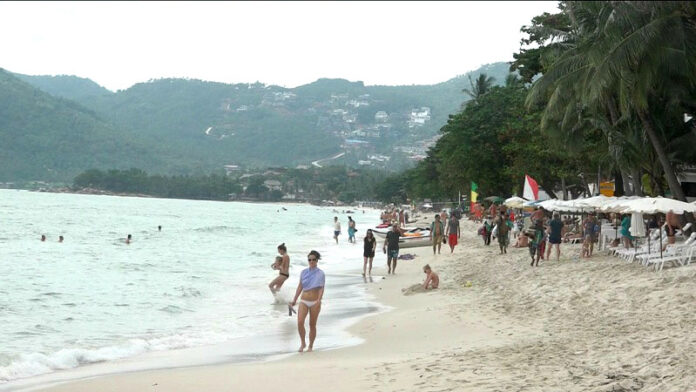
Tourists were returning Thursday to Koh Samui’s Chaweng beach.

SAMUI — Samui beaches were back to life Thursday as severe flooding in the south started easing in some areas.

Water levels fell on average in all 12 southern provinces where heavy rains had caused flash floods for more than a week, killing 36 people and affecting more than one million residents.

The damage is now estimated at 22 billion baht. Forecasts for economic growth in the southern region economic have been revised down 2 percent for year, down from the 3.2 percent originally forecast by the University of the Thai Chamber of Commerce.

The flood affected agriculture and business, two key sectors in the south’s economy. Tourism and transportation along with fishing, rubber production and palm oil plantations were damaged.

People evacuate their flooded homes Thursday in Surat Thani province.

The Meteorological Department said Thursday the south should soon resume seasonal typical weather with water levels returning to normal.

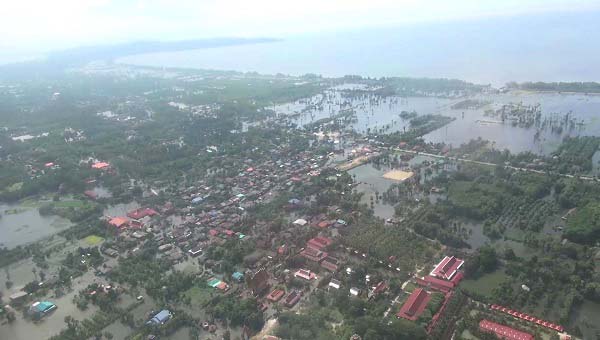
They still have a way to go. The water stood two- to three-meters high in many provinces as of Thursday afternoon.

A bird’s-eye view over Songkhla province shows water levels still in crisis.

The southern railway remains cut off but service was extended further southward to the Thung Song station of Nakhon Si Thammarat province.

All public bus routes resumed operation with modified timetables. Most will leave earlier due to traffic congestion on affected roads.

Related stories:

More Flash Floods Expected as North-to-South Road Reopens

Young Girl Drowns in Southern Flooding, Surprise Storm Lashes Bangkok

Reform Assembly Members Donate 5,000 Baht Each to Aid Flood Relief Efforts

19 Die as Floods Continue to Submerge South

Malls, Airport Closed as Worst Flood in Decades Hit South

Advertisement

Missing Japanese Tourist’s Mother Arrives Seeking Answers

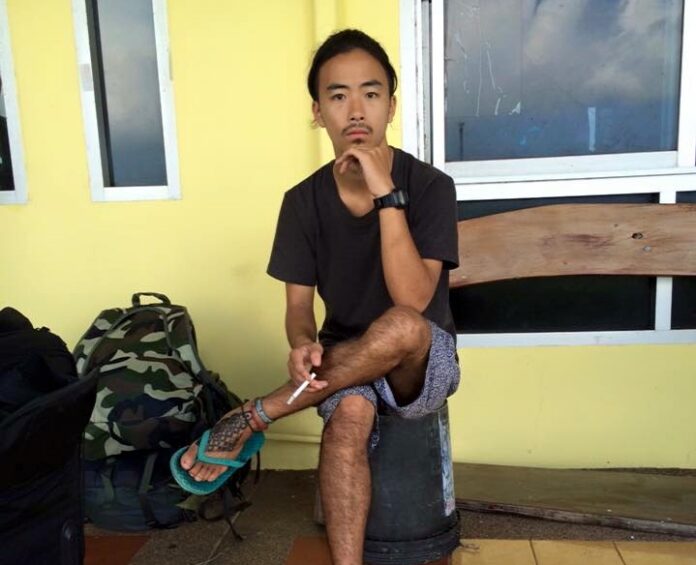
An undated photo of Sonam Tsuboi posted online by his brother.

BANGKOK — A Japanese tourist reported missing in Bangkok’s backpacker district just over two weeks remained unaccounted for Thursday, as his mother flew in to join the search efforts.

Sonam Tsuboi, 22, was last seen Dec. 27 at the Mama Guesthouse on Khaosan Road, according to a post shared online by his brother Tama Tsuboi, who said he would also come to Bangkok on Monday if the tourist is still missing at that time.

“We have contacted every police station in the country and so now they are aware,” Tama said via online chat. “My mother and father will search by themselves with a few friends going to places he might be.”

Read more: Japanese Man Reported Missing From Khaosan Road

Police in the area of Khaosan Road confirmed they received a missing person report on Sonam on Dec. 27 and opened an investigation.

Tama said his brother was traveling with a friend “but made many friends on his stay.” Sonam’s family found out he went missing because his girlfriend was supposed to meet him at the airport and he never showed up, Tama said.

He said he’s received no helpful leads so far.

“We’ve tried everything through social media but no information,” Tama wrote. “So there’s not much anyone can do right now apart from actually going there and spending time looking for him.”

Advertisement

Return of the Sorayuth: Convicted Anchor Re-Surfaces in Flooded South

A screengrab of Sorayuth Suthassanachinda’s Facebook Live reporting on flooded areas in Hua Sai district, Nakhon Si Thammarat.

NAKHON SI THAMMARAT — Sorayuth’s back.

After disappearing from the airwaves 10 months ago, convicted news anchor Sorayuth Suthassanachinda has waded, waist-deep, back to national audiences via Facebook live videos narrating the severe flooding in southern Thailand.

Since Sunday, the veteran journalist and former Channel 3 anchor has been posting field reports watched by millions, many of whom have welcomed him back warmly despite his tainted corruption.

“Since you left, I’ve never turned on Channel 3. Their quality really decreased, and it’s not as fun,” commented user May Waranpassorn on a Monday clip in which he chats with a man fishing in the floodwaters.

Read: Convicted TV Host Ends His Career Amid Pressure

That clip has been watched more than a million times and shared more than 9,000 times.

Sorayuth, who had just begun a new live stream at the time of publication, could not be reached for comment. A woman identifying herself as his secretary said he was in the field doing his thing.

His fans rejoiced when he first reported on the floods in Phetchaburi province before moving on to Nakhon Si Thammarat on Monday, Prachuap Khiri Khan on Tuesday and Surat Thani on Wednesday. In the latest posted Thursday, he hangs out with a local kanom jeen maker and chats with people about their waterlogged village.

Still it’s far from the millions he drew in every day as the face of Channel 3 before being convicted of fraud in February 2016.

Sorayuth was found guilty of embezzling 138 million baht in sales of advertising airtime through a company he ran. He resisted calls to step down and only did so under pressure in March. He was sentenced to 13 years in jail but is free on bail while his case is under appeal.

None of that has dampened the affection of many who began every day with his voice making sense of things from behind his news desk.

“You really are a man of the people,” user Tanaporn Wichai wrote. “You go to where the people are suffering instead of abandoning us.”


Related stories:

TV Celebrity Sorayuth Gets 13 Years for Embezzling Ad Revenue

Channel 3 Under Pressure to Pull Convicted Host Sorayuth

Advertisement

Hot News

LATEST NEWS

Bangkok
overcast clouds
29.9 ° C
31.1 °
28.8 °
90 %
2.8kmh
97 %
Sat
37 °
Sun
36 °
Mon
36 °
Tue
33 °
Wed
34 °