30.5 C
Bangkok
Thursday, June 25, 2026
Home Blog Page 2545

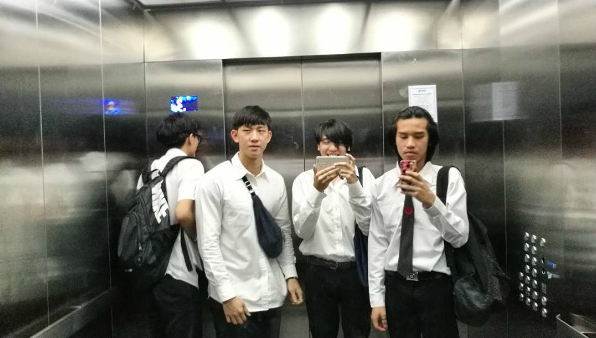
These Four Guys Got Stuck in an Elevator, Made a Song About it.

Photo: Omp_kanish21 / Instagram

BANGKOK A quartet of university sophomores found their voices instead of freaking out when they got stuck in a campus elevator to the delight of many online today.

To kill time while waiting to be rescued, they turned crisis into opportunity by filming themselves riffing on a classic comedy show song in a video which has quickly spread since it was posted Tuesday.

“10-20-30-40. I help the poor. I help the rich. Please help us. We’re stuck in the elevator!” they sing in the video uploaded to Instagram.

The clip of the four Srinakharinwirot University students singing went viral with over 19,000 shares and 57,000 likes as of Wednesday afternoon.

Apparently, someone came along and rescued the students, who are now safe and sound. They also recorded the moment of their escape.

ลิฟท์ค้างครับ วันนี้ดี

A photo posted by omp kanish (@omp_kanish21) on

ใช้ได้ๆ

A video posted by omp kanish (@omp_kanish21) on

Advertisement

Failed Negotiations With Wife’s Lover Lead Man to Murder

Jeeradech Charoentut, 40, poses for a mug shot Tuesday night at the Phra Khanong Police Station in Bangkok.

BANGKOK — About a month ago, Jeeradech Charoentut went to the man having sex with his wife with a simple request – please stop. The cuckolded 40-year-old was mortally offended by the man’s counter-offer: accept 200,000 baht to divorce your wife.

So much, police said, he cut the man off as he rode a motorcycle in Soi Punnawithi 3, then got out of his car to stab him in the mouth, cheek and torso and back again and again as he lay in the road.

After murdering Tongsa Sudla, police said he phoned them up.

“The perpetrator called the police and turned himself in,” said Col. Chanin Wachirapanichkul. “The two men were both van drivers. They had been friends.”

Tongsa Sudla’s motorcycle at the scene of his murder Tuesday night in Bangkok.

Jeeradech was taken into custody in the Bang Phli district of Samut Prakan province about an hour after 42-year-old Tongsa died.

Eyewitness Yanyong Ponthamul said he heard the crash and came out of his house to watch the whole bloody business. After Jeeradech got back into his Toyota Yaris and fled the scene, Yanyong called the police. It was about 11pm.

As Jeeradech would tell police, he found out about the affair a month ago. After Tongsa rebuffed his offer, Jeeradech said he pleaded with his wife to leave the man and stay with him for the sake of their children. Disagreements led to fighting, and when Jeeradech drove out of the house in anger Tuesday night and happened to see Tongsa riding down the road on his motorcycle, he decided to mow him down.

Advertisement

Full Moon Party Returns With Homage to Late King

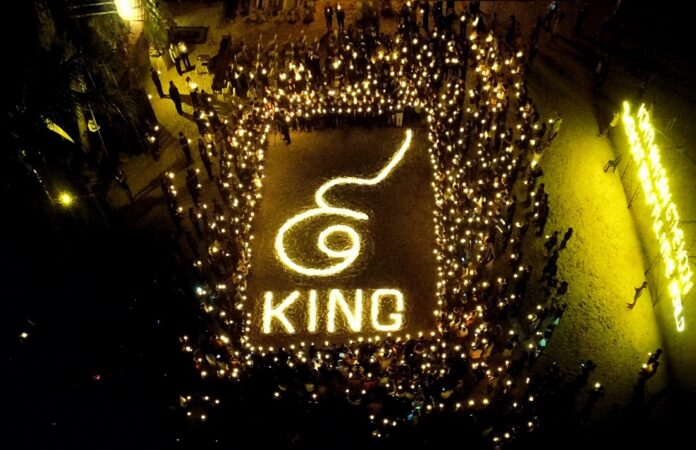
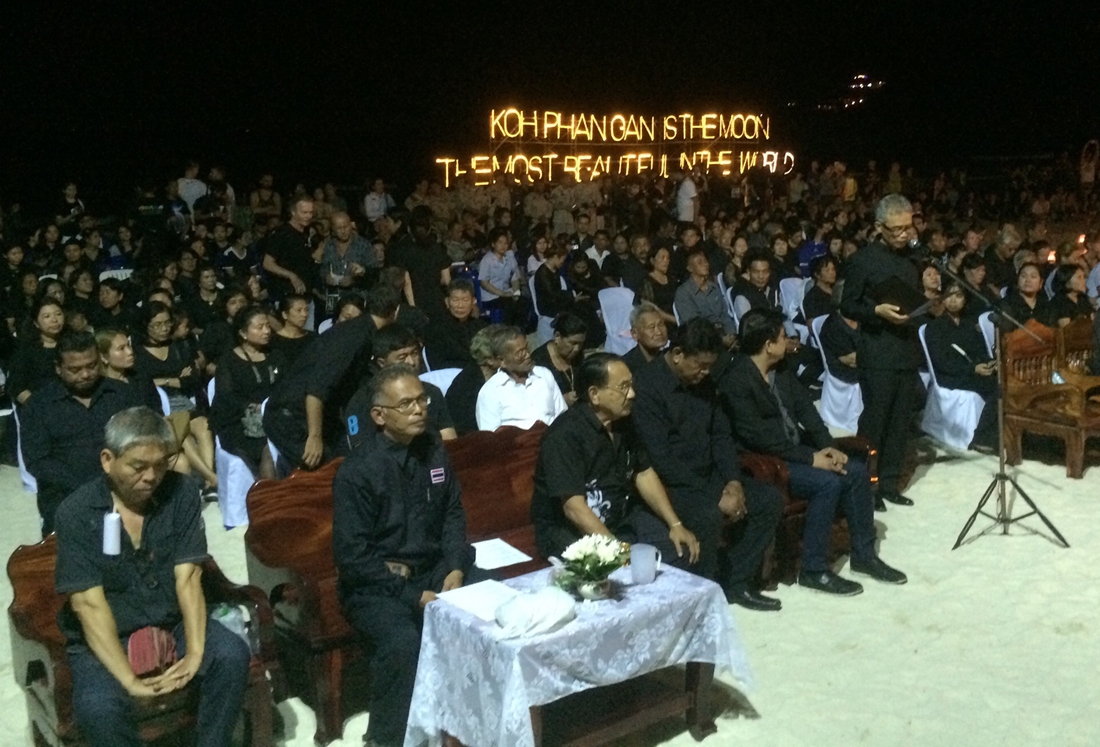
A ceremony attended by local officials was held in respect of His Late Majesty King Bhumibol on Tuesday night on Koh Phangan before the monthly Full Moon Party.

SURAT THANI —  One of the world’s most famous beach parties returned to Koh Phangan on Tuesday night.

For the first time in recent memory, Haad Rin’s monthly Full Moon Party was canceled in October following the death of His Majesty the Late King, which prompted the government to declare a year of national mourning and month-long ban on public entertainment.

The ban was lifted Monday, and the party known for hedonistic binge-drinking and drug use was given a greenlight for Tuesday, one day after the full moon and Loy Krathong festival. Along with the event’s return came an homage to King Bhumibol, who was widely revered in Thailand as the “father of the nation.”

Before the party kicked off, hundreds of officials led by Surat Thani Gov. Uaichai Innak gathered to pray for His Majesty the Late King on the beach where the party unfolds each month. Five foreigners read eulogies in memory of the monarch, who’s also known as King Rama IX.

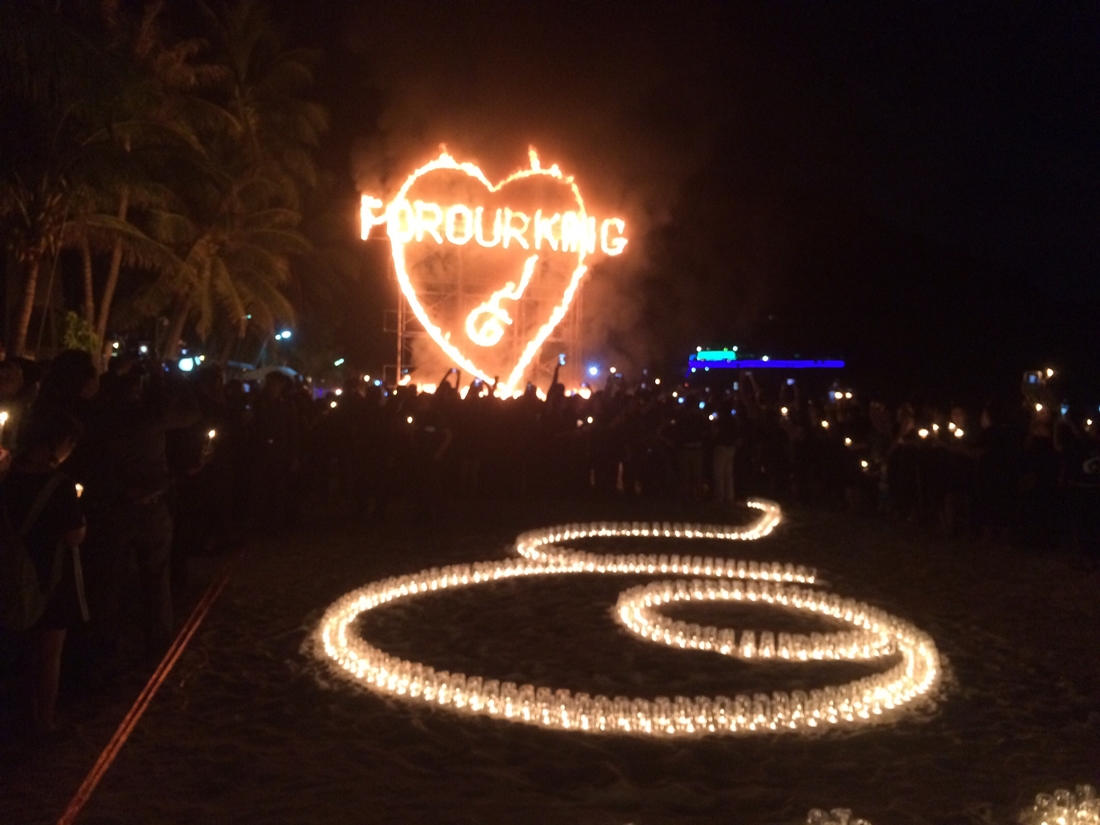
Meanwhile candles were laid in the shape of the No. 9 in Thai, a reference to King Rama IX.

The party’s iconic burning sign heralding “Full Moon Party Haad Rin Koh Phangan” was also changed to read “For Our King” inside a heart shape.  

The ceremony ended with singing of the Royal Anthem, and revelers were then allowed onto the beach for the party. Officials estimated the crowd to be about 30,000.

fullmoonparty-3 fullmoonparty-5 fullmoonparty-2 fullmoonparty-1

Advertisement

Court Dismisses Defamation Suit Against Thai PBS, Reporter

Top: An episode of Thai PBS program ‘Citizen Reporters’ which aired Sept. 1, 2015, drew a defamation complaint against its broadcaster and reporter for story about a mine-poisoned community.

BANGKOK — A court Wednesday dismissed a defamation claim against the Thai Public Broadcasting Service and four media professionals for broadcasting the report on the environmental impact of a gold mine.

Refuting Tungkum Ltd.’s argument that its mine had no impact on the environment, the Criminal Court was convinced by governmental findings submitted by Thai PBS that found the Huay River in Loei province was badly polluted and dismissed the case.

“We presented information showing that authorities from the Ministry of Public Health did forbid use of the river,” Sor Rattanamanee Polkla, one of the defense lawyers, said Wednesday.

Read: Court to Weigh Gold Mine’s Defamation Case Against Thai PBS

Tungkum’s original complaint said the news segment produced by 15-year-old community member and citizen journalist Wanpen Khunna and her friends in Loei province damaged its reputation. The report, aired by Thai PBS, included a reference to the mine as cause for the environmental damage which left the river’s water undrinkable.

The company, which has brought more than a dozen suits against community members opposed to its operations in Loei, demanded 50 million baht in damages from Thai PBS and its staff for criminal defamation and online defamation.

Wirada Saelim, the host of the “Citizen Reporters” program, said although the segment only provided the community’s side of the story, its purpose was to give a platform for a disenfranchised community to present their perspective.

The court today said the media organization executed its duties in good faith. In its ruling, the court said Wirada only repeated what was reported by the teen citizen journalist.

The defense team pointed out that though the Pollution Control Department did not blame the pollution solely on the mine, it concluded the Huay River was polluted and must be evaluated every three months. The Tungkum-operated mine is located in the mountains above the river.

Related stories:

Court to Weigh Gold Mine’s Defamation Case Against Thai PBS

Worker Advocate Hall Quits Thailand Over Harassment, Threats

Poisoned Lives: After 13 Years, Klity Community Prevails Over Lead Mine

Junta Orders All Gold Mines Shut Down

Amnesty Calls on Thailand to Reopen Investigation into Activist’s Murder

Masked Thugs Attack Villagers Protesting Gold Mine

Advertisement

New ‘Ghost Rider’ Clips Emerge as Police Zero in on Driver

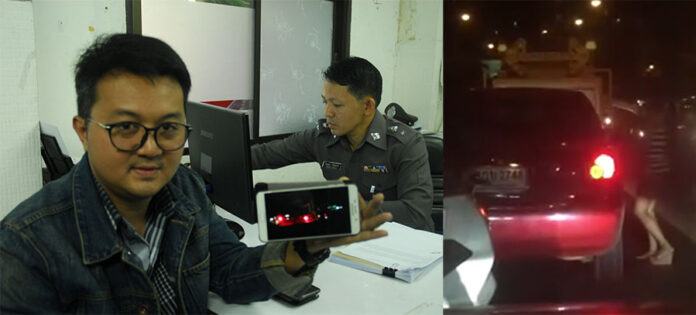
Pawarit Kasakul, 30, offers his testimony at the Hua Mak Police Station Monday. Right, the latest clip of the taxi hood-riding woman whacking the car window.

BANGKOK — A mysterious woman who rode the back of a car into imaginations everywhere has been seen at it again, and police said Wednesday they are close to zeroing in on the identity of her driver accomplice.

Since a clip of the woman sitting casually atop the back of a car speeding along Rama IX Road sent netizens into a tizzy Sunday, police working to crack the case said more eyewitness accounts and clips have surfaced, leading investigators closer to finding the owner of the vehicle.

“There are three clips in all now, and you can find them all on YouTube,” Lt. Col. Nopphorn Srisuchart of Hua Mak police said. “The clips clearly show us the license plate, so we have the name of the owner now and are looking for them.”

Read: Internet Puzzled By Woman’s Open-Air Taxi Ride Video

Nopphorn said the red Toyota Corolla Altis’ license plates were taken from a brown Opel, suggesting someone was using stolen plates.

“The third clip is especially helpful. That’s the one where the woman gets down from the car in her wedge heels and whacks the car window,” he said, referring to the latest clip to surface.

Meanwhile by Wednesday some online had turned from suspecting she was a ghost to believing it was a guerilla marketing stunt.

On Monday, the man who filmed Sunday’s clip now watched more than 2.5 million times, went to Hua Mak police to give his account. Pawarit Kasakul, a 30-year-old MCOT photographer, had just returned from a trip to Indonesia and was riding shotgun along Rama IX Road from the airport when they spotted the woman.

According to Nopphorn, the driver could be charged with reckless driving, a crime punishable with up to three years in jail and / or a 10,000 baht fine. The woman could be charged with clinging to a moving vehicle, a minor infraction incurring no more than a fine of 500 baht.

Two other clips appeared online Tuesday. One posted by meme clearinghouse Drama-addict shows a woman riding on the back of the car while it is light out. It was also filmed on Sunday.

A second video posted Tuesday simply consists of the woman smacking the vehicle for about 20 seconds.

People have expressed suspicions the whole thing was a marketing stunt for a car brand.

“What brand or company made this viral video? Just come out and admit it,” wrote user Talardnut in the most-liked comment to the Drama-addict video. “No more bullshitting or prostrating and making trouble for others. You didn’t kill anyone, so just come out and apologize so this whole thing can be over.”

Advertisement

Elderly Writer Arrested for Lese Majeste a Year After Alleged Offense

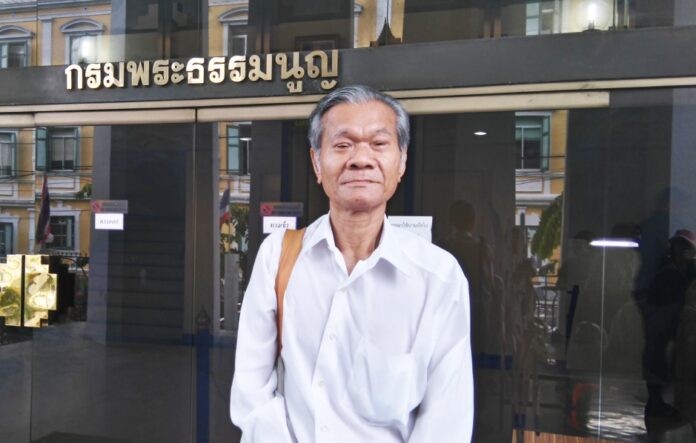
Juaseng Kow, aka Small Bundit Aneeya, poses in front of the military court in May. Image: Thai Lawyers for Human Rights

BANGKOK — A 75-year-old writer was arrested and charged with royal defamation for a speech he gave at a public forum a year ago, his lawyer said Wednesday.

Police detained Juaseng Kow, aka Small Bundit Aneeya, on Tuesday and charged him with lese majeste, which carries a maximum penalty of 15 years in jail. As of Wednesday morning, Juaseng, who’s been prosecuted numerous times on the royal libel charge, was awaiting to find out if the military tribunal would grant him bail.

Read: Writer Gets Suspended Sentence For Lese Majeste

The remark that brought the latest charge against Juaseng took place during a panel discussion on the new constitution at Thammasat University on Sept. 12, 2015, according to his attorney, Pavinee Chumsri. Pavinee, a member of Thai Lawyers for Human Rights, said a police committee on lese majeste cases only recently greenlit the legal action.

“Police explained that they sent a transcript of the video to a police committee,” Pavinee said by telephone. “They deliberated on it and ordered prosecution.”

Juaseng, who’s better known by his pen name Small Bundit, will be tried in a military court. Although the junta recently announced it would end military prosecutions of civilians, insulting the royal family is deemed a matter of national security and tribunals will continue hearing such cases.

Police took Juaseng into custody shortly after he addressed the crowd at last year’s forum on issues about human rights and the monarchy, but they did not file any charge against him at the time.

He was allowed to walk free after police lectured him not to do such a thing again, Prachatai reported.

An author by trade, Juaseng has been prosecuted for lese majeste repeatedly. The Supreme Court in 2014 found him guilty of the crime, dismissing his argument that he was mentally ill at the time of the offense. He was given a suspended jail term.

Juaseng also has another royal defamation case pending in the military court, as a result of remarks he made at a public panel discussion in November 2015.

Advertisement

Indonesia Police Name Jakarta Governor as Blasphemy Suspect

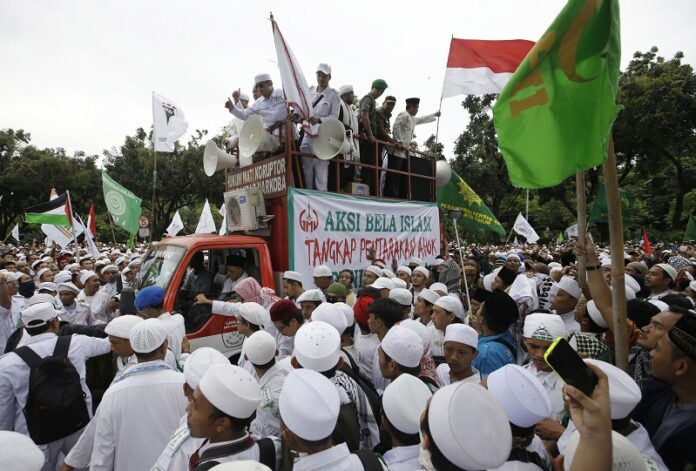
Muslim protesters gather in October with a banner calling for the arrest of Jakarta's ethic Chinese and Christian Governor Basuki Tjahaja Purnama, popularly known as "Ahok," outside the City Hall. Photo: Achmad Ibrahim / Associated Press

JAKARTA — Indonesian police on Wednesday named the minority Christian governor of the country’s capital as a suspect in a blasphemy investigation in a major test of the Muslim-majority nation’s reputation for religious toleration.

Earlier this month the capital Jakarta was rocked by a massive protest by conservative Muslims against the governor. One person died and dozens were injured in rioting.

Police announced at a press conference that the popular governor, Basuki “Ahok” Tjahaja Purnama, cannot leave the country while the investigation is underway.

The accusation of blasphemy against Ahok, an ethnic Chinese and Christian who is an ally of President Joko “Jokowi” Widodo, has galvanized Jokowi’s political opponents in the Muslim-majority nation of 250 million.

The Islamic Defenders Front, a vigilante group that wants to impose Shariah law, is demanding Ahok’s arrest after a video circulated online in which he joked to an audience about a passage in the Quran that could be interpreted as prohibiting Muslims from accepting non-Muslims as leaders. The governor has apologized for the comment.

Ahok, who is seeking a second term as Jakarta governor, is popular with the city’s middle class, but has made enemies from a tough stance against corruption and an urban renewal program that has evicted thousands of the city’s poorest from slums.

Advertisement

Prince William Arrives in Vietnam for Wildlife Meeting

Prince William waves with he Duchess of Cambridge in England in 2011. Photo: tsaiproject / Flickr

HANOI — Britain’s Prince William has arrived on his first visit to Vietnam where he will take part in an international conference on illegal wildlife trade in the fight to protect elephants, rhinos and other endangered species from extinction.

The Duke of Cambridge, who is president of United for Wildlife, will meet Vietnamese Prime Minister Nguyen Xuan Phuc and Vice President Dang Thi Ngoc Thinh on Wednesday before attending the two-day conference starting Thursday in Hanoi.

“He knows the people of Vietnam will share his concern that we have less than 25 years to save some of our most iconic species from extinction. He believes Vietnam has a real opportunity to be leaders in wildlife conservation,” the Prince’s office said in a statement Tuesday.

On Saturday, Vietnamese authorities destroyed 2,253 kilograms (4,956 pounds) of seized elephant ivory and rhino horns, sending a message that the government wants illegal wildlife trafficking stopped.

Vietnam is one of the world’s major transit points and consumers of trafficked ivory and rhino horns.

The Hanoi conference on illegal wildlife trade will bring together leaders and senior officials from more than 40 countries as well as experts from international wildlife conservation groups.

The conference is the third of its kind after the one held in London in 2014 and another in Botswana last year.

Advertisement

Bangkok Bombing Trial: Defendants Protest Chinese Interpreters

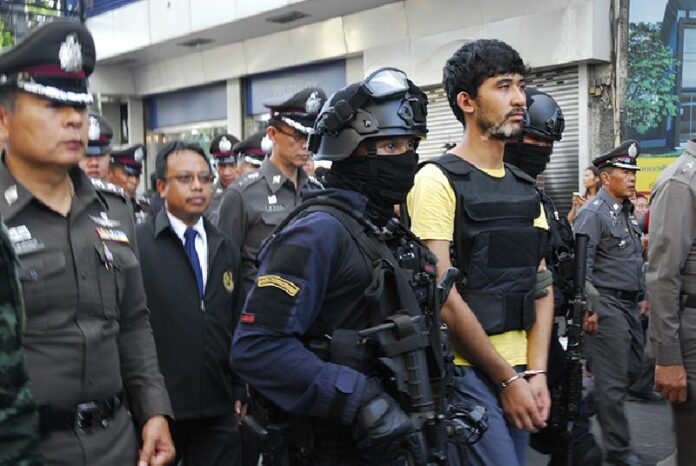
Bombing suspect Yusufu Mieraili is led through a police 're-enactment' on Sept. 9, 2015, in Bangkok.

BANGKOK — As the trial began Tuesday against two Uighur men accused of bombing a Bangkok shrine in the worst single terror attack in modern Thai history, the court-approved interpreter did not know the word “shrine.”

Abdulwali Aiyai stumbled on that and other words as he attempted to translate testimony inside the military courtroom where Yusufu Mieraili and Adem Karadag stand accused of bombing the Erawan Shrine, one of the capital’s most-trafficked religious sites, and killing 20 people.

One of his colleagues, who translated Thai to English, had to whisper explanations of what a shrine is.

Read: Cop Recounts Hunt For Bangkok Bombers as Long-Delayed Trial Opens

“It’s like a statue!” a defense lawyer chimed in helpfully.

Over the course of the two-hour session at the military tribunal, it emerged that Aiyai was also not familiar with words such as “wig,” “grey,” “arrest warrants,” or “police jurisdiction,” but his translation skills aren’t what concern the defense team.

It is his background as a reporter for Chinese state media that worries the lawyers that their clients, two members of an ethnic group persecuted by the Chinese authorities, would not receive a fair and impartial translation. Aiyai and another Uighur interpreter were employed for the trial by the Chinese embassy, whose prior objections led the court to reject other interpreters.

“Perhaps it’s his first day on the job, and he will be smoother next time,” defense attorney Schoochart Kanpai said after the court recessed.

Schoochart earlier filed a formal protest seeking the interpreter be removed on grounds of a conflict of interest.

Finding an interpreter for the case all sides agree to be qualified and impartial has been a point of prolonged contention. It’s been more than a year since the two Uighur men were arrested for the bombing, but their trial was repeatedly delayed because of hurdles providing translation.

A previous interpreter was disqualified after police arrested him on drug charges. Another interpreter, an Uzbek national in custody for immigration violations, was rejected after defendants learned she couldn’t actually speak Uighur. An interpreter requested by the defense team was turned down by the court because he belonged to a Germany-based advocacy group China said it deemed a terror organization.

Today the military judges settled with two interpreters sent by the Chinese embassy in Bangkok: Aiyai and his colleague, Truzun Niyasbilag. Shoochart, the defense attorney, said he only learned about it Tuesday morning before the trial got underway.

He immediately protested the decision, both verbally and in writing, arguing that two reporters from an Uighur-language news station in Beijing may have a conflict of interest with his clients.

“The defendants ask the court to arrange a new interpreter because China is unfair in its governance [of the Uighurs],” part of the formal protest read.

The Uighurs are a Muslim-majority ethnic group in the far-flung western province of Xinjiang, where conflict has simmered with the arrivals of ethnic Han Chinese to settle the area. Weeks before the shrine bombing, Thailand forcibly deported more than 100 Uighurs under pressure from Beijing, who then paraded them in hoods as “terrorists.”

Many analysts ascribe the attack as revenge; Thai authorities insist it was perpetrated by a criminal trafficking syndicate displeased with its crackdown on their operations.

On Tuesday the military judges rejected the defense motion on the grounds the two interpreters were of the same nationality as the defendants and could communicate well with them in Uighur. Furthermore, the judges said the pair had yet to show any “dishonest intentions” in their work.

So the first session in the trial of Erawan Shrine bombing commenced.

The first witness to take the stand was a former police investigator named Somkiat Ploytubtim. His testimony was first translated by a Thai interpreter into English which Aiyai then translated to Uighur. His colleague Niyasbilag watched silently.

Defendent Yusufu, who has a passable understanding of English, sometimes objected when he believed the translation did not match.

Once, Aiyai mistranslated “armband” as “long shirt sleeve,” and another time said one mobile phone was found inside Karadag’s residence whereas Somkiat said three.

“You translate wrong,” Yusufu said to Aiyai in English. “Some words you said different. I’m worried you will translate wrong.”

One of the three judges dismissed the complaint, saying that court documents only recorded the Thai testimony by Somkiat and not the erroneous translation.

The defense team expects the trial to conclude by early 2018.

Advertisement

Gen. Prayuth Plays Down Trump Comparisons
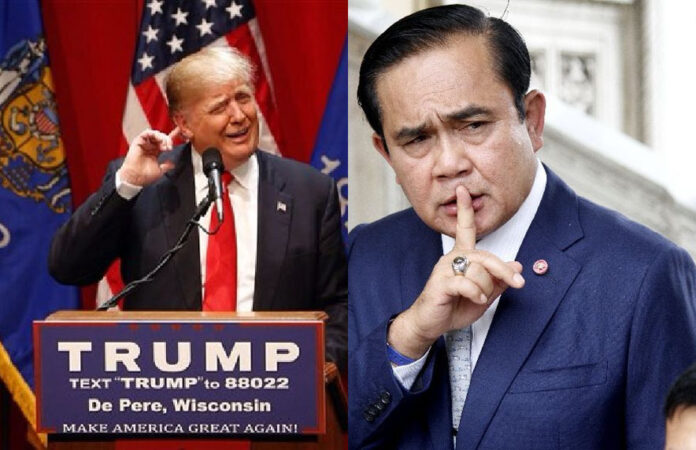
At left, then-candidate Donald Trump at a March 2016 campaign event. At right, Gen. Prayuth Chan-ocha last December.

BANGKOK — Gen. Prayuth Chan-ocha played down comparisons between him and Donald Trump on Tuesday, saying that while he may not be a politician like the U.S. president-elect, he is a straight shooter.

Asked about comparisons made between the two since the Republican’s election last week, the junta leader responded by launching into a lengthy discourse about himself and his style Tuesday at Government House.

“I don’t know if that’s good or bad, but I’m not a politician. But when I talk, I say what I believe according to my principles and the facts according to the law. Sometimes, the things I say are too true and impolite, but that’s my business.”

Prayuth, however, said that when he talks, he is sincere about his principles and true to his personality.

“However, my intentions are clear. After I say something, I don’t fester in anger at someone, because I let it go. It’s done, over. I go do something else. I might be angry again the next day because it’s who I am!

“Don’t take my bad qualities and use them as examples. I have a considerable amount of other, good qualities,” he concluded.

Advertisement

Hot News

LATEST NEWS

Bangkok
overcast clouds
30.5 ° C
30.5 °
30.5 °
78 %
6.6kmh
87 %
Thu
31 °
Fri
37 °
Sat
36 °
Sun
37 °
Mon
37 °