34.4 C
Bangkok
Monday, June 8, 2026
Home Blog Page 2556

Wonderfruit Not to Fall Until February

The 2015 Wonderfruit Festival. Photo: Wonderfruit / Facebook.

PATTAYA — This year’s Wonderfruit Festival has been rescheduled to next year in light of the death of His Majesty the Late King.

To observe a 100-day mourning period, Wonderfruit organizers announced Friday the four-day festival was postponed to February.

“Taking into account the sentiment of the country and the guidelines set by the government of Thailand, we will observe a 100-day grieving period, so we are able to pay our proper respects, in unity with the Thai people,” it reads.

The lineup for Wonderfruit’s third edition remains unchanged for now, while further updates will be posted on its website.

Tickets previously booked are still valid. Wonderfruiters unable to participate on the new dates can seek refunds via Eventpop Nov. 1-30.

Wonderfruit will run Feb. 16-19 at The Fields at the Siam Country Club in Pattaya, Chonburi province. Shuttle buses from city center to and from the venue will be available.

Pattaya can be reached by car or public transportation. Buses leave regularly throughout the day from Ekkamai’s Eastern Bus Terminal, the Northern Bus Terminal in Mo Chit or the Southern Bus Terminal.


Related Story:

Wonderfruit Lineup Adds Lianne La Havas, Others

Advertisement

Police Hunting for 230 Escaped Drug Addicts in Vietnam

A 2011 anti-drug protest in Binh Duong, Vietnam. Photo: garycycles7 / Flickr

HANOI, Vietnam — Vietnamese authorities were searching Monday for 230 drug addicts are still at large after a mass escape from a rehabilitation center in southern Vietnam.

Ho Van Loc, deputy director of labor department in Dong Nai province, said the breakout on Sunday night was started by two inmates and eventually 562 inmates, including 58 women, escaped.

Security guards who were overpowered by the inmates opened the main gate of the compound to let them out, Loc said.

Police have recaptured 332 of the inmate and were searching for the others, he said.

The center holds 1,481 inmates.

Officials have said that rehabilitation programs in Vietnam — which combine education, communist ideology and physical labor for one to two years — have a high failure rate, with more than 90 percent of the addicts relapsing within five years.

There are an estimated 200,000 drug addicts in Vietnam, many of them heroin users.

Advertisement

Hostages Held by Somali Pirates Rescued After 4 Years

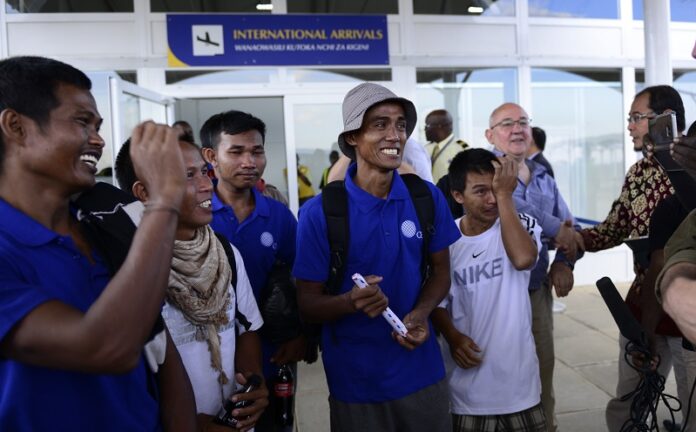
Sailors who had been held hostage by pirates for more than four years, and were released in October in Somalia, smile as they arrive at the airport in Nairobi, Kenya. Photo: Associated Press

NAIROBI, Kenya — Following more than four years in captivity, 26 Asian sailors held hostage by Somali pirates have been rescued from their captors, China’s Foreign Ministry confirmed Monday.

The sailors arrived in Nairobi, Kenya, on Sunday, and international mediators said the action the marks a turning point in the long-fought battle against Somali piracy.

The crew from Vietnam, Taiwan, Cambodia, Indonesia, China and the Philippines had been among the few hostages still in the hands of Somali pirates.

The sailors were the crew of the FV Naham 3, a Taiwan-owned fishing vessel seized in March 2012, said pirate representative Bile Hussein. The ship later sank.

Hussein said $1.5 million in ransom was paid for the sailors’ release. That claim could not be independently verified.

Chinese Foreign Ministry spokeswoman Hua Chunying said in a statement Sunday night that 10 of the hostages were from the Chinese mainland and two were from self-governing Taiwan.

She said the 26 crew members were rescued Saturday “through various efforts.” The Chinese government was grateful to “all the organizations and people who participated in the rescue,” she said.

The 26 sailors will be repatriated to their home countries, John Steed, coordinator of the Hostage Support Partners for the U.S.-based organization Oceans Beyond Piracy, said in a statement.

“They are reported to be in reasonable condition, considering their ordeal. … They have spent over four and a half years in deplorable conditions away from their families,” Steed said.

He said another member of the crew died in the hijacking and two died of illnesses in captivity.

Piracy off Somalia’s coast was once a serious threat to the global shipping industry. Attacks have dropped off dramatically in recent years amid patrols by the navies of NATO counties, China and India.

No commercial vessel has been successfully attacked since 2012, but the threat of piracy remains, Steed said.

Most hostages held by Somali pirates have been sailors on merchant ships, although European families also have been kidnapped from their yachts while traveling in the dangerous waters.

Advertisement

UK Banker Pleads Not Guilty to Murder in Hong Kong Trial

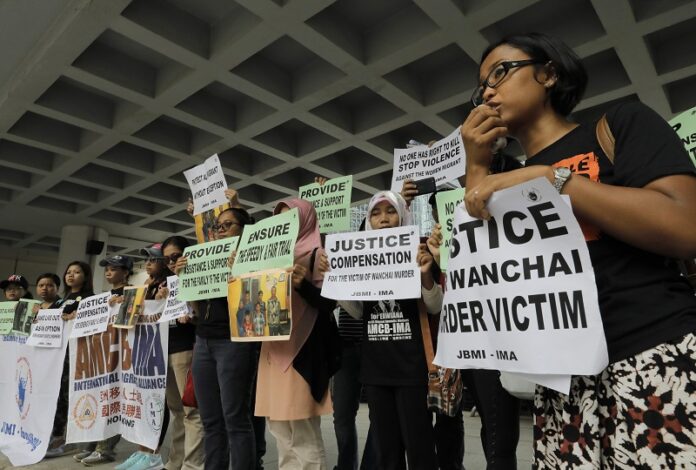
A migrant workers alliance group holds placards to protest the killings of two Indonesian women in 2014 outside the High Court in Hong Kong. Photo: Vincent Yu / Associated Press

HONG KONG — The Hong Kong trial of a British banker accused of the grisly 2014 killings of two Indonesian women is expected to be “particularly horrifying,” including photographic evidence of one victim’s torture, the judge told prospective jurors as the case got underway Monday.

The banker, Rurik Jutting, entered a plea of not guilty to two murder charges that were read out at the High Court, with prosecutors rejecting his attempt to plead guilty to the lesser charge of manslaughter.

Jutting is charged with the murders of Sumarti Ningsih and Seneng Mujiasih, whose bodies were found in his upscale apartment near the Asian financial center’s Wan Chai red-light district, in a case expected to highlight the Asian financial hub’s inequality and privileged lifestyle of its wealthy expat elite.

Jutting, who wore a dark blue shirt, glasses and looked a lot slimmer than in his court appearances last year, was put into a glass-screened dock when he arrived in the court. When the clerk asked what his plea was to the two murder charge, he replied “not guilty to murder by reason of diminished responsibility but guilty of manslaughter,” which the prosecutors refused to accept, meaning the trial on the murder charges will proceed.

A third charge was also read out, unlawful burial of Sumarti Ningsih’s body, to which he pleaded guilty. Her body was found stuffed in a suitcase left in a balcony while Seneng Mujiasih’s body had knife wounds on the neck and buttock, according to initial police reports.

Judge Michael Stuart-Moore said to jurors before the selection began that there were “particularly horrifying aspect to this case, with one victim subject to extreme violence and cruelty amounting to torture,” before she died.

He said the evidence includes color photographs that “are not pleasant photographs to look at. They are extremely upsetting.”

He added that “the defendant even recorded on his iPhone part of the torture he inflicted on his first victim,” which will be shown to the jury.

“Much of what the jury will see or hear is very disturbing indeed,” he said, but added that the Jutting is entitled to a fair trial.

While Jutting’s initial guilty manslaughter plea was rejected, the judge told jurors that they could still decide between finding him guilty of murder or manslaughter.

Jutting is a Cambridge University graduate who worked for Bank of America-Merrill Lynch in structured equity finance and trading. If convicted, he faces life in prison.

The case shocked the former British colony, which has a reputation for being safe, while also highlighting the city’s extreme inequality.

The victims had originally come to Hong Kong as foreign maids. But Seneng had let her domestic worker visa lapse and Sumarti had returned on a tourist visa.

They were among the more than 300,000 migrant domestic workers employed in Hong Kong, almost all of them women from Indonesia or the Philippines.

Story: Kelvin Chan

Advertisement

Mourners Warned of Fake Golden Banknotes

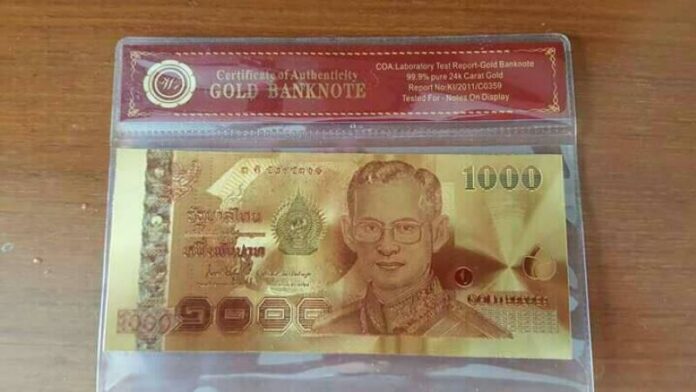
Image: Online News Hawks / Facebook

BANGKOK — A junta spokesman Sunday warned the public not to fall victim to forged banknotes being sold around the Grand Palace, where the late King Bhumibol is lying in state.

Many mourners in recent days were approached by vendors peddling what appeared to be commemorative, gilded banknotes but were in fact forgeries, junta spokesman Winthai Suvaree said.

“People who are selling these, please do not be opportunistic by seeking profit from the public at such an inappropriate time,” Col. Winthai told reporters at one of the security posts near the palace. “This is a destruction of the good atmosphere and image of Thai people.”

Anyone caught selling thee forged notes would be prosecuted, Winthai added.

A Facebook page called “Online News Hawks” on Friday posted an image of one of the counterfeit banknotes, which appeared to be paper or plastic colored gold. The admin also wrote that the notes were from China without citing any evidence.

“Please don’t be fooled into buying them. They are exploiting Thai people,” the admin wrote.

Commemorative banknotes, coins and stamps associated with King Bhumibol have become popular merchandise after the late monarch died on Oct. 13 at 88, after an unprecedented rule of 70 years. His body is undergoing a year of funerary rites at the Grand Palace, where tens of thousands of mourners have visited in the past week to sign their condolences.

Advertisement

See Burmese Boy Become Thai Folk Performer in German Doc

Photo: Marco Wilms / Facebook

BANGKOK — Watch friendship bloom between a Burmese refugee boy and popular Thai folk performer in a documentary by a German filmmaker next week.

In Marco Wilms’ “Likay Star,” 9-year-old Manop’s dream of becoming a famous likay actor takes a turn when accomplished likay star Chaiya Mitchai invites the boy to perform on stage in Pattaya.

It’s the first time the film is showing in Thailand.

Admission is free. Seats can be reserved online. The 74-minute documentary will show in Thai and German with English subtitles starting at 7pm on Oct. 30 at the Goethe-Institut. Director Wilms and the film’s performers will talk after their film finishes.

Advertisement

Going Off Message Again, Trump Vows to Sue all Female Accusers

Republican presidential candidate Donald Trump delivers a speech Saturday in Gettysburg, Pennsylvania. Photo: Evan Vucci / Associated Press

GETTYSBURG, Pennsylvania — Steering his campaign toward controversy yet again, Donald Trump vowed Saturday to sue every woman who has accused him of sexual assault or other inappropriate behavior. He called them “liars” whose allegations he blamed Democrats for orchestrating.

Trump’s blunt threat of legal action eclipsed his planned focus on serious-minded policy during a speech in Gettysburg. Though his campaign had billed the speech as a chance for Trump to lay out a to-do list for his first 100 days as president, he seemed unable to restrain himself from re-litigating grievances with Hillary Clinton, the media and especially the women who have come forward in recent days.

“All of these liars will be sued once the election is over,” Trump said. He added later: “I look so forward to doing that.”

Nearly a dozen women have publicly accused Trump of unwanted advances or sexual assault in the weeks since a 2005 recording emerged in which the former reality TV star boasted of kissing women and groping their genitals without their consent. The latest came on Saturday, when an adult film actress said the billionaire kissed her and two other women on the lips “without asking for permission” when they met him after a golf tournament in 2006.

Trump has denied all the allegations, while insisting some of the women weren’t attractive enough for him to want to pursue.

“Every woman lied when they came forward to hurt my campaign,” he said. Without offering evidence, he surmised that Clinton or the Democratic National Committee had put the women up to it.

Speaking to reporters aboard her campaign plane, Clinton said: “I saw where our opponent Donald Trump went to Gettysburg, one of the most extraordinary places in American history, and basically said if he’s president he’ll spend his time suing women who have made charges against him based on his behavior.” She also said the suggestion that Democrats or her campaign were encouraging women to level accusations against Trump “inaccurate.”

Clinton told reporters that, after three debates, she wasn’t thinking about responding to what Trump says anymore and would “let the American people decide what he offers and what we offer.”

Trump’s broadside against the women came at the start of an otherwise substantive speech that sought to weave the many policy ideas he has put forward into a single, cohesive agenda that he said he would pursue aggressively during his first three months in office.

The Republican nominee vowed to lift restrictions on domestic energy production, label China as a currency manipulator and renegotiate the North American Free Trade Agreement, familiar themes to supporters who have flocked to his rallies this year.

“This is my pledge to you, and if we follow these steps, we will once again have a government of, by and for the people,”Trump said, invoking a phrase from President Abraham Lincoln’s Gettysburg Address.

Though mostly a recap of policies he’s proposed before, Trump’s speech included a few new elements, such as a freeze on hiring new federal workers and a two-year mandatory minimum sentence for immigrants who re-enter the U.S. illegally after being deported a first time. In a pledge sure to raise eyebrows on Wall Street, he said he’d block a potential merger between AT&T and media conglomerate Time Warner.

Translating his proposals into digestible bullet points, he offered to-the-point titles for the legislative vehicles he’d need Congress to approve to accomplish his goals, such as the “End Illegal Immigration Act” and the “Repeal and Replace Obamacare Act.”

Throughout the GOP primary, Trump was criticized for shying away from detailed policy proposals. But his speech, which aides said would form the core of his closing argument to voters, underscored how the billionaire has gradually compiled a broad — if sometimes vague — policy portfolio that straddles conservative, isolationist and populist orthodoxies.

Yet any headway that Trump may have made was likely to be diluted by his legal threats against his accusers, just the latest example of Trump stepping on his intended message at inopportune moments. Days earlier, during the final debate, his otherwise well-received performance was marred by an alarming statement near the end that he might not accept the outcome of the election if he loses.

Trump didn’t say what kind of lawsuits he planned to file against the women, but any libel litigation could be complicated by the fact that Trump, in the 2005 recording, bragged about the same kind of conduct the women now accuse him of perpetrating. Trump recently vowed to sue The New York Times for libel, but has not yet followed through on the threat.

With the debates now over, Trump and Clinton have few apparent opportunities to alter the course the race substantially — a reality that benefits Clinton more than Trump. The Republican is trailing his opponent in most of the battleground states while Clinton eyes potential upset victories in traditionally safe GOP territory, with Arizona at the top of the list.

An increasingly confident Clinton on Saturday made what’s become her closing pitch in Pittsburgh, stressing unity and asking her backers to carry her message to any Trump supporters they meet.

“I understand that they need a president who cares about them, will listen to them and I want to be their president,” she said.

As Election Day nears, Clinton is also focusing on getting Democrats elected to Congress. She attacked the state’s Republican senator, Pat Toomey, saying he has refused to “stand up” to Trump as she touted his Democratic challenger, Katie McGinty.

Her campaign headquarters in New York was back up and running after a scare over an envelope that arrived containing a white powdery substance. Initial tests showed the substance wasn’t harmful.

Meanwhile, Clinton was getting a campaign boost from singer and pop icon Katy Perry, who was pushing early voting in Las Vegas. The singer surprised students at the University of Nevada Las Vegas when she knocked on the doors of their dorm rooms wearing a T-shirt that read “Nasty Woman,” a phrase Trump uttered at Wednesday’s debate in reference to Clinton. She headlined a short outdoor rally on campus but didn’t perform any of her songs.

Story: Josh Lederman, Jill Colvin

Advertisement

AT&T Buying HBO and CNN Owner Time Warner for USD$85.4 Billion

Pedestrians walk by an entrance to the Time Warner Center in New York on May 26, 2015. Photo: Mary Altaffer / Associated Press

NEW YORK — AT&T is buying Time Warner, the owner of the Warner Bros. movie studio as well as HBO and CNN, for USD$85.4 billion (3 trillion baht) in a deal that could shake up the media landscape.

The acquisition would combine a telecom giant that owns a leading cellphone business, DirecTV and internet service with the company behind some of the world’s most popular entertainment, including “Game of Thrones,” the “Harry Potter” franchise and professional basketball. It’s the latest big media acquisition by a major cable or phone company — deals like Comcast’s 2011 purchase of NBC Universal, all aimed at shoring up businesses upended by the internet.

Regulators would have to sign off on the acquisition, no certain thing. The prospect of another media giant on the horizon has already drawn fire on the campaign trail. Speaking in Gettysburg, Pennsylvania, GOP presidential nominee Donald Trump vowed to kill it if elected because it concentrates too much “power in the hands of too few.”

Sen. Al Franken, a Minnesota Democrat, said the deal “raises some immediate flags about consolidation in the media market” and said he would press for more information on how the deal will affect consumers.

Media Merger Mania

Companies that provide phone and internet connections are investing in media to find new revenue sources and ensure they don’t get relegated to being just “dumb pipes.” In addition to Comcast-NBC Universal, Verizon bought AOL last year and has now proposed a deal for Yahoo to build a digital-ad business.

After its attempt to buy wireless competitor T-Mobile was scrapped in 2011 following opposition from regulators, the company doubled down on television by purchasing satellite-TV company DirecTV for $48.5 billion. AT&T is expected to offer a streaming TV package, DirecTV Now, by the end of the year, aimed at people who have dropped their cable subscriptions or never had one.

The venerable phone company has to contend with slowing growth in wireless services, given that most Americans already have smartphones. And it faces new competitors for that business from cable companies. Comcast plans to launch a cellphone service for its customers next year.

AT&T CEO Randall Stephenson, who will run the combined company, said the deal will allow AT&T to offer unique services, particularly on mobile, though he didn’t provide details. Jeff Bewkes, the Time Warner CEO who will stay with the company for an undefined transition period, added that more money will help fund production of additional programming and films.

Both men stressed that it will be easier to “innovate” when the companies are joined and don’t have to negotiate usage rights at arm’s length. (AT&T, of course, will still have to strike such deals with other entertainment conglomerates.) The combined company is also likely to lean more heavily on advertisements targeted at individuals based on their interests and personal details.

Buying Time Warner may be “a good defensive move” against Comcast as the cable giant continues stretching into new businesses, New Street Research analyst Jonathan Chaplin said in a Friday note. Comcast also bought movie studio DreamWorks Animation in August.

Potential Downsides

Even if the AT&T deal overcomes opposition in Washington, it’s possible that regulators might saddle the combined company with so many conditions that the deal no longer makes sense.

“It’s not hard to imagine what you can do on paper. They would keep HBO exclusive for only DirecTV subscribers, or only make TNT or TBS available over AT&T Wireless,” said analyst Craig Moffett of research firm MoffettNathanson, referring to Time Warner networks. “But as a practical matter, those kinds of strategies are expressly prohibited by the FCC and antitrust law.”

Then there is the $85 billion that AT&T is handing over to Time Warner, almost 40 percent more than investors thought the company was worth a week ago.

“Count me as a skeptic that there is real value to be created,” Moffett said.

Amy Yong, an analyst at Macquarie Capital, recalled many celebrated media deals of the past have turned into duds — in particular, Time Warner’s disastrous acquisition by AOL in 2001. “If you look at history, it’s still an unproven” that big deals make sense, she said. AT&T, she noted, was paying “a huge price.”

Still, Yong said that AT&T and other phone companies feel they have to act because the threats to their business seem to be coming from every direction. “At the end of the day, these companies are trying to compete with Google and Facebook and Amazon, not just traditional competitors,” she said. “You see Google pivoting into wireless.”

John Bergmayer of the public-interest group Public Knowledge, which often criticizes media consolidation, warned of harm to consumers from the AT&T deal. He said, for example, AT&T might let wireless customers watch TV and movies from Time Warner without counting it against their data caps, which would make video from other providers less attractive.

Market Moves

Shares of AT&T, as is typical of acquirers in large deals, fell on reports of a deal in the works on Friday, ending the day down 3 percent. But the prospect of more media acquisitions sent several stocks soaring Friday. Netflix and Discovery Communications each jumped more than 3 percent.

Time Warner rose nearly 8 percent on Friday, and is now up 38 percent since the start of the year.

The company has moved aggressively to counter the threat that sliding cable subscriptions poses to its business. Among other things, it launched a streaming version of HBO for cord-cutters and, alongside an investment in internet TV provider Hulu, added its networks to Hulu’s live-TV service that’s expected next year.

The deal would make Time Warner the target of the two largest media-company acquisitions on record, according to Dealogic. The highest was AOL’s $94 billion acquisition of Time Warner at the end of the dot-com boom.

In that last deal, AOL paid entirely in its own stock, which then proceeded to crater. This time, Time Warner is playing it safer. It’s getting half of the deal in AT&T stock and half in cash.

Story: Tali Arbel, Bernard Condon

Advertisement

Sea of Voices Rise in Tribute for Late King

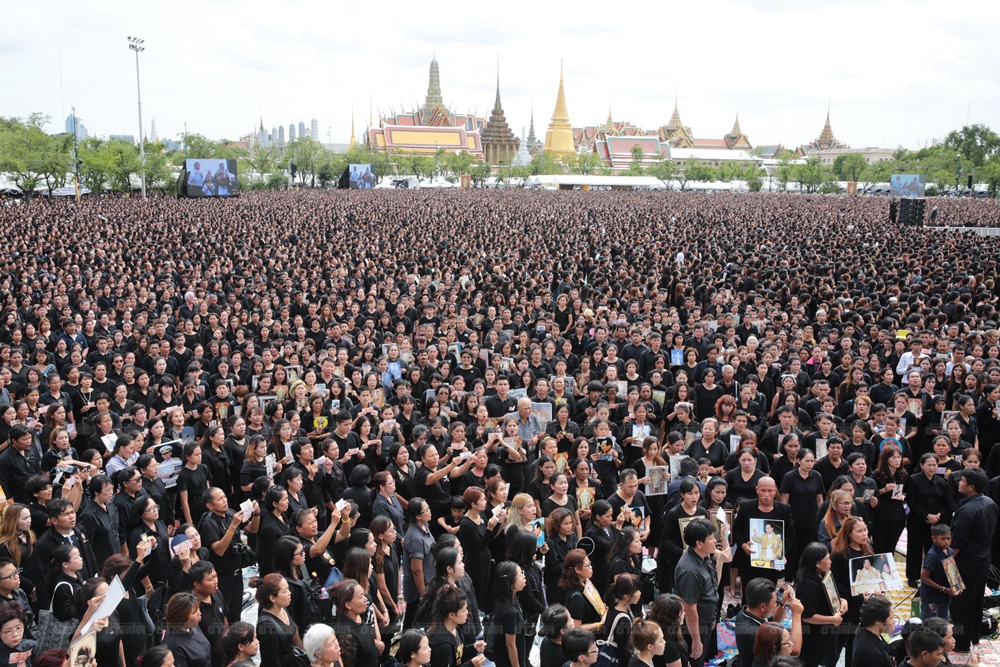
BANGKOK —  In the largest public gathering in recent history, a crowd estimated in the hundreds of thousands flooded the field in front of the Grand Palace today to sing the royal anthem in honor of the late King Bhumibol.

“We, servants of His Majesty the King, prostrate our hearts and heads, to pay respect to the ruler, whose merits are boundless,” the crowds at Sanam Luang sang the verse they knew so well as they faced toward the Grand Palace, where the late monarch is lying in state for a year of funerary rites.

The mass singing was organized by the Siam Philharmonic company and filmed for future uses in cinemas and theatres, where a music video of the anthem is played before performances. The authorities lent massive logistical support to the project, closing down scores of roads and shuttling people from major intersections to Sanam Luang since Saturday morning.

The event drew mourners from all across the country, coming to offer their singing in homage to King Bhumibol who died on Oct. 13 at 88. He ruled the country for 70 years; most people have known no other king.


Saowapha Petchkong, 53, said she left her hometown of Prachinburi with her son before dawn and arrived at the field at around 5am. She said participating in the event helps her deal with her sorrow.

“A relative showed me messages on Line that the king passed away. I was so shocked. I cried, and I’ve been crying since,” Saowapha said. “I cry everytime I read newspapers about his death … so I decided to come here.”

d001


Saowapha said she also has a personal attachment with King Bhumibol because she had a glimpse of the monarch while she once joined a crowd of well-wishers at Siriraj Hospital, where he spent much of the past seven years.

Apinya Uthorn, 38, held up a portrait of the king along with her husband and daughter as she sang the royal anthem at Sanam Luang. The family of three from Chonburi province had been waiting there since 8am.

“I’m here because it’s a once in a lifetime event,” Apinya said.

Not everyone was there just to join in the mass singing. Many were there as volunteers to hand out free food and water, collect garbage and assist mourners who fainted under the intense heat.

“I decided to come here because I saw on the news that there were many people, and they must be lacking staff,” said Watcharin Yimfueng, a 29-year-old graphic designer who lives in Bangkok. He and a friend were giving away candy and water in the morning, and when the foodstuff ran out they switched to collecting trash.

The project was a collaboration between filmmaker Chatrichalerm Yukol and composer Somtow Sucharitkul. The recording ran from 1pm to 5pm and was to repeat at 10pm.

Police said Friday they estimated that at least 200,000 people would gather in Sanam Luang and its vicinity throughout Saturday. No official count was available Saturday, but the crowds spilled out from the vast field onto the roads and avenues around it.

Large crowds are expected around Sanam Luang in coming weeks, especially beginning Friday after the royal household bureau allows mourners to pay respect inside the palace hall where the body of King Bhumibol is kept. Many mourners said they would come back for the opportunity.

201610221513376 20061002145931

anthem

Advertisement

Revering the Late King With Love Not Hate

View toward Wat Phra Kaew inside the grounds of the Grand Palace in Bangkok on Thursday.

Retention
In grief, people can rise above tragedy and become better or fall to the depths of their base emotions.

Thailand has seen both repeated during the nine days since the death of the late King, His Majesty King Bhumibol Adulyadej, at 88.

Anyone visiting the area around the Grand Palace, the epicenter of grief and mourning, could not fail to be touched by the many volunteers and do-gooders. Under a hot sun during the week, high school and university students pooled what little money they had or could raise to buy sweets, black ribbons and even paracetamol to hand out to mourners who refused to be far from the King’s remains.

Just outside my Bangkok office, a motorcycle cab told me he and his colleagues would set up a free ride service for those wanting to commute to and from the Sanam Luang. Although he won’t ask passengers to pay him, the low-earning man said he would welcome it if they did.

Read: Altruism, Youth Dominate at Grand Palace as Nation Mourns

Many of whom I spoke to vowed to become better people, even if just a little, in honor of the late King. Their reverence to the late King was almost god-like. When I visited the area outside the palace Thursday and Friday, the atmosphere was generally calm and orderly. Gone was the massive outpouring of emotion heard  the first day or two. The crowds there seemed to have accepted the passing of the King as another stage in the Buddhism’s cycle of birth, old age, illness and death. One woman holding a poster of the late King against the backdrop of the Grand Palace could even smile for a photo taken by her friend.

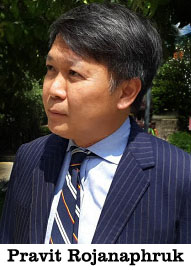
Pravit RojanaphrukAway from there are some who dwell in anger and negativity. Instead of doing good deeds or striving to be better people, they have focused on suppressing, physically attacking or threatening to kill anyone who disturbs their strongly held belief that all Thais must love and revere the late King as they claim to.



Mobs have surrounded homes in Phuket, Phang Nga and Koh Samui demanding people they believed to have defamed the King come out and be punished. In Bangkok earlier this week, a middle-aged woman on a bus, later found to be mentally ill, was harassed off a bus and slapped violently for her alleged insults to the King. In Chonburi province, southeast of Bangkok, a mob filmed a factory worker as he was beaten and forced to prostrate in front of the King’s portrait for what the vigilante crowd regarded as an insult on Facebook.

Then on Wednesday, I reported about a man in Samut Sakhon province who filmed himself driving around with two handguns and a portrait of the late King, vowing to search out and kill anyone defaming the late King.

I watched this 12-minute video repeatedly and truly wanted to understand the man, Suchaet Muangsamut.

“Why don’t you love him, love the royal father? What the fuck is wrong with you people?” he ranted, swinging between rage and bawling.

It appears such ultra-royalists as Suchaet, like religious fundamentalists, can’t accept or tolerate an alternate, competing reality. They are brought up to believe wholeheartedly that all Thais must naturally love and revere the late King. Suchaet admitted earlier in the video that he was very upset about Thais who posted comments attacking the late King on Facebook.

Suchaet was eventually found and arrested by police Friday but won’t be charged for making the threats. Police told me he might face weapons-related charges if guns were not legally registered to him. In a photo I obtained from someone over Facebook, Suchaet was photographed sitting in the police station with the two guns and documents. He wore a black T-shirt with the Thai No. 9 in reference to late King’s title of Rama IX. The name Rama comes from the seventh incarnation of Lord Vishnu, who is revered in Hinduism as part of a holy trinity and the guardian of men.

Interestingly enough, Friday on Channel 3, Sumet Tantivejkul, one of the most prominent administrators of the king’s numerous royal projects, said the late King was like a “prophet” whose teachings, like Buddhism and other religions, would live on for Thais to adhere for “thousands of years.”

There are some not disturbed by ultra-royalist threats to kill but the fact the news is being reported and spread in English to the wider world.

Suthin Wannabovorn, a Yellowshirt ultra-royalist and retired journalist, posted on his Facebook account urging the junta to do something about Khaosod English for reporting the news about Suchaet.

“Let me stress that the negative news that Westerners are writing about [Thailand] stems from the [the coverage] of [Khaosod English],” he wrote Thursday on Facebook. “If you do not want the reputation of the country damaged further, something needs to be done. Please listen again, related officers must do something.” The post had been shared 109 times and liked 499 times as of Saturday afternoon, with one comment calling for a mob to descend on the offices of Khaosod English.

People have the right to love and revere the late King as if he is a prophet or god-like. The problem is that some ultra-royalists are behaving like religious fundamentalists, full of intolerance. Thais can either focus of doing good deeds and converting others through good example, or force and threaten non-believers into fear and submission, or even vow to murder them, in the name of their love for the king.

Advertisement

Hot News

LATEST NEWS

Bangkok
overcast clouds
34.4 ° C
34.4 °
32.7 °
71 %
4.2kmh
99 %
Mon
33 °
Tue
34 °
Wed
35 °
Thu
31 °
Fri
30 °