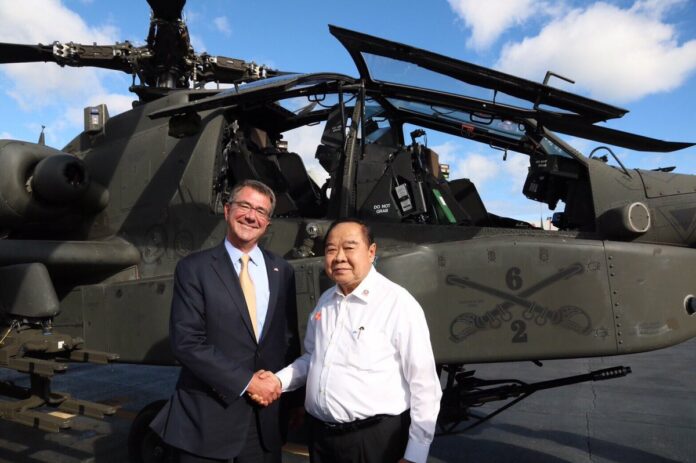
In an undated photo, junta deputy chairman Prawit Wongsuwan shakes hand with then-U.S. Secretary of Defense Ashton Carter during a visit to Hawaii. Image: Matichon
BANGKOK — The military government on Wednesday refused to disclose who accompanied the junta’s No. 2 general on a 20.9 million baht trip to attend an informal discussion with American officials in Hawaii last week.
The regime also would not confirm or deny the authenticity of what’s alleged to be a leaked passenger list of deputy junta chairman Prawit Wongsuwan’s flight, which included a TV reporter rumored to be a romantic partner of the general. The reporter said she wasn’t on the flight.
“If we disclose the list, what good will that do?” Maj. Gen. Kongcheep Tantravanich, spokesman for the Ministry of Defense, said Wednesday.
Prawit and his entourage visited Honolulu from Thursday to Friday for an event described as “ASEAN-US Defense Informal Meeting.” It later emerged that air fare for the trip cost taxpayers 20.9 million baht, of which 600,000 baht was spent on in-flight dining alone.
Khaosod English filed a request Wednesday under the freedom of information law requesting the Defense Ministry disclose the names of the 38 people in Prawit’s entourage. Kongcheep said the request was being deliberated by a committee and gave no timeframe for its response.
“Steps must be taken in accordance with protocols,” said Maj. Gen. Kongcheep, who was on the flight. “Is it [disclosing the list] appropriate or not? If it affects national security or affects any agency, then we will not disclose it.”
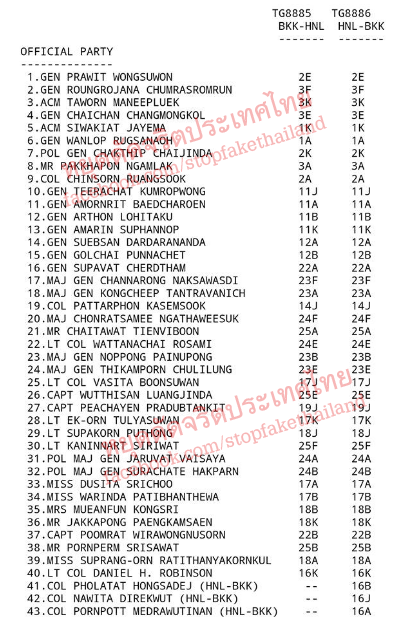
An anti-junta Facebook page called Stop Hypocrisy in Thailand on Wednesday night published what it said was full list of the passengers on the charter flight. It listed 40 people, including Gen. Prawit for the outbound flight, with three more officials joining the return trip.
Document published by Stop Hypocrisy in Thailand.
Among the purported list was Chonratsamee Ngathaweesuk, a reporter for the army-owned Channel 5 TV, who is rumored to be a romantic partner of Gen. Prawit, who is unmarried.
Kongcheep said he could not comment on whether the list was authentic, except for Chonratsamee. He said she was not one of the passengers.
Prior to the appearance of the photos and list, Chonratsamee wrote Tuesday on Facebook that she didn’t accompany Prawit to Hawaii. As proof, she posted a screenshot of a live news program she did on Friday, when the deputy junta chief was in Hawaii.
“This is funny! I was in Bangkok, reading live news on Channel 5, but people imagined that I was overseas,” Chonratsamee wrote. “This means that the news I do live from Monday to Friday isn’t famous enough.”
She hasn’t further commented on the matter publicly.
Nevertheless, the news revived the public’s curiosity about the 34-year-old reporter, who also holds the rank of army major.
Isra News, an investigative news site, reported in December 2014 that a media company owned by Chonratsamee won at least 3.3 million baht worth of contracts with state agencies that year.
On Wednesday, Isra published a note saying it received an email from its internet service provider to remove the 2014 article, citing an unspecified “request of cooperation from the bureaucracy.”
As of late Wednesday afternoon, the page was still on the site.
Note: The original image published with this article, which showed photos purporting to be of Chonratsamee Ngathaweesuk in Honolulu, were removed at the request of the management of Khaosod, which owns Khaosod English.
JAKARTA — Indonesian police say a man they arrested for broadcasting pornography on an electronic billboard in the country’s capital gained access to the system after it displayed its log-on credentials.
Jakarta Police Chief Muhammad Iriawan said Wednesday that the suspect, 24-year-old Samudera Al Hakam Ralial, admits he hacked the IT system of the billboard operator but claims that the broadcast of the Japanese porn movie was accidental.
Twitter in social media-mad Indonesia was set alight by the incident, which occurred not long after Friday prayers last week in the Muslim-majority country.
Many users posted clips of the billboard as it displayed a Japanese porn movie to passing traffic.
According to Iriawan, Samudera said he didn’t realize a pornographic website he accessed after breaking into the computer system was uploaded to the billboard.
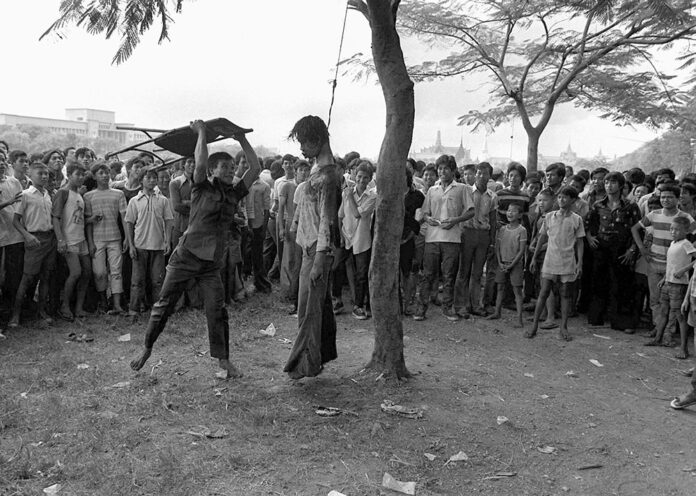
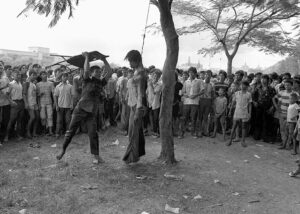
A member of a Thai political faction strikes at the lifeless body of a hanged student outside Thammasat University in Bangkok on Oct. 6, 1976. Photo: Neal Ulevich / Associated Press
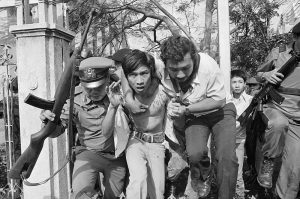
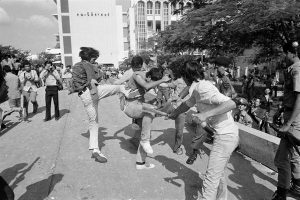
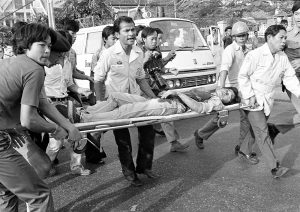
Associated Press Photographer Neal Ulevich won the Pulitzer Prize for his photos of the suppression of a left-wing student protest at Bangkok’s Thammasat University on Oct. 6, 1976, and the brutal lynchings in its wake. Ulevich, then 30, arrived as a night of tension at the campus broke into a full-scale assault by paramilitary police on thousands of trapped and defenseless students.
What follows was his first-person account as it was published.
BANGKOK — In a real riot no one knows you’re there. So as gunfire crackled over the campus of Bangkok’s Thammasat University Wednesday morning, I pushed my way through an angry sea of rightists and found a hole in the high metal fence surrounding the campus.
I paused momentarily while Boy Scouts pushed through the fence the body of a soldier with a chest wound. I jumped through.
The police were on the attack and the rightists were cheering their support. Troops armed with M-16 rifles were spraying wild fire across a quadrangle, shattering classroom windows and nicking holes in the walls.
With some Indochina combat coverage behind me, I could hear that more than 90 percent of the fire was going in one direction – toward the students. Occasionally it seemed a round came back.
On the quadrangle, troopers worked their way toward classrooms.
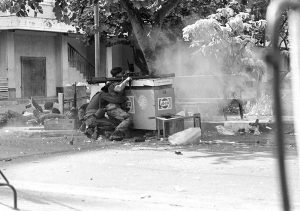
Some of the troopers tossed hand grenades through the windows. The “garrumph” of a grenade going off was followed by a puff of smoke and the tinkle of showering glass. Then the recoilless rifle crew moved up.
It wasn’t immediately clear why the border patrol police were there, or why they thought they needed an armor-piercing antitank weapon to conquer students. The two-man crew moved forward, followed by a shaggy right-winger carrying a box of ammunition. They blasted more classrooms.
A few minutes later, about 9:30 a.m., the battle seemed over.
Students began to pour out of campus buildings, some wounded. I began to move forward, 50 yards behind the soldiers. I began to feel apprehensive, just as I did in Vietnam when crossing open ground. And with good reason. The shooting began again.
Neal Ulevich. Photo: Courtesy
The students threw themselves to the ground – I did, too – as the Thai police emptied more thousands of rounds into the classrooms. The fire slackened and the students got up.
I reached the nearest classroom building.
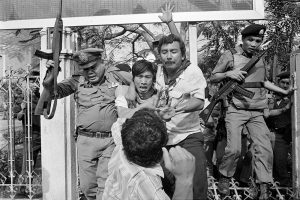
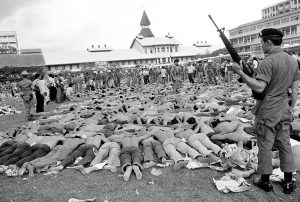
At the door, students were running out, diving to their hands and knees and crawling past soldiers who told them to take off their shirts, and coeds their blouses. Slow performance earned a kick.
A grenade went off in a classroom above us, showering troops and their captives with glass and plaster. The students crawled toward the center of the quadrangle to lie in the hot sun.
I was joined by a German reporter who speaks Thai, and we walked out through the gate.
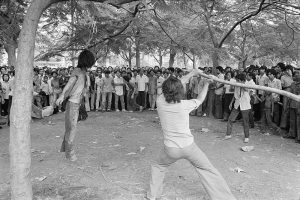
Then we were out on the street – close by the pleasant green trees that surround the Pramaine Ground site of Bangkok’s colorful weekend fair. But then we saw the angry swarm of Thais around two of those trees and their anger was white hot. I saw the body of a dead student hanging from one tree. The scene was being repeated just a few feet away.
I don’t know how much earlier the students had been lynched – probably just a few minutes – but enraged rightists felt robbed by death and continued to batter the bodies.
Other Thais who witnessed the 1973 student riots here said the earlier uprising, which left 70 dead, never evoked the brutality or hatred of Wednesday’s attack on the students.
No one had seen me. I had wandered throughout and taken pictures unmolested. But I had seen enough, and left.
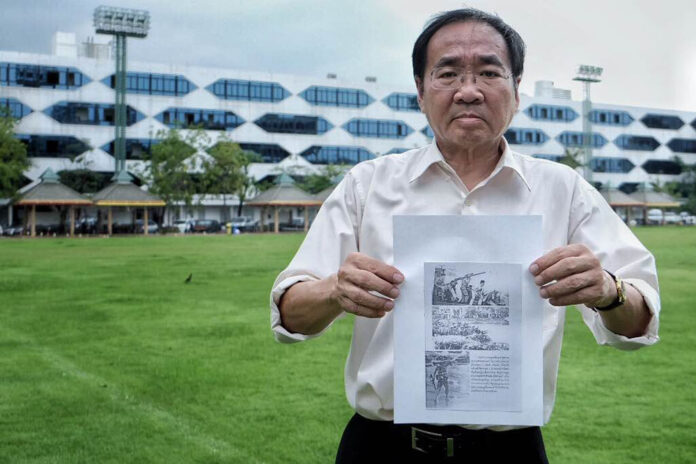
Krisadang Nutcharut stands Monday in the football field of Thammasat University's Tha Prachan campus. He holds a sheet printed with photos taken during the massacre of student protesters there 40 years ago on Oct. 6, 1976.
Top: Krisadang Nutcharut stands Monday in the football field of Thammasat University’s Tha Prachan campus. Photo: Thiti Meetam
BANGKOK — It was from the front gate to the campus that Krisadang Nutcharut recalls the first shots fired. Not far away from the football field, where later a large explosion killed some of the thousands of students gathered.
On Monday, Krisadang toured the campus of Thammasat University, where he was just 19 on Oct. 6, 1976, when he saw his classmates assaulted, shot, murdered and mutilated before dramatically escaping into the Chao Phraya River in search of safety.
The government said 46 were killed that day. Those who were there have put the number at more than 100.
It all began when a dictator ousted three years earlier in a popular revolt quietly returned to Bangkok in the robes of a monk. The students wanted Field Marshal Thanom Kittikachorn either prosecuted or expelled, but nothing was done by the the civilian government led by Seni Pramoj.
Krisadang, a sophomore law student and member of the student council, recalled that It was at the university’s Lan Pho, or the Bodhi Lawn, where a tall tree representing the Buddha’s enlightenment was planted, that Krisadang, a sophomore law student, recalls they first gathered in protest on Oct. 4.
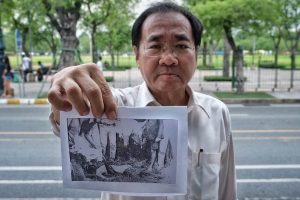
Krisadang Nutcharut holds a photograph of a dead young woman who was sexually assaulted across from where it happened in Bangkok’s Sanam Luang adjacent to Thammasat University. Photo: Thiti Meetam
“Demands were made the Thai-language examination be canceled,” he said, as more students were urged to join the demonstration, by then numbering 400 or 500 people.
Some students staged a play which mocked the lynching of two factory workers who earlier had protested Thanom’s return.
An ominous sign came in print the next day on Oct. 5, when at least one right-wing newspaper published a photo of the play – some believed it was doctored – accusing the students of making one of the performers hanged look like HRH the Crown Prince. To this day, Krisadang accuses one English-language newspaper, The Bangkok Post, of publishing a doctored version of the photo. The paper has denied this and, at the time, did not write that the students had mocked the prince.
Photo: Associated Press
A Call to Terrible Purpose
Cold War, anti-Communist sentiments were at fever pitch, and whatever happened on the stage was seized upon as a pretext to set events in motion.
A call from the military went out over more than 200 radio stations and was heard by right-wing reactionaries, from the state-sponsored rural militia known as the Village Scouts to anti-Communist extremists established by the military called Red Gaurs. Even the military’s Housewives Association mobilized.
Photo: Associated Press
The same message was repeated again and again.
“The call was to come out and kill students,” Krisadang said was his understanding, backed by other accounts, of what was broadcast over AM radio. After all, as a famous monk had recently declared: “Killing a Communist is not a sin.”
The students soon learned that right-wing, ultra-royalist forces had gathered around the statue of King Rama V at the Royal Plaza, a 40-minute walk from Thammasat.
“By that evening, forces organized by the military arrived in front of Thammasat,” Krisadang said.
Inhumanity on Display
Forty years later, Krisadang and other members of the so-called Oct. 6 generation still try to make sense of the atrocity.
“The other side believed that we were armed Communists and had defamed the monarchy,” Krisadang said, trying to explain the raw sadism of lynching, murder, rape and torture that seemed to have no precedent.
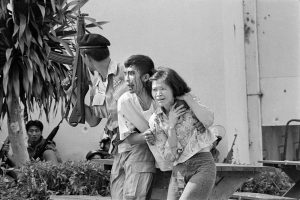
That sadism struck the world through photographs of mad mobs leering and grinning over defiled corpses, some burned, some sexually violated and at least one with a wooden stake driven into its chest.
A member of a Thai political faction strikes at the lifeless body of a hanged student outside Thammasat University in Bangkok on Oct. 6, 1976. Photo: Neal Ulevich / Associated Press
American photojournalist Neal Ulevich, working for the Associated Press, would win the Pulitzer Prize for the most remembered photo of the day.
In it, a student believed to be from Chulalongkorn University hangs by the neck from a tree. A barefoot man visibly exerts himself as he swings a folded metal chair downward to strike the body. Some faces in the crowd look horrified, yet many more beam with smiles and laughter.
Krisadang said he had no idea the paramilitary mob was capable of unleashing such hatred and violence. He faults political passions being whipped up to divide people and make them turn on one another.
“It came to a point where the ruling class felt they couldn’t let go of their power and believed Thailand would be the next ‘fallen domino,’” he said, referring to the Cold War jingoism that saw communism as an existential threat to the free world.
Krisadang said anyone who was seen as a political opponent was branded a Communist and anti-monarchist.
“It’s like now how people have been divided into yellow and red shirts,” he said. “Are we going to continue to be used as pawns?”
Photo: Associated Press
October 6
One man who claims he knew in advance the students were doomed was Jaran Ditapichai, then 29. Jaran was a mid-ranking Communist Party member dispatched to Thammasat University to save those “important” lives he could. He failed and barely managed to save himself.
“I entered because I was worried and wanted to offer suggestions,” Jaran said. “Some should be spared. Not all should be arrested or killed. My intelligence liaison told me I should leave immediately, however, saying they were going in for the kill tonight.”
By the night of Oct. 5, Jaran had heard border patrol police had occupied the National Museum compound on the north of the university.
Later that night, witnesses such as Jaran and Krisadang recall hearing shots fired intermittently.
Just before dawn on Oct. 6 came a signal things of what was to come.
Someone fired either a mortar shell or M79 grenade into the campus’ football field, where Krisadang estimates some 2,000 to 3,000 people, mostly students, were gathered.
Photo: Associated Press
The explosions instantly killed students where it hit and shook the buildings inside the historic university, once a command center for the Thai resistance movement against Japanese occupation during World War II.
“Many were killed,” Krisadang said. “Then we heard gunshots coming from Wat Mahathat,” he said, referring to a temple on the south side of the university.
Two student leaders on stage, Thongchai Winichakul and Somsak Jeamteerasakul, called futilely for the attack to stop, Krisadang said.
By 5am, gunfire erupted from the direction of the National Museum.
Jaran said several people around him were gunned down and killed. He said it was only by luck that he fell to a spot of lower ground – not the footpath or the football field where others were being shot – where he was shielded from the bullets.
“I smelled blood mixed with brains in the air,” he said. “Two or three people were lying dead.”
About the time the sun rose, two or three buses plowed through the gate of the university. That’s when Krisadang fled west from the gate toward the Chao Phraya River. It was low tide when he stumbled into the water, and he waded and swam south to the Tha Prachan Pier, where a kindly Thai-Chinese shopkeeper hid him.
Jaran made his way south across campus to the Faculty of Social Administration. He found a way into the basement and hid there overnight. He was arrested the following morning after soldiers noticed his footprints.
Photo: Associated Press
Making of a Massacre
Jaran managed to escape after a few days when a guard forgot to lock his cell, then fled into the jungle to join other members of the Communist Party of Thailand in hiding. Today he lives in exile in Paris, where he remains to avoid prosecution on a charge of insulting the royal family.
He notes that most of those who had gathered at Thammasat to protest Thanom were not communists. But he also thinks it’s time history shows there were communists present four decades ago.
He said the status quo saw them as a threat.
“Too many students and people were becoming ‘red’ too soon, and the ruling class became fearful, leading to the call for a total crackdown,” Jaran said.
Photo: Associated Press
He faults a persistent media campaign which demonized students and citizens for playing a major role. He compared it to the vilification of Redshirts today by the right-wing press.
“It went on until people lost their basic conscience, believing that all were communists, were demons, and that there was no sin in killing them. It was these decisive factors that led to Oct. 6,” he said.
The massacre should also be remembered for enabling a military coup later the same day, he said, just three years after the public had risen up to drive out a military dictatorship.
Untreated Trauma
Vipa Daomanee, then a 21-year-old Chulalongkorn University student and part of the Oct. 6 generation, was not present but remains deeply affected by what happened.
Photo: Associated Press
Vipa was on her campus drafting the last statement by the Students’ Confederation of Thailand at 1am on Oct. 6 while some of her friends were being murdered. It weighs on her that nobody has ever been held responsible for the atrocity, even after 40 years.
Attempts to bury it with the past have just made the wound fester, she said.
“It was a state crime wherein the ruling class used violence against its opponents,” Vipa said. “It has become a wound in society that has yet to heal.”
Sinsawat Yodbantoey, like Vipa and Krisadang, has actively commemorated the massacre for decades. He’s among those who see the massacre’s lessons as yet unlearned and unregistered in Thailand’s collective memory.
“There are things that have been recorded, and there are things that have been forgotten. There are selective memories and selective forgetting. This results in confusion,” Sinsawat said.
Sinsawat was a 22-year-old art student at Pho Chang College. He was saved that day by a childhood friend who had joined the Village Scouts and recognized him.
No commission has ever been established to gather evidence about who masterminded the massacre. It wasn’t until 2000 that an effort to build a small memorial on the campus prevailed.
Sinsawat said those in power today still do not want this episode of Thai history remembered.
“We have yet to be able to find evidence to launch a lawsuit, saying this or that person made the order,” Sinsawat said.
On the brighter side, Sinsawat said there’s renewed interest among young people in the issue as a result of the 2014 military coup.
While Krisadang was giving his tour of the campus on Monday, two young people were there taking photos, curious to learn about the incident.
As for Jaran, the man acknowledges that attempts to make Oct. 6 a collective memory have been a part – but not total – failure.
Photo: Associated Press
“The first 20 years was a period when nobody was willing to speak or write about it. People were still afraid,” said Jaran, the 69-year-old political exile said from Paris. A Redshirt leader, he fled the kingdom in 2014 after the coup and obtained asylum status in France.
“Oct. 6 is about defeat, and people try not to discuss it because of that. There’s also the allegations they were communists, and that made them even more reluctant to talk,” he said in an interview over the telephone.
“The ruling class and the military want us to forget while the other side is struggling for people to remember,” Jaran said. “Those who want to forget may forget, but I shall never. I was almost killed.”
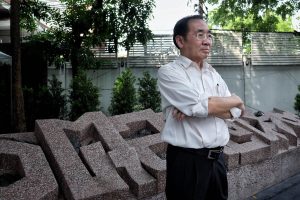
Krisadang Nutcharut stands in front of the memorial to the victims of the 1976 massacre at Thammasat University in Bangkok. Photo: Thiti Meetam
Collective Amnesia
There are forces suppressing knowledge and memory of that day that go beyond those responsible wanting it forgotten.
Today, with the massacre unmentioned in the classroom or textbook, Sinsawat said some university students can’t comprehend the cruelty depicted in the photographs. Some even doubt it happened.
“Some think it can’t be real, as if the picture must have been photoshopped,” he said.
Other youth simply refuse to engage with the issue, saying the topic is “too heavy.”
Krisadang and Vipa said there are others who just don’t want the orgy of violence and murder known publicly.
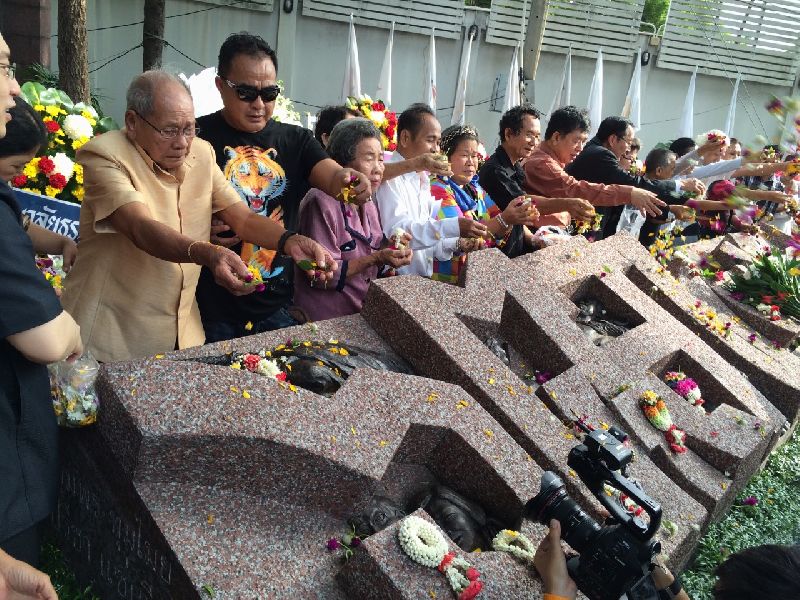
More than 50 participants laid flowers at the October 1976 massacre monument at Thammasat University on Oct. 6, 2014.
Forty years on, Vipa said some relatives of those killed are still unwilling to speak publicly. The Oct. 6 generation has its own infighting and bad blood, and those trying to chronicle what was arguably the cruelest episode of modern Thai history quibble over whether just two, four, or even five people were hanged by the mob that day.
Despite that, Vipa, who’s known for emotional outbursts when it comes time to commemorate the event, said there’s a power in the sheer fact 40 years have passed.
She said more people have become interested in what happened, with events planned in at least three universities.
“The number 40 is powerful. Those who should have become interested about the issue earlier and have not are now becoming curious,” said Vipa, who eventually became an academic before retiring. “We need to be reminded and keep holding the commemoration every year. No matter how many people show up, we must stress and link it to the present.”
Even more attention was called when Thai authorities on Wednesday detained a 19-year-old pro-democracy leader from Hong Kong who was invited to an event on the anniversary tomorrow to commemorate the massacre. Joshua Wong was held for some hours before being deported back home.
As for those who were there such as Krisadang, there are still new things to learn.
As he walked through Thammasat reminiscing about the past on Monday, he said just last year a friend and fellow member of the Oct. 6 generation, historian Thongchai Winichakul, was able to pin down one elusive detail. On the campus, one of the tamarind trees growing there, he concluded, once bore the weight of a murdered student left hanging beneath it.
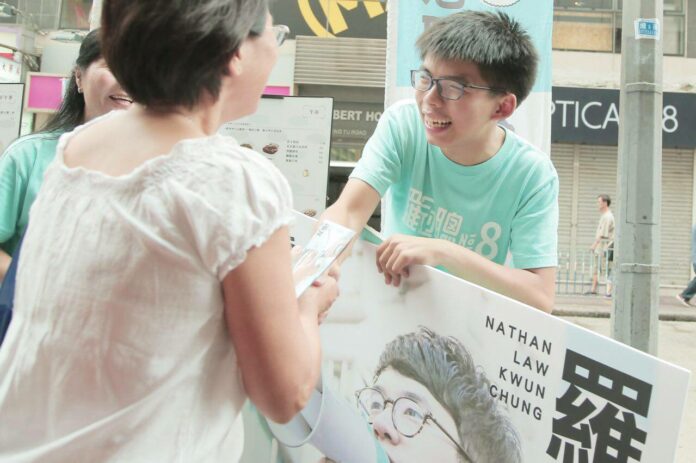
Joshua Wong on Sept. 4 shakes hand with a voter during his party's election campaign in Hong Kong. Photo: Demosisto / Facebook
BANGKOK — Pro-democracy activist Joshua Wong has boarded a plane back to Hong Kong after being denied entry to Thailand by immigration authorities, his political organization said.
The 19-year-old activist will arrive in Hong Kong at about 3:45pm local time, according to a statement posted online by Demosisto Party, of which he is a leader. Wong was supposed to speak at Chulalongkorn University on Thursday but was barred from entering the country upon landing at Suvarnuabhumi Airport.
Wong and Demosisto chairman Nathan Law will hold a news conference about the incident at Hong Kong’s parliament Thursday night, the statement said.
The well-known activist flew from Taiwan to Thailand on invitation by a student group to speak Thursday at an event commemorating the 40th anniversary of the Oct. 6 Massacre, in which dozens of left-wing students were killed by paramilitary and police forces.
The massacre remains a topic of taboo in Thailand due to the involvement of royalist groups at the time.
Immigration officials previously refused to clarify why Wong was denied entry, while Wong’s associates in Thailand alleged Thai immigration was following orders from the Chinese government, a claim the junta would neither confirm nor dispute.
Demosisto, which advocates for greater autonomy from the mainland government, staged a protest in front of the Thai Consulate in Hong Kong on Wednesday afternoon to denounce Wong’s detention.
BANGKOK — A 43-year-old man confessed Tuesday to stomping a 7-year-old boy’s head because he thought the child made his son cry.
Amnat Salubthong was behind bars Wednesday after security footage from a housing complex in northeastern Bangkok went viral, showing him run down the stairs and charge at the 7-year-old, who was playing with his 6-year-old son.
He kicked the child repeatedly before taking his son back upstairs to his apartment on Panya-Ramintra Road in the Khlong Sam Wa district.
“Amnat came to the police station yesterday and admitted he assaulted the kid,” Maj. Saowaluck Suwanmanee of Khanna Yao police said Wednesday. The boy was treated at the hospital and has recovered from his injuries. His father said he was still traumatized and was vomiting.
After turning himself in, Amnat told police he ran down from his fifth floor room to where the children were playing because he heard his son crying. He admitted to brutalizing the child because he could not control his rage.
Police were gathering evidence in order to file charges against Amnat later today, Maj. Saowaluck said.
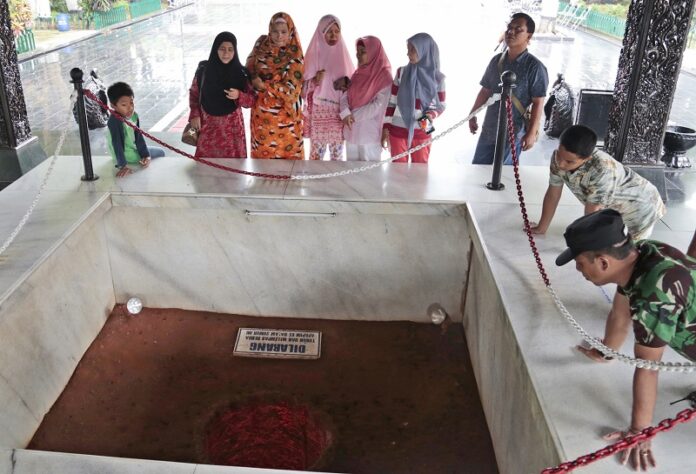
Visitors look at an old well where six Indonesian Army generals were buried after being killed in an abortive coup in 1965 that the military blamed on Indonesia’s Communist Party, Friday at Pancasila Sakti Monument in Jakarta, Indonesia. Photo: Dita Alangkara / Associated Press
PLUMBON, Indonesia — In a country pockmarked with hidden graves from one of the 20th century’s worst mass killings, the village of Plumbon has something that sets it apart: a monument that names some of those believed killed when the nationwide bloodletting engulfed this hamlet half a century ago.
Down a rutted track that passes a flimsy stall selling sugary tea, then penetrates into lush forest, the waist-high marker sits in the center of a rectangular clearing. An edge is broken off; locals blame that on children’s mischief.
It lists eight names: Moetiah, Soesatjo, Darsono, Sachroni, Joesoef, Soekandar, Doelkhamid, Soerono. And it adds that as many as 24 people could be buried here.
Erected in 2015 after activists persuaded villagers, religious leaders and local officials, the monument is a rare acknowledgement of the victims of Indonesia’s anti-communist massacres, which historians estimate killed half a million people. And yet, it also illustrates how thoroughly that history has been erased.
Are those eight men, and victims of related atrocities, truly buried there? The fog of memory may have placed it in the wrong place entirely. Political expediency and the passing of time may prevent anyone from ever knowing for sure.
An abortive coup on Sept. 30, 1965, ignited a months-long bloodbath by soldiers, militias and Islamic groups. The killing spree and mass incarcerations ensured that pro-Western general Suharto would sideline and ultimately replace President Sukarno, a socialist and anti-colonialist at odds with the U.S.
After decades of distorted victor’s history in which the events of 1965-66 were depicted as a heroic uprising, the government this year permitted an unprecedented symposium that brought together survivors, the military and Islamic groups. Organizers had hoped to pave the way for reconciliation and justice. But there was a conservative backlash, followed by a possible death blow: A cabinet reshuffle installed a former military chief with a checkered human rights record to the ministry overseeing work to locate mass graves.
Old age, meanwhile, whittles the ranks of witnesses. Facts blur and slip further from grasp.
Sabar, a frail, shrunken 83-year-old with milky eyes, can barely bring himself to remember. In the mid-1960s, he belonged to one of the mass organizations of Indonesia’s Communist Party.
Sabar’s lips trembled as he recalled being arrested in October 1965. He was held in the Kawedanan, or offices, of the Kendal district government with at least six of the men named on the monument. Plumbon is part of the district in Central Java province.
Sabar said he is certain only of the execution of one man on the monument: Soesatjo.
Yunantyo Adi, one of the activists behind the monument, believes all eight men named on it are buried there, but concedes there’s no proof unless the site is exhumed. Its bigger point, he said, is to serve as a symbol and draw attention to unprosecuted crimes against humanity.
Few people alive witnessed the killings in Plumbon. One of them, Supar, is now toothless and aged beyond his 68 years.
“I never want to see it (the gravesite) again. Some people even say grass won’t grow there,” he said.
He said it was 11 p.m. or later and raining heavily when 12 alleged communists were pulled from the truck that had delivered them to Plumbon. Their burial place had already been dug.
“They were told to sit down on the ground side by side. They prayed or recited whatever verse they knew,” Supar said.
“After the execution I was told to shine the flashlight. I couldn’t look so I turned my face away, but the soldier yelled at me, ‘Don’t look away!’ Those still moving, the soldiers shot them again.
“We buried the bodies, but it wasn’t perfect,” he said. “I heard that some people buried them properly the next day.”
Another witness, Sukar, lived in Plumbon, then a village of less than two dozen houses, at the time of the killings. He spoke to the AP while sitting on the ground where he remembers covering partially buried bodies the morning after mass killings.
“Blood was splattered around. The legs were sticking out of the dirt,” he said.
For decades, the scale and ferocity of the killings were expunged from national consciousness. The narrative has changed only slowly since Suharto’s 1998 ouster.
Agus Widjojo, an organizer of the symposium on the massacres and the son of a general killed in the abortive 1965 coup, said progress on reconciliation will continue once the lackluster economy improves.
“We have reached an objective, and that is people came out to express and state what they think about the tragedy of 1965, whereas before nobody dares to say anything,” he said.
BANGKOK — Brace yourselves for – big surprise – even more flooding, especially in northern Bangkok.
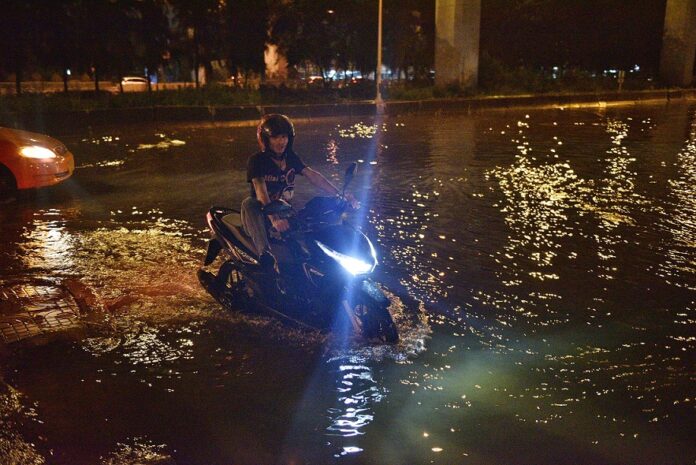
Last night’s torrential rains hit the district of Laksi the worst, where water levels rose over a meter. When officials later assessed the watery toll, they realized the nine areas they were worried about should have actually been 17 – those which flooded last night.
The Bangkok Metropolitan Flood Control Center warns medium to heavy rain will continue to fall in most districts of the capital, so here’s the updated list:
Sirat Expressway exit ramp onto Rama VI Road
Tao Poon-Pracha Rat Sai 2 intersection
Ngam Wong Wan Road in front of Soi Chinnaket
Saphan Kwai-Pradipat intersection
Chaeng Watthana Road between the Constitutional Court and TOT building
Phahon Yothin Road at the Bang Khen roundabout
Kamphaeng Phet Road at the Sapandam Tunnel area
Ratchayothin Junction on Phahon Yothin Road
Along Pradipat intersection until the Sapandam Tunnel area on Rama VI Road
Ratchadaphisek Road in front of Bangkok Bank
Bang Khun Thian Chai Tha Le Road in front of the Tum Yim restaurant
Suwinthawong Road intersection in front of the Min Buri Post Office
Ngam Wong Wan Road in front of Phong Phet and Amonphan Market
All along Thetsaban Songkhro Road, especially in front of Prachaniwet Market
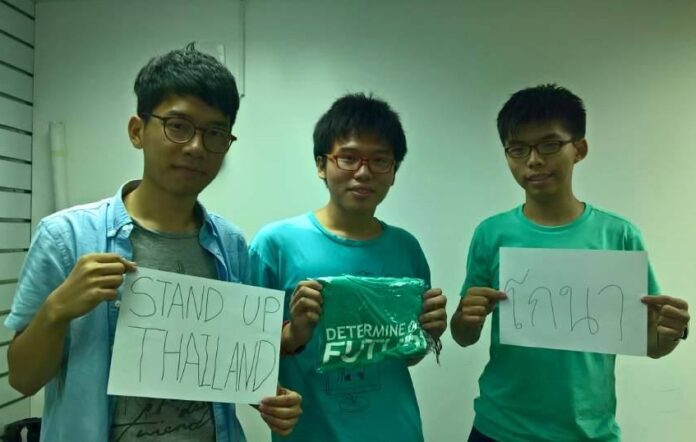
From left to right, Nathan Law and Joshua Wong of Hong Kong’s Demosisto Party pose for a July 25 photo with Thai activist Netiwit Chotiphatphaisal in Hong Kong. Photo: Netiwit Chotiphatphaisal / Facebook
BANGKOK — Associates of Hong Kong activist Joshua Wong said Wednesday afternoon they still had no information about his whereabouts hours after he was taken into custody upon landing at Bangkok’s Suvarnabhumi Airport.
Wong, who was to speak at a politically charged event at Chulalongkorn University, was detained upon landing in Bangkok around midnight, according to the Thai student activist who invited him, who also said he was told it was at the behest of mainland China.
Immigration officials said they don’t know about his detention, despite their authority over the facility.
“I don’t know anything about this. I swear to you with all honesty,” said Col. Chuchat Thareerat, deputy commander of the immigration division at the airport. “I am not playing word tricks with you.”
He said his supervisor, Sitthichai Lokanphai, was having “morning coffee with foreign ambassadors” and was therefore unavailable to comment.
Lt. Gen. Phakphum Sujjapan, commander of the national immigration bureau, said he’s unaware of why Wong was prevented from entering Thailand.
“I have to check for more information first,” Phakphum said.
Student activist Netiwit Chotiphatphaisal said he waited at the airport until 3am after Wong’s Emirates Airline flight landed at 11:45pm. According to Netiwit, Tourist Police officers there told him Wong had been detained at China’s request.
“Officials said they received a letter from Chinese authorities requesting that Joshua Wong be sent back to Hong Kong,” Netiwit said in an online statement at noon. “Because of this incident, we cannot contact Joshua Wong. We do not know about his present condition.”
Junta spokesman Winthai Suvaree said it was possible but suggested the junta was uninvolved.
“There is a possibility that China sent a request to the immigration police, and the immigration police exercised its judgment whether to approve the request or not,” Col. Winthai said. “The immigration police is a national security agency. It has channels of communication with many countries. It is normal procedure.”
The 19-year-old activist who rose to fame after leading a pro-democracy protest in 2014 flew from Taiwan to Thailand on invitation to speak Thursday at an event commemorating the 40th anniversary of the Oct. 6 Massacre, in which dozens of left-wing students were killed by paramilitary and police forces.
Winthai said the decision to detain Wong is entirely up to the immigration and not the military government.
Wong now heads a political party in Hong Kong called Demosisto, which advocates for greater autonomy from mainland China. The party’s leader, Nathan Law, wrote on Facebook that he’s also unaware of Wong’s whereabouts and when he will return to Hong Kong.
“Thai officials have not released any information or statement with regard to Wong’s detention thus far,” Law wrote. “Meanwhile, we have contacted the Immigration Department and the Security Bureau in Hong Kong, which have in turn notified us that they are currently following up on the case.”
At the time of publication, Law wrote in an online message he still had not received any update about Wong.
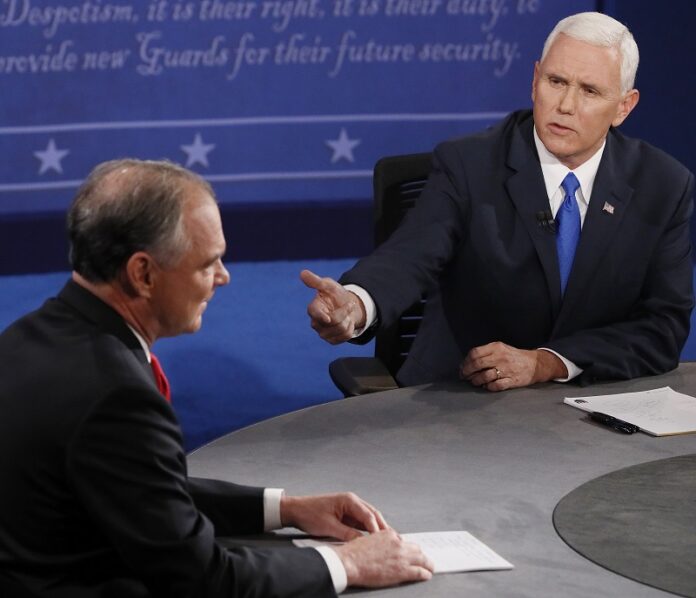
Republican vice-presidential nominee Gov. Mike Pence, right, and Democratic vice-presidential nominee Sen. Tim Kaine debate Tuesday during the vice-presidential debate at Longwood University in Farmville, Virginia. Photo: Andrew Gombert / Associated Press
FARMVILLE, Virginia — Democrat Tim Kaine aggressively challenged Republican Mike Pence over a long list of Donald Trump’s controversial positions and statements Tuesday night, drawing a vigorous defense of Trump’s tax history. But Pence sidestepped criticism of Trump’s demeaning comments about women, his public doubting of Barack Obama’s citizenship and broader questions about his temperament.
Indiana Gov. Pence and Virginia Sen. Kaine, who have received little attention in a race focused on Trump and Hillary Clinton, faced off for 90 minutes in the only vice presidential debate of the campaign.
With the close White House race perhaps starting to tip in Clinton’s favor, Pence outlined a detailed conservative agenda on tax policy, entitlements and immigration. He was markedly more prepared and more detailed in his answers than Trump was in last week’s first presidential debate. He was also more consistent in painting the Democratic ticket as career politicians unwilling to shake up Washington.
“Hillary Clinton and Tim Kaine want more of the same,” Pence said. He also repeatedly accused the Democrats of running an “insult-driven” campaign — an ironic attack line given that Trump has leveled repeated insults against Clinton and his former rivals in the Republican primaries.
There was a striking difference in the two men’s manner. Kaine, Clinton’s usually easygoing No. 2, went on the attack from the start, repeatedly interrupting and challenging Pence. Pence, an equally genial politician, was unflappable.
Kaine pressured Pence to answer for some of his running mate’s provocative statements, using Trump’s own words such as dismissing some women as pigs or slobs. He also challenged Pence on Trump’s decision to break with decades of campaign tradition by not releasing his taxes.
“Donald Trump must give the American public his tax returns to show he’s prepared to be president, and he’s breaking his promise,” Kaine said.
Asked about reports that Trump might not have paid any federal taxes for years, Pence said his running mate “used the tax code just the way it’s supposed to be used, and he did it brilliantly.”
Records obtained by The New York Times showed Trump suffered more than $900 million in losses in 1995 that could have allowed him to avoid paying federal income taxes for as many as 18 years.
Kaine, too, defended his running mate’s weaknesses, chiefly the public’s questions about her honesty and trustworthiness. He said that while Trump was “selfish,” Clinton had devoted her career to helping children and families.
Social issues were a bigger part of the conversation than in the first presidential showdown, reflecting both candidates’ religious faith.
Kaine, a Catholic who personally opposes abortion but has consistently voted in favor of abortion rights, said of the Republican nominee, “Why doesn’t Donald Trump trust women to make this choice for themselves?” He also pointed to Trump’s assertion that women should face some kind of “punishment” for abortion, a comment Trump later walked back.
Pence, raised Catholic but now a Protestant evangelical, stressed his opposition to abortion and said he was “proud to be standing with Donald Trump” on the issue.
On national security, Kaine revived Trump’s frequently flattering comments about Russian President Vladimir Putin.
“He loves dictators,” Kaine said. “He’s got like a personal Mount Rushmore: Vladimir Putin, Kim Jong Un, Moammar Gadhafi and Saddam Hussein.”
Pence tried to flip the tables by accusing Kaine’s running mate of stoking Russia’s belligerence.
“The weak and feckless foreign policy of Hillary Clinton and Barack Obama has awaked an aggression in Russia that first appeared in Russia a few years ago,” Pence said. “All the while, all we do is fold our arms and say we’re not having talks anymore.”
On criminal justice, Kaine argued that Trump’s embrace of “stop and frisk” style policing was a mistake. Pence argued that Clinton has used police shootings to argue that there is “implicit bias” in police departments, and he said the Democrats should “stop seizing on these moments of tragedy.”
Kaine quickly shot back: “I can’t believe you are defending the position that there’s no bias.”
Tuesday’s contest was the only time Kaine and Pence will face off in this election, while Trump and Clinton tangle in three contests.
Clinton was widely viewed as the winner of her opening debate with Trump, rattling the real estate mogul with jabs about his business record and demeaning statements about women, and responding to his attacks with calm rejoinders. New public opinion polls have showed her improving her standing in nearly all battleground states.
At least some of Clinton’s bounce is likely attributable to Trump’s conduct coming out of the debate. He redoubled his criticism of a beauty queen and her weight, one of the topics Clinton raised in the debate, and went on a pre-dawn Twitter tirade trying to disparage the former Miss Universe.
While Trump has five weeks until Election Day to regain his footing, early voting is already underway in some states.
The vice presidential showdown at Virginia’s Longwood University was moderated by Elaine Quijano of CBS News. While last week’s first presidential debate was watched by a record-setting television audience of 84 million people, Tuesday’s contest was expected to have smaller viewership given Pence and Kaine’s lower profiles in the campaign.