
































26.1 C
Bangkok
Saturday, June 20, 2026
Home Blog Page 2601

Thorn in the Pillar: Freshman Makes Enemies Upsetting Tradition. Allies Too.

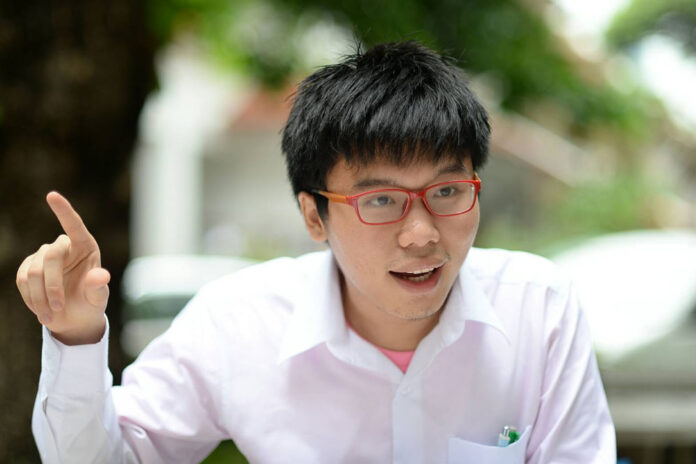
Chulalongkorn University student Netiwit Chotiphatphaisal gestures in a Sept. 20, 2016 file photo on the university's Bangkok campus.

BANGKOK — Every year freshmen in crisp uniforms press together on the campus of Chulalongkorn University. As one, thousands lower their heads to the ground in respect to statues of kings Rama V and VI in a swearing-in ceremony treated as a sacred ritual.

Except this year. On a Friday morning two months ago, a gangly political science freshman made a spectacle by refusing to prostrate to the kings’ statues. He and a friend just walked out, mid-ceremony, saying he was right by history – and one of the kings in question.

“Rama V himself cancelled the tradition of prostration,” Netiwit Chotiphatphaisal said in a recent interview. “Therefore, it’s illogical to continue to do it unthinkingly just because it’s become a norm.”

With that symbolic act, Netiwit put his peers and the institution billed as “pillar of the kingdom” on notice – he would respect the rules while throwing hammers at its customs and presumptions. For defying expectations students should be deferential and obedient, Netiwit has become both famous and infamous. Some admire his compulsion to stir thought; others complain he is an iconoclast unconcerned with their cherished values.

An interview was just beginning between classes Tuesday in his faculty’s library when, seemingly at mention of his name, library staff grew visibly uncomfortable and asked a reporter to take it elsewhere.

Sitting down on a bench outside, the 20-year-old from Samut Prakan donned his signature red glasses and clasped his hands at attention, laser-focused, to talk about that first provocative act of his university life.

“I had been thinking about not performing the swearing-in ceremony for a while, because I didn’t agree with it,” he said. “However, I also knew that I couldn’t just complain online and do nothing. I needed to incite thought.”
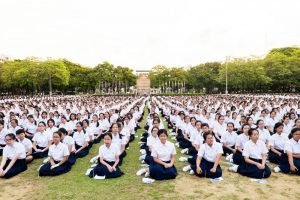
Chulalongkorn University freshmen participate in a mass induction on July 15, 2015, in Bangkok. Photo: Matichon
Chulalongkorn University freshmen participate in a mass induction
on July 15, 2015, in Bangkok. Photo: Matichon

Even before that morning in July, Netiwit was going after the education system’s conventions. He organized “schoolyard protests” against mandatory uniforms, standing for the national anthem, and prostrating to teachers. He founded activist reform group Education for the Liberation of Siam, declared himself a “conscientious objector” to refuse mandatory conscription at 18 and spoke out on hot-button issues, winning attention from social and traditional media.

“I want there to be more of a space in Thai society and schooling for young people: The school shouldn’t just be a place to prostrate and take tests,” he said.

For all his contrarian positions, Netiwit defies assumptions he’s some angry keyboard warrior. Instead, he comes across as a shy young man. Some might see a nerd.

“I’m not actually a rebel. I have no problem with following rules, both at school and university,” he said.

It’s when those rules exist only for their own sake and are backed by some threat of force that he reflexively balks.

“I can prostrate if you really want me to, but don’t make it an enforced thing,” he said.

‘I’m not actually a rebel. I have no problem with following rules, both at school and university’

He hopes to have it translated into English. He says that it’s the first book in many years about the educational system’s problems and believes English is important to reaching a wider audience.

He’s not trying to embarrass anyone, he said, just help bring about a greater good.That’s when he pulls from his orange-and-navy backpack, “Degenerate Student in a Wonderful Education System,” a collection of letters he wrote to his former school. Most oppose things such as using haircuts as a disciplinary measure or requiring students donate to build a statue.

“There is a ceiling of authoritarianism in Thai schools. The focus is on the teachers and the power they wield, as well as on visible material resources,” he said. “Schools like to show off new computers, expensive gyms, and farang teachers to upgrade the school’s image.”
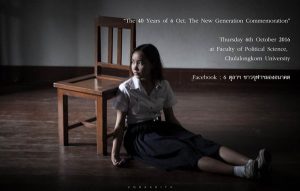
A promotional image for a seminar to be held at Chulalongkorn University on Oct. 6 to commemorate the 40th anniversary of the massacre of Chulalongkorn and Thammasat students.
A promotional image for a seminar to be held at
Chulalongkorn University on Oct. 6 to commemorate
the 40th anniversary of the massacre of Chulalongkorn
and Thammasat students.

Decrying the state of English-language learning, he complained some schools “hire farang teachers as decoration” to charge higher tuition, with the students in on the joke and unlikely to take them seriously.

Aware he was being interviewed for an English-language audience, Netiwit took the chance to call on those teachers to push for improvement, saying they as a base could make a “substantial push” in changing the education system.

“If you claim that you love Thailand, please help express vocally what’s wrong with the system,” he said. “The more the better. Together, we can work together for change.”

He credits his English not to Thai schools but friendly debates with Buddhists from other countries during a seven-month stay at the Deer Park Institute in India. He also decided there that learning could and should be fun.

Asked why he chose Chulalongkorn, an institution associated with conservative values over the historically liberal Thammasat University, Netiwit said that was the point. He didn’t only want to be around like-minded peers, and said conservative and progressive elements are found everywhere, regardless of the stereotypes.
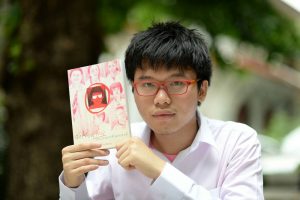
Netiwit shows Tuesday a book he's collected his letters to the administrators of his previous school. He's titled it 'Degenerate Student in a Wonderful Education System.'
Netiwit shows Tuesday a book he’s collected his letters to the
administrators of his previous school. He’s titled it
‘Degenerate Student in a Wonderful Education System.’

“It’s not as conservative as they say,” he said of Chulalongkorn.

Still, Chula is home to more than its share of sacred cows, making it a target-rich environment for someone looking to bludgeon them.

Since July’s initiation episode, he’s spoken out against the hazing rituals called rub nong. He was motivated after a number of fine arts students fainted this year during hong cheer, an activity in which upperclassmen encourage or coerce freshmen to attend day-long activities involving songs and games.

On Aug. 27 he posted an audio clip of seniors harassing their junior students, which led to the faculty canceling the event – and much shade thrown at Netiwit – until freshmen petitioned for it to be reinstated, albeit with better treatment from the upperclassmen.

That gets at the grievances he’s aroused in some of his classmates.

‘You have to learn how to do so in school in order to properly show that you’re Thai’

Netiwit’s detractors call him out for being a social aberration and disruptive rebel out to destroy Thai culture and customs. They say his words and actions amount to a reckless boy’s desire to be famous and a trending social media topic.

“He’s just a kid,” said Krittamet Kumlue, a third year engineering student and member of the university and national swimming teams. “And sometimes rules just need to be followed. When I was 15, I also didn’t want to shave my head. If you can’t even cut your hair like you’re asked to, what about when you go into the workforce? Are you going to rebel against wearing ID cards as well?”

Krittamet said things such as singing the anthem Netiwit so decries are necessary displays of national identity.

“On the international stage, Thai athletes stand up and sing the Thai anthem when we win a medal,” he said. “You have to learn how to do so in school in order to properly show that you’re Thai.”
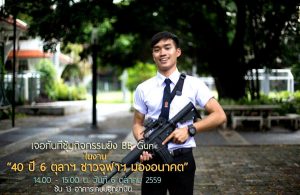
BB guns are promised in a promotional image for a seminar to be held at Chulalongkorn University on Oct. 6 to commemorate the 40th anniversary of the Thammasat University massacre.
BB guns are promised in a promotional image for a seminar to be
held at Chulalongkorn University on Oct. 6 to commemorate the 40th anniversary
of the Thammasat University massacre.

The swimmer, however, doesn’t agree with the nasty comments that openly appear on Netiwit’s Facebook page.

“Verbal abuse is not a good solution; it’s better to warn the kid. He should realize too, that society isn’t exactly as it appears from his point of view,” he said.

For his part, Netiwit said he is prepared for the attacks and isn’t discouraged by them.

But he’s also totally fired up now, having reached the topic of social change and his role.

“It’s everyone’s job to help fight for it. Individual bravery is important, but collective action is necessary,” he said. “I’ll admit that I’ve made some strategic mistakes of looking too independent in my actions.”

Whatever he’s done, there are also many cheering him on.

Worada Elstow, who graduated with a degree in French, views Netiwit as beneficial yet bitter medicine for Thai society.

“His ways of expressing his ideas may be crude and even radical, but they are necessary questions that someone needs to ask, just to open up the coconut shell that we’re all hiding under,” she said, referring to a common metaphor for Thailand’s insularism.

She said his walk-out during the swearing-in ceremony was impressive and empowering.

“This symbolic act of rebellion challenges so many conventional ideas at Chula and in Thai society,” she said. While others accuse him of destroying tradition, Worada said it cannot be destroyed, only set aside if people find no more use for it.

A promotional image for a seminar to be held at Chulalongkorn University on Oct. 6 to commemorate the 40th anniversary of the massacre of Chulalongkorn and Thammasat students.
A promotional image for a seminar to be held at
Chulalongkorn University on Oct. 6 to commemorate
the 40th anniversary of the massacre of Chulalongkorn and Thammasat students.

In true activist-nerd fashion, Netiwit was sure to plug his next act, possibly the only semi-formal recognition of the 40th anniversary of the 1976 massacre of Thammasat and Chulalongkorn university students by ultra-royalists and state security forces.

He’s excited that Oct 6: Chula Folks Look Into the Future, a seminar arranged by more than 50 other freshmen, has drawn Round Finger, a writer popular with youth; John Winyu, the devilish face of satire of “Shallow News in Depth” on YouTube; and Joshua Wong, the kindred spirit who emerged as a leader of Hong Kong’s Umbrella Movement. More than 1,000 students have registered to attend.

“I invited [Joshua] personally,” Netiwit said with a touch of pride and a smile. He starts to brag about the registration numbers before reverting to that laser-focus guise he wears when delivering the fire on society.

“Thai society is thirsting for new thoughts and ideas because society and government closes opportunities for such,” he said.

Soon after, a fan stops by and asks to take a photo with him in front of the political science department’s sign. Netiwit shyly complies, then runs off to class.

Related stories:

Chula Freshman Says Classmates Threaten Him For Calling Out Hazing
The Many Faces of Intolerance Dragging Down Thailand (Opinion)
Reformist Student Briefly Detained By Police
Outspoken ‘Reformist’ Student Stripped Of School Presidency


Advertisement

Art on Walk: Ratchaprasong Street Art Returns Next Month

Living Art Festival’s 3D graffiti by Juandrés Vera in 2014 near Gaysorn Shopping Centre. Photo: Living Art / Facebook

BANGKOK — Ratchaprasong skywalk is drum-rolling the arrival of local artists who will bring some “hip” to the commercial heart of Bangkok.

Nature is never the same when it lives in a busy urban city. The Ratchaprasong Art Maze – Urban by Nature kicks off next month with six contemporary artists – Sakarin Krue-On, Montri Toemsombat, Haritorn Akarapat, Ruangsak Anuwatwimon, Noraset Vaisayakul and Sophie Kao Arya – who will interpret nature and contribute to the art world in their own ways.

Ruangsak collected soil from across the country and will incorporate them in sculptures while Montri, inspired by traditional woven fish traps and his neglected town in Chaiyaphum province, will make futuristic-looking vessel out of bamboo.

Among other works, expect a giant wooden box, a fractal-painted floating floral field, sculpted dancing women and more.

14466874_1259656234075407_2078802583_o

The Art Maze takes place Oct. 13 through Nov. 13 on the skywalk between Amarin Plaza, the Erawan Shrine and Central World.

The celebrated art event this year is organized by Toot Yung Art Center, which was also behind the Bukruk Urban Arts Festival earlier this year.

Living Art Festival in 2014 at a skywalk near BTS Chit Lom. Photo: Living Art / Facebook

Advertisement

Al-Shabab Militarily Defeated, Says Somalia

Somalia's Foreign Minister Abdusalam Hadliyeh Omer addresses the 71st session of the United Nations General Assembly Saturday at U.N. headquarters. Photo: Andres Kudacki / Associated Press

UNITED NATIONS — Somalia’s Foreign Minister Abdisalam Omer says that as a result of successful joint operations by the Somali military and the African Union’s peacekeeping force “we have militarily defeated the evil that is al-Shabab.”

He said the al-Shabab extremist group controls less than 10 percent of the country and many of its leaders have been killed or have defected in recent months.

Omer told the U.N. General Assembly’s annual ministerial meeting on Saturday that al-Shabab has responded by turning to “asymmetric warfare tactics to conduct terror attacks against soft targets in Somalia and increasingly in neighboring countries.”

He said the government is trying “to enhance security cooperation” to prevent new attacks.

Al-Shabab is fighting to impose a strict version of Islam in Somalia, which is trying to recover from decades of violence.

Omer said the extremist group “is truly shunned by the Somali people” and its desperate suicide attacks are the best evidence of its “diminished capabilities.”

Advertisement

SOS for China’s SOEs

A signboard displays the logo of the Bank of China in 2008 in Hong Kong. Photo: Conor / Flickr

China’s economic slowdown has been the subject of countless debates, discussions, articles, and analyses. While the proposed remedies vary considerably, there seems to be a broad consensus that the illness is structural. But while structural problems, from diminishing returns to capital to the rise in protectionism since the global economic crisis, are certainly acting as a drag on growth, another factor has gone largely unnoticed: the business cycle.

For decades, China’s economy sustained double­digit GDP growth, seemingly impervious to business cycles. But it wasn’t immune: in fact, the six­year slowdown China experienced after the 1997 Asian financial crisis was a symptom of precisely such a cycle.

Today, China’s business cycle has led to the accumulation of non­performing loans (NPLs) in the corporate sector, just as it did at the turn of the century. While the rate of NPLs is, according to official data, lower than 2%, many economists estimate that it is actually more like 3­5%. If they are right, NPLs could amount to 6­7% of China’s GDP.

Most of this debt is held by state­owned enterprises (SOEs), which account for just one­third of industrial output, yet receive more than half of the credit dispensed by China’s banks. Though the debt­equity ratio of the industrial sector as a whole has declined over the past 15 years, the SOEs’ has increased since the global financial crisis, to an average of 66%, 15 percentage points higher than that of other kinds of firms.

A looming recession undoubtedly spurred this debt accumulation, possibly aided by former Prime Minister Wen Jiabao’s massive 2009 stimulus package. But it was lax financial discipline that enabled the debt buildup. Banks feel safe lending to SOEs, no matter how indebted, because the government implicitly guarantees the debt. As a result, the SOEs, not surprisingly, have developed a habit of debt­financed growth.

That may not have been a problem when China’s economy was growing, but it represents a serious economic risk today, which is why the government has set deleveraging as one of its major tasks for this year. But execution has been slow, owing partly to China’s failure to enforce its bankruptcy law fully.

The fact that commercial banks are not allowed to hold shares in companies has also impeded deleveraging, as it prohibits the use of direct debt­equity swaps to reduce SOE debt. This should change.

China has employed debt­equity swaps to reduce NPLs in the state­sector before. In 1999, it established four asset­management companies (AMCs) to take on the weakest loans of the four largest state-­owned banks, thereby improving those banks’ financial stability. Given China’s high growth rates in 2003­2012, the AMCs made handsome profits from those shares.

Today, too, debt­equity swaps may be the only viable solution to the NPL problem. But the government does not need to rely on government­owned entities to assume the debt. Instead, it should allow private equity funds, which have accumulated large amounts of savings as they await good investment opportunities, to act as AMCs, bidding for the NPLs at a discount.

Such an approach would not just address the NPL problem; by giving the private sector a stake in the SOEs, it would also help to spur performance­enhancing reforms. After all, despite their grim financial performance, many of China’s SOEs have a lot going for them, including state­of­the­art equipment, first­rate technical staff, and competitive products. Their problem is bad governance and poor management – a problem that, as China’s top leaders recognized in 2013, private­sector involvement can help resolve.

Of course, there are some obstacles to introducing debt­equity swaps between the public and private sectors, beginning with concern about the loss of state assets. Given the severity of SOEs’ debt problem – the National Railway Company alone holds CN¥3 trillion (over $40 billion) in debt – discounts are inevitable when SOE debts are transferred to private AMCs. This could cause some to assert that the private firms are realizing unjust gains.

In order to overcome this obstacle, China should engage in local experimentation – a tried­and-tested approach that has long guided the country’s reform efforts – beginning in the regions where the SOE debt problem is the most acute. The resulting revitalization of SOEs would also help quell any doubts about debt­equity swaps with the private sector.

Another obstacle is the fear that, by allowing SOEs, yet again, to escape market discipline, debt-equity swaps would set a dangerous precedent. But the improvements to corporate governance that would follow from the introduction of private shareholders would reduce substantially the likelihood that SOEs would continue to abuse the financial system. Moreover, their NPLs are essentially sunk costs; debt­equity swaps are pretty much the only way to claw back anything atall.

By allowing private­sector participation in debt­equity swaps, China could kill three birds with one stone: advance SOE deleveraging, strengthen corporate governance in the state sector, and enhance economic efficiency. With local experimentation, Chinese authorities map out that stone’s most effective trajectory.

Yao Yang is Director of the China Center for Economic Research and Dean at the National

School of Development at Peking University.

Copyright: Project Syndicate, 2016.

www.project­syndicate.org

Advertisement

Suspect in Deadly Washington State Mall Shooting Captured

Cascade Mall in Burlington, Wash. on Saturday. Photo: Ted S. Warren / Associated Press

BURLINGTON, Wash. — The suspect in a shooting at a Washington state mall that left five dead is in custody, authorities said Saturday.

The Skagit County Department of Emergency Management said via Twitter Saturday evening that the suspect had been captured. No other details were immediately available. A news conference was set for Saturday night.

A gunman opened fire at the Cascade Mall in Burlington, Washington, Friday night, killing four females and a male before fleeing. Law enforcement staged a massive search over more than 20 hours for the suspect, initially described by witnesses as a young Hispanic male wearing black.

The first 911 call came in just before 7 p.m. on a busy Friday night at the Cascade Mall: A man with a rifle was shooting at people in the Macy’s Department Store.

By the time police arrived moments later, the carnage at the Macy’s makeup counter was complete. Four people were dead and the shooter was gone, last seen walking toward Interstate 5. A fifth victim, a man, died in the early morning hours Saturday as police finished sweeping the 434,000-square-foot building.

“There are people waking up this morning, and their world has changed forever. The city of Burlington has probably changed forever, but I don’t think our way of life needs to change,” Burlington Mayor Steve Sexton said Saturday at a news conference. “This was a senseless act. It was the world knocking on our doorstep, and it came into our little community.”

As the small city absorbed the tragic news, critical questions remained, including the identity of the shooter and his motive.

The FBI said terrorism was not suspected.

Surveillance video captured the suspect entering the mall unarmed and then recorded him about 10 minutes later entering the Macy’s with a “hunting type” rifle in his hand, Mount Vernon police Lt. Chris Cammock said.

Authorities did not say how the suspect may have obtained the weapon — whether he retrieved it from outside or picked it up in the mall — but they believe he acted alone. The weapon was recovered at the scene.

The identities of the victims — four women who ranged in age from a teenager to a senior citizen — were withheld pending autopsies and notification of family. The identity of the man who was fatally shot was also withheld and may not be released until Monday.

“Probably one of the most difficult moments for us last night was knowing that there were family members wondering about their loved ones in there,” Mount Vernon police Lt. Chris Cammock said.

Earlier Saturday as police scrambled to find the shooter, the small city about 60 miles (97 kilometers) waited and worried.

The community of 8,600 people is too far from Seattle to be a commuter town, but its population swells to 55,000 during the day because of a popular outlet mall, retail stores and other businesses. Burlington is the only major retail center within 30 miles (48 kilometers) in a region where agriculture is king, said Linda Jones, president of the Burlington Chamber of Commerce.

Residents gathered Saturday to comfort each other at a community gathering in a city park.

“It’s too scary. It’s too close to home,” said Maria Elena Vasquez, who attended the gathering with her husband and two young children.

Those who survived were still trying to process what happened as their community became the latest entry on a list of places known by the rest of world for mass shootings.

Joanne Burkholder, 19, of nearby Mount Vernon, was watching the movie “The Magnificent Seven” in the mall’s theater when security guards came in and told them to evacuate immediately. Dozens of panicked moviegoers gathered in the hallway, and Burkholder heard screaming as the officers escorted them to safety in a parking lot.

As she drove home later, she had to pull over because she was shaking so hard, she told The Associated Press.

“I’m just very thankful for my life this morning. I’ve never been so terrified in my life,” she said Saturday, trying to hold back tears as she attended the community vigil.

“You’d think it would happen in Everett or Seattle, but a small town of Burlington, I’d never dream something like this would happen.”

People who believed they may have lost loved ones were being sequestered at a church three blocks from the mall, where counselors and a golden retriever therapy dog were present.

Dozens of people attended a Saturday evening prayer service for the victims. The gathering was held at Central United Methodist Church in nearby Sedro-Woolley, Washington.

The Rev. Cody Natland lit five candles on a table in front of the church, one for each victim.

The Cascade Mall is an enclosed shopping mall that opened in 1990. It features J.C. Penney, TJ Maxx, and Macy’s stores, among other shops, restaurants and a movie theater.

On Sept. 17, a man stabbed 10 people at a Minnesota mall before being shot and killed by an off-duty police officer. Authorities say Dahir Ahmed Adan, 20, stabbed the people at the Crossroads Center in St. Cloud.

Story: Phuong Le and Gillian Flaccus

Advertisement

Indonesia, Candidate for UN Security Council

Indonesian Vice President Jusuf Kalla meets Australian Foreign Minister Julie Bishop in March in Jakarta, Indonesia. Photo: Timothy Tobing / DFAT

JAKARTA — Indonesia announced Friday its candidacy for membership on the U.N. Security Council, saying its commitment and contribution to the world’s body make it a true partner for world peace.

In his speech before the U.N. General Assembly, the country’s Vice President Muhammad Jusuf Kalla said the United Nations needs reforms to make it stronger and more relevant to 21st century challenges and realities. Among issues it was facing, he cited irregular migration resulting from conflict in Syria, Yemen, Iraq and other places, along with climate change, unregulated fishing and cybercrime.

Kalla noted Indonesia’s steady commitment to increase its peacekeeping force to 4,000 personnel by 2019 and its efforts to fight terrorism both regional and globally. As the world’s most populous Muslim nation and its third-largest democracy, Indonesia sees Islam modernity and women empowerment as going hand in hand with the promotion of democracy, tolerance, pluralism and peace, he said.

Selections of the new non-permanent Security Council members in 2019-2020 will be made in mid-2019. Other Asia-Pacific candidates are India and Vietnam.

Advertisement

Can We Properly Learn from Our Ugly Past?

A prison cell at Berlin-Hohenschonhausen.

Retention

In Berlin, one can accidentally walk past the Holocaust memorial near the Brandenburg Gate or parts of the remaining Berlin Wall. At leafy Tier Garten, one notices a memorial for killed Roma people. Just in front of Humboldt University’s Law Faculty, one can stare through a glass square into a white room full of empty bookshelves, as a reminder of the banned books burnt during the Third Reich.

When it comes to learning lessons from our ugly pasts, Germany is one of the nations that has succeeded. Think of Buchenwald Nazi concentration camp near Weimar, which is one of the largest such camps in Germany to have been turned into a museum. Its gruesome permanent exhibition of tools used to annihilate Jews are for all to see and the horror of Hitler’s genocide for all to grasp.

In former East Berlin, this writer recently visited Berlin-Hohenschonhausen, the most well-known secret Stasi Prison. Today it’s a museum where an English-speaking guided tour is available to recount how the now defunct German Democratic Republic (GDR) dealt with its dissidents and critics in captivity.

For those not satiated by the walking tour, the prison-turned-museum also has a bookshop with books detailing the horror of Stasi’s tactics in greater depth.

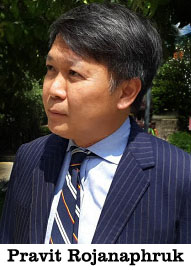
Pravit Rojanaphruk

According to the book “The Prohibited District: The Stasi Restricted Area Berlin-Hohenschonhausen” by Peter Erler and Hubertus Knabe, in the 1980s, anyone who “vilified” the state organs could be sentenced to up to two years in the prison.

Sound familiar?

Back to Thailand, as the kingdom approaches the 40th commemoration of the Oct. 6, 1976 massacre, the difference couldn’t be starker.

The Thai state is not doing anything to ensure that young Thais will remember what took place on that day almost four decades ago, when a mob of security forces and ultra-royalists killed at least 46, according to the government account. Some were lynched, and some survivors said more than 100 were killed. These people were accused of having committed the crime of being communist sympathizers and anti-monarchists. Some young female victims who were university students were raped and killed. Some perpetrators cast a deeply satisfied smile at the sight of dead bodies being repeatedly attacked and mutilated. Others were burnt alive or hung to death. The orgy captured by some photojournalists in print represents a testimony to arguably the ugliest and most senseless chapter in modern Thai history.

Today there’s no state-funded museum for Thais, particularly the young, to learn about this ugly past of Oct. 6, 1976. This historical incident continues to exist in obscurity among the majority of Thais, including young Thais, except for those who have a special interest in human rights, democracy and history.

There’s an old Thai adage that says: uneaten food will rot. Unrecounted old tales will be forgotten.

Pro-democracy activists and concerned academics are trying their best to document, make sense of the event and remind us of the significance of the day early next month. A number of forums are planned for next month, including ones at Chulalongkorn and Thammasat Universities despite Thai society being under military control. The front of Thammasat University at the Royal Lawn (Sanam Luang) was the actually site where the lynching took place.

Beyond these groups of politically-aware folks however, the general public continue to be oblivious to our society’s ugly past. We risk succumbing to the worst of political hatreds against those who think differently about politics and the monarchy if we do not try to properly learn from the past.

A state-funded museum and a guide or two who speak fluent English would also be helpful.

Correction: A previous version of this column indicated all victims of the massacre were lynched. Only some were killed by hanging, but the exact number is unknown.

Advertisement

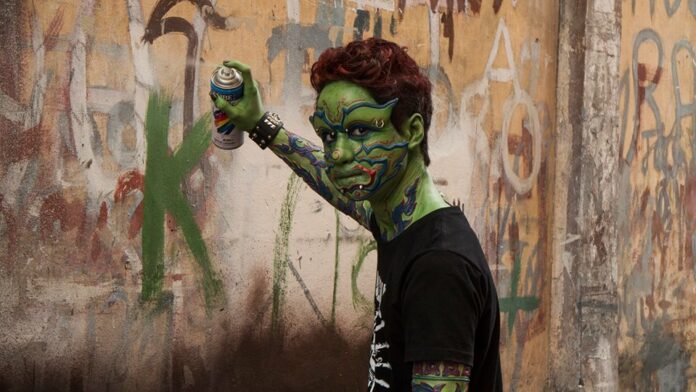
Internet Laughs Off Khon Controversy With Wonderful Memes

Photo: Teen Yak / Facebook

BANGKOK As debate over a tourism video using khon characters dominates the national conversation, the internet has weighed in with an abundance of humor and a fair amount of contempt.

The director of the video made for the tourism authority released a new version edited under pressure from a cultural purist who said scenes the fictional demons of Thai traditional dance go-karting and taking selfies was inappropriate.

Read: Khon Can’t Kart: Tourism Video Latest Front in Culture Wars

In recent days, disbelief that this was an issue inspired satire of the brouhaha in all forms, seemingly all in support of music video “Tiew Thai Me Hey (Travel in Thailand is Fun)” directed by Bhandit Thongdee for the Thai Tourism Authority.

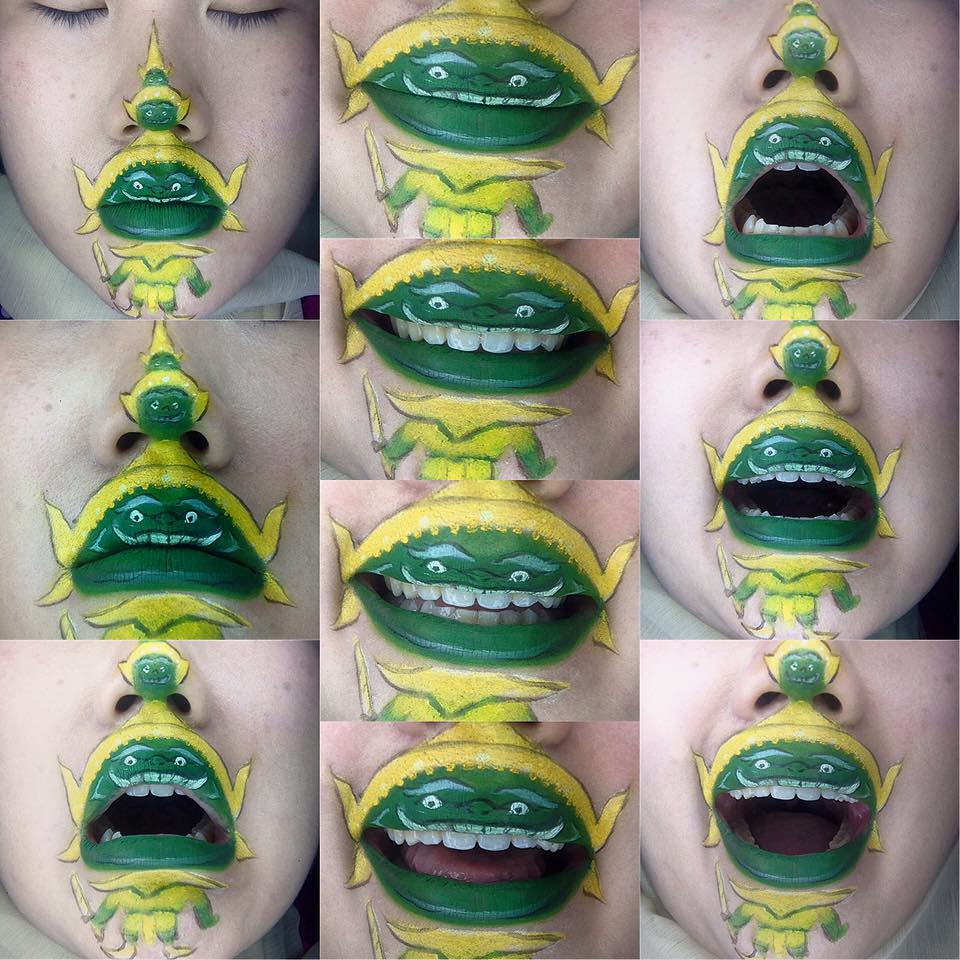
Popular Facebook outrage forum Drama Addict has even started a Thotsakan fanart contest, referring to the demon king who is a lead character in khon drama. The contest currently has more than 800 works submitted.

It’s certainly inspired a lot more inappropriate portrayals for Ladda Thangsupachai, former head of the Cultural Surveillance Bureau, to complain about.

Photo: Pompam Papang / Facebook

“Frozen Culture” chilled ready-to-eat lunch box. “Nationalism 50% Conservatism 50%” it reads. 

Photo: CafeMe2 / Facebook
Photo: Suchanat Chidthai / Facebook
A mural portraying the demon king Tosakan flirting with Benjagai, a female character in Ramakien. “Lemme grab, lemme touch.” said the blue line, and red line reads, “Don’t get naughty, baby.” Photo: Underground Karaoke / Facebook


Advertisement

MH370 Wreckage Hunter Determined to Solve Mystery

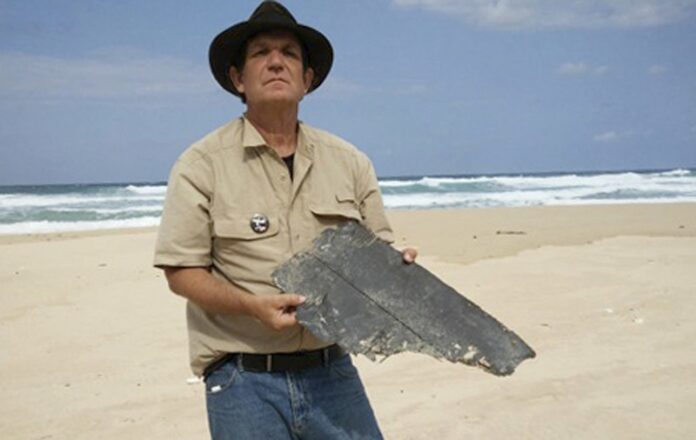
Blaine Gibson holds a piece of aircraft debris Sept. 16 on a beach in Madagascar. Photo: Blain Gibson / Associated Press

CANBERRA, Australia — The fedora, the bomber jacket and the consuming quest invite comparisons to Indiana Jones. Blaine Gibson, though, hasn’t matched the film hero’s triumph in finding the legendary chest containing the stone tablets inscribed with the Ten Commandments.

Not that he didn’t try. “The Ark of the Covenant, I did not find it. However, I do believe that it’s in Ethiopia somewhere,” Gibson told AP recently.

The amateur sleuth has had far greater success finding clues from a modern mystery: the disappearance of Malaysia Airlines Flight 370.

He is the first person searching for the plane who’s actually found any trace of it and says he won’t quit gathering clues until the mystery is solved.

“Travel is what I do, but I always love travel with a purpose, and solving the mystery of Malaysia 370 is a purpose … until I or someone else finds out what happened to the plane and those on board,” he said while in the Australian capital of Canberra to visit the headquarters for the official plane search.

The Boeing 777 carrying 227 passengers and 12 crew members is thought to have plunged into the southern Indian Ocean after inexplicably flying far off course during a flight from Kuala Lumpur, Malaysia, to Beijing, on March 8, 2014.

The first reports that Gibson had found a possible part of the plane met with skepticism. Other pieces of suspected debris have been stumbled upon by chance. But how could one private citizen succeed in finding a piece of the plane where a multi-government, multimillion-dollar search had failed? Answer: There is no official search being conducted, beyond that of the 120,000 square kilometers (46,000 square miles) of seabed southwest of Australia calculated to be the crash site.

But the triangular panel stenciled “no step” that Gibson found on Feb. 27 has been confirmed as almost certainly a horizontal stabilizer from a Flight 370 wing.

Gibson said he found himself in Mozambique partly because oceanographers had told him that debris might wash up on its beaches and partly because he had never visited the country. (The 58-year-old born in California has been to 177 countries in a quest to visit them all).

Getting to know relatives of the missing has ended any chance of him conceding defeat in his search.

“It was good management, but it was also a lot of luck,” Gibson said. “What you don’t see before that were the number of beaches that I combed in Reunion, in Mauritius in other parts of the world and found nothing.”

Gibson has since recovered another 13 pieces of potential debris in Madagascar, with the help of locals he has befriended who now search for him. He and victims’ relatives have been frustrated by Malaysia’s hesitance to collect the debris and potential personal effects and analyze them for clues.

Gibson hand-delivered five pieces of debris on Sept. 12 when he and relatives of Flight 370 victims met in Canberra with officials of the Australian Transport Safety Bureau, which is conducting the deep-sea sonar search on Malaysia’s behalf.

Warren Truss, a former deputy prime minister who oversaw the search until retiring from politics in February, expects more of Gibson’s finds will be confirmed. “He has certainly made a constructive contribution to the search,” said Truss.

Australian oceanographer David Griffin, one of two Gibson credits with pointing him the right direction, found the American to be frustrated that search responsibilities fell between cracks of coordinating agencies.

“He sees that one man can just go and get on with the job. I think it’s terrific that somebody who has the ability and resources to do that just gets on with it,” Griffin said.

Gibson has also been a volunteer archaeologist in Belize and Guatemala investigating the fate of the Mayan civilization. His old friend Peter Davenport said he was not surprised that the adventurer would immerse himself so completely in the aviation mystery.

Davenport, who is director of the National UFO Reporting Center based in Washington state, said he once got Gibson interested in the Tunguska event: a large explosion near the Stony Tunguska River in Siberia that flattened a vast area of forest in 1908.

“Next thing I know, he’s there trying to befriend people who knew something about it and trying to get to the heart of the mystery, which is still a mystery in my opinion. It was not a meteor, clearly,” Davenport said.

(Gibson concludes the explosion was caused by a meteor that vaporized in the atmosphere).

Davenport said his friend of more than two decades had the capability to solve mysteries as well as the desire.

“He is very engaging, he gets along with people very well, he’s non-confrontational, I would say, and these are all qualities that I think evoke in people a desire to work with him and to help him,” Davenport said.

Gibson said he has always worked to fund travel and selling his deceased parents’ home in Carmel, California, for more than USD$1 million in 2014 will keep him in the hunt for Flight 370.

But he and victims’ families wish governments would coordinate efforts to collect debris washing up on the western shores of the Indian Ocean. Studying the debris could explain the crash and drift modeling could better indicate where the main wreckage lies.

The underwater search is due to end around December if it finds nothing or fresh clues fail to pinpoint a crash site.

Gibson is not sure where he will search next, but the Seychelles and Comoros Islands are options unexplored.

He did not have a preferred theory of what happened, and warned against the public accepting a popular theory that Captain Zaharie Ahmad Shah stole the plane.

“People jump to that conclusion simply because there’s no other explanation, it’s easy to pin it on the pilot who is not around to defend himself, write the mystery off and the search off forever: that is not acceptable,” he said.

He said the missing plane was a world problem that more nations needed to work to solve. “We need to know that if we get on a plane, we’re not just going to disappear,” he added.

Story: Rod McGuirk

Advertisement

4 Dead in Shooting at Mall North of Seattle

Photo: Cascade Mall / Facebook

SEATTLE — Authorities in Washington state say four people have been killed during a shooting at a mall north of Seattle and that at least one suspect remains at large.

The Washington State Patrol says on Twitter that the four were shot Friday at the Cascade Mall in Burlington, about 65 miles (105 kilometers) north of Seattle.

Sgt. Mark Francis says authorities are searching for a man wearing gray who was last seen walking toward Interstate 5. Francis says it wasn’t immediately known if there was more than one gunman involved.

Francis said at about 8:30 p.m. that the mall had been evacuated and emergency medical personnel were cleared to enter and attend to any injuries. It wasn’t immediately clear how many people were hurt.

The Cascade Mall is an enclosed shopping mall in Burlington, Washington that opened in 1990, according to the mall’s website. It features J.C. Penney, TJ Maxx, and Macy’s stores, among other stores, restaurants and a movie theater.

Story: Lisa Baumann

Advertisement

Hot News

LATEST NEWS

Bangkok
overcast clouds
26.1 ° C
26.1 °
26.1 °
93 %
1.8kmh
100 %
Sat
33 °
Sun
35 °
Mon
37 °
Tue
37 °
Wed
36 °