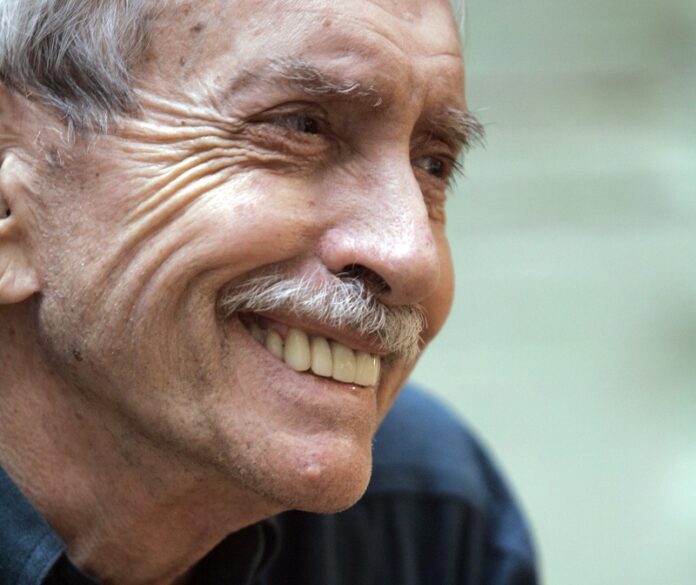
Lena Headey appears in a scene from "Game of Thrones." Photo: HBO
LOS ANGELES — HBO’s “Game of Thrones” is the winner of the best television drama series Emmy Award at Sunday’s 68th annual Primetime Emmy Awards at the Microsoft Theater.
The HBO fantasy series follows characters as they vie for power in a fictional world rife with brutality, magic and dragons.
AYUTTHAYA — Rescue workers were still searching for missing people after a boat sank late Sunday afternoon in the Chao Phraya River in Ayutthaya city, killing at least 13 and injuring 39.
At around 4pm on Sunday, a two-level vessel carrying more than 100 passengers from Nonthaburi en route to Ayutthaya foundered after crashing into a concrete berm at Wat Sanamchai and then sank, according to Krit Tienmittrapap, a city official.
Several people were still missing. Krit said the boat was carrying too many passengers.
Correction: An earlier version of this story misidentified what the vessel struck. It was a concrete berm and not a barge.
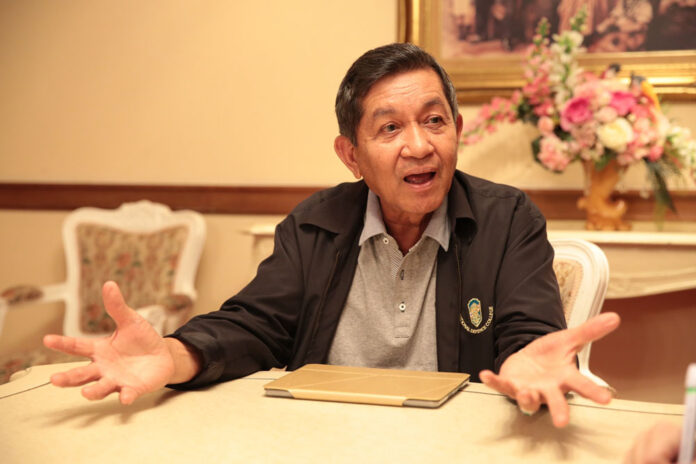
Former army chief and 2006 coup leader Gen. Sonthi Boonyaratglin, retired, during a Thursday interview on an army base in Bangkok.
BANGKOK — As Thailand’s first coup d’etat in over a decade was set in motion 10 years ago tomorrow, the man who ordered it was playing tennis at an army base near his home.
Gen. Sonthi Boonyaratglin said he later went home at about 8pm and listened to the news. Sure enough, tanks and troops under his command soon occupied all major government buildings. The elected government under then-Prime Minister Thaksin Shinawatra didn’t put up a fight. Sonthi, who was army chief at the time, was now in control of Thailand.
“It’s like fighting a war. In military principles, it’s about finding out and evaluating the forces of the other side,” Sonthi, now retired from the military, said in an exclusive interview Thursday at the same base he played on Sept. 19, 2006. “We already evaluated that there would be no resistance. No confrontation. Our information was clear.”
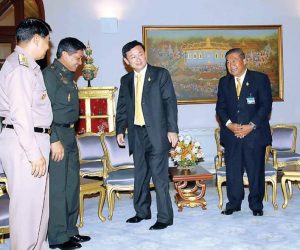
Former Prime Minister Thaksin Shinawatra, second from right, and army chief Gen. Sonthi Boonyaratglin, second from left, on Aug. 24, 2006, two weeks before Sonthi deposed Thaksin in a coup.
It was a coup that toppled the most popular elected government in Thailand’s recent history. Although Thailand had never been short of coups, the one in 2006 came as a major turning point in the conflict that pitted the grassroots-backed regime against urbanites and their allies in the establishment. It would later become a theme that defined the political crisis to span the following decade.
In an hour-long interview, Sonthi talked about how he views his legacy, and what he finds different between the 2006 coup and the latest one two years ago. As a ground rule, he said that he would not discuss the monarchy in any capacity.
Most of all, the general rejected the popular notion it was an “unfinished coup” which left conditions ripe for its follow-up in 2014 and said he has no regrets.
In his opinion, Thailand was on the verge of collapse. Anti-Thaksin protests, known as Yellowshirts, were taking to the streets at the same time as pro-Thaksin counter-protesters, and Sonthi said he learned that Thaksin planned to crack down on his opponents the next day on Sept. 20. He decided to step in to avert the crisis, he said.
“There would have been use of force on Sept. 20 against the anti-government crowds. There would be violence, and my job was to take care of the internal security of the nation,” Sonthi said. At the time the army had different plans for different scenarios, and he ordered the contingency plan that he said would prevent the bloodbath: a coup.
“I did what I had to do as a soldier,” he said, in summary of his actions.
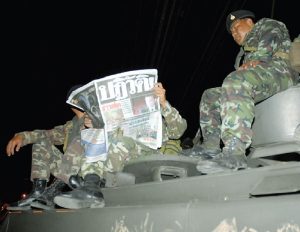
‘COUP!’ reads the front page of a Khaosod newspaper read by soldiers atop a tank on Sept. 20, 2006, one day after the military staged a coup against then-PM Thaksin Shinawatra.
Wasted Opportunity?
The coup came as a shock to many Thais because it had been 15 years since the last in 1991, which was widely thought to be “the last coup.” And the coup makers of 2006 followed the pattern of their predecessors: Sonthi assumed role as interim government leader for only two weeks before handing power – in name, at least – to a new prime minister, Surayud Chulanont.
Afterward, Sonthi receded into the background, remaining head of the junta, known officially as the Council of National Security, or CNS. Under the interim constitution, it had no formal power over the government.
He said the main objective of the coup, preventing the potential bloodshed, was already accomplished by the time he stepped down. Other aims that would later arise, like eradicating corruption, protecting the monarchy from slanders, and national reconciliation were works of the successive governments.
“It was the duty of other governments. I have already accomplished my mission. The coup d’etat achieved its objective,” Sonthi said.
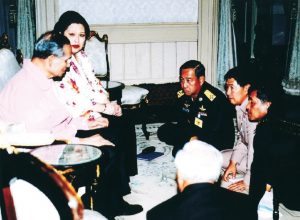
In a photo released by state media, the coup makers have an audience with His Majesty the King and Her Majesty the Queen at the Chitralada Palace on the night of Sept. 19, 2006.
But not everyone shared his opinion. While progressives and opponents of the military regime naturally denounced the coup, conservatives and hardline anti-Thaksin activists also criticized Sonthi’s regime for not going far enough to root out Thaksin’s influence in Thai politics. The main accusation is that the coup was a sia kong, or “wasted opportunity.”
“It was a sia kong coup, because it couldn’t stop ideological divisions of both sides,” an anonymous blogger wrote in 2009. “If anyone will stages a coup again, they have to think beyond merely stopping the bleeding, but to also bring peace to the country. If they cannot do that, don’t think of another sia kong coup.”
Thaksin, who was attending a U.N. meeting in New York City when the putsch came, assumed a life in exile. Yet his allies and family members continued to wield political influence on his behalf, including his sister Yingluck Shinawatra, elected prime minister in 2011 by a political base that welcomed her as a proxy for her brother.
After then-PM Thaksin learned of the unfolding coup, he announced a state of emergency and fired Sonthi as army chief. But it was too late; coup forces had already taken control of the capital
Sonthi rejects the allegation that he left the job undone as empty rhetoric to discredit his regime. He said he did what he could with what little time he had.
“It’s just rhetoric that is used again and again,” said Sonthi, who briefly dabbled in politics as an opposition MP in 2011. “I only had 14 days [as interim prime minister]. I already did the big job. That is all I could do. And it was an honorable job, too.”
But whereas Sonthi took a backseat in the aftermath of the 2006 coup, the army chief to follow suit eight years later, Gen. Prayuth Chan-ocha, broke with tradition. Retaining both positions as junta chairman and prime minister, Prayuth directly ran the post-coup administration and aggressively dismantled pro-Thaksin organizations. On Monday, the 10th anniversary of Sonthi’s coup and more than two years after his own, Prayuth will be in New York City at the head of the Thai delegation for a U.N. meeting focused on migrants and refugees.
Prayuth’s suppression of expression and political speech, which makes Sonthi’s regime look relatively enlightened, probably worked, too. Last month’s charter referendum, which turned out a sweeping junta victory for the junta, was even a greater blow to Thaksin’s political dynasty than 2007, when the post-coup regime’s preferred constitution won approval by a much narrower margin.
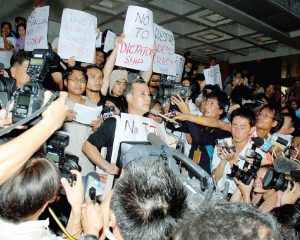
An anti-coup protest on Sept. 22, 2006, at Siam Paragon in Bangkok.
Old and New
Sonthi acknowledged that Prayuth is sterner stuff, and although he said he would never run a government by himself, he sympathized with Prayuth for choosing to do so.
“He had to come down and do it himself because, if not him, who would?” Sonthi said. “And if he appointed someone to the job, but that person refused his orders, what would he do? If anything goes wrong or turns against him, it will be his head on the block.”
He said Prayuth’s harsh measures are justified because the situation is more severe than in 2006. Ten years ago, Sonthi said, there was no centralized opposition movement – the group that would later become the Redshirt umbrella organization wasn’t formed until late 2007 – and political divisions were not yet so apparent.
The general also justified the coup as yet another necessary measure to save Thailand.
A man hangs garlands on a tank Sept. 22, 2006, in Bangkok.
“It was a situation that doesn’t leave any other solution,” Sonthi said. “The conflict was peaking. Parts of the city were occupied by protesters. Corruption was more severe than ever. So the army was forced to do something.”
But that goes back to the question: If such crisis returned to force the army’s hand again, doesn’t that make the 2006 coup a failure? As it has been argued, didn’t it leave a mess that had to be cleaned up by the 2014 coup makers?
Sonthi doesn’t think so. He maintained the faults laid with the governments that came after his regime, who should have behaved fairly and fixed Thailand’s problems. Instead, he said, they ended up perpetuating the conflict by looking after their own.
“When the state rulers were Pheu Thai, they sided with Pheu Thai. When the state rulers were Democrats, they sided with Democrats. So it just led to new conflict again.” Sonthi said.
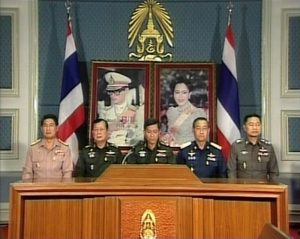
Gen. Sonthi sits at center in the first televised speech by the junta after it staged the 2006 coup.
So does he consider his job done well?
“Of course,” Sonthi said. “If on that day, I didn’t do it, can you imagine what would have happened? The consequences of that day made the country better.”
What about the current junta that’s embarking on yet another quixotic quest to root out all problems in Thailand?
“They’re doing it. But it’s not easy … so they have not accomplished the goals yet. But I see their effort,” he said.
Sonthi said he hopes the next government taking charge after a new election in 2017 will be impartial and transparent. Otherwise, he warned , the military will have to step in again.
“If the government doesn’t do those things, people would come out on the streets again, and it would end up like in the past,” Sonthi said.
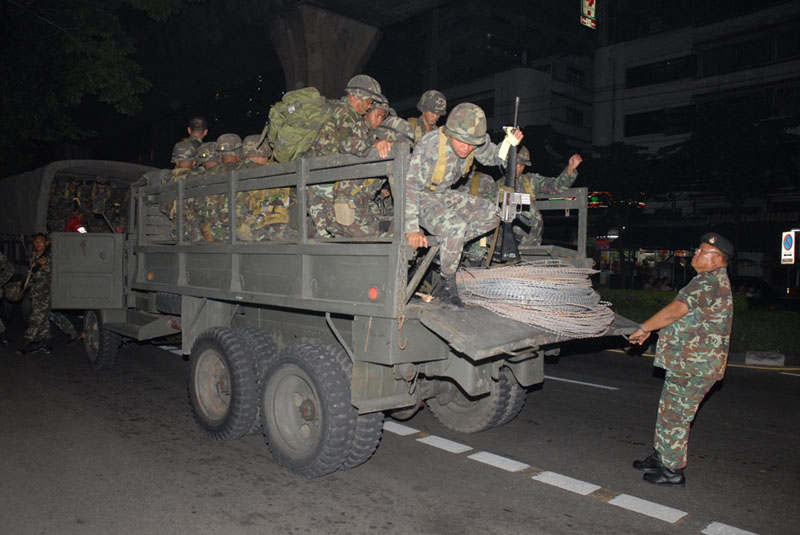
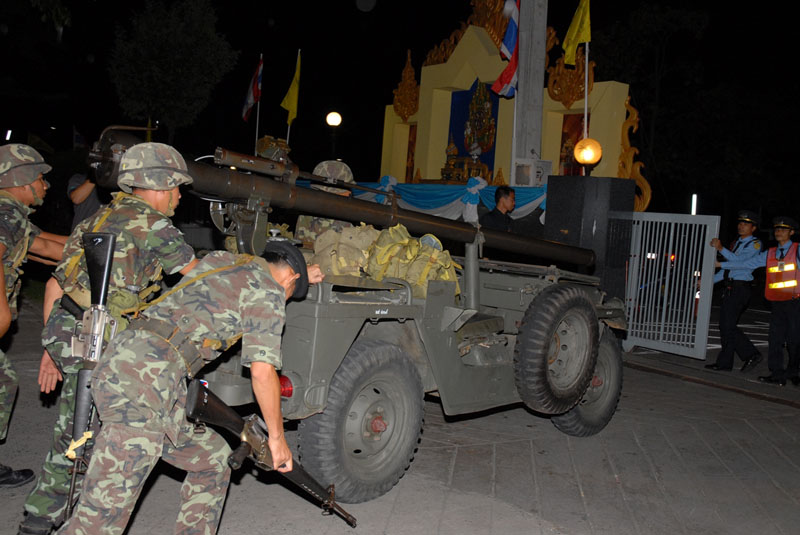
Soldiers deploy on Phahonyothin Road in Bangkok to set up roadblocks on the night of Sept. 19, 2006.Soldiers arrive to seize control of Channel 5 on the night of Sept. 19, 2006.
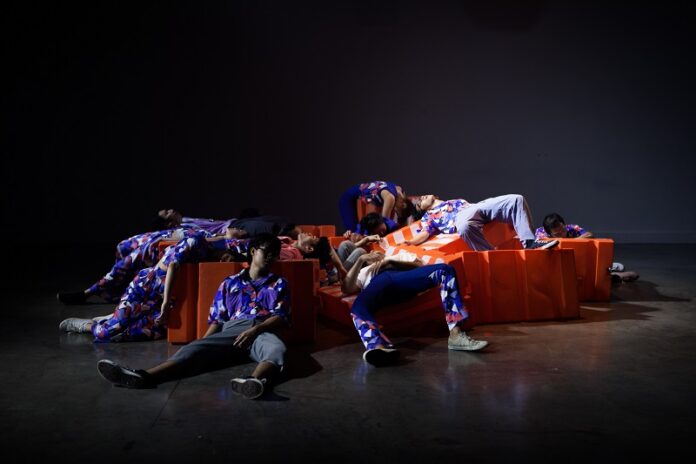
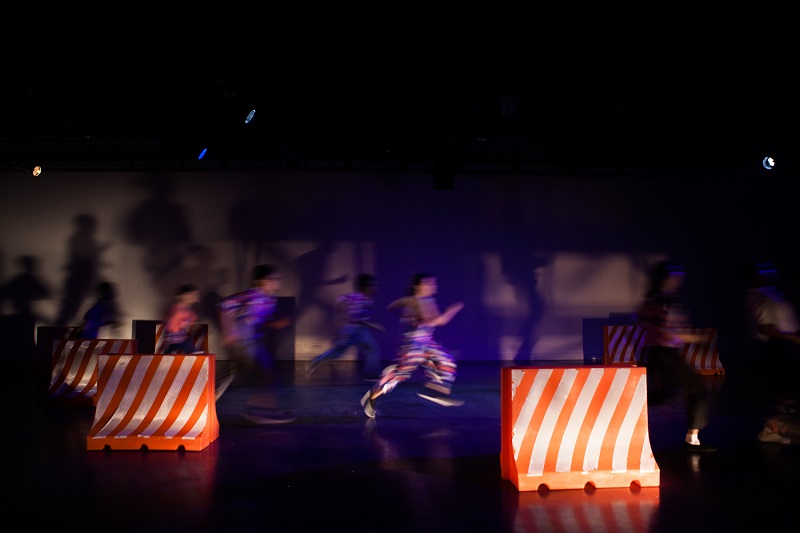
BANGKOK — People rise lifelessly behind orange road barriers. They take on different identities and personalities through movements alternating between zombies shuffling, mobs lynching, gunmen shooting, spectators cruelly laughing and shirtless students crawling.
“Fundamental,” an hourlong performance by the B-Floor theatre company, opened Wednesday to commemorate the Oct. 6 massacre, which happened 40 years ago, in a physical performance of movement. All minimally portrayed by 13 people, two mops, portable plastic barriers and a Roomba.
“Wherever the materials are, that’s where we are,” director Teerawat “Ka-ge” Mulvilai said at a recent rehearsal of his latest play.
It was back in 1999, when Ka-ge, then a recent arts grad and part of another Bangkok theatre troupe, wondered what a play would be like without spoken dialogue. That led to the founding of B-Floor, and 10 members who would meet every day at the Pridi Banomyong Institute to experiment with things they’d never done.
“Anything we have seen before, we wouldn’t do it,” Ka-ge said, adding that each of their very first productions consumed nearly six month, dealing with human body and visual elements.
Today B-Floor is still going strong. They’ve staged two performances this year: “Red Tanks” in February and “Fundamental” which runs a couple more weeks. Its members have performed abroad from Singapore to Germany.
Among dozens of productions over 17 years, B-Floor has reflected the issues around them from performances addressing violence in Southern Thailand and Buddhist monastic taboos to the daily injustices of society.
Its approach has put B-Floor at odds with the prevailing values – and in an increasingly fraught climate for expression since the military coup – in the sights of those intolerant of dissent.
All productions share one principal: Act more, talk less.
‘Iceberg,’ a 2015 solo performance by Ka-ge.
“As actors, we train our bodies to find their ‘quality,’” said Sasapin “Pupe” Siriwanij, who has performed with B-Floor since 2008. “With props, lighting and sound; we’re another element to make the director’s vision happen.”
Of course, when it comes to criticizing or questioning something without discourses, B-Floor’s works are often perceived as ‘too abstract.’ Some theatre amateurs would walk out of the studio with frowns, regret buying the tickets.
“Thai audiences in general just like being told,” actor-director Pupe said. “So when we don’t tell them directly, the audiences would think our work is too hard to understand … They think not understanding what’s going on is a failure.”
Any tips for enjoying B-Floor’s shows? Ka-ge says just trust yourself. Believe in what you see and feel. Time will help.
“If you’re gonna obsess over a certain scene – ‘What does it mean?’ – it’s impossible,” he said. “You need to sit and watch what happens, think and feel it. Let it sink in.”
B-Floor considers all members equal, but most performances are directed by either Ka-ge, Pupe or Dujdao Vadhanapakorn.
Ka-ge’s known for ensemble casts with themes that question society’s structure, while Pupe does something else.
Dujdao approaches things in a wholly different way.
“My works focus on individuality,” said Dujdao, known as the country’s only dance movement psychotherapist. “I look at the social issues, dig deeper into each individual and make them feel most connected to the issue.”
Last year at Dujdao’s “Secret Keeper,” the audience sat around a shallow, water-filled pool in which they would whisper their secrets to the performers beneath a steady drip of melting ice. Their secrets told, some looked relieved; others broke down into tears.
A promo for Dujdao Vadhanapakorn’s ‘Secret Keeper’
Unlike Dujdao, B-Floor co-founder Jarunan Phantachat has a different approach. She said her recent interest has been the interaction between audience and performer. She wants to have a conversation with her audience. She wants to know how they feel living in the same room.
Jarunan credits the 2014 coup for giving birth to last year’s “The Test of Endurance.” To attend, people first had to pass a test, including exchanging emails with the production crew. Some failed. At the play, “qualified” audience members were asked to wear sarongs before entering a room to watch traditional Thai dance.
Dead fish hung around the room provided a rank odor. Audience members could walk out at any time. The show ended when the last person did so.
“Each performance is unique. They can’t be the same,” Jarunan said.
Sasapin ‘Pupe’ Siriwanij, at left, and Jarunan Phantachat in ‘The Test of Endurance.’ Photo: B-Floor / Facebook
Stage Under Junta’s Spotlight, Meets Controversy
Soon after the military came to power and began to stamp out dissent, it paid close attention to the arts. It even took up a case of royal defamation against two student activist performers for 2013’s “The Wolf Bride.” It would send them to prison for two years.
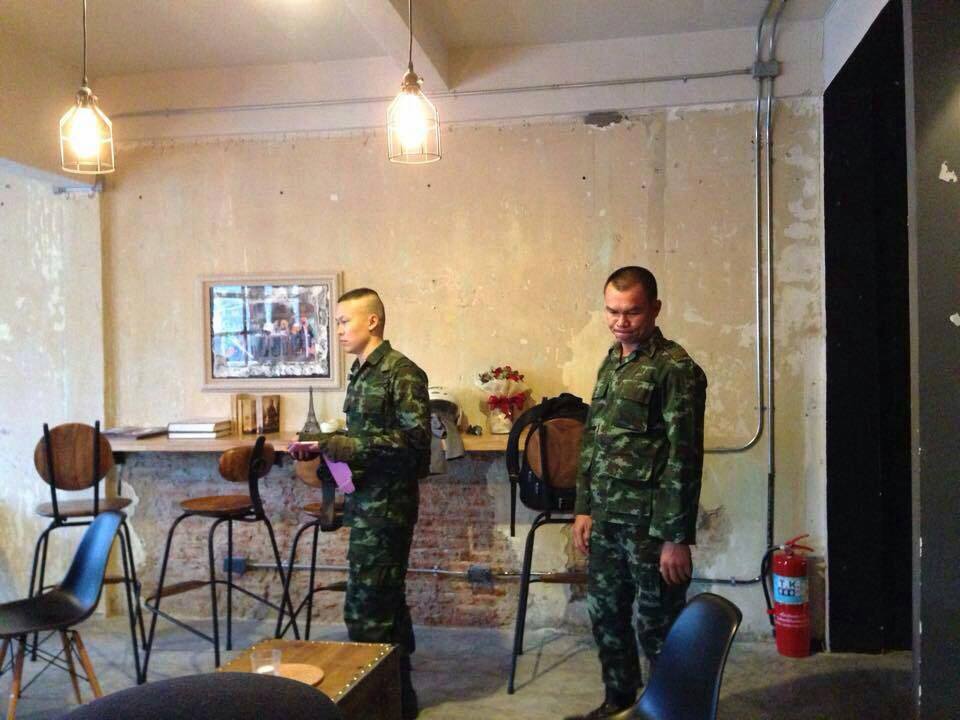
At a B-Floor production in 2015 at Thong Lor Art Space, two military officers were among dozens attending the production. They recorded the whole play. Every day before skipping the final two performances.
In fact B-Floor needed to get permission from the military for the first time Ornanong “Golf” Thaisriwong performed “Bang La Merd” there that January.
Two military officers at Thong Lor Art Space in January 2015 for ‘Bang La Merd.’ Photo: B-Floor / Facebook
Golf’s solo performance wasn’t new. Inspired by the conviction of Ampon Tangnoppakul for insulting the monarchy, it had first been staged without incident in 2012 at Pridi Banomyong Institute, the theatre troupe’s home. In 2015, she was invited by the curator of Thong Lor Art Space to restage it there.
“I wholeheartedly said yes,” Golf said. “I felt that at the time the play could still speak out to the audience. It was a short while after the coup and the [Thai Criminal Code] section 112 remained occur almost every day.”
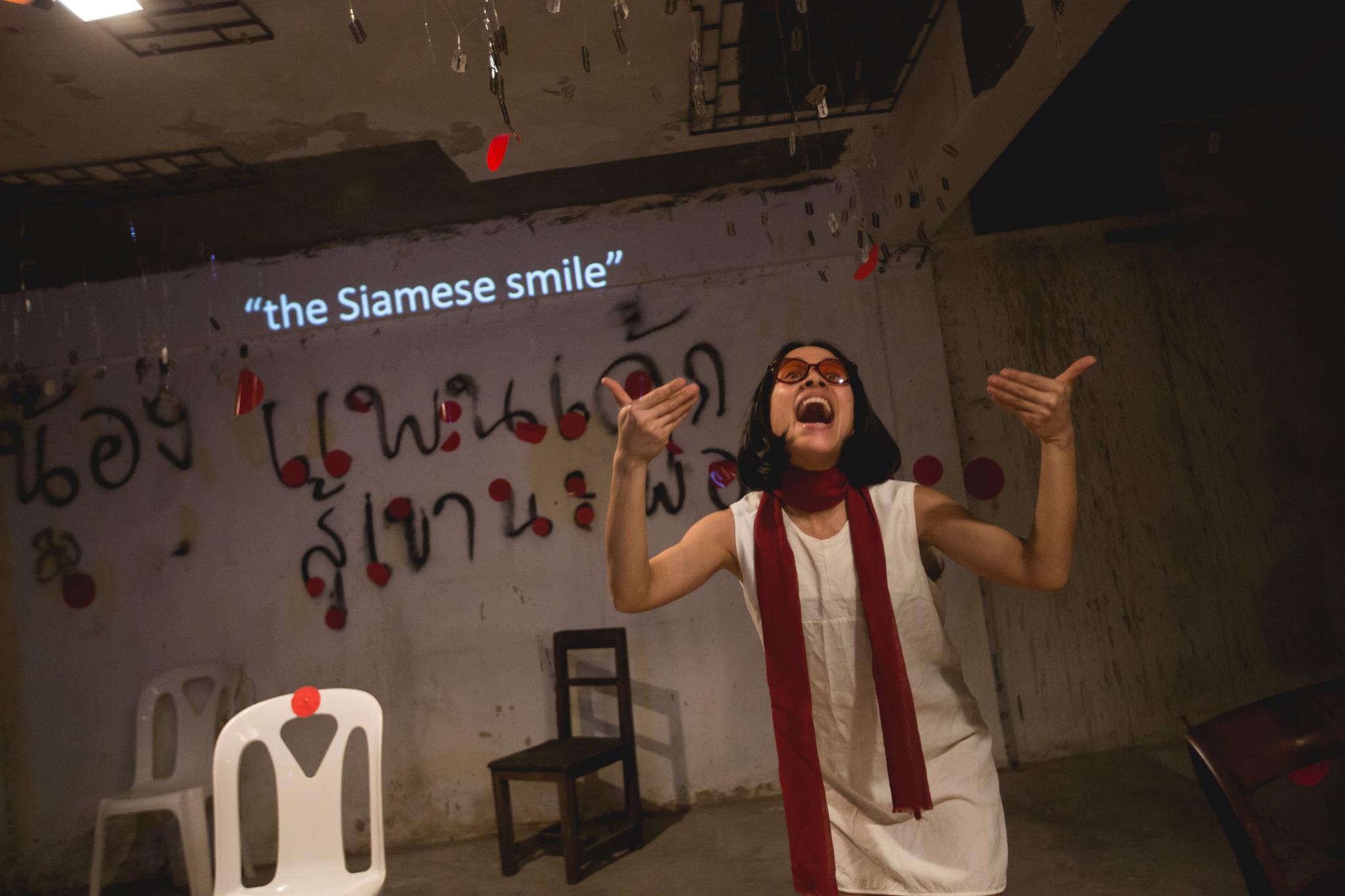
For 2015, she decided to update the performance by basing it on the cases of make it current. She created a literally dangerous space by hanging razor blades and changed its real-world basis to the that of Pornthip Munkong and Patiwat Saraiyaem, the two actors jailed for “The Wolf Bride.”
“We grew up with these issues. We had been taught to not talk about some specific topics in public,” the 35-year-old said. “If I talked about these issues in England or France, it would be very trivial for them. But in Thailand, it’s critically serious.”
Ornanong ‘Golf’ Thaisriwong performs “Bang La Merd” at Thong Lor Art Space in 2015. Photo: Thong Lor Art Space / Facebook
Apart from the two officers sent there to observe the play, did the audience enjoy the it? Not everyone.
An unexpected, emotional outburst broke out when a woman stood up in the first 15 minutes of the play while Golf mimics a teacher instructing the audience in “the Siamese smile.”
“Your show sucks, your show sucks, your show sucks!” the woman yelled in English. While everyone was stunned and shocked, Golf said she approached the woman, who told her she felt insulted and wanted to walk out immediately.
Although Golf thinks it’s not fair for her work to be judged at the middle of the play, she was glad her audience spoke up.
“I was thankful she expressed herself. It’s her right not to watch the play,” Ornanong said. “I wanted someone like this, someone who dares to speak out what they feel or think without using violence.”
So Who Cares?
By throwing out conventions to do experimental theater on challenging topics, B-Floor is definitely not theater for the masses. In fact, it may just be for other like-minded people, judging from the same faces which appear in their audiences. And no matter how artistically compelling their productions may be that they create and perform around the world, the group agrees their support in Thailand is small.
Without any hope of commercial success, their natural ally would be government support for fine arts. But that may be unlikely for a group that wouldn’t hesitate to bite the hand that feeds them.
“At no time, has any government given full support. Plus, people in general think our work is not entertaining,” Jarunan said, but said she’s not so surprised. “In every country, there are more movie-goers than theatre-goers, and more cinemas than theatres.”
Golf agreed the imbalance is about people’s personal preferences, as with any mainstream versus marginal culture. But what matters most, she said, is having a diverse space for expression.
“There’s no way the audiences [for movies and plays] can be even,” Golf said. “But I don’t believe that they would stick to seeing the same thing all the time … I think diversity should be encouraged so the people can choose what they want to watch.”
After 14 years with B-Floor, she said it’s a topic that has been put to rest.
“We shouldn’t hope for the government’s support,” she said. “If we did, we would have packed it in a long time ago.”
What’s important to Ka-ge is mostly support from other artists. To him, expression through the arts must be free, regardless of how different or opposed the opinions.
“No matter how they may think differently from us, when self-expression through art is forbidden – that’s dictatorship.”
Check out B-Floor through their Website, Facebook and Twitter. Their performance of “Fundamental” continues daily except Mondays and Tuesdays through Oct. 2 on the fourth-floor of the Bangkok Art and Cultural Centre. Tickets are 550 baht at the door and can be purchased in advance for 450 baht.
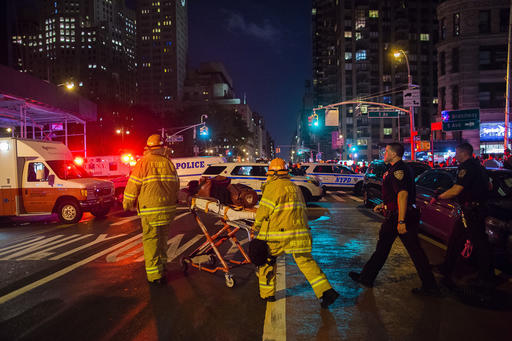
Police and firefighters work near the scene of an apparent explosion on Saturday in Manhattan's Chelsea neighborhood, in New York. Photo: Andres Kudacki / Associated Press
NEW YORK — An explosion in a crowded Chelsea neighborhood in Manhattan on Saturday night left 29 people injured, and authorities called the blast an “intentional act,” but said there was no terrorist connection.
New York Mayor Bill de Blasio also said a second site was being investigated.
“Tonight, New York City experienced a very bad incident,” de Blasio said at a news conference near the scene. “We have no credible and specific threat at this moment. ”
De Blasio said the blast was “an intentional act” and tried to calm any fears among nervous New Yorkers, saying the explosion had no terrorist connection and wasn’t related to a pipe bomb explosion earlier Saturday in New Jersey at a charity run.
A law enforcement official told The Associated Press that the explosion appears to have come from a construction toolbox in front of a building. The official spoke on condition of anonymity because the person wasn’t authorized to speak about an ongoing investigation.
New York officials said the incident was not due to a gas leak.
The blast happened on West 23rd street, front of a residence for the blind, near a major thoroughfare with many restaurants. Witnesses say the explosion at about 8:30 p.m. blew out the windows of businesses and scattered debris in the area. Officials said no evacuations were necessary.
Police spokesman J. Peter Donald said several people were taken to hospitals with injuries. One of the injured suffered a puncture wound and was considered serious. Officials said the other injuries were minor, described as scrapes and bruises.
Donald tweeted a warning to residents near the second site that officials are investigating, saying: “As a precautionary measure, we are asking residents who live on West 27th Street between 6th and 7th Avenues in Manhattan to stay away from windows facing 27th Street until we clear the suspicious.”
A number of New York City subway routes have been affected by the earlier explosion.
Chris Gonzalez, visiting from Dallas, was having dinner with friends at a restaurant in the area.
“We felt it, we heard it, the restaurant went real quiet, the 26-year-old Gonzalez said. “It wasn’t like jolting or anything, everyone just went quiet.”
Rudy Alcide, a bouncer at Vanity Nightclub at 21st Street and 6th Avenue, said he, at first, thought something large had fallen.
“It was an extremely loud noise, everything was shaking, the windows were shaking, it was crazy,” he said. “It was extremely loud, almost like thunder, but louder.”
The FBI and Homeland Security officials, along with the ATF arson and explosive task force are also at the scene.
The White House said President Barack Obama has been apprised of the explosion in New York City and will be updated as additional information becomes available.
In St. Cloud, Minnesota, police said multiple people were injured at a shopping mall Saturday evening in an attack that possibly involved both a shooting and stabbing. The suspect was believed to be dead.
Hillary Clinton says she has been briefed “about the bombings in New York and New Jersey and the attack in Minnesota.”
She says the nation needs to support its first responders and “pray for the victims.”
“We have to let this investigation unfold,” she said.
The reports of a possible blast come hours after a pipe bomb exploded in Seaside Park, New Jersey, shortly before thousands of runners participated in a charity 5K race to benefit Marines and sailors. No injuries were reported.
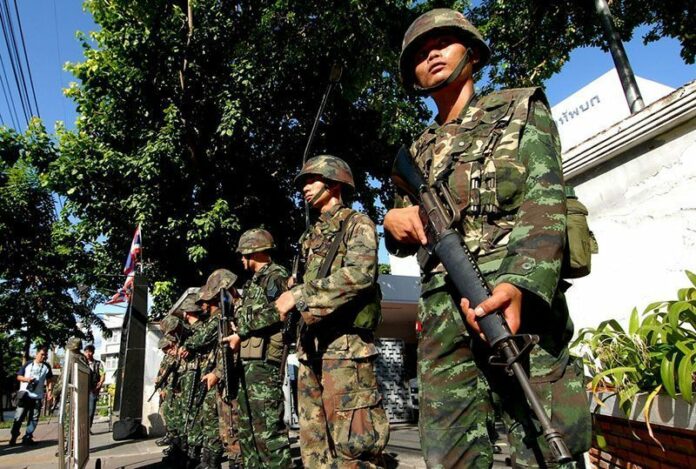
Soldiers posted outside an army auditorium where civilians were being brought in for ‘attitude adjustment’ one day after the coup on May 23, 2014, in Bangkok.
As with any action, there are different points of view on this week’s decision by junta leader Gen. Prayuth Chan-ocha to end the use of military tribunals to try civilians.
One can be positive about the junta’s latest political act and say Prayuth is merciful to end the use of military tribunals for cases deemed security related, at least until one considers those already charged were not included in the gesture.
Supporters of the National Council for Peace and Order, as the junta is callled, see it as proof the regime is willing to accommodate calls by the international community to end the practice. They see this as a positive sign is iron grip on society is gradually relaxing, and it’s not the extremist dictatorship described by critics.
It also reflects a military regime more at ease with wielding the power it robbed from the electorate then codified through a constitution it brokered no dissent in getting passed by 16 million voters.
Thai society may seem a tad less militarized as a result, but the move is far from altruistic.
Next week the government faces another review of its human rights record in Geneva. There it’s unlikely forgotten that since the May 2014 coup, 1,864 civilian cases have gone to military trial, according to Thai Lawyers for Human Rights. And many more are still heading there. The coup makers’ most prominent critics are among them.
People like Sombat Boonngam-anong, who made an early call for the public to rise up against the coup, and dozens of student activists, such members of New Democracy Movement. Known names such as Rangsiman Rome and Sirawit Seritiwat along with others whose names are not in the news. All still face long jail terms to be decided in military courts where they enjoy far fewer rights.
Thus the die-hard troublemakers remain on a short leash.
Some have said the move came because the military is inundated by nearly 2,000 cases, so they must allow the civilian court of justice relieve the burden.
More importantly, deputy junta leader Gen. Prawit Wongsuwan stated for the record that the junta may revoke the order if the situation gets out of control.
It reminds the public that, in fact, Thailand is becoming more dependent on use of the arbitrary absolute power known as Article 44 of the junta’s interim constitution, which gave Prayuth the unreviewable power to override all three branches of power: executive, legislative and judiciary.
Trapped in a seemingly endless cycle between use of accountable and absolute powers, the prevailing message is that power need not be accountable, to the detriment of the principle of rule of law.
The rule by law – as dictated by the junta – is becoming normalized as it continues using its unaccountable and absolute power.
While civilians opposed to the junta may not be fated to military prosecution, Thai society will continue to militarize.
Like it or not, even repealing the use of military courts against civilians provided just another reminder of this.
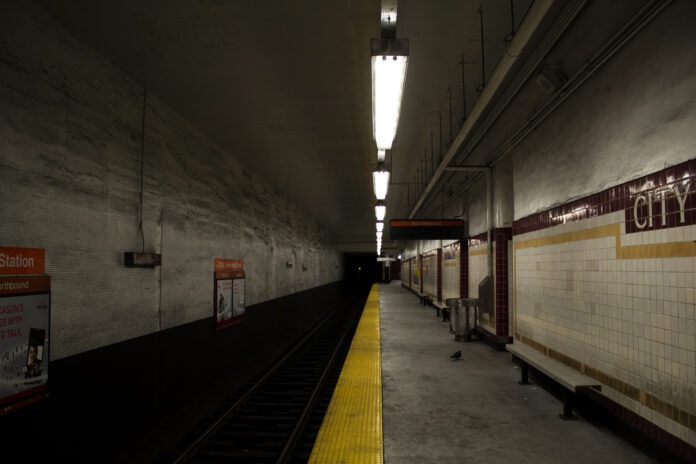
PHILADELPHIA – The city’s main transit agency plans to try urine-repelling paint to combat smells and complaints about cleanliness.
The Southeastern Pennsylvania Transportation Authority will run a trial this fall of a product called Ultra-Ever Dry, a surface coating that makes urine spray back on the offender.
SEPTA spokesman Andrew Busch said complaints are common for any large transit system. SEPTA’s maintenance crews are always looking for new ways to tackle cleanup issues aside from their regular cleaning routines, he said.
The coating has been used in public spaces in San Francisco and Hamburg, Germany.
“From what we’ve understood, it seems like there’s been some success (with the coating) so we are certainly willing to give this a try,” Busch said.
San Francisco’s public works department used the clear, liquid repellent on some of its city walls to fight a chronic public urination problem. A light pole corroded by urine fell on a car in San Francisco last year.
Public urination in Philadelphia, as in San Francisco, is illegal. The offense carries a USD$300 fine.
SEPTA officials haven’t decided whether they’ll coat elevators, which San Francisco’s Bay Area Rapid Transit agency did to 80 elevators last month, or try the repellent on walkways or walls.
The news website Billy Penn first reported the agency’s plans.
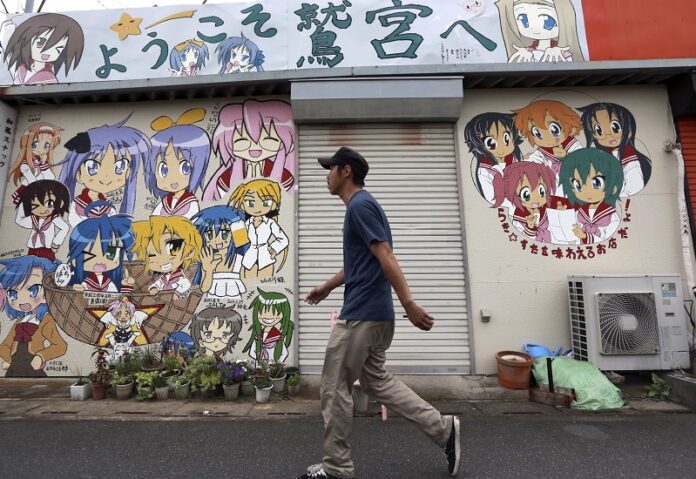
A man walks by an eatery with its facade painted with letters that read "Welcome to Washinomiya" and the characters of a TV animation series "Lucky Star" or "Raki Sta" near Washinomiya Jinja shrine On Friday in Saitama Perfecture, Tokyo. Photo: Eugene Hoshiko / Associated Press
TOKYO — Eighty-eight places in Japan are going to be designated “animation spots” to encourage visitors to seek out the train stations, school campuses, rural shrines and other fairly everyday places where popular “manga” characters are depicted.
Such landmarks number in the tens of thousands, given the popularity and volume of “manga” comics in Japan, but the project aims to compile the official list for any fan’s animation “pilgrimage,” as the places are known as “seichi,” or “sacred spots.”
Anyone can vote on the landmarks through a website set up in several languages, including English and Chinese.
“Japanese pop culture has grown to rival American Hollywood,” Tsugihiko Kadokawa, chairman of Kadokawa Corp. publisher and film studio, one of the officials behind the effort, said Friday at a Tokyo news conference. “Animation can change the times.”
The project highlights Japan’s push to make tourism a valuable boon for a stagnant economy, as dynamic as the export of Toyota vehicles and Sony electronics.
Foreign tourism has grown, under a “Cool Japan” initiative, reaching 20 million people last year — five years ahead of a goal set by the government, prompting officials to raise its 2020 target to 40 million tourists.
Kadokawa and other officials behind the newly formed Japan Anime Tourism Association said they would compile a travel route of 88 animation spots by December, including where manga and animation works took place, as well as the homes of manga artists and museums dedicated to their works.
Votes from fans will be considered in compiling the list. “Vote for the special spot you want to share with everyone,” the site says.
One shoo-in for the list, according to organizers, is Washinomiya Jinja, a picturesque shrine in Saitama prefecture on the outskirts of Tokyo, a familiar scene in comics by Kagami Yoshimizu, which later became a TV animation series, “Lucky Star” or “Raki Suta.”
The shrine is not as grand or famous as others in the country, such as Meiji Shrine in central Tokyo, but it’s still the one to visit for those who love the manga series, which depicts friendship among schoolgirls, all illustrated with the huge eyes and colorful hair characteristic of manga.
The shrine appears in the opening sequence to the TV show, whose typical episode will feature a heated discussion in cute, cooing voices on the correct way to eat a pastry.
Hopes are high at Washinomiya Jinja that it will be picked.
“I’m all for it,” said Teruko Masaki, whose restaurant near the shrine sells noodles and other products with the manga characters splashed on the packaging.
The pieces of wood on which visitors write their wishes, such as getting accepted at a college or having a healthy baby, are, at Washinomiya, covered with drawings of the “Lucky Star” girls.
Other possible animation spots include the “Gundam” giant robot statue on Odaiba, an artificial island in Tokyo Bay, and the Ghibli Studio of Hayao Miyazaki, the Oscar-winning animator who made “Spirited Away.”
Louis Lee, an editor from Hong Kong, who was at the Tokyo launch of the Japan Anime Tourism Association, said he was an avid manga fan, especially of “Slam Dunk,” a story about a high school basketball team.
“It teaches you not to give up until the end,” he said.
Fans like Lee say manga has proven useful for studying Japanese language and culture. They say animation spots should have manga character costumes that visitors can wear in photos, as well as manga-related products for sale.
The government’s Japan Tourism Agency has begun to study not only the numbers of tourists coming to Japan, but what compelled their visits. The agency’s survey of French and Thai people found that, although the two groups varied on what they hoped to do, they both said they became interested in Japan through movies and other entertainment content.
“But we are still not taking full advantage of such resources,” said agency Commissioner Akihiko Tamura. “A lot of work still needs to be done.”
Edward Albee is photographed during an interview in New York in 2008. Photo: Mary Altaffer / Associated Press
NEW YORK — Three-time Pulitzer Prize-winning playwright Edward Albee, who challenged theatrical convention in masterworks such as “Who’s Afraid of Virginia Woolf?” and “A Delicate Balance,” died Friday, his personal assistant said. He was 88.
He died at his home in Montauk, east of New York, assistant Jackob Holder said. No cause of death was immediately given, although he had suffered from diabetes. With the deaths of Arthur Miller and August Wilson in 2005, he was arguably America’s greatest living playwright.
Several years ago, before undergoing extensive surgery, Albee penned a note to be issued at the time of his death: “To all of you who have made my being alive so wonderful, so exciting and so full, my thanks and all my love.”
Albee was proclaimed the playwright of his generation after his blistering “Who’s Afraid of Virginia Woolf?” opened on Broadway in 1962. The Tony-winning play, still widely consideredAlbee’s finest, was made into an award-winning 1966 film starring Elizabeth Taylor and Richard Burton.
The play’s sharp-tongued humor and dark themes were the hallmarks of Albee’s style. In more than 30 plays, Albee skewered such mainstays of American culture as marriage, child-rearing, religion and upper-class comforts.
“If you have no wounds, how can you know you’re alive?” a character asks in Albee’s 1996 “The Play About the Baby.”
“It’s just a quirk of the brain that makes one a playwright,” Albee said in 2008. “I have the same experiences that everybody else does, but… I feel the need to translate a lot of what happens to me, a lot of what I think, into a play.”
Albee challenged audiences to question their assumptions about society and about theater itself. He did it with humor and a sense of linguistic delight, using withering barbs and word play to hint at deeper meaning.
Praise for the playwright came from far and wide on Twitter after his death. Mia Farrow, who was in a staged reading of “Who’s Afraid of Virginia Woolf?” called Albee “one of the great” playwrights “of our time.” Michael McKean wrote: “There was only one Edward Albee. #Irreplaceable.” Playwright Lynn Nottage wrote: “I will miss his wit, irreverence & wisdom. He enlivened the theatre landscape.”
Albee’s unconventional style won him great acclaim but also led to a nearly 20-year drought of critical and commercial recognition before his 1994 play, “Three Tall Women,” garnered his third Pulitzer Prize. His other Pulitzers were for “A Delicate Balance” (1967) and “Seascape” (1975).
Many of his productions in the years after “Seascape” were savaged by the press as inconsequential trickery, a shadow of his former works. But after “Three Tall Women,” a play he called an “exorcising of demons,” he had several major productions, including “The Play About the Baby” and “The Goat or Who Is Sylvia?” which won him his second Tony for best play in 2002.
Many of his works had similar things in common: domestic rancor inflamed by booze, a sense of unknown anxiety, a lost child who creates a marital friction and precise but flailing language that alternates between comic and profound.
In interviews, Albee recoiled at the idea of drawing parallels between his works or between his cynical outlook and his unhappy childhood.
“Each play of mine has a distinctive story to tell,” he told The Santa Fe New Mexican in 2001.
Albee was born in 1928 and was adopted by a wealthy suburban New York couple. His father, Reed Albee, ran the Keith-Albee chain of vaudeville theaters; his mother, Frances Albee, was a socialite and a commanding presence who kept a hold on him for much of his life.
Estranged from his parents, Albee moved to New York and worked as a messenger for Western Union before gaining notice with “The Zoo Story,” a one-act play written in 1958 about two strangers meeting on a bench in Central Park.
With “Who’s Afraid of Virginia Woolf?” and 1964’s “Tiny Alice,” Albee shook up a Broadway that had been dominated by Tennessee Williams, Miller and their intellectual disciples.
“Who’s Afraid of Virginia Woolf?” presents an all-night drinking bout in which a middle-age professor and his wife verbally spar and unravel their illusions during a visit by a younger couple. It won five Tonys including best play, actor (Arthur Hill) and actress (Uta Hagen), and the film version won five Oscars including best actress (Taylor) and supporting actress (Sandy Dennis).
Albee also directed the American premieres of many of his plays, starting with “Seascape” in 1975. “Seascape” and “Who’s Afraid of Virginia Woolf?” were revived on Broadway in 2005, and “Who’s Afraid of Virginia Woolf?” was revived on Broadway again in 2013. “A Delicate Balance” was revived a year later, starring Glenn Close.
Albee brought back “The Zoo Story” to startling effect in 2007 with “Edward Albee’s Peter and Jerry.” The shattering encounter between two strangers in a park that is “The Zoo Story” became the second act of the new work. The first act was based on Albee’s much later “Homelife.”
It was one of a number of fruitful productions around the time Albee turned 80 in 2008.
That year saw the world premiere of his play about identical twins, “Me, Myself and I,” in Princeton, New Jersey; a New York revival of two of his early one-act classics, “The American Dream” and “The Sandbox”; and the premiere of “Edward Albee’s Occupant,” about sculptor Louise Nevelson and the cult of celebrity.
Albee was honored by the Kennedy Center for the Performing Arts in 1996 for his lifetime contributions. Then-President Bill Clinton praised Albee as a man who inspired a generation of American dramatists. Clinton also awarded Albee a National Medal of the Arts that year.
Into his 70s, Albee continued to write provocative and unconventional plays. In “The Goat or Who is Sylvia?” the main character falls in love with a goat.
Albee’s longtime companion, sculptor Jonathan Thomas, died in 2005.
A rendered image of the riverside walkway as created by a university design team. Photo: Chao Phraya for All / Facebook
BANGKOK — A recent blow-up over the design of a controversial river project has led to a legal conflict that could affect architecture schools nationwide.
Two days after it withdrew a design proposal under plagiarism accusations, the university responsible for the 120-million baht riverside design process is in trouble again after the national architect’s association said it isn’t licensed to do the work.
The Architect Council of Thailand said King Mongkut’s Institute of Technology Ladkrabang, or KMITL, which is overseeing the design and study of the project, cannot do so despite the university’s assertion that everyone involved is a licensed architect.
Council President Jedkamchorn Phromyothi said it’s a fundamental legal question of accountability.
Should a dispute or problem arise, he asked, “do we sue hundreds of people working for KMITL separately?”
The university was chosen for the project after only one private contractor submitted a bid earlier this year. In March, KMITL and Khon Kaen University were awarded the contract by the military government. They were given seven months and 120 million baht to design and study plans for a seven-kilometer stretch of redevelopment along both banks of the Chao Phraya River.
The plan included walkways and structures the junta said would become a national landmark.
The two universities said there is precedent for unlicensed agencies overseeing architectural projects in the past.
But the architect council is unconvinced.
Jedkamchorn said they have requested a legal judgment from the Council of the State on the matter, which holds review authority of the law.
They may have to expedite their usual two-year review process, he said.
“The public wants the answer, so they might have to reconsider their process.”
Jedkamchorn said architecture faculties at 10 other universities have been found doing projects under the same arrangement that could be impacted by a judgment that it is illegal.
Despite the building scandals, the university’s design team insisted again Monday it will file its plans to City Hall on Sept. 26. Construction is expected to begin in early 2017 with the project completed mid-2018.