28.8 C
Bangkok
Sunday, June 28, 2026
Home Blog Page 2781

Public Can Register for Right to Speak Out on Draft Charter

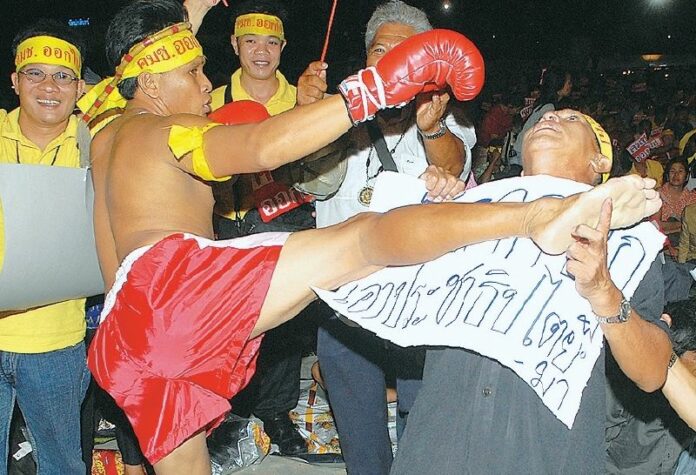
A man dressed as a Muay Thai fighter 'knocks out' a man representing the previous junta in a campaign opposing its 2007 draft constitution in a June 2007 file photo.

By Pravit Rojanaphruk
Senior Staff Writer

BANGKOK — Those planning to speak out publicly in the run-up to a vote on the junta-sponsored draft charter must formally register or risk arrest, Election Commissioner Somchai Srisuthiyakorn warns.

To avoid violating the junta’s ban on political gatherings, anyone who wants to take a stand for or against the proposed constitution should visit the commission to register the details of where, when and how they plan to express themselves, the commissioner said Monday.

Asked whether the commission can guarantee no one who registers will be arrested if they gather in groups exceeding five people – an activity banned since the May 2014 coup – Somchai stopped short of saying so explicitly.

“We will take care of it,” he replied.

The commissioner warned however that those holding signs criticizing the junta risk arrest under the ban, as the Election Commission will not request the National Council for Peace and Order, as the junta calls itself, to relax its ban on groups larger than four people gathering for a political purpose beyond the scope of the ballot.

“Say if they were walking and have a placard opposing the military dictatorship, then it has nothing to do with the referendum,” Somchai said. Those interested in campaigning must register in groups of at least 15.

Those provisions fall short of what would qualify the poll as “free and fair,” according to a veteran election observer.

“The least the Election Commission should do is to propose a temporary relaxation of the ban. They should make it a reality, as that is their job,” said Pongsak Chanon of We Watch, a group of Thai election observers.

He said anything short of freedom to express opinions about the draft charter will undermine the legitimacy of the whole process.

Come voting day, Somchai confirmed there will only be two ballot boxes for voters to choose between: endorse or reject.

The penalty for disrupting the coming referendum, Somchai said, will be the same as that for general elections.

Anyone found guilty of disrupting the referendum during voting, which will take place from 8am to 4pm, could face up to 10 years in jail and a 200,000 baht fine, Somchai said.

In early 2014, the last time a vote was held, protesters in many locations effectively blocked voters from reaching polling sites, leading the Constitutional Court to throw out the results.

As an example of such disruption, Somchai cited an infamous incident from the failed February 2014 elections in which a supporter of the People’s Committee for Absolute Democracy With the King As Head of State grabbed a would-be voter by the neck.

“Squeezing someone’s neck is definitely disruptive,” he said.

The man was never charged with a crime, and the only charges filed against a group of protesters were thrown out by a court.

\
Antigovernment protesters attack a voter on Jan. 26, 2014, near a polling station in Bangkok. Photo: Reuters

Advertisement

Former TV Host Wanted for Lese Majeste Rumored to Flee Country

Pinyo Traisuriyathamma moderates a March 14, 2013, debate about the role of the monarchy on his ‘Tob Jote’ program in a still image from Thai PBS.

By Teeranai Charuvastra
Staff Reporter

BANGKOK — A former talk show host being investigated for royal defamation has not been seen or heard from in some time, leading to speculation that he has fled the country.

Pinyo Traisuriyathamma, who faces a charge of lese majeste for hosting a debate about the role of the monarchy on his show in March 2013, has been unreachable by any obvious means three weeks after police announced they were moving forward with a case against him.

Numerous calls to Pinyo’s mobile phone and office since Monday have gone unanswered, while Facebook messages sent to the publishing company he owns have been received but gone unreplied.


Update: Former TV Host Pinyo Says He Will Return to Face Charges


Three people close to Pinyo declined to comment on his whereabouts.
 
However a man who’s worked closely with Pinyo’s company Openbooks said he believed the former Thai PBS newsman already fled.

“I can’t confirm anything, but I’d say he’s already gone,” said the source, who asked not to be identified due to the sensitivity of the topic.

In March 2013, Pinyo invited famous historians Sulak Sivaraksa and Somsak Jeamteerasakul to debate the role of the monarchy on his talk show Tob Jote (Answering Questions). 

In response, several hardline royalists filed complaints within days of the broadcast. Last month, nearly three years after the broadcast, police announced they would reopen an investigation into all three men.

Sulak is a self-identified royalist who has long called for reforms in the monarchy, while Somsak is well-known for fierce criticism of the royal institution’s role in politics. Both Sulak and Somsak spoke frankly about their views on the shows – a rare occurrence in Thailand where discussion about the monarchy is not only taboo, but often deemed illegal.

The interviews, aired during prime time on state-owned Thai PBS, were swiftly met with protests from hardline royalists, prompting Thai PBS to cancel Tob Jote.

On March 9, deputy police commander Sriwarah Rangsipramkul named host Pinyo as one of the suspects, which also include Sulak, Somsak and former Thai PBS executive Somchai Suwanban.

Authorities have aggressively pursued lese majeste offenses since the military junta seized power in May 2014. 

Related stories:

Monarchy Critic Faces Charge for 2013 Interview

State TV Fined For Airing Monarchy Debate

Lese Majeste Filed Against Historian For Questioning Ancient 'Elephant Battle'

Record Sentences Today For Facebook Lese Majeste Offenses


Teeranai Charuvastra can be reached at [email protected] and @Teeranai_C.


\

Advertisement

Finnish Man’s Fall From Pattaya Balcony Ruled a Suicide

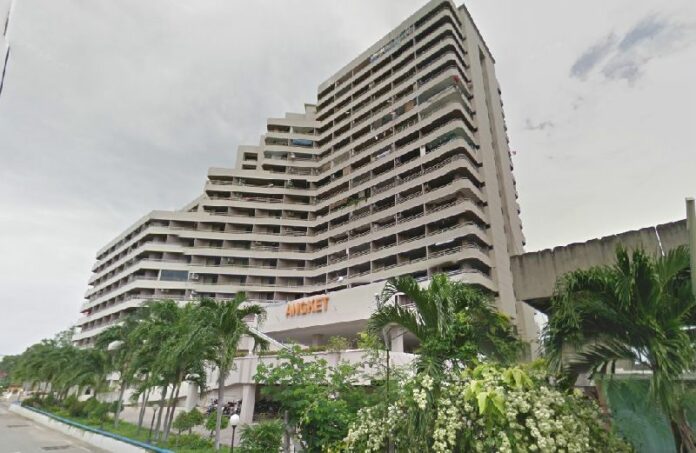
The Angket Condominium in Pattaya. Photo: Google

PATTAYA — A 78-year-old Finnish man was found dead 10 floors below the condominium balcony police said he jumped from this morning near Jomtien Beach.

The man, who reportedly lived on the fourth floor of the Angket Condominium, left a note for a friend in Swedish before going up to the 10th floor to jump from a hallway balcony, according to Lt. Nakornrat Nonsilad of Pattaya Police Station.

“Have a good one,” it concluded.

Police ruled the death a suicide, Nakornrat said, adding that the man had been suffering from poor health.

The man reportedly went to see a doctor Monday, and his friends said he occasionally talked about suicide, according to Nakornrat.


Chayanit Itthipongmaetee can be reached at[email protected] and @chayaniti92.


\

Advertisement

Lack of Competition Stifles Thai Film Industry

Crowds queue to buy tickets Saturday at Paragon Cineplex in Bangok. Owned by Major Cineplex, such cinemas remain popular destinations.

BANGKOK — Some of the ugly reality behind the business of make-believe was brought to light recently when a movie industry insider spoke out about a type of pay-to-play practice.

A broad conversation about how commercial expression is constrained by unfair and anti-competitive business practices started when someone behind a prominent film magazine shed light on a theater chain’s threat to keep a small film from reaching its audience unless its small distributor bought ad space in a national newspaper.

Thida Plitpholkarnpim of Bioscope magazine plucked the thread of what would become a wider conversation about the unsavory side of the dream machine by recounting on Facebook how a distributor was pressured to buy ads in Thairath newspaper by one of the two companies which owns most cinemas.

“They used the words ‘ask for your cooperation,’ but if we didn’t pay, they said the policy then is to limit the numbers of theatres the film will be screened,” Thida said in an interview.

Thida said Thairath’s full-page for promoting new films was recently bought out for resale by the nation’s two largest movie houses.

Apart from a few small players, Major Cineplex PLC holds 70 percent of the theater market, while No. 2 SF Group controls the rest. They account for the lion’s share of the 7 billion baht industry in 2015, according to Kasikorn Research Center.

Thida, who said she was not directly involved or affected, first raised the issue publicly earlier this month when she became aware of the small film distributor – she wouldn’t say which – being asked to buy advertising by Major Cineplex.

When the distributor refused, she said, its movie ended up showing in fewer theaters at fewer times instead of projected demand and audience popularity deciding its availability.

“With this way, movies are no longer judged by audiences,” she said.

Major Cineplex did not respond to requests for comment. However in a Wednesday report from BBC Thai, a company executive said since taking control of Thairath’s advertising page since March 1, it has not forced any distributor to buy ad space, which costs 1,600 baht per square inch.

\

Two Screens to Rule Them All

While the pay-to-play allegations grabbed attention, they opened the door to complaints from filmmakers about broader industry problems they argue limit creativity and the pool of movies made in Thailand.

The balance of power between studios and theaters is tipped in the latter’s favor. The studios and distributors get a small cut that tops out at 45 percent of the box office, with big studio blockbusters sometimes getting 55 percent, Thida said.

That’s considerably less than the norm in some other nations. In the United States, studios get up to 80 percent or 90 percent on opening day of ticket sales after a fee for the theater’s operating cost is deducted.

Studios in Thailand are also being compelled to pay cinemas a fee to subsidize their expensive switch from film to digital – even ones that didn’t make the switch.

“But why would newly opened cinemas launching with digital systems since the start, such as SFX Cinema Central Rama 9, also collect this fee?” Thida said.

Independent film director Kongdej Jaturanrasamee said the wider industry problems haven’t been addressed because everyone involved only sees things from their perspective.

Kongdej, who said he hasn’t been affected by the ad-buying issue, said the issues raised have been around for a long time. He said part of the problem is that studios have no power to negotiate.

“They don’t force us,” he said. “But we want to screen at their cinemas. And since it’s their cinemas, they can issue any policy.”

His latest award-winning film “Snap” got distribution help from M Pictures, a subsidiary of Major Cineplex. But even that was no guarantee the film would show widely, Kongdej said, saying he the experience showed him that it’s not only small, independent studios facing difficulties.

“I learned that even a small foreign movie imported by a distributor owned by Major itself also faced the same situation of decreasing showtimes after two days,” he said

To be considered a genuine industry, the famed director said it must become more diverse, but he doesn’t think portraying anyone as the villain is necessary to sort out the situation.

“Consumer behavior today has changed, so cinema operators are also facing their own problems,” he said of audiences who increasingly opt for pirating movies at home. “No one has an advantage over the other under these circumstances.”


Limited Selection

Audiences in the meantime can count on the same ghost stories and formula comedies.

Whereas mom-and-pop cinema owners once had control over selecting movies to be shown, only two companies decide what audiences can see. Thida, as a movie lover, said she worries that limits diversity and choice for audiences.

“They control the market; they decide which movies should be popular,” she said. “By gaining a monopoly over the audience’s taste, the audience will have no choice but to watch what has been picked for them.”

Whereas Kongdej accepts that no third player will step into the market to stoke competition and filmmakers must find new ways to distribute their films, a consumer advocate said the government is not meeting its obligation to foster competition.

“It’s because the government has never facilitated competition,” said Kannikar Kijtiwatchakul of consumer rights group FTA Watch. “Everywhere in the world, the government subsidizes and supports small operators to start and survive.”

Kannikar said the 17-year-old Trade Competition Law has never succeeded in creating a fair market, and the government has failed to see the importance of media and mass culture diversity, resulting in a limited cultural perspective.

These lead to broader social effects she said are far worse than the issues raised by Thida and Kongdej.

“Our access is limited to the same type of movies that carry some sort of same ideology,” she said. “There are few chances to watch a movie with a different perspective. That’s why Thais’ perceptions are so narrow.”


Related stories:

‘Freelance’ Wins Big at Golden Swan Awards

Film Giant GTH to Dissolve

Advertisement

Major Trafficking Trial Opens Amid Fears for Witnesses

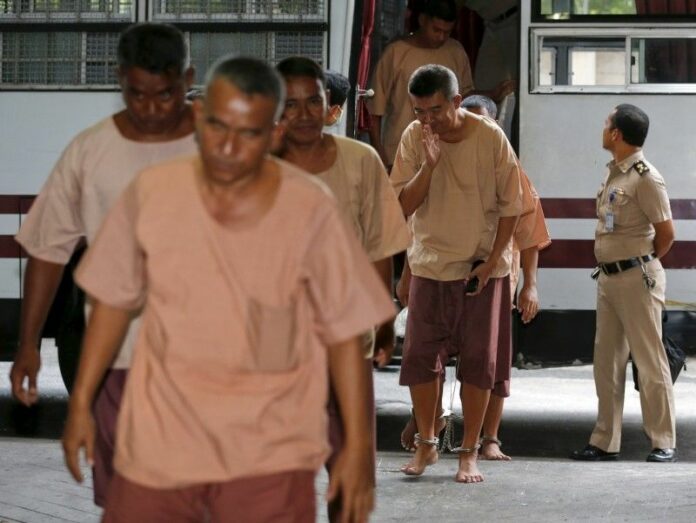
Human trafficking suspects arrive for a hearing at the criminal court in Bangkok, March 15, 2016. Photo: Chaiwat Subprasom / Reuters
By Amy Sawitta Lefevre
Reuters

BANGKOK — The trial of 92 suspected human traffickers, arrested after the discovery of shallow graves of migrants in the jungle, began in Bangkok on Tuesday and the attorney-general's office said it would be over within a year amid fears about the safety of witnesses.

Traffickers abandoned boatloads of migrants at sea last year after a crackdown by authorities that led to a regional migrant crisis with Indonesia, Malaysia, Thailand, Myanmar and Bangladesh refusing boats permission to land.

Rights groups had expressed fears that a drawn-out case, lasting anything up to two years, could put the hundreds of witnesses at risk because of inadequate police protection.

"The court is accelerating the case to finish within a year," said Prayuth Porsuttayaruk, deputy director-general of the human trafficking office at the Attorney-General's Office.

Thailand remains on the lowest tier on the U.S. State Department's Trafficking in Persons (TIP) report for not meeting the minimum standards for the elimination of trafficking.

Sunai Phasuk, senior researcher on Thailand at Human Rights Watch, welcomed a shorter trial but said the cases should not be rushed to impress the United States.

"It will totally send the wrong message if the trial is being fast-tracked simply to impress the TIP report reviewers."

The defendants, wearing beige prison uniforms, were brought to the packed court for the start of formal hearings.

The investigation and arrests followed the discovery of 30 shallow graves at a trafficking camp near the Malaysian border. Many of the bodies were believed to be of Rohingya, a persecuted ethnic Muslim minority in majority Buddhist Myanmar.

Weeks later, police revealed 139 graves had been found over the border in Malaysia.

That led to a crackdown on the multi-million dollar trade which had until then flourished in Thailand's southern provinces and in Malaysia.

The 92 suspected human traffickers include an army general, civilians and police.

Rights groups have called on authorities to step up witness protection after some witnesses said they had been forced into hiding because of threats.

Prayuth said the justice ministry was "looking after the witnesses", but did not say how many of the more than 400 witnesses were receiving police protection.

Around 50 suspects were still at large, said Prayuth. Some had fled to neighboring Myanmar.

The United Nations and rights group say the number of migrants leaving Myanmar and Bangladesh by boat in past months has plummeted because of Thai and Bangladeshi crackdowns on human smugglers.

The number of people trying to flee was expected to be significantly lower this year, they said.


To reach us about this article or another matter, please contact us by e-mail at: [email protected].

Follow Khaosod English on and Twitter for news, politics and more from Thailand.

\

Advertisement

Major Trafficking Trial Opens Amid Fears for Witnesses

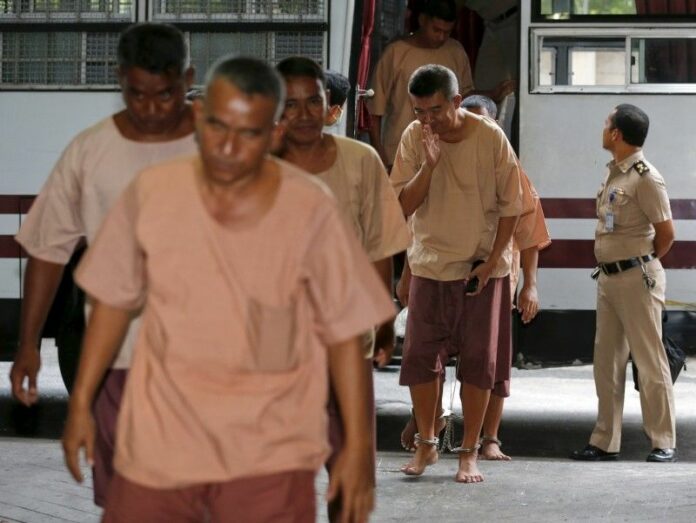
Human trafficking suspects arrive for a hearing at the criminal court in Bangkok, March 15, 2016. Photo: Chaiwat Subprasom / Reuters

By Amy Sawitta Lefevre
Reuters

BANGKOK — The trial of 92 suspected human traffickers, arrested after the discovery of shallow graves of migrants in the jungle, began in Bangkok on Tuesday and the attorney-general's office said it would be over within a year amid fears about the safety of witnesses.

Traffickers abandoned boatloads of migrants at sea last year after a crackdown by authorities that led to a regional migrant crisis with Indonesia, Malaysia, Thailand, Myanmar and Bangladesh refusing boats permission to land.

Rights groups had expressed fears that a drawn-out case, lasting anything up to two years, could put the hundreds of witnesses at risk because of inadequate police protection.

"The court is accelerating the case to finish within a year," said Prayuth Porsuttayaruk, deputy director-general of the human trafficking office at the Attorney-General's Office.

Thailand remains on the lowest tier on the U.S. State Department's Trafficking in Persons (TIP) report for not meeting the minimum standards for the elimination of trafficking.

Sunai Phasuk, senior researcher on Thailand at Human Rights Watch, welcomed a shorter trial but said the cases should not be rushed to impress the United States.

"It will totally send the wrong message if the trial is being fast-tracked simply to impress the TIP report reviewers."

The defendants, wearing beige prison uniforms, were brought to the packed court for the start of formal hearings.

The investigation and arrests followed the discovery of 30 shallow graves at a trafficking camp near the Malaysian border. Many of the bodies were believed to be of Rohingya, a persecuted ethnic Muslim minority in majority Buddhist Myanmar.

Weeks later, police revealed 139 graves had been found over the border in Malaysia.

That led to a crackdown on the multi-million dollar trade which had until then flourished in Thailand's southern provinces and in Malaysia.

The 92 suspected human traffickers include an army general, civilians and police.

Rights groups have called on authorities to step up witness protection after some witnesses said they had been forced into hiding because of threats.

Prayuth said the justice ministry was "looking after the witnesses", but did not say how many of the more than 400 witnesses were receiving police protection.

Around 50 suspects were still at large, said Prayuth. Some had fled to neighboring Myanmar.

The United Nations and rights group say the number of migrants leaving Myanmar and Bangladesh by boat in past months has plummeted because of Thai and Bangladeshi crackdowns on human smugglers.

The number of people trying to flee was expected to be significantly lower this year, they said.


Advertisement

Itinerant Argentine Photojournalist Tours, Shoots World on Two Wheels

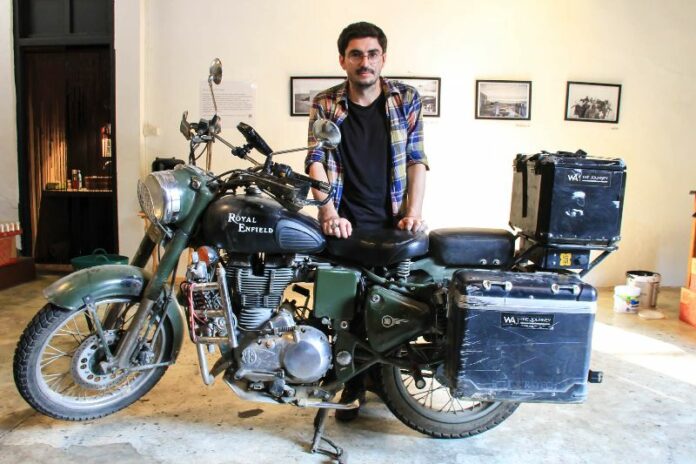
Walter Astrada poses Friday with his motorcycle named Athena, after the goddess of wisdom, at Cho Why in Bangkok

BANGKOK — People obtain motorcycle licenses for different reasons, but an award-winning photojournalist got one for a specific purpose: to travel the world.

Ten months ago Walter Astrada hopped on a Royal Enfield with his Nikon, a sleeping bag, a cooker, some tools and little in the way of planning. The Argentinian rode out of his second home of Barcelona and headed east.

“I planned only my visas, that’s it,” he said.

In February that bike brought Astrada to Bangkok, where the 41-year-old whose photographs have won many top awards during his career working for outlets such as Associated Press and AFP, is holding a five-day workshop and exhibiting photos from his trip at “The Journey” at Cho Why on Soi Nana.

Travel costs money, of course. Astrada now makes a living by selling prints of his work, giving lectures and hosting workshops in destinations along his route.

Astrada said he chose black and white for the theme of travel to communicate to his audience the idea there is little different between each country.

Asked what the biggest obstacle he faced on the road, Astrada paused to think. It wasn’t that he couldn’t find a gas station in a desert or got lost or couldn’t communicate with people. Instead it was the simple absence of a road.

“At some places in Mongolia, there was no road at all,” Astrada said, pulling out his smartphone to show photographic proof. “In the middle of rock, sand and mud, I had to make a path on my own.”

73-Road-to-Ulaangom-MONGOLIA-1600x1065.jpg
Another motorcyclist in August near Lake Uureg in Mongolia. Photo: Courtesy Walter Astrada

Astrada said he chose to travel the world on two wheels because flying is too fast. He explained the difference compared to a friend flying from one place to another.

“[My friend] would get to the destination in only a few hours, while I still can enjoy culture, people, food and environments,” Astrada said.

After his photo exhibition and workshop, Astrada will get back on the road into the north toward Mae Hong Son province to conquer its infamous 1,864 curves. Then he’s on to Laos and Cambodia. What’s next after that?

He said that remains unplanned.

Astrada’s photo exhibition “The Journey” featuring photographs taken during his 10-month journey on two-wheel motor takes place from Monday until the end of March at Cho Why on Soi Nana 17 near Charoen Krung Road.
Related stories:

Roam Old Streets, Appreciate Art on Gallery Hopping Night

Thai Photog Wins LA Street Photo Contest

Advertisement

Rights Group Urges Junta to Release Facebook Critic

Photo: Sarawut Bamrungkittikhun / Facebook

BANGKOK — A human rights group and U.N. agency are concerned about a man believed taken into secret military custody seven days ago because he runs a Facebook page critical of the junta.

Thai Lawyers for Human Rights along with the U.N. Human Rights Office said they are concerned about Sarawut Bamrungkittikhun because he has been missing for seven days, the maximum time someone can be held without being brought before a court for legal authorization to continue detaining them.

Sarawut was taken into custody at his home in Surat Thani last Wednesday by more than 30 police and military officers without an arrest warrant and did not charge him with any crime, according to Thai Lawyers for Human Rights.

“His relatives followed to the Vibhavadi Rangsit Military Camp in Surat Thani on March 10. It was confirmed that he was detained by military officers,” said Poonsuk Poonsukcharoen of Thai Lawyers for Human Rights, adding that officers told Sarawut’s mother her son was taken to Bangkok to be held at an undisclosed location.

Sarawut’s mobile phone was taken away by military officers and his relatives were not allowed to make contact with him, according to Poonsuk.

His Facebook page Peod Praden has been strongly critical of the military government. It was last updated March 7 and could no longer be accessed as of Tuesday morning. In his last update, Sarawut accused an admiral serving on the junta-appointed interim legislature of malfeasance, according to Prachatai English.

Sarawut’s last activity on his personal Facebook account was March 1.

On Saturday, a junta spokesman said it cannot confirm whether Sarawut was taken from his home by military personnel.

Col. Piyapong Klinphan said he would look into the alleged disappearance. He said that when the military wants anyone summoned, it does so openly. Some cases might be arranged by local officers, he said, but would still follow procedures laid out by the junta.

In a statement issued Monday, Thai Lawyers for Human Rights urged Sarawut’s immediate release, saying that under the authority of the National Council for Peace and Order, as the junta is formally called, military officers can only detain people for seven days without charge.

“Sarawut has been forcibly disappeared since March 9, 2016, which violates the International Convention for the Protection of All Persons from Enforced Disappearance,” the group wrote.

The U.N. Human Rights Office said it was also concerned about the case.

“The U.N. Human Rights Office is concerned about the fate and whereabouts of Sarawut Bamrungkittikhun,” spokesman Jeremy Laurence said in an e-mail message. “We are in contact with the authorities and are following the case closely.”

Despite the junta's assurances, there have been several cases of its critics disappearing from their homes, only to show up a week later in military detention. 

In March 2015 a nurse who testified that soldiers in 2010 opened fire on people sheltering inside a sanctuary during a military crackdown on protests in Bangkok was reported missing by her family. A junta spokesman insisted it was not involved in Nattathida Meewangpla's disappearance.

Seven days later, Nattathida suddenly reappeared at police headquarters under a soldier escort to be charged with insulting the monarchy and aiding "terror groups," at which point the junta admitted she had been held in military detention.

Additional reporting Pravit Rojanaphruk, Teeranai Charuvastra

Related stories:

Student Activist Leader 'Abducted' from University

Junta Spokesperson Admits to Detaining Missing Woman

Witness of Redshirt Crackdown Deaths 'Abducted by Military'


Advertisement

Charges Filed Against Execs in Deadly Gas Leak

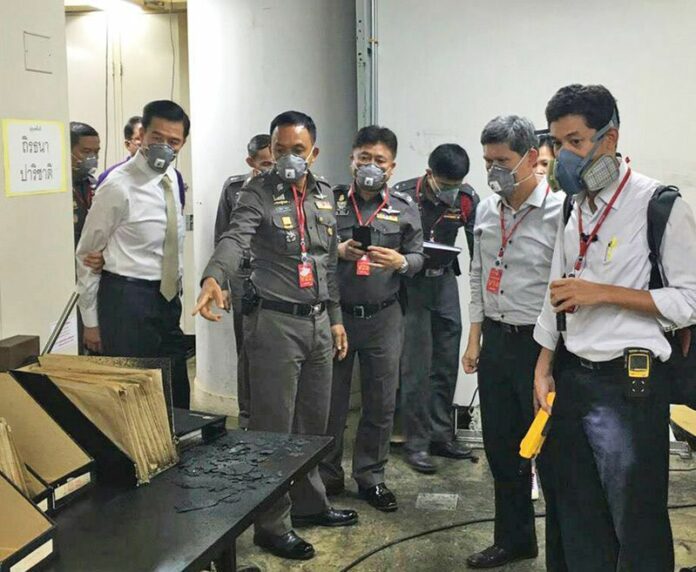
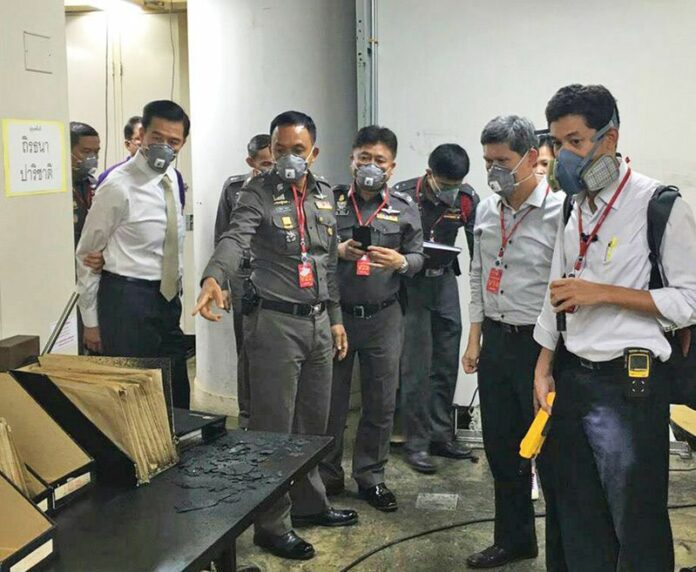
Lt. Gen. Sanit Mahatavorn, foreground second from left, points as investigators Monday inspect the basement of the SCB Park Plaza in Bangkok.

BANGKOK — Two executives from the contractor blamed for a deadly gas leak at SCB Park Plaza were charged today in connection with the incident that left eight people dead.

Mega Planet PLC Director Adisorn Foda, who authorized the contract to install a water-free fire suppression system at the bank’s headquarters, and Managing Director Napong Suksa-nguan arrived at the Phahon Yothin Police Station on Tuesday where they heard the charges and were to be questioned by investigators.

The two men rejected the charge, according to acting metro police chief Sanit Mahatavorn.

Investigators have other suspects in the Sunday night incident but cannot reveal their names as the investigation is ongoing, Lt. Gen. Sanit said.

According to Sanit, Mega Planet beat out four other firms to win the bid to install the pyrogen gas system, which activated during installation and suffocated five people to death immediately. Three others died later, and at least seven were injured.

Police said they are reviewing the details of the contract.

Siam Commercial Bank said the company will compensate the families of the deceased with 100,000 baht and an initial 30,000 baht to each of those injured.
 

Related stories:

SCB Blames Fire System Upgrade for 8 Deaths

7 Killed in Explosion at SCB Park


Chayanit Itthipongmaetee can be reached at[email protected] and @chayaniti92.


\

Advertisement

Charges Filed Against Execs in Deadly Gas Leak

Lt. Gen. Sanit Mahatavorn, foreground second from left, points as investigators Monday inspect the basement of the SCB Park Plaza in Bangkok.

BANGKOK — Two executives from the contractor blamed for a deadly gas leak at SCB Park Plaza were charged today in connection with the incident that left eight people dead.

Mega Planet PLC Director Adisorn Foda, who authorized the contract to install a water-free fire suppression system at the bank’s headquarters, and Managing Director Napong Suksa-nguan arrived at the Phahon Yothin Police Station on Tuesday where they heard the charges and were to be questioned by investigators.

The two men rejected the charge, according to acting metro police chief Sanit Mahatavorn.

Investigators have other suspects in the Sunday night incident but cannot reveal their names as the investigation is ongoing, Lt. Gen. Sanit said.

According to Sanit, Mega Planet beat out four other firms to win the bid to install the pyrogen gas system, which activated during installation and suffocated five people to death immediately. Three others died later, and at least seven were injured.

Police said they are reviewing the details of the contract.

Siam Commercial Bank said the company will compensate the families of the deceased with 100,000 baht and an initial 30,000 baht to each of those injured.
 

Related stories:

SCB Blames Fire System Upgrade for 8 Deaths

7 Killed in Explosion at SCB Park


Advertisement

Hot News

LATEST NEWS

Bangkok
overcast clouds
28.8 ° C
28.8 °
28.8 °
75 %
3.4kmh
100 %
Sun
34 °
Mon
34 °
Tue
33 °
Wed
33 °
Thu
33 °