30 C
Bangkok
Saturday, June 27, 2026
Home Blog Page 2788

Nation TV Fooled By Satirical Article, Blames Internet

Balenciaga's Fall/Winter 2016 collection Photo: Balenciaga

BANGKOK — Nation TV blamed an “inaccurate source” today for its reporting a piece of online satire as fact, despite the post being clearly labeled a work of fiction.

A few hours after Nation TV reported about a Spanish designer bag inspired by a type of cheap and colorful bag common to Thailand, the station apologized for the report based on a satirical Facebook post, placing the blame on social media.

“The investigation found that the information spread through social media was incorrect,” it wrote. “We apologize for the mistake and will be more careful in screening and using information from social media from now on.”

Read: No, Disneyland is Not Coming to Laos

That was a big reversal from earlier in the morning when it ran a story that a designer bag made by Balenciaga and valued at “nearly 100,000 baht, was actually inspired by the designer’s childhood selling stuff in the border areas of Thailand, Cambodia, China, Myanmar and Laos.” It cited a “prominent Facebook page” for the information.

That report’s author may not have read the last sentence in the post on the “prominent” Facebook page, actually an entertainment page called Did Hipster Kill Your Dad?

“Thank you for wasting your time reading #HowCanItBeFreakingTrue?” it said.


\

A story published and later retracted as false Tuesday by Nation TV. Photo: Ananda Aof Amataya / Facebook

The joke, which ended up being on the news channel which claims to be “the real deal,” began with an actual bag in Balenciaga’s latest collection.

With wide, colorful stripes, the bags look similar to the cheap, durable and somewhat iconic bags used for storage by merchants and strongly associated with rural life.

On Monday the Facebook page published a satirical post to create a backstory linking the bag to Thailand. It claimed Georgian designer Demna Gvasalia spent his childhood in Myanmar’s Shan State before moving to Chiang Rai province. The bag, it continued, was originally designed to help his family transport opium throughout the Golden Triangle.

In recent months, Nation TV has also retracted stories claiming that a Disneyland would be built in Laos, broadcasting photos of suicide vests taken from the Internet during a bombing investigation, and sending someone to impersonate the suspected bomber of the Erawan Shrine days after 20 people were killed there.


Thai parodies used the hashtag #balenciagabag:


\

Photo: YourboyzGtoon Show / Facebook

\

Photo : Jaychanatip / Instagram

\

Photo: Gluta Story / Facebook


Advertisement

Unless It’s For the K-Pop, Avoid Central Lardprao

‘Exo’ fans crowd into Central Lardprao at about 10am on Tuesday for a chance to see the Korean boy band. Photo: @Yingme1a / Twitter

BANGKOK — Commuters and motorists and even shoppers are warned to avoid Central Lardprao and surrounding roads this afternoon as a Korean-wave tsunami warning has been issued.

Thousands of Exols have flocked to the shopping mall today for the chance to see and get an autograph signed by the South Korean boy banders of Exo, who arrived in Thailand on Monday for an event called EXO Journey To Nature Republic Bangkok.

Fans have lined up since Monday night and traffic is expected to be crippled when the boys hold court from 3pm until 6pm. Some roads may be closed.

S__41910307.jpg

Photo: Plyor Wongsuchat

While traffic is presently smoother than it was earlier this morning, however, Col. Panudet Sukwong of Phahon Yothin police said motorists should avoid Vibhavadhi Rangsit, Phahon Yothin and Ho Wang roads this afternoon.

Panudet said police have placed barriers around the event space and are on the scene to help keep traffic moving and control the flow of fans.

Police and event coordinators will determine later in the afternoon whether the roads should be closed outright for the sake of traffic, Panudet said.

Advertisement

Bus Driver Goes Beast Mode on Passenger, Gets 1,000 Baht Fine (Video)

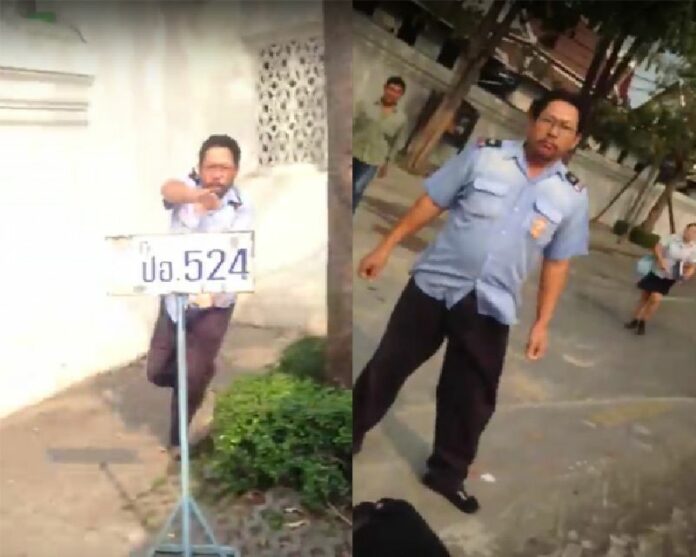
Grabbing a sign he would use to swing at a passenger, bus driver Buala Thongphu acts out a serious bout of road rage Sunday near Wat Pho in Bangkok in still images from a video of the incident. Image: Kolia / Pantip

BANGKOK — The public square that is Pantip.com has again proven an effective place to name and shame after a video showing a bus driver’s violent rampage led to his being gently fined and suspended.

In the video posted Sunday, Pantip user Kolia described being attacked by the driver of bus No. 524 after he confronted him over skipping a stop prior to the final stop near Wat Pho where the passenger had been waiting for a ride. In the video, a scowling man in a bus driver uniform is seen in full-tilt rage attempting to throw a road sign at the cameraman.

“I intended to ask and also speak for the passengers to let him know if the bus doesn’t stop at its stop, we are affected,” Kolia wrote.


Kolia said he was waiting at the bus stop near Bank of Thailand on Samsen Road in order to travel to the last stop near Wat Pho when he saw bus No. 524 roll by on the inner lane without any apparent attempt to pick up passengers at the bus stop.

Kolia wrote that he noted the bus’ license plate and went to seek an explanation from the driver himself when he reached the final stop near Wat Pho via another bus.

The passenger claimed that he was hit once by the furious driver and also fell, resulting in slight injuries that required treatment at hospital.

The Bangkok Mass Transit Authority, or BMTA, on Monday called in for questioning route operator Bangkok Union Service 524 Ltd. and its driver Buala Thongphu.

Buala admitted he was the man in the clip. He was fined 1,000 baht and suspended seven days. Authorities said he was placed on probation and will be punished seriously if found guilty a second time.

Failure to stop properly is a frequent complaint of Bangkok’s public bus service, as is letting passengers off in lanes far from the curb.

While BMTA encourages passengers to use official channels such as its 1348 hotline to file complaints, its effectiveness is debated.

“Usually we will secretly take photos of the license plate and driver to file a complaint on the website. I also did this myself, and it just went silent,” wrote Pantip user KongKamlangnaksuebpandib.

But user Kolfparin said he got lucky with the hotline.

“Bus No. 8 drove terribly, cutting off my car, so I called,” he wrote. “After that they called back to inform me they had investigated, and the driver was fined 500 baht.”


Advertisement

Sharapova Says She Failed Drug Test

Tennis star Maria Sharapova speaks during a news conference in Los Angeles on Monday, March 7, 2016. Photo: Damian Dovarganes / Associated Press

LOS ANGELES — Maria Sharapova's tennis career and Olympic hopes are in jeopardy, and she claims it's all because she failed to click on a link in an email that would have told her to stop taking meldonium.

The five-time major champion says she failed a doping test at the Australian Open in January for the little-known drug, which became a banned substance under the WADA code this year. The former world No. 1 took full responsibility for her mistake when she made the announcement at a news conference Monday in Los Angeles.

Sharapova could face a lengthy ban from the International Tennis Federation, possibly ending her season and preventing her from competing for Russia at the Rio Olympics.

"I know that with this, I face consequences," Sharapova said. "I don't want to end my career this way, and I really hope I will be given another chance to play this game."

The 28-year-old Sharapova received notice last week that she tested positive for meldonium, a blood flow-promoting drug she has been taking for 10 years for numerous health issues. Meldonium was banned because it aids oxygen uptake and endurance, and several athletes across international sports have already been caught using it.

Sharapova and all players were notified of the changes in the WADA banned substances list in December. Sharapova claimed she simply missed the change, neglecting to click on the link.

"I take great responsibility and professionalism in my job, and I made a huge mistake," Sharapova said. "I let my fans down. I let the sport down that I've been playing since the age of 4, that I love so deeply."

Meldonium, also known as mildronate, is a Latvian-manufactured drug popular for fighting heart disease in former Soviet Union countries. Meldonium treats ischemia, or lack of blood flow, but can be taken in large doses as a performance-enhancer.

Sharapova said she began taking meldonium for "several health issues I had back in 2006," including a magnesium deficiency, regular influenza, "irregular" heart test results and early indications of diabetes, of which she has a family history.

Sharapova's penalties could range from a multiyear ban to a minimal sanction with no suspension if officials believe she made an honest mistake. WADA President Craig Reedie told The Associated Press that any athlete found guilty of using meldonium would normally face a one-year suspension.

The ITF's anti-doping program announced in a statement that Sharapova will be provisionally suspended starting this weekend while her case is examined. WADA spokesman Ben Nichols said the organization won't comment until the ITF makes a decision.

Sharapova and her attorney, John J. Haggerty, declined to say where Sharapova was put on the drug or where she gets it now, citing the ongoing process with the ITF. Meldonium is not approved by the U.S. Food and Drug Administration.

"I understand the drug is sold particularly in Eastern Europe," Reedie told the AP in a telephone interview. "You can almost get it over the counter. For stronger versions, you might need a prescription. There has been a whole rash of these cases since the 1st of January when it appeared on the banned list. This might not be happening if athletes would be taking more care of the things that are on the list."

Reedie said meldonium can be "very strong medicine."

Although she has lived in the U.S. since childhood, Sharapova won a silver medal and served as Russia's flag-bearer at the London Olympics four years ago.

\

In this Jan. 20, 2016, file photo, Maria Sharapova, of Russia, hits a forehand return to Aliaksandra Sasnovich, of Belarus, during their second-round match at the Australian Open tennis championships in Melbourne, Australia. Photo: Vincent Thian / Associated Press


"I think it's all nonsense," Shamil Tarpshchev, the president of the Russian Tennis Federation, told the state Tass agency. "Athletes take what they're given by physiotherapists and doctors. I think that Sharapova will play at the Olympics anyway. But we have to see how events develop."

Two Ukrainian biathletes and Russian cyclist Eduard Vorganov have tested positive for meldonium since it was banned. Earlier Monday, Russia's Ekaterina Bobrova, a European champion ice dancer, told local media she had tested positive for meldonium.

Sharapova said she took the test shortly before she lost to Serena Williams in the Australian Open quarterfinals on Jan. 26. Sharapova hasn't played since then while recovering from a forearm injury, and she had already dropped out of the BNP Paribas Open in Indian Wells, which begins this week.

"She is very organized and she takes her career very seriously," Haggerty told the AP. "When she first started to take this back in 2006, she made sure it was approved, that it wasn't on the banned list, and checked in future years. Because she had taken it for so many years, and it was OK year after year, it just got off the radar.

"When she got the letter, she was shocked, completely stunned. She takes great pride in her integrity and how she approaches the game, and she immediately wanted to come forward and take responsibility."

Sharapova is one of the greatest players of her generation, with 35 career singles titles and over USD$36 million (1.3 billion baht) in career earnings. She is currently No. 7 in the WTA rankings after playing just three tournaments and the Fed Cup final in the last eight months since Wimbledon due to injuries.

Sharapova is thought to be the world's highest-paid female athlete due to endorsement deals and her extensive business ventures, including a high-profile candy line, Sugarpova. Forbes estimated her earnings at USD$29.5 million (1 billion baht) for 2015.

"I am very saddened to hear this news about Maria," WTA CEO Steve Simon said in a statement. "Maria is a leader and I have always known her to be a woman of great integrity. Nevertheless, as Maria acknowledged, it is every player's responsibility to know what they put in their body and to know if it is permissible."

Sharapova became a 17-year-old Wimbledon champion in 2004. She ascended to No. 1 in 2005, won the U.S. Open in 2006 and added the Australian Open in 2008 before completing the career Grand Slam with French Open titles in 2012 and 2014.

But Sharapova has struggled with injuries throughout her career, repeatedly forcing her to take extended breaks from competition. She had surgery to repair a torn rotator cuff, forcing her to change her serving motion, and has struggled with hamstring injuries.

Sharapova was born in Russia before moving to Florida. She lives primarily in Los Angeles now.

The star had a moment of levity when she acknowledged the incorrect assumptions about the reason she had called a news conference.

"If I was going to announce my retirement, it wouldn't be in a downtown Los Angeles hotel with this fairly ugly carpet," she said.

Story: Greg Beacham / Associated Press


Advertisement

Don't Dismiss, Don't Panic Over North Korean Nuke Threats

South Korean army soldiers stand on K-55 self-propelled howitzers during an annual exercise Monday in Paju, near the border with North Korea. Photo: Ahn Young-joon / Associated Press

SEOUL — When North Korea threatens to nuke its enemies, as it has twice over the last several days, outsiders often have one of two reactions: to dismiss it as yet another example of empty propaganda or to panic.

There are good reasons to do neither. There are many ways the North can retaliate that fall short of war, nuclear or conventional.

North Korea's latest warning came Monday in response to the beginning of annual South Korean-U.S. military drills, and included vows to turn its enemies into "seas in flames and ashes" with nuclear missiles aimed at South Korea, U.S. bases in the Pacific and the U.S. mainland.

Pyongyang always responds furiously to the springtime South Korean-U.S. drills, which it views as an invasion rehearsal. This year's drills are the largest ever, meant to respond to the North's recent nuclear test and long-range rocket launch. South Korea's Yonhap news agency, citing unidentified military sources, reported that the allies will work on drills for precision attacks on North Korean leadership and its nuclear and missile arsenal in the event of war.

The first thing to keep in mind is that Pyongyang's near-term nuclear warnings are mostly bluff; more of a strong deterrent that Pyongyang can use in its propaganda, rather than an actual sign of imminent war.

The North knows that its atomic program, which is still relatively primitive, is outgunned by the thousands of warheads the United States possesses. Pyongyang is very unlikely to do something that could lead to overwhelming retaliation by superior militaries in the United States and South Korea, and therefore end the ruling autocratic Kim dynasty in Pyongyang.

Still, the bellicose bluster is not without danger.

North Korea is so poorly understood by outsiders, even by analysts in the South, that its threats make the already jittery Korean Peninsula even tenser. This general anxiety causes both Korean militaries to bolster their positions and increases the possibility that a misjudgment by North Korea's young leader, Kim Jong Un, could lead to an escalation of violence should a skirmish erupt. South Korea has vowed to hit back hard on future North Korean attacks, raising the possibility of escalation.

South Korean analysts believe North Korea will follow its nuclear threats with some sort of low-level provocation. It launched short-range projectiles last week, hours after the U.N. Security Council approved new sanctions, and it could fire more missiles or artillery pieces into the sea as a show of force. It also could stage a cyberattack, which South Korea says Pyongyang has done in the past.

Rather than traditional military confrontations, in which it would be heavily outgunned, the North favors covert, surprise attacks that South Korea cannot immediately respond to. In 2010, North Korea was said to have staged a torpedo attack on a South Korean warship and an artillery bombardment on a South Korean island that killed a total of 50 South Koreans. The ship sinking happened when South Korean and U.S. militaries were conducting springtime military drills.

North Korea denies it torpedoed the South Korean ship, though it acknowledges shelling the South's frontline Yeonpyeong Island, its first attack on a civilian area in South Korea since the end of the 1950-53 Korean War.

The North's tenaciousness marks another reason the threats should worry.

The exact status of North Korea's nuclear weapons program is a mystery, but a general outside consensus is that North Korea has yet to master the technology needed to build a nuclear-armed missile that can directly attack the U.S. mainland.

Still, after four rounds of tests since 2006, the North is thought to have a handful of rudimentary nuclear bombs. Some analysts think it can arm shorter-range missiles with warheads. And even a crude nuclear weapon could be delivered by other means, such as a plane.

The country, one of the world's poorest, has also successfully sent satellites into orbit twice, rocket launches that outsiders say were covers for tests of banned technology used in long-range missile firing. Seoul defense officials believe North Korea doesn't yet have a workable re-entry vehicle necessary to get a warhead safely back into the Earth's atmosphere; this is something not tested in satellite launches.

Analysts, however, believe it's only a matter of time before North Korea gets a reliable intercontinental ballistic missile because its scientists will continue to explode new, advanced atomic devices, and send up rockets, to improve their designs and technologies.

By Hyung-Jin Kim, Associated Press

Advertisement

Indonesia Floats Plan to Tackle Deforestation, Fires

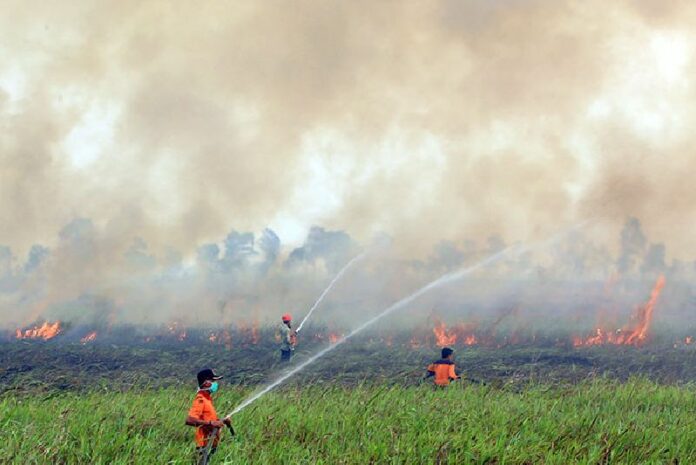
Firemen spray water to contain burning wildfire Sept. 5 in South Sumatra, Indonesia. Photo: Associated Press

JAKARTA — Indonesia's anti-graft commission on Monday said government agencies have agreed on a plan to combat corruption in the forestry industry that costs the state billions of dollars in lost revenue and is behind fires that pollute Southeast Asia.

The attempt to address a longstanding crisis in the management and conservation of Indonesia's prized tropical forests comes after a study by the anti-corruption commission estimated that the commercial value of undeclared logging was USD$60.7 billion to USD$81.4 billion (2.15 trillion baht to 2.86 trillion) baht) between 2003 and 2014. The study released in October estimated the government's loss of revenue from royalties at USD$6.5 billion to USD$9 billion over the same period.

Dian Patria, head of corruption prevention for natural resources at the Corruption Eradication Commission, said top officials from other ministries and agencies have given their backing to the plan.

Protecting extensive tropical forests that are among the largest in the world is a key issue for Indonesia and Southeast Asia. Unreported timber production deprives the Indonesian government of revenue it could use to improve infrastructure and services for its still largely poor population of more than 250 million.

Annual burning of forests and peatland in Sumatra and Kalimantan to clear land for palm oil plantations and other agriculture is a regular bane for Malaysia, Singapore, southern Thailand and parts of Indonesia. The fires produce a smoky haze that is a health hazard, often forcing people indoors and shutting down schools and airports.

Monica Tanuhandaru, the executive director of Kemitraan, which lobbies for clean government and business, said the plan is significant but will require continual support from President Joko "Jokowi" Widodo to be fully implemented.

The plan developed by the anti-corruption commission, along with Indonesia's Ministry of Environment and Forestry, Ministry of Finance, Supreme Audit Agency, and financial regulatory agencies, leans heavily on technology to build an accurate picture of where illegal deforestation and conversion of peatland into farmland is occurring.

The anti-corruption commission hopes use of Landsat satellites, drones and LIDAR pulsed laser-based mapping will identify land clearing on a close to real-time basis. That will provide the information for prosecuting companies that log more than they declare.

According to the report released in October, official statistics on timber production capture less than a quarter of what is cut down.

The plan also requires the Ministry of Environment and Forestry to disclose more information about its monitoring efforts. For the first time, it would issue quarterly reports on where deforestation and peatland conversion has occurred and also detail what law enforcement actions it has taken.

Story: Stephen Wright / Associated Press

Related stories:

Indonesia Floats Plan to Tackle Deforestation, Fires 

Southeast Asia to Choke on Smoke for Months as Indonesia Fails to Douse Fires

Storm Drives More Indonesian Smog Over Thai South

Indonesia Seeks Help to Put Out Fires

Indonesian Smoke Spreads to Thai South, Sickening Hundreds

Advertisement

Japanese Tourists’ Naked Swim Invites Investigation

Twitter photo of the Japanese tourists in the mass skinny dipping session on Hua Hin Beach on Saturday night. Photo: @KomsakAddams / Twitter

HUA HIN — Viral photos of dozens of Japanese tourists frolicking naked in the surf of Hua Hin prompted a fruitless police investigation over the weekend.

Investigators subsequently determined that the 20 to 30 men involved in the mass skinny dipping session were part of a Japanese tour group that eluded capture by departing the country as scheduled Monday morning, according to the commander of Hua Hin police.

“If they were still in the country, we would have brought them in for prosecution,” Col. Chaiyakorn Sriladaecho said by telephone. “But they already left the country, so there’s nothing we can do.” 

The case came to light after a Twitter user named Komsak Addams posted photos showing the naked young men, arms locked together, ankle-deep in the sea Saturday on Hua Hin beach.

“I was having a meal with friends at a seaside restaurant when all of sudden dozens of a Chinese [sic] male group tour stripped naked. Do you think I can eat anything now?” Komsak wrote in a message since retweeted more than 11,000 times. 

While some expressed shock,  others found humor. 

“My dear friend, why are you doing this? This is disgusting! Why didn’t you get closer? I can’t see anything.” user Tanacarnn wrote in reply.

When news reports identified the tourists as Japanese, Komsak took to Twitter to apologize for his assumption they were Chinese.

“I would like to apologize to China for accusing your tourists of stripping on Hua Hin Beach Saturday,” he wrote.

Chaiyakorn said police are still investigating the tour company to find out whether it encouraged the naked stunt. If so, the police colonel said, the company would be liable for public indecency. But he suspects the stunt was unendorsed by the company.

“I think it’s personal wrongdoing,” Chaiyakorn said.


Teeranai Charuvastra can be reached at [email protected] and @Teeranai_C.


\

Advertisement

This Endangered Community Has Been Fighting Eviction 24 Years (Photos)

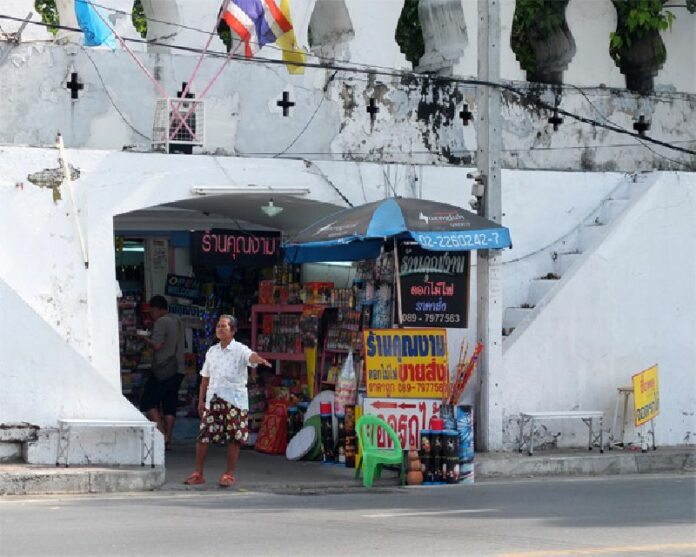
A woman sells fireworks near the old fort wall from which the Pom Mahakan community gets its name. More than 300 people live between the wall and Khlong Banglamphu, which the city declared eminent domain over in 1992 to build a park.

BANGKOK — A small community of holdouts famous for making and selling fireworks year-round from behind an old city wall asked for a public hearing Monday after the city moved to evict them again.

The 50 households comprising the Pom Mahakan community said they learned from media reports Monday that they would soon be forced from their homes to make way for a park.

“I thought the Phra Nakhon District office no longer exists,” community leader Thawatchai Woramahakhun said sarcastically. “They never informed us directly, we only knew it from the newspaper.”

For over two decades, City Hall has tried to evict the community which sits between the wall of the old fort from which it gets its name and Khlong Banglamphu.

In 1992 the Bangkok Metropolitan Administration declared eminent domain over the private land behind the old fort near Ratchadamnoen Road and Wat Saket, saying it would build a park there. At the time, it housed more than 100 families, and residents who have lived there for at least three generations put up a fight to stay.

In 2005, the Supreme Court ruled the city had the authority to evict the community because some residents had already accepted financial compensation. Thawatchai said Monday that while yes, locals did accept the money, authorities never returned to move the project forward.


\


Deep Roots

But the Pom Mahakan community is not just a pack of squatters and houses. It has deep roots in Bangkok’s history and still produces the bird cages, crafts and pottery for which it was famous. Fireworks were once made in the small community also, and today a wide manner of pyrotechnics are still sold from tables set up near the entrance gates.

The community has defenders outside its boundaries as well.

Apart from its fame for selling fireworks in Bangkok, Pom Mahakan has for years been known for its strong resistance against City Hall. It has become a case study internationally in community design, human rights and cultural diversity.

Concerned parties from academic circles and private foundations stepped in to urge compromise when it went to court in 2005. That led to an agreement under which the land would be shared for both park and residences, but it proved futile. The 1992 decree remains in effect.

Leading their resistance is Thawatchai, whose origin story can be traced to street gangs in the 1960s. He reformed his act but still lives in the same 111-year-old home.

Thawatchai said it has become a tradition for officials to break the eviction news for one reason or another, year after year. But despite years of pressure, more than 300 locals still refuse to move.

He urged city officials to engage the community in a public discussion, saying that a century of history means they’re not squatters.

“Unlike Saphan Lek, Khlong Thom or Pak Khlong Talad, my community is really a residential area, not for a commercial purpose,” Thawatchai said. “I am not encroaching on government land, in fact, the government is trying to invade mine.”


\


\


\


Advertisement

Tokyo Zoo to Work on Changing Living Conditions for Thai Elephant

In this Jan. 27, 2016, file photo, a zoo attendant feeds Hanako the elephant at Inokashira Park Zoo on the outskirts of Tokyo. Photo:Eugene Hoshiko / Associated Press

TOKYO — A Tokyo zoo said Monday it will work on improving the living conditions for its 69-year-old elephant after an animal welfare expert recommended simple additions such as infrared heaters and new toys instead of moving her to a sanctuary.

"The zoo has done a lot of good," said Carol Buckley, who was invited to the zoo by the "Help Hanako" campaign that sought to improve the elephant's situation or move it to a Thai sanctuary.

Hanako was among the healthiest elephants, for her age, she has ever seen, she added. Their usual lifespan is about 70 years.

Inokashira Park Zoo has said moving Hanako would be too stressful. A gift from Thailand in 1949, Hanako, or "flower child," has lived in a zoo since she was 2.

Buckley said Hanako is happy and loves her zookeepers. Instead of moving her, Buckley recommends infrared heaters and rubber mats to make her small concrete pen more livable. She suggested playing music and adding more toys, such as frozen fruit inside a tire. Tires and a tube are Hanako's favorite toys now.

Buckley, an American who founded an animal sanctuary and has worked with other captive elephants, said renovating or enlarging Hanako's pen would require noisy construction that might stress the animal. And introducing other elephants and even foliage could bewilder Hanako.

Zoo Curator Hidemasa Hori, who met with Buckley during her visit, said the zoo will work on making the "environmental enrichment" changes, although some bureaucratic procedures would be required. The city of Tokyo runs the zoo.

Ulara Nakagawa, whose blog inspired the campaign, says funds can be raised to help make changes for Hanako.

It was unclear whether those who were behind the petition drive to move Hanako out of the zoo would be convinced by Buckley's findings.

Buckley noted animal activists need to be educated, regardless of their good intentions.

"You think she should be put on a plane or a boat and go to Thailand? What are you thinking?" she said.

Buckley noted Hanako was clearly bored and needs more toys as well as more time with the zookeepers.

"When her keepers let her in the barn, she just lit up. Her eyes got big, and her body relaxed, and she came in and her ears were flapping," she said. "She came right over to the bars where they were and solicited their petting the entire time and didn't stop talking."

\

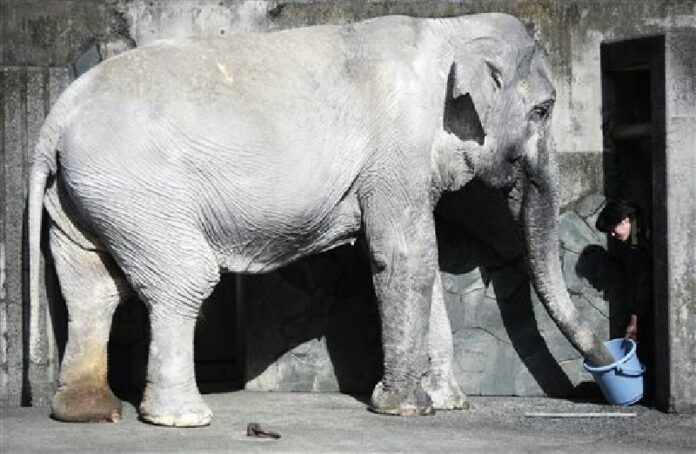
In this Jan. 27, 2016, file photo, Hanako the elephant stands in her pen at Inokashira Park Zoo on the outskirts of Tokyo. Photo: Eugene Hoshiko / Associated Press

Hori said the zoo was open to Buckley's ideas. He was happy the meeting had not been confrontational and was hopeful some of the easier changes might be in the works as early as Hanako's birthday party later this month.

"They agreed Hanako should not be moved," he said in a telephone interview, acknowledging that perhaps the zookeepers had too readily assumed Hanako did not want change. "This is just a beginning."

Story: Yuri Kageyama / Associated Press

Related Stories: 

Petition Calls for Japan's Oldest Elephant to Return to Thailand

Advertisement

Botched Gun Store Heist Not Terrorism, Police Say

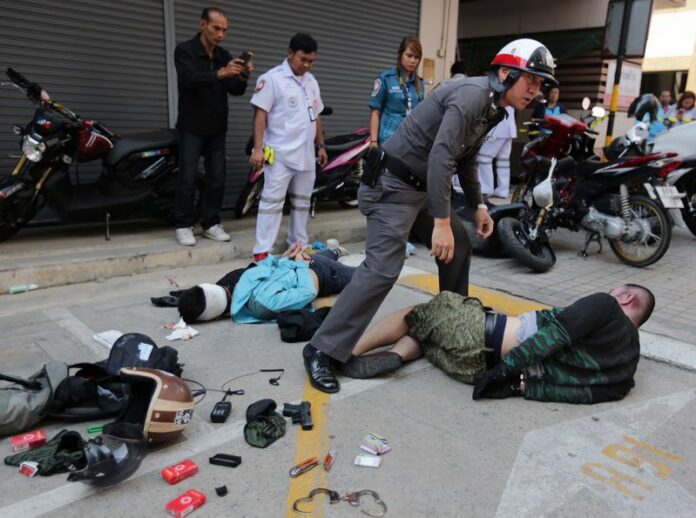
Scene from the attempted robbery at Inter Arms gun store in Bangkok on Friday

BANGKOK — A group of Chinese nationals who attempted to rob a gun store in Chinatown on Friday had no known links to any terror groups, the commander of Bangkok police said today.

Instead the botched robbery, which left one of the assailants dead and two others injured, was an attempt to acquire firearms for resale on the Chinese black market, said deputy police spokesman Songpol Wattanachai. 

“This has nothing to do with politics,” Gen. Songpol said by telephone Monday. “We checked with the Chinese Embassy. None of them was on the blacklist of Chinese authorities. No national security issue. No terrorism.” 

Three of the suspects and their alleged mastermind, Yang Zheng, were brought before the Criminal Court on Monday to be indicted and remanded into custody. The judge agreed the suspects pose a flight risk and denied them bail.

Friday’s bizarre attack, in which three of four Chinese men were shot trying to hold up a gun store with airguns and knives, brought to mind the August bombing of the Erawan Shrine, which was allegedly carried out by a group of Chinese Uighurs. The attack killed 20 people, including Chinese tourists, and isbelieved by some analysts to have been revenge on Beijing and Bangkok for persecution of the Uighurs.


\

Crime scene photo of officer Thawatchai Pewpong, who police said shot and killed robbery suspect Wu Xingjun.


Songpol said Yang confessed to plotting the robbery with his friend Wu Xingjun, who died from gunshot wounds sustained during the attempted robbery. They reportedly hired three other men for the job, identified by police as Lin Kunpeng, Ma Geng and Sun Junwei.

Yang and four other suspects scouted the location, a gun shop named Interarms near Chinatown, two days before the robbery, Songpol said.

Yang said he wanted to steal the guns and then smuggle them into China for sale on the black market, where one weapon can fetch up to 1 million baht, Songpol said.

“Some brands are worth 1 million baht in the black market, even though they only cost 50,000 to 100,000 baht normally [in Thailand],” Songpol said. 

According to Songpol, Yang watched from afar when the four suspects tried to hold up the Charoen Krung Road shop. The shopkeepers open fire, and the four were forced to retreat. Although earlier media reports said the shop owner shot one of the robbers dead, Songpol said it was a police officer in the area who killed Wu.

“They ran into police on their way out, and the officers assumed they were holding real guns,” Songpol said. “They couldn’t just let the robbers shoot at them, right?” 

Yang allegedly fled the scene and attempted to travel back to China but was later arrested near the border with Laos.

Songpol said the Chinese Embassy confirmed that all suspects are Chinese citizens. Two are from Inner Mongolia, an autonomous region in China, which likely contributed to erroneous reports identifying them as Mongolian. 

Songpol also said the four suspects do not have legal representation because “they said don’t need a lawyer.”


Related stories

Alleged Chinatown Gunshop Robbery Mastermind Arrested

Gunshop Heist Suspect Dies, Footage Shows Motorbike Street Justice

Five Injured After Attempted Robbery at Chinatown Gun Shop


Teeranai Charuvastra can be reached at [email protected] and @Teeranai_C.


\

Advertisement

Hot News

LATEST NEWS

Bangkok
overcast clouds
30 ° C
30 °
30 °
74 %
4.4kmh
100 %
Sat
29 °
Sun
36 °
Mon
35 °
Tue
33 °
Wed
32 °