Myanmar opposition leader Aung San Suu Kyi, center, leaves along with Win Myint, right, who was selected as Speaker for the Lower House for an upcoming parliament session, during a regular session of Parliament Thursday, Jan 28, 2016, in Naypyitaw, Myanmar. Photo: Aung Shine Oo / AP
NAYPYITAW, Myanmar — Hundreds of newly elected legislators, a majority of them from pro-democracy leader Aung San Suu Kyi's party, have begun a parliament session that will install their government and elect a new president.
The session on Monday marks a historic turnaround for the National League for Democracy party, which for years was suppressed by the military. The party won 80 percent of the elected seats in general elections in November, qualifying it to form a government.
The Southeast Asian nation started moving from a half-century of dictatorship toward democracy in 2011, when military rulers inexplicably agreed to hand over power to a nominally civilian government headed by President Thein Sein, a general turned reformist. He will stand down in late March or early April when an NLD president will take over.
Suu Kyi is constitutionally barred from taking the presidency, and has vowed to rule from behind the scenes through a proxy. She has not announced who her party will nominate for president.
Despite its landslide victory, the NLD in practice will have to share power with the military, for which the constitution reserves 25 percent of the seats in parliament. Suu Kyi has met with senior military leaders to try to ensure a smooth change of government, and they have vowed not to interfere.
Thein Sein's Union Solidarity and Development Party, which is backed by the military, won a 2010 election in which the NLD refused to participate, protesting that it was held under unfair conditions. After several changes in the election law, the NLD contested several dozen by-elections in 2012, winning virtually all of them.
The military has been in power since 1962, either directly or through a proxy government. It called an election in 1990, which Suu Kyi's party won handsomely, only to see the results annulled by the military and many of its leading members harassed and jailed.
Suu Kyi was put under house arrest prior to the 1990 election and spent 15 of the next 22 years mostly confined to her lakeside villa in Yangon. She was under house arrest when she won the 1991 Nobel Peace Prize.
A woman speaks on a public phone as a student looks at her mobile phone in Havana, Cuba, Jan. 26, 2016. Photo: Desmond Boylan / AP
HAVANA — Cuba says it is launching its first broadband home Internet service, a potentially major step forward in bringing the island online.
State telecommunications company ETECSA announced Sunday night that it would allow Cubans to order home service through fiber optic connections operated with Chinese telecom operator Huawei.
There are important caveats: ETECSA described the new service as a pilot project and said prices would be announced in the future. Most Cuban workers earn a state salary of about USD$25 (890 Baht) a month. Foreign firms in Cuba pay hundreds of dollars a month for home connections for their executives.
Still, fiber-optic home connections would be an important milestone in Cuba, where general public access to broadband Internet began only last year, with the opening of dozens of public WiFi spots.
Football player Promphong Kransumrong, 30, of Nakhon Ratchasima FC at a Jan. 23 match in Hua Hin, Prachuap Khiri Khan province.
KORAT — A professional football player in Nakhon Ratchasima province has been accused of breaking into a woman’s room early Friday morning and sexually assaulting her.
Promphong Kransumrong, the 30-year-old striker for Nakhon Ratchasima FC, was free on bail Monday after appearing briefly at a police station where he was charged with intruding into the woman’s home and sexually assaulting her, an alleged crime one police officer characterized as “not a serious case.”
“I think he will try to negotiate with the victim,” said Damrong Rodphothong, interim commander of the Cho Ho Police Station. “It’s not a serious case. He didn’t use his force to [successfully] rape her or injure her.”
According to the police report, the victim alleged that Promphong broke into her home at about 4am on Friday where she was staying alone and attempted raping her, but she managed to fight him off.
In a statement signed by football club manager Witthaya Nisaiyoke and posted on Facebook, the team said it would immediately fire Promphong if he’s found guilty.
Lt. Col. Worachet Pongsuthathan, an investigative officer at Cho Ho Station, said Promphong met with police Sunday night and heard the charges of the nighttime break-in and sexual assault. He was accompanied by his lawyer and club manager.
Damrong, the Cho Ho police station commander, said Promphong declined to give any testimony to police, saying he would only testify in the court. He was released on bail.
An attempted rape as alleged by the victim in this case is one of a number of criminal offenses which can be settled out of court.
BERKELEY — Until very recently, one of the biggest challenges facing mankind was making sure there was enough to eat. From the dawn of agriculture until well into the Industrial Age, the common human condition was what nutritionists and public-health experts would describe as severe and damaging nutritional biomedical stress.
Some 250 years ago, Georgian England was the richest society that had ever existed, and yet food shortages still afflicted large segments of the population. Adolescents sent to sea by the Marine Society to be officer’s servants were half a foot (15 centimeters) shorter than the sons of the gentry. A century of economic growth later, the working class in the United States was still spending 40 cents of every extra dollar earned on more calories.
Today, food scarcity is no longer a problem, at least in high-income countries. In the United States, roughly 1 percent of the labor force is able to grow enough food to supply the entire population with sufficient calories and essential nutrients, which are transported and distributed by another 1 percent of the labor force. That does not account for the entire food industry, of course. But most of what is being done by the remaining 14 percent of the labor force dedicated to delivering food to our mouths involves making what we eat tastier or more convenient – jobs that are more about entertainment or art than about necessity.
The challenges we face are now those of abundance. Indeed, when it comes to workers dedicated to our diets, we can add some of the 4 percent of the labor force who, working as nurses, pharmacists, and educators, help us solve problems resulting from having consumed too many calories or the wrong kinds of nutrients.
More than 20 years ago, Alan Greenspan, then-chair of the U.S. Federal Reserve, started pointing out that GDP growth in the United States was becoming less driven by consumers trying to acquire more stuff. Those in the prosperous middle class were becoming much more interested in communicating, seeking out information, and trying to acquire the right stuff to allow them to live their lives as they wished.
Of course, the rest of the world still faces problems of scarcity; roughly one-third of the world’s population struggles to get enough food. And there is no guarantee that those problems will solve themselves. It is worth recalling that a little over 150 years ago, both Karl Marx and John Stuart Mill believed that India and Britain would converge economically in no more than three generations.
There is no shortage of problems to worry about: the destructive power of our nuclear weapons, the pig-headed nature of our politics, the potentially enormous social disruptions that will be caused by climate change. But the number one priority for economists – indeed, for humankind – is finding ways to spur equitable economic growth.
But job number two– developing economic theories to guide societies in an age of abundance – is no less complicated. Some of the problems that are likely to emerge are already becoming obvious. Today, many people derive their self-esteem from their jobs. As labor becomes a less important part of the economy, and working-age men, in particular, become a smaller proportion of the workforce, problems related to social inclusion are bound to become both more chronic and more acute.
Such a trend could have consequences extending far beyond the personal or the emotional, creating a population that is, to borrow a phrase from the Nobel-laureate economists George Akerlof and Robert Shiller, easily phished for phools. In other words, they will be targeted by those who do not have their wellbeing as their primary goal – scammers like Bernie Madoff, corporate interests like McDonalds or tobacco companies, the guru of the month, or cash-strapped governments running exploitative lotteries.
Problems like these will require a very different type of economics from the one championed by Adam Smith. Instead of working to protect natural liberty where possible, and building institutions to approximate its effects elsewhere, the central challenge will be to help people protect themselves from manipulation.
To be sure, it is not clear that economists will have a comparative advantage in addressing these problems. But, for now at least, behavioral economists like Akerlof, Shiller, Richard Thaler, and Matthew Rabin seem to be leading the field. In any case, one need only glance at the headlines to comprehend that the issue has become a defining feature of our economic epoch.
J. Bradford DeLong is Professor of Economics at the University of California at Berkeley and a research associate at the National Bureau of Economic Research. He was Deputy Assistant U.S. Treasury Secretary during the Clinton Administration, where he was heavily involved in budget and trade negotiations.
Guided missile destroyer USS Curtis Wilbur sails in the open waters of the western Pacific Ocean in a 2003 file photo. Photo: U.S. Navy
BANGKOK — A U.S. warship sailed near a disputed island in the South China Sea on Saturday to exercise the U.S.'s freedom to navigate in international waters, a defense official said.
The USS Curtis Wilbur destroyer sailed within 12 nautical miles of Triton Island, in the Paracels chain, without notifying the three claimants to the surrounding seas beforehand, according to Defense Department spokesman Mark Wright in Washington.
China, Taiwan and Vietnam have claims in the Paracels and require prior notice from ships transiting in nearby waters. Wright said the claimants' attempts to restrict navigational rights by requiring prior notice are inconsistent with international law.
China later responded that the U.S. ship's actions violated Chinese law. "The Chinese side conducted surveillance and vocal warnings to the U.S. warship," Foreign Ministry spokesperson Hua Chunying said, according to the official Xinhua News Agency.
Wright reiterated that while insisting on freedom of navigation, the United States took no position on the competing territorial claims to natural islands in the South China Sea.
In October, another U.S. warship sailed in the disputed Spratly Islands near Subi Reef, where China has built an artificial island.
U.S. officials said after that operation that such ship movements would be regular in the future.
China says virtually the entire South China Sea and its islands, reefs and atolls are its sovereign territory, although five other regional governments have overlapping claims.
The area has some of the world's busiest shipping lanes, and U.S. officials say ensuring freedom of navigation there is in U.S. national interests.
A scene in Prabda Yoon’s 'Motel Mist.' Photo: Courtesy Motel Mist
BANGKOK — Five humans – a man with an unusual fetish, a motel worker, two schoolgirls and a former child actor haunted by aliens – connect at a Bangkok love motel.
That’s the premise of Thai-directed, surreal sci-fi thriller “Motel Mist,” the only Asian film among eight selected for the Europe’s A-list International Film Festival Rotterdam, which opened Wednesday.
The film was written and directed by well-known author Prabda Yoon, 42, for whom making the cut in Rotterdam is a distinction, as it was his first time in the director’s chair.
Many know Prabda as the son of Suthichai Yoon, the arch-nationalist commentator and co-founder of Nation Multimedia Group. But Prabda the son is a provocative and influential voice among young Thais recognized by critics for his contemporary literature.
At 29, Prabda became the youngest author to win the S.E.A. Write Award for his “Kwam Na Ja Pen” (Probability) anthology in 2002. In 2011, he and other writers made headlines for supporting to amending Article 112, a highly sensitive subject in the kingdom.
Prabda’s also known as the screenwriter behind the award-winning films “Last Life in the Universe” (2003) and “Invisible Waves” (2006) directed by Pen-Ek Ratanaruang.
Prabda and a promotional poster of “Motel Mist” on Thursday at International Film Festival Rotterdam. Photo: Motel Mist / Facebook
I sat down with Prabda this past Friday afternoon to talk about his new film and being a cultural misfit.
KE: What is the theme of this movie? What’s the big motive behind it?
Prabda: The theme of this movie is alienation in many forms. Motel Mist’s plot is literally about aliens. But symbolically, it talks about alienation in many ways such as sex, age, class, or even ideology.
KE: Why is “alienation” such a focus of the film?
Prabda: When I live in a society with different attitudes, it creates alienation in terms of ideology sometimes. It makes me feel uncomfortable, and sometimes I feel like I’m an alien who should live somewhere else.
I’m always thinking that Thailand is not a country that lacks quality people. We actually have many quality people, but they’re often suppressed by those who have power. At one point of being suppressed, they have to give up, shut up, or are even forced to leave the country. I believe that some of them must have felt like I do, an alien who wonders where’s the best place to live.
Photo: Motel Mist / Courtesy
KE: Why is the story set in a love motel in Bangkok? Why a motel? Why Bangkok?
Prabda: The fact is I had an idea to write about incidents running concurrently in three rooms of a love motel for a long time. Although the plot of “Motel Mist” changed a little, the core idea is still there.
KE: Do you think there’s any chance your movie will show in Thailand?
Prabda: The movie will definitely screen in Thai theaters later this year, although I don’t know exactly when yet. … I don’t think anything will be censored for Thai theaters. Okay, there might be some titillating scenes, but actually they’re not that strong that they need to be censored.
But to show the movie on TV, some parts might be censored by blurring because Thai television always blurs … it’s bullshit (laughs). So I guess my movie will be blurred ridiculously.
KE: How much of this film came from your own life?
Prabda: (Laughing) None. Well, typically, many people think that indie films must be inspired by the director’s life. But for me, I have no interest in using my own life and making it into a film. I wrote and directed this film mostly from my own imagination.
KE: Why do you think this film was selected to screen at Rotterdam?
Prabda: Rotterdam is usually known as an international film festival that supports new directors and experimental movies. Since I’m not on the jury, I can only say that they might find “Motel Mist” has characteristics that suit the Rotterdam policy.
For me, this year is a little strange since the Rotterdam festival in the past few years had around 15 films, mostly Asian. But this year, “Motel Mist” is the only Asian film selected among eight films. I guess they must have been more selective this year.
KE: Why did you go from writing to directing?
Prabda: I always had an interest in films, I used to write film reviews before I wrote books. I’d always wanted to make a film on my own since I studied art, but an opportunity to make one didn’t happen at the time. Compared to things I’ve done; writing, translating and designing, I’d say making a movie is the most difficult.
Photo: Motel Mist / Courtesy
KE: How do you find directing a movie different from writing a book?
Prabda: It was not as I expected … but in a good way. I first thought I wouldn’t like directing a movie since I’m someone who likes to be alone. I don’t know how to fit into a social group. I love writing books because it allows me to work on my own, without having to be involved with anybody.
I’d wanted to direct a movie for a long time, but I was worried that it wouldn’t fit my personality. I wanted to shoot a movie and edit the scenes quietly alone.
Anyway, directing this movie turned out to be incredibly fun.
KE: Any film you like that could be described as an influence on “Motel Mist?”
Prabda: I love watching B-movies and cult films. … I also like movies that are visually experimental and most of them are in the ‘60s and ‘70s. There’re so many films I like that come from ‘70s because they’re interesting in terms of visuals and storytelling. Most directors in ‘70s are interested in social and political issues, so they blend these elements imaginatively. Even many great horror films also came from ‘70s, such as “Friday the 13th.”
Photo: Motel Mist / Courtesy
KE: Some of your books are perceived as being “difficult to understand” by some readers, do you think this movie is going to receive the same kind of reaction?
Prabda: I think so. But for me, I don’t think it’s that complicated or hard to understand. It’s not quiet or boring like stereotypical Thai indie movies. This one is a thriller with some action. But it might be like some of my books; I believe they’re easy to read, but some readers say they don’t get it. Maybe because I usually don’t explain what the hidden message is.
If there is anything difficult to understand about this film, I think it must be the “alienation” concept. It might require some interpretation by audience just like when they watch The X-Files.
Photo: Motel Mist / Courtesy
KE: How do you think a general Thai audience would react to your latest?
Prabda: Well, since this movie has a sci-fi dimension, I hope it will create a new mainstream film culture for sci-fi in Thailand. … Because so far we don’t have many sci-fi films, probably because they aren’t usually profitable. But I think sci-fi is another interesting film genre, and Thailand shouldn’t only create comedies and ghost movies. I think it’d be great if we had more kinds of films.
Photo: Motel Mist / Courtesy
KE: What do you think of film culture generally in Thailand?
Prabda: Thai film culture still follows the mainstream instead of consuming the art itself. … Actually, the number of people who truly love movies is growing more and more, probably because of increased access to movies online. Therefore, people with interest and knowledge about movies – including quality directors – are increasing. You can say that many Thai movies are as good as international movies.
However, as long as authorities still have narrow, conservative attitudes towards Thai movies, many Thai directors then have to struggle with limited openness and space. Some directors are even forced to leave the country to progress in their career … For example, Apichatpong “Joey” Weerasethakul’s movies are sometimes rated highly in international magazines. But in Thailand, sadly, his movies are banned.
KE: What’s next? Prabda: Of course, the second movie! If possible, I want to write one book and produce one movie every year.
Prabda Yoon
“Motel Mist” will compete against seven other films for the Hivos Tiger Awards. The winner will be announced Feb. 5. A teaser for the film was released Tuesday evening. It will show in Thai theaters at some point in the future and later be broadcast on the True Vision channel.
BANGKOK — A junta sales representative has been ringing me up for a cup of coffee-cum-meeting for months now. We will finally meet Wednesday. Unlike those military men who “abducted,” verbally abused and allegedly lightly assault pro-democracy student activist Sirawith “Ja New” Seritiwat before dumping him off at a police station earlier this month, my military contact is effusively polite.
The last time I met Lt. Cholapat Pluengphai was last September when I was summoned by the junta, known formally as the National Council for Peace and Order, or NCPO, for six hours of interrogation and three days of detention without charge.
The slim and soft-spoken Cholapat was among the half dozen or so who interrogated me. He appeared to be more sympathetic, and before I was blindfolded by other uniformed officers, he and his direct superior asked me if there was anything I might like to have. I said newspapers – any newspapers. On the third and last day of my detention, some papers were delivered into my room which had no vista to the outside world because all the three solid-wooden windows in that small cell were shut.
Over a month after I was “asked” to resign from The Nation newspaper, Cholapat called to insist the junta played no role in my departure from the paper where I’d worked 23 years. He also informed me that his direct superior, a lieutenant colonel in charge of “overseeing” junta security in Bangkok’s Bang Kapi district, where my household registration is listed, had been reassigned.
An introduction to his new boss for a “meet and greet” would thus be appreciated, he explained. And after months of subsequent phone calls, I reluctantly set the date and venue for a meeting next week, knowing that such encounters cannot indefinitely be postponed without repercussion.
I referred to Cholapat as a sales representative instead of just a junta’s army officer, because he’s among those tasked with convincing me that we’re living under a benign dictatorship of Gen. Prayuth Chan-ocha, supreme leader of the NCPO. This is in contrast to the men who hooded and abducted Sirawith earlier this month in the middle of the night, or who blindfolded me and made sure I didn’t escape from a cell.
Cholapat is in a way like all the junta’s spokesmen: polite, seemingly considerate and able to say – without an iota of irony or shame – they respect human rights and treat their opponents with dignity, no matter the reality of the day. Part of Cholapat’s job is to monitor what I post on Twitter or Facebook on a daily basis. I know this because he’s been able to recount specific tweets of mine by heart, and in December he phoned to relay his boss’ displeasure with one of the more recent. He politely asked me to remove it; I politely refused.
While I feel relatively more comfortable with people like Cholapat, I am also aware they are part of the current, repressive military regime. They seem to exist in contrast to those who abducted Sirawith or do other “dirty job” to opponents of the regime, but they’re very much part of the whole package.
They may be a more agreeable side of the military regime, but in the end, they’re also part of the oppressive regime. No matter how polite, friendly or sincere they may appeared to be, they operate under the dictator’s order. (I am also reminded of a colonel who dropped me off by car at the nearest BTS station after I was released from the second detention in September and apologized, saying he has nothing personal against me and was merely acting on order and playing the role he was required to.)
These sales reps are just acting under orders to perform a specific task, and in the case of Cholapat, to be a carrot instead of a stick. Some of these men in uniforms deal with junta’s critics and opponents politely in an attempt to make military rule more agreeable and civilize.
Nevertheless, a polite phone call from an officer working for the junta asking for a meeting is more than just a request – it’s an order. Due to the unequal power relationship, a soldier calling me for a cup of coffee is a form of coercion because “invitees” such as myself have no choice but to accept the “invitation,” if not flee, or risk being arrested for defying junta’s dictatorial and illegitimate order. The same goes with the numerous “courtesy calls” made in person by men in military fatigues to homes of those who happened to visibly disagree with the junta. Coercion disguised as “courtesy” is just another form of repression, albeit less readily perceptible.
No amount of sugar-coating or verbal pleasantry, sincere or not, can camouflage the fact that coercion, on top of repression, is an indivisible part of the daily reality of those who disagree or oppose the military junta. No matter how nice or polite, being “requested” to have a coffee with the junta is definitely a form of coffee coercion.
I meet Lt. Cholapat at 11am four days from now at a coffee house somewhere downtown, and it’s sure to be a sweet reunion. Now, if you don’t hear from me afterward, then something unexpectedly soured.
Again, I wouldn’t blame Cholapat if that’s the case. It’s not personal. He’s just following orders.
Follow Khaosod English on Facebook and Twitter for news, politics and more from Thailand. To reach Khaosod English about this article or another matter, please contact us by e-mail at [email protected].
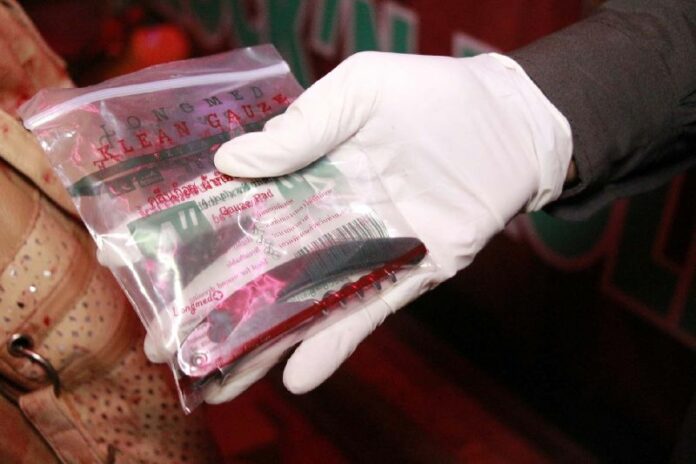
Police believe Nikom Jummanee stabbed Pornchita Saosa in the neck Friday night with this corkscrew.
CHONBURI — A go-go dancer was stabbed and seriously injured by a colleague early this morning in Chonburi’s Bang Lamung district.
Pornchita Saosa, 38, was found lying down in front of the We Are No.1 A Go Go bar. She was badly wounded after being stabbed in the back of her neck and right arm. Pornchita was treated for her injuries before being sent to Bang Lamung Hospital, police Capt. Krittha Prathumkaew said.
Another dancer reportedly standing by at the scene with a corkscrew in her hand, Nikom Jummanee, was identified as as Pornchita’s suspected attacker.
Nikom, 29, reportedly told police that she often argued with the Pornchita, mostly about stealing customers. They were talking it through in front of the bar before the fight broke out, Nikom said, when she became afraid for her safety so she grabbed the wine bottle opener and stabbed Pornchita in self-defense.
Krittha said police are questioning witnesses and inspecting security cameras at the scene.
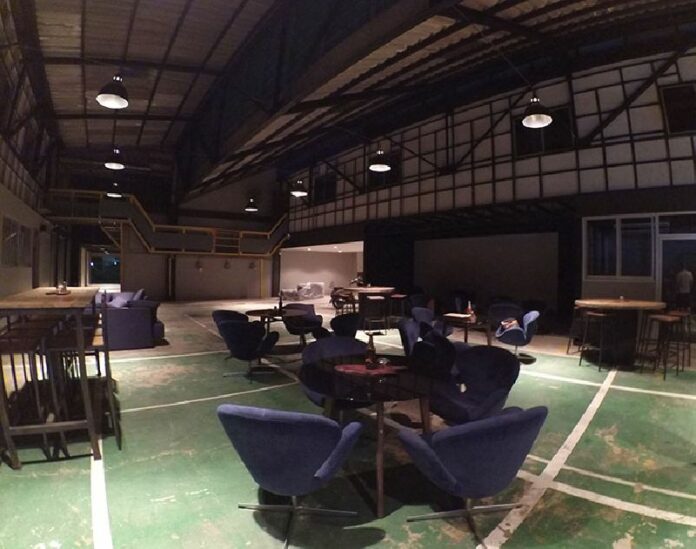
The former Sigma Elevators factory that now houses the new 'Wishbeer' bar.
BANGKOK — Late last year, the beer scene lost a sterling watering hole offering great craft beer and a rotation of of food trucks. You’d find beer geeks sipping esoteric brews while digital nomads whispered about e-payment gateway platforms over heady Belgian ales.
A temporary home meant to give a real-world presence for what had been an online-only service, Wishbeer closed after eight months. But now owner Jerome Le Louer has brought it back on quiet Soi Sukhumvit 67, a 10-minute walk from its former home.
“It’s sometimes frustrating being an online business; beer is such a social thing, it’s meant for sharing” he said. “From a business perspective, having a bar makes the most sense. it’s the only way to bridge the gap between the digital world and real life.”
The spot still isn’t permanent; it’s still very much a pop-up. Tables, taps and bar stools inhabit the former Sigma Elevators factory, a building about 20 meters down on the left side if you’re walking into the soi.
Instead of being outfitted to mimic the industrial-chic trend with exposed HVAC systems and unfinished outlets, Wishbeer actually is a former warehouse. There’s no affectation here, just an elevator production line to stare at while you drink.
The taps in the new ‘Wishbeer’ bar
Jerome plans to use the space in the same way as before but with more emphasis on making it a gateway drug to his online shop.
“What people order online at Wishbeer is changing. They’ll order one or two new, experimental things to try along with the normal weizen and popular styles,” he said, adding his hope the bar will be a place to try wild craft brews customers will later order online.
On a recent visit, a curious beer was on tap, glowing a pale shade of green, like a bubbly absinthe. It was called Verte Du Mont Blanc and was like a sudsy cousin of the famed green liquor because it uses genepi, a herb from the alps. The herb lends a chlorophyll-green hue to the beer and imparts a medicinal taste normally not found in beer.
Wishbeer is back.
Wishbeer is open from 5pm to midnight Monday through Thursday and 5pm to 1am on weekends.
An officer points out damage Thursday to the rear end of the speedboat Bantita 9.
KRABI — Five Chinese travelers were slightly injured in a speedboat crash yesterday near Krabi’s Koh Phi Phi.
The Bantita 9 was carrying about 40 Chinese tourists from Koh Phi Phi Lee en route to Phuket on Thursday night when it was hit by another speedboat called Leelu 3, 25-year-old boat operator Suwit Saithong told police.
The collision reportedly occurred near Koh Phi Phi Lee, which is about 5 kilometers from Koh Phi Phi pier. The five tourists were sent to Phuket Hospital and have now been released according to Lt. Col. Jetsada Chanpum, a police officer in Krabi province.
No one fell overboard, Jetsada said. The rear of speedboat Bantita 9 was damaged.
Jetsada said police are now questioning the two operators, but they haven’t filed charges against anyone so far.
To reach us about this article or another matter, please contact us by e-mail at:[email protected].
Follow Khaosod English onFacebookand Twitterfor news, politics and more from Thailand.














































 The slim and soft-spoken Cholapat was among the half dozen or so who interrogated me. He appeared to be more sympathetic, and before I was blindfolded by other uniformed officers, he and his direct superior asked me if there was anything I might like to have. I said newspapers – any newspapers. On the third and last day of my detention, some papers were delivered into my room which had no vista to the outside world because all the three solid-wooden windows in that small cell were shut.