



























32.7 C
Bangkok
Friday, June 19, 2026
Home Blog Page 2817

Scientists: More Research Needed into Zika-Microcephaly Link

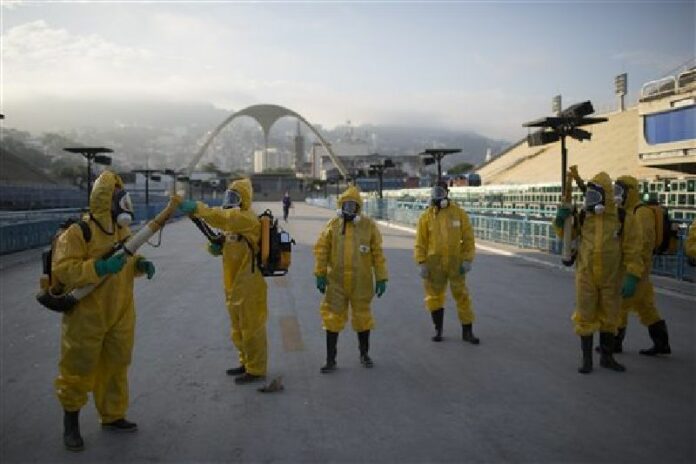
Health workers get ready, Tuesday, to spray insecticide to combat the Aedes aegypti mosquitoes that transmit the Zika virus under the bleachers of the Sambadrome in Rio de Janeiro, Brazil. Photo: Leo Correa / AP

RIO DE JANEIRO — The release of new figures apparently finding fewer cases of microcephaly in Brazil than first feared is adding force to calls for more research into the link between the rare birth defect and the spreading Zika virus.

Health experts have been looking at 4,180 suspected cases of microcephaly reported since October in Brazil, where authorities said the birth defect could be linked to the virus and announced that 220,000 military personnel were being deployed to help eradicate the Aedes aegypti mosquito that transmits Zika.

But on Wednesday, Health Ministry officials said they had done a more intense analysis of more than 700 of those cases, confirming 270 cases and ruling out 462 others.

What this means is hard to say, according to some experts. It does not answer whether the tropical Zika virus is causing the babies to have unusually small heads. Nor does it really tell us how big the problem is.

"I don't think we should lower our alarm over the Zika outbreak," said Paul Roepe, co-director of Georgetown University's Center for Infectious Disease.

Brazilian officials still say they believe there's a sharp increase in cases of microcephaly and strongly suspect the Zika virus is to blame. The concern is strong enough that the U.S. Centers for Disease Control and Prevention this month warned pregnant women to reconsider visits to areas where Zika is present, and officials in El Salvador, Colombia and Brazil have suggested women stop getting pregnant until the crisis has passed.

But the World Health Organization and others have stressed that any link between Zika and the defect remains circumstantial and is not yet proven scientifically. And the new figures were a reminder of just how little is known about the disease and its effects.


The arrival of the mosquito-borne illness in Brazil initially caused little alarm as the virus' symptoms are generally much milder than those of dengue. Then late last year, after noting what they said was a spike in the birth defect, Brazilian authorities for the first time asked doctors to report cases of patients in their care. So there are no solid numbers to compare with the new tally.

In 2014, only about 150 cases were reported in Brazil in a year — a surprisingly small amount for a large country with nearly 3 million births a year. The United States, with about 4 million births a year, has an estimated 2,500 cases of microcephaly a year, said Margaret Honein, a CDC epidemiologist.

Brazilian health officials have dismissed the idea there might have been a large number of unreported cases previously. But the rate of recorded microcephaly cases was only a fraction of what some experts thought it ought to be.

In establishing a registry, the Health Ministry cast a wide net, including live births, stillborn and miscarried babies, and fetuses shown to have unusually small heads by ultrasound or other diagnostic tests, the ministry said. In subsequent investigations, tests were done to see if the brain had been affected.

Brazilian health officials did not detail what they found in the 462 cases that were ruled out, but many of them were just premature and under-sized, a health ministry spokeswoman said.

The birth defect can be caused by factors such as genetics, malnutrition or drugs. Infections are also a cause although Zika-like viruses have not previously been linked to microcephaly.

The CDC's Honein said shifts in the numbers reported out of Brazil were not surprising, and much more investigation is needed.

She was echoed by Dr. Ganeshwaran Mochida, a pediatric neurologist at Boston Children's Hospital who specializes in microcephaly.

He said 270 confirmed cases "is still quite a substantial number" in a country that has been reporting far lower counts.

Story: Jenny Barchfield and Mike Stobbe / Associated Press

 

Advertisement

Buddhist Authority Chides Sea-Cruising Monks

Monks on a sightseeing trip near Koh Laoya  in Trat province. Photo: Chayathon Robrujane / Facebook

TRAT — The national Buddhist authority clarified that sightseeing in coral reefs and swimming are forbidden by Buddha’s teachings, if you’re a monk.

The warning came after photos spread on Facebook of monks on an excursion off the coast of Trat. The head of the Office of National Buddhism in that province said such fun is banned under Buddhist dogma, which prohibits monks from enjoying recreational activities.

“It’s considered a minor arbat,” said Santi Dinmuang, referring to a Pali word for a monk transgressions. “But in the eyes of society, it’s deeply inappropriate.” 

\

Monks on a sightseeing trip near Koh Laoya  in Trat province. Photo: Chayathon Robrujane / Facebook

Facebook user Chayathon Robrujane posted the photos Jan. 24 and said he spotted the ship full of monks near Koh Laoya. The monks were about to dive into the sea when he saw them, he wrote in a post that was removed by Thursday afternoon.

Santi, the head of Trat’s Buddhist authority, said he asked boat operators in the province about the incident. They told him the monks were from different temples in Bangkok traveling together. He added that he did not know which temples. 

“They said there was a group of monks who hired a ship for a coral reef sightseeing trip,” Santi said. “The boat captain actually knew they were monks and knew it was inappropriate, so he took them to a secluded area in the bay, but someone still spotted them, and photos spread very quickly on social media.” 

Santi added he has already sent letters to all boat operators, telling them to respect religious rules when it comes to doing business with monks.

“They can go on a tour, but it has to stay within acceptable boundaries,” he said. 

Related stories:

Astrologer Monk Rebuked for Touching Schoolgirl

Monk Defends Smacking Temple-Goers with Holy Stick

Monk Arrested for Rape and Blackmail of 11-Year-Old Girl

Horror Film May 'Destroy' Buddhism, Activists Warn


To reach us about this article or another matter, please contact us by e-mail at: [email protected].

Follow Khaosod English on and Twitter for news, politics and more from Thailand.

\

Advertisement

Australian Accused of Planning to Pack Kangaroo with Bomb

Photo: Richard G. Hawley / Flickr

MELBOURNE — A teenage suspect discussed with a British accomplice packing a kangaroo with explosives before setting it loose on Australian police officers, prosecutors alleged on Thursday.

Sevdet Ramadan Besim was ordered in the Melbourne Magistrates Court on Thursday to stand trial in the Victoria state Supreme Court on charges that he planned an Islamic State group-inspired terrorist attack at a Veterans' Day ceremony that included targeting police officers in April last year.

Besim, 19, pleaded not guilty to four charges relating to a plot to attack commemorative services in Melbourne or the neighboring city of Dandenong to mark ANZAC Day, the annual April 25 commemoration of the 1915 Gallipoli landings in Turkey. The campaign was the first major military action fought by the Australian and New Zealand Army Corps during World War I and hundreds of thousands attend commemoration services around Australia. Besim faces a potential life sentence in prison if convicted.

Besim and four alleged conspirators were arrested in Melbourne a week before ANZAC Day. He has been in custody since.

Prosecutors alleged in court documents that Besim discussed with a British-based accomplice in online conversations that a kangaroo could be packed with explosives, painted with "the IS symbol" and set loose on police.

Besim was also accused of planning to use a car to run over, then behead, a police officer.

Besim allegedly said in online communications he was "ready to fight these dogs on there (sic) doorstep."

"I'd love to take out some cops," Besim is alleged to have written. "I was gonna meet with them then take some heads."

Police allege Besim was motivated by an extremist ideology and had expressed support for terrorist organizations, particularly the Islamic State movement.

A British court in October sentenced a 15-year-old boy from Blackburn, northwestern England, for his part in the ANZAC Day plot.

In passing sentence in the Manchester Crown Court, Judge John Saunders said the teenager, who can't be named because of his age, would only be released when he was no longer a danger to the public. Saunders handed down a life sentence with no chance of parole for five years

Story: Associated Press


Advertisement

Grandmonster ‘Godzilla’ and Friends to Roar Outdoors at Silpakorn

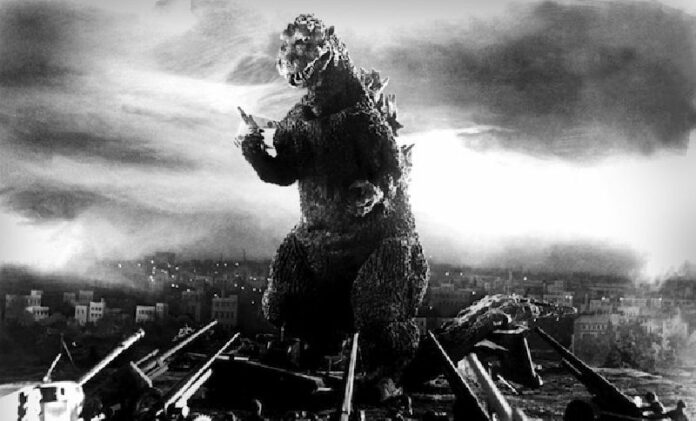
‘Godzilla’ (1954), directed by Ishiro Honda, is the first film of Godzilla franchise. The monster symbolically represents the nuclear holocaust in Japan.

BANGKOK — Godzilla will wreck the world and WALL-E will survey its destruction while the Na’vi defend their’s from human greed – all under the stars in Bangkok’s historic quarter.

Instead of showing documentary snore-dom, the archeology students of Silpakorn University have dug deep to find mainstream films with eco-positive values for their annual outdoor film fest next month.

“Green Film” will feature a selection of six films relating to environmental issues to show Feb. 10 through Feb. 12 in a campus plaza next to the Peerasri Art Gallery Museum.

The fest kicks off with the story of a Maori girl’s unlikely quest to become tribal leader in “Whale Rider” (2002) and Studio Ghibli’s animated classic “My Neighbor Totoro” (1988), in which two sisters discover magical forest residents in rural Japan.

On Feb. 11, marvel at the humanity of the world’s most pitiful robot, “WALL-E,” (2008) as he tries to salvage the planet from a wasteland of garbage before jumping to Pandora, a planet under assault by greedy humans in “Avatar” (2009).

Feb. 12 opens with tourists in tsunami-devastated Thailand in disaster drama “The Impossible” (2004) and the original postnuclear monster film “Godzilla” (1954).

All films will show in their original languages with Thai subtitles, except Godzilla, which will have English subtitles.

Apart from the film screenings, each three days features lecturers who will discuss the intersection of the environment and media with topics such as eco-terrorism and oil in “Mad Max: Fury Road” (2015). The talks run from 4pm to 6pm before the films and will held in Thai.

Admission is free. Silpakorn University is located on Na Phra Lan and Maharat roads, near Sanam Luang and the Grand Palace.


\
The films will be screened in the plaza between buildings No. 2 and 8
 

\


To reach us about this article or another matter, please contact us by e-mail at: [email protected].

Follow Khaosod English on Facebook and Twitter for news, politics and more from Thailand.

\

Advertisement

Grandmonster ‘Godzilla’ and Friends to Roar Outdoors at Silpakorn

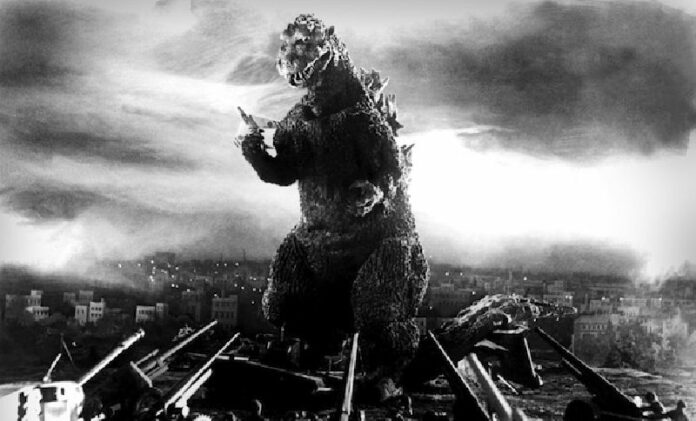
‘Godzilla’ (1954), directed by Ishiro Honda, is the first film of Godzilla franchise. The monster symbolically represents the nuclear holocaust in Japan.

BANGKOK — Godzilla will wreck the world and WALL-E will survey its destruction while the Na’vi defend their’s from human greed – all under the stars in Bangkok’s historic quarter.

Instead of showing documentary snore-dom, the archeology students of Silpakorn University have dug deep to find mainstream films with eco-positive values for their annual outdoor film fest next month.

“Green Film” will feature a selection of six films relating to environmental issues to show Feb. 10 through Feb. 12 in a campus plaza next to the Peerasri Art Gallery Museum.

The fest kicks off with the story of a Maori girl’s unlikely quest to become tribal leader in “Whale Rider” (2002) and Studio Ghibli’s animated classic “My Neighbor Totoro” (1988), in which two sisters discover magical forest residents in rural Japan.

On Feb. 11, marvel at the humanity of the world’s most pitiful robot, “WALL-E,” (2008) as he tries to salvage the planet from a wasteland of garbage before jumping to Pandora, a planet under assault by greedy humans in “Avatar” (2009).

Feb. 12 opens with tourists in tsunami-devastated Thailand in disaster drama “The Impossible” (2004) and the original postnuclear monster film “Godzilla” (1954).

All films will show in their original languages with Thai subtitles, except Godzilla, which will have English subtitles.

Apart from the film screenings, each three days features lecturers who will discuss the intersection of the environment and media with topics such as eco-terrorism and oil in “Mad Max: Fury Road” (2015). The talks run from 4pm to 6pm before the films and will held in Thai.

Admission is free. Silpakorn University is located on Na Phra Lan and Maharat roads, near Sanam Luang and the Grand Palace.


\
The films will be screened in the plaza between buildings No. 2 and 8
 

\


To reach us about this article or another matter, please contact us by e-mail at: [email protected].

Follow Khaosod English on Facebook and Twitter for news, politics and more from Thailand.

Follow @KhaosodEnglish

\


Advertisement

Woman Jailed for Defenestrating Chihuahua

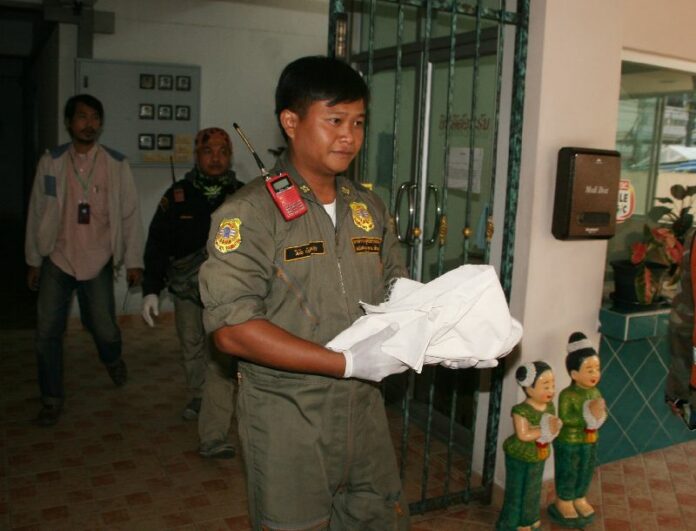
A rescue worker carries Wednesday the body of 4-year-old chihuahua ‘Dehlee’

BANGKOK — A 23-year-old woman was sentenced to two months in prison today for killing her roommate’s pet dog by throwing it out a window.

In a verdict delivered less than 24 hours after Yollada Champasri reportedly confessed to killing the 4-year-old Chihuahua the North Bangkok Circuit Court found her guilty of animal abuse and sentenced her to a two-month jail term, unsuspended.

Yollada’s lawyer said he would appeal the ruling. Yollada is being held at the court as it considers her appeal and whether to grant her bail.

“If I could turn back time, I wouldn’t have done it. I would have just kicked the dog out of my room,” Yollada said before entering the courtroom.


Puppy Thrown to Death Over Messy Room


Yollada was arrested Wednesday after she threw her roommate’s belongings out of the fifth floor window in a fit of rage, including the pet chihuahua named Dehlee. 

Yollada said she was angry at her roommate, 23-year-old Meyanee Sitthisuk, because she was untidy and ungrateful to her though she let Meyanee stay there for free. According to Yollada, she paid for Dehlee’s food and and let the dog stay there despite the apartment’s no-dog policy. 

The penalty for animal abuse was increased in November 2014 when the junta’s interim parliament passed the Animal Welfare Act, the first of its kind in Thailand. The legislation carries a penalty of up to two years in prison for acts of cruelty against animals with some exceptions, such as traditional sports and religious killings. 

Update: The court has accepted Yollada's appeal and released her on a 18,000-baht bond.

Related stories:

Activists Seek Clarity In Animal Cruelty Law

Soldiers, Police Arrest Condominium Manager for Beating Dog 

Police Investigating 5 Men for Eating Cat Meat in NE Thailand


To reach us about this article or another matter, please contact us by e-mail at: [email protected].

Follow Khaosod English on and Twitter for news, politics and more from Thailand.

\

Advertisement

13 Years Later, Chuwit Gets 2 Years for Demolishing Property

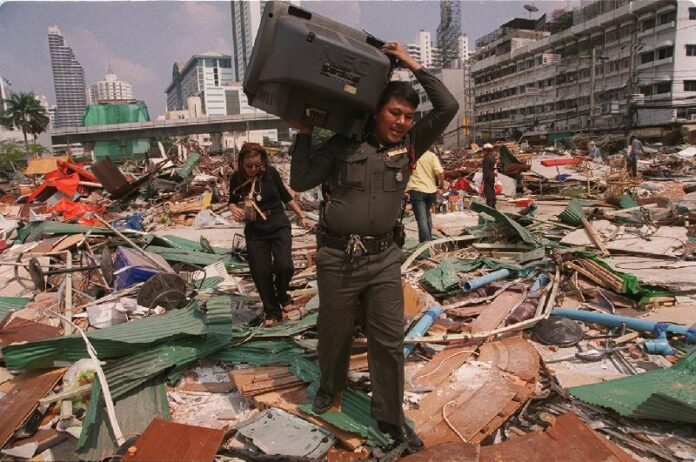
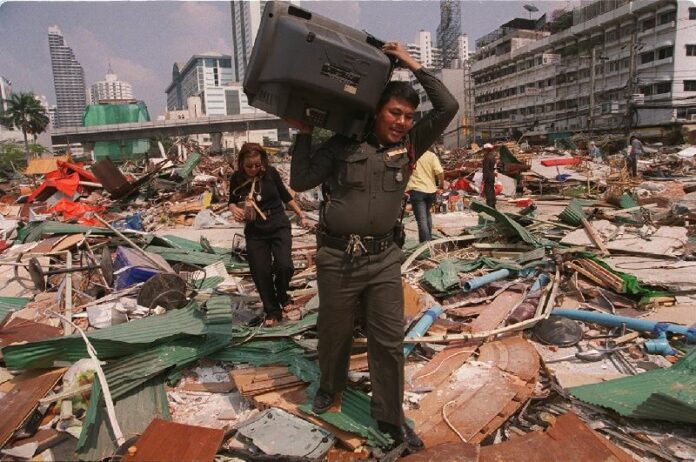
A police officer removes an intact television from a sea of debris in a Jan. 27 file photo of land demolished in Soi Sukhumvit 10.

BANGKOK — Massage parlor king-turned-politician Chuwit Kamolvisit was sentenced to two years in prison today for demolishing bars and shops 13 years ago on land he later turned into a park named after himself.

The leader of Rak Thailand Party and 65 others were sentenced by the Supreme Court to five years in prison for hiring a group of men to destroy 60 bars located in Soi Sukhumvit 10 in 2003. Unlike other high-profile cases, the court did not suspend Chuwit’s sentence, however it was reduced to two years because he filed a guilty plea before the verdict was originally to be read in October.

At 4am on Jan. 26, 2003, several hundred men arrived with backhoes and leveled 60 beer bars and other shops to clear about 10 rai of land called Sukhumvit Square, which Chuwit had recently purchased. In 2006 it became a private park called Chuwit Garden.

Chuwit, 55, is a larger than life character best known as the one-time owner of the most massage parlors in Thailand before he entered public life. He won a seat in Parliament in 2005 and has sought to frame himself as a no-nonsense graft-buster willing to expose entrenched interests and corruption.

Chuwit and a number of high-ranking military officers were among 131 men later indicted for the demolition. The Appeal Court found Chuwit and 65 others guilty while the rest were acquitted.

Today’s verdict was postponed from October when Chuwit contradicted his previous testimony to plead guilty.

Before entering the courtroom, Chuwit told reporters he would accept the verdict and not seek royal pardon if convicted.


To reach us about this article or another matter, please contact us by e-mail at: [email protected].

Follow Khaosod English on and Twitter for news, politics and more from Thailand.

\

Advertisement

13 Years Later, Chuwit Gets 2 Years for Demolishing Property

A police officer removes an intact television from a sea of debris in a Jan. 27 file photo of land demolished in Soi Sukhumvit 10.

BANGKOK — Massage parlor king-turned-politician Chuwit Kamolvisit was sentenced to two years in prison today for demolishing bars and shops 13 years ago on land he later turned into a park named after himself.

The leader of Rak Thailand Party and 65 others were sentenced by the Supreme Court to five years in prison for hiring a group of men to destroy 60 bars located in Soi Sukhumvit 10 in 2003. Unlike other high-profile cases, the court did not suspend Chuwit’s sentence, however it was reduced to two years because he filed a guilty plea before the verdict was originally to be read in October.

At 4am on Jan. 26, 2003, several hundred men arrived with backhoes and leveled 60 beer bars and other shops to clear about 10 rai of land called Sukhumvit Square, which Chuwit had recently purchased. In 2006 it became a private park called Chuwit Garden.

Chuwit, 55, is a larger than life character best known as the one-time owner of the most massage parlors in Thailand before he entered public life. He won a seat in Parliament in 2005 and has sought to frame himself as a no-nonsense graft-buster willing to expose entrenched interests and corruption.

Chuwit and a number of high-ranking military officers were among 131 men later indicted for the demolition. The Appeal Court found Chuwit and 65 others guilty while the rest were acquitted.

Today’s verdict was postponed from October when Chuwit contradicted his previous testimony to plead guilty.

Before entering the courtroom, Chuwit told reporters he would accept the verdict and not seek royal pardon if convicted.


Advertisement

Govt Shuts Down Illegal Ivory Shops

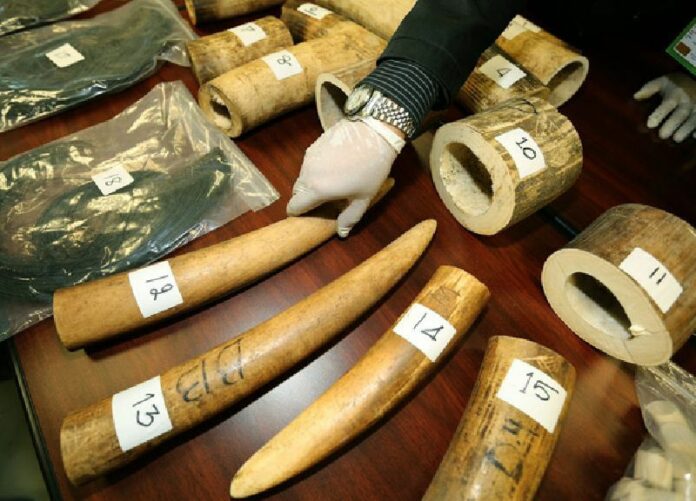
A Thai customs officer displays seized smuggled African elephant tusks April 17 at Suvarnabhumi Airport in Bangkok. Photo: Narong Sangnak / EPA

BANGKOK — Every ivory shop nationwide must be inspected by the end of March as part of the government’s effort to comply with the international wildlife trafficking agreement CITES, the state-run news bureau reported.

The crackdown by the Department of National Parks resulted in 13 of 24 ivory shops being closed in Nakhon Sawan province because they could not show prove they were legal. Nakhon Sawan’s ivory trade is second only to Bangkok, according to a 2009 report from wildlife monitoring group Traffic.

Since the current ivory trade enforcement effort began last year, four cases have been forwarded to prosecutors. Inspections will continue of the remaining 216 shops across the country.

Thailand is among eight countries identified by CITES as the worst offenders in illegal trade of ivory. It narrowly avoided threatened trade sanctions in 2015 but remains on a watch list.

Wildlife officials will apply for withdrawal from the list by submitting their progress report at the upcoming CITES meeting in October in South Africa, according to dailynews.


Related stories:

Ivory Holders Rush to Meet Thai Government Deadline

Customs Agents Seize Smuggled Ivory at Bangkok Airport

Hunt For Ayutthaya Elephant Killer, Ivory Smuggler

Thai Ivory Trade Trebles Amid Illegal Trade Concerns


Advertisement

Police Investigate Former ‘Golden Mount’ Abbot’s Death as Suspicious

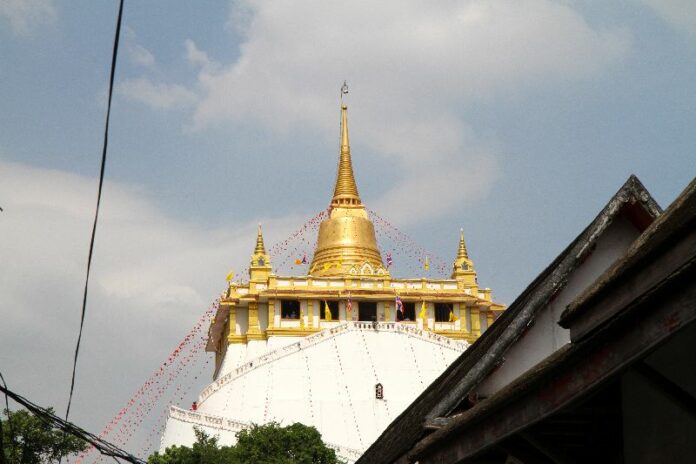
Photo: Jason Eppink / Flickr

BANGKOK — Days after a former abbot of the famed Golden Mount Temple was found hanged in his room, police now say the monk could have been murdered.

The investigation into the death of Phra Phromsuthi, who was once probed for misusing 64 million baht in state funds, was announced Thursday by the commander of Royal Thai Police, who described the monk’s death as “suspicious.” 

“We found some suspicious clues that need further investigation, but I cannot yet disclose details to you,” commander Chakthip Chaijinda told reporters yesterday. “Please give some time for the Metropolitan Police to work on this. I believe there would be progress by Jan. 29.” 


Disgraced Former 'Golden Mount' Abbot Found Hanged at Wat Saket


He said he has ordered police to “thoroughly investigate both evidence found at the scene and CCTV footage in the area. They have to investigate every dimension of this case in detail before they can conclude the true cause.”

Temple staff notified police on Monday that Phra Phromsuthi, 58, was found hanged in his monk residence at Wat Saket, aka Golden Mount Temple, in Bangkok’s historic quarters. Police initially said the former abbot committed suicide. 

\

Police officers in front of Phra Phromsuthi's residence on Monday. Photo: Matichon

Prior to his death, Phra Phromsuthi was embroiled in a national scandal for allegedly misspending 42 million of 67 million baht provided by the state for a prominent prelate’s 2013 funeral. The Office of Auditor General also accused Phra Phromsuthi of keeping the rest of the money – 25 million baht – for himself.

After the Auditor General launched its investigation into Phra Phromsuthi in 2014, he was dismissed as the abbot of the Golden Mount Temple, formally known as Wat Saket, though he still resided there as a monk. The temple later returned 25 million baht to the authorities. 

Police spokesman Dechnarong Suticharnbancha said temple staff and relatives of Phra Phromsuthi told police he “looked depressed about personal issues” before he was found hanged.

“The family said they don’t suspect anything, but we have to investigate this,” Gen. Dechnarong said. 

No one has been arrested or treated as a suspect so far, Dechnarong said, adding that police have conducted a forensic examination of Phra Phromsuthi’s body to find any evidence of foul play. He said he’s not sure when the results will be available. 

“The preliminary examination of the body is already done. We concluded that he died of suffocation, possibly caused by a rope, but how he died needs more investigation,” Dechnarong said.

If a crime was committed, Dechnarong was optimistic about the police’s ability to bring justice.

“But let me say, if, if it’s really murder, we are confident that police’s capability will have no trouble finding the perpetrator.” 


To reach us about this article or another matter, please contact us by e-mail at: [email protected].

Follow Khaosod English on and Twitter for news, politics and more from Thailand.

\

Advertisement

Hot News

LATEST NEWS

Bangkok
overcast clouds
32.7 ° C
35 °
32.7 °
68 %
4kmh
99 %
Fri
30 °
Sat
31 °
Sun
35 °
Mon
36 °
Tue
37 °