





























31.6 C
Bangkok
Thursday, June 18, 2026
Home Blog Page 2828

Navigating China’s New Silk Road

Photo: Lindsay Turner / Flickr

By Liu MingKang and Wenzhi Lu
Project Syndicate

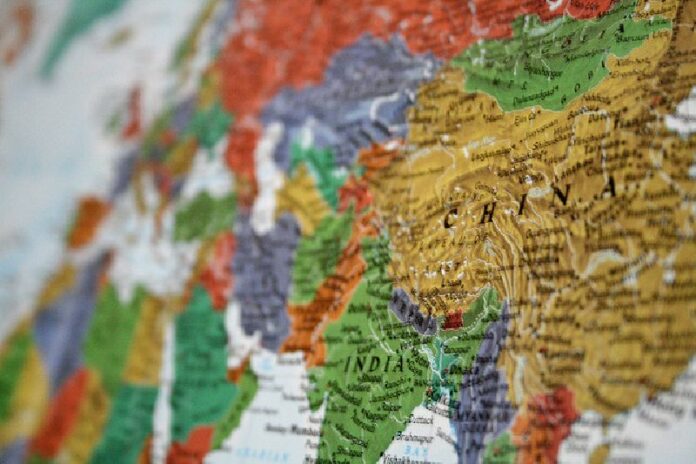
BEIJING – Since its introduction by Chinese President Xi Jinping in 2013, the “one belt, one road” initiative – an ambitious plan to revitalize the ancient Silk Road overland and maritime trade routes linking East and West – has attracted considerable attention. And for good reason: The project, which involves more than 60 countries and quite a few international organizations, implies unprecedented opportunities – and challenges.

The original Silk Road, established more than 2,000 years ago, was a critical network of trade routes that promoted economic, political, and cultural exchange among Asia, Africa, and Europe. China’s new “Silk Road Economic Belt” and “Twenty-First Century Maritime Silk Road” will do the same, with newly built or upgraded infrastructure facilitating the flow of trade, investment, culture, and ideas – and thus supporting shared economic growth.

From China’s perspective, the logic behind the strategy is clear. With its sources of GDP growth coming under increasing strain, China must continue to make progress in opening up the economy. That means building mutually beneficial relationships with neighboring countries, which can benefit by taking over some of China’s lower-value-added activities. That promises to boost their own growth while creating space for the Chinese economy to move up the value chain, where productivity and wages – important determinants of consumption – are higher.

China has already laid the groundwork for these relationships, strengthening economic cooperation and trade with countries along the “belt and road.” It has also spearheaded the creation of multilateral institutions – notably, the Asian Infrastructure Investment Bank – to support the investment projects.

China’s comparative advantages, including a global financial center in Hong Kong and a regional financial center in Shanghai, reinforce its leadership role. Add to that the recent surge in fast-growing, innovative companies – such as Huawei, Alibaba, and Wanda – and China is well placed to implement Xi’s ambitious vision.

But it will not be smooth sailing. Like any cross-border initiative, the “one belt, one road” initiative will require wise diplomacy to manage relationships with diverse countries and careful planning to scale up effectively.

Each country along the “belt and road” faces a unique combination of risks and challenges. Many face macroeconomic risks, owing to exchange-rate volatility, large debt burdens, and non-diversified, unsustainable economic structures. On the microeconomic level, risks include, for example, weak banking sectors.

Governance failures, ranging from corruption to inefficient implementation of reforms, also pose a serious challenge, as do social and political tensions (and, in some areas, the threat of terrorism). And one must not forget the ever-present risk of natural disasters, exacerbated by climate change.

Then there are the complex and varied laws, rules, and regulations shaping the business environment in each country. Of course, it is virtually impossible for Chinese enterprises to understand fully each environment before entering it. But any violation could put a company’s entire operation and investment at risk.

The challenges may be complex, but the formula for navigating them is simple. First and foremost, there can be no corruption, which would not only hurt the “one belt, one road” initiative, but would also undermine China’s ability to pursue other cross-border initiatives in the future. Second, no infrastructure project should be pursued without careful consideration of both its financial costs and benefits and its ecological impact, such as air pollution and destruction of ecosystems. Finally, all projects must be transparent and include effective checks and balances.

To reinforce this approach, the provision of financing for “belt and road” projects must adhere strictly to market rules. Given the scale of most investments, project finance – which is based on projected cash flows, rather than its sponsors’ balance sheets – will prove highly useful, as will effective risk-sharing mechanisms.

Furthermore, sponsors should look beyond a project’s construction to the achievement of its long-term objectives, such as ensuring profitability and managing its lasting impact on the local community and the environment. Consultants, lawyers, auditors, NGOs, and other entities with international experience can play a vital role in all of these efforts.

There are also practical steps that can be taken to mitigate specific risks. For example, to minimize the risks associated with operating in an unfamiliar regulatory and legislative environment, businesses should establish links in advance with a local entity to guide their activities.

China, as the leading promoter of the “one belt, one road” initiative, must take steps to ensure that businesses act responsibly. The central government will have to regulate and coordinate sub-national governments effectively, while working to ensure that competition is fair and constructive. At the same time, China should implement a well-designed training program that provides officials at all levels of government and entrepreneurs with basic information about operating abroad. And it should do more to spur the involvement of Hong Kong – which possesses major advantages in finance and logistics, information accessibility, talent recruitment, and implementation of the rule of law – in the initiative. Last but not the least, the central government needs to strengthen the guidance of crisis management and exit strategies.

Realizing the “one belt, one road” initiative will not be easy. But China has all of the tools it needs to succeed. As long as it uses them in a way that is clean, green, and transparent, China and its neighbors will reap vast rewards.

Liu Mingkang, a former chairman of the China Banking Regulatory Commission, is BCT Distinguished Research Fellow at the Institute of Global Economics and Finance at The Chinese University of Hong Kong and Distinguished Fellow for the Asia Global Institute at the University of Hong Kong.

Copyright 2015, Project Syndicate
Advertisement

In Reversal, Tourists Accused of Running Scam

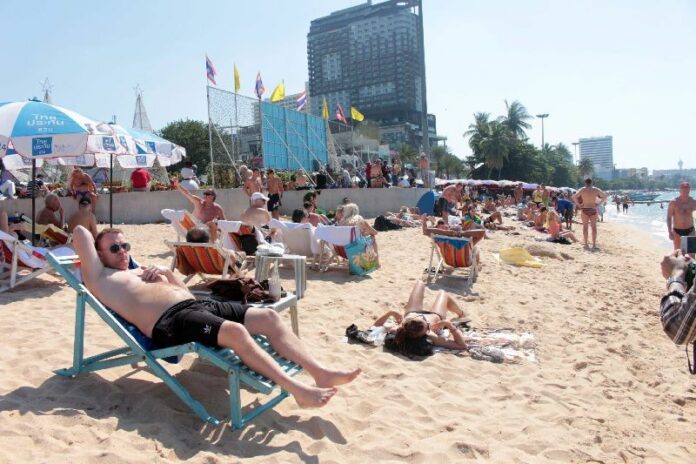
Pattaya beach in a December 2014 file photo.

By Teeranai Charuvastra
Staff Reporter

PATTAYA — Two men from China were enjoying a seaside holiday near Pattaya last week when a local vendor selling leather bags approached them. The man made them a simple offer: buy his bags or get punched, so fearing for their lives – as they would later tell police – they paid 12,000 baht to buy the bags.

It’s a scam familiar to those who know Pattaya. But in this case, police said it could be the Chinese tourists who played the scam.

According to the vendor, he never forced the tourists – 43-year-old Chen Lei and 45-year-old Xu Guangming – to buy his goods as the pair alleged. Police now believe the tourists made a false complaint to file an insurance claim – another practice that police say has become widespread in Pattaya.

“We believe it’s a case of a false complaint,” said Sukthat Pumpanmuang, commander of Pattaya City Police Station.

If true, it would be another type of racket to become somewhat common in a place with a reputation for scams. But instead of the usual complaints involving tourists getting shafted over jet skis, gems or taxi rides, it’s the tourists running the scam.

The two tourists from China initially told police Tuesday night they fell victim to the extortion while visiting Koh Larn, a nearby island. They said the vendor forced them to buy four leather bags.

Col. Sukthat said police searched the island for the perpetrator, and on Thursday arrested a merchant who fit the victims’ description. That man, 45-year-old Apicha Yenphukao, denied the accusation.

“He said he sold the bags to the tourists as normal. There was no intimidation,” Sukthat said Friday by telephone. “And now we couldn’t find the victims … We went to their hotel, but they already checked out. They’re probably back in China by now.”

Sukthat said his main reason for believing Apicha’s version of events is because the tourists did not seek help until 10pm that night, 10 hours after they said the incident took place.


Claim Game

Travel insurance service bought by foreign tourists generally covers events of theft, but claimants need to supply a full police report as evidence.

There have been occasional cases of insurance fraud in Pattaya, a popular tourist destination well-known for its seedy nightlife and high rate of crimes against foreigners.

On Feb. 5, an Australian tourist said he was robbed there but later confessed to inventing the story to file an insurance claim, according to police reports. Four months later, a Filipino was arrested under the same circumstances.

“We have a lot of those cases. It’s frequent,” Sukthat said. “Sometimes we catch them red-handed. CCTV footage didn’t show the crimes they claimed, so they confessed, and we arrested them right away and sent them to court.”

Asked whether the number of false complaints makes police skeptical of foreigners who report robberies, commander Sukthat said their judgment isn’t colored.

“No, we don’t treat them all as suspicious,” he said. “We investigate every complaint per normal procedure. We don’t have any preconceptions.”

Even more recently, on Wednesday, Pattaya police took in a Danish man who first claimed to have been robbed before admitting to making it up.

Police Col. Pramote Ngampradit said the Dane has been sent to stand trial for filing a false police report. It’s difficult to find out what happens to such cases after charges have been filed: Pramote said he’s unaware of the case’s disposition, a staff member at the Pattaya Circuit Court said they could not divulge any information per regulations, and the Danish Embassy in Bangkok did not respond to a request for comment.

“But I think he would just enter a guilty plea and let the court case end, because it would be easy for him that way,” Pramote said.

In at least one case, a British national who was initially charged with false complaint was later acquitted by the court. According to an interview with blogger Andrew Drummond, the Briton never made any false complaint, and police charged him with the crime out of language misunderstanding.

Advertisement

Academics to Expand Opposition to Junta

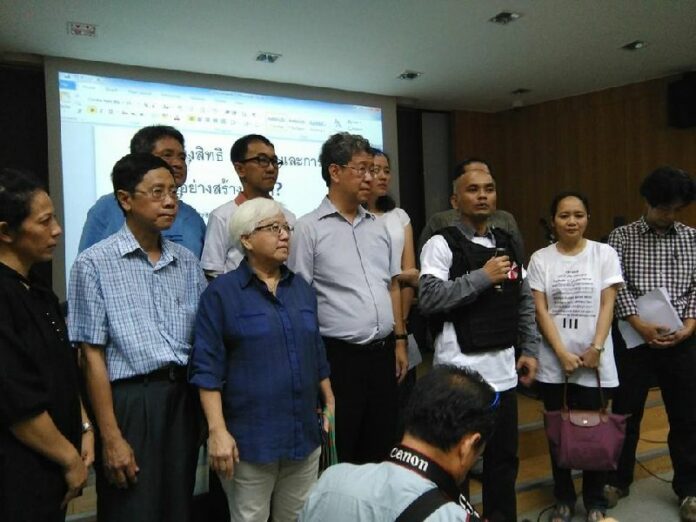
Anusorn Unno (speaking), dean of Thammasat University’s Faculty of Sociology and Anthropology, on Dec. 4 at Thammasat University. Photo: New Democracy Movement / Facebook

By Pravit Rojanaphruk
Senior Staff Writer

BANGKOK — Pro-democracy academics want to shift to a proactive stance in an attempt to restore some political rights amid concerns the junta may attempt to remain in power much longer.

Some 30 academics and NGO activists organized as “Thai Academics for Civil Rights” will meet Thursday through Saturday to review their role and come up with strategies and measures to push back against repression by the military junta against students and scholars.

“In the past we have always been in a state of reaction,” said Anusorn Unno, dean of Thammasat University’s Faculty of Sociology and Anthropology.

Such measures could involve the setting up of people’s assembly to scrutinize the regime and engage in monthly deliberations of problems and potential solutions.

“What can we do to steal the agenda from the National Council for Peace and Order (NCPO)?” Anusorn said, referring to the formal name of the military junta which seized power in May 2014.

Anusorn said his group of academics, comprising about 400 lecturers both inside and outside Thailand, are best suited to support pro-democracy groups because they are accepted by society in general as having altruistic motives.

Anusorn said his group is counting on the growing disillusionment of groups which used to support the coup-makers, including medical doctors, NGO workers, rubber farmers and some members of the movement created to oust the former civilian government, the People’s Committee for Absolute Democracy with the King as Head of State, or PCAD.

“These people increasingly recognize that paving way for the military to seize power didn’t enable [the country] to progress,” he said. “It wasn’t that clear in the first year since the coup, but the dust has now settled.”


Ghosts of the Past

Anusorn is well aware that due to the past role of academics and students in overthrowing military dictators in 1970s and 1990s, the current military regime is wary of overreacting or using tactics that are overly repressive.

He believes the junta is concerned harsh repression of anti-coup students and academics could lead to a widespread uprising and their eventual demise, as has occurred in the past, and this has informed how they currently behave vis-a-vis toward students and academics.

Anusorn admitted however that the number of anti-coup student activists have dwindled so much compared to the past that they’re now been relegated to serving as just one of the groups opposing the junta.

“Students are just one of the voices now,” he said.

What’s more, said Anusorn, unlike during the Cold War, it’s no longer possible to expect anything like a mass revolution. Nevertheless, the United States and European Union are expected to continue piling pressure on the junta. Due to these factors, Anusorn rules out mass murder by the junta.

He said the goal for the anti-coup academics is to thus “continually raise the ceiling of society’s level of rejection of the junta.”

Anusorn said he’s aware that there’s a limit to the supposed absolute power of the military, and the group looks forward to mounting an offensive in the coming months.

“We must lift the ceiling of fear and keep moving,” he said, adding that this year might even mark the end of the junta.

“The support base of the regime is eroding and simmering conflicts which have been suppressed await to be reignited,” he said, adding that there has been no progress in national reconciliation, national reform, and now the junta itself is embroiled in corruption allegations over the construction of Rajabhakti Park.

“The NCPO can’t move forward. It can’t step back,” he said. “They are simply seeking to keep themselves afloat.”

The junta insists they are asking for more time in power and “request” those who disapprove wait until a general election, currently promised by mid-2017, which Anusorn said makes no sense.

“The regime lacks legitimacy from the very start,” he said, adding that even those who entertained such an excuse are increasingly realizing the junta is not really solving any problems as it clings to power.

“You don’t have legitimacy to ask people to wait from the beginning,” he said. “What you did is to put a halt to [political] mayhem, but the same hatred is still simmering and waiting to resurface.”


Uncertain Outcome

Not all are convinced the plan will work out so easily.

“Some academics feel that it’s difficult to find ways to mount effective [moves],” said Pongkwan Sawasdipakd, a Thammasat University political scientist, sounding frustrated. “I don’t know what we can do more than just issuing statements only to find they are ineffectual. … There should be a better strategy than just issuing statements.”

Pongkwan, who is publicly against the junta but not a member of the network, said there’s also disagreement between older and younger generations of anti-coup academics on how to move forward, and many members are just too individualist.

Himself participating in an anti-junta video clip last year, Pongkwan said it’s unrealistic to expect the junta will be ousted by revolt.

“I personally think it’s difficult if we want to oust [the junta],” she said. “They’re clearly in power. Ousting [the junta] requires conflict within the ruling class.”

Taking a realistic yet optimistic approach is Barame Chairat, a member of the network and coordinator of Assembly of the Poor, an NGO which seeks to engage historically marginalized communities in development processes affecting them.

“I agree that we need to launch an offensive because we have been on the receiving end so far,” Barame said. “If we don’t do this, more will suffer.”

Baramee acknowledge that kicking the junta out can’t be done by academics, and the task is up to the masses. Academics and NGO workers like himself can provide the public with information that could convince people to act, however. At the same time he played down the disagreement among pro-democracy academics, saying it’s a normal thing.

“If we do something, move forward, we can build legitimacy, and other academics who are less vocal will eventually join,” he said.

There is a big caveat, however.

“I think [the junta] will try to stay in power as long as they can. And I don’t think until the middle of next year but eight to 10 more years,” he said. “So it’s our duty [to do something].”


To reach us about this article or another matter, please contact us by e-mail at: [email protected].

Follow Khaosod English on and Twitter for news, politics and more from Thailand.

\

Advertisement

Academics to Expand Opposition to Junta

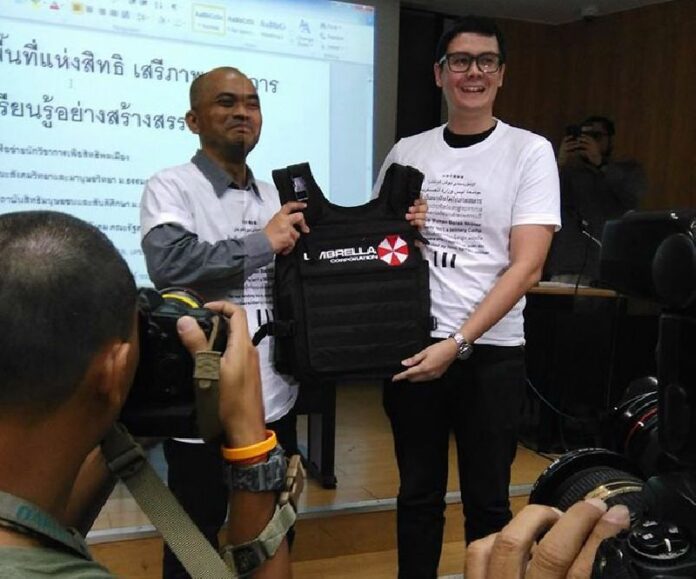
Rangsiman Rome, a student member of the New Democracy Movement at right, presents a prop bullet- and possibly zombie-proof vest to Anusorn Unno, dean of Thammasat University’s Faculty of Sociology and Anthropology on Dec. 4 at Thammasat University. Photo: New Democracy Movement / Facebook

By Pravit Rojanaphruk
Senior Staff Writer

BANGKOK — Pro-democracy academics want to shift to a proactive stance in an attempt to restore some political rights amid concerns the junta may attempt to remain in power much longer.

Some 30 academics and NGO activists organized as “Thai Academics for Civil Rights” will meet Thursday through Saturday to review their role and come up with strategies and measures to push back against repression by the military junta against students and scholars.

“In the past we have always been in a state of reaction,” said Anusorn Unno, dean of Thammasat University’s Faculty of Sociology and Anthropology.

Such measures could involve the setting up of people’s assembly to scrutinize the regime and engage in monthly deliberations of problems and potential solutions.

“What can we do to steal the agenda from the National Council for Peace and Order (NCPO)?” Anusorn said, referring to the formal name of the military junta which seized power in May 2014.

Anusorn said his group of academics, comprising about 400 lecturers both inside and outside Thailand, are best suited to support pro-democracy groups because they are accepted by society in general as having altruistic motives.

Anusorn said his group is counting on the growing disillusionment of groups which used to support the coup-makers, including medical doctors, NGO workers, rubber farmers and some members of the movement created to oust the former civilian government, the People’s Committee for Absolute Democracy with the King as Head of State, or PCAD.

“These people increasingly recognize that paving way for the military to seize power didn’t enable [the country] to progress,” he said. “It wasn’t that clear in the first year since the coup, but the dust has now settled.”


Ghosts of the Past

Anusorn is well aware that due to the past role of academics and students in overthrowing military dictators in 1970s and 1990s, the current military regime is wary of overreacting or using tactics that are overly repressive.

He believes the junta is concerned harsh repression of anti-coup students and academics could lead to a widespread uprising and their eventual demise, as has occurred in the past, and this has informed how they currently behave vis-a-vis toward students and academics.

Anusorn admitted however that the number of anti-coup student activists have dwindled so much compared to the past that they’re now been relegated to serving as just one of the groups opposing the junta.

“Students are just one of the voices now,” he said.

What’s more, said Anusorn, unlike during the Cold War, it’s no longer possible to expect anything like a mass revolution. Nevertheless, the United States and European Union are expected to continue piling pressure on the junta. Due to these factors, Anusorn rules out mass murder by the junta.

He said the goal for the anti-coup academics is to thus “continually raise the ceiling of society’s level of rejection of the junta.”

Anusorn said he’s aware that there’s a limit to the supposed absolute power of the military, and the group looks forward to mounting an offensive in the coming months.

“We must lift the ceiling of fear and keep moving,” he said, adding that this year might even mark the end of the junta.

“The support base of the regime is eroding and simmering conflicts which have been suppressed await to be reignited,” he said, adding that there has been no progress in national reconciliation, national reform, and now the junta itself is embroiled in corruption allegations over the construction of Rajabhakti Park.

“The NCPO can’t move forward. It can’t step back,” he said. “They are simply seeking to keep themselves afloat.”

The junta insists they are asking for more time in power and “request” those who disapprove wait until a general election, currently promised by mid-2017, which Anusorn said makes no sense.

“The regime lacks legitimacy from the very start,” he said, adding that even those who entertained such an excuse are increasingly realizing the junta is not really solving any problems as it clings to power.

“You don’t have legitimacy to ask people to wait from the beginning,” he said. “What you did is to put a halt to [political] mayhem, but the same hatred is still simmering and waiting to resurface.”


Uncertain Outcome

Not all are convinced the plan will work out so easily.

“Some academics feel that it’s difficult to find ways to mount effective [moves],” said Pongkwan Sawasdipakd, a Thammasat University political scientist, sounding frustrated. “I don’t know what we can do more than just issuing statements only to find they are ineffectual. … There should be a better strategy than just issuing statements.”

Pongkwan, who is publicly against the junta but not a member of the network, said there’s also disagreement between older and younger generations of anti-coup academics on how to move forward, and many members are just too individualist.

Himself participating in an anti-junta video clip last year, Pongkwan said it’s unrealistic to expect the junta will be ousted by revolt.

“I personally think it’s difficult if we want to oust [the junta],” she said. “They’re clearly in power. Ousting [the junta] requires conflict within the ruling class.”

Taking a realistic yet optimistic approach is Barame Chairat, a member of the network and coordinator of Assembly of the Poor, an NGO which seeks to engage historically marginalized communities in development processes affecting them.

“I agree that we need to launch an offensive because we have been on the receiving end so far,” Barame said. “If we don’t do this, more will suffer.”

Baramee acknowledge that kicking the junta out can’t be done by academics, and the task is up to the masses. Academics and NGO workers like himself can provide the public with information that could convince people to act, however. At the same time he played down the disagreement among pro-democracy academics, saying it’s a normal thing.

“If we do something, move forward, we can build legitimacy, and other academics who are less vocal will eventually join,” he said.

There is a big caveat, however.

“I think [the junta] will try to stay in power as long as they can. And I don’t think until the middle of next year but eight to 10 more years,” he said. “So it’s our duty [to do something].”

Advertisement

West Lifts Sanctions Against Iran

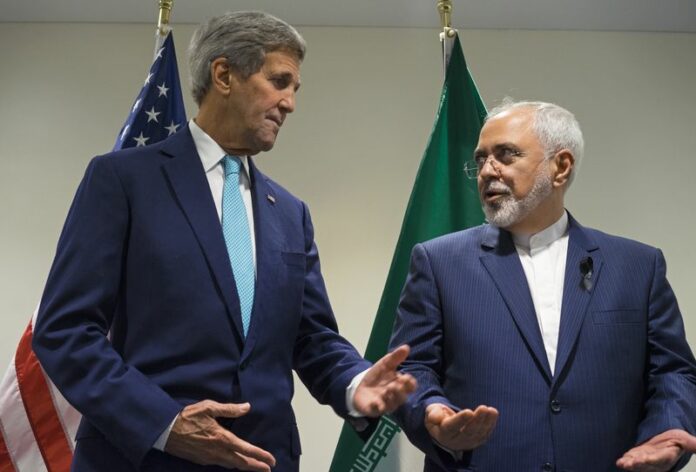
U.S. Secretary of State John Kerry and Iranian Foreign Affairs Minister Mohammad Javad Zarif. Photo: Craig Ruttle / DPA

TEHRAN, Iran — The head of the UN nuclear watchdog was due to arrive in Tehran on Sunday, one day after international sanctions were lifted as part of a landmark nuclear accord.

Yukiya Amano, head of the International Atomic Energy Agency, or IAEA, would meet Iranian President Hassan Rowhani and the chairman of the country's Atomic Energy Organization, Ali Akbar Salehi, the UN agency said.

The European Union and United States lifted sanctions targeting Iran and announced a prisoner exchange Saturday, ending Tehran's international isolation.

The IAEA confirmed that Tehran had kept its side of last year's agreement with six major powers by significantly scaling down its nuclear programme.

Amano's meetings would "focus on the IAEA's role in verifying and monitoring Iran's nuclear-related commitments," the IAEA statement said.

Story: DPA

Advertisement

West Lifts Sanctions Against Iran

TEHRAN, Iran — The head of the UN nuclear watchdog was due to arrive in Tehran on Sunday, one day after international sanctions were lifted as part of a landmark nuclear accord.

Yukiya Amano, head of the International Atomic Energy Agency, or IAEA, would meet Iranian President Hassan Rowhani and the chairman of the country's Atomic Energy Organization, Ali Akbar Salehi, the UN agency said.

The European Union and United States lifted sanctions targeting Iran and announced a prisoner exchange Saturday, ending Tehran's international isolation.

The IAEA confirmed that Tehran had kept its side of last year's agreement with six major powers by significantly scaling down its nuclear programme.

Amano's meetings would "focus on the IAEA's role in verifying and monitoring Iran's nuclear-related commitments," the IAEA statement said.

Story: DPA

Advertisement

Foreigners Among 26 Dead in Burkina Faso Terrorist Siege

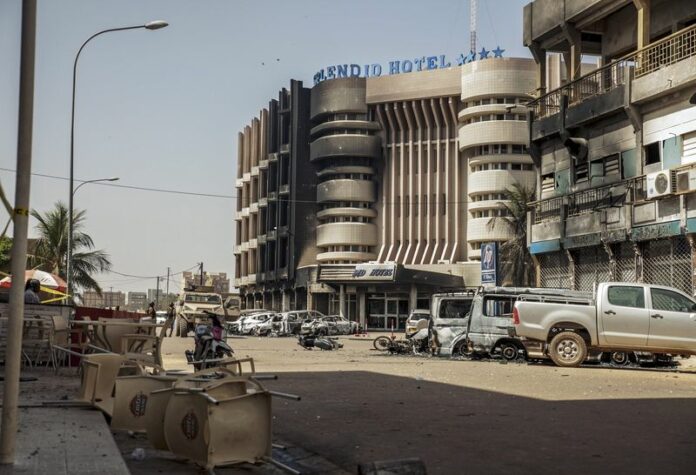
Outside the Splendid Hotel in Burkina Faso's capital city of Ouagadougou where Al-Qaeda militants killed 26 people Saturday. Photo: Wouter Elsen / EPA

OUAGADOUGOU, Burkina Faso — Al Qaeda militants in Burkina Faso killed 26 people from several countries in an attack on a cafe and a luxury hotel in the capital, which ended after raids by security forces on Saturday.

Prime Minister Paul Kaba Thieba gave the confirmed death toll from the attacks after an emergency meeting of his cabinet. A further 56 people were injured, several of them seriously, according to Thieba.

Interior Minister Simon Compaore said 126 hostages had been freed from the 147-room Splendid Hotel in the West African country's capital, Ouagadougou. Another 30 were safe at the Cappuchino cafe.

Among the dead were six Canadians and one U.S. citizen.

Calling the attack a "terrible crime," Canadian Prime Minister Justin Trudeau said Canada was "deeply saddened by these senseless acts of violence on innocent civilians."

The U.S. State Department named the American victim as Michael James Riddering, who was a missionary according to U.S. media.

Two Swiss nationals and two French citizens – work colleagues according to French news agency AFP – were also reported killed.

The siege, which began Friday evening and continued overnight with sporadic reports of gunfire and explosions, ended with Burkinabe and French soldiers launching a counter-assault on the hotel.

The attackers first opened fire upon the Cappuccino Cafe before moving on to the hotel next door, which is popular with foreigners.

Four militants were killed, Compaore said.

The U.S.-based monitoring group SITE Intel said the group al-Qaeda in the Islamic Maghreb (AQIM) claimed responsibility.

UN Secretary General Ban Ki-moon condemned the "heinous terrorist attacks."

The assault occurred just weeks after President Roch Kabore took office. Kabore was elected in November in the first free elections in the country in 50 years.

The landlocked country, a former French colony, is the largest cotton producer in Africa and is also rich in gold. Despite its resources, it is one of the poorest countries in the world.

French President Francois Hollande "declared his complete support for President Kabore and to the Burkinabe people in the despicable and cowardly attack that has hit Ouagadougou," his office said in a statement.

Story: DPA

Advertisement

Public's Watchdogs Become Dictator's Lapdogs

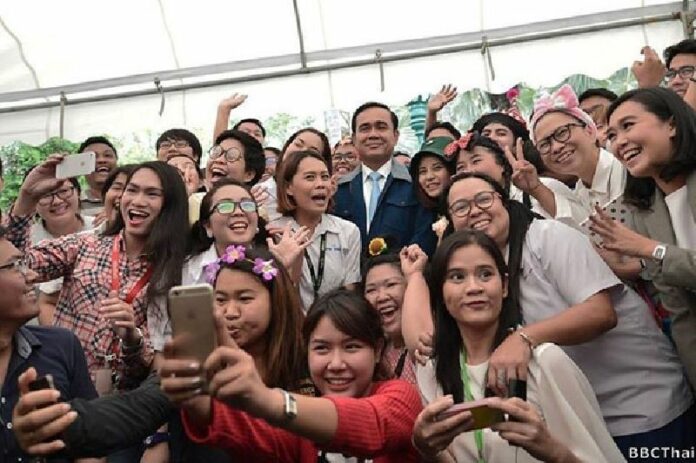
Dressed as children, members of Thailand's press corps mug for selfies recently with junta chairman Prayuth Chan-ocha. Photo: BBC Thai

By Pravit Rojanaphruk
Senior Staff Writer

\

BANGKOK — In a country where military coups are common occurrences, the mass media serve as more than just victims of repression. All too often they serve as admirers, supporters, collaborators and even spin doctors for the junta.

Instead of holding the coup-makers feet to the fire, some media in Thailand instead serve to normalize what is an otherwise unpalatable, illegitimate and anti-democratic regime.

\

For example, the kingdom’s best-selling tabloid, Thai Rath, often refers to the junta leader’s dictatorial power under Article 44 of its provisional charter using the Thai word for “special” (phisaet), which has a much more positive meaning than it does in English. (Think special occasions, special prices or special editions.) There’s nothing “special” about absolute dictatorial power, however. If there were any proper adjective for it, it should be “autocratic” or “illegitimate,” if not both.

Such practices may be subtle, but they’re definitely insidious, as they influence uncritical readers into accepting the junta’s power as normal, or even truly “special.”

I can also confirm that at one newspaper, by order of the editor, the term “military government” is effectively banned. And don’t forget, a number of newspapers effectively acted as coup apologists through their editorials in the aftermath of the May 2014 putsch, as some did right after the 2006 coup.

More blatant was a picture of many Government House beat reporters at a New Year party hosted by Thailand’s junta leader-cum-prime minister Gen. Prayuth Chan-ocha last week. Partaking in such a “party” with the dictator is embarrassing enough, but the pictures showed these reporters elated, ecstatic and even flattered to be bamboozled in their group selfies with the dictator.

What’s more, many of these young journalists later changed into schoolchildren’s uniforms to greet Prayuth, mimicking the National Children’s Day celebration, a move that caught some junta leaders by surprise. The photos suggest these young reporters are a little too cozy and comfortable with the military dictator. (A foreign correspondent and former president of the Foreign Correspondents Club of Thailand messaged me after he saw one of the pictures captured by BBC Thai, asking, “Seriously? The journos dressed as schoolchildren?” I answered affirmatively, which he described as “amazing.”)


\

Reporters dress in school uniforms for young children and girl scout uniforms recently at a New Year's party with junta chairman Prayuth Chan-ocha at Government House in Bangkok.

If you think these mostly young reporters are embarrassed by such faux pas, you’d be wrong, and a number of newspapers even proudly published the photos with no hint of irony or self-awareness. Judging by these photos, I’m sure we can fully entrust these journalists to scrutinize the dictator and his regime.


Just Deserts?

This cozying up to power hasn't seemed to bring any benefits, at least not for the public or state of Thai journalism.

Barely a week went by after the scandalous photos were flaunted by the media themselves when the junta’s appointed charter drafters proposed writing media censorship into the next constitution, to be enabled whenever a state of emergency or martial law is invoked, thus extending such powers beyond the current junta’s lifespan.

I can’t just blame these young reporters for being chummy and clueless with a dictator when some of their seniors, which includes two past presidents of the Thai Journalists Association, the kingdom’s premier reporter’s guild, collaborated with the current military regime. First it was Pradit Ruangdit, then sitting president of the association, who soon after the coup accepted appointment to the now-defunct National Reform Council. Pradit said he did so to defend journalists’ interests.

Still working hard for the junta until now is Phatara Khamphitak, another former president of the association, who is a member of the junta-appointed Constitution Drafting Committee.

Given the wide range of collaboration, support and admiration between a substantial number of media organizations and journalists with the military junta, it’s wrong to say Thai media were victims or opponents of the coup makers.

Some may have censored themselves out of fear, others did it out of support and admiration for military rule. There’s also many media who support Prayuth as the lesser of the two evils, compared to the Shinawatras. Yet others simply have forgotten or abandoned their roles as watchdogs and been reduced to lapdogs.

No matter what the reason, or however unknowingly, a good portion of Thailand’s media has helped normalize and legitimize a military dictatorship and perpetuated the vicious cycle of coups that stunts the development of a free and democratic Thailand.

Pravit Rojanaphruk can be followed on Twitter at @PravitR


To reach us about this article or another matter, please contact us by e-mail at: [email protected].

Follow Khaosod English on Facebook and Twitter for news, politics and more from Thailand.

Follow @KhaosodEnglish

\

Advertisement

The Depraved Joy of Chris Coles and the ‘Bangkok Noir’

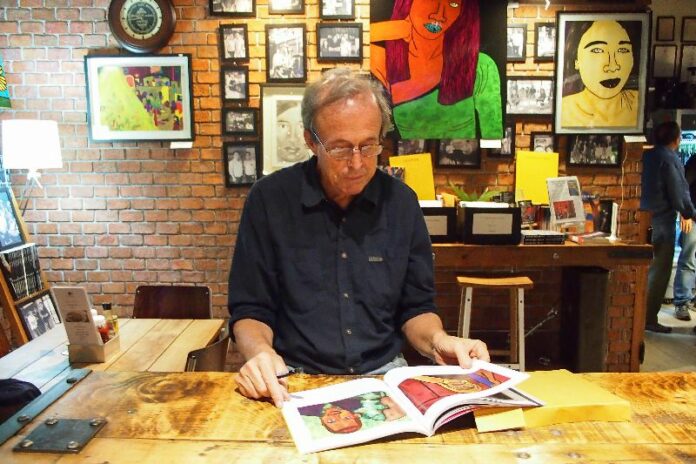
BANGKOK — Lurid is the first word that comes to mind when absorbing the portraits and nightscapes of painter Chris Coles.

Not just for the vivid and feverish colors, but the late-night scenes of barflys, sex workers and the “informal economy.” In recent years Coles has painted prolifically and built a following online and off.

On Thursday, a crowd of around 30, mostly older expat men, gathered at Bangkok’s Brainwake Cafe and Gallery on Soi Sukhumvit 33 for the American painter’s exhibition "Flowers, One Butterfly and the Bangkok Night.” Many were writers and journos (whom Coles engages heavily with on social media) and John Gartland read one of his poems from “Bangkok, Heart of Noir,” a book featuring Coles’ paintings.

Where the subject matter could come off as creepy, Coles paints with a gleeful honesty that avoids romanticism. The patina of white male desperation offsets the Orientalism at play in a body of work preoccupied with foreign men and Asian sex workers. Many figures' grins are indistinguishable from grimaces. They're all mad here, swerving between anguish and ecstasy.

There is anachronism in its focus, given the Bangkok of 2016, as it plays into those arguably tired stereotypes of Thailand and Southeast Asia.

But it’s the darker aspects of it all that is alluring to Coles, who doesn’t seem the type to be thrilled by sexploitation, more than he is enamored of the darker recesses of the human heart.

“They get delivered like a pizza,” Coles blurted out somewhat grimly during a discussion Thursday of sexually trafficked women he’s met the region.

I sent some questions to him. Here’s how he replied:

KE: The "Bangkok Noir," as you describe your work, often involves the purveyors or patrons of the flesh trade. A lot of farang with eyes somewhere between lust and lost. What draws you to that?

CC: Nightlife/sex business has often been used by artists. Paris around 1900, all the famous artists painted nightlife, nightlife workers. Same with Berlin 1920s, 1930s. … I think because there's so much color, so much exaggerated behavior, so many characters suffering. Humanity revealed.


KE: What do you see in a subject that makes you want to paint them?

CC: I like looking at all kinds of art and design, but my favorite art by far is German Expressionist art and the French Fauvists who came before them. I love the wild use of color, the distortion, and that the German Expressionists had a social context in their paintings, not just abstract, not just "decoration." Berlin 1920s and 1930s [saw a] rise of Fascism, authoritarian rule, social disintegration, alienation and dysfunction, like a volcano erupting.

That's what drew me into painting the Bangkok Night such wild colors, lighting, neon, so many different people, characters, larger than life, exaggerated, from all over the world [and] behaving badly in all sorts of ways.


\

‘Closing Time Nana Plaza’ Photo: Courtesy Chris Coles


KE: Are your subjects as deranged as they often appear, or do you take some license? Like, is there that much depravity out there, or do you turn up the volume?

CC: I don't want to make a "copy" of "reality" in a "realistic style.” Realism is boring. …I want to look past the surface into the dark deep interior where all the forbidden and ugly human stuff's going on.

The human animal is so bad, not well-intentioned, not "nice" at all. Humans kill, murder, maim, torture, rape millions of other humans,traffic other humans,buy and sell other humans, brutally exploit other humans. In my Bangkok Night paintings, I try to capture the true nature of humanity, not the "pretend," "nice" side of the human animal.


KE: What is new in "Flowers, One Butterfly And The Bangkok Night"?

CC: Oh, I was just thinking there's something in common between the Night Business and flowers and butterflies. The girls working in the night are like pretty flowers, pretty colors, nice shapes, pretty costumes, nice smell, makeup and hair. All are to attract the human male, who's like a butterfly flying around looking for pretty flowers. So I thought combining flowers, butterflies and Bangkok Night paintings would be kind of interesting, fun and illuminating.


\

“Blue Butterfly in the Bangkok Night” Photo: Courtesy Chris Coles


KE: Which came first, spending a lot of time in bars or finding subjects to paint?

CC: First came a lot of pencil/graphite portraits of people's faces. I was fascinated by the genetic diversity of Bangkok and Southeast Asia. So many interesting faces.

When I came to Thailand the first time, I was doing a big Hollywood movie. … Naturally, people would go out at night: bars, night clubs, restaurants. Waves of neon, lighting, faces from all over the world, pretty girls, ladyboys, rent-boys, the smell of all sorts of food, the new pop music of Thailand and Asia just washed over me. I'd never been in Asia at all before. I said to myself, “Hey, something's going on here. Things are changing at the speed of light. A volcano is erupting. This is a special moment in Southeast Asia.”


KE: That side of Bangkok seems to be rapidly disappearing, as a new generation of migrants and residents replaces it with Quinoa salad joints, artisanal cafes serving single-sourced brunches and fitness centers. How do you feel about that?

CC: There are many layers and aspects to modern Bangkok. And as you point out, increasing prosperity. … But the Thonglor/Ekkamai side of modern Bangkok is only one slice, there are many other slices as well, from very high billionaire level to very bottom-end, dark, horrible level.


\

‘Midnight Patpong’ Photo: Courtesy Chris Coles


KE: How long have you been in SEA? Do you still split your time between Cambodia and Thailand? How would you say the city/night cultures have evolved relative to each other?

CC: I'm based in Bangkok. Upper Sukhumvit. One of the nicest urban big city districts in the whole world, but I go around a lot. … [A]nd yes, every city, country, culture has its own style of nightlife which reflects many of the unique aspects. … For instance, nightlife in 20 million-person Jakarta is radically different from nightlife in Bangkok. Phnom Penh too. Same with Singapore, Saigon, Shanghai, Beijing, or New York, London, Paris. Nightlife reveals so much. It's where the secrets float to the surface.


KE: What's next?

CC: I'm off to Saigon in a few weeks. Saigon's changing at the speed of light. Vietnam's changing at the speed of light, very different from Bangkok. So far I haven't figured out what to paint or how to paint it, but I'm working on it. I need to spend more time there.

Also, more paintings away from the nightlife business. More flowers, butterflies, maybe even fish! Here's one I did called "Male Fish Swimming Around Ratchada Fishbowl Looking for a Female Fish." Kind of a playful joke on Ratchada’s giant massage palaces, and Thai guys always swimming around there looking for females.


\

‘Male Fish Swimming Around Ratchada Fishbowl Looking for a Female Fish’ Photo: Courtesy Chris Coles


Coles work is available from his online gallery. He’s also published “Navigating the Bangkok Noir,” a photo book featuring more than 100 paintings of the lost hearts and souls of Bangkok.


\


\


\


\


\


\


To reach us about this article or another matter, please contact us by e-mail at: [email protected].

Follow Khaosod English on Facebook and Twitter for news, politics and more from Thailand.

Follow @KhaosodEnglish

\


Advertisement

Democracy Activists Commit to Fight Over Flight

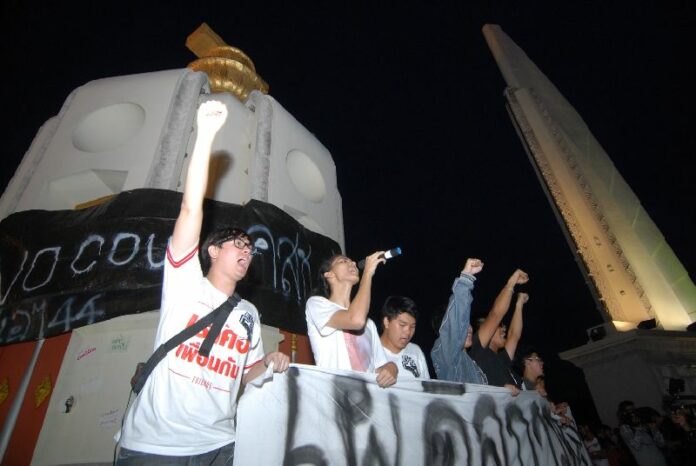
Members of the New Democracy Movement at an anti-junta rally at Democracy Monument in Bangkok on June 25, 2015.

BANGKOK — Members of the New Democracy Movement issued a statement this morning saying they will not flee the country and will continue “fighting for freedom and democracy.”

The statement referenced fresh warrants and summons for several of the groups’ members in the wake of their campaign to call attention to the Rajabhakti Park scandal and vowed to remain in the country to call attention to the allegations of corruption in the army’s construction of the billion-baht park.


Fugitive Activist Vows to Return and Face Justice


“We would like to confirm our remarks that we will not flee anywhere. We will publicly and peacefully live our lives,” it read. “We, then, will continue fighting for freedom and democracy against the Junta until our last day to ensure that justice will be achieved.”

Today’s announcement comes two days it became public an activist facing a military tribunal over a charge of sedition for criticizing the junta had fled the country.

That activist, Thanet Anantawong, was named in six warrants approved Wednesday by a military court. The warrants sought their arrest for allegedly violating the ban on political gatherings of five or more people when they tried to board a train last month to visit the park in Hua Hin, Prachuap Khiri Khan province.

Anond Nampa, who represents Thanet and a number of the group’s activists, said the 25-year-old and his family had been experiencing harassment since he was released on a 100,000-baht bond last month. Thanet has since said he will eventually return to face justice.


Related stories:

Activist Deprived of Freedom, Fresh Air for Five Days in Small Room

Snatched from Hospital Room, Activist Tells Associates

Military Closes Park 'For Maintenance,' Detains Dozens of Activists

Junta Weighs Charges Against Coup Anniversary Marchers

Democracy Activists Ignore Junta Order to Call Off March

No Arrests at Pro-Democracy Demonstration in BKK


To reach us about this article or another matter, please contact us by e-mail at: [email protected].

Follow Khaosod English on Facebook and Twitter for news, politics and more from Thailand.

\

Advertisement

Hot News

LATEST NEWS

Bangkok
overcast clouds
31.6 ° C
32.2 °
31.6 °
97 %
4.6kmh
95 %
Thu
30 °
Fri
36 °
Sat
36 °
Sun
36 °
Mon
36 °