32.8 C
Bangkok
Thursday, June 25, 2026
Home Blog Page 2966

Thai Man Attempts to Open Airplane's Emergency Door In-Flight

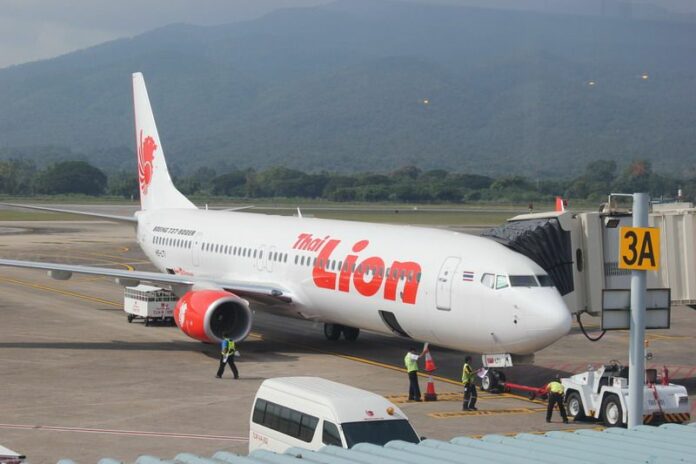
File photo of a Lion Air aircraft at Hat Yai airport in Songkhla province, 20 August 2014.

SONGKHLA — A man from Phattalung province has been arrested for allegedly trying to open an emergency door of an aircraft while it was flying 10,000 feet over southern Thailand yesterday.

Police said the incident took place on Lion Air's flight SL8542, which was flying from Bangkok's Don Mueang Airport to Hat Yai Airport in Songkhla province on 25 June.

Three off-duty police officers on the plane reportedly tackled the man, who has been identified as a 30-year-old engineer named Amnat, after they saw him attempt to open the emergency exit door. Police said 160 people were on board the plane at the time.

Lion Air, which is owned by the national flag carrier Thai Airways, contacted authorities after the plane landed in Songkhla.

"The suspect said he committed the act because he was stressed," said Pol.Col. Pansak Meesaeng, superintendent of Klong Hoi Khong Police Station. Amnat also said he was severely sleep deprived and was having suicidal thoughts, according to police.

Amnat has been charged with violating aircraft commander's safety instructions, which carries a maximum penalty of one year in prison and 40,000 baht fine. 


For comments, or corrections to this article please contact:[email protected]

You can also find Khaosod English on Twitter and Facebook
http://twitter.com/KhaosodEnglish
http://www.facebook.com/KhaosodEnglish

Advertisement

Loy Kratong Comes Early for Chinese Tourists in Chiang Mai

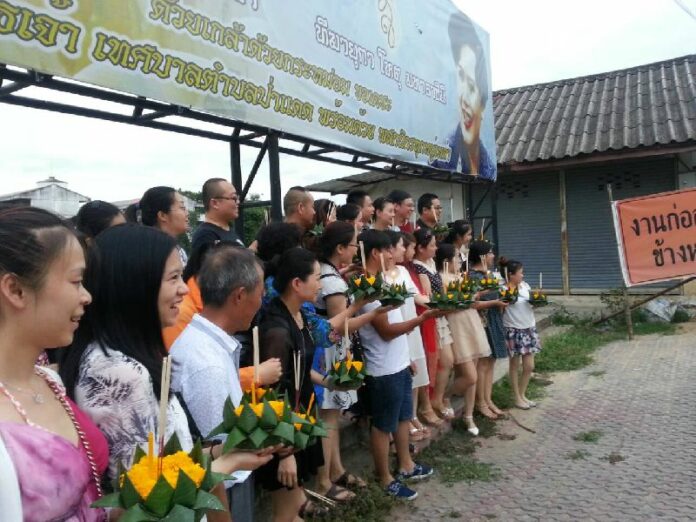
Chinese tourists in Chiang Mai celebrate a mock Loy Kratong festival five months early, 25 June 2015.

CHIANG MAI — A travel company for Chinese tourists in the northern Thai city of Chiang Mai is celebrating Loy Kratong – the Thai floating lantern festival – five months early this year.

The company held a mock Loy Kratong festival for around 30 Chinese tourists on the bank of Ping River near Pa Daed Bridge yesterday evening, attracting curious attention from some Chiang Mai residents in the area, as Loy Kratong is normally held on a full moon in November. The tourists left the area on a bus after the ceremony was over. 

Photos of the incident also went viral on social media, with some commentators praising the company for teaching Thai culture to the tourists, and others expressing concern that the river will be polluted by kratong (floating lanterns made of banana leafs) if too many Chinese tourists follow the example. 

Wallop Namwongprom, a member of the Cultural Committee of Chiang Mai Province, said he has seen photos of the Loy Kratong festival and believes it is a "gimmick" by the tour company to draw tourists.

"Releasing hot air lanterns is forbidden, so the company may have resorted to only floating the kratong, so that tourists can engage in Thai traditions and take photos," Wallop said. "But I think it looks rather strange, because Loy Kratong actually takes place during the flood season, when water is reaching up to the river bank, but they held Loy Kratong while the Ping River is still very dry. But, of course, they can do that, for the sake of tourism, to help tourists learn about [Thai traditions]."

He added, "It's better than letting Chinese tourists climb ancient walls, defecate in the city moat, spit on the street, or blow their noses in public. It's good that they are engaging in this Lanna [northern] tradition."

Chiang Mai is a popular destination for Chinese tourists, some of whom arrive in the city by driving from China by car. Official records say 4.5 million Chinese tourists visited Thailand in 2014 – more than any other nation – bringing in more than 190 billion baht in revenue for the Kingdom. 

However, the influx of Chinese tourists has also led to tension between native Thais and the Chinese visitors, who some locals have accused of behaving rudely and lacking cultural sensitivity. Last year Thailand's tourism agency printed pamphlets for Chinese visitors explaining –  in Mandarin – proper etiquette for visiting museums and temples, as well as driving and queueing.

Earlier this month MasterCard’s chief economist Yuwa Hedrick-Wong told Reuters that some countries in Asia are too "dependent" on Chinese tourists, and urged them to diversify their sources of visitors. 


For comments, or corrections to this article please contact: [email protected]

You can also find Khaosod English on Twitter and Facebook
http://twitter.com/KhaosodEnglish
http://www.facebook.com/KhaosodEnglish

Advertisement

Malaysia to Hire 1.5 Million Bangladeshi Workers

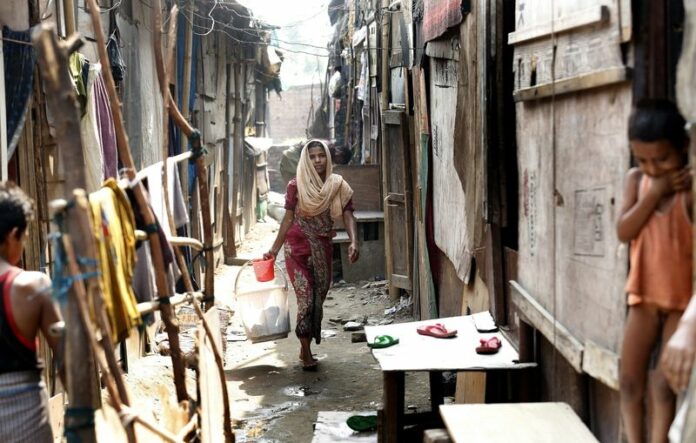
A Rohingya refugee woman returning home after washing her clothes in a makeshift settlement in Madanpur Khadar on the eve of World Refugee Day, in New Delhi, India, 17 June 2015. EPA/RAJAT GUPTA

KUALA LUMPUR (DPA) — Malaysia will hire 1.5 million workers from Bangladesh in stages over the next three years, a senior official said Friday, despite rejecting a plea from the UN to allow more than 150,000 refugees in the country to find jobs.

Malaysian Home Minister Ahmad Zahid Hamidi said that an agreement between Dhaka and Kuala Lumpur would be signed next month to formalize the employment of Bangladeshi workers.

"These workers will be involved in various fields, especially in the plantation sector and will meet the demands of the job market in Peninsular Malaysia, Sabah and Sarawak," the state-run Bernama news agency quoted Ahmad Zahid as saying.

The announcement came a few days after human resources deputy minister Ismail Muttalib said that the predominantly Islamic South-East Asian country will not allow refugees and asylum seekers to work in the country despite a plea from the UN refugee agency UNHCR.

A senior official of the human resources ministry who asked not to be named said that Malaysia is allowing a set number of Bangladeshi workers into the country for a fixed number of years, after which they will return home.

"If their employers will have financial problems, these [Bangladeshi] workers have no choice but to return home," the official said. "They cannot find other job outside the employers who hired them."

The official said that the case of UN refugees in Malaysia is different because allowing them to work would entice "more refugees to come into the country."

"It will be beyond the control of the government," the official added.

At present there are already 1.9 million foreign workers in Malaysia, and an estimated more than 1 million illegal workers, according to the human resources ministry.

Malaysia is one of the more developed countries in South-East Asia and has become a favourite destination of migrant workers from its less developed neighbours such as the Philippines, Indonesia, Myanmar and Cambodia.


For comments, or corrections to this article please contact: [email protected]

You can also find Khaosod English on Twitter and Facebook
http://twitter.com/KhaosodEnglish
http://www.facebook.com/KhaosodEnglish

Advertisement

Thailand Battles to Contain Rising Drug Use

PHRA PHUTTHABAT (DPA) — In a rehab centre north of Bangkok, one recovering addict remembers the highs as well as the lows.

"I felt like I could do anything and the world was mine," said the 25-year-old, who gave her name only as Sai. "I was happy and free of all stress."

"Then I became depressed, confused and paranoid. So I needed the drugs again. I wanted to end that cycle."

Sai is trying to control her drug addiction at Thamkrabok Monastery, Thailand's oldest and largest free drug rehabilitation facility, 140 kilometres north of Bangkok.

She started using methamphetamine tablets and crystals at 17 and developed a compulsive habit.

Around 1.4 per cent of Thais are addicted to amphetamine-type stimulants (ATS), including methamphetamine and MDMA, or ecstasy, among the highest percentage in the world, according to estimates by the United Nations Office of Drugs and Crime (UNODC).

Thai users of these and other drugs are estimated at more than 1.2 million people, or around 2 per cent of the population, and that number may be rising fast.

Between 2009 and 2014, the numbers of drugs cases more than doubled from about 151,000 to about 347,000, while the number of registered drug offenders rose at a similar rate from nearly 168,000 to almost 366,000, officials figures show.

Strict laws appear to have made little impact.

"The harsh punishment never crossed my mind," said Sai, who has been in jail three times for drug abuse. "All I thought about when I needed drugs was that I had to get it."

Thailand is one of 32 countries that imposes the death penalty for some drug offences.

Producing or trafficking illicit drugs can lead to capital punishment, while users face imprisonment, fines or mandatory rehabilitation, depending on the type and amount of drugs.

Thailand has executed 30 people for drug crimes since it became a capital offence in 1979, and 14 are currently on death row. Since lethal injection was adopted in 2003, five out of six people executed in Thailand were killed for drug offences.

Drug offenders account for nearly 77 per cent of all prison inmates.

"Drug problems have become more prevalent and persistent," said Chuenjit Iemwimangsa, principal of Chaengarkart Amrung Primary School, whose pupils were on a school trip to Thamkrabok on the day that dpa visited.

"There are news reports about drugs everyday, more frequently than before," she said.

Thai authorities say they seize about 100 million methamphetamine pills, 1 ton of crystal methamphetamine and 800 kilograms of heroin each year, with official figures showing an upward trend.

The key problem, however, is that the authorities only manage to seize an estimated 20 per cent of the drugs that are trafficked through the country, according to the Thai Office of Narcotics Control Board (ONCB).

Police corruption may play a role. After a drugs raid earlier in June, 12 police officers were suspected of participating in the drugs trade and reassigned.

About three-quarters of the drugs are trafficked through northern Thailand near the Golden Triangle, an area along the borders of Thailand, Myanmar and Laos, where the majority of opium and synthetic drugs in the region are produced, said Sucheep Kotcharin of the northern branch of ONCB.

"The traffickers take advantage of the country's good road networks," he said, adding that they also used routes through forests and mountain ranges.

"There was never a shortage of drugs when I needed them," said Tui, another patient at the monastery, who has been using methamphetamine for 19 years, since he was 14.

Sai said she could walk to a street corner in her hometown near the Thai-Cambodian border to buy drugs, while Tui had dealers' numbers on speed-dial and could call for a delivery any time in Bangkok.

They both paid around 200-300 baht (between 6 and 9 dollars) for a single methamphetamine pill, which they would ingest. The current minimum wage in Thailand is 300 baht per day.

"The profit made by traffickers and dealers is the main motivator," said Secretary General Permpong Chaowalit of the ONCB. "For them, the money is worth the risk of getting caught."

"I started using because I wanted to have fun," Tui said. "But it's not fun anymore. I can't function each day without it."

Sai and Tui felt the effect of drugs on their health: fatigue, pain, premature aging, insomnia and loss of appetite. With several days left at the monastery, both vowed not to return to drugs.

"No matter how harsh the law is, the reason not to do it should be that you love yourself," Sai said. "I wish someone had told me not to do drugs then."

(Reporting by Siraphob Thanthong-Knight)


For comments, or corrections to this article please contact: [email protected]

You can also find Khaosod English on Twitter and Facebook
http://twitter.com/KhaosodEnglish
http://www.facebook.com/KhaosodEnglish

Advertisement

Thailand Battles to Contain Rising Drug Use

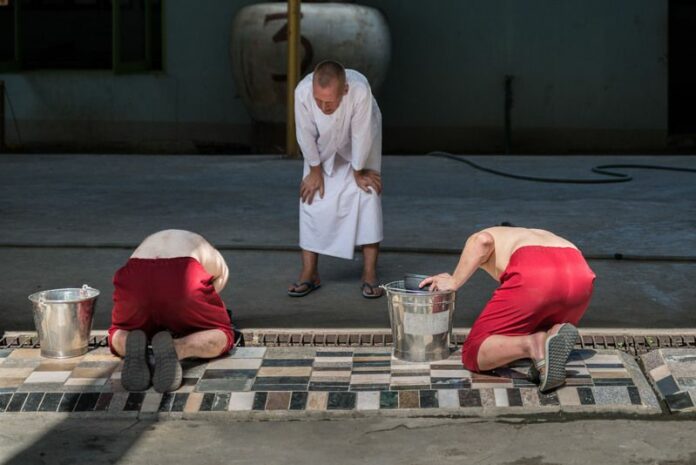
Two patients vomit after drinking an herbal potion at the Thamkrabok Monastery Drug Treatment and Rehabilitation Centre in Phra Phutthabat. DPA/IAN ROBERT KNIGHT

PHRA PHUTTHABAT (DPA) — In a rehab centre north of Bangkok, one recovering addict remembers the highs as well as the lows.

"I felt like I could do anything and the world was mine," said the 25-year-old, who gave her name only as Sai. "I was happy and free of all stress."

"Then I became depressed, confused and paranoid. So I needed the drugs again. I wanted to end that cycle."

Sai is trying to control her drug addiction at Thamkrabok Monastery, Thailand's oldest and largest free drug rehabilitation facility, 140 kilometres north of Bangkok.

She started using methamphetamine tablets and crystals at 17 and developed a compulsive habit.

Around 1.4 per cent of Thais are addicted to amphetamine-type stimulants (ATS), including methamphetamine and MDMA, or ecstasy, among the highest percentage in the world, according to estimates by the United Nations Office of Drugs and Crime (UNODC).

Thai users of these and other drugs are estimated at more than 1.2 million people, or around 2 per cent of the population, and that number may be rising fast.

Between 2009 and 2014, the numbers of drugs cases more than doubled from about 151,000 to about 347,000, while the number of registered drug offenders rose at a similar rate from nearly 168,000 to almost 366,000, officials figures show.

Strict laws appear to have made little impact.

"The harsh punishment never crossed my mind," said Sai, who has been in jail three times for drug abuse. "All I thought about when I needed drugs was that I had to get it."

Thailand is one of 32 countries that imposes the death penalty for some drug offences.

Producing or trafficking illicit drugs can lead to capital punishment, while users face imprisonment, fines or mandatory rehabilitation, depending on the type and amount of drugs.

Thailand has executed 30 people for drug crimes since it became a capital offence in 1979, and 14 are currently on death row. Since lethal injection was adopted in 2003, five out of six people executed in Thailand were killed for drug offences.

Drug offenders account for nearly 77 per cent of all prison inmates.

"Drug problems have become more prevalent and persistent," said Chuenjit Iemwimangsa, principal of Chaengarkart Amrung Primary School, whose pupils were on a school trip to Thamkrabok on the day that dpa visited.

"There are news reports about drugs everyday, more frequently than before," she said.

Thai authorities say they seize about 100 million methamphetamine pills, 1 ton of crystal methamphetamine and 800 kilograms of heroin each year, with official figures showing an upward trend.

The key problem, however, is that the authorities only manage to seize an estimated 20 per cent of the drugs that are trafficked through the country, according to the Thai Office of Narcotics Control Board (ONCB).

Police corruption may play a role. After a drugs raid earlier in June, 12 police officers were suspected of participating in the drugs trade and reassigned.

About three-quarters of the drugs are trafficked through northern Thailand near the Golden Triangle, an area along the borders of Thailand, Myanmar and Laos, where the majority of opium and synthetic drugs in the region are produced, said Sucheep Kotcharin of the northern branch of ONCB.

"The traffickers take advantage of the country's good road networks," he said, adding that they also used routes through forests and mountain ranges.

"There was never a shortage of drugs when I needed them," said Tui, another patient at the monastery, who has been using methamphetamine for 19 years, since he was 14.

Sai said she could walk to a street corner in her hometown near the Thai-Cambodian border to buy drugs, while Tui had dealers' numbers on speed-dial and could call for a delivery any time in Bangkok.

They both paid around 200-300 baht (between 6 and 9 dollars) for a single methamphetamine pill, which they would ingest. The current minimum wage in Thailand is 300 baht per day.

"The profit made by traffickers and dealers is the main motivator," said Secretary General Permpong Chaowalit of the ONCB. "For them, the money is worth the risk of getting caught."

"I started using because I wanted to have fun," Tui said. "But it's not fun anymore. I can't function each day without it."

Sai and Tui felt the effect of drugs on their health: fatigue, pain, premature aging, insomnia and loss of appetite. With several days left at the monastery, both vowed not to return to drugs.

"No matter how harsh the law is, the reason not to do it should be that you love yourself," Sai said. "I wish someone had told me not to do drugs then."

(Reporting by Siraphob Thanthong-Knight)
 

For comments, or corrections to this article please contact: [email protected]

You can also find Khaosod English on Twitter and Facebook
http://twitter.com/KhaosodEnglish
http://www.facebook.com/KhaosodEnglish

Advertisement

Thai Police Block Discussion on Vietnam's Rights Abuses

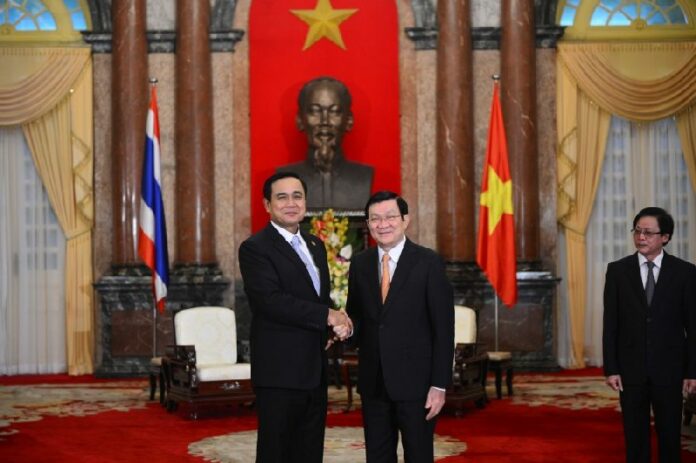
Thai junta chairman Prayuth Chan-ocha with President of the Socialist Republic of Vietnam Trương Tấn Sang in Hanoi, 27 November 2015

BANGKOK — Thai authorities widened the scope of their suppression on free speech today by blocking a human rights group's press conference in Bangkok on the persecution of an ethnic minority in Vietnam.

Although police and soldiers under the ruling military junta have interfered with more than 70 panel discussions and academic events on Thai politics over the past year, today marks the first time since the coup that authorities have blocked an event that does not directly pertain to Thailand.

The international watchdog Human Rights Watch had scheduled a press conference this morning to release a 33-page report detailing Vietnam’s ethnic and religious persecution of the Montagnards, a Christian minority that lives in Vietnam’s Central Highlands.

However, Thai police delivered a written order to the Foreign Correspondents’ Club of Thailand (FCCT) – which has now had three events canceled by authorities in the past month – citing concerns that the press conference may “affect national security, or the friendship and international cooperation between Thailand and Vietnam, or allow people with ill intention to exploit and cause havoc, which is inappropriate during the current situation.”
Human Right’s Watch’s deputy Asia director Phil Robertson called the forced cancelation “profoundly disturbing.

“This report had nothing to do with Thailand whatsoever,” he said. “Something that should have been a discussion about Vietnam has now become a discussion about Thailand. And that’s the Thai government’s fault.

According to Robertson, police said Vietnamese authorities contacted Thailand's Ministry of Foreign Affairs and asked the government to cancel the event.

In 2010, the Thai government ceded to similar pressure from Vietnam and asked the FCCT to drop a discussion on human rights violations in Vietnam. Two years ago, a pro-democracy opposition politician from Cambodia was also forced to skype-in to his book launch at the FCCT after the Thai government denied him entry to the Kingdom. 

In a statement clarifying today’s cancelation, the FCCT noted that it has hosted numerous events concerning rights abuses in foreign countries in the past.

“The release of reports with no particular connection to Thailand, such as the one on the Vietnam's Montagnards cancelled today, reflects the significant foreign media presence in Thailand covering Southeast Asia, nothing more,” the club said. “The situation of the Montagnards in Vietnam is a subject of legitimate international public interest.

Several hours before today's event was canceled, the US Department of State released a report on the grim status of human rights in post-coup Thailand, describing the "significant restrictions on freedom of speech and press" imposed by the Thai junta, among a host of other rights violations. 

The Thai junta, which seized power after six months of street protests, has defended its tight lid on freedom of expression as a necessary measure to "heal" Thailand's bitter political divisions and maintain order. 

For comments, or corrections to this article please contact: [email protected]

You can also find Khaosod English on Twitter and Facebook
http://twitter.com/KhaosodEnglish
http://www.facebook.com/KhaosodEnglish

Advertisement

Charter Referendum Set for 10 Jan: Election Commissioner

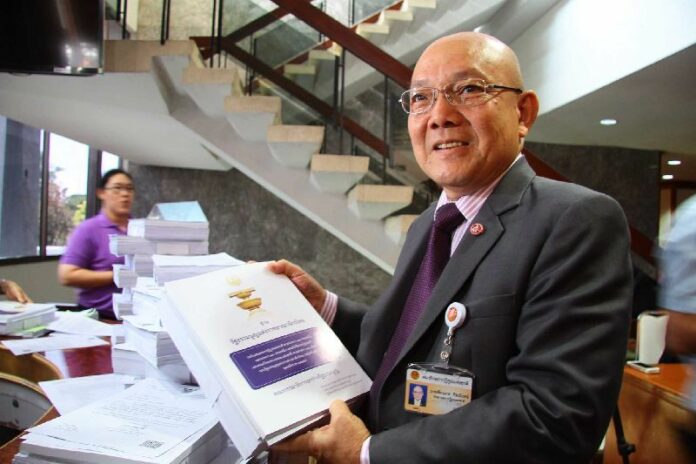
Thianchay Kiranandana, chairman of the National Reform Council (NRC), with the draft of the new constitution, 17 April 2015.

BANGKOK — The referendum on the Thai junta's new constitution will be held in January 2016, according to an election official.

"As a preliminary date, we have set it for 10 January," said Boonyakiat Rackchartcharoen, the deputy secretary of the Election Commission (EC). "We have to consider the procedure of publishing and distributing charter drafts to 19 million voters. If the distribution exceeds 80 percent, the date for the referendum will not be changed."

Thailand's 20th constitution is being drafted by a committee appointed by the military junta that seized power and dissolved the previous charter on 22 May 2014. The junta has agreed to put the charter draft to a referendum.

Boonyakiat said voters will only be able to accept or reject the constitution, which has been criticized as the least democratic charter in decades.

"If voters do not use their rights to tick the 'for' or 'against' boxes, the ballot would be voided," he said.

According to Boonyakiat, there will not be overseas or advance voting for the referendum. The voting will only take place in Thailand on a single day. 

He also told reporters that the government can add other questions related to the constitution on the ballot, such as whether a Prime Minister must be elected. The charter drafters will then be required to amend the draft in accordance with the opinions expressed in the referendum. 

"As for other irrelevant questions, like whether to legalize casinos, or whether the government should stay on for two more years, or whether there should be reforms before election, the laws do not require the state to act on the results of these questions in the referendum," Boonyakiat said. "It's like simply giving information to the government to use in its decision making." 

The military government has pushed back the date for national elections several times since seizing power, and now says a poll will be held in September 2016 if the charter passes the referendum vote. Officials have not said what will happen if the charter is rejected.

The junta has also dismissed calls to lift its ban on political activities and campaigning, which has been in place since it staged a coup, to allow for free debate about the charter before the referendum. 

In the referendum for the post-coup 2007 charter, which was also drafted by a junta-appointed council, voters were also only permitted to accept or decline the document. Critics say that many voters reluctantly approved the charter out of fear of prolonged military rule.


For comments, or corrections to this article please contact: [email protected]

You can also find Khaosod English on Twitter and Facebook
http://twitter.com/KhaosodEnglish
http://www.facebook.com/KhaosodEnglish

Advertisement

No Arrests at Pro-Democracy Demonstration in BKK

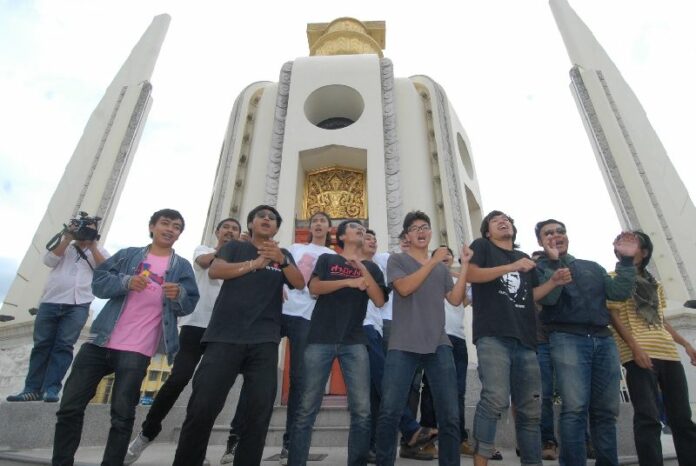
The activists sing a pro-democracy song at Democracy Monument on 25 June 2015.

BANGKOK — In a rare departure from the junta's zero tolerance on political protests, police did not arrest any of the fourteen pro-democracy activists who marched along a historic road in Bangkok today.

Seven of the activists are members of a Bangkok-based student network, while the others belong to Dao Din, a social justice group founded by law students in the northeastern province of Khon Kaen.

All fourteen are facing charges of violating the junta's ban on protests for staging demonstrations to commemorate the first anniversary of the 2014 coup last month, and have since defied police's orders to surrender for formal prosecution. 

The group announced the formation of a new group called Neo-Democracy Movement this morning, which they said will campaign for democracy, public participation in politics, human rights, justice, and non-violence. The activists made the announcement at a press conference outside the home of the prominent historian Sulak Sivaraksa, whose house also doubles as a bookshop and hostel. 

Speaking at the press conference this morning, Rangsiman Rome, one of the activists from Bangkok's Thammasat University, said his group is ready to accept any punishment from authorities for their struggle against the junta. 

"If we are to be punished by the NCPO, we are willing to accept it," Rangsiman said, referring to junta's official, the National Council for Peace and Order (NCPO). "But our acceptance does not mean we recognize that our actions are illegal. It is because we have only two hands, and we are few in number, while the NCPO has guns and numerous personnel at its disposal, and they use these forces barbarically to violate human rights." 

He continued, "I insist that even if we are to be detained, and our human rights are stripped, we will only stay in prison physically while our hearts will still [hold on to] democracy, and hunger for freedom." 

The activists then set out for Ratchadamnoen Avenue on a bus, with dozens of plain-clothed and uniformed security officers trailing them. After arriving on the avenue, the activists marched to various landmarks in Thai political history, including the monument to the 1973 Student Uprising, the memorial to the 1976 massacre of student activists at Thammasat University, and Democracy Monument, the focal point of numerous political protests over the past decade.

\
The activists before they set out on their pro-democracy march in Bangkok, 25 June 2015.

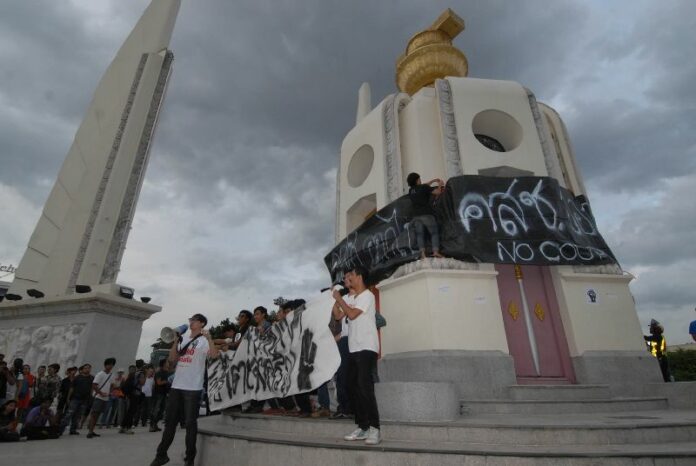
After wrapping Democracy Monument with black banners to symbolize the junta’s suspension of democracy, and delivering speeches to a crowd of supporters, the activists declared the end of the demonstration at around 7 pm and dispersed peacefully from the scene. Rangsiman said his group "will be back" for further campaigns against the junta. 

No arrests were made throughout the day, marking a notable exception to security officers' standard practice of swiftly arresting anti-coup dissidents. Public protests and political activities of any kind remain banned by the NCPO, which has sent some violators to stand trial in martial courts.  

Adul Kiewboriboon, a chairperson of the Relatives of May 1992 Martyrs and a member of the junta’s reform center, observed the protest today. Adul told Matichon he believes the activists' march was a "colorful" event and not provocative. He also said the junta's reform forum may invite the fourteen activists for discussion in the future, Mathichon reported.

Asked what he thought of the security officers who had been stalking the activists for hours, Adul replied, "It's a security measure. They weren't only there to follow the activists, but also provide protection to the activists."


For comments, or corrections to this article please contact: [email protected]

You can also find Khaosod English on Twitter and Facebook
http://twitter.com/KhaosodEnglish
http://www.facebook.com/KhaosodEnglish

Advertisement

No Arrests at Pro-Democracy Demonstration in BKK

Pro-democracy activists wrapped banners around Democracy Monument in Bangkok on 25 June 2015.

BANGKOK — In a rare departure from the junta's zero tolerance on political protests, police did not arrest any of the fourteen pro-democracy activists who marched along a historic road in Bangkok today.

Seven of the activists are members of a Bangkok-based student network, while the others belong to Dao Din, a social justice group founded by law students in the northeastern province of Khon Kaen.

All fourteen are facing charges of violating the junta's ban on protests for staging demonstrations to commemorate the first anniversary of the 2014 coup last month, and have since defied police's orders to surrender for formal prosecution. 

The group announced the formation of a new group called Neo-Democracy Movement this morning, which they said will campaign for democracy, public participation in politics, human rights, justice, and non-violence. The activists made the announcement at a press conference outside the home of the prominent historian Sulak Sivaraksa, whose house also doubles as a bookshop and hostel. 

Speaking at the press conference this morning, Rangsiman Rome, one of the activists from Bangkok's Thammasat University, said his group is ready to accept any punishment from authorities for their struggle against the junta. 

"If we are to be punished by the NCPO, we are willing to accept it," Rangsiman said, referring to junta's official, the National Council for Peace and Order (NCPO). "But our acceptance does not mean we recognize that our actions are illegal. It is because we have only two hands, and we are few in number, while the NCPO has guns and numerous personnel at its disposal, and they use these forces barbarically to violate human rights." 

He continued, "I insist that even if we are to be detained, and our human rights are stripped, we will only stay in prison physically while our hearts will still [hold on to] democracy, and hunger for freedom." 

The activists then set out for Ratchadamnoen Avenue on a bus, with dozens of plain-clothed and uniformed security officers trailing them. After arriving on the avenue, the activists marched to various landmarks in Thai political history, including the monument to the 1973 Student Uprising, the memorial to the 1976 massacre of student activists at Thammasat University, and Democracy Monument, the focal point of numerous political protests over the past decade.

\
The activists before they set out on their pro-democracy march in Bangkok, 25 June 2015.

After wrapping Democracy Monument with black banners to symbolize the junta’s suspension of democracy, and delivering speeches to a crowd of supporters, the activists declared the end of the demonstration at around 7 pm and dispersed peacefully from the scene. Rangsiman said his group "will be back" for further campaigns against the junta. 

No arrests were made throughout the day, marking a notable exception to security officers' standard practice of swiftly arresting anti-coup dissidents. Public protests and political activities of any kind remain banned by the NCPO, which has sent some violators to stand trial in martial courts.  

Adul Kiewboriboon, a chairperson of the Relatives of May 1992 Martyrs and a member of the junta’s reform center, observed the protest today. Adul told Matichon he believes the activists' march was a "colorful" event and not provocative. He also said the junta's reform forum may invite the fourteen activists for discussion in the future, Mathichon reported.

Asked what he thought of the security officers who had been stalking the activists for hours, Adul replied, "It's a security measure. They weren't only there to follow the activists, but also provide protection to the activists."


For comments, or corrections to this article please contact: [email protected]

You can also find Khaosod English on Twitter and Facebook
http://twitter.com/KhaosodEnglish
http://www.facebook.com/KhaosodEnglish

Advertisement

Thai Airport Says Ex-Cop Arrested in Japan Didn't Bring Gun from Thailand

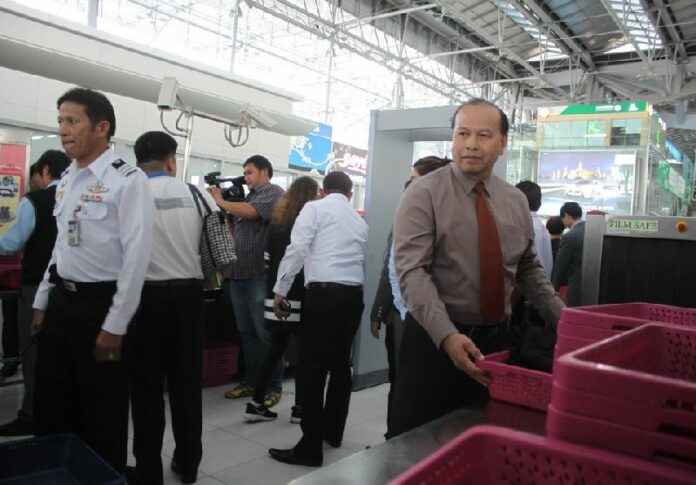
Airport staff demonstrate security protocols at Suvarnabhumi Airport on 25 June 2015.

BANGKOK — The director of Bangkok's Suvarnabhumi Airport said his staff did not detect a firearm when they inspected the luggage of a former Bangkok police chief who was arrested in Japan with a loaded gun this week.

Pol.Lt.Gen. Kamronwit Thoopkrachang, 60, who served as commander of Bangkok Metropolitan Police from 2012 to 2014, is being held in Japanese custody after security officers in Tokyo's Narita Airport reportedly discovered a loaded revolver in his suitcase on 22 June. The penalty for carrying a loaded firearm without permission in Japan is 3-10 years imprisonment. 

Kamronwit's arrest raised concerns among Thai officials that Suvarnabhumi Airport staff may have failed to spot the firearm in Kamronwit's belongings, or provided him with VIP treatment.

Sirote Duangrat, the airport’s director, dismissed the speculation in a press conference today.

Sirote said Kamronwit went through an x-ray scan and body search at the airport before he left Thailand on the Thai Airways flight TG640. His checked luggage was also inspected, Sirote said. 

"We did not discover any item that is dangerous to the aircraft," Sirote said. 

He also told reporters that the body scanner devices used at Suvarnabhumi Airport meet international standards, and are the same as the machines used in Japan’s Narita airport.

"Officials who man the devices went through at least six months of training, and we shift the personnel all the time to prevent exhaustion," he said. "Each personnel is an expert in this profession. However, from now on we will increase frequency and intensity of our inspections."

\
A still provided by airport officials showing staff search 
Pol.Lt.Gen. Kamronwit Thoopkrachang at Suvarnabhumi on 18 June 2015.

Sirote added that licensed gun owners can file for a special permission to carry firearms in checked luggage, which Kamronwit did not do.

Japanese officials told AFP that Kamronwit said "the gun was his own and was a gift from a friend, and that he had forgotten he had put it inside the suitcase." It is unclear whether he said he recieved the alleged gift in Japan or Thailand.

A spokesperson for the Thai police force, Pol.Lt.Gen. Prawuth Thawornsiri, told reporters that Japanese public prosecutors have not yet formally brought charges against Kamronwit.

"They still need time to deliberate on the case files," Pol.Lt.Gen. Prawuth said, adding that under Japanese laws suspects can be detained for up to 20 days while prosecutors deliberate on their case. 

Thailand’s Minister of Tranport, Air Chief Marshal Prajin Janthong, said authorities will still investigate whether Suvarnabhumi airport's equipment failed to spot the firearm, and whether staff employed sufficient caution when they searched Kamronwit's belongings. 

Kamronwit is considered a close ally to former Prime Minister Thaksin Shinawatra, who was deposed in a military coup in 2006 but still retains considerable influence over a powerful political dynasty in Thailand. Kamronwit retired from the Royal Thai Police in October 2014, five months after the military staged a coup d'etat against a government led by Thaksin’s sister.

For comments, or corrections to this article please contact: [email protected]

You can also find Khaosod English on Twitter and Facebook
http://twitter.com/KhaosodEnglish
http://www.facebook.com/KhaosodEnglish

Advertisement

Hot News

LATEST NEWS

Bangkok
overcast clouds
32.8 ° C
32.8 °
32.8 °
92 %
4.7kmh
86 %
Wed
33 °
Thu
36 °
Fri
38 °
Sat
36 °
Sun
36 °