



























33.8 C
Bangkok
Saturday, June 20, 2026
Home Blog Page 2979

Suthep to Leave Monkhood and Return to Activism

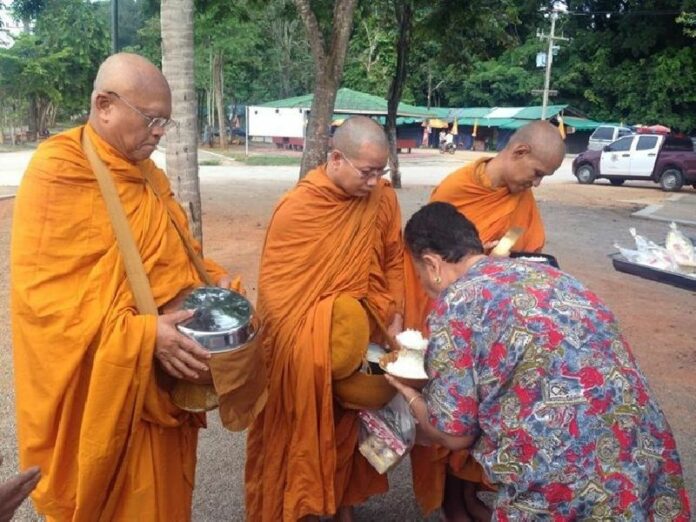
Former anti-government protest leader Suthep Thaugsuban surprised many by appearing as a monk in Surat Thani, 16 July 2014.

SURAT THANI — The firebrand leader of the ultra-conservative protest movement that helped pave the way for the 2014 coup d’etat says he will leave the monkhood and return to activism in the near future.

Suthep Thaugsuban, a veteran Democrat Party politician who became a monk after leading mass anti-government protests for six months prior to the 22 May coup, told reporters at a forest monastery in Surat Thani today that the rumors about his plan to return to secular – and political – life are true.

“The rumors are true,” said Suthep, who is also known by his monk name as Phra Suthep Paphakaro. “I have determined that there are works in the current situation that I have to help. So I decided I will leave monkhood, but when, I have to think about it first.”

Suthep said he will return to “campaign on civil issues” with the Great Mass of the People Foundation, a charity founded by the leaders of the former anti-government protest campaign.

“The foundation will work in promoting strength and cohesiveness among the people, such as how to make people have Dharma in their heart,” Suthep said. “We will promote a moral and ethical society. We will support self-sufficiency communities projects, and model communities for married, poor couples who want to live  meaningful, moral, and self-reliant lives as farmers.”

Suthep said the charity will purchase plots of land on Koh Samui island to conduct these projects.

In November 2013, Suthep quit his position as the deputy chairman of the Democrat Party to lead the protests against then-Prime Minister Yingluck Shinawatra. The protests were sparked by the government’s attempt to pass a law that would have granted legal amnesty to Yingluck’s brother, former Prime Minister Thaksin Shinawatra, who was ousted in a 2006 military coup and later convicted of corruption.

Thaksin is extremely popular among farmers in Thailand’s rural north and northeast but fervently loathed by the Democrat Party and its supporters among the Bangkok bourgeois and other traditional elites. The controversial leader has been living in exile since 2008 to avoid the corruption verdict, but has continued to assert his influence through his political allies and proxies.

Suthep’s street protests later evolved into an effort to topple Yingluck’s government completely, and replace it with an unelected “people’s council.” The protests came to an end when then-army chief Gen. Prayuth Chan-ocha stepped in and staged a coup with the stated aim of restoring peace and order.

Gen. Prayuth, who is now acting as Prime Minister, says a new election will be held by September 2016 at the earliest. Critics say the junta has largely taken up the demands of the anti-government protesters.

In today’s interview, Suthep insisted that he would not return to parliamentary politics with the Democrat Party.

“I will not take up membership in the Democrat Party,” he said. “I will not run as a candidate in the next election. I won’t fight in politics in the same way that I used to do.”

However, he said he would not condemn other former protest leaders who do return to politics under the wing of the Democrat Party.

“It’s their right,” Suthep said. “There were millions of people who came out to fight alongside us in 2013 and 2014. I cannot judge them the same way I judge myself. Some have to go back to being MPs. Some have to work in politics. This is up to the thoughts of each person.”

When a reporter asked him whether he would still welcome the politicians who seek his counsel, Suthep said, “I am not the most important person in this country. I am only an ordinary person. I would like to do my duty for His Majesty the King, for the country, and the people.”
Advertisement

Prayuth Will Stay in Power if 'Everyone Wants Me to'

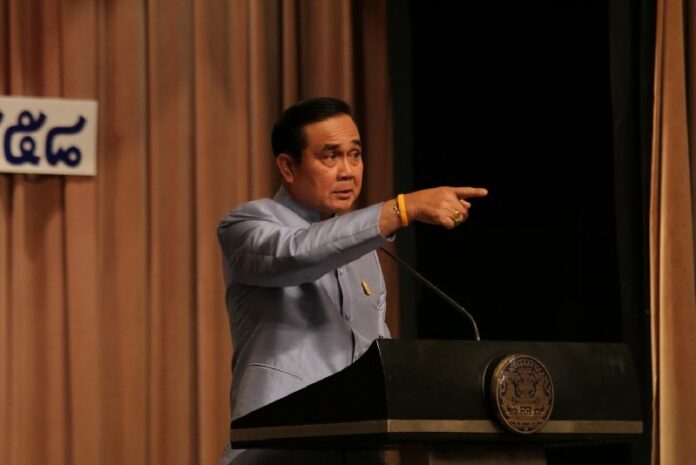
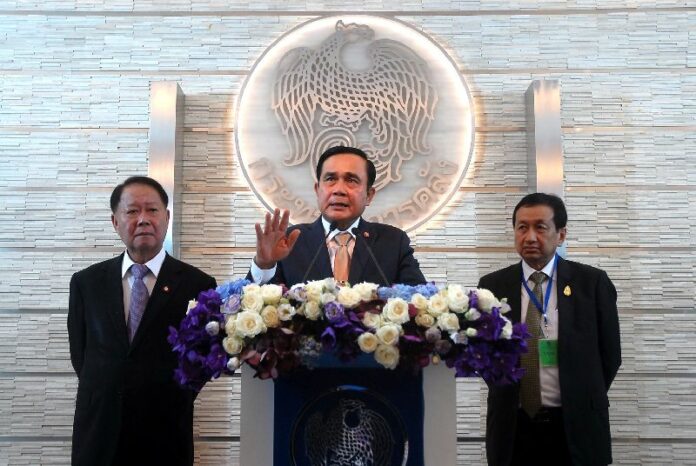
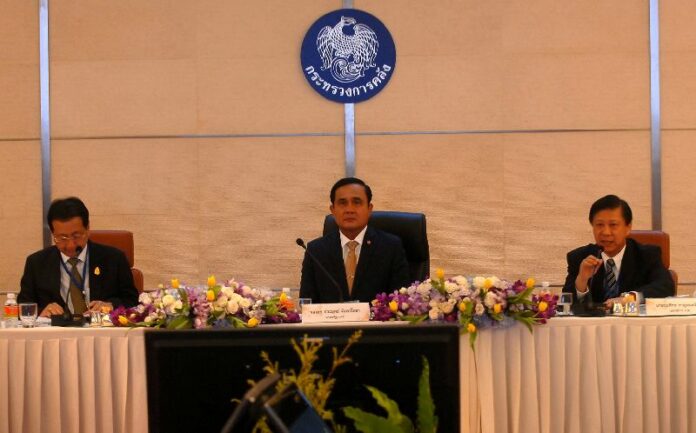
Gen. Prayuth Chan-ocha speaking to reporters at Ministry of Finance, 3 June 2015

BANGKOK — Junta chairman and Prime Minister Prayuth Chan-ocha said he will stay in power for two more years if the measure, which was recently proposed by members of the junta’s reform body, has support from the Thai people.

The junta chairman was referring to a proposal submitted by 26 members of the National Reform Council that calls for holding a referendum to determine whether to postpone national elections for two more years so that Gen. Prayuth can continue working on his stated missions of reforming and reconciling the country.

"I'm so-so. If they want me to stay, I will do it," said Gen. Prayuth, who seized power in coup d’etat one year ago. 

"I won't stay by using power. If everyone wants me to stay, I will stay, I will do it for you. But you have to help shield me from domestic and external [pressures] – the accusations that I want to hold on to my power. I don't want power, because I don't have anything to gain from this. I only want to make this country better."

He continued, "Let me ask you, do you think I would be happy if I were to stay? If they want me to stay, find a channel. But whether this proposal is good or not, I don't know. How can I deliberate on it and say whether it's good? Because I am in power right now, how can I say whether it will be good if I stay longer? Can I say that right here? So, today, whoever wants me to reform the country, the people must go and find me a way." 

According to the junta’s current timetable, a national election will take place by September 2016 at the earliest, given that the public votes in favor of the new constitution being drafted under the junta's oversight.

After seizing power in May 2014, Gen. Prayuth appointed several committees to implement reforms across a variety of sectors. Throughout the reform process, the junta has kept a tight lid on freedom of expression in the name of reconciling the country's divided political factions, which were staging mass rallies in Bangkok prior to the coup. Those who violate the junta's ban on politicial activities and protests are usually arrested, and some have been prosecuted in martial court. 

When a reporter asked Gen. Prayuth to comment on whether his current government or the next elected government will be better suited for reforming the country, the general replied, "You want democracy, isn't that right? You told me I am not democratic. I didn't come here through an election. You keep telling me that every day. International communities also ask me when there will be the next election. So, it's up to Thai people, how they will set the future of Thailand. It's up the 67 million Thai people. It's their say, not mine."

When the reporter commented that a wave of criticism is expected to break out if Gen. Prayuth decides to stay on for two more years, Gen. Prayuth quipped, "I am not afraid of criticism. The more you criticize me, the more resolve I have." 

 
For comments, or corrections to this article please contact: [email protected]

You can also find Khaosod English on Twitter and Facebook
http://twitter.com/KhaosodEnglish
http://www.facebook.com/KhaosodEnglish

Advertisement

Prayuth Will Stay in Power if 'Everyone Wants Me to'

Gen. Prayuth Chan-ocha heading a meeting at Ministry of Finance, 3 June 2015

BANGKOK — Junta chairman and Prime Minister Prayuth Chan-ocha said he will stay in power for two more years if the measure – which was recently proposed by members of the junta’s reform body – has support from the Thai people.

The junta chairman was referring to a proposal submitted by 26 members of the National Reform Council that calls for holding a referendum to determine whether to postpone national elections for two more years so that Gen. Prayuth can continue working on his stated missions of reforming and reconciling the country.

"I'm so-so. If they want me to stay, I will do it," said Gen. Prayuth, who seized power in coup d’etat one year ago. 

"I won't stay by using power. If everyone wants me to stay, I will stay, I will do it for you. But you have to help shield me from domestic and external [pressures] – the accusations that I want to hold on to my power. I don't want power, because I don't have anything to gain from this. I only want to make this country better."

He continued, "Let me ask you, do you think I would be happy if I were to stay? If they want me to stay, find a channel. But whether this proposal is good or not, I don't know. How can I deliberate on it and say whether it's good? Because I am in power right now, how can I say whether it will be good if I stay longer? Can I say that right here? So, today, whoever wants me to reform the country, the people must go and find me a way." 

According to the junta’s current timetable, a national election will take place by September 2016 at the earliest, given that the public votes in favor of the new constitution being drafted under the junta's oversight.

After seizing power in May 2014, Gen. Prayuth appointed several committees to implement reforms across a variety of sectors. Throughout the reform process, the junta has kept a tight lid on freedom of expression in the name of reconciling the country's divided political factions, which were staging mass rallies in Bangkok prior to the coup. Those who violate the junta's ban on politicial activities and protests are usually arrested, and some have been prosecuted in martial court. 

When a reporter asked Gen. Prayuth to comment on whether his current government or the next elected government will be better suited for reforming the country, the general replied, "You want democracy, isn't that right? You told me I am not democratic. I didn't come here through an election. You keep telling me that every day. International communities also ask me when there will be the next election. So, it's up to Thai people, how they will set the future of Thailand. It's up the 67 million Thai people. It's their say, not mine."

When the reporter commented that a wave of criticism is expected to break out if Gen. Prayuth decides to stay on for two more years, Gen. Prayuth quipped, "I am not afraid of criticism. The more you criticize me, the more resolve I have." 

 
For comments, or corrections to this article please contact: [email protected]

You can also find Khaosod English on Twitter and Facebook
http://twitter.com/KhaosodEnglish
http://www.facebook.com/KhaosodEnglish

Advertisement

Talk on Human Rights in Post-Coup Thailand Canceled on Junta's Orders

Junta chairman Gen. Prayuth Chan-ocha at the Government House in Bangkok on 4 June 2015.

BANGKOK — The Foreign Correspondents' Club of Thailand (FCCT) has cancelled a panel discussion on the junta's suppression of human rights after police officers presented the club's board with a written order from the military government this morning.

The event was organized by the Thai Lawyers for Human Rights, a group whose talks have been similarly blocked by Thai authorities since the May 2014 coup.

In a statement sent out at 2:30pm, the FCCT said the event was officially "cancelled on the orders of the NCPO and the police."

The junta, known formally as the National Council for Peace and Order (NCPO), has maintained a ban on political activities and public criticism since it toppled an elected government one year ago.

The order delivered by police to the FCCT today said authorities had "received information from relevant individuals" that the event "may allow individuals with ill intention to create a [negative] situation and cause unrest, and may lead to a violation of the laws, and will not be appropriate under the current situation."

Writing on Twitter, FCCT President Jonathan Head said the club would be "open as usual tonight," despite the cancellation. "Please be aware there will be a visible police presence," he wrote.

Poonsuk Poonsukcharoen, a member of the Thai Lawyers for Human Rights, told Khaosod English that the group still plans to go to the FCCT at 6pm tonight to discuss the junta's human rights violations.

"I insist that we will go ahead [with the event]," she said.

Over the past year, the military government has come under steady criticism from human rights groups for suspending democracy and trampling on civil liberties in the name of achieving "national reconciliation." 

In a press release for tonight's event, the Thai Lawyers for Human Rights said the junta had "stripped the people of their rights" by detaining people without charges, banning political assemblies, and prosecuting civilians in martial court.

On the one-year anniversary of the coup last month, Human Rights Watch published a detailed report describing how the junta has "used dictatorial power to systematically repress human rights throughout the country."

"Thailand is a political dictatorship with all power in the hands of one man," said HRW's Asia Director Brad Adams, referring to junta chairman and Prime Minister Gen. Prayuth Chan-ocha. "Backsliding on respect for basic rights and democratic reform seems to have no end in sight."

Today marked the third time Thai authorities have interfered with events at the FCCT, long considered a sanctuary for free debate, since the May 2014 coup. 

Five days after the coup on 27 May 2014, soldiers stormed the FCCT and detained former Minister of Education Chaturon Chaisaeng while he was speaking to a crowd of foreign journalists about why he did not surrender himself to the NCPO, which summoned hundreds of politicians and activists for "attitude adjustment" in the wake of the military takeover.

In September, police barged into the club to stop the Thai Lawyers for Human Rights from holding a talk titled "Access to Justice in Thailand: Currently Unavailable."
 
(Reporting by Sally Mairs)
 
For comments, or corrections to this article please contact: [email protected]

You can also find Khaosod English on Twitter and Facebook
http://twitter.com/KhaosodEnglish
http://www.facebook.com/KhaosodEnglish


Advertisement

First Refugees Arrive in Cambodia Under Australia Resettlement Deal

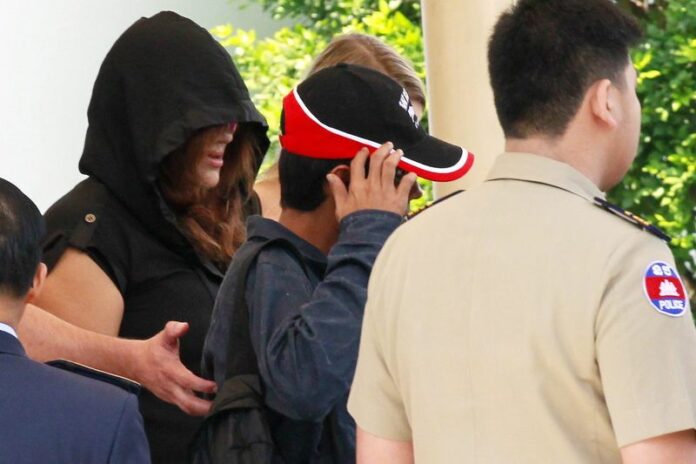
Refugees from Australia (C), are guarded by Cambodian officers as they arrive at Phnom Penh International Airport, Cambodia, 04 June 2015. Cambodia received four refugees from Australia following an agreement of the resettlement of refugees between Australian and Cambodian governments. EPA/MAK REMISSA

PHNOM PENH (DPA) — The first group of refugees to be resettled in Cambodia under a controversial refugee deal with Australia arrived in the capital Phnom Penh early Thursday.

The four, three Iranians and one man from the ethnic Rohingya group in Myanmar, arrived at Phomm Penh airport on a flight from Kuala Lumpur.

They had been previously been held on the Pacific island of Nauru, where Australia has one of its offshore detention centres housing some 1,200 refugees. 

The refugees and accompanying officials left the airport in two white vans.

Under a deal signed in September 2014, Cambodia was to receive 40 million Australian dollars (31 million US dollars) in aid from Australia in exchange for resettling refugees on a voluntary basis. Canberra would also pay transportation costs. 

"A number of [refugees] found to be in genuine need of protection will now have the opportunity and support to re-establish their lives free from persecution" in Cambodia, the two countries said at the time.

The transfer was facilitated by the International Organization for Migration, which will also help them with settling into normal lives in Cambodia, although little detailed information has been released about the refugees' future living conditions.

The deal has been widely criticized by human rights groups, and UN agencies such as the children's fund UNICEF, who say it violates treaties including the Convention on the Rights of the Child.

Others accuse Australia of passing the burden of resettling refugees on to a poorer country less well-equipped to host them.

Australian leaders have defended the resettlement policy, which is part of its aim to stop the arrival of illegal boat migrants on Australian shores.

Almost no boats, which used to mainly come from Indonesia, have reached Australia since Prime Minister Tony Abbott toughened the policy on boat migrants after winning elections in September 2013.

(Reporting by Kyaw Lynn)

 
For comments, or corrections to this article please contact: [email protected]

You can also find Khaosod English on Twitter and Facebook
http://twitter.com/KhaosodEnglish
http://www.facebook.com/KhaosodEnglish

Advertisement

New Commercial Airport Near Thai Capital to Open by 2017

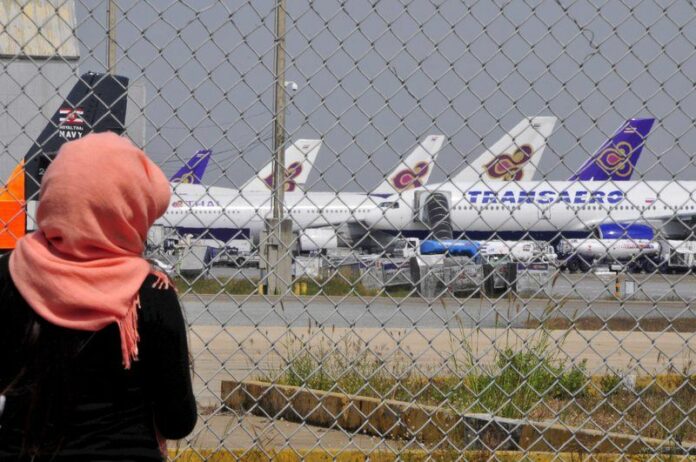
A file photo shows a foreign tourist looking through the security fence at the U-Tapao international airport near Pattaya, 30 November 2008. EPA/UDO WEITZ

BANGKOK (DPA) — Thailand's military government plans to open a new commercial airport near Bangkok by 2017, officials said Thursday.

The government plans to redevelop U-Tapao, a former Vietnam War-era Air Force base located near the tourist resort of Pattaya, around 140 kilometres from Bangkok.

It would be the third airport to serve the capital, along with Suvarnabhumi and Don Muang airports.

U-Tapao currently receives chartered flights from Russia and China, but Transport Minister Prajin Juntong told reporters he wants to make it a low-cost carrier hub. 

Tourism accounts for 10 per cent of Thailand's economy. 

A report by MasterCard earlier this month revealed that Bangkok was the world's second-most visited city in 2014, with 18.24 million arrivals. It followed London, which had 18.82 million visitors. 


For comments, or corrections to this article please contact: [email protected]

You can also find Khaosod English on Twitter and Facebook
http://twitter.com/KhaosodEnglish
http://www.facebook.com/KhaosodEnglish

Advertisement

Human Trafficking Crackdown: Army Officer Faces 13 Charges

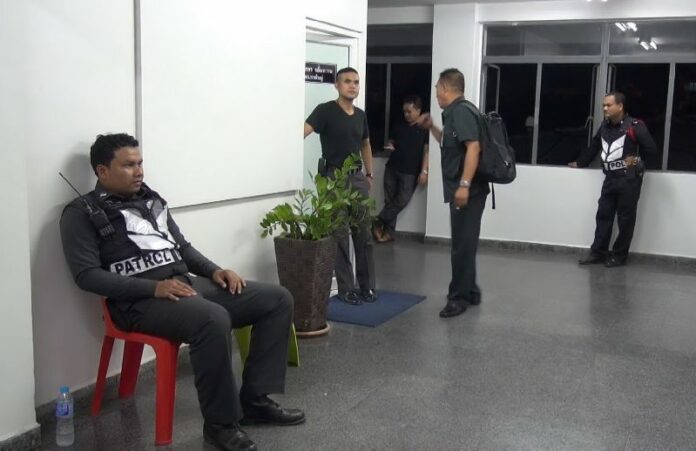
Police officers posted to keep guard in front of the room where Lt.Gen. Manas Kongpaen was being interrogated at Hat Yai Police Station, Songkhla, 3 June 2015

SONGKHLA — The army general accused of running a human trafficking operation in southern Thailand has been charged with 13 different offenses after eight hours of police interrogation last night.

Lt.Gen. Manas Kongpaen, who is listed as a "special senior adviser" to the Royal Thai Army, surrendered to police in Bangkok yesterday after he was charged with human trafficking, illegal detention, assisting aliens in illegal entry to the Kingdom, and holding individuals for ransom.

Yet after eight hours interrogation at a police station in Songkhla province last night, police decided to charge him with nine more offenses, including concealment of dead bodies, physical assault, and conspiring in a transnational crime, police say. Lt.Gen. Manas reportedly denied all charges. 

Officers from Staff Judge Advocate corps – the military branch that operates martial courts – accompanied Lt.Gen Manas throughout the interrogation.

Thai police launched a crackdown on long-running smuggling operations in the south after discovering an abandoned jungle prison used to detain migrants and demand ransom from their relatives on 1 May. Scores of shallow graves – presumably containing the corpses of those who did not survive the grim conditions of the camps or were unable to secure ransom funds – were found nearby along the Thai-Malaysian border. Most of the migrants, who arrive in Thailand by boat from the Bay of Bengal, are Rohingyas and Bangladeshis seeking to live in Muslim-majority Malaysia. 

According to police, Lt.Gen. Manas will be taken to court in Songkhla today, where police will ask for permission to detain him in a remand prison while he awaits trial. Public prosecutors will contest any bail request, police said. 

A total of 84 arrest warrants have been issued in connection with human trafficking operation since crackdown was launched. Fifty-two people, including local police and politicians, have been arrested so far. Lt.Gen. Manas is the first army officer to be implicated in the criminal network. 

According to his military records, Maj.Gen. Manas has commanded several units in his career, including the 25th Infantry Regiment in 2005-2006, a counter-insurgency force in southern Thailand in 2007, and the 42nd Army District in 2008-2009. 

 
For comments, or corrections to this article please contact: [email protected]

You can also find Khaosod English on Twitter and Facebook
http://twitter.com/KhaosodEnglish
http://www.facebook.com/KhaosodEnglish

Advertisement

Human Trafficking Crackdown: Army Officer Faces 13 Charges

Lt.Gen. Manas Kongpaen arriving at Hat Yai police station. 3 June 2015.

SONGKHLA — The army general accused of running a human trafficking operation in southern Thailand has been charged with 13 different offenses after eight hours of police interrogation last night.

Lt.Gen. Manas Kongpaen, who is listed as a "special senior adviser" to the Royal Thai Army, surrendered to police in Bangkok yesterday after he was charged with human trafficking, illegal detention, assisting aliens in illegal entry to the Kingdom, and holding individuals for ransom.

Yet after eight hours interrogation at a police station in Songkhla province last night, police decided to charge him with nine more offenses, including concealment of dead bodies, physical assault, and conspiring in a transnational crime, police say. Lt.Gen. Manas reportedly denied all charges. 

Officers from Staff Judge Advocate corps – the military branch that operates martial courts – accompanied Lt.Gen Manas throughout the interrogation.

Thai police launched a crackdown on long-running smuggling operations in the south after discovering an abandoned jungle prison used to detain migrants and demand ransom from their relatives on 1 May. Scores of shallow graves – presumably containing the corpses of those who did not survive the grim conditions of the camps or were unable to secure ransom funds – were found nearby along the Thai-Malaysian border. Most of the migrants, who arrive in Thailand by boat from the Bay of Bengal, are Rohingyas and Bangladeshis seeking to live in Muslim-majority Malaysia. 

According to police, Lt.Gen. Manas will be taken to court in Songkhla today, where police will ask for permission to detain him in a remand prison while he awaits trial. Public prosecutors will contest any bail request, police said. 

A total of 84 arrest warrants have been issued in connection with human trafficking operation since crackdown was launched. Fifty-two people, including local police and politicians, have been arrested so far. Lt.Gen. Manas is the first army officer to be implicated in the criminal network. 

According to his military records, Maj.Gen. Manas has commanded several units in his career, including the 25th Infantry Regiment in 2005-2006, a counter-insurgency force in southern Thailand in 2007, and the 42nd Army District in 2008-2009. 

 
For comments, or corrections to this article please contact: [email protected]

You can also find Khaosod English on Twitter and Facebook
http://twitter.com/KhaosodEnglish
http://www.facebook.com/KhaosodEnglish


Advertisement

China's New World Order

By Zhang Jun

SHANGHAI – Economists are increasingly divided over China’s economic future. Optimists emphasize its capacity for learning and rapid accumulation of human capital. Pessimists focus on the rapid decline of its demographic dividend, its high debt-to-GDP ratio, the contraction of its export markets, and its industrial overcapacity. But both groups neglect a more fundamental determinant of China’s economic prospects: the world order.

The question is simple: Can China sustain rapid GDP growth within the confines of the current global order, including its trade rules, or must the current US-dominated order change drastically to accommodate China’s continued economic rise? The answer, however, remains unclear.

One way that China is attempting to find out is by pushing to have the renminbi added to the basket of currencies that determine the value of the International Monetary Fund’s reserve asset, the Special Drawing Right (SDR). As it stands, that basket comprises the euro, the Japanese yen, the British pound, and the US dollar.

The SDR issue was the audience’s main concern when IMF Managing Director Christine Lagarde spoke in Shanghai in April. Her stance – that it is just a matter of time before the renminbi is added to the basket – garnered considerable media attention. (Regrettably, however, the media read too much into her statement.)

Former US Federal Reserve Chair Ben Bernanke faced the same question in Shanghai last month. He was purposely vague in his response: the renminbi’s inclusion in the SDR would be a positive step, he said, but it could not be taken until China makes much more progress in reforming its financial sector and transforming its growth model.

The IMF is expected to vote on the renminbi’s inclusion in the SDR this October, at its regular five-year review of the SDR basket’s composition. But even if, unlike in 2010, a majority votes to add the renminbi to the basket, the United States may exercise its veto power. Such an outcome would not be surprising, given that US opposition (though in Congress, not within the Obama administration) blocked reforms, agreed in 2010, to increase China’s voting power within the IMF.

Limited use of the SDR implies that adding the renminbi would be a largely symbolic move; but it would be a powerful symbol to the extent that it served as a kind of endorsement of the currency for global use. Such an outcome would not only advance the renminbi’s internationalization; it would also provide insight into just how much room there is for China within the existing global economic order.

So far, it seems that there is not enough. In a 2011 book, the economist Arvind Subramanian projected that the renminbi would become a global reserve currency by the end of this decade, or early next decade, based on his observation that the lag between economic and currency dominance is shorter than traditionally believed. Today, China is the world’s largest economy (based on purchasing power parity) and the largest participant in world trade, and its government has been actively promoting renminbi internationalization, such as through the relaxation of foreign-exchange regulations. And yet the renminbi is used internationally much less than Subramanian’s model predicted.

As a result, China remains subject to US monetary policy. If the Federal Reserve raises interest rates, China must follow suit to keep capital from flowing out, despite the negative impact of higher interest rates on domestic growth. Given the US dollar’s dominance in international transactions, Chinese companies investing abroad also face risks associated with exchange-rate fluctuations.

In fact, over the last decade, international trade rules have created significant friction between China and many other countries, including the US. Now, free-trade agreements are being negotiated – namely, the Trans-Pacific Partnership and the Trans-Atlantic Trade and Investment Partnership – that will undermine the continued expansion of Chinese exports to the extent that they raise entry barriers for Chinese firms.

Clearly, China has faced major challenges within the existing global system as it tries to carve out a role befitting its economic might. That may explain why, with its “one belt, one road” initiative and its establishment of the Asian Infrastructure Investment Bank (AIIB), China’s government is increasingly attempting to recast the world order – in particular, the monetary and trading systems – on its own terms.

The “one belt, one road” initiative aims to re-create the ancient overland and maritime Silk Roads that carried goods and ideas from Asia to Europe. Given that the project will entail significant Chinese investment affecting some 50 countries, its appeal in the developing world is not difficult to fathom.

The AIIB, too, has proved appealing – and not just to developing countries. In fact, 57 countries – including major powers like France, Germany, and the United Kingdom – have signed up as founding members, which may reflect a growing awareness of the US-dominated order’s diminishing returns.

From China’s perspective, sustained domestic economic growth seems unlikely within the existing global system – a challenge that Japan and the other East Asian economies did not encounter during their economic rise. Indeed, the only country that has encountered it is the US, when it replaced the UK as the world’s dominant economic and financial power before World War II; fortunately, that precedent is one of accommodation and a peaceful transition.

To be sure, China still needs to undertake important domestic reforms, especially of the financial sector, in order to eliminate distortions in resource allocation and stem the economy’s slowdown. But the refusal by China’s leaders to pursue export-boosting currency depreciation, even in the face of decelerating growth, suggests that they are willing to make the needed sacrifices to secure the renminbi’s international role and, with it, long-term economic growth and prosperity.

Whether or not the renminbi is added to the SDR basket this October, a gradual transformation of the global system to accommodate China seems all but inevitable.

Zhang Jun is Professor of Economics and Director of the China Center for Economic Studies, Fudan University.

Copyright: Project Syndicate, 2015.

For comments, or corrections to this article please contact: [email protected]

You can also find Khaosod English on Twitter and Facebook
http://twitter.com/KhaosodEnglish
http://www.facebook.com/KhaosodEnglish

Advertisement

Suspected Separatists Kill Four Soldiers in Deep South

Lt.Gen. Prakarn Chollayuth, commander of the Fourth Region Army, met with around 1,000 Muslim clerics from local mosques at headquarters of the Central Islamic Committee in Narathiwat province, 3 June 2015.

YALA — Four soldiers were shot dead while they were driving in the restive province of Yala this evening.

The bodies of the soldiers, who were returning from a football event, appeared to have been dragged out of their vehicle and left on the center of the road in Raman district. The officer's weapons, which included three assualt rifles and one handgun, were missing when their bodies were found. 

Police say they believe the attack was carried out by local Islamic separatists who are seeking to secede the three Muslim-majority provinces of Yala, Narathiwat, and Pattani. 

The region, known colloquially as the Deep South, was annexed by Thailand in the early 20th century. Unlike the rest of Thailand, whose population is more than 90 percent Buddhist, the majority of residents in the Deep South are Muslim and speak a Malay dialect. 

Since the most recent waves of secessionist violence broke out in 2004, insurgents have staged near-daily bomb attacks and shootings, claiming the lives of more than 6,200 people, according to data collected by human rights groups. 

Earlier today, Lt.Gen. Prakarn Chollayuth, commander of the Fourth Region Army, met with around 1,000 Muslim clerics from local mosques in Narathiwat province and warned against extremists who cite religious beliefs in the name of violence.

"Local mosques, which are center of communities, should be used to the fullest benefit as a place of worship, a place that helps people have faith in religion and goodness, and a center of teachings that are correct and pure," Lt.Gen. Prakarn said. "You must not allow the abuse of religious beliefs into an incorrect or illegal ways that may threaten national security." 

Lt.Gen. Prakarn also expressed his hope that local residents in the Deep South would continue to support the government and reject the use of violence in the region.


For comments, or corrections to this article please contact: [email protected]

You can also find Khaosod English on Twitter and Facebook
http://twitter.com/KhaosodEnglish
http://www.facebook.com/KhaosodEnglish


Advertisement

Hot News

LATEST NEWS

Bangkok
overcast clouds
33.8 ° C
34.4 °
32.2 °
65 %
3.4kmh
100 %
Sat
34 °
Sun
36 °
Mon
37 °
Tue
36 °
Wed
36 °