





























36.6 C
Bangkok
Monday, June 22, 2026
Home Blog Page 2981

China's New World Order

By Zhang Jun

SHANGHAI – Economists are increasingly divided over China’s economic future. Optimists emphasize its capacity for learning and rapid accumulation of human capital. Pessimists focus on the rapid decline of its demographic dividend, its high debt-to-GDP ratio, the contraction of its export markets, and its industrial overcapacity. But both groups neglect a more fundamental determinant of China’s economic prospects: the world order.

The question is simple: Can China sustain rapid GDP growth within the confines of the current global order, including its trade rules, or must the current US-dominated order change drastically to accommodate China’s continued economic rise? The answer, however, remains unclear.

One way that China is attempting to find out is by pushing to have the renminbi added to the basket of currencies that determine the value of the International Monetary Fund’s reserve asset, the Special Drawing Right (SDR). As it stands, that basket comprises the euro, the Japanese yen, the British pound, and the US dollar.

The SDR issue was the audience’s main concern when IMF Managing Director Christine Lagarde spoke in Shanghai in April. Her stance – that it is just a matter of time before the renminbi is added to the basket – garnered considerable media attention. (Regrettably, however, the media read too much into her statement.)

Former US Federal Reserve Chair Ben Bernanke faced the same question in Shanghai last month. He was purposely vague in his response: the renminbi’s inclusion in the SDR would be a positive step, he said, but it could not be taken until China makes much more progress in reforming its financial sector and transforming its growth model.

The IMF is expected to vote on the renminbi’s inclusion in the SDR this October, at its regular five-year review of the SDR basket’s composition. But even if, unlike in 2010, a majority votes to add the renminbi to the basket, the United States may exercise its veto power. Such an outcome would not be surprising, given that US opposition (though in Congress, not within the Obama administration) blocked reforms, agreed in 2010, to increase China’s voting power within the IMF.

Limited use of the SDR implies that adding the renminbi would be a largely symbolic move; but it would be a powerful symbol to the extent that it served as a kind of endorsement of the currency for global use. Such an outcome would not only advance the renminbi’s internationalization; it would also provide insight into just how much room there is for China within the existing global economic order.

So far, it seems that there is not enough. In a 2011 book, the economist Arvind Subramanian projected that the renminbi would become a global reserve currency by the end of this decade, or early next decade, based on his observation that the lag between economic and currency dominance is shorter than traditionally believed. Today, China is the world’s largest economy (based on purchasing power parity) and the largest participant in world trade, and its government has been actively promoting renminbi internationalization, such as through the relaxation of foreign-exchange regulations. And yet the renminbi is used internationally much less than Subramanian’s model predicted.

As a result, China remains subject to US monetary policy. If the Federal Reserve raises interest rates, China must follow suit to keep capital from flowing out, despite the negative impact of higher interest rates on domestic growth. Given the US dollar’s dominance in international transactions, Chinese companies investing abroad also face risks associated with exchange-rate fluctuations.

In fact, over the last decade, international trade rules have created significant friction between China and many other countries, including the US. Now, free-trade agreements are being negotiated – namely, the Trans-Pacific Partnership and the Trans-Atlantic Trade and Investment Partnership – that will undermine the continued expansion of Chinese exports to the extent that they raise entry barriers for Chinese firms.

Clearly, China has faced major challenges within the existing global system as it tries to carve out a role befitting its economic might. That may explain why, with its “one belt, one road” initiative and its establishment of the Asian Infrastructure Investment Bank (AIIB), China’s government is increasingly attempting to recast the world order – in particular, the monetary and trading systems – on its own terms.

The “one belt, one road” initiative aims to re-create the ancient overland and maritime Silk Roads that carried goods and ideas from Asia to Europe. Given that the project will entail significant Chinese investment affecting some 50 countries, its appeal in the developing world is not difficult to fathom.

The AIIB, too, has proved appealing – and not just to developing countries. In fact, 57 countries – including major powers like France, Germany, and the United Kingdom – have signed up as founding members, which may reflect a growing awareness of the US-dominated order’s diminishing returns.

From China’s perspective, sustained domestic economic growth seems unlikely within the existing global system – a challenge that Japan and the other East Asian economies did not encounter during their economic rise. Indeed, the only country that has encountered it is the US, when it replaced the UK as the world’s dominant economic and financial power before World War II; fortunately, that precedent is one of accommodation and a peaceful transition.

To be sure, China still needs to undertake important domestic reforms, especially of the financial sector, in order to eliminate distortions in resource allocation and stem the economy’s slowdown. But the refusal by China’s leaders to pursue export-boosting currency depreciation, even in the face of decelerating growth, suggests that they are willing to make the needed sacrifices to secure the renminbi’s international role and, with it, long-term economic growth and prosperity.

Whether or not the renminbi is added to the SDR basket this October, a gradual transformation of the global system to accommodate China seems all but inevitable.

Zhang Jun is Professor of Economics and Director of the China Center for Economic Studies, Fudan University.

Copyright: Project Syndicate, 2015.

For comments, or corrections to this article please contact: [email protected]

You can also find Khaosod English on Twitter and Facebook
http://twitter.com/KhaosodEnglish
http://www.facebook.com/KhaosodEnglish
Advertisement

Suspected Separatists Kill Four Soldiers in Deep South

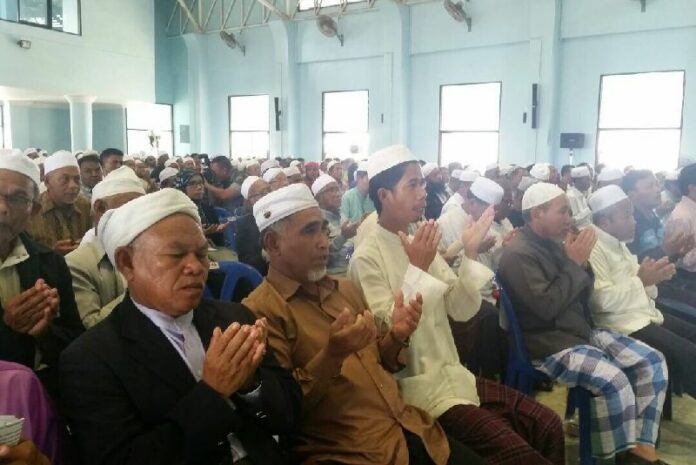
Lt.Gen. Prakarn Chollayuth, commander of the Fourth Region Army, met with around 1,000 Muslim clerics from local mosques at headquarters of the Central Islamic Committee in Narathiwat province, 3 June 2015.

YALA — Four soldiers were shot dead while they were driving in the restive province of Yala this evening.

The bodies of the soldiers, who were returning from a football event, appeared to have been dragged out of their vehicle and left on the center of the road in Raman district. The officer's weapons, which included three assualt rifles and one handgun, were missing when their bodies were found. 

Police say they believe the attack was carried out by local Islamic separatists who are seeking to secede the three Muslim-majority provinces of Yala, Narathiwat, and Pattani. 

The region, known colloquially as the Deep South, was annexed by Thailand in the early 20th century. Unlike the rest of Thailand, whose population is more than 90 percent Buddhist, the majority of residents in the Deep South are Muslim and speak a Malay dialect. 

Since the most recent waves of secessionist violence broke out in 2004, insurgents have staged near-daily bomb attacks and shootings, claiming the lives of more than 6,200 people, according to data collected by human rights groups. 

Earlier today, Lt.Gen. Prakarn Chollayuth, commander of the Fourth Region Army, met with around 1,000 Muslim clerics from local mosques in Narathiwat province and warned against extremists who cite religious beliefs in the name of violence.

"Local mosques, which are center of communities, should be used to the fullest benefit as a place of worship, a place that helps people have faith in religion and goodness, and a center of teachings that are correct and pure," Lt.Gen. Prakarn said. "You must not allow the abuse of religious beliefs into an incorrect or illegal ways that may threaten national security." 

Lt.Gen. Prakarn also expressed his hope that local residents in the Deep South would continue to support the government and reject the use of violence in the region.


For comments, or corrections to this article please contact: [email protected]

You can also find Khaosod English on Twitter and Facebook
http://twitter.com/KhaosodEnglish
http://www.facebook.com/KhaosodEnglish
 

Advertisement

Chiang Mai Cops Hunting for Man Behind Naked Road Sign Photos

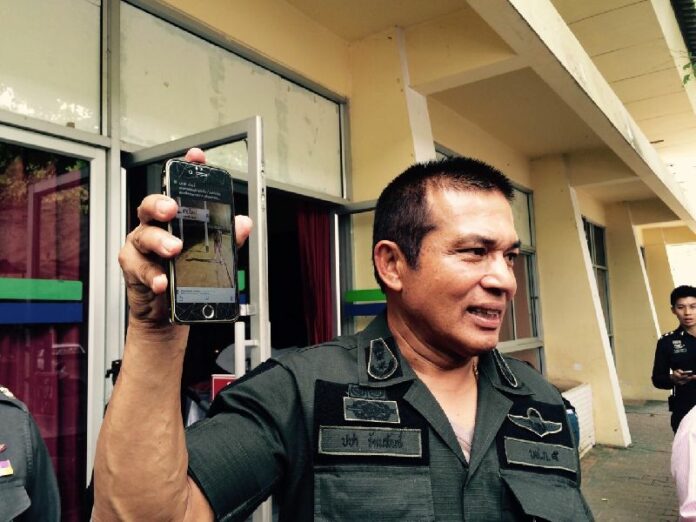
Pol.Maj.Gen. Pacha Rattapan showing one of the photos of the naked man on his phone, 3 June 2015.

CHIANG MAI — Police are looking for a man who has posted a series of nude photos on Facebook of himself standing next to road signs in the northern province of Chiang Mai.

Pol.Maj.Gen. Pacha Rattapan, deputy commander of Fifth Region Police, said the Thai man, whose identity is still unknown, has greatly damaged the reputation of Chiang Mai city with his widely-shared photos.

He said police are studying CCTV footage to identify the suspect, and officers have been dispatched to the locations seen in the photos to look for any evidence.

Pol.Maj.Gen. Pacha said he will be charged with the Computer Crime Act, a draconian law that bans dissemination of inappropriate or obscene material online.

The officer described the suspect as a "teenager," though in Thailand the term is also loosely used to describe individuals up to age 25.

"I believe the action was committed out of recklessness. Maybe he was reckless and wanted to show [the photos] to his friends, and then his friends shared the photos on the social media," Pol.Maj.Gen. Pacha said. "We will find this man for interrogation. The spots where the teenager took nude photos have clear signs. There are numbers that pinpoint the distance. It won't be difficult for us to track him down." 

He also urged members of the public and foreign tourists not to replicate the suspect's actions. 

In 2013, a 24-year-old man was arrested and fined by police after he was filmed riding a motorcycle naked around the city of Chiang Mai. 


For comments, or corrections to this article please contact: [email protected]

You can also find Khaosod English on Twitter and Facebook
http://twitter.com/KhaosodEnglish
http://www.facebook.com/KhaosodEnglish
Advertisement

Vietnam Plans More Tourist Cruises to Disputed Spratly Islands

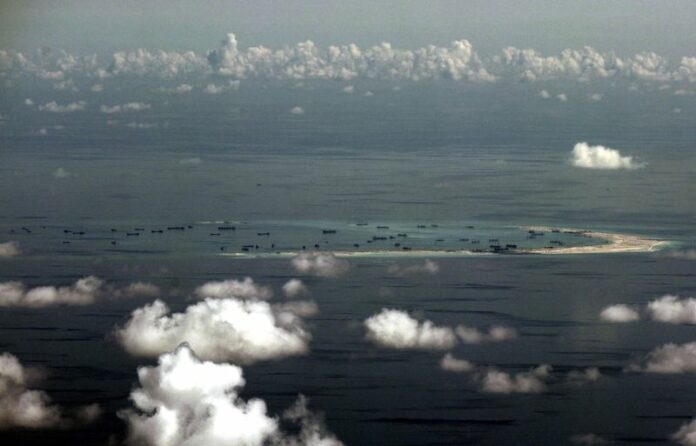
An aerial photo shows the Spratly group of islands in the South China Sea, west of Palawan, Philippines, 11 May 2015. Vietnam tour companies that entice travellers to experience the beauty of Ha Long Bay and charm of Hoi An may soon be touting the tension of the Spratly Islands. EPA/RITCHIE B. TONGO / POOL

HANOI (DPA) — Vietnam tour companies that entice travellers to experience the beauty of Ha Long Bay and charm of Hoi An may soon be touting the tension of the Spratly Islands, an archipelago at the centre of an international territorial dispute.

Authorities in Vietnam's biggest city, Ho Chi Minh City, have approved plans allowing local tour companies to organize ocean cruises through the South China Sea archipelago, where China has sparked international alarm with its island construction projects, news reports said Wednesday.

Previously, only tour companies based in Hai Phong in northern Vietnam had permission to sail to the area.

The Spratlys are an unlikely tourist destination, comprising a scattering of small rocky islands and reefs, although several have been developed in recent years with buildings, storage sites and even runways.

A cruise from Ho Chi Minh City to the islands – a two-day journey one-way – would venture into waters where the Chinese navy was recently accused of harassing a Vietnamese vessel, and where naval clashes are a frequent occurrence.

Ho Chi Minh City authorities asked tourism companies to "offer a reasonable price to attract tourists to the islands," as soon as June 22, Tuoi Tre newspaper reported.

The tours would not be a first. Last December, the Hoa Binh Travel company based in Hai Phong organized 7-day cruises to the area, including the chance to visit soldiers, residents and a museum describing efforts to defend the islands.

In February, the Ministry of Transport announced a plan to launch commercial flights to Truong Sa Lon, or Big Spratly Island.

China's activities in the South China Sea are contested by Vietnam, the Philippines, Indonesia, Malaysia, Brunei and Taiwan, who all claim sometimes overlapping sections. 

The arrival of a Chinese exploration rig in the Paracel islands in the South China Sea last year touched off anti-China protests in Vietnam.

For comments, or corrections to this article please contact: [email protected]

You can also find Khaosod English on Twitter and Facebook
http://twitter.com/KhaosodEnglish
http://www.facebook.com/KhaosodEnglish
Advertisement

Thai Military Detains, Demands DNA Samples of Southern Students

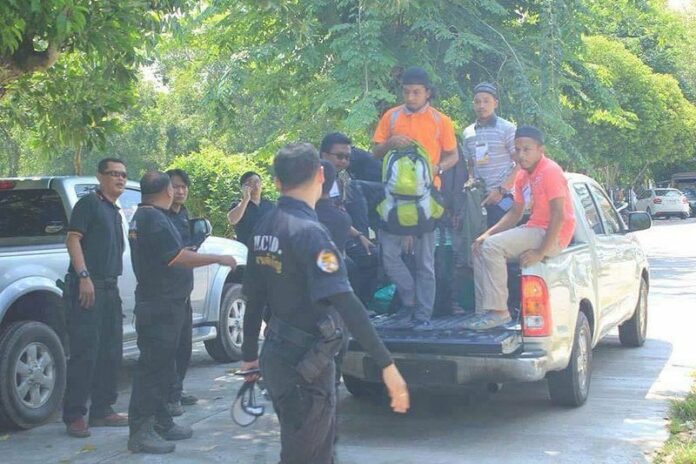
Security officers detain five students from the Islam Wittaya Foundation (IVM) at a school in Phatthalung on the morning of 2 June 2015 (courtesy from Wartani).  

(Prachatai English)

BANGKOK – The Thai military detained five students without arrest warrants while carrying out a search and collected DNA samples from another group of students in the restive deep south.

According to Wartani, military and security officers from the Southern Border Provinces Police Operation Centre (SBPPOC) stormed into Darussalam Foundation School in Bang Kaew District of southern Phatthalung Province at around 10.20 am on Tuesday and detained five students without arrest warrants.

The five were senior students from the Islam Wittaya Foundation (IVM), who were organising a youth camp for university students in the deep south. They are natives of the southern province of Yala.

Read more here.


Note: Khaosod English is not responsible for content on other websites.

Advertisement

'Reckless' Teenagers Steal Rifles from Police Armory

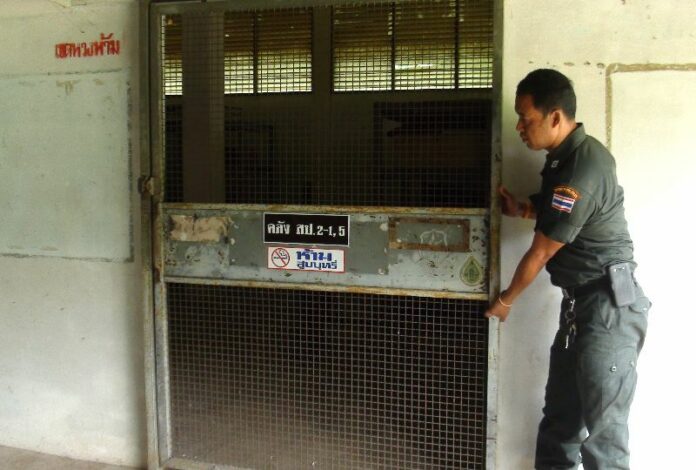
A police officer shows reporters the arsenal where assault rifles were stolen at the base of Border Patrol Police in Nakhon Si Thammarat province, 28 May 2015

NAKHON SI THAMMARAT — Police say they have arrested five people, including two minors, who allegedly stole assault rifles from a police base in Nakhon Si Thammarat province.

According to police, the five suspects broke into the arsenal of a Border Patrol Police command center in Thung Song district, stole the weapons, and sold them in the black market to buy narcotics.

Two of the suspects are 16, and the rest are 19, 33, and 40, said said Pol.Maj.Gen. Kiattipong Khaosam-ang, commander of the police force in the region.

One of the teenagers is the son of a police officer stationed in the base, he said.

"Based on our investigation, the crime was initiated out of recklessness," said Pol.Maj.Gen. Kiattipong. 

Police officers discovered that the weapons were missing on 26 May, and have recovered ten assault rifles so far, said Pol.Maj.Gen. Kiattipong. He did not say how many weapons were stolen in total or when the thefts took place.

"They stole two to three guns each time," Pol.Maj.Gen. Kiattipong said. "They committed the crimes multiple times." 

Police will also issue separate arrest warrants on those who purchased the weapons, Pol.Maj.Gen. Kiattipong said. 

Border Patrol Police in the region have been instructed to review and step up their security measures in the wake of the theft, he added. 

For comments, or corrections to this article please contact: [email protected]

You can also find Khaosod English on Twitter and Facebook
http://twitter.com/KhaosodEnglish
http://www.facebook.com/KhaosodEnglish
Advertisement

22 Arrested Over Yala Bombing Spree

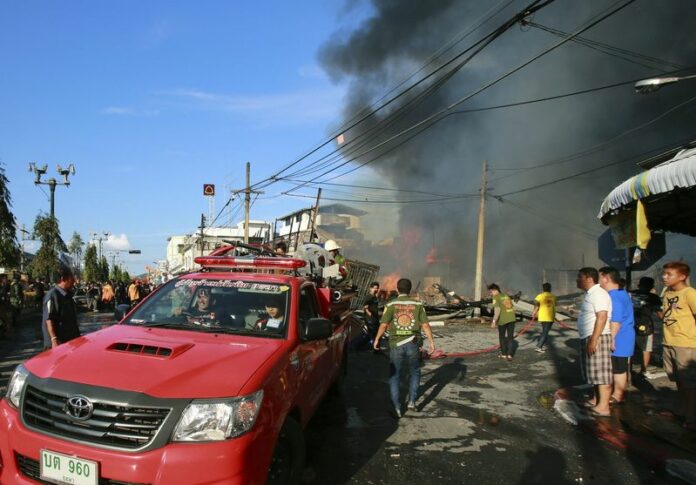
Thai firemen and volunteers try to extinguish a fire after a bomb attack in Yala, southern Thailand, 06 April 2014. Up to 39 explosions injured 22 people over the past three days in Thailand's restive southern province of Yala. EPA/NAKHARIN CHINNAWORNKOMOL

YALA — Thai authorities have arrested 22 suspects in connection with a three-day spate of bombings in the southern border province of Yala that injured nearly 20 people last month.

According to Col. Isra Chantakrayom, commander of the 41st Ranger Division, security officers tracked down the suspects using CCTV footage and witnesses' testimonies.

\
Thai firemen and volunteers try to extinguish a fire after a bomb attack in Yala, southern Thailand, 06 April 2014.  EPA/NAKHARIN CHINNAWORNKOMOL

The bombings, which rocked Yala between 14 – 16 May, injured 18 people, including children. Police say at least 56 homemade explosives were detonated throughout the weekend.

Although the explosions themselves were relatively small, the incident was one of the most coordinated attacks to strike the insurgent-torn region in recent months.

Col. Isra said the 22 suspects, who were arrested on 2 June, have not been formally charged wiht a crime, except for one man who already had a pre-existing arrest warrant on him for separate charges. 

"As for the detention of these 22 suspects, I insist that we will quickly interrogate them, and once the interrogation determines that they are not related to the incident, they will be immediately released," Col. Isra explained. "Their relatives have already have been informed."

Col. Isra also told reporters that three suspects have already confessed to their involvement in the May bombings, but he declined to provide further details, citing classified information. 

The Muslim-majority southern provinces of Yala, Narathiwat, and Pattani – a region known as the Deep South – have been plagued by a bloody Islamic insurgency for the past decade. The insurgents are seeking to revive the Islamic state of Patani, which was annexed by Thailand in the early 20th century. 

Near-daily bomb attacks and shootings have claimed the lives of more than 6,200 people since the most recent waves of secessionist violence broke out in January 2004. 


For comments, or corrections to this article please contact: [email protected]

You can also find Khaosod English on Twitter and Facebook
http://twitter.com/KhaosodEnglish
http://www.facebook.com/KhaosodEnglish
Advertisement

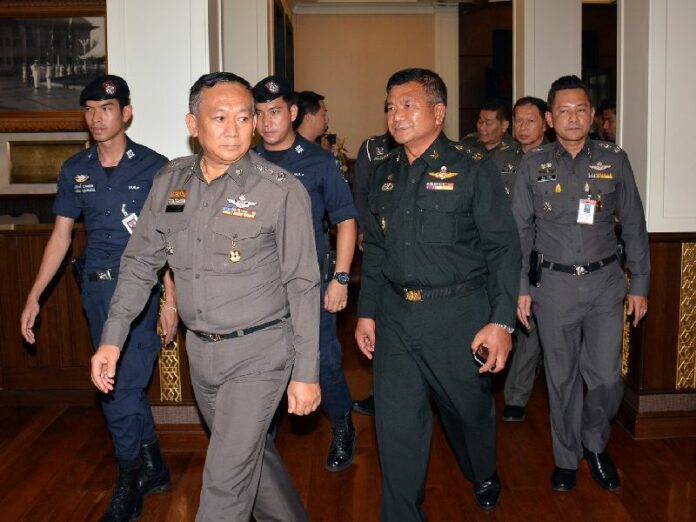
Defense Minister Say Army General Charged With Trafficking a 'Dedicated' Officer

Lt.Gen. Manas Kongpaen (in green) surrendered to police at the at the Royal Thai Police HQ in Bangkok on 3 June 2015.

BANGKOK — Thailand's defense minister Prawit Wongsuwan described the army general who surrendered to police today on charges of human trafficking as a hard-working military officer.

Lt.Gen. Manas Kongpaen, a "senior adviser" to the Royal Thai Army, turned himself in this morning after police accused him of aiding trafficking operations in southern Thailand that involved holding Rohingya and Bangladeshi migrants in jungle camps and extorting ransoms from their families. Lt.Gen. Manas has allegedly been involved in the operation since May 2012. 

\
Lt.Gen. Manas Kongpaen arriving at a police station in Hat Yai, Songkhla, 3 June 2015.

When a reporter asked Gen. Prawit, the Defense Minister, whether the armed forces had any knowledge of Lt. Gen. Manas's alleged criminal activity, he replied, "No. He has worked well. As far as I know, he is dedicated in his works, generally speaking. He has done a lot of work for the country." 

He added, "This is a personal issue. He is still only an accused."

Police obtained an arrest warrant for Lt.Gen. Manas on 1 June, and charged him with human trafficking, assisting aliens in illegal entry to the Kingdom, illegal detention, and holding individuals for ransom.

He is the first army officer to be named as a suspect in police’s ongoing crackdown on human trafficking rings in the south. Fifty-one people have been arrested so far, including local police officers, politicians, and businessmen. 

Lt.Gen. Manas told reporters yesterday that he would turn himself in at a police station in Songkhla province – where the abandoned detention camps were found – but instead met with high-ranking police officers at the headquarters of the Thai police in Bangkok today.

He was later transferred to a police station in Hat Yai, Songkhla, where he will be held for up to 48-hours of interrogation.

Thai police chief Pol.Gen. Somyot Pumpanmuang said Lt.Gen. Manas denied the charges this morning, but did not provide any further testimony during their meeting. 

Speaking to reporters on the phone yesterday, Lt.Gen. Manas asked the public to withold their judgment until his case is formally processed in court.

"I would like to ask society not to judge me as a guilty person," he said. "I want them to look at information from both sides, and let the court decide. I would like to ask for fairness. I am willing to cooperate with the officials in any way. No matter what the verdict is, I will accept it. I don't have problem with it. I am a Thai person, I accept all rules in this society."

A total of ​84 arrest warrants have been issued since the crackdown on human trafficking started on 1 May, said Pol.Gen. Aek Angsananont, deputy commander of Thai police. Regarding Lt.Gen. Manas's arrest, he said, "Police will give dignity to the suspect, who is a senior army officer. But we will also treat him with the same standard as other suspects." 


For comments, or corrections to this article please contact: [email protected]

You can also find Khaosod English on Twitter and Facebook
http://twitter.com/KhaosodEnglish
http://www.facebook.com/KhaosodEnglish

Advertisement

22 Arrested Over Yala Bombing Spree

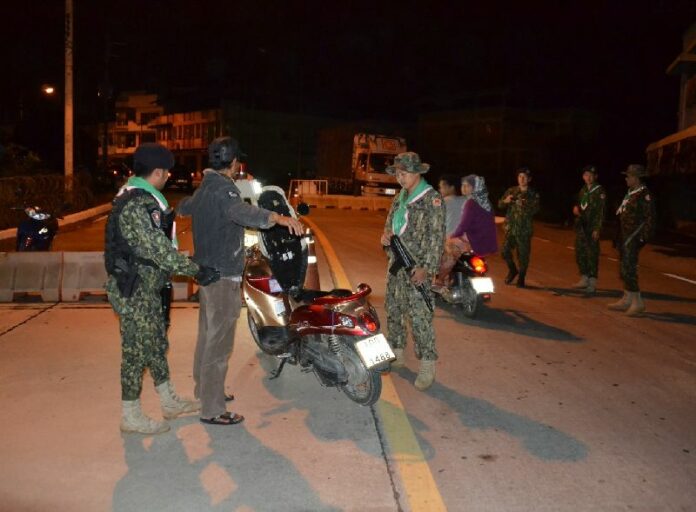
A security checkpoint in Yala province, 24 May 2015.

YALA — Thai authorities have arrested 22 suspects in connection with a three-day spate of bombings in the southern border province of Yala that injured nearly 20 people last month.

According to Col. Isra Chantakrayom, commander of the 41st Ranger Division, security officers tracked down the suspects using CCTV footage and witnesses' testimonies.

\
Thai firemen and volunteers try to extinguish a fire after a bomb attack in Yala, southern Thailand, 06 April 2014.  EPA/NAKHARIN CHINNAWORNKOMOL

The bombings, which rocked Yala between 14 – 16 May, injured 18 people, including children. Police say at least 56 homemade explosives were detonated throughout the weekend.

Although the explosions themselves were relatively small, the incident was one of the most coordinated attacks to strike the insurgent-torn region in recent months.

Col. Isra said the 22 suspects, who were arrested on 2 June, have not been formally charged wiht a crime, except for one man who already had a pre-existing arrest warrant on him for separate charges. 

"As for the detention of these 22 suspects, I insist that we will quickly interrogate them, and once the interrogation determines that they are not related to the incident, they will be immediately released," Col. Isra explained. "Their relatives have already have been informed."

Col. Isra also told reporters that three suspects have already confessed to their involvement in the May bombings, but he declined to provide further details, citing classified information. 

The Muslim-majority southern provinces of Yala, Narathiwat, and Pattani – a region known as the Deep South – have been plagued by a bloody Islamic insurgency for the past decade. The insurgents are seeking to revive the Islamic state of Patani, which was annexed by Thailand in the early 20th century. 

Near-daily bomb attacks and shootings have claimed the lives of more than 6,200 people since the most recent waves of secessionist violence broke out in January 2004. 


For comments, or corrections to this article please contact: [email protected]

You can also find Khaosod English on Twitter and Facebook
http://twitter.com/KhaosodEnglish
http://www.facebook.com/KhaosodEnglish
Advertisement

Thai Govt Combats Drought With Rain-Summoning Ceremony

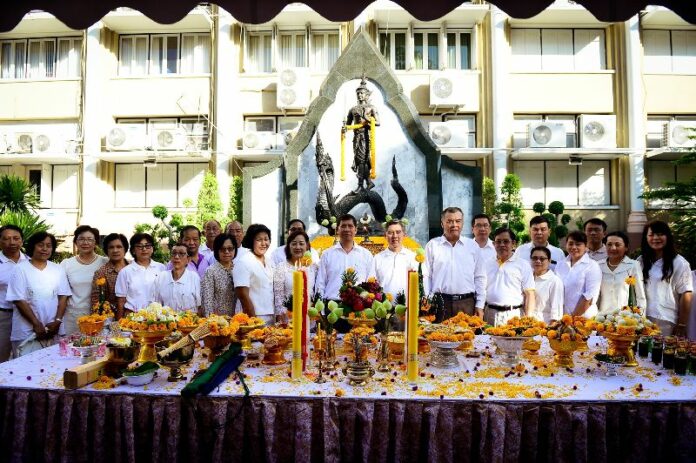
A rain-summoning ceremony at the Ministry of Agriculture and Cooperatives in Bangkok on 2 June 2015.

BANGKOK — Thailand’s military government turned to supernatural forces yesterday in an effort to stave off the annual droughts that occur during Thailand’s dry season.

Chavalit Chookajorn, Permanent Secretary of Agriculture and Cooperatives, presided over a traditional Thai ceremony asking Phra Pirun – the god of rain in Hindu beliefs – to bless the Kingdom with rain.

The Secretary was assisted by Sorajja Nual-yu, a well-known astrologer who styles himself as “Thailand’s Nostradamus.”

Speaking to reporters today, Chavalit said Sorajja, who used to work at the Ministry of Agriculture, warned that a severe drought is imminent.

“Brother Chui has the sixth sense,” Chavalit said, referring to Sorajja by his nickname. “He told me that there will certainly be a drought this year. So he wanted the Ministry to conduct a ceremony to ask for rain.”

Thailand experiences droughts every year during dry season, which lasts from November to April.

“Personally, I think it’s a good thing,” Chavalit said, in reference to the ceremony. “It’s not a superstition. It doesn’t hurt if we do the ceremony. It’s about finding something your spirit can hold on to.”

Many Thais are deeply superstitious and draw upon astrology, feng shui, and other spiritual beliefs to guide their daily lives. It is common practice for government officials and leading politicians to consult personal astrologers.

Sorajja previously predicted that a major earthquake would strike Thailand some time before “12 July.” His prediction earned him a rebuke from a government spokesperson who asked astrologers not to cause panic among the public.

Meanwhile, Lertchai Sri-anand, a director of the Royal Irrigation Department, said farmers in the lower part of the Chao Praya River plain are suffering from water shortages because those in the upper plain are diverting the water for their own use.

“I have to admit that the Department is facing problems in water management for agriculture, because farmers in the upper part of the river worried that this year’s water level will be low, and drought may be coming, and there won’t be enough water for agriculture, so they pump the water into their own ponds,” Lertchai said.

He insisted that sufficient water is being stored in many reservoirs to meet farmers’ needs throughout the country, and asked farmers not to worry.


Advertisement

Hot News

LATEST NEWS

Bangkok
broken clouds
36.6 ° C
37.8 °
35.5 °
47 %
3kmh
82 %
Mon
35 °
Tue
37 °
Wed
37 °
Thu
36 °
Fri
36 °