




























30 C
Bangkok
Friday, July 17, 2026
Home Blog Page 2983

Deep South Bombing Spree Continues, Killing One Ranger

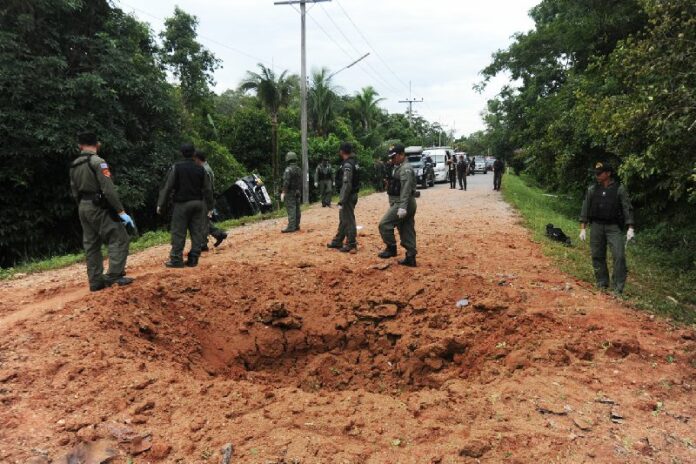
The crater caused by a roadside bomb in Narathiwat that killed one ranger and injured six others, 14 July 2015.

NARATHIWAT — A paramilitary ranger was killed and six more rangers were severely injured by a bomb in southern Thailand’s today, the latest in a spate of attacks that claimed six lives over the weekend.

Police said the rangers were traveling in Narathiwat province when the bomb exploded near their vehicle at around 8.50am. The explosive – made from 50 kg gas canister – destroyed the rangers’ pick-up truck and created a four-meter-wide crater in the road, police said. One ranger died and six others were severely injured.

According to police, the rangers were returning to their base after escorting a group of teachers to school, another frequent target of Muslim insurgents in the region. 

A police officer blamed the attack on "terrorists," referring to the separatists who have been waging a bloody campaign to secede Narathiwat and its neighboring provinces of Pattani and Yala from Thai authorities for the past decade. The secessionist violence also occasionally spills to the nearby province Songkhla – a popular destination for Thai and Malaysian tourists. 

Today's attack followed bombings in Songkhla, Narathiwat, and Yala over the weekend, targeting banks, restaurants, and hotels. The attacks killed six people, officials said. Police believe the bombings were organized by the insurgent network, though no arrest warrants have been issued. 

Yesterday two smaller bomb attacks also targeted security officers in Pattani province, wounding two soldiers and two rangers. A 47-year-old man was later shot and killed on the same day on Pattani-Narathiwat Road. Police said the assassination may be related to the insurgency, but more investigation is needed. 

\
Police inspect the scene of a bombing in Narathiwat city center, 14 July 2015.

More than 6,000 people have been killed since the latest wave of separatist violence broke out in the Muslim-majority region – known as the Deep South – in January 2004. The militants are have been fighting to revive the sultanate of Patani, which was annexed by Thailand in the early 20th century. 

Speaking to reporters yesterday, junta chairman and Prime Minister Prayuth Chan-ocha said that "80 percent" of people in the Deep South sympathize with the government, despite the recent uptick in violence. 

"It's normal that the other side refuses to stop," said Gen. Prayuth, who came to power by staging a coup in May 2014. "That side has many factions and groups. They have political and military factions, young generation and old generation factions. The older generation has been fighting us for a long time. They must be feeling exhausted. Some of them have entered a peace dialogue [with the government]. But the younger generation has been implanted with a chip of [violent struggle]. We have to reach understanding with them and reduce their violence." 

Gen. Prayuth also told reporters that his government will continue peace talks with the insurgents.

"We are talking with the leadership and coordinator level of different groups. Right now, many have joined the discussion. Even people who join it don't agree with each other. There's not much unity on their side … You cannot hope to finish this tomorrow or the day after tomorrow. The more we press them, the more they will pressure us with violence, because it's us who wants it to be over."

In a message for those behind the bombings, Gen. Prayuth added, "I am telling you today, the country has to stick together. If you have a problem, fix it through the legal process and the justice system. If you keep fighting, it will damage all of us." 

The elected government toppled by Gen. Prayuth in the May 2014 coup carried out several ground-breaking peace dialogues with one of the militant groups in 2013, but the process was derailed after six months of protests debilitated the central government, culminating in the military takeover. 


For comments, or corrections to this article please contact: [email protected]

You can also find Khaosod English on Twitter and Facebook
http://twitter.com/KhaosodEnglish
http://www.facebook.com/KhaosodEnglish
Advertisement

10 Jailed for Running Anti-Monarchy Broadcasting Network

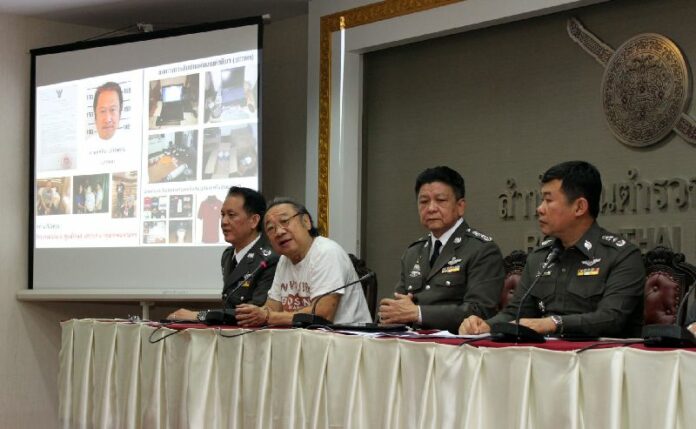
Police announce the arrest of Hasadin Uraipraiwan, aka Banpodj, in February 2015.

BANGKOK — A martial court in Bangkok has handed down jail terms to ten alleged members of an anti-monarchy network that produced nearly 400 online video clips criticizing Thailand's royal family.

Police cracked down on the group, known collectively as the "Banpodj Network," in February and arrested a total of 14 suspects.

The 64-year-old man accused of leading of the network, Hasadin Uraipraiwan, aka Banpodj, was arrested at a hotel in Bangkok on 9 February. 

The group was sent to face trial in military court on charges of violating Section 112 of the Thai Criminal Codes, which outlaws criticizing the monarch and carries a maximum penalty of 15 years in prison, and violating the Computer Crime Act, which bans circulating defamatory content and is punishable by up to 5 years in prison.  

Hasadin and seven others were sentenced to five years in prison today, while his wife and a motorcycle taxi driver were sentenced to three years in jail for "providing assistance" to the network. The judge said their jail terms were halved from the original 10-year and 6-year sentences because the defendants plead guilty. 

Four other suspects have decided to contest their charges in martial court. They are Ngernkhoon Udomkunakorn, Sivaporn Panya, Thara Wanichpongpan, and Anchan Preelert. 

According to the court briefing, the Banpodj Network had produced nearly 400 video and audio clips since 2009 that defame the Thai monarchy. The segments were published on the internet, mostly through Youtube.

Banpodj was well known among a radical wing of the Redshirt movement for constructing complex conspiracy theories about the Royal Family. 


For comments, or corrections to this article please contact: [email protected]

You can also find Khaosod English on Twitter and Facebook
http://twitter.com/KhaosodEnglish
http://www.facebook.com/KhaosodEnglish
Advertisement

Thai Minister Asks French Diplomat to Extradite Lese Majeste Suspects

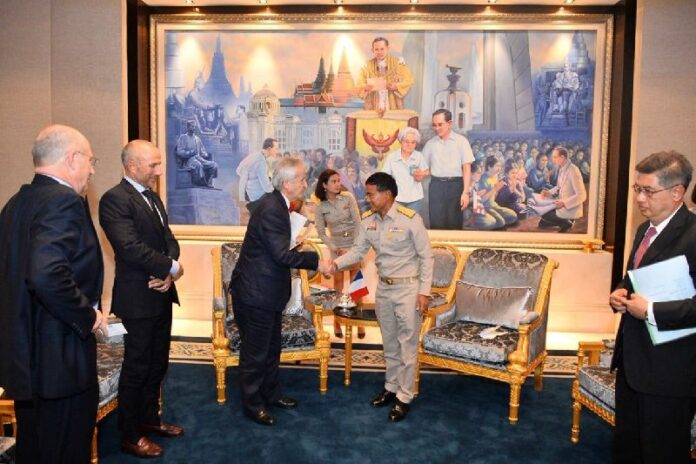
Thai Justice Minister Gen. Paiboon Khumchaya (R) with France's Ambassador to Thailand, Thierry Viteau (L), 13 July 2015.

BANGKOK — Thailand's Minister of Justice said he has asked the French ambassador to help extradite Thais charged with insulting the monarchy, a crime punishable by up to 15 years in prison.

Gen. Paiboon Khumchaya met with the ambassador, Thierry Viteau, at the Ministry of Justice yesterday. 

Speaking to reporters after the meeting, Gen. Paiboon said he told Viteau about three Thais who fled to France and are facing charges of lese majeste (defaming the monarchy).

Gen. Paiboon said he asked Viteau to "understand" the nature of the wrongdoing and help facilitate the suspects’ extradition to Thailand. 

"I have explained and created understanding with Mr. Thierry about the cases that affect national security and the Thai monarchy," Gen. Paiboon said. "I have explained to him in detail about how each individual is related to the security of the monarchy, and to political security."

Gen. Paiboon continued, "We want the French government to acknowledge this, and proceed with the legal procedure." 

The general did not say how the French ambassador responded to the request, though Thailand’s military government has never successfully extradited a lese majeste suspect living abroad. The government says 31 people charged with lese majeste are currently living in exile, with 14 of them residing in neighboring Laos. 

Gen. Paiboon also told reporters that he will chair a meeting between the Ministry of Justice and the Division of Special Investigation (DSI) about developing measures to further deter lese majeste violations in Thailand. 

Although Gen. Paiboon did not identify the three fugitives by name, three well-known critics of the Thai monarchy are currently residing in France. They include Saran Chuichai, Jaran Ditapichai, and Somsak Jeamteerasakul. 

Saran, aka Aum Neko, is an LGBT activist who has harshly criticized the Thai Royal Family on social media, Jaran is a former national human rights commissioner and Redshirt leader, and Somsak is a former history lecturer and prolific writer on the Thai monarchy. 

The three are believed to have fled Thailand shortly after the military staged a coup d'etat against an elected government in May 2014. 

Last month, Saran told the BBC that she, Somsak, and Jaran have all been granted political asylum by French authorities.

Since the military takeover, Thailand’s ruling junta has clamped down on civil rights – banning protests and censoring the media, among other measures – and stepped up the enforcement of the Kingdom’s draconian lese majeste law. 

In the past year, nearly 50 people have been charged with lese majeste, and more than half of them have been denied bail while they await trial, according to iLaw, a watchdog group that tracks legal cases in Thailand. 

The junta has also granted military courts jurisdiction over lese majeste cases, citing the crime’s “threat to national security.”

Today a martial court sentenced eight people to five years in prison for allegedly producing a series of videos on Youtube that slander the monarchy, Prachatai reported. Two more people were also sentenced to three years in prison for "assisting" the group. 

Death penalty concerns

According to Gen. Paiboon, the French ambassador also urged the Thai government to abolish the death penalty, which Gen. Paiboon said is not possible at this time. 

"I explained the attitude of Thai people and the context of Thai society," Gen. Paiboon said. "I raised the example of the rape and murder of a school child on a train. It prompted people to campaign for the death penalty [for rape convicts]. The death penalty is deeply-rooted in the mind and attitude of Thai people, so we cannot abolish it yet."

He added, "However, the attitude of Thai government does not reject or oppose human rights and other international obligations. It's just that we are waiting for Thai people's attitude to be more prepared and understanding [about abolition of death penalty]. And Mr. Thierry understands this issue." 


For comments, or corrections to this article please contact: [email protected]

You can also find Khaosod English on Twitter and Facebook
http://twitter.com/KhaosodEnglish
http://www.facebook.com/KhaosodEnglish
Advertisement

Police: Former BKK Top Cop to be Banned From Japan

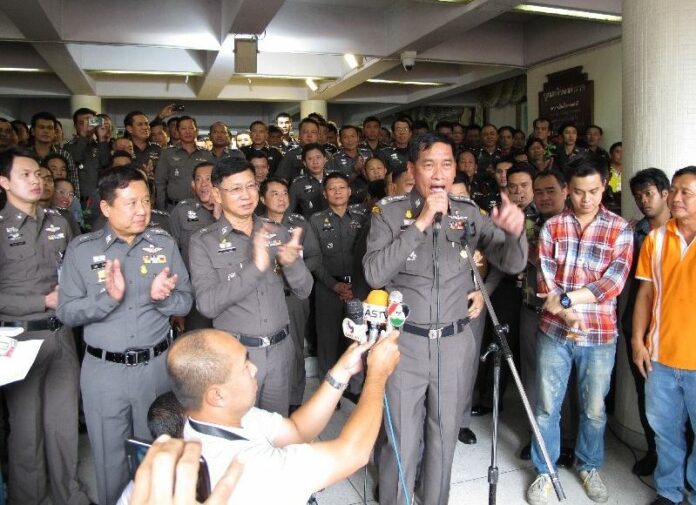
Pol.Lt.Gen. Kamronwit Thoopkrachang addressing a crowd of policemen at Bangkok Metropolitan Bureau on 7 September 2012 [Matichon]

BANGKOK — The former commander of the Bangkok police force will not stand trial in Japan for carrying a loaded gun into a Tokyo airport last month, but is expected to be barred from entering the country for at least one year, according to a Thai police spokesperson.

Pol.Lt.Gen. Kamronwit Thoopkrachang, who led Bangkok's police force from 2012 to 2014, has been detained in Japanese prison since he was arrested on 22 June for carrying a loaded revolver in his suitcase at Narita Airport.

He was released from prison today after Japanese prosecutors decided not to take up the case, said Pol.Lt.Gen. Prawuth Thawornsiri, spokesperson of the Royal Thai Police.

Kamronwit was immediately transferred into the custody of Japan’s immigration police, where he will be processed for overstaying his 15-day visa, Pol.Lt.Gen. Prawuth said.

"It was an overstay that occurred during his detention while his case was being deliberated," Pol.Lt.Gen. Prawuth said at the press conference. "Afterward, he will be processed for a return to Thailand in accordance with the immigration laws." 

Pol.Lt.Gen. Prawuth said he was informed that Kamronwit will be barred from entering Japan for at least one year because of the visa violation.

"The lightest condition would be a normal send-back. In that case, he would banned from Japan for one year," Pol.Lt.Gen Prawuth explained. "If he is deported, the ban will extend to two or three years, depending on the judgment of the Japanese authorities. But I can say that within the next year, he will certainly not be able to return to Japan." 

He added that Thai officials have not been able to meet with Kamronwit since he was released from the Japanese prison, but will question him upon his return.

Pol.Lt.Gen. Prawuth also dismissed reports in some Thai media agencies that Kamronwit's relatives have already booked a plane ticket back to Bangkok for the former Bangkok police chief.

"As for the news about Pol.Lt.Gen. Kamronwit's return to Thailand, we have no clear information to confirm it," he said. "We have to wait for the procedure of the Japanese immigration police. Thai police will be directly coordinating with Japanese police, because his relatives have not been granted permission to meet with Pol.Lt.Gen. Kamronwit, which may have led to a misunderstanding." 

Kamronwit is considered a close ally to former Prime Minister Thaksin Shinawatra, who was deposed in a military coup in 2006 but still retains considerable influence over a powerful political dynasty in Thailand. Kamronwit retired from the Royal Thai Police in October 2014, five months after the ruling military staged a coup d'etat against a government led by Thaksin’s sister.


For comments, or corrections to this article please contact: [email protected]

You can also find Khaosod English on Twitter and Facebook
http://twitter.com/KhaosodEnglish
http://www.facebook.com/KhaosodEnglish
Advertisement

Koh Tao Murder Timeline


For comments, or corrections to this article please contact: [email protected]

You can also find Khaosod English on Twitter and Facebook
http://twitter.com/KhaosodEnglish
http://www.facebook.com/KhaosodEnglish
Advertisement

Soldiers, Police Arrest Condominium Manager for Beating Dog

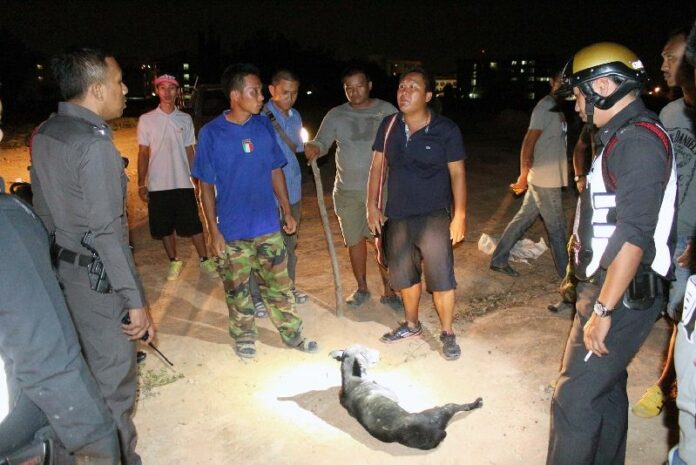
Police inspect the crime scene several hours before they returned to arrest the condominium's manager on 13 July 2015.

CHONBURI — A group of soldiers and policemen raided a condominium in the resort town of Pattaya today to arrest the building's manager for allegedly beating a stray dog on the property.

Thawat Pinyipyoke, 50, was arrested at Pattaya City Resort Condominium this morning by police officers from Pattaya City Police Station and soldiers from 14th Army District. 

Thawat told police – who were responding to a complaint from local residents – that he ordered his staff to drive off several stray dogs that regularly gathered on the grounds of the condominium and rummaged through garbage bins, attracting complaints from the building’s occupants.

He  said he initially contacted Pattaya city administration about the problem but officials never addressed the issue.

According to Thawat, some of the dogs resisted the eviction, so he and his staff captured them in sacks in an attempt to transport them off the property. However, one of the dogs jumped out of the sack, so he used a stick to beat the dog on the head.

"I did not intend to harm or commit any cruelty against the animal," Thawat told police officers, adding that he is willing to pay all medical bills for the dog. 

The dog was sent to a local animal hospital and is being treated for severe head injuries.

Police say they have charged Thawat with violating the 2014 Prevention of Animal Cruelty and Provision of Animal Welfare Act, which carries a maximum penalty of two years for prison for cruel or inhumane treatment of animals. 

Police added that they have not charged any the eight Burmese staff who helped with the effort because only Thawat confessed to beating the dog, and there is currently no evidence linking the Burmese men to the crime. 


For comments, or corrections to this article please contact: [email protected]

You can also find Khaosod English on Twitter and Facebook
http://twitter.com/KhaosodEnglish
http://www.facebook.com/KhaosodEnglish
Advertisement

NGOs in Cambodia to Face Regulation

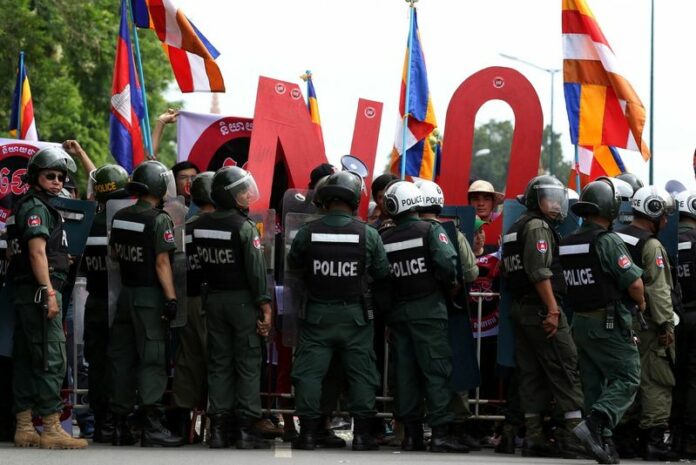
Cambodian police officers block protesters during a rally in Phnom Penh, Cambodia, 13 July 2015.  EPA/KHEM SOVANNARA

PHNOM PENH (DPA) — Non-governmental organizations (NGOs) in Cambodia will come under a new regulatory system approved by the lower house of parliament Monday, amid criticism by human rights groups and Western embassies.

All organizations in the country will be required to register, remain politically neutral, and respect Cambodia's "culture, traditions and customs," according to a draft seen earlier by dpa.

Any organization that threatens "political security, stability and order" could be refused registration or fined.

International rights groups have expressed concern that the law will be used to repress political dissent, and said it violates freedom of assembly.

The European Parliament on Thursday adopted a resolution urging Cambodia to rewrite the law with more input from civil society.

The latest requirements "impose unwarranted restrictions on the rights to freedom of association and expression," it said, "and create legal grounds for arbitrarily closing or denying registration to politically disfavoured NGOs."

Phnom Penh said the move was necessary to manage the country's more than 4,000 currently unregulated NGOs, and that it consulted 500 individuals and several embassies in the course of drafting the law.

"The US, UK and other countries have an NGO law. Why not in Cambodia?" government spokesman Phay Siphan said.

In June, Prime Minister Hun Sen dismissed foreign criticism as "a violation of Cambodia's sovereignty" and called for "respect for Cambodia's decisions as an independent state and a UN member," Radio Free Asia reported.

Monday's vote was boycotted by the opposition Cambodian National Rescue Party, whose spokesman Yim Sovann said the law did not reflect "the will of civil society."

After passing the National Assembly, the bill was to go to the Senate and then to the king for final signing into law, which are expected.

(Reporting by Erin Hale)


For comments, or corrections to this article please contact: [email protected]

You can also find Khaosod English on Twitter and Facebook
http://twitter.com/KhaosodEnglish
http://www.facebook.com/KhaosodEnglish
Advertisement

Martial Court Approves Bail for Woman Accused of Spreading Prayuth Rumor

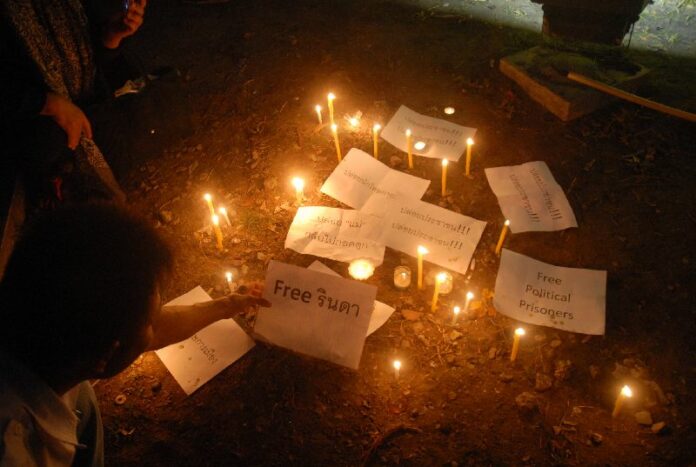
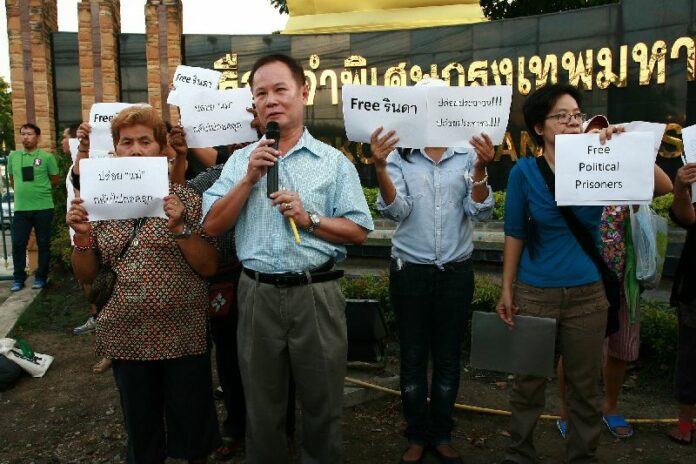
Activists light candles outside Bangkok Remand Prison to demand the release of Rinda Paruechabutr, who has been accused of spreading a rumor about junta chairman Gen. Prayuth Chan-ohca, 12 July 2015.

BANGKOK — A martial court has reversed its ruling to allow a single mother to be released on bail while she awaits trial for allegedly spreading a rumor about junta chairman Prayuth Chan-ocha.

Police say Rinda Paruechabutr, 45, started a spurious rumor on social media that Gen. Prayuth had transferred 10 billion baht to an offshore bank account in Singapore. She is facing up to twelve years in prison on charges of violating the Computer Crime Act, inciting unrest, and causing panic.

She was arrested on 9 July and kept in prison for three days after Bangkok’s martial court ordered her to be jailed while she awaited trial.

However, the court issued a new ruling today to approve Rinda’s request for bail, setting her bond money at 100,000 baht, Matichon reported. The judge reportedly said Rinda was unlikely to flee the country, and had to take care of her two children outside the prison.

Rinda became the sole guardian of her children, ages 7 and 16, after her husband passed away in 2012.

Police say she belongs to a local chapter of the Redshirt movement – which opposed the May 2014 coup – in Pathum Thani province. 

Under the conditions of her release, Rinda is barred from leaving the country or participating in any political campaigns.

The ruling came after 30 people gathered outside the entrance to Bangkok Remand Prison last night to hold a vigil for Rinda and what they described as "other political prisoners." The gathering was organized by several pro-democracy groups, including the New Democracy Movement, Resistant Citizens, and Thai Lawyers for Human Rights. 

Arnon Nampha, a human rights lawyer and member of Resistant Citizens group, said he joined the rally to insist that civilians not be sent to stand trial in martial courts.

Gen. Prayuth's decision to grant military courts jurisdiction over all cases that "affect national security" has been widely condemned by human rights groups. At least 140 civilians are currently facing trial in martial courts, where military officers sit as judges and appeals are not possible.  

Songtham Kaewpanpruk, a member of the New Democracy Movement who attended last night's rally, told reporters he believes the junta should listen to criticism from the people.

"We demand that Mrs. Rinda be granted bail. She's not a threat to any national security," said Songtham, who is facing a separate trial in military court for participating in a pro-democracy demonstration last month. "She's just a small woman. She has not done anything evil, like stage a coup." 

A representative of the protesters read a joint statement urging authorities to drop the charges against Rinda, and to "give justice to all political prisoners." The statement also demanded Gen. Prayuth step down from his position as Prime Minister to take responsibility for the deterioration of civil rights in Thailand under his military regime. 

Security officers observed the rally without interfering until the protesters dispersed peacefully from the scene at around 8 pm. 

Speaking to reporters today, government spokesperson Maj.Gen. Sansern Kaewkamnerd denied that Rinda was a "political prisoner."

"This matter is not about politics, even though some people try to fan the news that she is a [prisoner] in political case," said Maj.Gen. Sansern. "She is involved in criminal offense for defaming other people."

He said Gen. Prayuth is concerned that false allegations about government agencies or national figures could damage Thailand’s reputation abroad.

"Gen. Prayuth has insisted that things will only improve only if the country is stable and has earned confidence from inside and outside Thailand," Maj.Gen. Sansern said. "Everything is connected. Therefore, I ask every side to be more conscious about doing this sort of thing, because it will affect the confidence of people inside and outside the country." 

At a police press conference last week, Rinda said she posted the message after someone texted in to her through the chat application LINE, but insisted that she had no intention to damage the country.

"I think that, as a citizen, I have the rights to criticize and express my opinion, since the Prime Minister is a public figure," Rinda said. "But I concede that my words affect other people. So I'd like to warn other people who use social media to be careful, because this is a sensitive issue." 

For comments, or corrections to this article please contact: [email protected]

You can also find Khaosod English on Twitter and Facebook
http://twitter.com/KhaosodEnglish
http://www.facebook.com/KhaosodEnglish
Advertisement

Martial Court Approves Bail for Woman Accused of Spreading Prayuth Rumor

Activists gather outside Bangkok Remand Prison to demand release of Rinda Paruechabutr, who has been accused of spreading a rumor about junta chairman Gen. Prayuth Chan-ohca, 12 July 2015.

BANGKOK — A martial court has reversed its ruling to allow a single mother to be released on bail while she awaits trial for allegedly spreading a rumor about junta chairman Prayuth Chan-ocha.

Police say Rinda Paruechabutr, 45, started a spurious rumor on social media that Gen. Prayuth had transferred 10 billion baht to an offshore bank account in Singapore. She is facing up to twelve years in prison on charges of violating the Computer Crime Act, inciting unrest, and causing panic.

She was arrested on 9 July and kept in prison for three days after Bangkok’s martial court ordered her to be jailed while she awaited trial.

However, the court issued a new ruling today to approve Rinda’s request for bail, setting her bond money at 100,000 baht, Matichon reported. The judge reportedly said Rinda was unlikely to flee the country, and had to take care of her two children outside the prison.

Rinda became the sole guardian of her children, ages 7 and 16, after her husband passed away in 2012.

Police say she belongs to a local chapter of the Redshirt movement – which opposed the May 2014 coup – in Pathum Thani province. 

Under the conditions of her release, Rinda is barred from leaving the country or participating in any political campaigns.

The ruling came after 30 people gathered outside the entrance to Bangkok Remand Prison last night to hold a vigil for Rinda and what they described as "other political prisoners." The gathering was organized by several pro-democracy groups, including the New Democracy Movement, Resistant Citizens, and Thai Lawyers for Human Rights. 

Arnon Nampha, a human rights lawyer and member of Resistant Citizens group, said he joined the rally to insist that civilians not be sent to stand trial in martial courts.

Gen. Prayuth's decision to grant military courts jurisdiction over all cases that "affect national security" has been widely condemned by human rights groups. At least 140 civilians are currently facing trial in martial courts, where military officers sit as judges and appeals are not possible.  

Songtham Kaewpanpruk, a member of the New Democracy Movement who attended last night's rally, told reporters he believes the junta should listen to criticism from the people.

"We demand that Mrs. Rinda be granted bail. She's not a threat to any national security," said Songtham, who is facing a separate trial in military court for participating in a pro-democracy demonstration last month. "She's just a small woman. She has not done anything evil, like stage a coup." 

A representative of the protesters read a joint statement urging authorities to drop the charges against Rinda, and to "give justice to all political prisoners." The statement also demanded Gen. Prayuth step down from his position as Prime Minister to take responsibility for the deterioration of civil rights in Thailand under his military regime. 

Security officers observed the rally without interfering until the protesters dispersed peacefully from the scene at around 8 pm. 

Speaking to reporters today, government spokesperson Maj.Gen. Sansern Kaewkamnerd denied that Rinda was a "political prisoner."

"This matter is not about politics, even though some people try to fan the news that she is a [prisoner] in political case," said Maj.Gen. Sansern. "She is involved in criminal offense for defaming other people."

He said Gen. Prayuth is concerned that false allegations about government agencies or national figures could damage Thailand’s reputation abroad.

"Gen. Prayuth has insisted that things will only improve only if the country is stable and has earned confidence from inside and outside Thailand," Maj.Gen. Sansern said. "Everything is connected. Therefore, I ask every side to be more conscious about doing this sort of thing, because it will affect the confidence of people inside and outside the country." 

At a police press conference last week, Rinda said she posted the message after someone texted in to her through the chat application LINE, but insisted that she had no intention to damage the country.

"I think that, as a citizen, I have the rights to criticize and express my opinion, since the Prime Minister is a public figure," Rinda said. "But I concede that my words affect other people. So I'd like to warn other people who use social media to be careful, because this is a sensitive issue." 

For comments, or corrections to this article please contact: [email protected]

You can also find Khaosod English on Twitter and Facebook
http://twitter.com/KhaosodEnglish
http://www.facebook.com/KhaosodEnglish

Advertisement

Lack of Evidence, Local Media Coverage Adds to Mystery of Koh Tao Murder

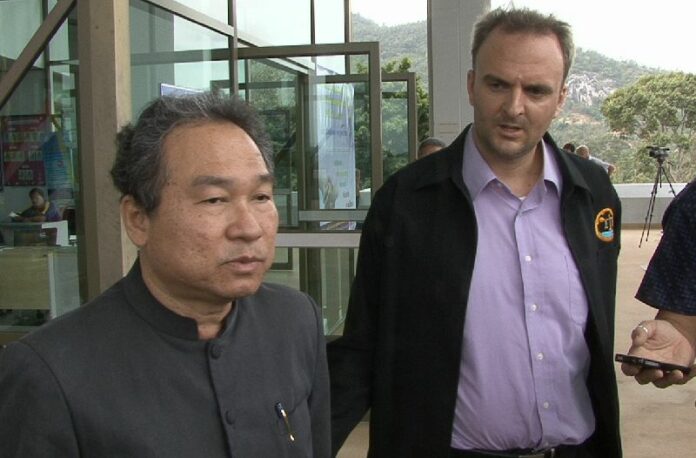
Nakhon Chompuchat (L) and Andy Hall (R) speaking to reporters outside the court on 9 July 2015.

BANGKOK — The first week of the trial of two Burmese men accused of murdering British tourists on a Thai island last year has done little to shed light on a case that has been shrouded in mystery from the start.

Zaw Lin and Wai Phyo, both 22, have been charged with murder, rape, and theft over the deaths of British travelers David Miller, 24, and Hannah Witheridge, 23. The tourists’ badly beaten bodies were found on Koh Tao’s Sairee beach in the early morning of 15 September 2014.

The gruesome murder shocked the idyllic resort island and captured the attention of the foreign press, who detailed police’s every stumble in a wayward investigation that ended with the arrest of Zaw Lin and Wai Phyo several weeks later. 

The suspects initially confessed after being interrogated by police without a professional interpreter or lawyer, but later declared their innocence and said they were tortured. They could face the death penalty if convicted.

Suspicions that the Burmese men were used as scapegoats to wrap up a case that was threatening to harm Thailand’s tourist industry were compounded last year by reports of locals refusing the speak to journalists, citing fears of “powerful families” on the 21 km2 island.

Despite hopes that the first round of witness examinations last week would provide clarity on the murder, questions remain about what police have described as their “watertight” case, and rumors about a suspected cover-up continue to flourish.

'Used up evidence'

In response to the defense team’s repeated calls for access to forensic evidence that the prosecution said links Zaw Lin and Wai Phyo to the rape and murder, police revealed in court that swabs taken from semen found in Witheridge’s body are no longer available because they were “used up” in the original testing, which was conducted privately.

“For police to say they don’t have these materials completely undermines the credibility of their investigation,” said Andy Hall, a migrants' rights activist from the UK who is assisting the defendants.

The only evidence available for the re-examination approved by the Koh Samui court on Friday are the sharp garden hoe allegedly used in the murder, a shoe, sock, and bags from the scene. Last week, a partially blind Burmese beach cleaner told the court he spotted the garden hoe at the scene before police arrived, and returned the tool to its normal spot nearby. Upon police's request, he later retrieved the hoe, which he said he was unaware was covered in blood.

“The garden hoe yielded no DNA traces and no fingerprints, according to police,” said the defendants’ lawyer, Nakhon Chompuchat. “But we think there should be something left.”

The defense has requested the remaining evidence be re-tested by the Central Forensic Institute, an agency administered by the Ministry of Justice.

"We want an independent agency to retest [the evidence]," said Nakhon, the lawyer representing the accused. "Not the police, because the police are intent on sending the suspects to jail. And their method is neither consistent nor transparent. Only two people were present for the entire process: a police officer and a police doctor. There were no  photographs of the process, either. When we mentioned this in the court, they quipped that we have been watching too much CSI."

An officer at the police station that oversees Koh Tao said he was unable to comment because he has been strictly ordered by his superiors not to speak on the record while the trial is ongoing.

Hush-hush local coverage 

In addition to the “used up” evidence, suspicions about police’s case against the Burmese men have been fanned by a lack attention from the Thai press.

“I wonder if there's any attempt by Thai media to cover-up the trial, because there's been so little news reports about it,” Nakhon told Khaosod English.

Some foreign reporters commented on the lack of a Thai media presence at last week's court hearings, which Hall said was only attended by 2-3 Thai journalists, compared to 15-20 reporters from foreign news outlets.

“In the beginning of this case I had the Thai media calling me 24 hours a day,” said Hall. “[Since the trial] I have not had one Thai media language person contact me. Not one. I am shocked.”

Most of Thailand’s mainstream newspapers have provided scant coverage of the court hearings, solely relying on quotes provided by police officers.

Reporters have also been barred from taking notes during the trial, which has led to further confusion. According to Hall, court officials said they decided to prohibit note-taking in order to ensure that the media did not take and report “inaccurate” notes.

“The justification doesn’t make much sense to me,” he said, adding that the Thailand's criminal justice system is critically weakened by the lack of verbatim records of court proceedings.

Relatives of Miller and Witheridge flew back to the UK this weekend after attending the first court session, while the mothers’ of the two Burmese defendants are seeking to secure visas to attend the trial next week. 

The prosecution’s second round of witness examinations is scheduled to start on 22 July, with a verdict expected in October. 

Timeline of the Koh Tao murder investigation (click to expand)

CORRECTION: The beach cleaner who removed the garden hoe from the crime scene did not tell the court he also washed the tool, as was originally reported.

For comments, or corrections to this article please contact: [email protected]

You can also find Khaosod English on Twitter and Facebook
http://twitter.com/KhaosodEnglish
http://www.facebook.com/KhaosodEnglish

Advertisement

Hot News

LATEST NEWS

Bangkok
overcast clouds
30 ° C
30 °
30 °
81 %
3.5kmh
99 %
Fri
29 °
Sat
37 °
Sun
37 °
Mon
35 °
Tue
33 °