


























28.8 C
Bangkok
Saturday, June 27, 2026
Home Blog Page 3020

Chiang Mai University to Probe Violent Hazing Rituals

Photos that circulated on social media showing two Chang Mai University freshmen with with bruises.

CHIANG MAI — A prominent state university in Chiang Mai province has pledged to take disciplinary action against senior students who forced first years to engage in abusive hazing rituals.

The announcement came after series of photos on social media showed two Chang Mai University freshmen with with bruises on their bodies. The caption said the two women were beaten by senior students in a hazing camp in Nan province.

Thanarak Suwanprapit, deputy dean of Chiang Mai University, said the incident took place between 17 – 19 April, when seniors told the university administration they were organizing a community service trip to paint schools and build a small dam in Nan province. In reality, he said, the senior students were holding an initiation ceremony, known as rub nong in Thai, for freshmen students.

“We are investigating and finding information about the incident,” Thanarak said. “We will use it to consider punishment for the senior students.”

Thanarak said the students violated a university regulation that requires all initiation ceremonies be observed by school officials in order to prevent any violence or harassment. 

“Punishments for organizing rub nong without approval from the university range from verbal caution, class suspension, and expulsion from the university, in accordance with the disciplinary regulations,” said Thanarak.  

He added that the university has informed parents of the victims that the initiation ceremonies were not endorsed in any way by the university.

Rub nong was initially adopted from Western military academies by a handful number of Thai colleges in the early 20th century, but the practice is now common in many universities and schools across Kingdom. While some universities opt for friendly initiation ceremonies, other schools are known for violent and abusive activities that involve assaulting students, forcing them to drink alcohol, and sexual harassment. 

Brutal activities in the name of the rub nong tradition have also led to fatalities. In August 2014, a 16-year-old student from a vocational school in Pathum Thani province died after a night of seaside hazing.

In recent years progressive student activists have campaigned to end rub nong, but defenders of the ritual say it helps promote the ideals of SOTUS – Seniority, Order, Tradition, Unity, and Spirit – among new students. 

For comments, or corrections to this article please contact: [email protected]

You can also find Khaosod English on Twitter and Facebook
http://twitter.com/KhaosodEnglish
http://www.facebook.com/KhaosodEnglish
Advertisement

Thailand's Drought Lets NE Rice Farmers' Debt Grow

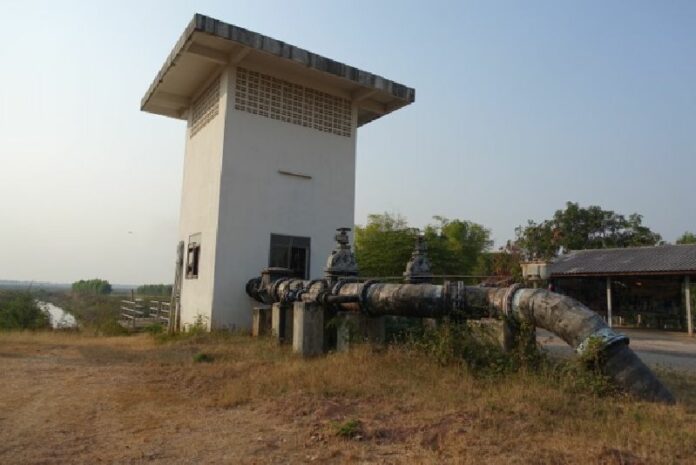
The government water pump in Nong Pheu village in Khon Kaen’s Nong Rua district [Photo: Isaan Record].

(Isaan Record)

KHON KAEN – In the debt-ridden Northeast, many rice farmers struggle to make ends meet after the government shut off the irrigation systems leaving them without the profits of the second annual rice crop. But for the military government, the drought might help its economic strategy.

Read the story here

Note: Khaosod English is not responsible for content on other websites.

 
Advertisement

Bomb Prematurely Explodes, Kills Suspected Southern Insurgent

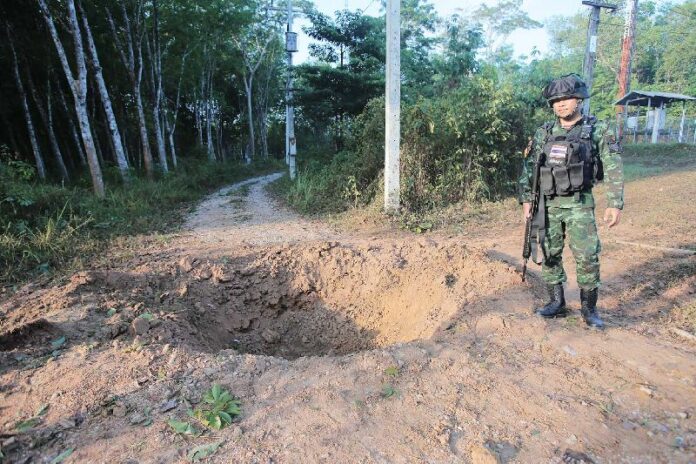
The blast site in Yala province, 21 April 2015.

YALA — A roadside bomb prematurely exploded in Yala province last night, killing the person who was planting the explosive, military officers say.

According to the military statement released to the press, the bomb exploded on a road in Raman district at around midnight, leaving a three-meter-wide crater at the blast site. Security officers who inspected the crime scene determined that the explosive was a 15 kilogram homemade bomb made of a gas canister.

\
The blast site in Yala province, 21 April 2015. 

Security officers also found remains of a human being around the blast site, leading the military to believe that an insurgent was planting the IED when it accidentally exploded. DNA testing of the remains are underway. 

The military press report said that the bomb was planted in the spot where an armored vehicle typically parks every morning to conduct a security search.

The southern provinces of Pattani, Yala, and Narathiwat have been the hotbed of a separatist insurgency for the last decade. Shadowy Islamic militants regularly stage bomb attacks, arson, and shootings against security forces and civilians in a bid to revive the independent sultanate of Patani, which was annexed by Thailand in early 20th century. 

More than 6,200 people are believed to have been killed since the secessionist campaign broke out in the region, known as the Deep South, in 2004. Around 60,000 security officers have been stationed in the Deep South to combat the insurgency. 


For comments, or corrections to this article please contact: [email protected]

You can also find Khaosod English on Twitter and Facebook
http://twitter.com/KhaosodEnglish
http://www.facebook.com/KhaosodEnglish
Advertisement

Pakistan Project is China Silk Road Fund's First Investment

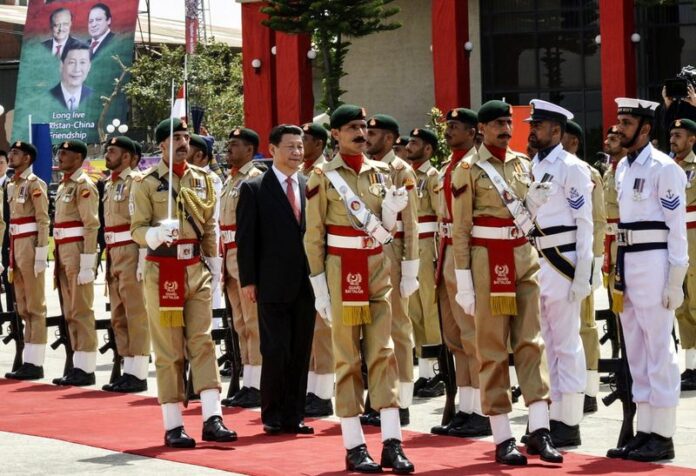
Chinese President Xi Jinping inspects the Guard of Honor in Islamabad. Xi arrived in Pakistan on Monday as part of a two-day trip to hammer out infrastructure investment agreements worth approximately 46 billion dollars. EPA/PRESS INFORMATION DEPARTMENT/HAN

BEIJING (DPA) — A Pakistan hydropower project will receive the first funding from China's 40-billion-dollar Silk Road Fund in support of an ambitious infrastructure investment belt linking China to Europe through Central Asia, state media reported Tuesday.

The fund will inject capital into China Three Gorges South Asia Investment, a subsidiary of the China Three Gorges Corporation, to develop the 1.65-billion-dollar Karot hydropower project and other clean-energy projects, the Xinhua news agency reported.

Karot is a priority project for the broader China-Pakistan Economic Corridor initiative, proposed by Chinese Premier Li Keqiang in May 2013 and heavily promoted by state media during President Xi Jinping's visit Monday to Pakistan.

The 46-billion-dollar, 3,000-kilometre corridor would connect China, Pakistan and the Arab world via roads, railways and energy projects starting in north-west China's Xinjiang region across the Karakoram mountain range to south-west Pakistan's deepwater Gwadar Port.

The hydropower project marks the first investment from the fund since its establishment in December, the official China Daily reported. The Silk Road Fund will join the Export-Import Bank of China, one of China's major policy lenders, and other financial institutions to extend loans for the project, an unnamed official told the paper.

A Silk Road Fund envoy signed a memorandum of understanding Monday with the China Three Gorges Corporation and the Pakistan Private Power and Infrastructure Board to provide capital to construct the project, Xinhua said.

Chinese companies plan to develop a capacity of 3,350 megawatts along the Jhelum River through new developments, mergers and acquisitions, Xinhua said.

The project is in the fourth stage of the river's five-stage development plan, with an installed capacity of 720,000 kilowatts and an annual power generation capacity of 3.2 billion kilowatt-hours.

(Reporting by Sajjad Malik, dpa)

For comments, or corrections to this article please contact: [email protected]

You can also find Khaosod English on Twitter and Facebook
http://twitter.com/KhaosodEnglish
http://www.facebook.com/KhaosodEnglish

Advertisement

Bomb Prematurely Explodes, Kills Suspected Southern Insurgent

The blast site in Yala province, 21 April 2015.

YALA — A roadside bomb prematurely exploded in Yala province last night, killing the person who was planting the explosive, military officers say.

According to the military statement released to the press, the bomb exploded on a road in Raman district at around midnight, leaving a three-meter-wide crater at the blast site. Security officers who inspected the crime scene determined that the explosive was a 15 kilogram homemade bomb made of a gas canister.

\
The blast site in Yala province, 21 April 2015. 

Security officers also found remains of a human being around the blast site, leading the military to believe that an insurgent was planting the IED when it accidentally exploded. DNA testing of the remains are underway. 

The military press report said that the bomb was planted in the spot where an armored vehicle typically parks every morning to conduct a security search.

The southern provinces of Pattani, Yala, and Narathiwat have been the hotbed of a separatist insurgency for the last decade. Shadowy Islamic militants regularly stage bomb attacks, arson, and shootings against security forces and civilians in a bid to revive the independent sultanate of Patani, which was annexed by Thailand in early 20th century. 

More than 6,200 people are believed to have been killed since the secessionist campaign broke out in the region, known as the Deep South, in 2004. Around 60,000 security officers have been stationed in the Deep South to combat the insurgency. 


For comments, or corrections to this article please contact: [email protected]

You can also find Khaosod English on Twitter and Facebook
http://twitter.com/KhaosodEnglish
http://www.facebook.com/KhaosodEnglish
Advertisement

Thai Junta to Issue New Law Banning Begging

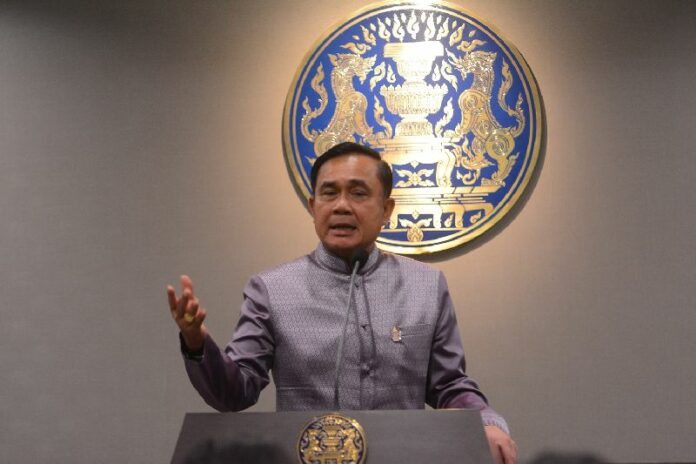
Gen. Prayuth Chan-ocha signed a draft of the Control of Begging Act on 29 April 2015.

BANGKOK — The Thai military government has approved the draft of a law that will criminalize begging, a common practice in streets of Thailand's major cities.

The new law, which will replace previous legislation on begging enacted 74 years ago, was approved in a Cabinet meeting today, said Maj.Gen. Sansern Kaewkamnerd, a government spokesperson.

Named the Control of Begging Act, the law is intended to reduce begging and provide panhandlers with rehabilitation and job training programs, said Maj.Gen. Sansern.

Under the act, those who cannot be trained to work – such as children, the elderly, and the disabled – will be sent to shelter homes and provided with welfare assistance. 

According to the draft of the legislation, the following actions constitute begging:

– asking for assets of others with words, texts, or any other gesture, without compensating the giver with any form of work or assets. (The clause excludes asking for money from family members and lawful charity fundraising)

– committing any gesture that compels others to donate assets out of pity without compensating the giver with any form of work or assets.

The spokesperson said that busking and other types of street performance will not be considered begging, but that performers will be required to inform local authorities and comply with guidelines set by law enforcement officials.

The law will also punish individuals who encourage begging, beggars who escape shelter homes, buskers who do not obtain permission from local authorities, and individuals who coerce other persons to beg for their own benefit. Foreign beggars will be deported to their home countries. 

"We have also instructed the Ministry of Social Development to study other laws about providing assistance to beggars who are … in dire situations in order to help them escape the status of being beggars, and to take care of and rehabilitate them, so that those individuals can look after themselves in the society," Maj.Gen. Sansern said. 

The new law will replace the existing law on begging, enacted in 1941, which did not make any distinction between begging and busking. 

Beggars are common in many parts of Thailand, especially in metropolitan areas and popular tourist locales. NGOs and state agencies say many of the beggars, especially children, are victims of human trafficking by crime syndicates. The Mirror Foundation, a prominent charity organization focused on combating child trafficking, has repeatedly urged members of the public not to give money to children, but alert authorities to rescue them instead. 

Since seizing power from an elected government in a military coup d'etat in May 2014, Thailand's military government has cracked down on organized crime and publicized efforts aimed at curbing human trafficking. 

As a part of the junta's campaign to end begging in Thailand, security officers arrested at least 1,186 beggars across the country in series of coordinated raids in January. According to the Ministry of Social Development and Human Security, 436 of those arrested are foreigners who entered Thailand with tourist visas and work permits, but ended up begging on the streets.

In February, a beggar in Mukdahan province made national news after police arrested him and found more than 131,000 baht in his possession. The man, Preeda Kammoongkoon, reportedly told police he once made 400,000 baht from begging in Nakhon Ratchasima province in a month. Preeda was later released on the condition that he would cease begging and find employment.

For comments, or corrections to this article please contact: [email protected]

You can also find Khaosod English on Twitter and Facebook
http://twitter.com/KhaosodEnglish
http://www.facebook.com/KhaosodEnglish

Advertisement

Thailand to Miss UN Aviation Agency's Safety Deadline

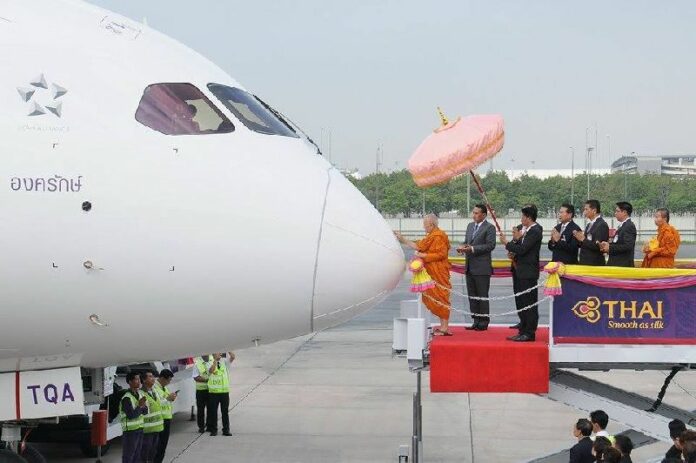
A monk blesses a Boeing plane newly acquired by Thai Airways at Suvarnabhumi Airport, 28 October 2014

BANGKOK — Thailand will not be able to address airline safety issues within the time frame demanded by the United Nation's aviation regulatory body, Minister of Transport Prajin Juntong said today.

The International Civil Aviation Organization (ICAO) carried out an audit in January and found serious gaps in safety standards at some airlines operating from Thailand, including Thai AirAsia, Thai AirAsia X, Nok Air, and the state-owned Thai Airways.

The ICAO said it would formally downgrade Thailand’s ranking in early June if the Thai Department of Civil Aviation is unable to fix the safety flaws in time. 

Air Chief Marshal Prajin said today that Thailand is expected to miss the deadline. 

"It is taking longer than we expected," ACM Prajin told reporters. "Our effort may be completed as late as mid-July 2015."

ACM Prajin conceded that the failure to comply with the ICAO's demands will be felt by several airlines in Thailand, including the flag carrier Thai Airways.

"It will affect permanent routes of airlines. The Ministry will closely discuss the issue with Thai Airways company, because the impact on the company is very worrying. It will be worse than the case of chartered flights that have already been affected," ACM Prajin said, referring to Japan, China, and South Korea’s ban all chartered flights from Thailand-registered airline companies.

The three countries also barred establishing any new flights from Thailand, which has affected tour groups that sell their tickets in advance.

The Japanese government later granted a 90-day reprieve for Thai airlines in early April. 

Arkhom Termpittayapaisith, assistant to ACM Prajin, said he is scheduled to attend a meeting with the ICAO on 15 June to discuss proposed improvements to aviation safety in Thailand, such as the implementation of inspection manuals, training of inspectors, revision of the existing flight license system, and major restructuring in the Department of Civil Aviation.

Junta chairman and Prime Minister Gen. Prayuth Chan-ocha has said he will invoke emergency powers to "swiftly solve" the ICAO's grievances, but has yet to formally pen any orders. 

For comments, or corrections to this article please contact: [email protected]

You can also find Khaosod English on Twitter and Facebook
http://twitter.com/KhaosodEnglish
http://www.facebook.com/KhaosodEnglish

Advertisement

Buddhist Temple Paints Crematorium Pink to Ease Fears

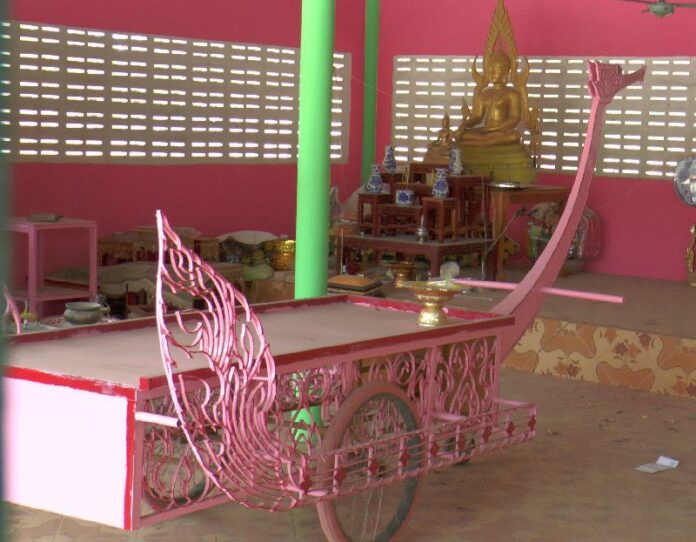
In addition to the crematorium, the cart used to carry coffins Wat Phob Suk Temple in Nakhon Ratchasima province was also painted pink to bring consolation to mourners and local residents.

NAKHON RATCHASIMA — A Buddhist temple in northeastern Thailand has repainted its crematorium pink to console funeral-goers and local residents.

"Residents who walked past the temple by night felt scared by the crematorium," said Phra Witthaya Wiratthano, a monk who lives at Wat Phob Suk Temple in Nakhon Ratchasima province. 

During a renovation of the structure last November, Phra Witthaya said he decided to repaint the building in bright pink to ease visitors' fears. The original coat of white paint had faded over the years, he said.

\

The pink crematorium at Wat Phob Suk Temple in Mueang district of Nakhon Ratchasima province.

The temple pavilion and the cart used to carry coffins were also painted pink, with the hope that the playful color will bring some consolation to funeral-goers, the monk explained. 

"Relatives [of the deceased] who attend funerals and cremations won't be afflicted with more grief than what they already suffer," Phra Witthaya said.  

According to the monk, the temple has received positive feedback from local residents, who say they are no longer scared by the crematorium.

He also suggested that the new color may have brought some fortune to the community.

"We used to have four or five funerals per month. After the temple painted the crematorium pink, the number is down to one per month," Phra Witthaya said. "Some villagers think it's a way to bring about good luck."

For comments, or corrections to this article please contact: [email protected]

You can also find Khaosod English on Twitter and Facebook
http://twitter.com/KhaosodEnglish
http://www.facebook.com/KhaosodEnglish
 

Advertisement

Ex-DSI Chief Calls Asset Freezing a Political Attack

File photo of former chief of the Division of Special Investigation (DSI) Tharit Pengdith.

BANGKOK — Former chief of the Division of Special Investigation (DSI) Tharit Pengdith has accused Thailand’s national anti-graft agency of participating in an effort to smear his reputation.

The National Anti-Corruption Commission (NACC) is investigating Tharit for potentially corrupt practices during his tenure as head of the DSI, and announced yesterday that 40,954,720.58 baht worth of his assets have been frozen.

The NACC said the freeze will be lifted if Tharit is determined to be innocent. The former DSI chief was also ordered to declare the financial assets of his family to the NACC in 30 days. 

"I believe this action by the NACC is a part of the movement to discredit me," Tharit told Khaosod. "I have always been one of their top targets." 

Tharit told Khaosod he has been a frequent victim of political attacks because of his oversight of major legal cases such as the investigation into the deadly military crackdown on Redshirt protests in 2010, and lawsuits against leaders of the anti-government protests that preceded the May 2014 coup d'etat. 

"As the director of the DSI, I was responsible for many important cases against political groups, such as the attempt to obstruct the election," Tharit said, referring to the anti-government protests' effort to block the 2 February 2014 national poll. "These people are influential people of Thailand. After I left my post, these people have taken legal actions against me in every way. They sued me in the Criminal Court for 30 cases, and the court has already acquitted 19 of them. They also complained to the NACC. They complained to the Ministry of Justice. And they used many other methods."

Tharit, who became director of the DSI in 2009, was ousted from his position several days after the military overthrew an elected government in May 2014. Anti-government protesters accused Tharit of being an instrument of the Redshirt movement, which supported the government toppled in the coup.  

The NACC said it launched the investigation into Tharit's assets because the former DSI chief was seen as "unusually wealthy," NACC sec-gen Sansern Poljiak said yesterday.

Tharit vowed to fight the accusation. "Eventually, these discredit attempts and this bullying has to be ruled by the court of justice," Tharit said. "Including the issues of NACC's freezing of my assets. Everything has to be in accordance with the system of court of justice. I am willing to fight every case against me to the Supreme Court. I am confident that I will be granted fairness." 

Since the May 2014 coup, the NACC has pursued legal cases against members of the former government, including former PM Yingluck Shinawatra, who was retrospectively impeached in January on charges of negligence. As a result of the impeachment, Yingluck has been banned from politics for five years. 

The NACC has also charged former Prime Minister Abhisit Vejjajiva and his deputy, Suthep Thaugsuban, with "abuse of power" for authorizing the military crackdown on Redshirts in 2010. If their case is passed on to the junta's interim legislature, the pair could also be banned from political office for five years.

For comments, or corrections to this article please contact: [email protected]

You can also find Khaosod English on Twitter and Facebook
http://twitter.com/KhaosodEnglish
http://www.facebook.com/KhaosodEnglish
 

Advertisement

Koh Samui Bombing: Redshirt Activist Released

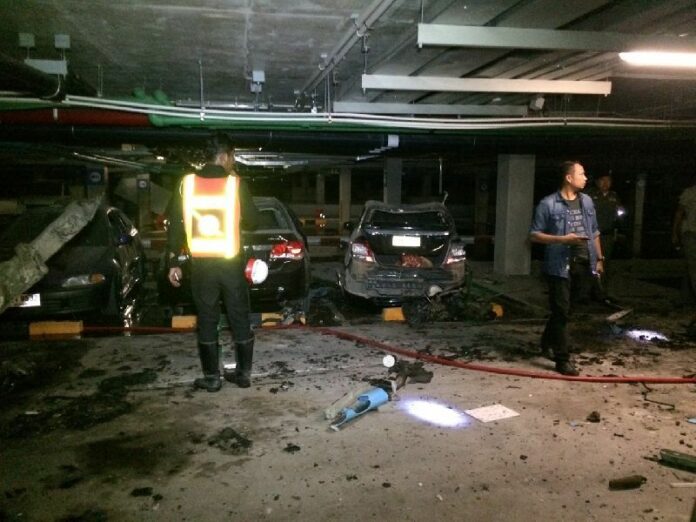
The scene of the bombing on Koh Samui, 10 April 2015.

BANGKOK — A Redshirt activist has been released from custody at a secret location and cleared of any connection to the recent bombing on Koh Samui island, a junta spokesperson says.

Narin Ambuathong, aka M Redshirt, was arrested by military officers on 11 April on suspicion of plotting a car bomb at Central Festival Samui shopping mall on the previous day. The bomb, which exploded in an underground parking lot, injured seven people, including a 12-year-old Italian girl. 

The military declined to say where Narin was held. 

According to junta spokesperson Col. Winthai Suwaree, Narin was released on 17 April without charges after security officers established that he was not connected to the attack.

Narin was initially considered a suspect because he allegedly wrote on his Facebook account several hours prior to the blast "Tonight, bring it on in Surat," referring to Surat Thani province, where the popular tourist island is located.

"Security officers proceeded with evidence and facts, concerning the message that M posted," Col. Winthai said. "We had to inquire him for clarity, before we released him."

Under provisions issued through Article 44 of the post-coup interim charter, soldiers can search properties and detain individuals for up to seven days without court warrants. 

According to Pol.Lt.Gen. Prawut Thawornsiri, spokesperson of the Royal Thai Police, police are close to arresting the perpetrator of the car bomb.

"We cannot identify the perpetrator, but we are close to issuing an arrest warrant," Pol.Lt.Gen. Prawut. "I cannot say whether the perpetrator is still in Thailand, because we have not detained the person. But I am confident that we will be able to arrest all perpetrators involved in the attack."

He added, "We are looking at the evidence to expand the investigation. I cannot divulge in-depth information to you right now, because it may affect the case." 


For comments, or corrections to this article please contact: [email protected]

You can also find Khaosod English on Twitter and Facebook
http://twitter.com/KhaosodEnglish
http://www.facebook.com/KhaosodEnglish
Advertisement

Hot News

LATEST NEWS

Bangkok
overcast clouds
28.8 ° C
28.8 °
28.8 °
83 %
3.2kmh
100 %
Fri
29 °
Sat
37 °
Sun
36 °
Mon
36 °
Tue
33 °