


























28.8 C
Bangkok
Sunday, June 28, 2026
Home Blog Page 3037

Anti-Coup Activist Arrested on Eve of Protest March

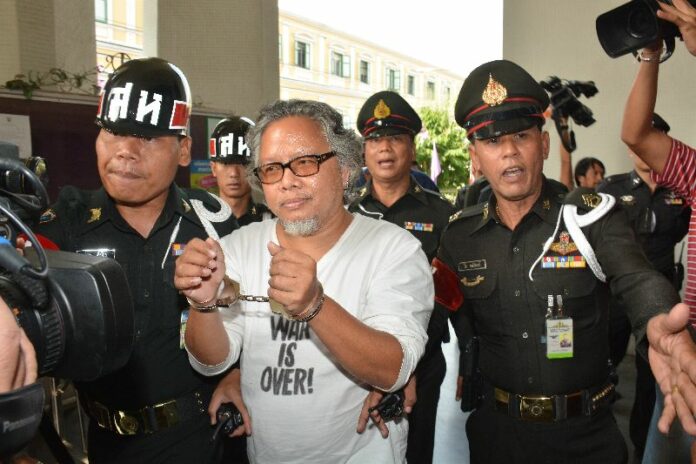
Pansak Srithep arriving at martial court in Bangkok, 26 March 2015.

BANGKOK — Police preemptively arrested an anti-coup activist at his home last night, hours before he planned to set out on a protest march to a martial court in Bangkok.

A group of police officers arrested Pansak Srithep shortly after midnight and brought him to Chanasongkram Police Station in Bangkok for interrogation.

\
Pansak Srithep arriving at martial court in Bangkok, 26 March 2015.

After 40 minutes of questioning, the commander of the Bangkok Metropolitan Police, Pol.Maj.Gen.Sriwarah Rangsipramkul, emerged and told reporters that "the arrest was in accordance with an existing arrest warrant" from the weekend that Pansak embarked on his first one-man protest march from his home to a police station in Bangkok.

Although police officers arrested Pansak an hour after he began the first walk on 14 March, they released him without charges and allowed him to continue the next day. 

However, a martial court then approved an arrest warrant on Pansak for "inciting unrest," defying the junta’s ban on protests, and violating the Computer Crime Act.

Pol.Maj.Gen. Sriwarah did not explain why officers waited until last night to arrest Pansak. 

"We followed the legal procedure," the police commander said.

Pansak was held at the police station overnight until he was transferred this morning to martial court, where he is facing trial for the charges pressed against him in connection with his protest walk on 14-15 March.  

Since seizing power from an elected government on 22 May 2014, Thailand's military junta has banned all political activities and tried violators in martial court, where military officers serve as judges and appeals are not permitted. 

Although prosecutors contested Pansak's bail release, the military court agreed to free him on a bail of 500,000 baht. His lawyer, Arnon Nampha, said a majority of the bond money was donated. 

\
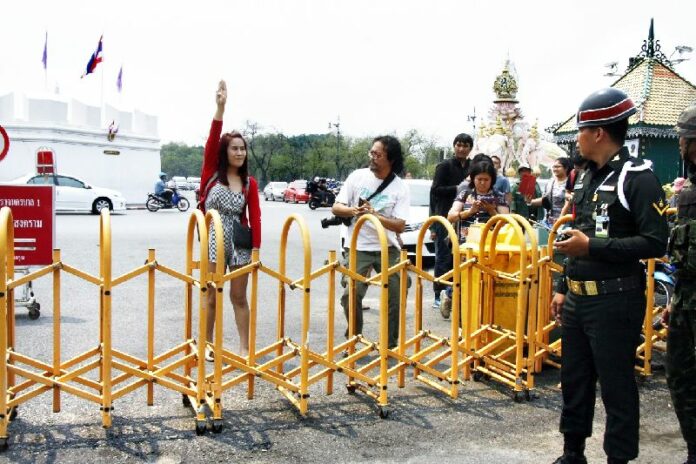
An army officer holding the leaflets scattered by student activists near the martial court, 26 March 2015.

Security officers sealed off roads around the courthouse as Pansak arrived in a police van. Prevented from gathering outside the court, several student activists flashed anti-coup salutes near the barricade and threw flyers that said "Civilians must no go to martial court." Security officers did not intervene with the small protest.  

Pansak is also facing a separate trial in martial court for the pro-election rally he and his anti-coup group, Resistant Citizens, organized in Bangkok on 14 February. 

Pansak became an prominent progressive activist after his 17-year-old son Samapan Srithep was shot dead during the military crackdown on Redshirt protesters in May 2010. Witnesses say they saw soldiers firing at Samapan and a group of Redshirt protesters in Ratchaprarop district, though an official court inquest on Samapan's death has not been completed.

Related coverage:
Anti-Coup Marcher Allowed to Walk


For comments, or corrections to this article please contact: [email protected]

You can also find Khaosod English on Twitter and Facebook
http://twitter.com/KhaosodEnglish
http://www.facebook.com/KhaosodEnglish
Advertisement

Anti-Coup Activist Arrested on Eve of Protest March

BANGKOK — Police preemptively arrested an anti-coup activist at his home last night, hours before he planned to set out on a protest march to a martial court in Bangkok.

A group of police officers arrested Pansak Srithep shortly after midnight and brought him to Chanasongkram Police Station in Bangkok for interrogation.

\
Pansak Srithep arriving at martial court in Bangkok, 26 March 2015.

After 40 minutes of questioning, the commander of the Bangkok Metropolitan Police, Pol.Maj.Gen. Sriwarah Rangsipramkul, emerged and told reporters that "the arrest was in accordance with an existing arrest warrant" from the weekend that Pansak embarked on his first one-man protest march from his home to a police station in Bangkok.

Although police officers arrested Pansak an hour after he began the first walk on 14 March, they released him without charges and allowed him to continue the next day. 

However, a martial court then approved an arrest warrant on Pansak for "inciting unrest," defying the junta’s ban on protests, and violating the Computer Crime Act.

Pol.Maj.Gen. Sriwarah did not explain why officers waited until last night to arrest Pansak. 

"We followed the legal procedure," the police commander said.

Pansak was held at the police station overnight until he was transferred this morning to martial court, where he is facing trial for the charges pressed against him in connection with his protest walk on 14-15 March.  

Since seizing power from an elected government on 22 May 2014, Thailand's military junta has banned all political activities and tried violators in martial court, where military officers serve as judges and appeals are not permitted. 

Although prosecutors contested Pansak's bail release, the military court agreed to free him on a bail of 500,000 baht. His lawyer, Arnon Nampha, said a majority of the bond money was donated. 

\
An army officer holding the leaflets scattered by student activists near the martial court, 26 March 2015.

Security officers sealed off roads around the courthouse as Pansak arrived in a police van. Prevented from gathering outside the court, several student activists flashed anti-coup salutes near the barricade and threw flyers that said "Civilians must no go to martial court." Security officers did not intervene with the small protest.  

Pansak is also facing a separate trial in martial court for the pro-election rally he and his anti-coup group, Resistant Citizens, organized in Bangkok on 14 February. 

Pansak became an prominent progressive activist after his 17-year-old son Samapan Srithep was shot dead during the military crackdown on Redshirt protesters in May 2010. Witnesses say they saw soldiers firing at Samapan and a group of Redshirt protesters in Ratchaprarop district, though an official court inquest on Samapan's death has not been completed.

Related coverage:
Anti-Coup Marcher Allowed to Walk


For comments, or corrections to this article please contact: [email protected]

You can also find Khaosod English on Twitter and Facebook
http://twitter.com/KhaosodEnglish
http://www.facebook.com/KhaosodEnglish

Advertisement

Families of 20 Student Activists Report Military Harassment

Student activist flashes an anti-coup salute in front of martial court in Bangkok on 26 March 2015.

BANGKOK – At least 20 student activists have reported harassment from security officers who allegedly visited their families or searched their homes without court warrants in the past week.

According to the Thai Student Center for Democracy (TSCD), a university student activist group, soldiers visited the family homes of two student activists on 19 March, and police officers attempted to search the residences of two other student activists on 20 March.

Thirteen more students were allegedly targeted yesterday, the group reported in a detailed chronology of the incidents  posted on Facebook, translated below:

25 March

  • 10.30 am: Three officers from the Special Branch Police searched residence of family of a student activist in Buriram province.
  • 1.10 pm: Officers from the Special Branch Police visited the family of student activist Cholthicha Chaengrew in Pathum Thani province.
  • 1.20 pm: Soldiers and Special Branch Police officers visited the family of student activist Piyarath Chonthep in Kalasin province.
  • 1.30 pm: Three officers from the Special Branch Police visited the family of student activist Natchacha Kongudom in Nong Khai province.
  • 1.40 pm: Two officers from the Special Branch Police visited the family of student activist Pongnarin Nonkam at their residence in Chiang Rai province.
  • 1.50 pm: Soldiers and police officers visited the family of a student activists in Chayabhum province. 
  • 2.30 pm: Three plainclothed police officers searched residence of student activist Weerachai Fendee in Chonburi province. 
  • 3.30 pm: Two officers from the Special Branch Police visited the family of student activist Witchapol Yanaso.
  • 4.30 pm: Soldiers visited the family of student activist Rangsiman Rome at their residence in Pathum Thani province. 
  • 4.40 pm: Special Branch Police officers visited the family of a student activist who studies at Kasetsat University. 
  • 4.50 pm: Two Special Branch Police officers visited another student activist who studies at Kasetsat University.
  • 5.00 pm: Soldiers visited the family of a student activist at their residence in Chiang Mai province. 
  • Late night: Security officers visited the family of student activist Wachrawit Kongkalai. 

A member of the TSCD, Than Rittiphan, told Khaosod English the family homes of three more student activists were searched today by security officers who arrived in an armored vehicle.

The TSCD said in statement they believe security forces are attempting to intimidate students into ceasing their political activities and acts of dissent against the ruling junta.

"There are also a number of students who are being followed and threatened by security officers. We are closely monitoring the situation," the group said in a statement.

Since seizing power from an elected government on 22 May 2014, the military junta has cracked down on civil rights in Thailand, namely by imposing a ban on political activities, censoring the media, and trying dissidents under the military court, where military officers serve as judges and no appeal is permitted. 

Several groups of student activists have organized sporadic protests against the junta, which is known formally as the National Council for Peace and Order (NCPO). The students have hung pro-democracy banners, distributed leaflets, and organized other political forums and events

In November 2014, four students flashed the anti-coup "three-finger salute" in front of junta chairman and Prime Minister Prayuth Chan-ocha as he was giving a speech in Khon Kaen province. The activists were dragged away by security officers and briefly detained at army camps, but no charges were filed against them. 

Sirawit, whose dorm police allegedly attempted to search on 20 May, is currently facing trial in military court for violating the junta's ban on protests by organizing a pro-election rally in Bangkok on 14 February 2015. 

For comments, or corrections to this article please contact[email protected]

You can also find Khaosod English on Twitter and Facebook
http://twitter.com/KhaosodEnglish
http://www.facebook.com/KhaosodEnglish
Advertisement

New Zealand to Investigate Claims it Spied on Citizens in the Pacific

Whistleblower Edward Snowden seen on 7 January 2015 on a TV screen in Hamburg, Germany. The New Zealand government spied on international diplomats competing with its own candidate for the job of director-general of the World Trade Organisation, the New Zealand Herald said Monday. Photo: Christian Charisius/dpa

WELLINGTON (DPA) – New Zealand was to probe allegations its intelligence service monitored electronic communications of its citizens in the Pacific region, an official said Thursday.

The move followed reports this month that the Government Communications Security Bureau (GCSB) used electronic surveillance to spy on its Pacific neighbours including Kiribati, Samoa, Fiji and Tonga, inspector-general of intelligence and security Cheryl Gwyn said.

One of the complaints was from the Green Party, which claimed the GCSB had broken the law by spying on New Zealanders holidaying, living and working in the Pacific.

Gwyn, who provides independent oversight of the GCSB, said the complaints and public allegations raised wider questions about the collection, retention and sharing of communications data.

She said this had prompted her not just to investigate the complaints but also to bring forward and expand her ongoing review and audit of GCSB procedures and compliance systems.

Her audit "doesn't, of course, scrutinise or second-guess every day-to-day aspect of the GCSB's operations," she said.

"What it does allow for […] is a focussed review of a particular area of GCSB practice."


For comments, or corrections to this article please contact: [email protected]

You can also find Khaosod English on Twitter and Facebook
http://twitter.com/KhaosodEnglish
http://www.facebook.com/KhaosodEnglish
Advertisement

'Pirate' Fishing Ship and Cargo Still Being Held in Phuket

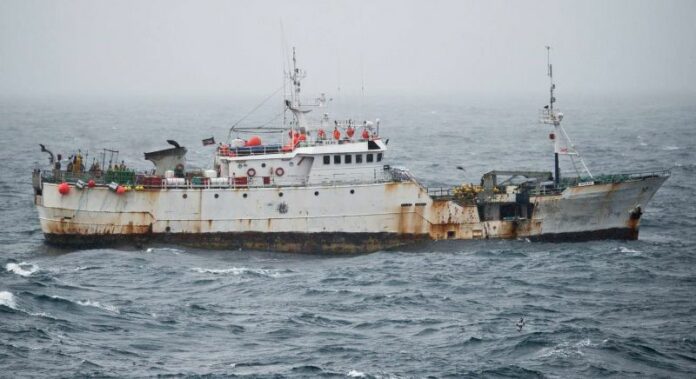
The Kunlun, as it was then, photographed in the Antarctic by the New Zealand Navy [Phuket News]

(The Phuket News)

PHUKET – Customs officials are still working on the legal tangle revolving around the alleged pirate fishing ship Taishan, previously named the Kunlun.

The ship was chased all around Antarctic waters by the Australian and New Zealand navies on suspicion it was poaching large amounts of valuable Patagonian toothfish, known to chefs as Chilean seabass

An Interpol Purple Notice was issued on the ship in January. Purple Notices are "to seek or provide information on modi operandi, objects, devices and concealment methods used by criminals."

Read more here

Note: Khaosod English is not responsible for content on other websites.

Advertisement

Locals Fearful as South-East Asia Megaproject Awaits Green Light

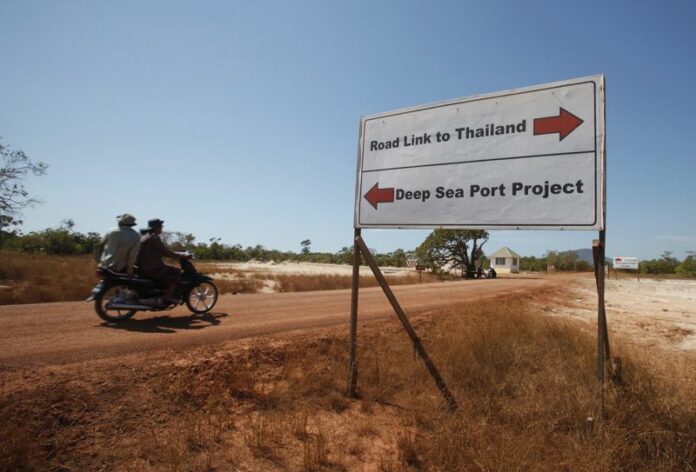
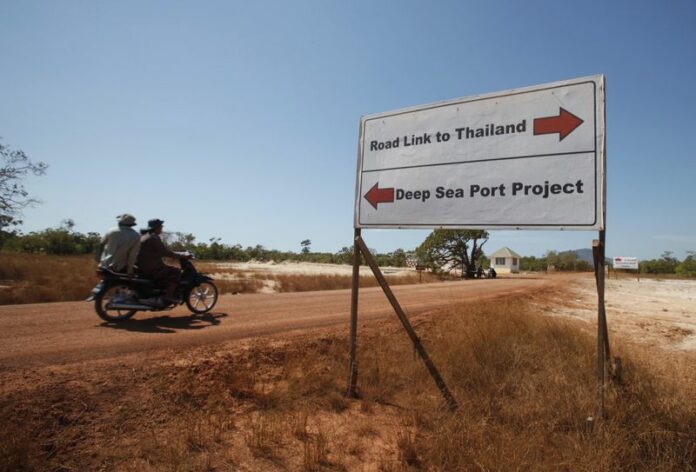
A file photo made available on 31 January 2012 shows the road instruction sign of the Dawei Deep Sea Project Plan in Dawei Township, Tanintharyi Division, Myanmar, 28 January 2012. A new deep sea port at the heart of a massive construction project on the Myanmar coast could revitalize trade in South-East Asia, but at a high cost. EPA/NYEIN CHAN NAING

By Cod Satrusayang and Kyaw Lynn

BANGKOK (DPA) — Ma Nu May and her husband started a small cashew nut farm near the coastal town of Dawei in southern Myanmar seven years ago, but life in the past two years has been far from peaceful.

Most of her cashew trees are still lying on the ground after being bulldozed in mid-2013 in preparation for a government-backed megaproject named the Dawei Special Economic Zone (SEZ).

"I can't imagine selling my farm for only this amount of money," said Ma Nu May, who was offered 5,000 dollars for the land.

Covering just five acres, the produce from their farm brings in about 4,000 dollars per year.

"It's better for us to die rather than accepting such compensation," she said.

Time is against local farmers such as Ma Nu May.

A signing ceremony the capital Naypyidaw between Myanmar and its development partner Thailand is expected any day, starting the initial phase of development in what could be the largest project of its kind in South-East Asia.

If construction goes ahead the 50-billion-dollar Dawei SEZ aims to help Myanmar capitalize on its strategic location between India and China, after years of being deprived of foreign investment as an international pariah under military rule.

The port and industrial facilities, due to be built by Thai real estate giant Italian-Thai Development (ITD), will cover over 200 square kilometres and have the capacity to hold 250 million tons of cargo, more than the ports of Los Angeles and New York combined.

"Dawei is critical for regional infrastructure connectivity," said Chayut Setboonsarng, an analyst at a Bangkok-based think tank specializing in South-East Asia.

The zone will also feature factories, its own coal mine and power plant as well as golf courses and five-star hotels for visiting executives.

Using Dawei will shortening the travel time of freight from Europe and the Middle East to Asia as it allows goods to bypass the long oversea journey through the South China Sea, which has also been a source of regional tension in recent years.

Italian-Thai Development also say that the project will be good for the local economy by creating up to 100,000 jobs by the time the project is completed in 2025.

That's little comfort to tens of thousands of people living in the Dawei area who will be forcibly relocated, according to a local rights NGO.

"Although the project has not yet started, local people are already losing income because of land confiscations in preparation for the project," Chit Chit Win, a field researcher for the Tavoyan Women's Union, told dpa.

The group maintains that most of them will have their lands and livelihoods confiscated with little or no compensation.

"The Dawei project has barely begun, but is already destroying the economic backbone of our communities. It must be stopped before it proceeds any further," said the group's Su Su Swe.

The group may take heart from the fact that the project had previously been put on hold in 2013 after Italian-Thai were unable to secure financing.

It was put back on track by diplomatic efforts between Bangkok's new military government and Naypyidaw in late 2014.

A study by another non-governmental group, the Dawei Development Association, agrees that "the compensation process is deeply flawed."

The group concludes that the development of the Dawei Project "breaches many fundamental human rights."

ITD disagrees with this assessment.

"Most of the villagers want us to come to the area," said Pravee Kamolkanchana, the firm's marketing manager.

"We will provide many jobs both in the construction and once the factories and ports are completed," he said.

Pravee says that the company's officials have visited Dawei numerous times to talk to locals about its "new global gateway of Indochina."

The company has plans in place to build houses, hospitals, schools and even temples for the villagers in a relocation destination 10 kilometres away from the zone.

Chayut concurs that "Dawei significantly benefits local citizens and not just the major stakeholders."

Such an enormous project in the region's "prime real estate" is unlikely to be delayed, he concludes.


For comments, or corrections to this article please contact: [email protected]

You can also find Khaosod English on Twitter and Facebook
http://twitter.com/KhaosodEnglish
http://www.facebook.com/KhaosodEnglish
Advertisement

Locals Fearful as South-East Asia Megaproject Awaits Green Light

A file photo made available on 31 January 2012 shows the road instruction sign of the Dawei Deep Sea Project Plan in Dawei Township, Tanintharyi Division, Myanmar, 28 January 2012. A new deep sea port at the heart of a massive construction project on the Myanmar coast could revitalize trade in South-East Asia, but at a high cost. EPA/NYEIN CHAN NAING

By Cod Satrusayang and Kyaw Lynn

BANGKOK (DPA) — Ma Nu May and her husband started a small cashew nut farm near the coastal town of Dawei in southern Myanmar seven years ago, but life in the past two years has been far from peaceful.

Most of her cashew trees are still lying on the ground after being bulldozed in mid-2013 in preparation for a government-backed megaproject named the Dawei Special Economic Zone (SEZ).

"I can't imagine selling my farm for only this amount of money," said Ma Nu May, who was offered 5,000 dollars for the land.

Covering just five acres, the produce from their farm brings in about 4,000 dollars per year.

"It's better for us to die rather than accepting such compensation," she said.

Time is against local farmers such as Ma Nu May.

A signing ceremony the capital Naypyidaw between Myanmar and its development partner Thailand is expected any day, starting the initial phase of development in what could be the largest project of its kind in South-East Asia.

If construction goes ahead the 50-billion-dollar Dawei SEZ aims to help Myanmar capitalize on its strategic location between India and China, after years of being deprived of foreign investment as an international pariah under military rule.

The port and industrial facilities, due to be built by Thai real estate giant Italian-Thai Development (ITD), will cover over 200 square kilometres and have the capacity to hold 250 million tons of cargo, more than the ports of Los Angeles and New York combined.

"Dawei is critical for regional infrastructure connectivity," said Chayut Setboonsarng, an analyst at a Bangkok-based think tank specializing in South-East Asia.

The zone will also feature factories, its own coal mine and power plant as well as golf courses and five-star hotels for visiting executives.

Using Dawei will shortening the travel time of freight from Europe and the Middle East to Asia as it allows goods to bypass the long oversea journey through the South China Sea, which has also been a source of regional tension in recent years.

Italian-Thai Development also say that the project will be good for the local economy by creating up to 100,000 jobs by the time the project is completed in 2025.

That's little comfort to tens of thousands of people living in the Dawei area who will be forcibly relocated, according to a local rights NGO.

"Although the project has not yet started, local people are already losing income because of land confiscations in preparation for the project," Chit Chit Win, a field researcher for the Tavoyan Women's Union, told dpa.

The group maintains that most of them will have their lands and livelihoods confiscated with little or no compensation.

"The Dawei project has barely begun, but is already destroying the economic backbone of our communities. It must be stopped before it proceeds any further," said the group's Su Su Swe.

The group may take heart from the fact that the project had previously been put on hold in 2013 after Italian-Thai were unable to secure financing.

It was put back on track by diplomatic efforts between Bangkok's new military government and Naypyidaw in late 2014.

A study by another non-governmental group, the Dawei Development Association, agrees that "the compensation process is deeply flawed."

The group concludes that the development of the Dawei Project "breaches many fundamental human rights."

ITD disagrees with this assessment.

"Most of the villagers want us to come to the area," said Pravee Kamolkanchana, the firm's marketing manager.

"We will provide many jobs both in the construction and once the factories and ports are completed," he said.

Pravee says that the company's officials have visited Dawei numerous times to talk to locals about its "new global gateway of Indochina."

The company has plans in place to build houses, hospitals, schools and even temples for the villagers in a relocation destination 10 kilometres away from the zone.

Chayut concurs that "Dawei significantly benefits local citizens and not just the major stakeholders."

Such an enormous project in the region's "prime real estate" is unlikely to be delayed, he concludes.


For comments, or corrections to this article please contact: [email protected]

You can also find Khaosod English on Twitter and Facebook
http://twitter.com/KhaosodEnglish
http://www.facebook.com/KhaosodEnglish
 

Advertisement

Security Tightened in Deep South After Officers Kill 4 Suspected Insurgents

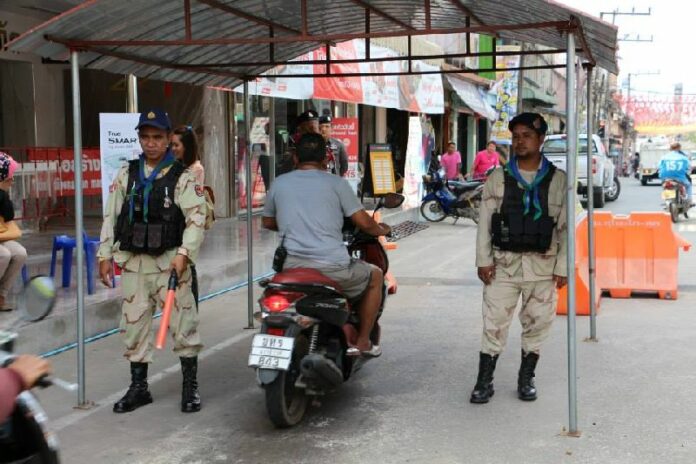
Security officers at a checkpoint in Narathiwat province on 24 March 2015.

PATTANI — Authorities in Thailand’s three southern border provinces say they are preparing for possible retaliatory attacks by Islamic militants after four suspected insurgents were shot dead by security officers last night.

The four men were killed during a raid on a village in Thung Yang Daeng district at around 6 pm yesterday.

The raid was conducted by a group of police, soldiers, and paramilitary rangers.

Police say the raid was intended to capture members of the Islamic separatist movement who have launched regular attacks in the region in an effort to secede the three provinces of Pattani, Yala, and Narathiwat from Thailand. 

According to police, a gunfight ensued after security officers approached the houses, lasting for about 10 minutes before the officers managed to secure the area.

Four men were shot dead and 22 more suspects were detained, police say. 

Two of the deceased were identified as operatives of RKK, one of the militant groups behind the insurgency. The other two men were not immediately identified.

Security officers also say they found two AK-47 rifles and one handgun at the crime scene. 

Pol.Maj.Gen. Thanongsak Wangsupha, commander of Yala province, said all units in the region have been instructed to tighten security measures, especially in urban areas, to prevent "wrongdoers from committing incidents to retaliate against state officials."

"I have instructed police to inspect any suspicious vehicles and [arrest] individuals that are wanted by the court to prevent any incidents," Pol.Maj.Gen. Thanongsak said. 

According to security officers, the raid followed an intelligence report that a group of militants were convening in the village to plan violent attacks against authorities. 

More than 6,000 people have been killed since waves of secessionist violence broke out Thailand's southern border provinces in early 2004, according to data compiled by human rights groups. 

The Islamic insurgents are seeking to revive the independent sultanate of Pattani, which was incorporated into modern day Thailand in the early 20th century. 

In contrast to the predominantly Buddhist populations in other parts of Thailand, the Deep South is heavily populated by Muslims who trace their ancestry to the Malays and speak a distinct dialect called Yawi. 


For comments, or corrections to this article please contact: [email protected]

You can also find Khaosod English on Twitter and Facebook
http://twitter.com/KhaosodEnglish
http://www.facebook.com/KhaosodEnglish
Advertisement

Thai Press Groups Respond to Junta’s Execution Threats with Mild Rebukes

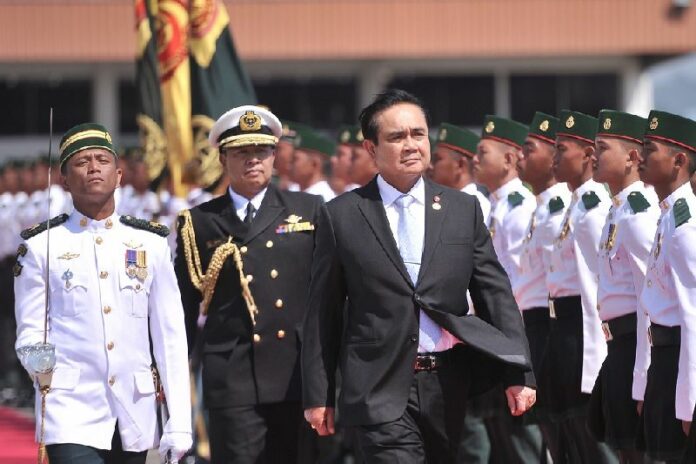
Thai junta chairman Gen. Prayuth Chan-ocha in Brunei on 25 March 2015.

BANGKOK — Press associations in Thailand have politely asked the junta to refrain from intervening in issues of media ethics, following a fiery rant by Gen. Prayuth Chan-ocha yesterday in which he threatened to “execute” reporters who criticize his regime.

Pattara Khampitak, the chairman of the non-governmental Thai Press Council, suggested junta chairman Gen. Prayuth allow Thai media agencies hold each other accountable instead.

In a particularly heated press conference yesterday, Gen. Prayuth reminded reporters of the junta’s supreme power and quipped that any reporter who criticizes his government could face “execution.”

He also asked Thai media associations to investigate any news agencies that “cause divisions,” or else the junta may directly intervene.

“I will keep my eyes on all media [agencies] and, if necessary, I will use my power on everyone,” he said. “Any media agency that causes divisions has to be dealt with by the [Thai Journalist] Association. Let it investigate them. But if the Association can’t do anything, I will have the Council [National Council for Peace and Order] investigate them. Let’s see whether that damn media agency causes divisions.”

Speaking to TNN24 news channel yesterday, Pattara said he is “glad” to see that Gen. Prayuth respects the internal investigation procedure among media organizations.

“If any state agency believes that any member of our organization steps beyond the boundaries of good media, they can alert us at any time,” Pattara said. “The Press Council has a working committee responsible for controlling media ethics. If the Prime Minister has any concern about media operations, the Press Council would like him to specifically name the issue and the company.”

Pattara also suggested that Gen. Prayuth’s “focus on using power does not benefit the Prime Minister or the NCPO,” using an acronym of the junta’s formal name, the National Council for Peace and Order.

A spokesperson from the Thai Journalist Association, Manop Thip-osot, asked Gen. Prayuth to understand the media’s duty to scrutinize those in power.

“The Prime Minister and the government are the wielders of state power,” Manop told Manager newspaper. “The media has a duty to investigate the workings of the state to make it transparent and beneficial to the people in the country.”

The Brussels-based International Federation of Journalists (IFJ) took a harsher stance against the junta chairman in a statement that called Gen. Prayuth’s comments “deplorable” and evidence of the “complete disregard for freedom of expression in Thailand.”

In the same statement, the President of the National Union of Journalists, Thailand (NUJT) noted Gen. Prayuth’s outburst yet stopped short of openly condemning it.

“The comments by Prayuth is just the latest outburst aimed directly at the news agencies and journalists,” NUJT president Sumeth Somkanae was quoted as saying. “The NUJT continues their support of press freedom in Thailand and encourages journalists to continue their work in providing independent, ethical journalism and playing a positive role in building a functioning democracy.”

All news agencies owned by Matichon Group, including Khaosod English, are not members of Thai Press Council, NUJT, or Thai Journalist Association.

Since seizing power last May, the NCPO has extensively curtailed civil rights and media freedom in Thailand, namely by threatening to shut down media agencies that report negatively about the junta, and pressuring outlets to drop news programs that are critical of the regime. Although the junta has stopped short of full-scale censorship, its threats and intimidation tactics have led many Thai news outlets to exercise self-censorship when reporting about the military government.

Advertisement

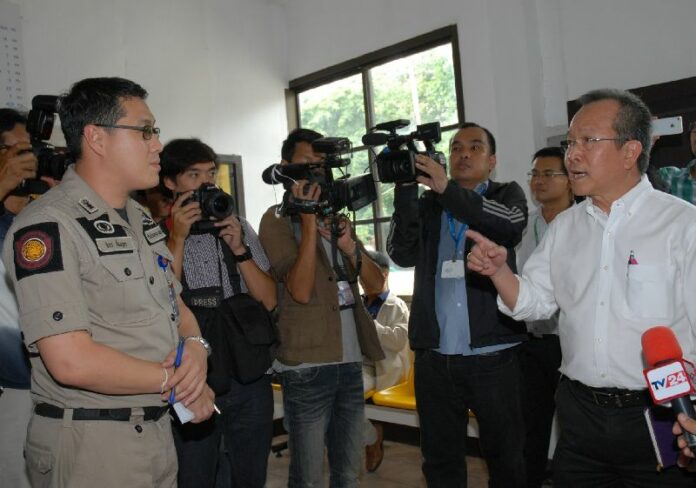
Human Rights Officials Barred From Visiting Alleged Torture Victims in Prison

NHRC director Niran Pitakwatchara (R) arguing with prison wardens at Bangkok Remand Prison, 25 March 2015.

BANGKOK — The Director of Thailand’s National Human Rights Commission (NHRC) was turned away by officials at Bangkok Remand Prison today when he tried to meet with four men who say they were tortured by military officers.

The four men, who are awaiting trial on terrorism charges, told their lawyers they were beaten by soldiers who detained them at an army camp for six days before transferring them to police earlier this month.

One of the suspects said he was electrocuted on his legs “30 – 40” times by soldiers because he refused to confess. 

\
NHRC director Niran Pitakwatchara (R) arguing with prison wardens at Bangkok Remand Prison, 25 March 2015.

NHRC director Niran Pitakwatchara visited the prison today with forensic science experts from the Ministry of Justice in an effort to investigate the torture claims.  

However, prison wardens said the group could not meet with the suspects because the visit had not been authorized by the Department of Correction’s director. 

"I am here as a director of the NHRC," Niran fumed after an argument with the prison wardens ensued. "I am a state official. I am not an NGO." 

Speaking to reporters afterward, Niran said he sent a letter to the Department of Correction on 20 March. 

"They spent four days deliberating on the letter, and they have not yet agreed to allow the NHRC to visit the detainees." Niran said. "This kind of incident has never happened before. According to international human rights principles, visiting detainees in prison is a necessary measure to prevent human rights violations. We are not even required to alert supervisors at each agency, because if we did, they may stage a scene for us." 

The director continued, "This is an urgent matter. The United Nations and other human rights organizations around the world asked the NHRC to investigate this incident. Furthermore, it is an issue that has a lot of attention from society."

Niran added that although the Thai army chief and other government officials have denied the torture allegations, an impartial investigation is still needed.

"This is why I invited officials from the Forensic Science Department to come along with me. It is for the sake of credibility and transparency," Niran said.

He also noted that the delay of his meeting with the four men could affect crucial evidence in the case. "Time will reduce clear marks on the body for inspection," he said. 

Niran said he will summon representatives from all relevant agencies, such as the military, police, prison, and lawyers of the four suspects for a meeting at the NHRC headquarters on 30 March. 


One of the suspects, Sansern Sri-unruen, shows Prachatai news evidence of alleged electrocution on his leg applied by soliders, 19 March 2015 [Prachatai].

The four men, Sansern Sri-unruen, Charnvit Jariyanukul, Norapat Luepol, and Wichai Yoosuk, have been accused of participating in a plot to "create chaos" and draw an intervention from the United Nations by staging bomb attacks around Bangkok. Police say the network was responsible for the grenade attack at the Criminal Court on the night 7 March. No one was injured in the explosion, which caused minor damages to the court’s parking lot.

At least 17 arrest warrants have been issued in connection with the case so far.

All arrested suspects have been detained at army camps for up to seven days of interrogation prior to hearing their charges. They are now facing trial in martial court, where military officers serve as judges and appeals are not permitted.

Related coverage:
Martial Court Denies Alleged Torture Victim Bail
Army Chief Threatens Legal Action Over Torture Allegation


For comments, or corrections to this article please contact: [email protected]

You can also find Khaosod English on Twitter and Facebook
http://twitter.com/KhaosodEnglish
http://www.facebook.com/KhaosodEnglish
Advertisement

Hot News

LATEST NEWS

Bangkok
overcast clouds
28.8 ° C
28.8 °
28.8 °
75 %
3.4kmh
100 %
Sun
34 °
Mon
34 °
Tue
33 °
Wed
33 °
Thu
33 °