



























31.6 C
Bangkok
Sunday, June 28, 2026
Home Blog Page 3043

OECD Lowers China's Growth Forecast, Calls For Education Reforms


A file photo of the Organisation for Economic Co-operation and Development (OECD) Secretary General Jose Angel Gurria seen giving a speech at the OECD headquarter in Paris, France, 26 June 2014. China's economy could still double between 2010 and 2020 despite a slowing economy, but educational inequalities could impede necessary economic reforms. EPA/ETIENNE LAURENT

BEIJING (DPA) — China's economy could still double between 2010 and 2020 despite a slowing economy, but educational inequalities could impede necessary economic reforms, the Organization for Economic Cooperation and Development (OECD) said Friday.

"Education inequalities are stark, stemming first and foremost from the urban-rural divide and secondly from social stratification," the consortium of Western economies said in a report.

China's development will increasingly depend on the quality of its human capital as the share of the working-age population falls and people continue to leave rural areas for higher-productivity jobs in cities, it said.

But, "access to good education is not equally available for all," the OECD's economic survey of China said.

Little is being spent on vocational training at the secondary and tertiary level, and salaries of primary and middle-school teachers are lower than in most other professions, the report found.

China should boost public spending on education, including increased teacher compensation, establishing a country-wide vocational education system, enhancing career guidance, and opening up public schools to all children of migrant workers, the report said.

China should also promote greater research autonomy and stronger intellectual property rights to attract and retain world-class researchers, according to the report.

The OECD did not mention a January ban on the use by universities of imported textbooks seen as promoting Western values, a move which had sparked concerns about academic freedom in the country.

In November the OECD projected that China and India would retain the highest rates of GDP growth in 2015 at 7.1 per cent and 6.4 per cent, respectively.

But on Friday it trimmed the projection for China to 7 per cent growth in 2015 and 6.9 per cent for 2016.

Any sharper slowdown would have global spillovers, it said.

"Unwavering commitment" to structural reforms was needed to make the shift away from the current reliance on investment and manufacturing towards consumption and services, it said.

Investment might slow down more than foreseen if stimulus measures fail to counterbalance the effects of the cooling property market, capacity adjustments in some heavy industry sectors, and the leadership's ongoing anti-corruption campaign, which has lowered demand for some luxury goods.

The slowdown of the Chinese economy has already contributed to the end of the so-called "commodity super cycle" internationally, the report said.

A shift away from heavy industry in China has meant lower imports of iron ore, coking coal for steel production, manganese ore and aluminium ore, affecting a range of countries as diverse as Australia, Brazil, Gabon, Myanmar and South Africa, the report said.

It mentioned some positive initiatives by the government.

An economic work plan endorsed by the National People's Congress this month reduced by half the number of fields where foreign investment is restricted.

The plan also pushes forward with reforms to the structure and performance of state-owned enterprises, which dominate the telecoms, shipping, securities, banking and oil and gas sectors. 

China's economy grew last year by 7.4 per cent, the weakest growth in 24 years. 

 
Advertisement

Junta Open to Amnesty for Political Prisoners

Redshirt prisoners released from Laksi Special Prison in Bangkok, 19 April 2013.

BANGKOK — A top leader in Thailand's military junta says the regime is open to granting amnesty to political prisoners in Thailand if the move will help bring about reconciliation between the country's divided factions.

Gen. Prawit Wongsuwan, deputy chairman of the ruling military junta, said yesterday morning that the junta would support dissolving legal cases against activists who participated in political protests in recent years, as long as they did not commit "serious crimes."

"Whatever that can bring about reconciliation, do it," Gen. Prawit said at the press conference. "As long as all sides and the people accept it, we will agree. Except what breaks the laws of the country, we cannot do that." 

Paiboon Nititawan, a member of the Constitution Drafting Committee (CDC), told Bangkok Business News that he also supported legal amnesty for protesters, regardless of their political alignment. According to Paiboon, over 400 Yellowshirts and nearly 1,000 Redshirts have faced legal action of some sort for their role in protests.

"In my opinion, these people qualify for an amnesty," Paiboon was quoted as saying. "Except criminal cases that harmed lives, arson charges, corruption, and insulting the monarchy. Those crimes cannot be granted amesty." 

In November 2013, the Redshirt-backed government sparked mass protests by passing an amnesty bill that would have covered not only political activists, but also protest leaders, government officials involved in the crackdown, and past politicians convicted of corruption.

Protesters took to the streets and accused the government of trying to dissolve the corruption conviction of former Prime Minister Thaksin Shinawatra, who has lived in self-imposed exile since 2008 but continued to influence Thai politics as the de facto leader of the Redshirt movement. 

Some Redshirt activists also opposed the amnesty bill because it would have exempted government officials from facing legal action for their roles in the 2010 crackdown on Redshirt protesters that left over 90 people dead.

The government eventually withdrew the bill in the face of public outcry, but the anti-government protests continued, eventually culminating in the May 2014 coup d'etat.

Payao Akhard, whose daughter was killed by soldiers in the 2010 crackdown on Redshirt protesters, told Khaosod yesterday that she is glad to see Gen. Prawit's support for amnesty, but said the bill should only apply to demonstrators, and not protest leaders or government officials. 

"It has been my stance since the beginning that people who joined the protests and were arrested for politically-motivated reasons deserve fairness," said Payao, whose daughter, Kamolkate Akhard, was shot dead by soldiers as she was serving as a volunteer medic on 19 May 2010. "These people are not criminals. They were merely political victims that were affected by the rallies. They deserve freedom to live their lives once again. And this justice will be a part of process to build reconciliation."

Nearly 2,000 Redshirt demonstrators were arrested and put in jail following the crackdown in May 2010. Some of the protesters were accused of terrorism and arson, while others faced charges for violating the ban on protests imposed by the government at the time. Many were denied bail release for months while they awaited trials. Their plight has spurred Redshirt activists to campaign for the immediate release of all detainees, whom they describe as political prisoners. 

It is estimated that several dozen Redshirt protesters from 2010 are currently being held in prison, some of whom are awaiting appeals trials.

Payao said she has been visiting political prisoners in Bangkok, and plans to visit prisoners in northeastern provinces like Ubon Ratchathani, Mukdahan, Udon Thani, and Khon Kaen to provide moral support. 

"I would like to collect information about the exact number of political prisoners for a procedure to assist them and give them fairness in the future," Payao said. 

Payao added that she hopes security officers will strictly investigate the allegation that Nattathida Meewangpla, one of the key witnesses to her daughter's death in 2010, is linked to a terror network.

Nattathida testified in a 2013 court inquest that determined soldiers to be responsible for the death of Payao's daughter and five others inside a temple in Bangkok during the crackdown. Last week, Nattathida was detained by the military on 11 March and later charged with participating in a terrorism plot. 

Nattathida is currently being held at a Bangkok prison while she awaits trial in military court. Police say Nattathida's network was responsible for the grenade attack on the Criminal Court on 7 March.

"The behavior of the security officers is very suspicious," Payao said, "From quickly abducting her to barring her from having a lawyer that volunteered to represent her. The army also has a stake in the case of six deaths at Wat Pathum Temple. Three high-ranking military officers in that event are now holding power in the NCPO." 

The three officers are Gen. Prayuth Chan-ocha, Gen. Prawit Wongsuwan, and Gen. Anupong Paochinda, who commanded the army to disperse the Redshirt protesters in 2010. Gen. Prayuth is now chairman of the military junta, formally known as the National Council for Peace and Order (NCPO), while Gen. Prawit and Gen. Anupong are serving as his deputies. 

 
Advertisement

Brothers of Ex-Princess Imprisoned for Defaming Royal Family

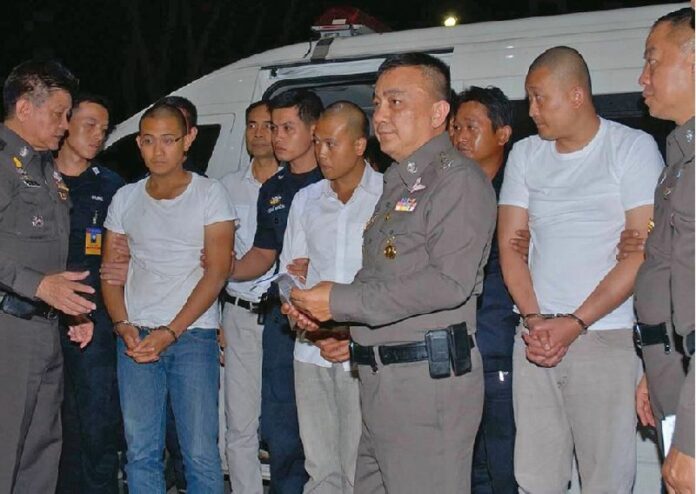
Nattapol Suwadee was arrested on 27 November, 2014.

BANGKOK — Two brothers and the nephew of the third wife of Thailand’s Crown Prince have been sentenced to five and a half years in prison for insulting the monarchy.

According to the prosecutor, Nattapol Suwadee, Narong Suwadee, and Sitthisak Suwadee were hired by a businessman named Nopporn Supphapipat to coerce a money lender into reducing Nopporn's debt from 120 million baht to 20 million baht.

Nattapol, 30, and Narong, 42, are brothers of Srirasmi Suwadee, the former wife of Crown Prince Vajiralongkorn, while Sitthisak, 25, is her nephew. Nattapol and Narong were serving in the Crown Prince's personal bodyguard unit at the time of the alleged crime. 

The prosecutors say the three men abducted Nopporn's money lender, Witthaya Panyathaweekool, in front of his house in Bangkok on 20 March 2014. The trio allegedly detained him overnight and forced him to reduce Nopporn’s debt, citing their connection to then-Princess Srirasmi.

Witthaya was released the next morning, but not before the suspects robbed him of his belongings, according to the prosecutors.

Nattapol, Narong, and Sitthisak were arrested in November 2014 and charged with lese majeste (insulting the monarchy), illegal detention, carrying firearms into residential areas without due cause, and robbery. 

Today the court found the defendants guilty of all charges and sentenced them to 11 years in prison. The jail term was halved to five years and a half because the defendants confessed. 

Nattapol, Narong, and Sitthisak were escorted back to Bangkok Remand Prison immediately after the ruling, where they had been held since their arrests in November 2014. Police say the businessman who allegedly hired them, Nopporn, is still at large.

The three defendants are the latest releatives of Srirasmi to be sentencd to jail for lese majeste and running a sprawling crime syndicate involved in racketeering, illegal gambling, money laundering, oil smuggling, and other crimes. The alleged leader of the criminal network, Pol.Lt.Gen. Pongpat Chayapan, was the chief of Thailand's Central Investigation Bureau and is an uncle of Srirasmi. 

After the scandal broke in November 2014, the Crown Prince stripped Srirasmi's family of the royally-bestowed surname Akharaphongpreecha, forcing Srirasmi and her relatives to revert to the commoner surname of Suwadee.

Srirasmi later relinquished all of her royal titles in December 2014 and moved out of the Crown Prince's palace. It is understood that the pair, who has a 9-year-old son, has divorced after a decade of marriage. 

At least eight relatives of Srirasmi have been convicted of lese majeste in recent months, including her parents, who were sentenced to to 2.5 years on 11 March 2015.

 
Advertisement

Brothers of Ex-Princess Imprisoned for Defaming Royal Family

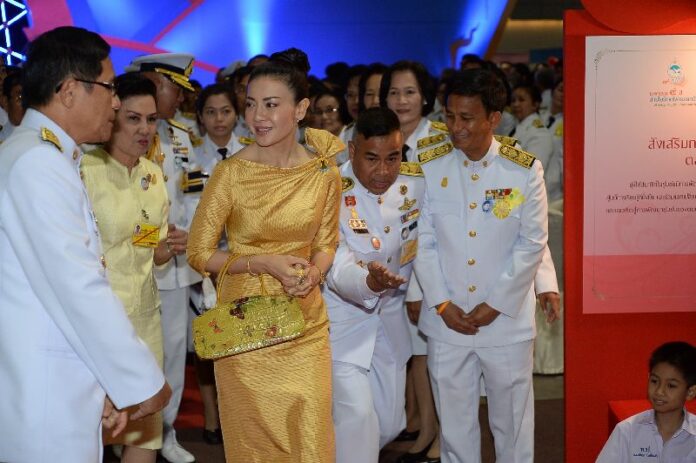
File photo of ex-Princess Srirasmi Suwadee, the former wife of Crown Prince Vajiralongkorn.

BANGKOK — Two brothers and the nephew of the third wife of Thailand’s Crown Prince have been sentenced to five and a half years in prison for insulting the monarchy.

According to the prosecutor, Nattapol Suwadee, Narong Suwadee, and Sitthisak Suwadee were hired by a businessman named Nopporn Supphapipat to coerce a money lender into reducing Nopporn's debt from 120 million baht to 20 million baht.

Nattapol, 30, and Narong, 42, are brothers of Srirasmi Suwadee, the former wife of Crown Prince Vajiralongkorn, while Sitthisak, 25, is her nephew. Nattapol and Narong were serving in the Crown Prince's personal bodyguard unit at the time of the alleged crime. 

The prosecutors say the three men abducted Nopporn's money lender, Witthaya Panyathaweekool, in front of his house in Bangkok on 20 March 2014. The trio allegedly detained him overnight and forced him to reduce Nopporn’s debt, citing their connection to then-Princess Srirasmi.

Witthaya was released the next morning, but not before the suspects robbed him of his belongings, according to the prosecutors.

Nattapol, Narong, and Sitthisak were arrested in November 2014 and charged with lese majeste (insulting the monarchy), illegal detention, carrying firearms into residential areas without due cause, and robbery. 

Today the court found the defendants guilty of all charges and sentenced them to 11 years in prison. The jail term was halved to five years and a half because the defendants confessed. 

Nattapol, Narong, and Sitthisak were escorted back to Bangkok Remand Prison immediately after the ruling, where they had been held since their arrests in November 2014. Police say the businessman who allegedly hired them, Nopporn, is still at large.

The three defendants are the latest releatives of Srirasmi to be sentencd to jail for lese majeste and running a sprawling crime syndicate involved in racketeering, illegal gambling, money laundering, oil smuggling, and other crimes. The alleged leader of the criminal network, Pol.Lt.Gen. Pongpat Chayapan, was the chief of Thailand's Central Investigation Bureau and is an uncle of Srirasmi. 

After the scandal broke in November 2014, the Crown Prince stripped Srirasmi's family of the royally-bestowed surname Akharaphongpreecha, forcing Srirasmi and her relatives to revert to the commoner surname of Suwadee.

Srirasmi later relinquished all of her royal titles in December 2014 and moved out of the Crown Prince's palace. It is understood that the pair, who has a 9-year-old son, has divorced after a decade of marriage. 

At least eight relatives of Srirasmi have been convicted of lese majeste in recent months, including her parents, who were sentenced to to 2.5 years on 11 March 2015.

 
Advertisement

Karen Villager Jailed 1.5 Years for Illegal Logging

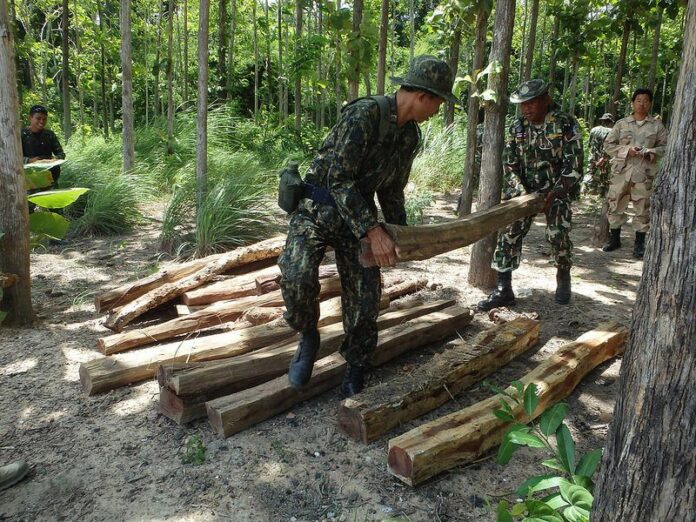
Military and Royal Forest Department officers confiscate planks of wood which, according to claims by villagers in Dong Yai Wildlife Sanctuary, Buriram Province in northeastern Thailand, were to be used to build their houses. [Prachatai English]

(Prachatai English)

BANGKOK – A Court of Appeals in the nothern province of Mae Hong Son sentenced a Karen villager accused of illegal logging in northern Thailand to 1.5 years in prison.

The court in Mae Sariang District confirmed the verdict of the Court of First Instance to convict Anan Phadeangsanga, 33, a Pakayaw Karen tribesman, of illegal logging

According to Thai Lawyers for Human Rights (TLHR), Anan is the first of 16 Pakayaw Karen tribesmen from Tung Pa Ka Community in Mae Sariang District, all of whom have been accused of illegal logging, to be sentenced to prison.

The court has scheduled the verdict reading of 16 other defendants on 22 April 2015.  

Read more here
 
Note: Khaosod English is not responsible for content on other websites.
Advertisement

67-Year-Old Man Jailed For Anti-Monarchy Graffiti

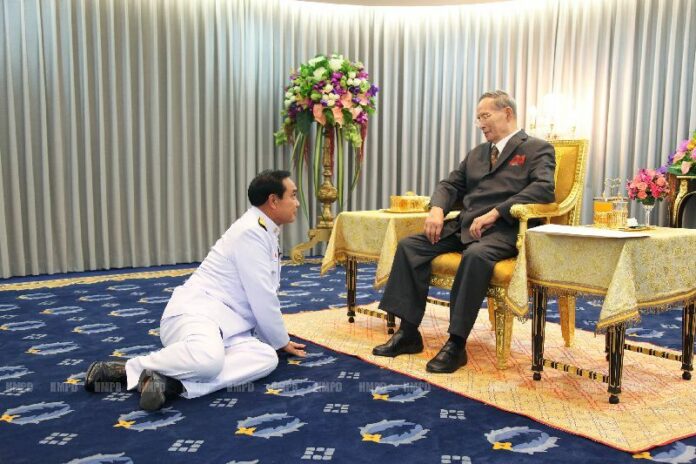
Junta leader and Prime Minister Prayuth Chan-ocha with His Majesty the King, 23 November 2014

BANGKOK — A 67-year-old man was sentenced to 1.5 years in prison for scribbling anti-monarchy graffiti inside the restroom of a Bangkok shopping mall.

Opas Charnsuksai was arrested last October and charged with violating Thailand’s lese majeste law, which criminalizes defaming the monarchy, after cleaning staff at Seacon Square mall in Bangkok spotted him writing anti-monarchy messages inside the walls of several toilet stalls.

Opas was sentenced to 1.5 years in prison this morning by a military court, which was granted jurisdiction over lese majeste cases following the May 2014 coup d’etat. As is common with lese majeste suspects, Opas was repeatedly refused bail and has been held in prison since his arrest.

Opas told reporters in October that he wrote the anonymous remarks – which criticized both the monarchy and the May 2014 coup – because Thailand's lese majeste law prevented him from speaking openly. 

Although the letter of the law only specifically criminalizes insulting the King, Queen, Regent, and Heir-Apparent, in practice it is used to silence criticism of any aspect of the monarchy.

The number of lese majeste cases has surged since the coup last May, which was led by Gen. Prayuth Chan-ocha, a staunch royalist who has declared defending the monarch a top priority of his administration. 


Advertisement

DJ Arrested for Inciting Riot at Police Station

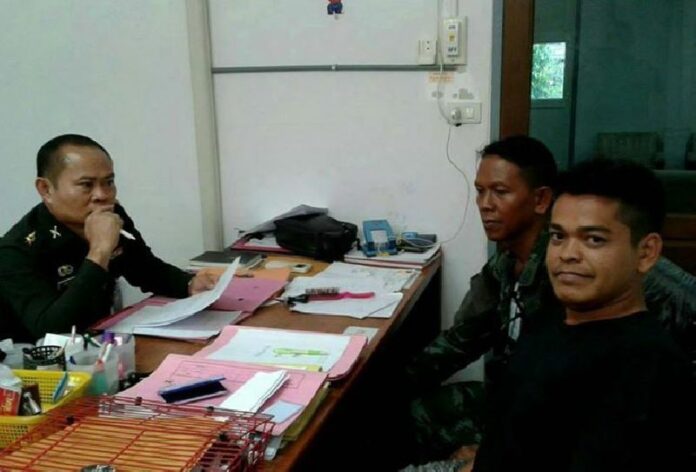
Radio DJ Wannawong Dechdechdecho [wearing black] was questioned by police on 18 March 2015.

NAKHON SI THAMMARAT — A radio DJ in the southern province of Nakhon Si Thammarat was arrested for distributing leaflets urging people to bring gasoline and tires for a protest in front of a local police station.

Wannawong Dechdechdecho, who works for 107.75 MHz, was arrested by soldiers on 19 March and taken to an army camp for "attitude adjustment" and interrogation, police say.

According to police, Wannawong, 36, confessed to distributing the leaflets, which invited the public to rally in front of the police station on 30 March to protest police’s “oppressive” practices.

The DJ reportedly told police he was frustrated with officers who set up checkpoints and fine motorists 400-500 baht for petty traffic violations. Wannawong also complained that police in the province often raid homes and detain individuals based on dubious drug charges, said Pol.Col. Chawasilpa Boonpradith, superintendent of Nakhon Si Thammarat Police Station.

Protests are currently banned by the military junta, which seized power from an elected government on 22 May 2014.

The full text of the leaflets read:

"To all vendors, people, and wise elders in the city of Nakhon Si Thammarat, I hereby arrange a protest, because police have oppressed the people, students, and teenagers, by causing widespread troubles. They have pressed fake charges, planted drugs, beat suspects. They arrest us, both motorists and motorcyclists, like bandits. They are clearly the bandits, my brothers and sisters. They pressed all kind of false charges on us. They are more evil each day. I and my team would like to invite all brothers and sisters of Khon City [nicknake of Nakhon Si Thammarat] to meet at the City Hall. Then we will march to protest in front of Nakhon Si Thammarat Police Station.

At 9'oclock.

Whoever has gasoline, car tires, loudspeakers, bring it on, brothers and sisters. As for other stuff, I have no need to say about them. Depends on you. I thank you for reading this. See you on 30 March 2015, from 9 o'clock onward."

Pol.Col. Chawasailpa said he was especially troubled by the leaflet's instructions to bring "gasoline" and "car tires." However, Wannawong reportedly promised not to resort to such methods in the future, and was released after both parties "reached an understanding," the officer said. 

"It was a reckless action," said Pol.Col. Chawasailpa. "He didn't expect that the leaflets would be so widely distributed and caused a buzz, and escalating into big issue."

It is a common complaint among Thais that traffic police officers appear more intent on making money from petty traffic violation fines than from stopping serious offenses. Traffic police are also known for demanding bribes. 

Related coverage:
Noodle Vendor Gives Free Meals to Traffic Violators

 
Advertisement

Junta Open to Amnesty for Political Prisoners

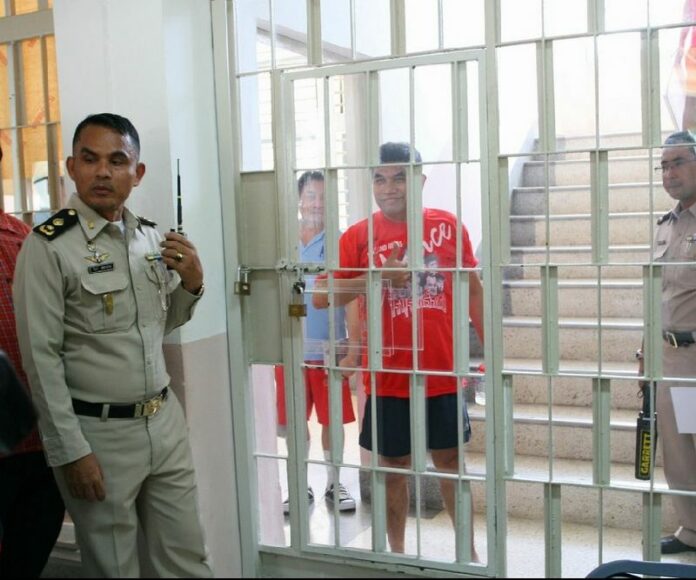
Redshirt leader Yosawarit Chooklom greets to a group of visitors at Laksi Special Prison in Bangkok, 24 August 2012.

BANGKOK — A top leader in Thailand's military junta says the regime is open to granting amnesty to political prisoners in Thailand if the move will help bring about reconciliation between the country's divided factions.

Gen. Prawit Wongsuwan, deputy chairman of the ruling military junta, said yesterday morning that the junta would support dissolving legal cases against activists who participated in political protests in recent years, as long as they did not commit "serious crimes."

"Whatever that can bring about reconciliation, do it," Gen. Prawit said at the press conference. "As long as all sides and the people accept it, we will agree. Except what breaks the laws of the country, we cannot do that." 

Paiboon Nititawan, a member of the Constitution Drafting Committee (CDC), told Bangkok Business News that he also supported legal amnesty for protesters, regardless of their political alignment. According to Paiboon, over 400 Yellowshirts and nearly 1,000 Redshirts have faced legal action of some sort for their role in protests.

"In my opinion, these people qualify for an amnesty," Paiboon was quoted as saying. "Except criminal cases that harmed lives, arson charges, corruption, and insulting the monarchy. Those crimes cannot be granted amesty." 

In November 2013, the Redshirt-backed government sparked mass protests by passing an amnesty bill that would have covered not only political activists, but also protest leaders, government officials involved in the crackdown, and past politicians convicted of corruption.

Protesters took to the streets and accused the government of trying to dissolve the corruption conviction of former Prime Minister Thaksin Shinawatra, who has lived in self-imposed exile since 2008 but continued to influence Thai politics as the de facto leader of the Redshirt movement. 

Some Redshirt activists also opposed the amnesty bill because it would have exempted government officials from facing legal action for their roles in the 2010 crackdown on Redshirt protesters that left over 90 people dead.

The government eventually withdrew the bill in the face of public outcry, but the anti-government protests continued, eventually culminating in the May 2014 coup d'etat.

Payao Akhard, whose daughter was killed by soldiers in the 2010 crackdown on Redshirt protesters, told Khaosod yesterday that she is glad to see Gen. Prawit's support for amnesty, but said the bill should only apply to demonstrators, and not protest leaders or government officials. 

"It has been my stance since the beginning that people who joined the protests and were arrested for politically-motivated reasons deserve fairness," said Payao, whose daughter, Kamolkate Akhard, was shot dead by soldiers as she was serving as a volunteer medic on 19 May 2010. "These people are not criminals. They were merely political victims that were affected by the rallies. They deserve freedom to live their lives once again. And this justice will be a part of process to build reconciliation."

Nearly 2,000 Redshirt demonstrators were arrested and put in jail following the crackdown in May 2010. Some of the protesters were accused of terrorism and arson, while others faced charges for violating the ban on protests imposed by the government at the time. Many were denied bail release for months while they awaited trials. Their plight has spurred Redshirt activists to campaign for the immediate release of all detainees, whom they describe as political prisoners. 

It is estimated that several dozen Redshirt protesters from 2010 are currently being held in prison, some of whom are awaiting appeals trials.

Payao said she has been visiting political prisoners in Bangkok, and plans to visit prisoners in northeastern provinces like Ubon Ratchathani, Mukdahan, Udon Thani, and Khon Kaen to provide moral support. 

"I would like to collect information about the exact number of political prisoners for a procedure to assist them and give them fairness in the future," Payao said. 

Payao added that she hopes security officers will strictly investigate the allegation that Nattathida Meewangpla, one of the key witnesses to her daughter's death in 2010, is linked to a terror network.

Nattathida testified in a 2013 court inquest that determined soldiers to be responsible for the death of Payao's daughter and five others inside a temple in Bangkok during the crackdown. Last week, Nattathida was detained by the military on 11 March and later charged with participating in a terrorism plot. 

Nattathida is currently being held at a Bangkok prison while she awaits trial in military court. Police say Nattathida's network was responsible for the grenade attack on the Criminal Court on 7 March.

"The behavior of the security officers is very suspicious," Payao said, "From quickly abducting her to barring her from having a lawyer that volunteered to represent her. The army also has a stake in the case of six deaths at Wat Pathum Temple. Three high-ranking military officers in that event are now holding power in the NCPO." 

The three officers are Gen. Prayuth Chan-ocha, Gen. Prawit Wongsuwan, and Gen. Anupong Paochinda, who commanded the army to disperse the Redshirt protesters in 2010. Gen. Prayuth is now chairman of the military junta, formally known as the National Council for Peace and Order (NCPO), while Gen. Prawit and Gen. Anupong are serving as his deputies. 

 
Advertisement

Diving Company to Face Charges for 'Starfish Ads'

Photos posted on the Facebook page of Lanta Adventure Trips.

KRABI — The Director of Lanta National Park in southern Thailand says he will file charges against a diving company that advertised its business with photos of a tour guide picking up marine life.

The park director, Kankasem Meesuk, said he received a complaint that Lanta Adventure Trips had published photos (below) on its Facebook account of a guide holding rare marine creatures such as starfish, turtles, and sea cucumbers.

\

"We have investigated the information and identified the perpetrators, including the person who picked up the marine life to show off to tourists, and the tour company," Kankasem said today. 

He added that he will press charges of harming marine life in National Park area against the company, in accordance with the 1961 National Park Act. The maximum penalty for the violation is five years in prison and 20,000 baht fine.

According to its Facebook page, Lanta Adventure Trips offers snorkeling trips off of the Lanta Islands in Krabi province. The offending photos have been removed and replaced with an apology.

"The administrator would like to apologize for some inappropriate images. We have deleted them, and we will not repeat such action again," the post read. "We thank officials from the Department of National Resources for phoning us and giving us a polite warning. Thank you." 

Suriyan Narongkul, chief of Koh Lanta district, said he has urged all diving companies and tour guides in the area to refrain from disturbing the local ecology.

"We would like to also ask for cooperation from tourists," Suriyan said, "Don't use service of tour companies or guides that pick up marine animals to show off to tourists." 


Advertisement

Martial Law Impacting Chiang Rai’s Special Economic Zone

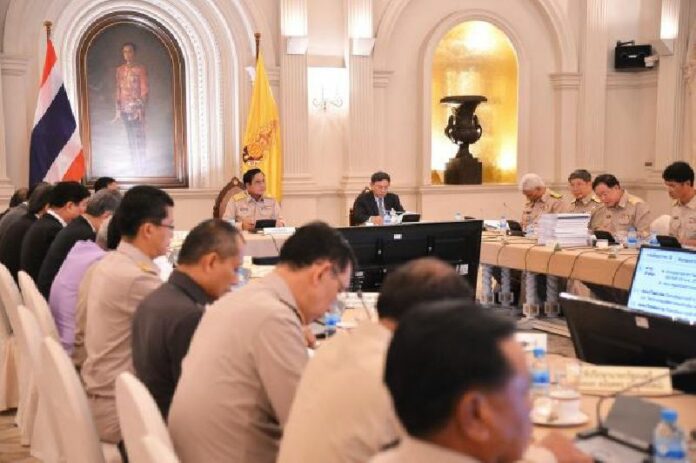
Prime Minister Prayut meeting with the Policy Committee on Special Economic Zone Development [Chiang Rai Times]

(Chiang Rai Times)

CHIANG RAI – Prime Minister Prayuth promised yesterday that the government would seek appropriate solutions in a bid to ease investor concerns over the enforcement of martial law in Special Economic Zones.

The government has designated border provinces like Chiang Rai to be Special Economic Zones but the provinces are still under martial law and experiencing heightened border security.

The Special Economic Zones border with Laos, Cambodia, Myanmar and Malaysia, where security sensitivities lie due to the threat of insurgency, smuggling and trafficking.

Financial institutions are reluctant to provide loans for Special Economic Zones investments that cannot be covered by insurance.

After yesterday’s meeting with the Policy Committee on Special Economic Zone Development, the premier said he was aware of the impact martial law was having and he would find an acceptable solution to help reduce the problem.

Read more here

Note: Khaosod English is not responsible for content on other websites.

Advertisement

Hot News

LATEST NEWS

Bangkok
overcast clouds
31.6 ° C
32.7 °
31.6 °
99 %
5.2kmh
100 %
Sun
30 °
Mon
34 °
Tue
33 °
Wed
31 °
Thu
29 °