






















28.3 C
Bangkok
Monday, June 29, 2026
Home Blog Page 3047

Martial Court Frees Anti-Coup Activists

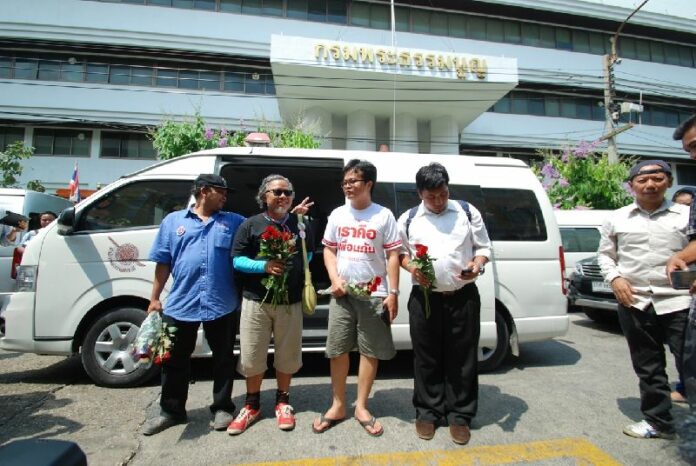
Four political activists charged with violating the junta's ban on protest were brought on March 15, 2015 to the military court in Bangkok.

BANGKOK — Four anti-coup activists charged with violating the junta's ban on protests were released by a military court in Bangkok today.

The four defendants were charged with defying the ban after they organized a pro-democracy rally in downtown Bangkok last month. 

The four defendants include Arnon Nampha, 30, a human rights lawyer; Pansak Srithep, 48, an activist whose teenage son was killed in the 2010 crackdown on Redshirt protesters; Siriwit Serithiwat, 24, a fourth-year political science student at Thammasat University; and Wannakiat Chusuwan, 36, a taxi driver.

\
Siriwit Serithiwat, 24, a fourth-year political science student at Thammasat University hugs his mother after being granted release on bail, 15 March 2015.

The four men helped found the anti-coup group "Resistant Citizens," which has organized non-violent resistance against the military junta that seized power from an elected government last May.

Police escorted the activists to the military court at around 2 pm today. At around 6.30 pm, the four defendants emerged from the court, officially known as the Office of Staff Judge Advocate, and told reporters they had been released without any conditions.

In other cases, the court has required defendants to forswear partaking in political rallies or traveling outside the country in order to evade detention.

The activists' lawyer, Pavinee Chumsri, said prosecutors have not formally indicted the four men because they need more time to deliberate on the case files. 

The judge denied prosecutors' request to remand the defendants during the deliberation, said Pavinee, attorney from Thai Lawyers for Human Rights.

"The court reckons that the accused have clear addresses and have no intention to flee from the trial," said Pavinee.

The defendants have been ordered to return to the court on 27 March to hear whether prosecutors will formally indict them.

Speaking to the press upon his release, Arnon said he would like to thank the military court for giving him and other activists the chance to contest the charges outside prison. He declined to say whether his group will stage more rallies in the future. 

"We will focus on fighting our case in the military court in accordance with the legal process," said Arnon, who is a lawyer by profession.

While the court debated whether to detain the four men, a group of university students rallied outside to show their support for the defendants. The group passed around a loudspeaker, condemning the junta’s practice of trying civilians in martial courts, where military officers serve as judges and appeals are not permitted.

\
Students protest the junta's orders to try civilians in martial court, 15 March 2015.

One of the students also flashed the forbidden three-finger anti-coup salute at soldiers, who closed the gate that led to the court but did not interfere with the rally.

The students concluded their rally soon after the activists were released. 

The court hearing followed Pansak's weekend  "march for justice" from his home in Bangbuathong district to Pathumwan Police Station, where he and other defendants were scheduled to report to police today. The walk was billed as an effort to raise awareness about the junta's suppression of civil liberties. 

\
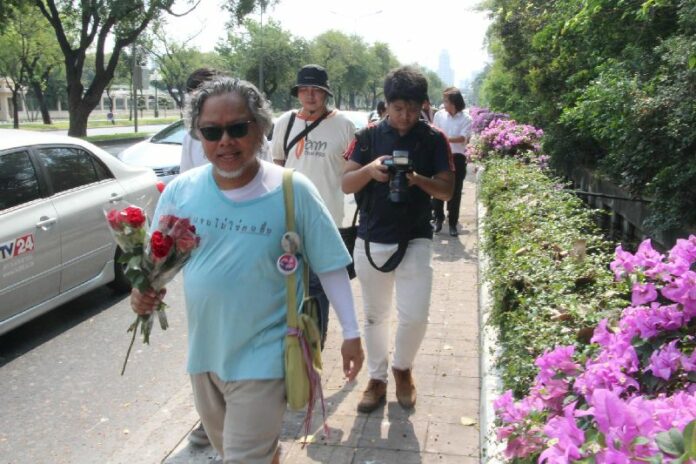
Pansak walking through Thammasat University campus on his way to the police station, 15 March 2015.

The march, which would have totaled 50-km, was interrupted an hour after it began when police officers detained Pansak for defying the junta's ban on political protests.

However, police released the activist later that day without charges, and allowed him to continue portions of his walk over the next two days, culminating in his arrival at Pathumwan Police Station this morning. 

Shortly after seizing power in a coup on 22 May 2014, the junta granted military courts jurisdiction over cases involving lese majeste (insulting the monarchy) and other offenses that "affect national security," including violating the junta's orders. At least 60 civilians are currently facing trials in martial court for violating the junta’s ban on public protests.

On 13 March, a junta spokesperson dismissed complaints from human rights activists about the martial court trials.

"If the accused is guilty based on complete evidence and witnesses' testimonies, the verdict will not be different regardless of what court delivers it," said the spokesperson, Col. Winthai Suwaree. 

 
CORRECTION: The defendants were not required to post bail in order to secure their release, as the original version of this article mistakenly reported. 
 

For comments, or corrections to this article please contact: [email protected]

You can also find Khaosod English on Twitter and Facebook
http://twitter.com/KhaosodEnglish
http://www.facebook.com/KhaosodEnglish

Advertisement

Woman Asks to Be Jailed to Escape Drug-Addicted Girlfriend

PATHUM THANI — A 40-year-old woman arrived at a police station in Pathum Thani province yesterday with a tablet of amphetamine and asked to be jailed in order to flee her drug-addicted girlfriend, police say.

According to officers at Pratunam Chulalongkorn Police Station, Tassanee Jintanakarnwilai said she had been had been dating a 34-year-old woman named Yui who regularly took amphetamines and often coereced her into taking the pills as well.

"Two days ago, my girlfriend and her friends forced me to take drug. I said no. But they beat me and I complied," Tassanee told police yesterday. "Then I made an escape."

She told police officers she would rather live in prison, where she would be fed daily and be protected from her girlfriend.

"I want to go to jail," Tassanee said. "I don't want to get involved with narcotics circles. And I don't have any money at all. At least in prison, there's food for me, and I can be away from my girlfriend and her friends. They cannot harm me." 

Pol.Lt. Thanong Kraiprab, an officer at Pratunam Chulalongkorn Police Station, said he has transferred Tassanee to a hospital to check for traces of narcotics in her body. "If so, she will undergo a rehab," the officer said. 

He told reporters that he has also charged Tassanee with possessing first category narcotics. Police are trying to locate and arrest the girlfriend who allegedly forced her into taking the drugs, he said.


For comments, or corrections to this article please contact: [email protected]

You can also find Khaosod English on Twitter and Facebook
http://twitter.com/KhaosodEnglish
http://www.facebook.com/KhaosodEnglish


Advertisement

Iranian Arrested With Fake Passport in NE Thailand

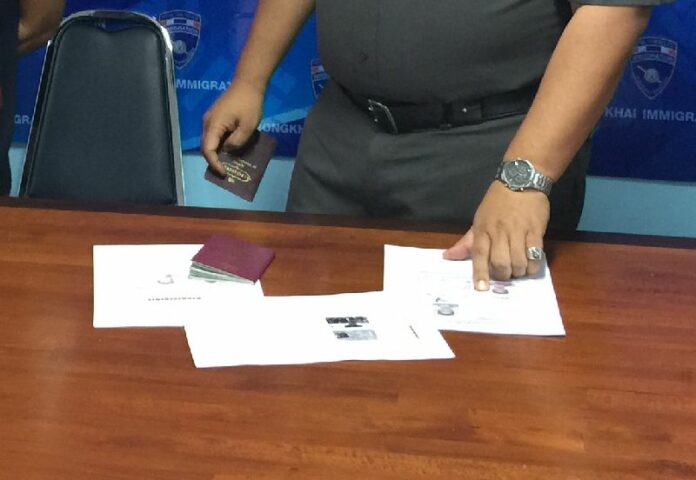
Police in Nong Khai province comparing the two passports at a press conference on 16 March 2015.

NONG KHAI — An Iranian man was arrested at the Thai-Laotian border today for allegedly attempting to cross into Thailand with a fake passport.

The 29-year-old man, identified as Alireza Motevalli, arrived at the border check point this morning with what appeared to be a British passport, said Pol.Col. Pallop Suriyakul na Aytthaya, commander of immigration police in Nong Khai province.

However, when an immigration police officer entered the passport number into the computer, it was revealed to belong to a British woman who reported losing her passport in Bangkok last September, said Pol.Col. Pallop.

Police then searched Motevalli’s bag and found his Iranian passport.

According to Pol.Col. Pallop, Motevalli confessed to entering Thailand last month on a tourist visa and hiring someone to procure a fake passport for him. 

"Motevalli wanted to travel to a third country in Europe, but he believed it would be difficult to do with an Iranian passport, so he hired an Iranian national to create a British passport for him at the price of 360,000 baht," said Pol.Col. Pallop. Motevalli allegedly left Thailand for Laos on 8 March 2015 with his Iranian passport, and then tried to use the fake passport when he returned today. 

Police say Motevalli is being held at Nong Khai Police Station while officers investigate whether he is involved in any other illegal activities. 

In February 2012, three Iranian nationals were arrested in Bangkok after explosives in their residence blew up. Thai authorities believe the three were plotting to assassinate Israeli diplomats in the capital city.


For comments, or corrections to this article please contact: [email protected]

You can also find Khaosod English on Twitter and Facebook
http://twitter.com/KhaosodEnglish
http://www.facebook.com/KhaosodEnglish

Advertisement

Anti-Coup Marcher Allowed to Walk

Pansak Srithep was allowed to continue his walk in Bangkok on 15 March, 2015.

BANGKOK — An anti-coup activist was allowed to continue his symbolic march against the military junta in Bangkok yesterday following a change of tactics from police, who had arrested him for walking on the previous day.

Police officers detained Pansak Srithep on Saturday, only an hour after he began what was supposed to be a 50-km "march for justice" in protest of the junta’s suppression of civil rights. Police said the walk was a political activity, which the junta banned after seizing power last May. Pansak was later released that afternoon without charges.

Pansak renewed his walk on Sunday, starting in Bangkok's Makkasak district, where his 17-year-old son Samapan Srithep was shot dead during the military crackdown on Redshirt protesters in May 2010. 

Police officers followed Pansak throughout his walk, but made no attempts to arrest him. One of the police officers told reporters they were there to prevent any "third hand party" from picking a fight with Pansak or "causing chaos."

\
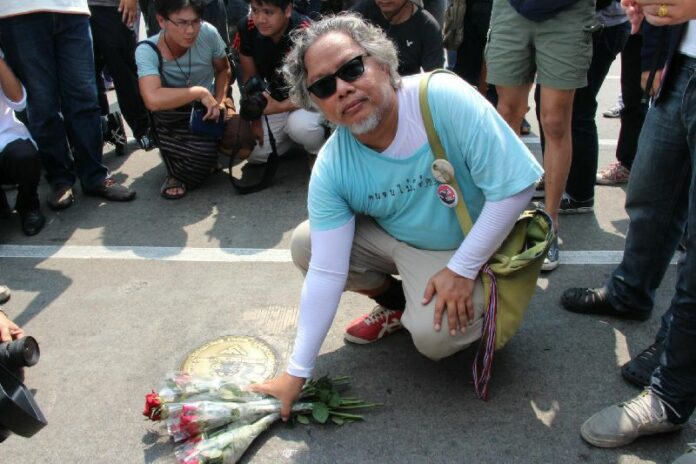
Pansak Srithep laying flowers on a plaque that marks the spot where a group of military officers and civilians seized power from the royal government in 1932 and proclaimed Thailand a constitutional democracy, 15 March 2015.

At the spot where Samapan was killed, now marked by a small plaque on the road, Pansak read a poem dedicated to his son. Although a court inquest investigating the cause of Samapan’s death has not been released, witnesses say he was killed by soldiers who opened fire on Redshirt protesters near Soi Ratchaprarop 18 during the crackdown on 15 May 2010.

After reading the poem, Pansak walked to the Royal Plaza and laid flowers on a small plaque that marks the spot where a group of military officers and civilians seized power from the royal government on 24 June 1932 and proclaimed Thailand a constitutional democracy. He then continued on to Thammasat University. 

Pansak is a member of an anti-coup group called Resistant Citizens that has organized non-violent resistance against the junta. The groups says its name is a tribute to American president Thomas Jefferson's remark that "when injustice becomes laws, resistance becomes duty." 

Pansak and three other activists are currently facing charges of violating the junta's ban on protests for staging a rally demanding an election on 14 February. The four appeared today before a martial court, where military officers serve as judges and appeals are not permitted. 

\
Watcharin Silpadith, 49, protested Resistant Citizens' anti-coup activities on 15 March 2015.

Also on Sunday, a man showed up in front of Thairath newspaper headquarters in Bangkok to protest Resistant Citizens and voice his support for the military junta. The site, where a taxi driver hanged himself in protest of the 2006 coup, was originally on Pansak's march itinerary. 

The man identified himself as Watcharin Silpadith, 49, and told reporters that he didn't belong to any political group, but was merely expressing his own opinion. He held a sign that read: "Enough, please. Let the country rest," and "I don't care who the Prime Minister is, but the people will not tolerate it if someone uses an election to cheat the country." 

Police officers eventually approached Watcharin and ordered him to put down the sign. After some argument, Watcharin agreed and left the area.

Speaking at a press conference yesterday, Maj.Gen. Sansern Kaewkamnerd, a spokesperson of the military government, asked Resistant Citizens to cease their activities and abide by the junta's orders. 

"Please stop. Please understand the situation in the country today," Maj.Gen. Sansern said, "Security officers try to talk and reach understanding with them. But if the talks fail, we will uphold the interest of the country. In fact, the officers don't want to take any legal action against them, because their penalty may be severe. Gen. Prayuth Chan-ocha, the Prime Minister, stressed that he didn't want to escalate small issues into big issues." 


For comments, or corrections to this article please contact: [email protected]

You can also find Khaosod English on Twitter and Facebook
http://twitter.com/KhaosodEnglish
http://www.facebook.com/KhaosodEnglish


Advertisement

Anti-Coup Marcher Allowed to Walk

Activist Pansak Srithep lays flowers on a plaque that marks the spot where a group of military officers and civilians seized power from the royal government in 1932 and proclaimed Thailand a constitutional democracy, 15 March 2015.

BANGKOK — An anti-coup activist was allowed to continue his symbolic march against the military junta in Bangkok yesterday following a change of tactics from police, who had arrested him for walking on the previous day.

Police officers detained Pansak Srithep on Saturday, only an hour after he began what was supposed to be a 50-km "march for justice" in protest of the junta’s suppression of civil rights. Police said the walk was a political activity, which the junta banned after seizing power last May. Pansak was later released that afternoon without charges.

Pansak renewed his walk on Sunday, starting in Bangkok's Makkasak district, where his 17-year-old son Samapan Srithep was shot dead during the military crackdown on Redshirt protesters in May 2010. 

\
Pansak Srithep was allowed to continue his walk in Bangkok on 15 March, 2015.

Police officers followed Pansak throughout his walk, but made no attempts to arrest him. One of the police officers told reporters they were there to prevent any "third hand party" from picking a fight with Pansak or "causing chaos."

At the spot where Samapan was killed, now marked by a small plaque on the road, Pansak read a poem dedicated to his son. Although a court inquest investigating the cause of Samapan’s death has not been released, witnesses say he was killed by soldiers who opened fire on Redshirt protesters near Soi Ratchaprarop 18 during the crackdown on 15 May 2010.

After reading the poem, Pansak walked to the Royal Plaza and laid flowers on a small plaque that marks the spot where a group of military officers and civilians seized power from the royal government on 24 June 1932 and proclaimed Thailand a constitutional democracy. He then continued on to Thammasat University. 

Pansak is a member of an anti-coup group called Resistant Citizens that has organized non-violent resistance against the junta. The groups says its name is a tribute to American president Thomas Jefferson's remark that "when injustice becomes laws, resistance becomes duty." 

Pansak and three other activists are currently facing charges of violating the junta's ban on protests for staging a rally demanding an election on 14 February. The four appeared today before a martial court, where military officers serve as judges and appeals are not permitted. 

\
Watcharin Silpadith, 49, protested Resistant Citizens' anti-coup activities on 15 March 2015.

Also on Sunday, a man showed up in front of Thairath newspaper headquarters in Bangkok to protest Resistant Citizens and voice his support for the military junta. The site, where a taxi driver hanged himself in protest of the 2006 coup, was originally on Pansak's march itinerary. 

The man identified himself as Watcharin Silpadith, 49, and told reporters that he didn't belong to any political group, but was merely expressing his own opinion. He held a sign that read: "Enough, please. Let the country rest," and "I don't care who the Prime Minister is, but the people will not tolerate it if someone uses an election to cheat the country." 

Police officers eventually approached Watcharin and ordered him to put down the sign. After some argument, Watcharin agreed and left the area.

Speaking at a press conference yesterday, Maj.Gen. Sansern Kaewkamnerd, a spokesperson of the military government, asked Resistant Citizens to cease their activities and abide by the junta's orders. 

"Please stop. Please understand the situation in the country today," Maj.Gen. Sansern said, "Security officers try to talk and reach understanding with them. But if the talks fail, we will uphold the interest of the country. In fact, the officers don't want to take any legal action against them, because their penalty may be severe. Gen. Prayuth Chan-ocha, the Prime Minister, stressed that he didn't want to escalate small issues into big issues." 


For comments, or corrections to this article please contact: [email protected]

You can also find Khaosod English on Twitter and Facebook
http://twitter.com/KhaosodEnglish
http://www.facebook.com/KhaosodEnglish


Advertisement

Witness of Redshirt Crackdown Deaths 'Abducted by Military'

Soldiers occupy the first aid station previously manned by medics in Wat Pathum Temple, 21 May 2010.

BANGKOK – A volunteer nurse who witnessed the killing of two fellow medics by soldiers in a Bangkok temple during the crackdown on Redshirt protests in 2010 has been abducted from her home by security officers, according to her family.

Nattathida Meewangpla was taken from her residence in Samut Prakarn province at around 3.30 pm on 11 March, her relatives told Khaosod yesterday. 

\
Nattathida Meewangpla showing photos she took of the incidents on 19 May 2010 to a Khaosod reporter, 21 Feb 2012.

According to her cousin, Nattathida received a phone call from men who said they wanted to visit her home and discuss a possible land purchase. However, the potential buyers turned out to be two soldiers and three plain-clothed security officers, who arrived at Nattathida's house and ordered her to come with them for interrogation.  

The soldiers said they didn’t need a warrant to detain Nattathida because they were acting under martial law, according to Nattathida’s cousin, who asked not to be identified by name. Under martial law, which was imposed by the ruling junta last May, the military may detain individuals without charges for up to seven days.

Nattathida has not been heard from since the arrest, her relatives say.

"They simply told her to bring some clothes. They didn't say on what charges they arrested her," her cousin told Khaosod. "They didn't say where they were taking her, and they wouldn't let us photograph them. We have been too afraid to tell the police." 

Speaking to Khaosod today, a spokesperson of the military junta denied that soldiers detained Nattathida, and suggested that "individuals with ill-intention" might have falsely claimed to act in the junta's name in order to "mislead society."

"Please be confident that every action and mission of the security officers is in accordance with boundary of the laws," said Col. Winthai Suwaree. "The enforcement of laws is also done when necessary and with clear reasons. By principle, it only affects people who violate the laws and individuals who support them." 

Winyat Chartmontri, a member of the pro-bono lawyer group called Free Thai Legal Aid, said he has been appointed by Nattathida's family to seek answers from the junta about her disappearance. 

The lawyer said he would visit the junta's headquarters at 1 pm tomorrow to demand an explanation about her alleged abduction.

"Such action has made her family concerned about her safety, and it constitutes a violation of human rights," said Winyat, who has represented other suspects who detained by the military since the coup. 

Nattathida's boyfriend said he hasn’t heard from Nattathida since 11 March, and insisted that she has not been involved in any illegal activities.

"Since I started dating her, Waen [Nattathida's nickname] liked to volunteer as medic to help people of all sides when there were protests, including Redshirts, Yellowshirts, and other groups," said her boyfriend, who requested that his name not be printed. "If the officers proceed with this case based on facts, Waen won’t be found guilty of any crimes, because she has not done anything wrong."

Nattathida, a volunteer nurse, was a key witness in the 2013 court inquest concerning the deaths of six civilians inside Wat Pathumwanararm Temple during the military’s final assault on Redshirt demonstrators on 19 May 2010.

\
Screenshot from footage of soldiers firing into Wat Pathum temple,19 May 2010.

The court ruled that soldiers who were standing on the skytrain track across from the temple were responsible for the deaths, which included two volunteer medics, Kamolkate Akhard, 25, and Akradech Khankaew, 22.

The temple had been designated as “safe zone” by authorities, and was housing hundreds of demonstrators at the time.

Speaking to Khaosod in 2012, Nattathida said she was initially afraid to participate in the court inquest.

"At first I was too scared to step forward, because I was afraid I would be harmed, and I couldn't accept what happened, but now I am ready," Nattathida said on 21 February 2012. "Medics who perform their duty in battlefields are protected by Geneva Convention. But volunteer medics who helped people [on 19 May] ended up under the hail of gunfire."

Despite the court ruling on 6 August 2013, government officials and military commanders who oversaw the crackdown have refused to take responsibility for the deaths.

Gen. Prayuth Chan-ocha, who commanded the First Region Army in 2010, told the press after the ruling that he did not want to "interfere" with court procedures, but that the inquest should not be seen as the final verdict. He also insisted that "the army never ordered anyone to harm anyone" and that "none of my subordinate officers ever admitted to shooting anyone dead." 

"What happened during the protest was that the army only tried to keep the situation under control," said Gen.Prayuth, who is now Prime Minister after leading a military coup last May. "We have our legal team closely watching the issue … please stop looking at the army as the accused. The army is not the accused."

Since seizing power from a Redshirt-backed government on 22 May 2014, Gen. Prayuth has extensively curtailed civil rights in Thailand by banning political protests, intimidating the media, and detaining hundreds of individuals in army camps without warrants for interrogation and "attitude adjustment" sessions.

Last May, the junta held a Redshirt activist incommunicado for three weeks – violating the seven-day limit under martial law – before admitting to the public that she was in military custody. The activist, Kritsuda Khunasen, fled Thailand shortly after she was released and accused soldiers of torturing her while she was in their custody.

Read more:

For comments, or corrections to this article please contact: [email protected]

You can also find Khaosod English on Twitter and Facebook
http://twitter.com/KhaosodEnglish
http://www.facebook.com/KhaosodEnglish

Advertisement

Witness of Redshirt Crackdown Deaths 'Abducted by Military'

A photo of Nattathida Meewangpla provided by her family. She has not been seen since 11 March when alleged soldiers arrested her at her home.

BANGKOK – A volunteer nurse who witnessed the killing of two fellow medics by soldiers in a Bangkok temple during the 2010 crackdown on Redshirt protesters has been abducted from her home by security officers, according to her family.

Nattathida Meewangpla was taken from her residence in Samut Prakarn province at around 3.30 pm on 11 March, her relatives told Khaosod yesterday. 

\
Nattathida Meewangpla showing photos she took of the incidents on 19 May 2010 to a Khaosod reporter, 21 Feb 2012.

According to her cousin, Nattathida received a phone call from men who said they wanted to visit her home and discuss a possible land purchase. However, the potential buyers turned out to be two soldiers and three plain-clothed security officers, who arrived at Nattathida's house and ordered her to come with them for interrogation.  

The soldiers said they didn’t need a warrant to detain Nattathida because they were acting under martial law, according to Nattathida’s cousin, who asked not to be identified by name. Martial law, which was imposed by the ruling junta last May, allows the military to detain individuals without charges for up to seven days.

Nattathida has not been heard from since the arrest, her relatives say.

"They simply told her to bring some clothes. They didn't say on what charges they arrested her," her cousin told Khaosod. "They didn't say where they were taking her, and they wouldn't let us photograph them. We have been too afraid to tell the police." 

Speaking to Khaosod today, a spokesperson of the military junta denied that soldiers detained Nattathida, and suggested that "individuals with ill-intention" might have falsely claimed to act in the junta's name in order to "mislead society."

"Please be confident that every action and mission of the security officers is in accordance with boundary of the laws," said Col. Winthai Suwaree. "The enforcement of laws is also done when necessary and with clear reasons. By principle, it only affects people who violate the laws and individuals who support them." 

Winyat Chartmontri, a member of the pro-bono lawyer group called Free Thai Legal Aid, said he has been appointed by Nattathida's family to seek answers from the junta about her disappearance. 

The lawyer said he would visit the junta's headquarters at 1 pm tomorrow to demand an explanation about her alleged abduction.

"Such action has made her family concerned about her safety, and it constitutes a violation of human rights," said Winyat, who has represented other suspects who detained by the military since the coup. 

Nattathida's boyfriend said he hasn’t heard from Nattathida since 11 March, and insisted that she has not been involved in any illegal activities.

"Since I started dating her, Waen [Nattathida's nickname] liked to volunteer as medic to help people of all sides when there were protests, including Redshirts, Yellowshirts, and other groups," said her boyfriend, who requested that his name not be printed. "If the officers proceed with this case based on facts, Waen won’t be found guilty of any crimes, because she has not done anything wrong."

Nattathida, a volunteer nurse, was a key witness in the 2013 court inquest concerning the deaths of six civilians inside Wat Pathumwanararm Temple during the military’s final assault on Redshirt demonstrators on 19 May 2010.

\
Screenshot from footage of soldiers firing into Wat Pathum temple,19 May 2010.

The court ruled that soldiers who were standing on the skytrain track across from the temple were responsible for the deaths, which included two volunteer medics, Kamolkate Akhard, 25, and Akradech Khankaew, 22.

The temple had been designated as “safe zone” by authorities, and was housing hundreds of demonstrators at the time.

Speaking to Khaosod in 2012, Nattathida said she was initially afraid to participate in the court inquest.

"At first I was too scared to step forward, because I was afraid I would be harmed, and I couldn't accept what happened, but now I am ready," Nattathida said on 21 February 2012. "Medics who perform their duty in battlefields are protected by Geneva Convention. But volunteer medics who helped people [on 19 May] ended up under the hail of gunfire."

Despite the court ruling on 6 August 2013, government officials and military commanders who oversaw the crackdown have refused to take responsibility for the deaths.

Gen. Prayuth Chan-ocha, who commanded the First Region Army in 2010, told the press after the ruling that he did not want to "interfere" with court procedures, but that the inquest should not be seen as the final verdict. He also insisted that "the army never ordered anyone to harm anyone" and that "none of my subordinate officers ever admitted to shooting anyone dead." 

"What happened during the protest was that the army only tried to keep the situation under control," said Gen.Prayuth, who is now Prime Minister after leading a military coup last May. "We have our legal team closely watching the issue … please stop looking at the army as the accused. The army is not the accused."

Since seizing power from a Redshirt-backed government on 22 May 2014, Gen. Prayuth has extensively curtailed civil rights in Thailand by banning political protests, intimidating the media, and detaining hundreds of individuals in army camps without warrants for interrogation and "attitude adjustment" sessions.

Last May, the junta held a Redshirt activist incommunicado for three weeks – violating the seven-day limit under martial law – before admitting to the public that she was in military custody. The activist, Kritsuda Khunasen, fled Thailand shortly after she was released and accused soldiers of torturing her while she was in their custody.

For comments, or corrections to this article please contact: [email protected]

You can also find Khaosod English on Twitter and Facebook
http://twitter.com/KhaosodEnglish
http://www.facebook.com/KhaosodEnglish

Advertisement

Asia Increases Arms Imports, New Report Says

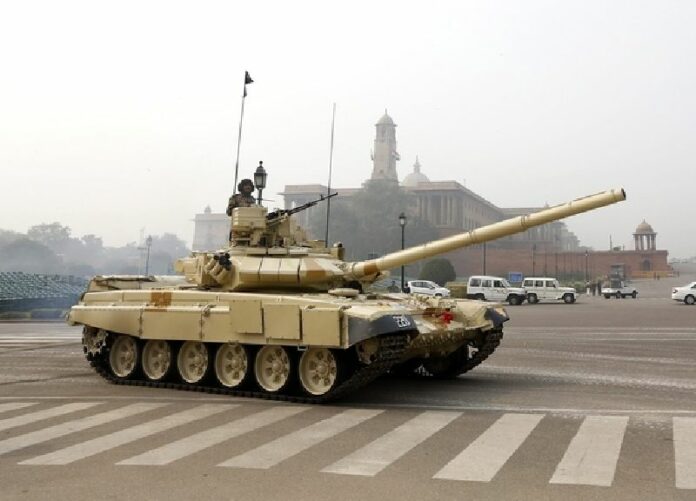
An Indian army tank drives near the Indian president's house after participating in rehearsals for the Republic Day Parade in New Delhi, India, 21 January 2015. The United States and Russia accounted for more than half of the world's global arms supplies in the past five years, a period during which Asia - led by India - increased its arms imports, a Swedish-based research institute said Monday. EPA/HARISH TYAGI

STOCKHOLM (DPA) — The United States and Russia accounted for more than half of the world's global arms supplies in the past five years, a period during which Asia – led by India – increased its arms imports, a Swedish-based research institute said Monday.

India's 2010-14 imports stood at 15 per cent of the world's total, three times larger than those of rivaling China and Pakistan that also belong to the top five importers, the Stockholm International Peace Research Institute (SIPRI) said.

The think tank estimated that India received 70 per cent of its arms imports from Russia, adding that the US and Israel were also main suppliers. The US, for example, provided anti-submarine warfare aircraft and signed a contract last year to deliver 22 attack helicopters.

The US was the world's top exporter during the five-year period, posting a 31-per-cent share of global arms exports. It sold arms to 94 countries, including the main defence markets of South Korea, the United Arab Emirates (UAE) and Australia, SIPRI said.

US exports have become necessary "to help the US arms industry maintain production levels at a time of decreasing US military expenditure," SIPRI researcher Aude Fleurant said.

Russia, in the number two spot, delivered arms to 56 countries and was a main supplier of helicopters and other aircraft. India, China and Algeria accounted for well over half of Russia's exports.

SIPRI estimated Russia's share of global arms exports was 27 per cent during 2010-14, up 5 percentage points compared to the pervious five-year period.

China's 5-per-cent share of global exports landed it the number three spot, just ahead of Germany and France.

China sold arms to 35 countries, but about two-thirds of its exports went to its traditional allies of Pakistan and Myanmar, as well as Bangladesh.

Chinese arms were also exported to 18 African countries, including Nigeria.

In its overview, SIPRI said there were 60 arms-exporting countries.

Five of the top-10 arms importers were located in Asia, with India, China, Pakistan, South Korea and Singapore accounting for almost a third of all arms imports to Asia.

The Middle East was another region where imports increased in the period, with Saudi Arabia becoming the world's second-largest importer, accounting for 5 per cent of all global arms imports.

The kingdom took on deliveries of 45 combat aircraft from Britain, 38 combat helicopters from the US, 4 tanker aircraft from Spain and 600 armoured vehicles from Canada, SIPRI said.

The volume of world arms transfers increased in the period by 16 per cent compared to 2005-2009.

The SIPRI Arms Transfers Database, which does not include small arms, is based on public sources ranging from national and regional newspapers to specialized international journals, as well as government and industry reports.

SIPRI said it used a five-year cycle to even out fluctuations caused by a big order during any specific year.


For comments, or corrections to this article please contact: [email protected]

You can also find Khaosod English on Twitter and Facebook
http://twitter.com/KhaosodEnglish
http://www.facebook.com/KhaosodEnglish

Advertisement

Foreign Tourist Assaults Waitresses & Police in Pattaya

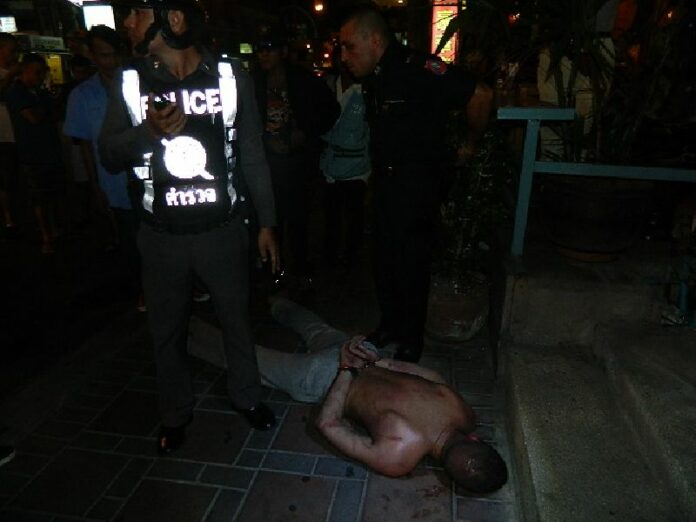
Police subdue the tourist in Pattaya on 14 March 2015.

CHONBURI – An intoxicated Dutch tourist was arrested in the resort town of Pattaya last night after assaulting several waitresses and a police officer.

Police identified the suspect as Dennis Tagga, a 25-year-old tourist from the Netherlands. 

Yaowathida Chantho, a 38-year-old waitress at Aroi Dee Restaurant, said Tagga "looked like he was high on something" when he entered the restaurant on 14 March.  She said she asked him what he wanted to order, but Tagga refused to speak to anyone and simply sat on his seat.

Five minutes later, he reportedly started throwing tables and chairs at waitresses in the restaurant, including Yaowathida. 

Pol.Lt. Sarayuth Saengpetch, a traffic police officer, said he was directing traffic in the area when he heard the commotion and tried to stop Tagga, but the tourist started attacking him and punched him in the face. Tagga also reportedly tried to reach for Pol.Lt. Sarayuth's handgun, so the officer called for reinforcement. 

Twenty police officers responded to the call and arrested Tagga. It is unclear whether he faces any charges.

Sanong Boonpanya, 60, later met with police and identified himself as the manager of the hotel where Tagga had been staying. According to Sanong, prior to the incident Tagga also went on a rampage and damaged property at the hotel. He eventually jumped from the window on the third floor and ran off, Sanong said.

"Luckily, the ground was sandy, so he didn't get injured," Sanong told police, "Hotel staff tried to bring him in and calm him, but he didn't care. So he went out and cause troubles, until he was arrested."


For comments, or corrections to this article please contact:[email protected]

You can also find Khaosod English on Twitter and Facebook
http://twitter.com/KhaosodEnglish
http://www.facebook.com/KhaosodEnglish
Advertisement

Muslim Cleric Recounts Traumatic Police Raid in Deep South

The madras in Yarang district, Pattani, photo taken on 14 March 2015.

PATTANI — A Muslim cleric in the restive province of Pattani says he was mistreated by Thai police who claimed to find several assault rifles at his religious school last month.

In a press conference yesterday, Marobi Niseng, a cleric and owner of Nahtatul Ulumidiniyah madras in Yarang district of Pattani, said Thai security forces falsely accused him of of possessing four assault rifles and one handgun after raiding the madras on 18 February. 

According to the military's statement at the time, security officers discovered the weapons inside the religious school. The raid was conducted after military and police officers recieved information that a high-ranking militant was hiding in the district around the madras.

Security officers also said they found bomb-making equipment inside the school.

Marobi said yesterday that he and his family were relaxing in their house, which is located inside the madras compound, on 18 February when more than a hundred black-clad, armed security officers arrived. The security officers rounded up everyone outside while they searched the property, Marobi said. 

"The security officers searched every corner of my house. They even searched my bed three times," the cleric said. 

According to Marobi, the officers eventually presented several assault rifles and told him to pose for a photo next to them, even though the weapons were in fact discovered in the wooded area 200 meters away from the religious school. 

Pol.Col. Somboon Puangmalai, superintendent of Yarang Police Station, admitted yesterday that the weapons were found "outside the area of the madras" but did not elaborate any further. He also told Khaosod there is no evidence that links the weapons with Marobi at the moment. 

"Currently, we are waiting to see whether the results of fingerprints and DNA tests match anyone," Pol.Col. Somboon said. 

Speaking at yesterday’s press conference, Marobid described being taken to Wang Phaya army ranger camp that night for interrogation, where security officers allegedly mocked his Thai accent and threatened to throw him in jail for 20 years. 

"They were rude at me. They said how can I be a Thai when I cannot even speak Thai properly. I told them at the very beginning that my Thai isn't good, but they insisted on asking questions in Thai to me," Marobi said, "But what really concerns me wasn't the mocking of the officers. It was the officers threat that I would be jailed for 20 years, and that my madras will be closed down. I couldn't accept that. They accused me so strongly. I had nothing to do with those things. Why would I? How would it benefit me or my students if I do that?"

Marobi said he was later released, but authorities ordered his madras to close down for two months. The state education agency in the province also cut funding to the school because of its alleged ties to the insurgency, Marobi told the press. His wife also suffered psychological trauma from the raid and is now receiving treatment from a local clinic, according to the cleric. 

"It angers many people in the area," Marobi added.

More than 6,000 people have been killed since waves of secessionist violence broke out Thailand's southern border provinces in early 2004, according to data compiled by human rights groups. The bloody campaign has been waged by Islamic insurgents seeking to revive the independent sultanate of Pattani, which was incorporated into modern day Thailand in the early 20th century. 

Contrary to the rest of the Buddhist-prevalent Thailand, the Deep South is heavily populated by Muslims who trace their ancestry to the Malays and speak a distinct dialect called Yawi. 

Waedueramae Mamingi, chairman of the Central Islamic Committee in Pattani, said security officers should avoid causing ill feelings to local residents in their search operations, as it may contribute to further division in the region.

"Today everyone is trying to build a space and atmosphere of dialogue and peace," Waedueramae said. 


For comments, or corrections to this article please contact: [email protected]

You can also find Khaosod English on Twitter and Facebook
http://twitter.com/KhaosodEnglish
http://www.facebook.com/KhaosodEnglish

Advertisement

Hot News

LATEST NEWS

Bangkok
overcast clouds
28.3 ° C
28.3 °
28.3 °
79 %
4.1kmh
100 %
Sun
28 °
Mon
34 °
Tue
34 °
Wed
32 °
Thu
33 °