





























32.7 C
Bangkok
Sunday, July 5, 2026
Home Blog Page 3090

Chinese Defense Minister Praises Thai Coup

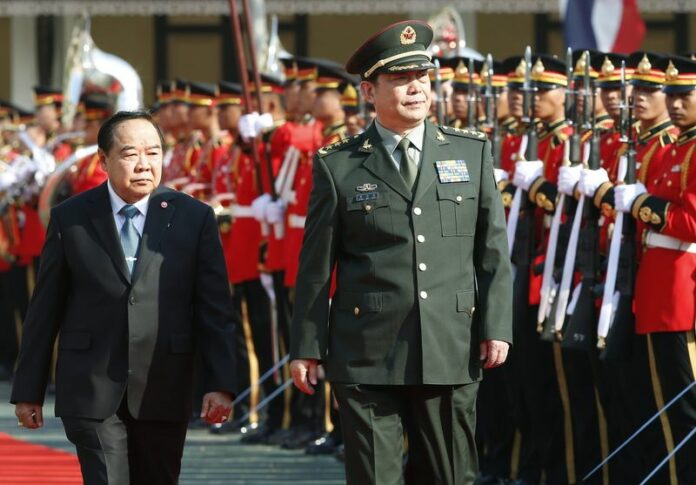
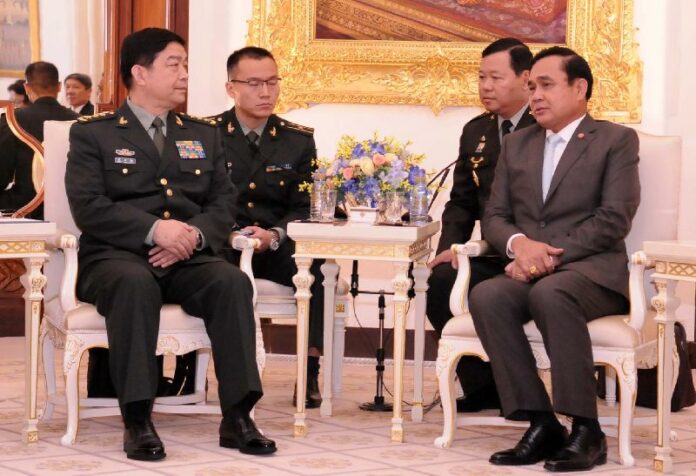
Chinese Defense Minister Chang Wanquan (R) and Thai Defense Minister Prawit Wongsuwon (L) during a welcoming ceremony at the Ministry of Defence in Bangkok, Thailand, 06 February 2015. Thailand and China have agreed to more military cooperation amid irritation in the ruling Thai junta over a call by a US diplomat to end martial law. EPA/NARONG SANGNAK

BANGKOK — A senior Chinese minister reportedly praised the May 2014 military coup in Thailand and vowed to strengthen ties between the two countries during his state visit in Bangkok today.

Gen. Chang Wanquan, Minister of the Defense of the People's Republic of China, expressed his "understanding" of the political situation that led to the coup, according to Col. Kongcheep Tantrawanich, a spokesperson for the Thai Ministry of Defense. 

\

Gen. Chang Wanquan (L) and Thai junta chairman Gen. Prayuth Chan-ocha in Bangkok, 6 Feb 2015.

"The Chinese government understands the political situation in Thailand because it has been following very closely," Col. Kongcheep quoted Wanquan as saying. "The Chinese government is aware that Thailand has gone through complicated changes in recent years. He also praised the Thai armed forces for taking control of the situation to restore peace and order, as desired by the people." 

Thailand's military junta says it imposed martial law and toppled an elected government on 22 May 2014 to restore order after the country had been rocked by six months of sporadically violent anti-government street protests.

According to Col. Kongcheep, Wanquan said "the Chinese government respects the Thai government's solution to its domestic problems, and will not interfere."

Wanquan's visit to Bangkok follows the cooling of diplomatic relations between Thailand's post-coup military government and the United States, which has criticized the coup and called for a return to democratic rule. On Thursday, a senior US State Department official told reporters that the US would not fully restore its military alliance with Thailand until the junta cedes power to a democratically elected government, AFP reported

Last month, US Assistant Secretary of State Daniel Russel raised the ire of Thai officials by urging the junta to repeal martial law and all restrictions of civil rights. The Thai Ministry of Foreign Affairs called the speech “disappointing” and accused Russel of interfering in Thailand’s domestic affairs. The MFA later summoned the US Charge d'Affaires in Bangkok to discuss Russel's remarks. 

In contrast to the US and other western countries, the Chinese Communist regime has never publicly criticized Thailand’s military coup. Three days after the military takeover, The Global Times, a pro-government Chinese daily, published an editorial describing the coup as a result of the "disorder" caused by experiments with Western-style democracy in Thailand.  

"As Western democracy has thrown many small countries into disorder, more and more people began to realize that destructive elements may be activated if China adopts it," the editorial said. "Fortunately, China has the wisdom and capability to seek an independent political path."

According to Col. Kongcheep, Wanquan assured the Thai government that Chinese authorities will support Thailand in various fields, such as exchanging intelligence reports and cracking down on the narcotics trade, human trafficking, and other transnational crimes.

China will also "support Thailand's defense industry" and cooperate economically with the Kingdom, Col. Kongcheep told reporters.

Despite diplomatic tensions, the US is still set to commence its annual Cobra Gold military exercise in Thailand on 9 Februray. 

For comments, or corrections to this article please contact:[email protected]

You can also find Khaosod English on Twitter and Facebook
http://twitter.com/KhaosodEnglish
http://www.facebook.com/KhaosodEnglish
Advertisement

Chinese Defense Minister Praises Thai Coup

Gen. Chang Wanquan, Minister of the Defense of the People's Republic of China, meeting with Thai junta chairman and PM Prayuth Chan-ocha in Bangkok, Feb. 6 2015.

BANGKOK — A senior Chinese minister reportedly praised the May 2014 military coup in Thailand and vowed to strengthen ties between the two countries during his state visit in Bangkok today.

Gen. Chang Wanquan, Minister of the Defense of the People's Republic of China, expressed his "understanding" of the political situation that led to the coup, according to Col. Kongcheep Tantrawanich, a spokesperson for the Thai Ministry of Defense. 

\
Gen. Chang Wanquan (L) and Thai junta chairman Gen. Prayuth Chan-ocha in Bangkok, 6 Feb 2015.

"The Chinese government understands the political situation in Thailand because it has been following very closely," Col. Kongcheep quoted Wanquan as saying. "The Chinese government is aware that Thailand has gone through complicated changes in recent years. He also praised the Thai armed forces for taking control of the situation to restore peace and order, as desired by the people." 

Thailand's military junta says it imposed martial law and toppled an elected government on 22 May 2014 to restore order after the country had been rocked by six months of sporadically violent anti-government street protests.

According to Col. Kongcheep, Wanquan said "the Chinese government respects the Thai government's solution to its domestic problems, and will not interfere."

Wanquan's visit to Bangkok follows the cooling of diplomatic relations between Thailand's post-coup military government and the United States, which has criticized the coup and called for a return to democratic rule. On Thursday, a senior US State Department official told reporters that the US would not fully restore its military alliance with Thailand until the junta cedes power to a democratically elected government

Last month, US Assistant Secretary of State Daniel Russel raised the ire of Thai officials by urging the junta to repeal martial law and all restrictions of civil rights. The Thai Ministry of Foreign Affairs called the speech “disappointing” and accused Russel of interfering in Thailand’s domestic affairs. The MFA later summoned the US Charge d'Affaires in Bangkok to discuss Russel's remarks. 

In contrast to the US and other western countries, the Chinese Communist regime has never publicly criticized Thailand’s military coup. Three days after the military takeover, The Global Times, a pro-government Chinese daily, published an editorial describing the coup as a result of the "disorder" caused by experiments with Western-style democracy in Thailand.  

"As Western democracy has thrown many small countries into disorder, more and more people began to realize that destructive elements may be activated if China adopts it," the editorial said. "Fortunately, China has the wisdom and capability to seek an independent political path."

According to Col. Kongcheep, Wanquan assured the Thai government that Chinese authorities will support Thailand in various fields, such as exchanging intelligence reports and cracking down on the narcotics trade, human trafficking, and other transnational crimes.

China will also "support Thailand's defense industry" and cooperate economically with the Kingdom, Col. Kongcheep told reporters.

Despite diplomatic tensions, the US is still set to commence its annual Cobra Gold military exercise in Thailand on 9 Februray. 

For comments, or corrections to this article please contact: [email protected]

You can also find Khaosod English on Twitter and Facebook
http://twitter.com/KhaosodEnglish
http://www.facebook.com/KhaosodEnglish

Advertisement

Police, Soldiers Raid Pattaya 'Naked Sushi' Restaurant

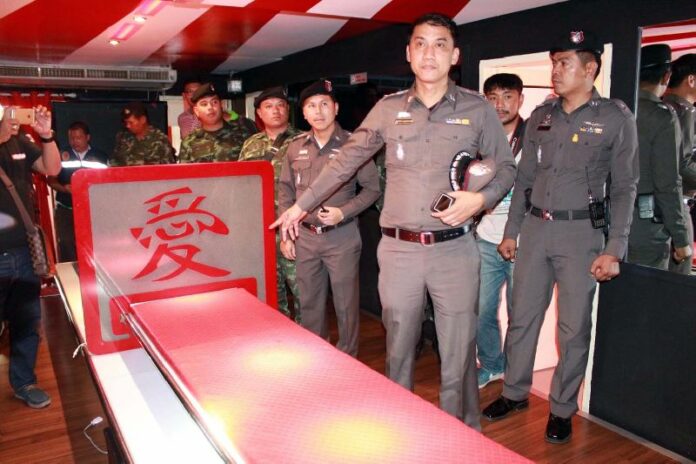
Police and military officers raid a restaurant in Pattaya where sushi was reportedly served on bodies of naked women, 5 Feb 2015.

CHONBURI – Police and military officers have raided a restaurant in Pattaya where sushi was reportedly served on the bodies of naked women.

Security officers raided the restaurant, named Tokyo Kids, located on Soi Kor Phai 10 in the popular beach town of Pattaya at around 10 am yesterday. 

The raid followed an uproar on social media in response to advertisements for the restaurant that appeared on several Thai webforums and Facebook pages. The ads touted the restaurant's nyotaimori service, a Japanese practice in which sushi is served from the bodies of naked women. 

\
An advertisement for Tokyo Kids's nyotamori service. 

During the raid, security officers found a long table that appeared to match the table seen in the restaurant’s advertisements. However, no clients or waitresses were at the restaurant when the raid took place. 

Apichart Wongsuriya, 38, identified himself as the manager of the restaurant and told police that Toyko Kids is owned by a 60-year-old Australian man named "Jason," who rarely visits. According to Apichart, the restaurant has been in operation since 2011.

The manager admitted that the restaurant offers nyotamori meals to its customers, who are mostly Korean and Chinese tourists. He said the restaurant charges each customer 5,000 baht per session, and pays the women around 2,000 baht for providing the service.

"This morning Jason phoned me and told me not to open the restaurant today," said Apichart, "because he was afraid of a police raid, especially after there was a public uproar." 

Police have confiscated CCTV footage and restaurant receipts for further investigation. 

Pol. Col. Sukthat Pumpanmuang, commander of Mueang Pattaya Police Station, said the restaurant owner will be charged with operating a restaurant and selling alcohol without a permit. The women providing the nyotaimori service will also be charged with public indecency, he said.

"It has caused foreigners to view Thai women and the image of Pattaya in a damaging way," said Pol.Col. Sukthat. Pattaya is known for its rowdy nightlight and free-wheeling sex industry. 

Nyotaimori is reportedly offered in a small number of restaurants in Japan's red-light districts, though the practice has been imported by some high-end restaurants in Western countries in recent years, drawing criticism from women's rights advocates who see the practice as demeaning and humiliating to women.

Supensri Puengkhoksoong, the official in charge of Ministry of Social Development and Human Security's center for gender equality, said the nyotaimori offered at Tokyo Kids restaurant is "inappropriate and damages the image of women." 

"It treats women as commercialized gender. The restaurant only thinks about drawing customers without considering principles of morality," Supensri told Khaosod. "As for people who respect the dignity of human beings, they should help boycott the restaurant for trampling on dignity of women." 


For comments, or corrections to this article please contact: [email protected]

You can also find Khaosod English on Twitter and Facebook
http://twitter.com/KhaosodEnglish
http://www.facebook.com/KhaosodEnglish
Advertisement

Fake Royal Document: Suspect Denied Access to Lawyer

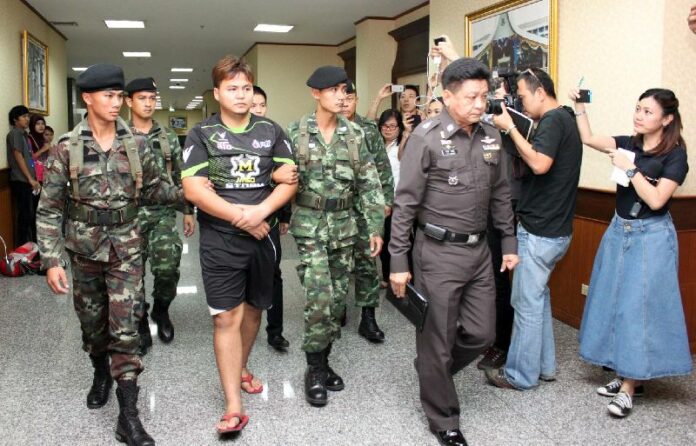
Krit Bootdeecheen, 25, is taken by soldiers for interrogation on 4 Feb 2015 in connection with a fake royal statement that was spread on social media.

BANGKOK — The Thai military has reportedly denied legal counsel to a Redshirt activist who was arrested for spreading a fake royal statement, citing powers granted to the military under martial law.

Police say Krit Bootdeecheen, 25, was "among the first" to share a document on social media that purported to be issued by His Majesty the King on 2 February. The statement claimed that King Bhumibol had appointed a Regent to act on his behalf. Within an hour, the Thai government announced that the document was forged. 

Krit, who has been identified as member of the Redshirt movement, is currently facing charges of lese majeste (insulting the monarchy) and violating Computer Crimes Act, which criminalizes using a computer to spread false information.

Winyat Chartmontri, a lawyer dispatched by Redshirt leaders to assist Krit today, told reporters he was refused entry into the 11th Infantry Regiment headquarters, where Krit has been detained since his arrest yesterday. According to Winyat, military officers claimed they had the right to detain Krit without any access to legal representation for up to seven days under martial law. 

Winyat said he cited a series of other laws in an effort to change the minds of the military officers, including Section 4 of the junta’s interim charter, which proclaims the protection of every citizen’s civil rights, and Section 7/1 of the Thai Criminal Codes, which outlines a suspect's rights to legal assistance while in custody. 

"The officers that met with me told me to forget all those laws, because the country is under martial law at the moment," Winyat said. "So they wouldn't let me meet with the suspect. They said I can only meet him after seven days of detention."

He continued, "I would like to inform all relevant authorities that suspects deserve protection in accordance with human rights principles and the Constitution, even though martial law is in place at the moment."

Since seizing power last May, the Thai military junta has used martial law to ban all political activities, censor the press, detain more than 300 individuals in military camps for several days without charges, and try dissidents in military courts, where appeals are not permitted. The junta has also granted military courts jurisdiction over lese majeste lawsuits and other cases that concern "national security."

Worawut Wichaidith, a spokesperson of the Redshirt organization the United Front of Democracy Against Dictatorship (UDD), raised concerns that authorities may be "selectively" prosecuting Redshirt activists in connection with the forged royal document. 

"Do the authorities have an intention to politically bully Redshirts?" Worawut asked. 

Jatupon Prompan, a top UDD leader, compared Krit's treatment to that of a royalist newspaper, ASTV Manager, that published the false statement on its website. 

"Krit is no different than the website of ASTV Manager," Jatuporn said. "But they were treated so differently. Because Krit is a Redshirt, he is detained like a major criminal."

Police summoned the ASTV Manager's online editor for questioning but have not filed any charges. 

The Redshirt movement is regularly accused of harboring anti-monarchy elements in its ranks. Redshirt leaders have repeatedly denied the allegations, though a number of radical Redshirt activists are known for their criticism of the monarchy


For comments, or corrections to this article please contact: [email protected]

You can also find Khaosod English on Twitter and Facebook
http://twitter.com/KhaosodEnglish
http://www.facebook.com/KhaosodEnglish
Advertisement

Lese Majeste Charges Filed Against Parents of Former Princess

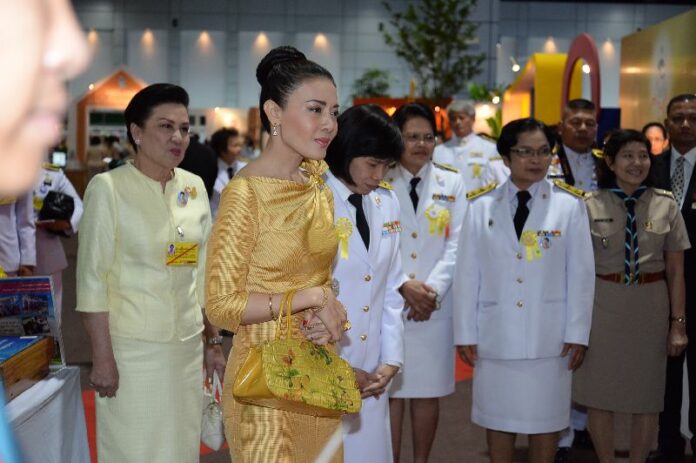
File photo of former Princess Srirasmi, the wife of Thailand's Crown Prince.

BANGKOK — The parents of the wife of Thailand's Crown Prince, who resigned from her status as a member of the Royal Family last December, are facing charges of lese majeste, police say.

The lese majeste (insult of monarchy) charges were filed by Sawita Maneechan, a resident in Ratchaburi province. Sawita accused Apiruj and Wantanee Suwadee, the parents of former princess Srirasmi, of using their royal connection to bully her in 2003. 

Speaking at a press conference today, Sawita said that Wantanee falsely accused her of having an affair with Apiruj. As punishment, Wantanee later used her royal connection to convince a high-ranking police officer to charge Sawita with a bogus fraud charge, Sawita told reporters.

Sawita said she was found guilty in court and sentenced to 24 months in prison; the sentence was reduced to 18 months in jail because she confessed.

"The charge was utterly false, but I was forced to make a confession because I was afraid of the influence [of the Suwadee family]," Sawita said. "My family had to move out of Ratchaburi province, and I couldn't find a job because of my prison record. I would like to ask for fairness from the police. I want them to investigate the facts and dissolve my criminal record."

Pol.Maj.Gen. Thitirat Nongharnpitak said police will investigate the allegation.

"I insist that we will give fairness to all sides," Pol.Maj.Gen. Thitirat said. "We will summon every person related to the issue for interrogation. If police believe there is truth to the allegation, we will punish the wrongdoers."

Defaming the Royal Family is punishable by up to 15 years in prison under Thailand's lese majeste law. Charges can be filed by any member of the public.

Srirasmi resigned from her position as a Royal Family member in December 2014 after several of her relatives, including her brother and sister, were arrested on charges of lese majeste and running a massive corruption ring.

Police say the crime syndicate was headed by Pol.Lt.Gen. Pongpat Chayaphan, the former head of the Central Bureau of Investigation, and Pol.Col. Nattapong Akharaphongpreecha. Pongpat and Nattapong are Srirasmi’s uncle and brother, respectively. At least 27 arrest warrants have been issued to people in connection with the crime network. 

In response to the scandal, Crown Prince Vajiralongkorn stripped Srirasmi's entire family of the royally-bestowed surname Akharaphongpreecha, forcing them to revert back to their "commoner" surname, Suwadee, on 30 November. 

After her royal resignation, Srirasmi moved out of the Crown Prince's palace in Bangkok to live with her parents in Ratchaburi province and has not been seen in public since 13 December, when she applied for a new national ID card as a commoner. She later issued a statement requesting privacy from the crowd of reporters who were camping in front of her residence. 

It is unclear whether Srirasmi and the Crown Prince are formally divorced. The couple married in 2001 and have one 9-year-old son. 

Related coverage:
Ex-CIB Chief Gets 6 Years for Defaming Thai Crown Prince
Sister of Former Princess Jailed for Insulting Monarchy
CIB Scandal: 28-Year-Old Arrested For Flaunting 'Royal Connection'


Advertisement

Fake Royal Document: Suspect Denied Access to Lawyer

Krit Bootdeecheen (center) led by police at the Royal Thai Police HQ in Bangkok, 4 Feb 2015.

BANGKOK — The Thai military has reportedly denied legal counsel to a Redshirt activist who was arrested for spreading a fake royal statement, citing powers granted to the military under martial law.

Police say Krit Bootdeecheen, 25, was "among the first" to share a document on social media that purported to be issued by His Majesty the King on 2 February. The statement claimed that King Bhumibol had appointed a Regent to act on his behalf. Within an hour, the Thai government announced that the document was forged. 

Krit, who has been identified as member of the Redshirt movement, is currently facing charges of lese majeste (insulting the monarchy) and violating Computer Crimes Act, which criminalizes using a computer to spread false information.

Winyat Chartmontri, a lawyer dispatched by Redshirt leaders to assist Krit today, told reporters he was refused entry into the 11th Infantry Regiment headquarters, where Krit has been detained since his arrest yesterday. According to Winyat, military officers claimed they had the right to detain Krit without any access to legal representation for up to seven days under martial law. 

Winyat said he cited a series of other laws in an effort to change the minds of the military officers, including Section 4 of the junta’s interim charter, which proclaims the protection of every citizen’s civil rights, and Section 7/1 of the Thai Criminal Codes, which outlines a suspect's rights to legal assistance while in custody. 

"The officers that met with me told me to forget all those laws, because the country is under martial law at the moment," Winyat said. "So they wouldn't let me meet with the suspect. They said I can only meet him after seven days of detention."

He continued, "I would like to inform all relevant authorities that suspects deserve protection in accordance with human rights principles and the Constitution, even though martial law is in place at the moment."

Since seizing power last May, the Thai military junta has used martial law to ban all political activities, censor the press, detain more than 300 individuals in military camps for several days without charges, and try dissidents in military courts, where appeals are not permitted. The junta has also granted military courts jurisdiction over lese majeste lawsuits and other cases that concern "national security."

Worawut Wichaidith, a spokesperson of the Redshirt organization the United Front of Democracy Against Dictatorship (UDD), raised concerns that authorities may be "selectively" prosecuting Redshirt activists in connection with the forged royal document. 

"Do the authorities have an intention to politically bully Redshirts?" Worawut asked. 

Jatupon Prompan, a top UDD leader, compared Krit's treatment to that of a royalist newspaper, ASTV Manager, that published the false statement on its website. 

"Krit is no different than the website of ASTV Manager," Jatuporn said. "But they were treated so differently. Because Krit is a Redshirt, he is detained like a major criminal."

Police summoned the ASTV Manager's online editor for questioning but have not filed any charges. 

The Redshirt movement is regularly accused of harboring anti-monarchy elements in its ranks. Redshirt leaders have repeatedly denied the allegations, though a number of radical Redshirt activists are known for their criticism of the monarchy


For comments, or corrections to this article please contact: [email protected]

You can also find Khaosod English on Twitter and Facebook
http://twitter.com/KhaosodEnglish
http://www.facebook.com/KhaosodEnglish
 
Advertisement

Deep South Banners Decry 'Siamese Colonization'

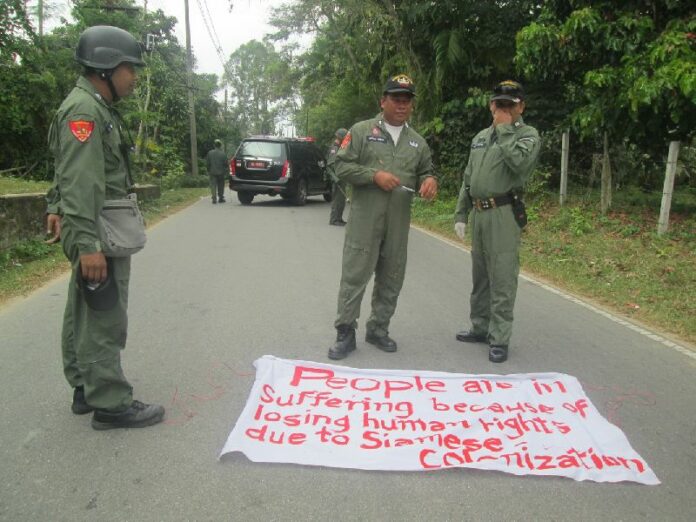
Several banners were spotted in Pattani, Narathiwat, and Yala on 5 Feb 2015.

PATTANI — Police say secessionist insurgents in southern Thailand have hung several banners accusing Thai authorities of human rights violations.

The banners were spotted in Pattani, Narathiwat, and Yala – a region known as the Deep South – between 6-7 am this morning. All of the banners bear the same English text: "People are in suffering because of losing human rights due to Siamese Colonization."

\

Police believe the banners were hung by local Islamic insurgents who have been battling Thai authorities for the past decade in an effort to revive the independent sultanate of Pattani, which was incorporated into modern-day Thailand, then known as Siam, in the early 20th century. 

EOD teams were dispatched the remove the banners out of fear that the insurgents may have planted explosives nearby, as has happened the past.  However, there were no reports of explosives being found in today's operations. 

In December, suspected insurgents hung a series of banners across the region questioning the sincerity of the Thai junta, which had declared its intention to organize peace talks. The banners, written in Thai, English, and Malay, read: "Is it appropriate to negotiate with the coup government? There is no guarantee for sincerity." Homemade explosives were planted near several of the banners. 

In contrast to the rest of the country, which is dominated by Buddhists, a majority of those living in the Deep South are Muslims who speak a Malaysian dialect. 

More than 6,000 people, mostly civilians, have been killed in the simmering conflict over the past decade, according to data compiled by rights groups.

The shadowy insurgent groups regularly target public schools andteacherspresumably because they are viewed as "instruments" of the Buddhist state. Nearly 200 teachers have been killed in the region since 2004. Many teachers now travel with a large convoy of bodyguards and soldiers. 

Human rights groups have also criticised the Thai military's occasionally heavy-handed approach to stamping out violence in the southern border provinces, as well as their reliance on rangers, many of whom are armed volunteers.


For comments, or corrections to this article please contact: [email protected]

You can also find Khaosod English on Twitter and Facebook
http://twitter.com/KhaosodEnglish
http://www.facebook.com/KhaosodEnglish
Advertisement

Thai Hmong Association Condemns 'Racist Remarks' on State TV

Nok Lae performing on the "The Family Gang" on Channel 3 on 31 January 2015.

BANGKOK — The Association of Hmong in Thailand has condemned a talk show on a state-owned TV channel that it says aired "racist" comments about the ethnic group.

In a statement released to the press today, the Association said the remarks were made during a talk show called "The Family Gang" on Channel 3 on 31 January 2015. The show featured a children's folk band called "Nok Lae," whose members are not Hmong but dress in traditional Hmong clothing.

During the interview, the founder of the band, Somkiat Sayarat, said he decided to dress the group's members in traditional Hmong garb because he was inspired by the lifestyle of the Hmong people in northern Thailand. He also claimed that the Hmong "never washed their clothes" and "never took baths," prompting one of the hosts to respond with laughter and say, "Ah, I thought the maids were cooking salty fish or something in the studio. It was the smell of the costumes! It stinks up the entire studio!"

The Association of Hmong called such remarks false and"racist."

"They may mislead the general public to perceive the Hmong in an incorrect, humorous manner, and see them as a disgusting, dirty ethnic group," the statement reads.

The statement added that the video of show has been widely circulated and criticized among Hmong communities around the world, especially after a Hmong TV channel in the United States picked up the issue. It is estimated that more than 200,000 Hmong are living in the US, 150,000 in Thailand, and 460,000 in Laos. 

"The Association of Hmong and the brothers and sisters of Hmong in Thailand and other countries hereby request Somkiat, the members of Nok Lae band, and the talk show hosts who said those remarks to apologize publicly to the Hmong communities," the statement says. "We also request all relevant groups, both state and private, to take responsibility for the incident … and find measures to prevent such incident from happening again in the future."

According to MThai, a entertainment website, Somkiat apologized for his "reckless" remark and said that he never intended to offend the Hmong. Channel 3 has not yet publicly commented on the issue. 

Surapong Kongchantuk, the official in charge of minority rights at the Lawyers Council of Thailand, told Khaosod he is deeply disappointed to see the founder of Nok Lae band spread false stereotypes about the ethnic group that inspired his musical career. 

"Nok Lae, a band that reflects the spirit of tribal children, should have understood the ethnic group, but it ends up making fun of them," Surapong said. "Concerning racist remarks toward ethnic groups, people should exercise caution when they speak, because, as they can see, wars in many places around the world happened because of lack of acceptance and understanding about ethnic groups."


For comments, or corrections to this article please contact: [email protected]

You can also find Khaosod English on Twitter and Facebook
http://twitter.com/KhaosodEnglish
http://www.facebook.com/KhaosodEnglish

Advertisement

Thai Hmong Association Condemns 'Racist Remarks' on State TV

Nok Lae is interviewed on the "The Family Gang" on Channel 3 on 31 January 2015.

BANGKOK — The Association of Hmong in Thailand has condemned a talk show on a state-owned TV channel that it says aired "racist" comments about the ethnic group.

In a statement released to the press today, the Association said the remarks were made during a talk show called "The Family Gang" on Channel 3 on 31 January 2015. The show featured a children's folk band called "Nok Lae," whose members are not Hmong but dress in traditional Hmong clothing.

During the interview, the founder of the band, Somkiat Sayarat, said he decided to dress the group's members in traditional Hmong garb because he was inspired by the lifestyle of the Hmong people in northern Thailand. He also claimed that the Hmong "never washed their clothes" and "never took baths," prompting one of the hosts to respond with laughter and say, "Ah, I thought the maids were cooking salty fish or something in the studio. It was the smell of the costumes! It stinks up the entire studio!"

The Association of Hmong called such remarks false and"racist."

"They may mislead the general public to perceive the Hmong in an incorrect, humorous manner, and see them as a disgusting, dirty ethnic group," the statement reads.

The statement added that the video of show has been widely circulated and criticized among Hmong communities around the world, especially after a Hmong TV channel in the United States picked up the issue. It is estimated that more than 200,000 Hmong are living in the US, 150,000 in Thailand, and 460,000 in Laos. 

"The Association of Hmong and the brothers and sisters of Hmong in Thailand and other countries hereby request Somkiat, the members of Nok Lae band, and the talk show hosts who said those remarks to apologize publicly to the Hmong communities," the statement says. "We also request all relevant groups, both state and private, to take responsibility for the incident … and find measures to prevent such incident from happening again in the future."

According to MThai, a entertainment website, Somkiat apologized for his "reckless" remark and said that he never intended to offend the Hmong. Channel 3 has not yet publicly commented on the issue. 

Surapong Kongchantuk, the official in charge of minority rights at the Lawyers Council of Thailand, told Khaosod he is deeply disappointed to see the founder of Nok Lae band spread false stereotypes about the ethnic group that inspired his musical career. 

"Nok Lae, a band that reflects the spirit of tribal children, should have understood the ethnic group, but it ends up making fun of them," Surapong said. "Concerning racist remarks toward ethnic groups, people should exercise caution when they speak, because, as they can see, wars in many places around the world happened because of lack of acceptance and understanding about ethnic groups."


For comments, or corrections to this article please contact: [email protected]

You can also find Khaosod English on Twitter and Facebook
http://twitter.com/KhaosodEnglish
http://www.facebook.com/KhaosodEnglish

Advertisement

Deep South Banners Decry 'Siamese Colonization'

Several banners were spotted in Pattani, Narathiwat, and Yala on 5 Feb 2015.

PATTANI — Police say secessionist insurgents in southern Thailand have hung several banners accusing Thai authorities of human rights violations.

The banners were spotted in Pattani, Narathiwat, and Yala – a region known as the Deep South – between 6-7 am this morning. All of the banners bear the same English text: "People are in suffering because of losing human rights due to Siamese Colonization."

\

Police believe the banners were hung by local Islamic insurgents who have been battling Thai authorities for the past decade in an effort to revive the independent sultanate of Pattani, which was incorporated into modern-day Thailand, then known as Siam, in the early 20th century. 

EOD teams were dispatched the remove the banners out of fear that the insurgents may have planted explosives nearby, as has happened the past.  However, there were no reports of explosives being found in today's operations. 

In December, suspected insurgents hung a series of banners across the region questioning the sincerity of the Thai junta, which had declared its intention to organize peace talks. The banners, written in Thai, English, and Malay, read: "Is it appropriate to negotiate with the coup government? There is no guarantee for sincerity." Homemade explosives were planted near several of the banners. 

In contrast to the rest of the country, which is dominated by Buddhists, a majority of those living in the Deep South are Muslims who speak a Malaysian dialect. 

More than 6,200 people, mostly civilians, have been killed in the simmering conflict over the past decade, according to data compiled by rights groups.

The shadowy insurgent groups regularly target public schools and teacherspresumably because they are viewed as "instruments" of the Buddhist state. Nearly 200 teachers have been killed in the region since 2004. Many teachers now travel with a large convoy of bodyguards and soldiers. 

Human rights groups have also criticized the Thai military's occasionally heavy-handed approach to stamping out violence in the southern border provinces, as well as their reliance on rangers, many of whom are armed volunteers.


For comments, or corrections to this article please contact: [email protected]

You can also find Khaosod English on Twitter and Facebook
http://twitter.com/KhaosodEnglish
http://www.facebook.com/KhaosodEnglish

Advertisement

Hot News

LATEST NEWS

Bangkok
overcast clouds
32.7 ° C
33.3 °
32.2 °
67 %
4.4kmh
100 %
Sun
35 °
Mon
32 °
Tue
27 °
Wed
27 °
Thu
29 °