





























27.7 C
Bangkok
Friday, June 26, 2026
Home Blog Page 3114

ICT Pledges To Sniff Out Anti-Monarchy Chat Messages

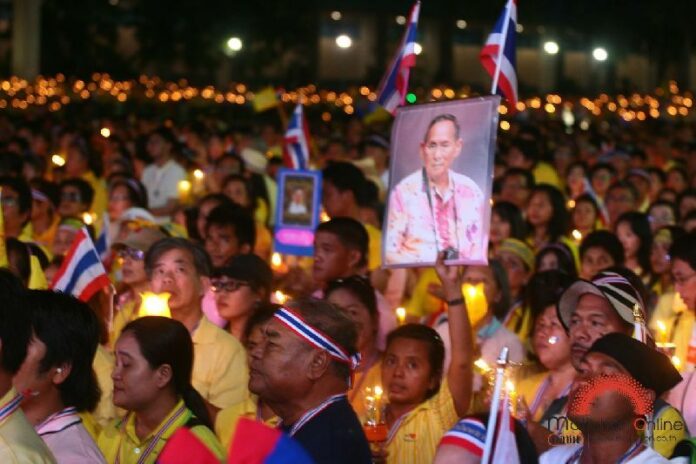
Anti-government protesters held up portraits of His Majesty the King on 5 December 2013. King Bhimibol is revered as a demi god by many Thais.

BANGKOK – Thailand's military government has claimed it has the ability to search for anti-monarchy remarks on private chat messages.

Pornchai Rujiprapa, the Minister of Information, Communication, and Technology (ICT), said yesterday that the Ministry is currently monitoring more than 40 million messages sent via the popular chat application LINE every day. 

"We can see what type of messages are being forwarded," Pornchai told reporters. "We focus especially on those that are libelous, anti-monarchy, or threatening national security."

LINE is one of the most popular chat applications in social media obsessed Thailand. According to the Japan-based company, there are at least 24 million registered LINE users in Thailand out of a population of 65 million.

Pornchai warned that the ICT and police have the authority to identify, locate, and prosecute senders of anti-monarchy messages on charges of lese majeate, a law that criminalises insulting the monarchy and carries a maximum penalty of 15 years in prison.

"The suspects cannot claim that they were not aware of the consequences of their actions, because the law regards them as conspirators in the crimes," Pornchai said. "Therefore, if you receive [anti-monarchy] messages, you should not forward them."

The Minister also vowed to seek the IP addresses and other information about anti-monarchy websites from foreign companies that host their servers, though he admitted that the process could take a long time. 

"It could take a long while because there needs to be a negotiation. Some countries have cultures that are different to Thai," Pornchai explained.

A LINE representative in Thailand told Khaosod that the company cannot simply hand over information of its users to the ICT unless a Japanese court orders the company to do so. 

"I don't know what method the ICT is using to monitor the messages, but let me insist that LINE cannot disclose the information of the users, because it is regarded as privacy rights," said the representative, Waradee Wasawanond.  

When the Thai government stated in August 2013 that it planned to ask LINE to hand over data about possible lese majeste offenders, the Japanese company similarly refused.

"We prize the privacy of our users," LINE said in a statement at the time.

Criticising the Royal Family is punishable by up to 15 years in prison under Section 112 of Thailand's Criminal Code, the law known as "lese majeste." Although the letter of the law only bans criticism of the King, Queen, Regent, and Heir-Apparent, in practice it is used to punish any discussion of the monarchy. 

King Bhumibol, 87, is widely revered as a demi-god by many Thais.

However, public criticism of the monarchy has risen in Thailand in recent years, largely due to the proliferation of Internet access, social media, and chat applications.

Thai junta leader, Gen. Prayuth Chan-ocha, has intensified the crackdown on anti-monarchy networks since he seized power on 22 May 2014. The hardline royalist general has also granted military courts – which do not permit appeals – jurisdiction over lese majeste cases. 

Related news: Thai Govt Releases LINE 'Twelve Values' Stickers


For comments, or corrections to this article please contact: [email protected]

You can also find Khaosod English on Twitter and Facebook
http://twitter.com/KhaosodEnglish
http://www.facebook.com/KhaosodEnglish

Advertisement

No Anti-Coup Student Activists Attend Junta’s Reform Forum

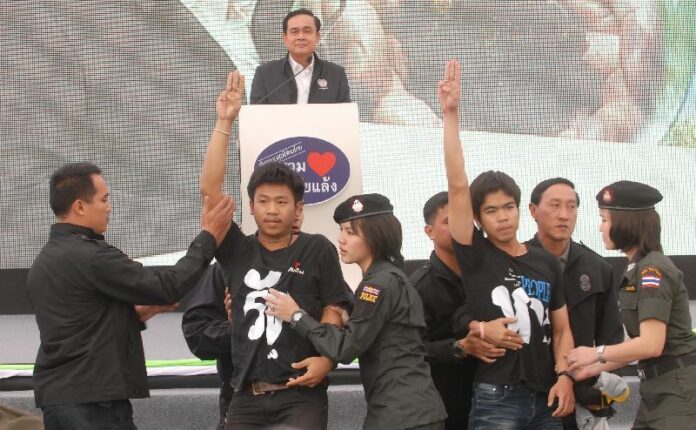
Student activists in Khon Kaen interrupt PM Prayuth Chan-ocha on 19 November to flash an anti-coup salute.

(Prachatai English)

No anti-coup student activist participated in the junta’s national reform forum organized to collect students’ opinions on reform; they say that they do not want to be part of the apparatus of the military government.  

None of the student activists engaged in anti-junta activities participated in ‘Uniting the Force of Students for National Reform’, held from 19-21 December. This forum, which was organized by the junta’s Constitutional Drafting Committee (CDC) and the National Reform Council (NRC), was designed specifically for students, Matichon Online reported on Sunday.

According to the invitation letter sent to universities, the forum is meant to allow students to voice opinions on the direction of the national reform policies of the junta.

Read more of the story: http://www.prachatai.com/english/node/4626


Note: Khaosod English is not responsible for content on other websites.


Advertisement

Japanese Man Wins Surin's Eel Catching Contest

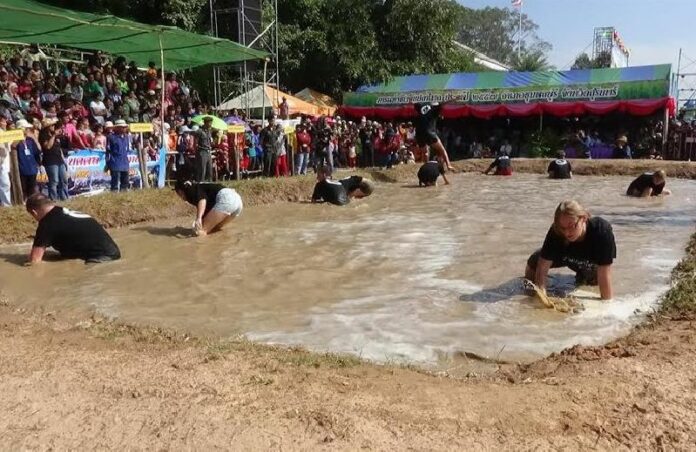
Ten contestants from various countries competed with each other in the 17th Eel Catching Tournament organised by Surin provincial administration in Chumpolburi district, 21 December 2014

SURIN – A Japanese man has been named the winner of the 2014 annual eel catching contest in Surin province.

Ten contestants from various countries such as China, Japan, the Netherlands, and the United Kingdom competed with each other in the 17th Eel Catching Tournament organised by Surin's provincial administration in Chumpolburi district yesterday. 

The tournament is a homage to local tradition and involves contestants searching for eels in a ditch for five minutes. The contestant who manages to catch the highest number of eels and successfully places the slippery creatures in a bamboo-weaved basket wins the contest.

\

However, this year's competition resulted in a tie between a German and a Japanese, as both of them caught 10 eels. The referees decided to hold a second round of contest. The Japanese national eventually won the prize. 

The tournament is a part of annual "Eel Festival" in Chumpolburi district, which also features a market selling local products and rice harvested in the region. 

Teerapol Sakulrak, Chumpolburi's Chief District Officer, said he hoped the festival will encourage tourists from other parts of Thailand to visit Chumpolburi.


For comments, or corrections to this article please contact: [email protected]

You can also find Khaosod English on Twitter and Facebook
http://twitter.com/KhaosodEnglish
http://www.facebook.com/KhaosodEnglish

Advertisement

Soldiers Alarmed By 'Three-Finger Salute' Monkey Warrior

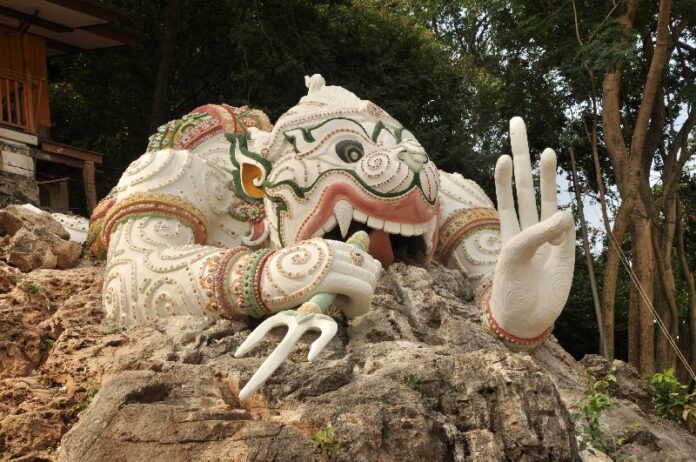
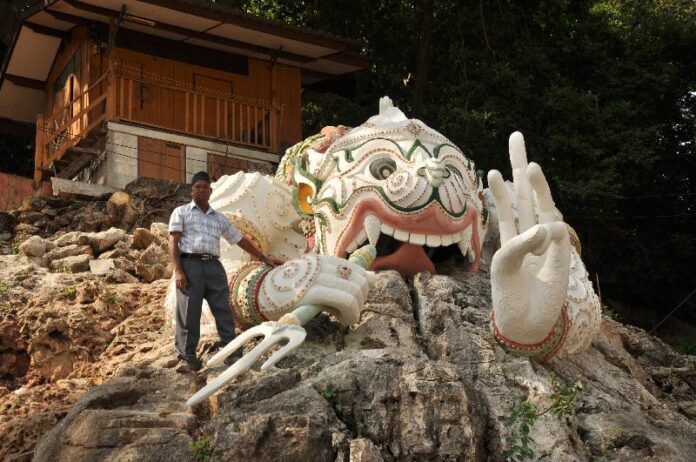
The three-metre tall statue of Hanuman at Rai Don Temple in Phetchaburi province.

PHETCHABURI – Soldiers were dispatched to a temple in Phetchaburi province today to inspect a statue of a mythical monkey warrior raising the forbidden "three-finger salute."

A group of soldiers from 15th Army District arrived at Rai Don Temple in Mueang district at around 10 am and talked with the temple abbot about the statue, which depicts Hanuman, the prominent character of the epic Ramakien, with three fingers raised.

The three-metre tall statue stands on a hill by Bangkok – Phetchaburi road, and has drawn attention from a local military unit for its hand gesture's resemblance to the "three-finger salute" anti-coup protesters have adopted as a symbol of resistance against the junta. 

Samruay Em-oat, the sculptor who created the statue, said he assured soldiers that he did not design the statue with an anti-coup intent. According to the artist, the three fingers raised by Hanuman in fact refer to the so-called Three Pillars of Thailand –  Nation, Religion, and Monarchy. 

"They are the tools that unite all Thai people and create harmony, love, and peace in the society," Samruay said. 

Samruay added that Hanuman is an exemplary warrior who fights evil with moral power.

"The same goes with the current government," Samruay said, "They should only exercise their power in a legitimate, correct, and just way for the sake of people's happiness."

\

Samruay Em-oat, the sculptor who created the artwork, told reporters that the statue did not carry any political message.

In the tale of Ramakien, which is heavily influenced by the Indian epic Ramayana, Hanuman is the captain of a monkey army loyal to King Rama, who wages a war against the evil giant Thotsakan. Ramakien has been the 'official' literature of the Thai Royal Court for hundreds of years; scenes of Ramakien stories are depicted in the massive mural at the Grand Palace in Bangkok.

Phra Kru Sri Thammarat, the abbot of Rai Don Temple, also insisted that Hanuman's three-finger gesture do not carry any political messages. 

"Apart from the Three Pillars of the Nation, in Buddhism the three fingers can refer to the three Dharma that Lord Buddha has discovered: uncertainty, suffering, and illusion, which are the common law that [governs] all things in this world," Phra Kru Sri Thammarat explained. "The only thing that remains in this world is goodness. So, the statue of Hanuman is meant to remind those who pass by to always do good. That is what the temple wants to convey to all Buddhists."

The soldiers eventually left the temple without any incident. 

The three-finger salute became a symbol of anti-coup resistance shortly after the military seized power on 22 May, and is said to be inspired by the popular sci-fi book and movie series, "The Hunger Games," where it is used to symbolize rebellion against totalitarian rule.

Under the junta's ban on all sort of political activities, flashing the three-finger salute in public has been banned along with other anti-coup gestures, such as eating sandwiches, posting a photo with anti-coup messages on Facebook, or reading George Orwell's dystopian novel Nineteen-Eightyfour

\

Protester flashing the three-finger salute at an anti-coup demonstration in Bangkok on 1 June 2014.

Some violators of the ban on protest have been tried and given suspended jail terms in military court, where appeals are not permitted. 

Juna leader and Prime Minister Prayuth Chan-ocha said in a televised address in June that anti-coup protesters are only allowed to raise the three-finger salute "in their own homes."

However, five student activists from Khon Kaen University defied Gen. Prayuth's order and flashed the salute in front of the junta chairman as he was making a speech in Khon Kaen province on 19 November. The students were quickly escorted away to a military camp, where they were interrogated and later released without any charges.  

For comments, or corrections to this article please contact: [email protected]

You can also find Khaosod English on Twitter and Facebook
http://twitter.com/KhaosodEnglish
http://www.facebook.com/KhaosodEnglish

Advertisement

Soldiers Alarmed By 'Three-Finger Salute' Monkey Warrior

The three-metre tall statue of Hanuman at Rai Don Temple in Phetchaburi province.

PHETCHABURI – Soldiers were dispatched to a temple in Phetchaburi province today to inspect a statue of a mythical monkey warrior raising the forbidden "three-finger salute."

A group of soldiers from 15th Army District arrived at Rai Don Temple in Mueang district at around 10 am and talked with the temple abbot about the statue, which depicts Hanuman, the prominent character of the epic Ramakien, with three fingers raised.

The three-metre tall statue stands on a hill by Bangkok – Phetchaburi road, and has drawn attention from a local military unit for its hand gesture's resemblance to the "three-finger salute" anti-coup protesters have adopted as a symbol of resistance against the junta. 

Samruay Em-oat, the sculptor who created the statue, said he assured soldiers that he did not design the statue with an anti-coup intent. According to the artist, the three fingers raised by Hanuman in fact refer to the so-called Three Pillars of Thailand –  Nation, Religion, and Monarchy. 

"They are the tools that unite all Thai people and create harmony, love, and peace in the society," Samruay said. 

Samruay added that Hanuman is an exemplary warrior who fights evil with moral power.

"The same goes with the current government," Samruay said, "They should only exercise their power in a legitimate, correct, and just way for the sake of people's happiness."

\

Samruay Em-oat, the sculptor who created the artwork, told reporters that the statue did not carry any political message.

In the tale of Ramakien, which is heavily influenced by the Indian epic Ramayana, Hanuman is the captain of a monkey army loyal to King Rama, who wages a war against the evil giant Thotsakan. Ramakien has been the 'official' literature of the Thai Royal Court for hundreds of years; scenes of Ramakien stories are depicted in the massive mural at the Grand Palace in Bangkok.

Phra Kru Sri Thammarat, the abbot of Rai Don Temple, also insisted that Hanuman's three-finger gesture do not carry any political messages. 

"Apart from the Three Pillars of the Nation, in Buddhism the three fingers can refer to the three Dharma that Lord Buddha has discovered: uncertainty, suffering, and illusion, which are the common law that [governs] all things in this world," Phra Kru Sri Thammarat explained. "The only thing that remains in this world is goodness. So, the statue of Hanuman is meant to remind those who pass by to always do good. That is what the temple wants to convey to all Buddhists."

The soldiers eventually left the temple without any incident. 

The three-finger salute became a symbol of anti-coup resistance shortly after the military seized power on 22 May, and is said to be inspired by the popular sci-fi book and movie series, "The Hunger Games," where it is used to symbolize rebellion against totalitarian rule.

Under the junta's ban on all sort of political activities, flashing the three-finger salute in public has been banned along with other anti-coup gestures, such as eating sandwiches, posting a photo with anti-coup messages on Facebook, or reading George Orwell's dystopian novel Nineteen-Eightyfour

\

Protester flashing the three-finger salute at an anti-coup demonstration in Bangkok on 1 June 2014.

Some violators of the ban on protest have been tried and given suspended jail terms in military court, where appeals are not permitted. 

Juna leader and Prime Minister Prayuth Chan-ocha said in a televised address in June that anti-coup protesters are only allowed to raise the three-finger salute "in their own homes."

However, five student activists from Khon Kaen University defied Gen. Prayuth's order and flashed the salute in front of the junta chairman as he was making a speech in Khon Kaen province on 19 November. The students were quickly escorted away to a military camp, where they were interrogated and later released without any charges.  


For comments, or corrections to this article please contact: [email protected]

You can also find Khaosod English on Twitter and Facebook
http://twitter.com/KhaosodEnglish
http://www.facebook.com/KhaosodEnglish

Advertisement

Thai Govt Releases LINE 'Twelve Values' Stickers

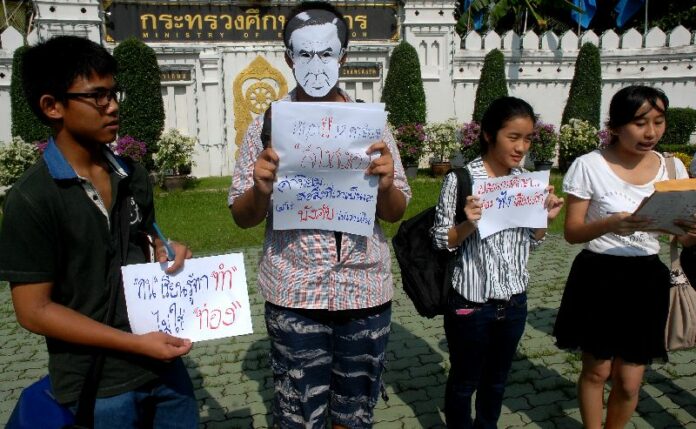
Student activists protest against the "Twelve Values," which they call a "propaganda," in front of the Ministry of Education, 13 Oct 2014.

BANGKOK – The Thai military government has officially unveiled a set of "stickers" that depict the moral teaching of junta leader Prayuth Chan-ocha for the chat application LINE.

Images of the "Twelve Values" stickers were published on the website of the Ministry of Information, Communication, Technology (ICT) today. The set consists of twelve stickers representing each of the "Twelve Values" that Gen. Prayuth wants all Thais to practice, and four stickers for "general occasions."

For instance, the first value, "Loyalty to the Nation, the Religion, and the Monarchy," is depicted by an animated woman hugging a big heart, with the caption "Love with all my heart!," while the sixth value, "Morality and good will for others," is portrayed with a cartoon character telling the phone users, "Don't lie!"

The four "general occasion" stickers feature a cartoon character saying "Happy New Year," "Roger that," "Good morning," and "Good night."

The stickers will be available for download for LINE application between 30 December and 28 January free of charge, the website says. ICT officials previously termed the stickers as a "New Year present" to all Thais.

"We want to help Thai people know more about the values," Songpon said. "So that they will send the stickers to each other on New Year's [Day]," said Deputy Permanent Secretary of the ICT, Songpon Komolsuradet on 16 December. 

LINE was chosen as the platform for the stickers presumably because it is one of the most popular chat applications in social media obsessed Thailand. According to the Japan-based company, there are at least 24 million registered LINE users in Thailand out of a population of 65 million.

The instant messaging application is known for its "stickers," or sets of cartoons and emojis that can be purchased from an online store.

The Thai government will pay LINE seven million baht to provide the Twelve Values stickers to users free of charge, documents on the ICT website reveal

The Twelve Values, which Gen. Prayuth bestowed to the nation in a televised broadcast in July, are the following: 

1. Loyalty to the Nation, the Religion, and the Monarchy

2. Honesty, sacrifice, endurance, and noble ideology for the greater good

3. Gratitude for parents, guardians, and teachers

4. Diligence in acquiring knowledge, via school studies and other methods

5. Preserving the Thai customs and tradition

6. Morality and good will for others

7. Correct understanding of democracy with the King as Head of State

8. Discipline, respect for law, and obedience to the older citizens

9. Constant consciousness to practice good deeds all the time, as taught by His Majesty the King

10. Practice of Self-Sufficient Economy in accordance with the teaching of His Majesty the King

11. Physical and mental strength. Refusal to surrender to religious sins.

12. Uphold the interest of the nation over oneself.

Authorities have already instructed public schools and state agencies to hang a banner listing Gen. Prayuth’s teachings on their premises. State agencies have also produced a poem, song, and 12-part film based on the Twelve Values.

The film, titled "Thai Niyom," stirred controversy shortly after it was released on 6 December because of a scene in which two children are seen painting and praising a picture of Adolf Hitler.

A Cabinet minister from the Office of Prime Minister, which was responsible for the film’s production, was forced to apologise to the Israeli ambassador in Bangkok after the diplomat said he was "deeply saddened" to see the "trivialization and misuse" of Nazi symbols in an official Thai government film. 


For comments, or corrections to this article please contact: [email protected]

You can also find Khaosod English on Twitter and Facebook
http://twitter.com/KhaosodEnglish
http://www.facebook.com/KhaosodEnglish

Advertisement

Thai Govt 'Willing' To Abolish Death Penalty: Official

Wanchai Saengkhao, the State Railway of Thailand (SRT) employee who police say confessed to raping and murdering a 13-year-old girl on a night train on 6 July. The court later sentenced him to death. [Photo from July 8, 2014].

BANGKOK – The Thai government may abolish Thailand's death penalty in the near future, a senior official said, as delegates from around the world overwhelmingly supported the UN's proposal for suspension of death sentence.

"The Ministry of Justice has drafted its plan for national human rights. The goal of the plan is to abolish death penalty," said Chanchao Chaiyanukit, deputy permanent secretary of the Ministry of Justice.

He continued, "It is possible for us to abolish death penalty, if we manage to accomplish the national human rights plan and convince the public to be confident that the Ministry can still punish wrongdoers without death penalty."

Chanchao also claimed that Thailand has not actually executed any prisoner in the last ten years. However, a report by the International Federation for Human Rights (FIDH) indicated that the last execution in Thailand in fact took place in April 2009, when two men were put to death by lethal injection with just one-hour notice at Bang Khwang Prison. 

The official's comment came after Bowornsak Uwanno, the head of the junta-appointed Constitutional Drafting Committee (CDC), suggested that it is time for Thailand to do away with death penalty. Bowornsak said he planned to push ahead with his proposal by adding a clause in the new Constitution to explicitly ban death sentence in Thailand.

Chanchao told Khaosod yesterday that such constitutional clause "can be done."

Current Thai laws allow execution for those convicted of serious crimes such as premeditated murder, armed robbery or rape that leads to deaths, and insurrection against the state. 

Meanwhile, Thailand's representatives to the United Nations abstained from voting on the UN General Assembly's motion that calls on all member nations to suspend death penalties in their countries. 

A majority of the UN member nations – 117 out of 193 – voted in favour of the motion on 18 December, while 38 voted no and 34 abstained. 

It is the third consecutive time that Thai delegates abstained from voting on the motion; Thailand voted no in 2008, when the motion was first introduced to the UN General Assembly, and 2009. 

In a statement released to the press, the US-based human rights organisation Amnesty International hailed the latest vote as a proof that death penalty is increasingly viewed as unacceptable among the world community. 


For comments, or corrections to this article please contact: [email protected]

You can also find Khaosod English on Twitter and Facebook
http://twitter.com/KhaosodEnglish
http://www.facebook.com/KhaosodEnglish

Advertisement

Norwegian Allegedly Assaults 'Annoying Friend'

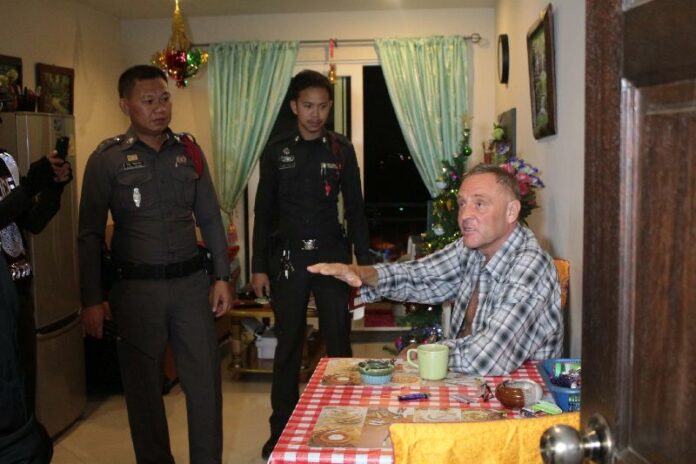
Arne Garden, 57, gave his testimony to the police at his apartment room in Chonburi province, 19 December 2014.

CHONBURI – A Norwegian in Chonburi province has been charged with assault for allegedly slashing a knife at his friend who was being "annoying."

Police officers arrived at Park Lane Jomtien Resort in Banglamung district at around 2. 30 am this morning after security guards at the condominium alerted police of a fight taking place.

Upon arriving at the scene, police found a blood-soaked foreign man waiting for help. Rescue workers applied first aid to the man, who had a knife wound on his head, and sent him to hospital. 

Police officers then visited the room of Arne Garden, 57, whom security guards identified as the attacker. Garden was making coffee when the police arrived and politely invited them into his room. 

Police say Garden's nationality is Norwegian.

Speaking to police between sips of coffee, Garden said he has been friends with the victim for several years. He said the victim showed up at his door earlier tonight and drunkenly asked him to accompany to an ATM to check his money balance.

After Garden and the victim finished checking the balance, the man reportedly asked the Norwegian to visit the ATM with him again.

"The victim kept annoying Garden in front of his door, so Garden seized a kitchen knife, opened the door, and lunged at the man," said Pol.Cpt. Wisanu Chaisuwan. 

Garden has been charged with physical assault. 


For comments, or corrections to this article please contact: [email protected]

You can also find Khaosod English on Twitter and Facebook
http://twitter.com/KhaosodEnglish
http://www.facebook.com/KhaosodEnglish
Advertisement

Royal Resignation: Charges Piled On Srirasmi's Family

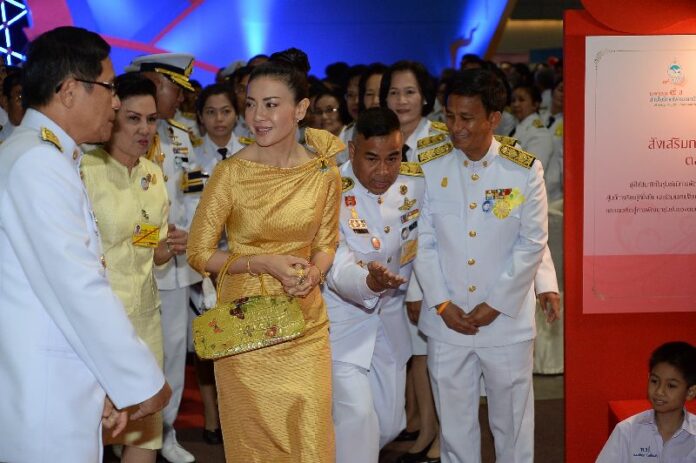
Srirasmi Suwadee, then known as Her Royal Highness Princess Srirasmi at a public in Bangkok (file photo)

BANGKOK – Police say they are speeding up their effort to prosecute relatives of Srirasmi Suwadee, the wife of Thai Crown Prince who resigned from her royal status last week.

Pol.Gen. Aek Angsananond said yesterday that police are nearly finished preparing case files for public prosecutors on the members of the alleged criminal ring associated with Srirasmi's family. According to police, the criminal network was run by Srirasmi's uncle, former chief of the Central Investigation Bureau (CIB) Pol.Lt.Gen. Pongpat Chayapan, and his deputies. 

Pol.Lt.Gen. Pongpat and his accomplices have been charged with numerous offences, including lese majeste (insult of monarchy), corruption, abuse of political office, money laundering, and running illegal gambling businesses.

"We are checking the facts of the cases carefully," said Pol.Gen. Aek. "In our inspection so far, we have not encountered any problem in the cases. We expect to forward them to the public prosecutors soon."

Srirasmi's brother and sister are also accused of belonging to Pongpat's alleged criminal network. Her brother, Col. Nattapol Suwadee, is under arrest on charges of armed racketeering and illegal detention, and her sister, Sudathip Muangnuan, is being held in a Bangkok prison for citing her connections to the monarchy in order to win exclusive rights to sell certain food products to the Crown Prince's palace at an overpriced rate.

In total, 26 arrest warrants have been issued on individuals suspected of belonging to the criminal ring; 11 of these individuals face lese majeste charges, which carry a maximum penalty of 15 years in prison. 

In response to the ongoing scandal, Crown Prince Vajiralongkorn stripped Srirasmi's entire family of the royally-bestowed surname of Akharaphongpreecha, forcing them to revert back to their "commoner" surname, Suwadee, on 30 November. 

Less than two weeks later, on 12 December, the Royal Household Bureau announced that Srirasmi has resigned from her status as a member of the Thai Royal Family. She moved out of the Crown Prince's palace in Bangkok to live with her parents in Ratchaburi province and has not been seen since 13 December, when she applied for a new national ID card as a commoner. 

It is unclear whether Srirasmi and the Crown Prince are formally divorced. The couple married in 2001 and have one 9-year-old son. 

Pol.Lt.Gen. Sriwara Rangsiphramanakul, commander of Bangkok Metropolitan Police, said he expected that police will finalise their investigation of suspects charged with lese majeste "by the end of this week."

"We have excellent paper evidence, material evidence, and witness' testimony [against the suspects]," Pol.Lt.Gen. Sriwara said yesterday. 


For comments, or corrections to this article please contact: [email protected]

You can also find Khaosod English on Twitter and Facebook
http://twitter.com/KhaosodEnglish
http://www.facebook.com/KhaosodEnglish

Advertisement

Royal Resignation: Charges Piled On Srirasmi's Family

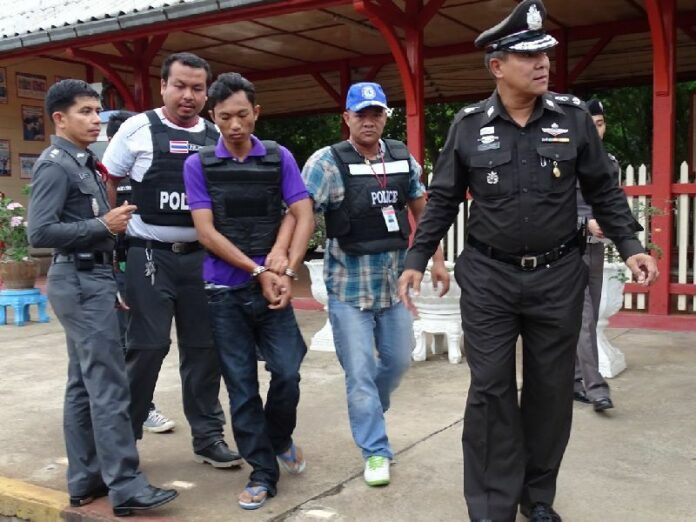
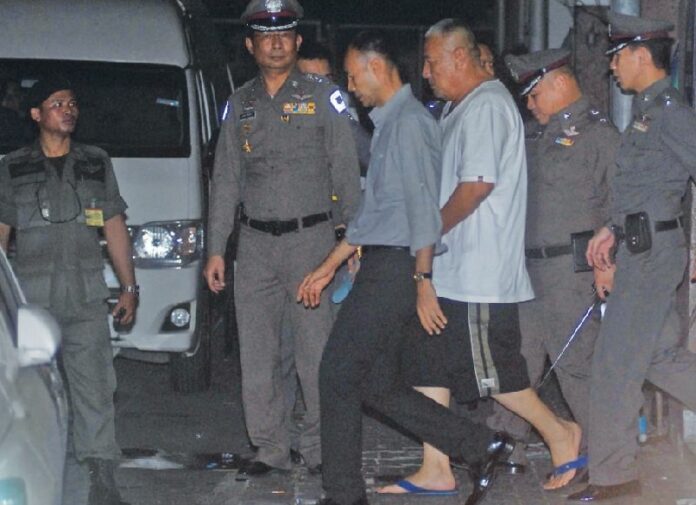
Pol.Lt.Gen. Pongpat Chayapan (in white) being taken to court, where he was denied bail, 24 November 2014

BANGKOK – Police say they are speeding up their effort to prosecute relatives of Srirasmi Suwadee, the wife of Thai Crown Prince who resigned from her royal status last week.

Pol.Gen. Aek Angsananond said yesterday that police are nearly finished preparing case files for public prosecutors on the members of the alleged criminal ring associated with Srirasmi's family. According to police, the criminal network was run by Srirasmi's uncle, former chief of the Central Investigation Bureau (CIB) Pol.Lt.Gen. Pongpat Chayapan, and his deputies. 

Pol.Lt.Gen. Pongpat and his accomplices have been charged with numerous offences, including lese majeste (insult of monarchy), corruption, abuse of political office, money laundering, and running illegal gambling businesses.

"We are checking the facts of the cases carefully," said Pol.Gen. Aek. "In our inspection so far, we have not encountered any problem in the cases. We expect to forward them to the public prosecutors soon."

Srirasmi's brother and sister are also accused of belonging to Pongpat's alleged criminal network. Her brother, Col. Nattapol Suwadee, is under arrest on charges of armed racketeering and illegal detention, and her sister, Sudathip Muangnuan, is being held in a Bangkok prison for citing her connections to the monarchy in order to win exclusive rights to sell certain food products to the Crown Prince's palace at an overpriced rate.

In total, 26 arrest warrants have been issued on individuals suspected of belonging to the criminal ring; 11 of these individuals face lese majeste charges, which carry a maximum penalty of 15 years in prison. 

In response to the ongoing scandal, Crown Prince Vajiralongkorn stripped Srirasmi's entire family of the royally-bestowed surname of Akharaphongpreecha, forcing them to revert back to their "commoner" surname, Suwadee, on 30 November. 

Less than two weeks later, on 12 December, the Royal Household Bureau announced that Srirasmi has resigned from her status as a member of the Thai Royal Family. She moved out of the Crown Prince's palace in Bangkok to live with her parents in Ratchaburi province and has not been seen since 13 December, when she applied for a new national ID card as a commoner. 

It is unclear whether Srirasmi and the Crown Prince are formally divorced. The couple married in 2001 and have one 9-year-old son. 

Pol.Lt.Gen. Sriwara Rangsiphramanakul, commander of Bangkok Metropolitan Police, said he expected that police will finalise their investigation of suspects charged with lese majeste "by the end of this week."

"We have excellent paper evidence, material evidence, and witness' testimony [against the suspects]," Pol.Lt.Gen. Sriwara said yesterday. 


For comments, or corrections to this article please contact: [email protected]

You can also find Khaosod English on Twitter and Facebook
http://twitter.com/KhaosodEnglish
http://www.facebook.com/KhaosodEnglish
Advertisement

Hot News

LATEST NEWS

Bangkok
overcast clouds
27.7 ° C
31.1 °
27.7 °
77 %
2.8kmh
99 %
Thu
28 °
Fri
37 °
Sat
36 °
Sun
37 °
Mon
37 °