30.5 C
Bangkok
Tuesday, June 23, 2026
Home Blog Page 3126

Riot Police Deployed to Hong Kong Protest Site Near Government HQ

--------------------------------------------------------------------------------
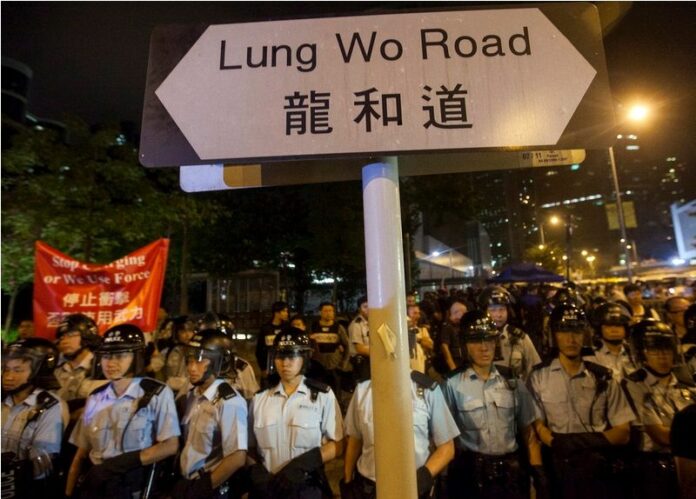
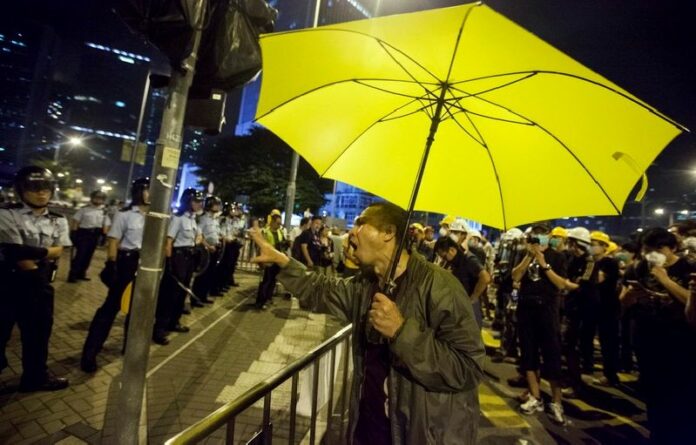
A pro-democracy protester shouts at police on Lung Wo Road, next to the Hong Kong Chief Executive's Office, Hong Kong, China, 01 December 2014. Police clashed with pro-democracy protestors on Hong Kong island early Monday, after the fifth consecutive night of clashes since authorities cleared out a major protest camp last week. EPA/ALEX HOFFORD

By Christy Choi

HONG KONG (DPA) Police clashed with pro-democracy protesters on Hong Kong island early Monday, after a fifth consecutive night of violence in the Chinese territory led to dozens of arrests.

As of 5 am (2100 GMT Sunday), 32 people had been arrested, a police spokeswoman said, including 20 in Admiralty district near government headquarters and 12 in the Kowloon district of Mong Kok.

\
A pro-democracy protester shouts at police on Lung Wo Road, next to the Hong Kong Chief Executive's Office, Hong Kong, China, 01 December 2014 [EPA].

Four police officers had been injured, government-run RTHK radio reported.

The clashes have intensified since authorities cleared out a major protest camp in Mong Kok last week.

The government advised staff Monday not to go to work at their Admiralty headquarters.

Television and social media images early Monday showed riot police running down the escalators adjoining government offices in Admiralty, where hundreds of protesters remained camped out.

Police accused protesters of moving away from their principles of non-violence by charging police lines.

\
Hong Kong riot police are seen on Lung Wo Road, next to the Hong Kong Chief Executive's Office, Hong Kong, China, 01 December 2014 [EPA]

Protesters had gathered overnight in response to a threat by a leading student union – the Hong Kong Federation of Students – that it could escalate its months-long protest against restrictions imposed by Beijing on who could become Hong Kong's next chief executive.

Some protesters threw water bottles and umbrellas towards the police, hurling insults, who used pepper spray and batons to push back the crowds.

Protesters told dpa overnight they determined to stay, despite recent polls showing they are losing public favour.

"I don't think the government will do anything if we leave the streets," said Bernie Ma, a 25-year-old legal industry professional.

For comments, or corrections to this article please contact: [email protected]

You can also find Khaosod English on Twitter and Facebook
http://twitter.com/KhaosodEnglish
http://www.facebook.com/KhaosodEnglish

Advertisement

Riot Police Deployed to Hong Kong Protest Site Near Government HQ

Hong Kong riot police are seen on Lung Wo Road, next to the Hong Kong Chief Executive's Office, Hong Kong, China, 01 December 2014 [EPA]

By Christy Choi

HONG KONG (DPA) Police clashed with pro-democracy protesters on Hong Kong island early Monday, after a fifth consecutive night of violence in the Chinese territory led to dozens of arrests.

As of 5 am (2100 GMT Sunday), 32 people had been arrested, a police spokeswoman said, including 20 in Admiralty district near government headquarters and 12 in the Kowloon district of Mong Kok.

\
A pro-democracy protester shouts at police on Lung Wo Road, next to the Hong Kong Chief Executive's Office, Hong Kong, China, 01 December 2014 [EPA].

Four police officers had been injured, government-run RTHK radio reported.

The clashes have intensified since authorities cleared out a major protest camp in Mong Kok last week.

The government advised staff Monday not to go to work at their Admiralty headquarters.

Television and social media images early Monday showed riot police running down the escalators adjoining government offices in Admiralty, where hundreds of protesters remained camped out.

Police accused protesters of moving away from their principles of non-violence by charging police lines.

\
Hong Kong riot police are seen on Lung Wo Road, next to the Hong Kong Chief Executive's Office, Hong Kong, China, 01 December 2014 [EPA]

Protesters had gathered overnight in response to a threat by a leading student union – the Hong Kong Federation of Students – that it could escalate its months-long protest against restrictions imposed by Beijing on who could become Hong Kong's next chief executive.

Some protesters threw water bottles and umbrellas towards the police, hurling insults, who used pepper spray and batons to push back the crowds.

Protesters told dpa overnight they determined to stay, despite recent polls showing they are losing public favour.

"I don't think the government will do anything if we leave the streets," said Bernie Ma, a 25-year-old legal industry professional.

For comments, or corrections to this article please contact: [email protected]

You can also find Khaosod English on Twitter and Facebook
http://twitter.com/KhaosodEnglish
http://www.facebook.com/KhaosodEnglish

Advertisement

Udon Thani Temple Building '300,000-Coin Buddha' Statue

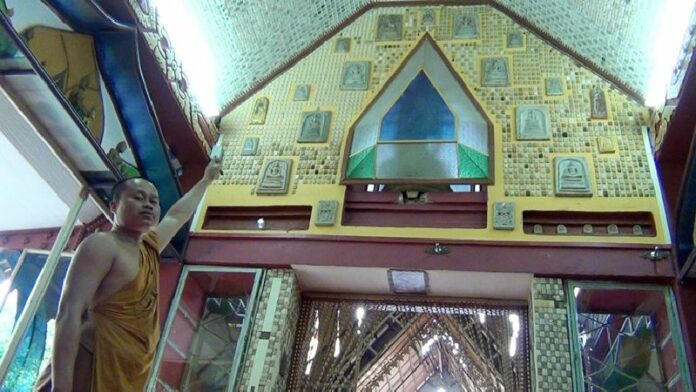
Decoration inside the temple

UDON THANI — A temple in Udon Thani is nearly finished with the ambitious project of covering a Buddha statue with 300,000 coins of Thai and foreign currencies.

Phra Jedsada Mahalapo, a deputy abbot of Wat Tong Toom Kum Temple, said the 9-metre Meditating Buddha statue already has more than 200,000 coins on its surface, thanks to donations from enthusiastic temple-goers. 

The artwork includes rare coins, some dating back to the reign of Rama IV, and foreign currencies, Phra Jedsada told Khaosod.

\

"It was the abbot’s idea to decorate the Buddha statue with coins," Phra Jessada said. "Because coins bear the portrait of His Majesty the King on one side and pictures of important places around Thailand on the other, we instructed the artists to show both sides of the coins. We want to preserve these coins for the future generation to see."

He added that members of the public are welcomed to see the artwork for themselves and donate their own coins if they wish to do so. 

\

Apart from the 9-metre Meditating Buddha, the temple's 7.9-metre Reclining Buddha and walls around the prayer chapel are also decorated with more than 130,000 coins. 

 
For comments, or corrections to this article please contact[email protected]

You can also find Khaosod English on Twitter and Facebook
http://twitter.com/KhaosodEnglish
http://www.facebook.com/KhaosodEnglish

Advertisement

Southern 'Separatist Banners' Dismiss Peace Talks

--------------------------------------------------------------------------------
Dozens of banners questioning upcoming peace talks between southern insurgents and Thailand's military government were hung across Pattani, Yala, and Narathiwat provinces

YALA — Suspected insurgents in southern Thailand have hung dozens of banners across the region questioning upcoming peace talks with Thailand's military government.

Security officers say the banners were found between 5 and 6 am this morning in many districts across Pattani, Yala, and Narathiwat provinces, an area known as Thailand’s "Deep South." Similar banners were also hung in Songhkla province’s Saba Yoi district, which neighbours the Deep South region.

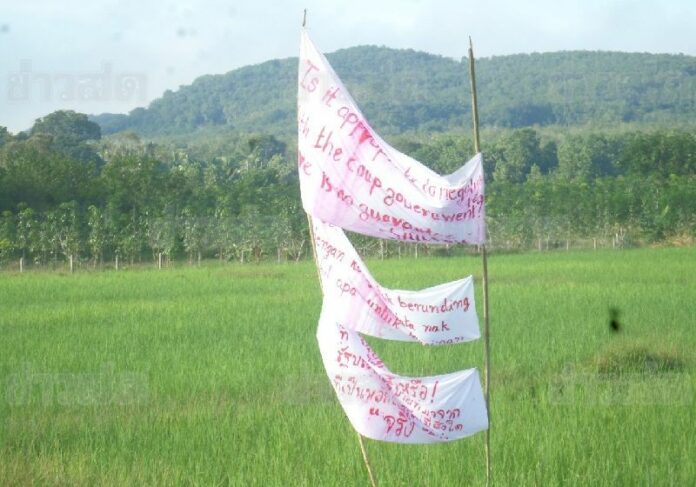
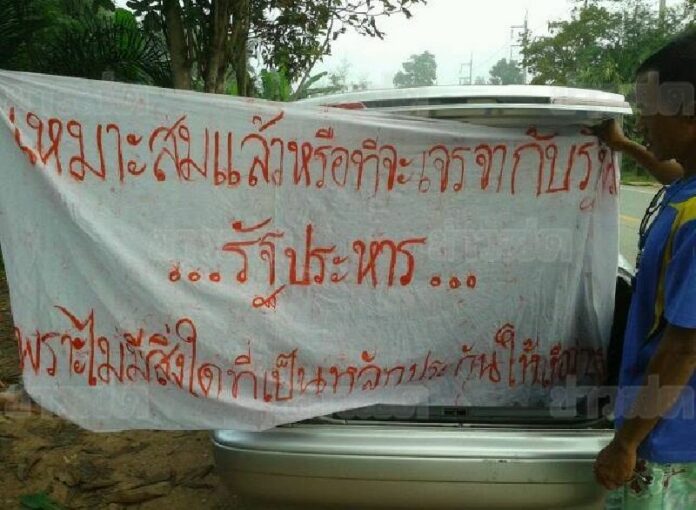
The banners, written in Thai, English, and Malay, read: "Is it appropriate to negotiate with the coup government? There is no guarantee for sincerity."

\

The statement appears to refer to tentative "peace talks" between Thai authorities and representatives of the Islamic insurgent groups in the Deep South that will be mediated by the Malaysian government. Thai officials hinted that the government is willing to participate in the talks, though no further details have been released.

The banners surfaced on the same day Thai Prime Minister and junta chairman Prayuth Chan-ocha departed for Malaysia to meet with Malaysian PM Najib Razak. The peace talks are expected to be one of the major talking points during the two leaders’ meeting.

Homemade explosives were placed near some of the banners, apparently in an effort to kill or wound removal teams, officials said. In one incident, soldiers and police officers narrowly escaped injury when a homemade bomb exploded after they finished taking down a banner in Yala's Muang district at around 8 am today. Other bombs were defused without any incident. 

One suspect has been arrested in Pattani this morning on suspicion of hanging the banners. 

At least 6,200 people have been killed since secessionist violence broke out in the Deep South in 2004. The bloody campaign has been waged by shadowy militant groups that seek to revive the independent sultanate of Pattani that was incorporated into modern Thailand in the early 20th century.

In contrast to the rest of country, where the vast majority of Thais are Buddhist, the Deep South is dominated by Muslims who speak a Malaysian dialect and often do not consider themselves Thai.  

\

In 2013, former Prime Minister Yingluck Shinawatra's government attempted to resolve the protracted conflict in the Deep South by organising a ground-breaking "peace dialogue" with several groups believed to have been responsible for a many attacks in the restive region. 

However, the process was eventually aborted, partly because of resistance from hawkish factions in the armed forces who insisted that Bangkok should not negotiate with the insurgents. The talks were also derailed by anti-government protests that erupted in 2013 and debilitated Yingluck’s government.  

After six months of prolonged street protests, Gen. Prayuth seized power in a military coup on 22 May 2014. The Thai military junta has promised to bring "peace" to the southern region "within a year."

Last week, the government approved a fresh shipment of firearms for state-organised "armed volunteers" in the Deep South. 

Related articles:
Southern Separatist Banners Mock 'Happiness' Policy

Southern Unrest: Roadside Bomb Injures Teacher Bodyguards

For comments, or corrections to this article please contact: [email protected]

You can also find Khaosod English on Twitter and Facebook
http://twitter.com/KhaosodEnglish
http://www.facebook.com/KhaosodEnglish

Advertisement

Southern 'Separatist Banners' Dismiss Peace Talks

The banners, written in Thai, English, and Malay, read: "Is it appropriate to negotiate with the coup government? There is no guarantee for sincerity."

YALA — Suspected insurgents in southern Thailand have hung dozens of banners across the region questioning upcoming peace talks with Thailand's military government.

Security officers say the banners were found between 5 and 6 am this morning in many districts across Pattani, Yala, and Narathiwat provinces, an area known as Thailand’s "Deep South." Similar banners were also hung in Songhkla province’s Saba Yoi district, which neighbours the Deep South region.

The banners, written in Thai, English, and Malay, read: "Is it appropriate to negotiate with the coup government? There is no guarantee for sincerity."

\

The statement appears to refer to tentative "peace talks" between Thai authorities and representatives of the Islamic insurgent groups in the Deep South that will be mediated by the Malaysian government. Thai officials hinted that the government is willing to participate in the talks, though no further details have been released.

The banners surfaced on the same day Thai Prime Minister and junta chairman Prayuth Chan-ocha departed for Malaysia to meet with Malaysian PM Najib Razak. The peace talks are expected to be one of the major talking points during the two leaders’ meeting.

Homemade explosives were placed near some of the banners, apparently in an effort to kill or wound removal teams, officials said. In one incident, soldiers and police officers narrowly escaped injury when a homemade bomb exploded after they finished taking down a banner in Yala's Muang district at around 8 am today. Other bombs were defused without any incident. 

One suspect has been arrested in Pattani this morning on suspicion of hanging the banners. 

At least 6,200 people have been killed since secessionist violence broke out in the Deep South in 2004. The bloody campaign has been waged by shadowy militant groups that seek to revive the independent sultanate of Pattani that was incorporated into modern Thailand in the early 20th century.

In contrast to the rest of country, where the vast majority of Thais are Buddhist, the Deep South is dominated by Muslims who speak a Malaysian dialect and often do not consider themselves Thai.  

\

In 2013, former Prime Minister Yingluck Shinawatra's government attempted to resolve the protracted conflict in the Deep South by organising a ground-breaking "peace dialogue" with several groups believed to have been responsible for a many attacks in the restive region. 

However, the process was eventually aborted, partly because of resistance from hawkish factions in the armed forces who insisted that Bangkok should not negotiate with the insurgents. The talks were also derailed by anti-government protests that erupted in 2013 and debilitated Yingluck’s government.  

After six months of prolonged street protests, Gen. Prayuth seized power in a military coup on 22 May 2014. The Thai military junta has promised to bring "peace" to the southern region "within a year."

Last week, the government approved a fresh shipment of firearms for state-organised "armed volunteers" in the Deep South. 

Related articles:
Southern Separatist Banners Mock 'Happiness' Policy

Southern Unrest: Roadside Bomb Injures Teacher Bodyguards
 

For comments, or corrections to this article please contact: [email protected]

You can also find Khaosod English on Twitter and Facebook
http://twitter.com/KhaosodEnglish
http://www.facebook.com/KhaosodEnglish

Advertisement

Junta Spokesman Faults CNN For 'Misleading' Report on Anti-Coup Protests

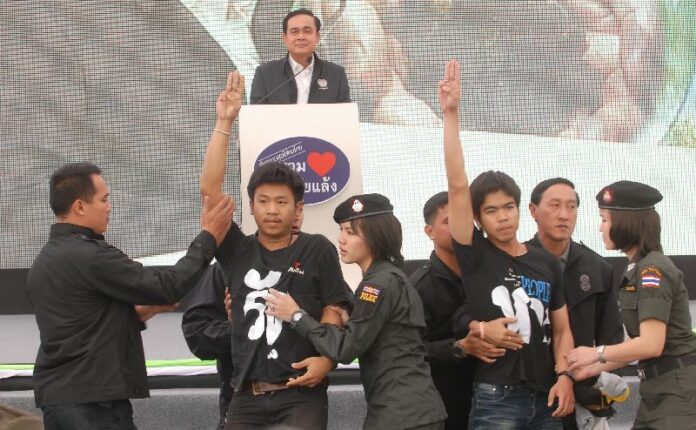
Five student activists from Khon Kaen University interrupted a speech by Gen. Prayuth Chan-ocha in Khon Kaen province on 19 November, and flashed the forbidden "three-finger salute", an anti-coup gesture inspired by "The Hunger Games" movies.

BANGKOK — A spokesperson for Thailand’s military government has expressed concern over a recent CNN report’s "misleading presentation" of events in post-coup Thailand.

Col. Sansern Kaewkumnerd, spokesperson of the Office of Prime Minister, warned yesterday that the CNN report, titled "More held in military-led Thailand after flashing 'Hunger Games' salute," may mislead international audiences into believing there is an ongoing anti-coup protest movement in Thailand. 

"The fact that CNN presented the news by using old footage may mislead people into thinking that the situation in our country has not returned to normalcy yet," Col. Sansern said. "They may think there's a lot of conflict here."

The article, published on 20 November, describes the recent arrests of student activists who staged flash protests against the military junta in Bangkok and Khon Kaen province. 

\ 
Student activists in Khon Kaen interrupt PM Prayuth Chan-ocha on 19 November to flash an anti-coup salute.

Although a video published with the article does feature some older footage of substantially larger anti-coup protests that occurred in late May, the news content is focused on more recent developments, such as the five student activists in Khon Kaen who interrupted a speech by the junta leader on 19 November to flash the forbidden three-finger salute, an anti-coup gesture inspired by "The Hunger Games" movies.

The next day, police arrested two more student activists in Bangkok for attempting to organise a mass screening of the latest installment of "The Hunger Games" trilogy, "Mockingjay – Part One." Another student was also arrested for raising the three-finger salute in the lobby of a cinema where the film was being shown. 

\
Natcha Kong-udom was arrested by police after she began flashing the three-finger salute in Siam Paragon's cinema, 20 Nov 2014.

The CNN report also quoted several activists and human rights experts who have  criticised the Thai junta, formally known as the National Council for Peace and Order (NCPO), for infringing on freedom of expression in Thailand since the 22 May 2014 coup.

"There's little indication the opposition is going away, nor is there anything like national elections on the immediate horizon suggesting a return to civilian rule," the report noted. 

Today, Col. Sansern said the US-based news agency should understand that "the situation in our country is not one hundred percent perfect. The problems in their country and the problems in our country are different."

The spokesperson, who was also quoted in the CNN article, added that retaining martial law is necessary because it allows security forces to "put an end to any incident" as soon as it happens. Normal laws would prevent security forces from acting swifly because of their "many procedures," Col. Sansern said.

Under martial law, security forces do not need a warrant to search and arrest any person that they have “reasonable ground to suspect” is violating the junta's orders.

"Our main concern is the happiness of the people and safety of the public," the spokesperson told reporters this morning. "If the people in our country feel satisfied, and if there is peace and order in the country, foreigners will see it."

According to the Col. Sansern said, the Ministry of Foreign Affairs has been instructed to "create understanding" with CNN's editorial board.

"We are worried about this issue. However, let me insist that we still respect the [rights] of Thai and foreign media," Col. Sansern asserted. "But their news presentation has to rest on facts."

 
For comments, or corrections to this article please contact: [email protected]

You can also find Khaosod English on Twitter and Facebook
http://twitter.com/KhaosodEnglish
http://www.facebook.com/KhaosodEnglish

Advertisement

Too Much Monkey Business: Thai Town’s Love-Hate Relationship

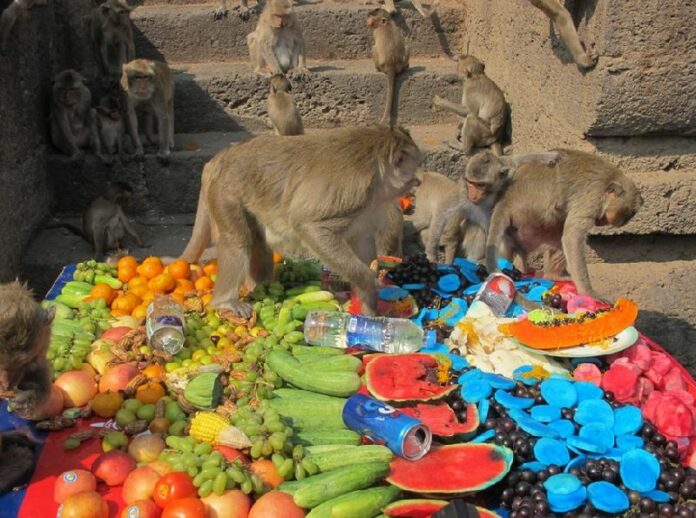
A group of monkeys feasting on a variety of fresh fruit in Lopburi, Thailand, 29 November 2014. The city's 26th annual Monkey Festival was held on Sunday to honour the thousands of crab-eating macaques living in Lopburi's old town. Photo: Bill Bredesen/dpa

By Bill Bredesen

LOPBURI (DPA) — They swing from the telephone wires, loot passing pickup trucks and barge into local shophouses, taking whatever they can get their little paws on.

For the thousands of crab-eating macaque monkeys that have taken up residence in the historical city centre of Lopburi, Thailand, 150 kilometres north of Bangkok, ordinary rules of good citizenship don’t always apply.

Local residents say theirs is a love-hate relationship.

On one hand, the monkeys are Lopburi’s prime tourist attraction, the sole reason that many out-of-towners visit, and a seemingly endless source of smiles and good cheer.

But the monkeys are also a nuisance and seem to be reproducing at an unchecked rate. Nearly everyone in Lopburi voices some level of appreciation for them before expressing hope that the city government will do something to limit their numbers.

On Sunday, the macaques were the guests of honour at the city’s 26th annual Monkey Festival, where they were treated to an extravagant buffet: more than 2 tons of fruit and 1 ton of vegetables, along with sweetened drinks like lychee sodas, all donated by local residents and the hotel group that sponsors the event.

The main celebration was held at Wat Prong Sam Yot, a 13th-century Khmer-style temple that often is better known simply as the “monkey temple.” During non-festival times, it marks the heart of their domain in Lopburi.

The festival cost roughly 400,000 baht (12,200 dollars), with four monkey “seatings” scheduled throughout the day. Most residents said they were happy to give back to the monkeys for bringing so many tourists to their town.

A live band played traditional Thai music, while costumed dancers performed, and camera-happy tourists snapped photographs of the feasting monkeys.

Despite their special status in Lopburi, the monkeys are also a source of persistent headaches for some shop owners, workers and residents, particularly in the immediate vicinity of the monkey temple.

“Lately it seems like they are more of a problem because their numbers are increasing and they are spreading out into more neighbourhoods,” said Itiphat Tantipati, 40, a hotel owner, as he wielded a metre-long bamboo stick to chase monkeys away from his guests’ automobiles the day before the festival.

“They damage the building, tear out wires, break windows, pull the rubber parts off cars,” he said.

Nearly everyone who lives or works around Wat Prong Sam Yot keeps a similar “monkey control” device on-hand, whether a long stick, a slingshot or a noisy toy pistol.

Some businesses have been forced to shut down because of the monkeys, Itiphat said, pointing to an abandoned building on the opposite corner. Originally a popular theatre, it was later converted into a shopping mall, but that too failed when the ever-curious macaques went after everyone’s shopping bags.

“It’s been empty for 10 years. No investor would want to come here. It’s not worth the money,” he said.

“These buildings are all deserted,” agreed Sorapong Wongdeen, 55, a local resident, gazing up at the shuttered second- and third-storey windows of other shophouses in the square overlooking the temple. “Who knows where they went. They can’t sell anything. People can’t even park their cars around here.”

Some building owners have installed 12-volt, non-lethal electric fencing along their upper levels in an attempt to keep the animals off their roofs and awnings. At regular intervals, the ominous “snapping” sound of electrical currents, and a briefly visible jolt of electricity, is sometimes enough to keep the monkeys away.

Others accept the animals as a fact of life in Lopburi.

“I play with them,” said Suthip Tantiwong, the 60-year-old owner of a small automobile parts shop across the street from the monkey temple.

As she talked, a baby macaque wandered into the shop and climbed up onto a glass display case. Suthip gently shook hands with the little creature and then reached into a plastic bag full of sweets, unwrapping one to give to the small monkey.

Several more quickly appeared in the shop, perhaps anticipating a free meal. But before things could become unwieldy, Suthip brandished a toy pistol, pointed at the newcomers and pulled the trigger. At the sound, the monkeys fled in hisses and shrieks.

“They steal every day, but they don’t bite unless they’re angry,” said Sunit Krataipo, 59, a traffic policeman stationed at a busy intersection opposite the temple.

“But even though there are some problems, serious monkey bites or scratches do not happen very frequently.”

Advertisement

Thailand's Crown Prince Strips Wife's Family of Royal Name

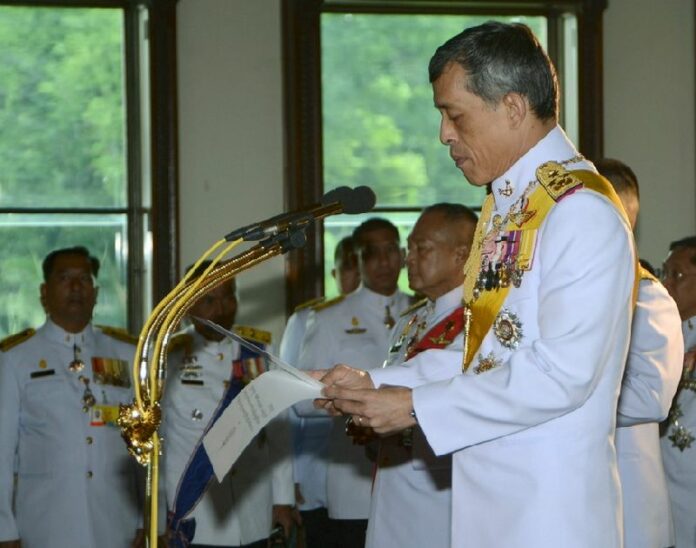
A Thai Parliament handout photograph shows Thai Crown Prince Maha Vajiralongkorn (R) during the opening ceremony of the inaugural meeting of the military-appointed National Legislative Assembly at the Ananta Samakhom Throne Hall of Dusit Palace, in Bangkok, Thailand, 07 August 2014. Crown Prince Maha Vajiralongorn issued an official letter stripping his wife's family of its royally bestowed surname due to a corruption scandal. EPA/THAILAND PARLIAMENT

BANGKOK (DPA) — Thai Crown Prince Maha Vajiralongorn issued an official letter stripping his wife's family of its royally bestowed surname due to a corruption scandal, local media reported Sunday.

The letter comes after the arrest of three close relatives of the Princess Srirasmi Akrapongpreecha for involvement in a graft network allegedly headed by the ousted Central Investigation Bureau chief.

"The Akrapongpreecha family must revert to their previous surname," the letter addressed to the Ministry of Interior stated.

Police spokesman Colonel Prawut Thawornsiri confirmed that the letter had been received.

A royally appointed surname is given as an honour to a family that has served the country or the monarchy.

The crown prince and Srirasmi married in 2001 and have a son together.


Advertisement

Too Much Monkey Business: Thai Town's Love-Hate Relationship

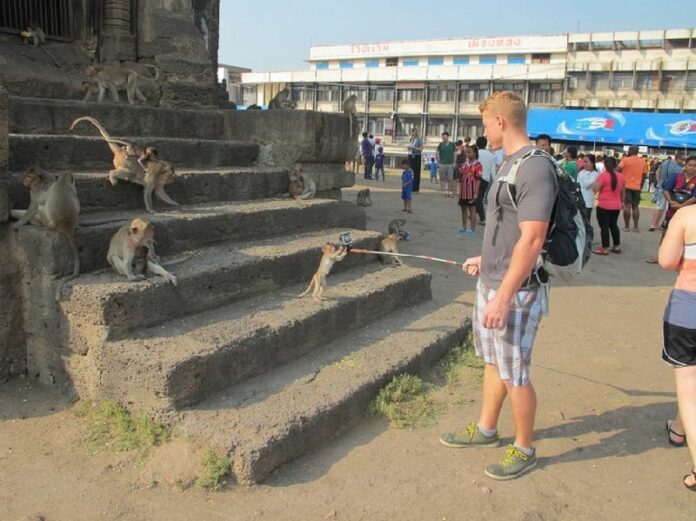
A monkey curiously examines a tourist's GoPro camera in Lopburi, Thailand, 29 November 2014. The city's 26th annual Monkey Festival was held on Sunday to honour the thousands of crab-eating macaques living in Lopburi's old town. Photo: Bill Bredesen/dpa

By Bill Bredesen

LOPBURI (DPA) – They swing from the telephone wires, loot passing pickup trucks and barge into local shophouses, taking whatever they can get their little paws on.

For the thousands of crab-eating macaque monkeys that have taken up residence in the historical city centre of Lopburi, Thailand, 150 kilometres north of Bangkok, ordinary rules of good citizenship don't always apply.

Local residents say theirs is a love-hate relationship.

On one hand, the monkeys are Lopburi's prime tourist attraction, the sole reason that many out-of-towners visit, and a seemingly endless source of smiles and good cheer.

But the monkeys are also a nuisance and seem to be reproducing at an unchecked rate. Nearly everyone in Lopburi voices some level of appreciation for them before expressing hope that the city government will do something to limit their numbers.

\

On Sunday, the macaques were the guests of honour at the city's 26th annual Monkey Festival, where they were treated to an extravagant buffet: more than 2 tons of fruit and 1 ton of vegetables, along with sweetened drinks like lychee sodas, all donated by local residents and the hotel group that sponsors the event.

The main celebration was held at Wat Prong Sam Yot, a 13th-century Khmer-style temple that often is better known simply as the "monkey temple." During non-festival times, it marks the heart of their domain in Lopburi.

The festival cost roughly 400,000 baht (12,200 dollars), with four monkey "seatings" scheduled throughout the day. Most residents said they were happy to give back to the monkeys for bringing so many tourists to their town.

A live band played traditional Thai music, while costumed dancers performed, and camera-happy tourists snapped photographs of the feasting monkeys.

Despite their special status in Lopburi, the monkeys are also a source of persistent headaches for some shop owners, workers and residents, particularly in the immediate vicinity of the monkey temple.

"Lately it seems like they are more of a problem because their numbers are increasing and they are spreading out into more neighbourhoods," said Itiphat Tantipati, 40, a hotel owner, as he wielded a metre-long bamboo stick to chase monkeys away from his guests' automobiles the day before the festival.

"They damage the building, tear out wires, break windows, pull the rubber parts off cars," he said.

Nearly everyone who lives or works around Wat Prong Sam Yot keeps a similar "monkey control" device on-hand, whether a long stick, a slingshot or a noisy toy pistol.

Some businesses have been forced to shut down because of the monkeys, Itiphat said, pointing to an abandoned building on the opposite corner. Originally a popular theatre, it was later converted into a shopping mall, but that too failed when the ever-curious macaques went after everyone's shopping bags.

"It's been empty for 10 years. No investor would want to come here. It's not worth the money," he said.

"These buildings are all deserted," agreed Sorapong Wongdeen, 55, a local resident, gazing up at the shuttered second- and third-storey windows of other shophouses in the square overlooking the temple. "Who knows where they went. They can't sell anything. People can't even park their cars around here."

Some building owners have installed 12-volt, non-lethal electric fencing along their upper levels in an attempt to keep the animals off their roofs and awnings. At regular intervals, the ominous "snapping" sound of electrical currents, and a briefly visible jolt of electricity, is sometimes enough to keep the monkeys away.

Others accept the animals as a fact of life in Lopburi.

"I play with them," said Suthip Tantiwong, the 60-year-old owner of a small automobile parts shop across the street from the monkey temple.

As she talked, a baby macaque wandered into the shop and climbed up onto a glass display case. Suthip gently shook hands with the little creature and then reached into a plastic bag full of sweets, unwrapping one to give to the small monkey.

Several more quickly appeared in the shop, perhaps anticipating a free meal. But before things could become unwieldy, Suthip brandished a toy pistol, pointed at the newcomers and pulled the trigger. At the sound, the monkeys fled in hisses and shrieks.

"They steal every day, but they don't bite unless they're angry," said Sunit Krataipo, 59, a traffic policeman stationed at a busy intersection opposite the temple.

"But even though there are some problems, serious monkey bites or scratches do not happen very frequently."


For comments, or corrections to this article please contact: [email protected]

You can also find Khaosod English on Twitter and Facebook
http://twitter.com/KhaosodEnglish
http://www.facebook.com/KhaosodEnglish

Advertisement

Thai Transport Dept Rules Uber Service Illegal

Thai actress Paula Taylor poses with an Uber driver in a promotional photo released to the press by Uber in February 2014

BANGKOK – Thailand has become the latest country to ban the service of the international crowd-source taxi company Uber.

Teerapong Rordprasert, director of the Department of Land Transport, said in a statement today that Uber service is against public vehicle laws in Thailand because its drivers do not hold proper licenses to operate as taxis and are not registered, while its fares are lower than the standard set by Thai authorities.

“Furthermore, the payment of fares via credit cards may affect the financial security of the passengers,” Teerapong said.
According to the announcement, the formal ban on Uber service in Thailand has been reached following a joint meeting between the Department of Land Transport and military units in Bangkok; since Thailand is currently under martial, the armed forces are also responsible for laws enforcement and other civilian matters.

The US-based company Uber first launched its premium car service in Thailand in April 2014. Mobile phone users could book sedans serviced by drivers contracted with Uber and pay for their rides via credit card.

Although many customers were initially dissuaded by the service’s relatively steep price, the company launched a low-cost service in Bangkok in October offering cheaper rates than the proposed fare increase for conventional taxis. The service, called UberX, offers a base fare of 25 baht plus 1 baht per minute, with a minimum fare set at 45 baht.

The rate is significantly lower than the base fare of 35 baht plus 5-5.50 baht per kilometre currently charged by conventional taxis in Bangkok. The Thai military government also recently approved a fare hike for taxis that will increase the current per-kilometre fare by 8 percent in December 2014 and 13 percent in June 2015.

Uber previously made headlines around the world for its disruption of conventional taxi businesses in many capital cities, such as Paris, Kuala Lumpur, and Frankfurt. The confrontation led taxi unions in some countries to seek legal action against Uber, citing a lack of regulations over the self-employed drivers working for the company.

Teerapong, the Department of Land Transport director, warned that Uber drivers in Thailand risk paying a fine of at least 4,000 baht if arrested by police.

“The Department of Land Transport would like to ask the public to only use legally-registered taxis, and do not be misled by the purported advantage [of Uber],” Teerapong said.

However, a number of Bangkokians have expressed their support for Uber service on the social media, arguing that many Thai taxi drivers in the financial district notoriously refuse to pick up Thai passengers, preferring foreign customers who they can charge an extortionate flat-fee instead. Some passengers are also concerned by a lack of criminal background check for conventional taxi drivers.

The chronic problem led to the creation of several mobile phone applications that allow Bangkokians to call taxi drivers and arrange taxi rides on their own, such as Grab Taxi and Easy Taxi.

Advertisement

Hot News

LATEST NEWS

Bangkok
overcast clouds
30.5 ° C
30.5 °
30.5 °
77 %
3.3kmh
100 %
Mon
30 °
Tue
36 °
Wed
38 °
Thu
36 °
Fri
36 °