29.4 C
Bangkok
Tuesday, June 23, 2026
Home Blog Page 3125

Interview With Khon Kaen Governor

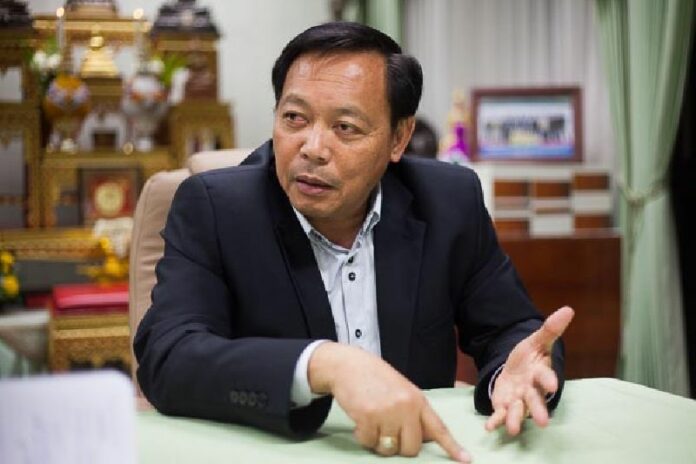
Kamtorn Tawornsatit, the Governor of Khon Kaen province. [Isaan Record/Jeremy Starn]

(The Isaan Record)

The Isaan Record sat down with Kamtorn Tawornsatit, the Governor of Khon Kaen province appointed shortly after the 22 May coup, to discuss his take on Thailand's colour-coded politics and the role of provincial government.

The Isaan Record: How have you been handling the creation of harmony and conformity of people in Khon Kaen in the case of colored-shirt villages?

Governor Kamtorn Tawornsatit: I’d like to inform you that the word ‘colored-shirt villages’ was a measurement to address the critical atmosphere caused by the differences in information and beliefs of the people. The NCPO therefore came and took control of the country. First, we have to look at the people as Thai, that we are all Thai. This idea eliminates division and violence. When we are divided, we think of others not as Thai, but as opponents. Thus, this crisis could be peacefully resolved if we looked at others as Thai. There would be no violence if we trusted each other.

Read the full interview here

Advertisement

Thai and Malaysian PMs Set Conditions for Peace Talks With Southern Rebels

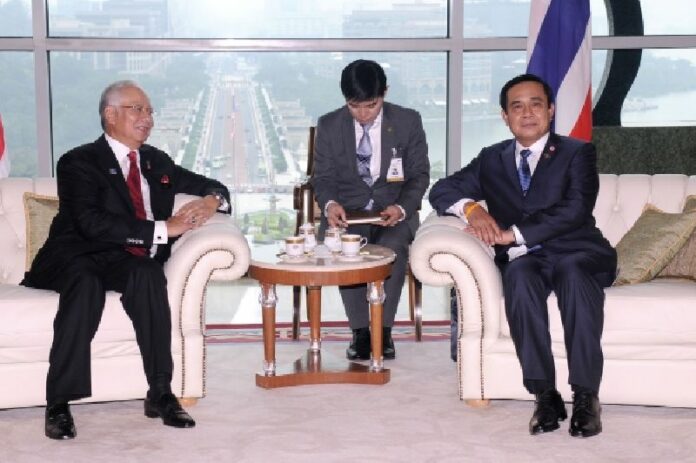
Malaysian Prime Minister Najib Razak and Thai PM Prayuth Chan-ocha met for bilateral talks in Malaysia on 1 Dec 2014. [Photo: NNT]

BANGKOK — Thai Prime Minister Gen. Prayuth Chan-ocha and his counterpart in Malaysia have set conditions for potential Malaysian-brokered peace talks between Thai authorities and Muslim insurgents in Thailand’s southern border provinces.

The insurgent groups who have been launching deadly attacks on civilians and security forces in southern Thailand must first honour a ceasefire, Malaysian Prime Minister Najib Razak told the press after his bilateral meeting with Thai PM Gen. Prayuth in Kuala Lumpur yesterday.

In addition, all militant groups involved in the insurgency must be represented at the talks and unite around a shared set of demands, Najib said.

“In other words, all the parties must agree to a list of demands or requests that they should put forward to the Thai government and that would be the basis of starting the actual substantive negotiations with the Thai government,” he was quoted as saying by The Star.

Gen. Prayuth also stressed yesterday that the new round of peace talks will differ from the former government’s effort, which focused on only one of the rebel groups operating in what is known as Thailand's 'Deep South.'

Former Prime Minister Yingluck Shinawatra's government carried out several ground-breaking “peace dialogues” with one militant group in 2013, but the process was derailed after six months of anti-government protests debilitated the central government and paved the way for the military coup led by Gen. Prayuth.

Gen. Prayuth has refused to provide a timeline for his administration's talks, and it remains unclear whether insurgent groups in the south will agree to the ambitions conditions he and Prime Minister Najib have set.

Just yesterday, security officers found dozens of banners across the southern provinces of Pattani, Yala, and Narathiwat, that read: "Is it appropriate to negotiate with the coup government? There is no guarantee for sincerity."

\

More than 6,000 people — mostly civilians — have died in near-daily violence that has plagued Thailand’s Deep South since 2004. The attacks have been launched by a number of shadowy militant groups seeking to revive the independent sultanate of Pattani that was incorporated into modern Thailand in the early 20th century.

In contrast to the rest of country, where the vast majority of Thais are Buddhist, the Deep South is dominated by Muslims who speak a Malaysian dialect and often do not consider themselves Thai.  

Yesterday was Gen. Prayuth's first official visit to Malaysia since he was voted into the premiership by a junta-appointed parliament on 25 August. His arrival was met with protests led by political and human rights activists in front of Thailand's embassy in Malaysia. 

The protesters held a banner that read "Dictator not Welcome," and also denounced Prime Minister Najib Razak for inviting the Thai junta chairman.

"The reception for Prayuth is an act that recognizes and lends legitimacy to the illegal government in Thailand which grabbed power through a military coup and suppression of democracy since May this year, " the protesters said in a statement.

Read more:
Southern 'Separatist Banners' Dismiss Peace Talks
Protesters Denounce Thai Premier's Visit to Malaysia

179th Teacher Murdered In Restive South


For comments, or corrections to this article please contact: [email protected]

You can also find Khaosod English on Twitter and Facebook
http://twitter.com/KhaosodEnglish
http://www.facebook.com/KhaosodEnglish

Advertisement

Myanmar Parliament To Consider Interfaith Marriage Bill

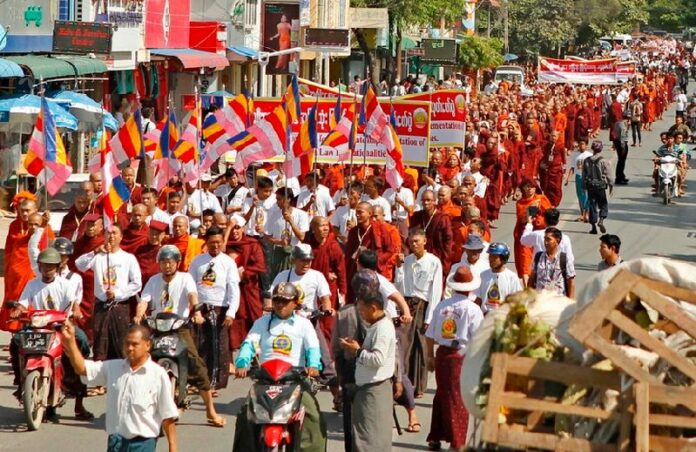
Buddhist monks and lay people march during a demonstration in favour of a law banning interfaith marriage in Mandalay, Myanmar, 30 October 2014. Four controversial bills, including one to restrict interfaith marriage, have been submitted to parliament in Myanmar for debate and a vote. EPA/PYAE SONE AUNG

YANGON (DPA) — Four controversial bills, including one to restrict interfaith marriage, have been submitted to parliament in Myanmar for debate and a vote, state media reported Monday.

The government submitted the bills – covering marriage, religious conversion, monogamy and population control – to the parliament late last month, state-run newspaper The Mirror said.

The bill for religion conversion says anyone who wants to convert needs to get official permission, and offenders will be punished by up to two years in prison.

\
Buddhist nuns, monks and lay people march in a demonstration in favour of a law banning interfaith marriage in Mandalay 30 Oct 2014 [EPA/PYAE SONE AUNG]

Although the latest version of the interfaith marriage bill has not been published, previous drafts stipulated that a non-Buddhist man who wants to marry a Buddhist must convert to her faith or face a jail sentence.

The Ma Ba Tha (Central Nationality and Religion Safeguarding Association), led by a group of senior monks, are pressuring the government of President Thein Sein to enact the laws despite criticism by international and local rights groups.

The interfaith legislation was first proposed by extremist monk Wirathu, who has been blamed for encouraging anti-Muslim hate campaigns that sparked a series of deadly sectarian clashes since mid-2012.

Buddhists make up about 80 per cent of Myanmar's population.

"As there has no official discussion yet on the bills, I don't want to make any comment on it," said Nyan Win, a spokesman for the main opposition National League for Democracy party, led by Aung San Suu Kyi.

The bills are expected to be debated and voted on after parliament reopens in mid-January.


Advertisement

Constitution Drafters Look to German Election Model

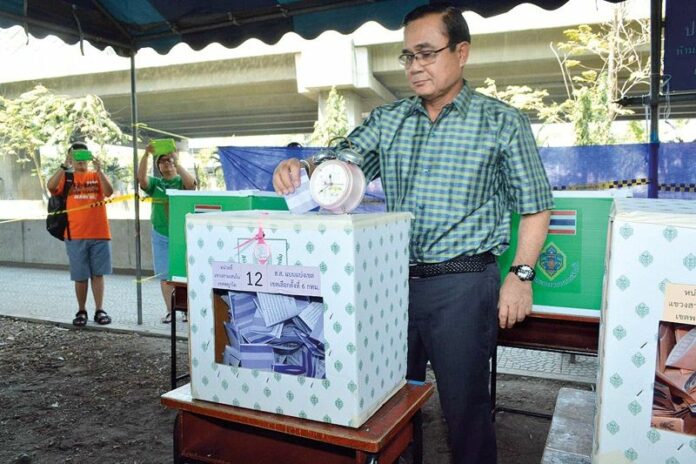
Junta leader Prayuth Chan-ocha votes in the 2014 snap poll called by former Prime Minister Yingluck Shinawatra.

BANGKOK — The junta-appointed committee tasked with drafting Thailand’s 19th constitution is considering adopting the German model of elections, officials say.

A subcommittee of the Constitutional Drafting Committee (CDC) discussed the electoral models of several different countries over the weekend, but the majority of the group’s members preferred the German model, said CDC member Anek Laothamthat.

Thailand's military junta appointed the CDC to replace the constitution that was dissolved shortly after the 22 May coup.

Since seizing power, the junta has suspended democracy to oversee a year-long reform effort aimed at achieving "national reconciliation" between Thailand's rival political camps, which are bitterly divided over electoral politics.

Germany’s proportional representation system, which was proposed by CDC member Nakarin Mektrirat over the weekend, bases the number of MPs from a political party solely on the percentage of votes the party receives in an election.

In contrast, the model used Thailand’s 2007 charter enables MPs to be elected through both a proportional representation party list system and a first-past-the-post constituency system.

Under this combined model, voters in national elections cast ballots for a national party, as well as a candidate running to represent their specific constituency. As a result, in addition to candidates that win constituency elections, political parties will send additional representatives to Parliament based on how many “party-list” votes they receive.

The anti-government protesters that paved the way for the 22 May coup frequently criticised the former ruling Pheu Thai party of acting as a “tyrannical majority.” In the 2011 election, Pheu Thai won 53% of the MP seats,  204 through the constiuency system, and 61 through the party list system.

Yesterday, former Pheu Thai MP Cherdchai Tantisirin pushed back against the idea of adopting the German model.

"The government system and Parliament format of Thailand and Germany are very different," Cherdchai said. He suggested returning to the 1997 constitution, known as the "People's Constitution," in which both the House of Representatives and Senate were directly elected.

The 2007 charter, which was drafted following the 2006 coup, changed the Senate to a half-elected, half-appointed body.

"[The 1997 charter] is best for Thailand, and people wont be confused," Cherdchai said. "We should stick to the principle of one person one vote."

The junta's reforms are expected to curb the influence of the Pheu Thai party and its predecessors, which are immensely popular among Thailand's rural masses and have won every national election since 2011.


 

For comments, or corrections to this article please contact: [email protected]

You can also find Khaosod English on Twitter and Facebook
http://twitter.com/KhaosodEnglish
http://www.facebook.com/KhaosodEnglish


Advertisement

Court Rules to Secretly Try Another Lese Majeste Case

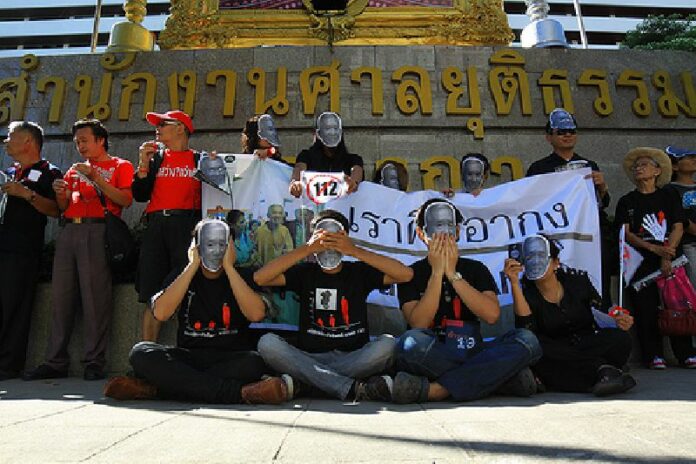
Protests against lese majeste law in Bangkok, 9 December 2011. (photo by Prachatai)

(Prachatai English)

BANGKOK – The Criminal Court on Monday ruled to try the case of a man charged with lese majeste for sending a link to content deemed defaming the King to Stop Lese Majeste blog. 
At 3.15pm, Tanet (last name withheld due to privacy concern) was taken to the Court for preliminary hearing. His lawyer prepared to submit the doctor’s certificate which states that Tanet is suffering from paranoid schizophrenia.

Read more  here.


Note: Khaosod English is not responsible for content on other websites.

Advertisement

Charge Filed Over NRC Deputy Chairman’s ‘Woman Ruler’ Speech

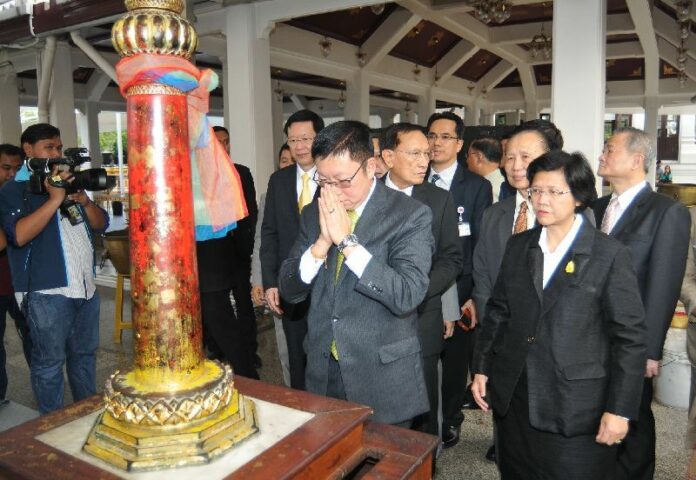
NRC deputy chairman Borwornsak Uwanno praying to Bangkok's city pillar, 5 November 2014.

BANGKOK — The deputy chairperson of the National Reform Council (NRC) says one of his recent speeches was distorted to imply that he insulted Thailand’s Crown Prince.

Borwornsak Uwanno filed a charge against the “Voice of Siam” Facebook page on Saturday, accusing the group of violating the Computer Crimes Act by misrepresenting a speech he gave on women’s rights at the Prince Palace Hotel on 21 November.

Borwornsak says the page’s administrators “distorted” his speech by only showing the moment when he suggested that the next ruler of Thailand will be a “woman,” implying that he believes the next monarch will be female, contrary to the current law of succession.

“I was in fact talking about how women in general would be the rulers of our country,” Borwornsak said after he filed his complaint at Thai police’s Technology Crime Division (TCD) on Saturday. “But Voice of Siam edited my remarks and caused a lot of misunderstanding. It has been posted on many websites that are affiliated to a certain political side.”

Borwornsak urged the public to watch the full version of his talk on 21 November instead of the “distorted” version posted by Voice of Siam.

In the speech, Borwornsak cites a well-known poem, said to be a century-old enigmatic prophecy penned by a renowned Buddhist monk, which proclaims that under the next monarch, Thais will become “Civilized People.”

However, Borwornsak said that the original poem did not use the word “Civilized” because the author, Somdej To, could not have been literate in English. Instead, Borwornsak believes the author meant to write “Saowilai,” or “Beautiful Woman.”

“That means he was predicting that the ruler/rulers of the land will be female,” Borwornsak told the audience, and went on to suggest that the prophecy “has some truths” because women are increasingly visible in leading academic and bureaucratic posts.

In the now-deleted post, Voice of Siam alleged that Borwornsak preferred a female queen to rule Thailand instead of Crown Prince Vajiralongkorn, who is the current designated heir to the throne.

When framed as a comment on royal succession, the remark has serious implications in Thailand, where criticism of the royal family can be punished by up to 10 years in prison.


For comments, or corrections to this article please contact: [email protected]

You can also find Khaosod English on Twitter and Facebook
http://twitter.com/KhaosodEnglish
http://www.facebook.com/KhaosodEnglish

Advertisement

Protesters Denounce Thai Premier's Visit to Malaysia

Gen. Prayuth Chan-ocha talks to the press at Government House, 21 November 2014

KUALA LUMPUR (DPA) – Political and human rights activists protested at Thailand's embassy in Malaysia Monday against the visit by Thai Prime Minister General Prayuth Chan-ocha.

The protesters carrying a banner reading "Dictator not Welcome" also denounced Malaysian Prime Minister Najib Razak for inviting him.

"The reception for Prayuth is an act that recognizes and lends legitimacy to the illegal government in Thailand which grabbed power through a military coup and suppression of democracy since May this year, " the protesters said in a statement.

They also called on the Malaysian government to stop recognizing Prayuth's government until he repeals martial law in Thailand, stops a crackdown on political dissidents and restores the electoral process.

Prayuth and Najib met to discuss the stalled peace talks in the troubled southern Thailand, as well as bilateral trade and investments issues.

Malaysia is the facilitator of peace talks between the Thai government and the Muslim rebels.

Najib said he and Prayuth agreed that there should be a period of no violence in the area before peace talks can resume.

"All parties need to respect the law and the Thai prime minister has agreed that the army could reduce its presence," he said.

Prayuth accompanied by a 19-member delegation, arrived in Kuala Lumpur Monday. It was his first visit to Thailand's southern neighbour since becoming prime minister August 25.


For comments, or corrections to this article please contact: [email protected]

You can also find Khaosod English on Twitter and Facebook
http://twitter.com/KhaosodEnglish
http://www.facebook.com/KhaosodEnglish

Advertisement

Rival Ambulance Crews Brawl in Thailand, Leaving One Dead

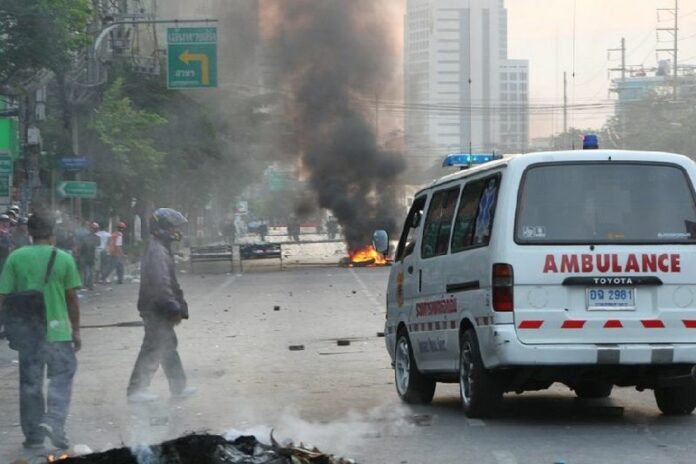
An ambulance races into a protest site in Bangkok, Thailand, 14 May 2010. One volunteer rescue worker died when rival ambulance squads brawled on the streets of Bangkok early Monday. EPA/BARBARA WALTON

BANGKOK (DPA) – One volunteer rescue worker died when rival ambulance squads brawled on the streets of Bangkok early Monday, officials said.

The incident started when an ambulance crew belonging to the Pai Rom Sai Foundation accused another from the Por Tek Tung Foundation of encroaching on its territory in responding to a traffic accident.

The Pai Rom Sai crew allegedly attacked the Por Tek Tung Foundation with clubs and handguns leaving one volunteer member dead and two others wounded.

"We don't understand why they would do this," said Chumpol Boonpakdee, assistant director of Por Tek Tung Foundation.

"We had explained to them earlier that we are just volunteers serving society, there is no need for rivalry." 

There are several volunteer rescue squad in Thailand that get paid by the number of patients they bring to hospital or bodies to a morgue, leading them to be known locally as the "body snatchers."

For comments, or corrections to this article please contact: [email protected]

You can also find Khaosod English on Twitter and Facebook
http://twitter.com/KhaosodEnglish
http://www.facebook.com/KhaosodEnglish

Advertisement

Protesters Denounce Thai Premier's Visit to Malaysia

Thai Prime Minister and former military chief Prayuth Chan-ocha in Chonburi, Thailand, 21 August 2014. Political and human rights activists protested at Thailand's embassy in Malaysia on Monday against the visit by Prayuth. EPA/RUNGROJ YONGRIT

KUALA LUMPUR (DPA) – Political and human rights activists protested at Thailand's embassy in Malaysia Monday against the visit by Thai Prime Minister General Prayuth Chan-ocha.

The protesters carrying a banner reading "Dictator not Welcome" also denounced Malaysian Prime Minister Najib Razak for inviting him.

"The reception for Prayuth is an act that recognizes and lends legitimacy to the illegal government in Thailand which grabbed power through a military coup and suppression of democracy since May this year, " the protesters said in a statement.

They also called on the Malaysian government to stop recognizing Prayuth's government until he repeals martial law in Thailand, stops a crackdown on political dissidents and restores the electoral process.

Prayuth and Najib met to discuss the stalled peace talks in the troubled southern Thailand, as well as bilateral trade and investments issues.

Malaysia is the facilitator of peace talks between the Thai government and the Muslim rebels.

Najib said he and Prayuth agreed that there should be a period of no violence in the area before peace talks can resume.

"All parties need to respect the law and the Thai prime minister has agreed that the army could reduce its presence," he said.

Prayuth accompanied by a 19-member delegation, arrived in Kuala Lumpur Monday. It was his first visit to Thailand's southern neighbour since becoming prime minister August 25.


For comments, or corrections to this article please contact: [email protected]

You can also find Khaosod English on Twitter and Facebook
http://twitter.com/KhaosodEnglish
http://www.facebook.com/KhaosodEnglish

Advertisement

Student Activists Paid To Flash Three-Finger Salute: Army Commander

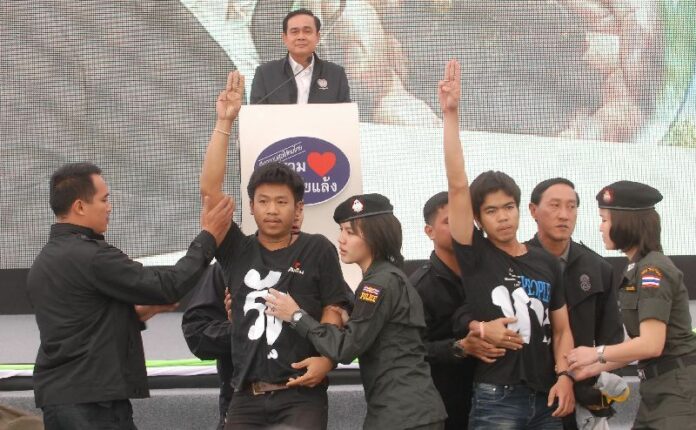
Student activists in Khon Kaen interrupt PM Prayuth Chan-ocha on 19 November to flash an anti-coup salute.

BANGKOK – A high-ranking army commander has insisted that student activists who staged a flash protest in front of Thailand’s military ruler last month were paid to disrupt the event by politicians.

"Some student groups have connections to political groups," said Lt.Gen. Kampanat Ruddit, commander of the 1st Region Army.

"For example, the Khon Kaen students,” he said, referring to the five student activists who interrupted a speech by Prime Minister and junta chairman Prayuth Chan-ocha in Khon Kaen province on 19 November to raise the "three-finger salute." Security officers promptly detained the five students for flashing the anti-coup gesture, which is banned under the junta's rule.

“My intelligence units have told me that they were paid to compete for space in the media with the Prime Minister," Lt.Gen. Kampanat was quoted as saying by Matichon today. "They were paid for about 50,000 baht by certain politicians in the region."

\ 
Student activists in Khon Kaen interrupt PM Prayuth Chan-ocha on 19 November to flash an anti-coup salute.

He did not provide any further evidence to back up the assertion, which was not the first unsubstantiated and bizarre allegation the Thai military has made regarding the anti-coup movement. In late May, the military claimed that an "impostor" hi-jacked an army jeep near an anti-coup protest in Bangkok and used it to denounce protesters as "scums."

Lt.Gen. Kampanat also dismissed calls from human rights organisations to repeal martial law, which the junta imposed over the entire nation in May 2014. According to Lt.Gen. Kampanat, security officers need the law to respond to any anti-coup protests quickly. 

"Furthermore, the martial law is not dangerous to good people at all," Lt.Gen. Kampanat said.


For comments, or corrections to this article please contact[email protected]

You can also find Khaosod English on Twitter and Facebook
http://twitter.com/KhaosodEnglish
http://www.facebook.com/KhaosodEnglish

Advertisement

Hot News

LATEST NEWS

Bangkok
broken clouds
29.4 ° C
29.4 °
25.5 °
71 %
2.9kmh
60 %
Mon
29 °
Tue
38 °
Wed
37 °
Thu
36 °
Fri
37 °